

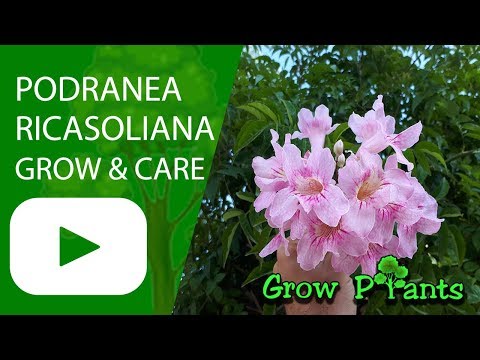

Plant Profile & Key Characteristics
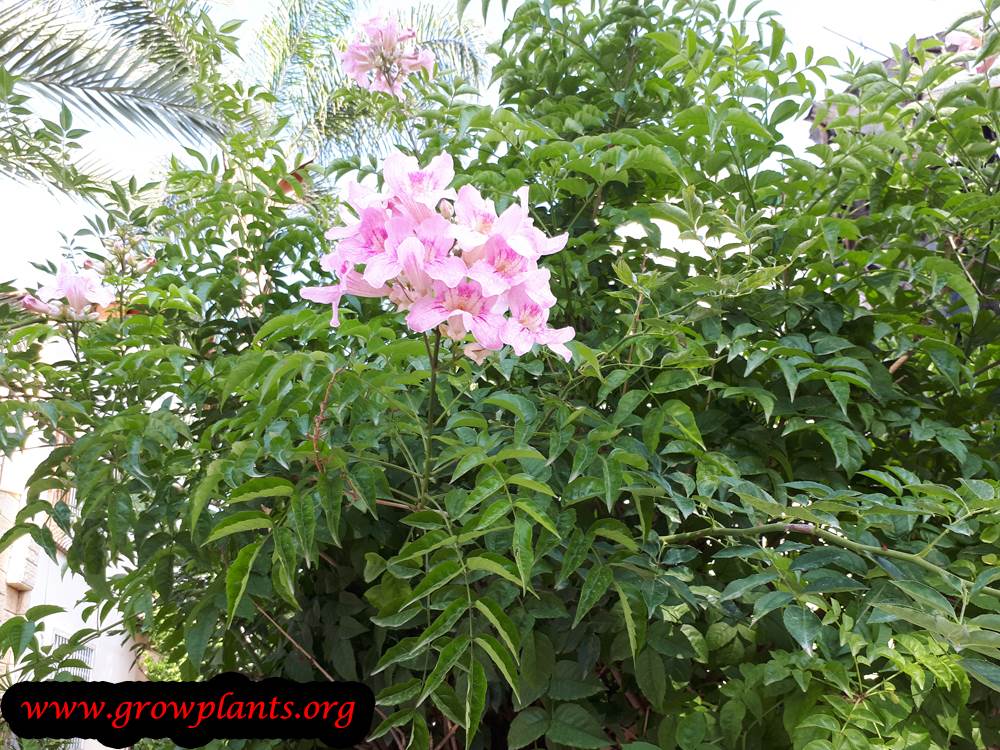
Overview: Podranea ricasoliana (pink trumpet vine) is an evergreen to semi-deciduous shrubby climber reaching 2-8 m (6-24 ft). This fast- to moderate-growing perennial is grown as an ornamental and informal hedge for its clusters of pink trumpet flowers.
Quick Specifications
| Specification | Attribute |
|---|---|
| Plant Type / Life Cycle | Perennial (evergreen to deciduous) |
| Foliage Type | Evergreen to semi-deciduous |
| Mature Size | 2-8 m (6-24 ft) |
| Growth Rate | Fast to moderate |
| Toxicity | Reported poisonous |
| Hardiness | USDA zone 9+ |
Growth Form & Structure
- Height & Spread: Climbs 2-8 m (6-24 ft) on a trellis or fence; can also be kept in a large container with support.
- Growth Habit & Form: Vigorous, shrubby scrambling vine that needs trellising to climb.
- Lifespan & Maturity: Fast to establish and long-lived, flowering freely once settled.
Anatomy & Physical Features
- Leaves & Foliage: Green, lance- to elliptic-shaped leaflets arranged in a pinnate (feather-like) pattern.
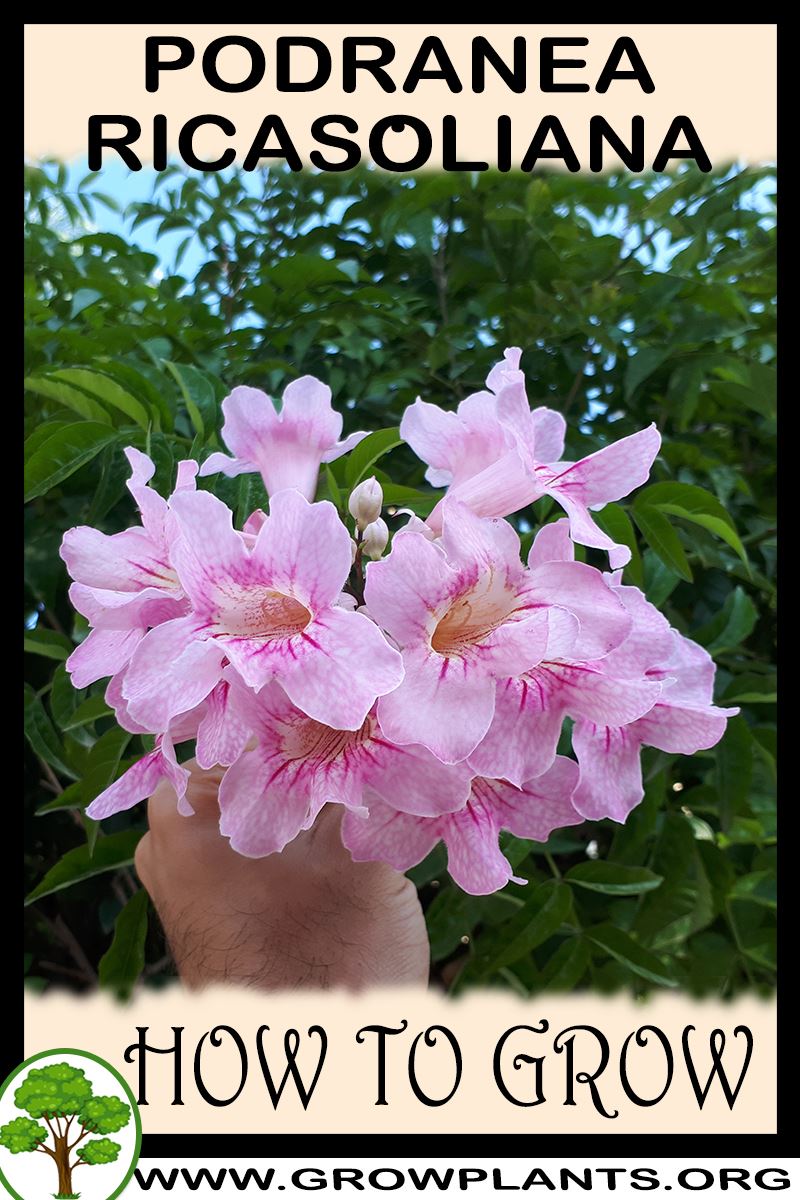
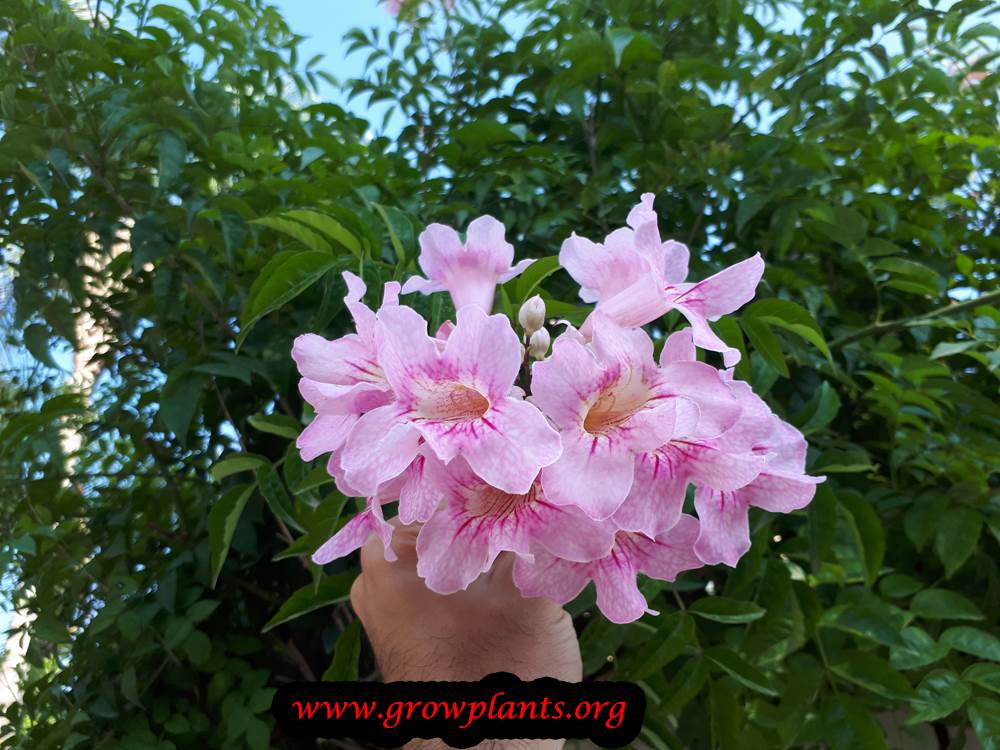
- Flower Characteristics: Pink, trumpet-shaped flowers carried in showy clusters through summer and autumn.
Primary Uses & Landscape Value
- Functional & Ornamental Roles: Flowering climber for fences, pergolas and arches, informal screening hedge, and container plant.
Care Guide: Planting, Soil & Watering
Overview: Pink trumpet vine is a vigorous climber that thrives in full sun with fertile, well-draining soil and steady moisture. It takes moderate to generous watering and needs a sturdy trellis or support to scramble over.
Quick Care Requirements
| Requirement | Ideal Condition |
|---|---|
| Planting Season | Spring through autumn in the warm growing season |
| Growth Rate | Moderate to fast |
| Soil Type | Fertile, well-draining soil |
| Water Need | Moderate to high — keep evenly moist through the growing season |
Planting & Establishment
- Best Planting Season: Plant in the warm season, from spring through autumn after frost, so the vine can establish and start climbing before cooler weather; set it beside its support at planting time.
- How to Plant:
- Hole Preparation: Dig a hole about twice as wide as the root ball, close to the trellis, fence or arch it will climb, loosening the surrounding soil.
- Soil Amendments: Mix compost and organic matter into the backfill to feed this hungry, fast grower and improve moisture retention while keeping drainage free.
- Planting Depth: Set the plant so the top of the root ball is level with the soil surface, keeping the root collar at grade and never burying the stem.
- Growth Speed & Expectations: A fast, vigorous climber that can cover a support in a season or two under warm conditions — give it room and regular pruning to keep it in bounds.
Soil, Watering & Drainage Care
- Soil Mix & Drainage Needs: Provide fertile, free-draining soil; in containers use a rich potting mix with reliable drainage so the roots stay moist but never waterlogged.
- Watering Schedule & Technique:
- Young / Newly Planted: Water regularly after planting to keep the soil evenly moist while the roots establish and the vine begins to climb.
- Established: Water deeply and regularly in warm weather, letting the top few centimetres dry between waterings; it appreciates generous moisture when growing hard.
- Seasonal Adjustments: Increase watering in heat and reduce in winter as growth slows.
Climate, Light & Hardiness
Podranea ricasoliana (pink trumpet vine) is a fast-growing, evergreen-to-deciduous vine suited to tropical, subtropical, Mediterranean, and warm temperate climates. It needs full sun and is reliably hardy from USDA zone 9 upward.
Quick Climate Specifications
| Climate Zones | Tropic, subtropical, mediterranean, temperate |
|---|---|
| USDA Hardiness Zones | 9+ |
| Light Conditions | Full sun |
| Frost Tolerance | Low to moderate – established plants may take light frost with dieback |
Sunlight & Light Exposure
Optimal Light Setup
Needs full sun to flower well and support its vigorous vining growth.
Temperature Extremes & Hardiness
USDA Hardiness & Regional Limits
Hardy from zone 9 upward; toward the cooler edge of this range it may behave more deciduously, losing leaves in cold spells.
Frost Sensitivity
Frost can damage or kill soft new growth, and a hard freeze can kill top growth back to the ground on established plants, though the roots may survive within zone 9.
Cold Damage & Winter Protection
In borderline zone-9 sites, a sheltered position such as against a warm wall reduces the risk of significant cold damage.
Wind, Humidity & Microclimate
Wind Tolerance
Moderate – as a vigorous vine it needs sturdy support and benefits from some shelter from strong, sustained wind.
Humidity Preferences
Tolerates the humid conditions typical of tropical and subtropical climates as well as drier Mediterranean summers.
Growing in Pots, Balconies & Indoors
Pink trumpet vine is a large, fast shrubby climber grown for its clusters of pink trumpets – not a houseplant, but young plants grow well in a big container with a trellis on a sunny patio or balcony.
Quick Details
- Container Size: A large, heavy pot with a strong trellis – it is a vigorous climber
- Indoor Suitability: Not a true houseplant; grows best outdoors
- Best Spot: Full sun on a strong support
- Soil & Drainage: Aerated, organic-rich mix (peat or coir with perlite or vermiculite); must drain freely
- Watering in Pots: Keep evenly moist in growth; it is thirsty in heat but must not stay waterlogged
Indoors & On the Windowsill
- Houseplant limits: It is a big, sun-hungry climber that needs a strong support and far more light than a room offers.
- Overwintering: In cold climates a potted plant can be moved into a bright, frost-free spot for winter, then returned outdoors once frosts pass.
- Safety: The grower notes this plant is poisonous – keep it away from children and pets and wash hands after pruning.
On a Balcony or Patio
- Light & wind: Give it your sunniest wall and a robust trellis; the stems are vigorous and heavy, so anchor the support well and shelter from strong wind. Walls and paving reflect heat, so pots dry quickly – check moisture often in hot weather.
- Practicalities: Set the pot where drainage runoff won’t stain, and remember a full, wet container is heavy to move.
Choosing the Pot, Soil & Long-Term Care
- Pot & drainage: A container with strong drainage holes and no standing-water saucer, to avoid root rot; terracotta breathes and dries faster, glazed or plastic holds moisture longer.
- Potting mix: A well-aerated, organic-rich mix – peat or coir with perlite or vermiculite.
- Feeding: Potted plants exhaust their soil quickly – feed a little more often, since watering leaches nutrients away.
- Repotting: Refresh the top of the mix each year and pot on every couple of years, trimming the root ball lightly.
Fertilizing & Feeding
Podranea ricasoliana is a fast-growing, vigorous flowering vine that benefits from steady, moderate feeding through its warm active growing and flowering season, tapering off during any cooler winter slowdown.
Quick Fertilizing Specs
| Feeding Level | moderate |
|---|---|
| Main Nutrient Priority | a balanced fertilizer that supports vigorous vining growth and its clustered pink trumpet flowers |
| Best Feeding Period | the warm active growing season through summer-into-autumn bloom |
| Reduce/Stop Feeding | ease off feeding heading into winter, when this vine is pruned back and growth slows |
Feeding by Growth Stage
Establishment
Help a newly planted, trellis-trained vine root in and begin climbing before pushing heavy top growth.
| Nutrient direction | A balanced, root-supporting fertilizer suits new plantings. |
|---|---|
| Timing | At planting and through the first part of the growing season. |
| Frequency | Light, regular feeding while the vine establishes its root system supports steady rooting. |
| Fertilizer types | A balanced, general-purpose fertilizer suited to new plantings |
| Precautions | Avoid heavy feeding right at planting; let the root system establish, and provide sturdy trellising to support its vigorous climbing habit. |
Active Growth and Bloom
Support the vine’s fast climbing growth and its clustered pink trumpet flowers through the warm season.
| Nutrient direction | A balanced fertilizer with adequate nitrogen suits this vigorous, fast-growing vine. |
|---|---|
| Timing | Through the warm active growing and summer-into-autumn bloom period. |
| Frequency | Regular light feedings through the growing season support both vining growth and bloom. |
| Fertilizer types | A balanced, general-purpose fertilizer applied through the active growing season |
| Routine trace nutrients | iron, manganese |
| Precautions | Match feeding to the vine’s vigorous habit without overdoing it, since excess nitrogen mainly pushes more of the fast growth this species already shows at the expense of flowering; this plant is also considered poisonous, so keep fertilizing and pruning debris away from children and pets. |
Winter Rest
Let the vine slow down and rest over winter, when it is typically pruned back.
| Nutrient direction | None – withhold fertilizer through the winter rest and pruning period. |
|---|---|
| Timing | Winter, alongside its typical pruning period. |
| Frequency | No feeding at this stage. |
| Fertilizer types | No feeding at this stage; resume with the establishment/active growth feeding |
| Precautions | Do not fertilize during winter rest and pruning; resume only once active new growth resumes. |
Nutrient Deficiency Signs & Corrections
Pale green leaves and slower vining growth than expected for this vigorous species.
| Possible causes | Insufficient nitrogen during active growth, Root competition in a crowded planting area, Poor soil fertility at the planting site |
|---|---|
| Appears first on | Older, lower leaves |
| What to check | Review feeding history, Check for root competition, Assess soil fertility |
| Possible correction | Apply a balanced, nitrogen-forward fertilizer during the active growing season. |
New leaves show yellowing between green veins.
| Possible causes | Soil pH too high for good iron availability, Poor drainage stressing the root system, Alkaline irrigation water raising soil pH over time |
|---|---|
| Appears first on | Newest leaves at vine tips |
| What to check | Test soil and water pH, Check drainage, Rule out pest or disease pressure |
| Possible correction | Improve drainage, address high soil pH, and apply a chelated iron product per its label if chlorosis persists. |
Vigorous leafy vining growth but noticeably fewer trumpet-shaped flowers than expected.
| Possible causes | Excess nitrogen favoring foliage over flower production, Pruning at the wrong time removing developing flower buds, Insufficient sun exposure reducing bloom regardless of feeding |
|---|---|
| Appears first on | Overall reduced bloom across the vine |
| What to check | Review recent fertilizer nitrogen levels, Check pruning timing against the bloom cycle, Assess sun exposure |
| Possible correction | Moderate nitrogen, time pruning correctly, and confirm adequate sun exposure. |
Pruning, Training & Seasonal Maintenance
Podranea ricasoliana is a vigorous, fast-growing vine that tolerates hard annual pruning well, since left unchecked it can reach 6–8m and quickly overwhelm a trellis or pergola; the objective is to keep it within its support structure, force the new growth it flowers on, and remove spent flower clusters and old woody stems. The safest and most effective period for the main cutback is winter, while the vine is least active, because this species flowers on the current season’s new growth, so a hard winter prune does not sacrifice bloom – it produces it.
Quick Pruning & Maintenance Specs
| Pruning Tolerance | High (vigorous grower, tolerates hard annual cutback) |
| Primary Pruning Window | Winter (dormant/least active period) |
| Secondary Maintenance Window | Light trimming through spring–summer to control size and deadhead |
| Typical Frequency | One hard annual cutback, plus periodic light trims |
| Main Objective | Control size on its support and renew flowering wood |
| Young Plant Priority | Establish and tie in 2–4 main leaders onto the trellis/pergola |
| Mature Plant Priority | Hard annual renewal cutback; remove old woody, unproductive stems |
| Best Tool Type | Bypass secateurs and loppers, with a pruning saw for old thick stems |
| Avoid Heavy Pruning During | Peak summer–autumn bloom, if the display is the priority |
Pruning by Plant Age & Size
Newly Established
Avoid cutting back beyond removing damaged growth in the first year; instead direct and loosely tie young stems onto the trellis or pergola to begin the framework.
Young / Formative
Train as a trellised/scrambling vine: select and tie in several strong leaders as the permanent framework, pinching lateral tips to fill out the support before allowing it to flower freely.
Mature / Established
Cut back hard each winter, removing a substantial portion of the previous season’s growth to keep the vine within its space; thin out old, thick, unproductive woody stems periodically to keep the framework renewing rather than becoming a tangled mass.
Seasonal Pruning Schedule
| Stage | Objective | Remove | Do Not Remove | Expected Response | Flowering Impact |
| Dormant / Winter | Renew flowering wood, control size | Overlong runners, old unproductive woody stems, crossing growth | The main framework leaders tied to the support | Vigorous new growth flush in spring | Forces the new-season growth this vine flowers on – improves the coming display |
| Summer Canopy Management | Keep growth in bounds during peak vigor | Wayward shoots growing off the support or into structures/gutters | Flowering laterals | Slows spread without stopping bloom | Minimal if only wayward growth is trimmed |
Flowering & Fruiting Wood
Podranea ricasoliana flowers on new growth produced in the current season, not on old wood, so the main winter cutback – even a hard one – sets up rather than sacrifices next season’s bloom. Pruning during an active summer–autumn flush removes that cycle’s open flowers but does not damage future flowering potential.
Structural Pruning & Training
Select and tie in the strongest stems as the permanent framework on the trellis/pergola/hedge line; remove crossing, rubbing, or inward-growing stems, and thin old woody growth periodically since this vine can build up a dense, heavy mass of old stems if never renewed.
Special Growth to Remove
- Spent flower clusters – deadhead to tidy appearance, though this species reblooms readily from new growth regardless.
- Old woody, unproductive stems – cut out at the base periodically to keep the vine renewing rather than accumulating dead weight on the support.
Container & Small-Space Pruning
In a container, prune considerably harder and more often than an in-ground planting to keep this naturally 6–8m vine proportionate to a small support; regular pinching of tips through the season helps prevent long bare runners.
Tools
- Bypass secateurs for most stems and deadheading
- Loppers for thicker growth
- Pruning saw for old woody stems on a mature, long-established plant
Tool Hygiene & Disease Risk
Routine – clean, sharp tools are sufficient; aphids and mites are the noted pests rather than a transmissible disease requiring disinfection. The plant is noted as poisonous, so wear gloves when pruning and wash hands afterward, and keep cut material away from children and pets.
Cut Placement & Technique
Cut back to just above a healthy bud or side shoot so regrowth is directed along the support; remove old woody stems at their base close to the main framework rather than leaving stubs.
Heavy Pruning & Rejuvenation
An overgrown, leggy or top-heavy vine tolerates being cut back hard in winter, removing up to half or more of the top growth; expect a vigorous flush of new growth through spring with flowering resuming on that new growth within the same season.
Post-Pruning Care
Water normally after a light trim; after a hard winter cutback, water consistently as spring growth resumes and re-tie new leaders to the support as they extend, since the regrowth can be rapid and heavy.
Common Pruning Mistakes
- Never renewing old woody stems, letting the vine become a heavy, tangled mass that strains its support.
- Pruning hard right before or during peak bloom, sacrificing the current display unnecessarily.
- Handling cut material without gloves, given the plant is noted as poisonous.
When NOT to Prune
Avoid major pruning right before or during the main summer–autumn bloom if the display is the priority for that period.
Recommended Tools (by task)
- bypass_secateurs – for routine shaping cuts and deadheading.
- loppers – for thicker stems during the winter renewal cutback.
- pruning_saw – for removing old, thick woody stems on a long-established plant.
- soft_ties_stakes – for tying new leaders onto the trellis or pergola as the vine is trained.
Propagation Guide
Podranea ricasoliana is a vigorous vine that is well known for spreading by root suckers, making transplanting a rooted sucker the easiest way most gardeners propagate an established plant; semi-hardwood stem cuttings are the standard alternative, especially for starting new plants without an existing specimen to sucker from. Seed is viable but less commonly used in cultivation. Propagation is easy.
Quick Propagation Specs
| Best Propagation Method | Root suckers (dig and transplant rooted suckers) |
| Alternative Methods | Semi-hardwood stem cuttings; layering of trailing/climbing stems; seed |
| Propagation Difficulty | Easy |
| Seed True-to-Type | Yes (species) |
| Vegetative True-to-Type | Yes |
| Best Propagation Season | Suckers/division in the dormant-to-early growing season (matching the site’s winter pruning season); cuttings in summer during active growth |
| Cutting Rooting Time | Several weeks |
Growing from Seed
Sow the winged seed (produced in long capsules typical of this plant family) in warm, well-drained conditions in spring; germination is not usually difficult but seed-grown plants take longer to reach flowering size than vegetative starts.
Stem Cuttings
Cutting Type
Semi-hardwood tip cuttings from non-flowering growth.
Best Timing
Summer, during active growth.
Cutting Preparation
Take cuttings with a few nodes, remove lower leaves, and insert into a free-draining, moist cutting mix.
Rooting Hormone
Beneficial for this semi-woody vine wood, though not strictly required.
Rooting Time
Typically several weeks under warm, humid conditions.
Air & Ground Layering
Given its trellising, climbing habit (site care note: trellising), a low or trailing stem pegged into contact with moist soil will often root at a node over a season; sever and transplant once well rooted.
Division, Offsets, Pups & Suckers
Established plants frequently produce root suckers at some distance from the main stem. Dig a rooted sucker with its own root system attached, separate it from the parent’s root, and transplant; do this while the plant is dormant or just before active spring growth begins, coinciding with the site’s winter pruning window.
Bloom & Flower Guide
Quick Details
- Bloom Season: Summer into autumn
- Flower Appearance: Clusters of soft pink, trumpet-shaped flowers, often with darker veining in the throat
- Edibility: Grown as an ornamental
Detailed Blooming Overview
Pink trumpet vine is a vigorous climber that hangs generous clusters of pale pink trumpets through the warm months. The blooms are lightly fragrant and show up beautifully against the ferny foliage, drawing bees and other pollinators.
Flower Characteristics
- Trumpet-shaped pink flowers borne in clusters, as the grower describes.
- Throats are often finely veined in a deeper shade.
Bloom Care & Thinning
- Keep it flowering: It blooms on new growth, so prune after the main flush to shape and renew.
- Site: Full sun and warmth give the heaviest display.
- Support: Give it a sturdy frame – it climbs quickly and flowers best when well-lit.
Pests, Diseases & Troubleshooting
Overview: Podranea ricasoliana (Port St John’s creeper) is a vigorous, generally trouble-free Bignoniaceae climber. Its few problems are the standard sap-suckers of soft growth — aphids, spider mites, whitefly and mealybugs — plus root rot in waterlogged soil and frost damage in cold climates. Its vigor usually outgrows minor pest damage; favor sun, airflow and organic control.
Quick Troubleshooting Overview
| Issue / Pest | Main Symptom | Primary Solution |
|---|---|---|
| Aphids | Curled shoot tips, honeydew, sooty mold, ants | Hose off, insecticidal soap, predators |
| Spider mites | Fine stippling and webbing in hot dry air | Rinse, raise humidity, oil/soap |
| Whitefly | White flies rising from leaves; sticky foliage | Sticky traps, soap, parasitoids |
| Mealybugs & scale | White fluff / brown bumps, honeydew | Alcohol swab, horticultural oil |
| Root rot | Wilting and yellowing in wet, heavy soil | Improve drainage, reduce watering |
Common Pests & Management
- Aphids (Aphis and Myzus spp.):
- Symptoms: Dense green or black colonies on soft new shoots and flower buds, causing curling, stickiness, sooty mold and attendant ants.
- Prevention & Control: Blast off with water, pinch the worst tips, and encourage ladybirds, lacewings and hoverflies; insecticidal soap or a light oil handles heavy outbreaks. The vine’s vigor usually shrugs off minor feeding.
- Spider mites (Tetranychus urticae):
- Symptoms: Fine pale stippling, bronzing and webbing on leaf undersides in hot, dry, dusty spells, especially on stressed plants.
- Prevention & Control: Rinse foliage, keep the roots watered, raise humidity and airflow, and apply insecticidal soap or a light horticultural oil, repeating in heat.
- Whitefly (Aleyrodidae):
- Symptoms: Clouds of tiny white flies lift from disturbed foliage, leaving sticky honeydew and sooty mold on soft growth.
- Prevention & Control: Hang yellow sticky traps, encourage parasitoids, and spray insecticidal soap to leaf undersides in the evening, repeating to catch new hatches.
- Mealybugs & scale (Pseudococcus spp. and Coccidae):
- Symptoms: White cottony masses in leaf axils and brown bumps along stems, with honeydew and sooty mold, mostly on stressed or container plants.
- Prevention & Control: Swab with alcohol, prune encrusted wood, and spray horticultural oil for coverage; control ants and encourage natural enemies.
Diseases & Fungal Issues
- Root & stem rot (Phytophthora / Rhizoctonia spp.):
- Symptoms: Wilting, yellowing and a blackening base in heavy, waterlogged soil despite watering; can kill young plants.
- Treatment & Management: Plant in free-draining soil, water deeply but let the surface dry, and avoid wet feet; remove badly affected plants and improve drainage.
- Powdery mildew (Erysiphales):
- Symptoms: White powdery film on leaves in humid, crowded, shady conditions, with some yellowing and leaf drop.
- Treatment & Management: Thin and train the vine for airflow, site in sun, avoid overhead watering, and apply sulfur or potassium bicarbonate at first signs.
- Leaf spot (Cercospora / Alternaria spp.):
- Symptoms: Brown or grey spots on leaves in prolonged wet weather; usually cosmetic on such a vigorous plant.
- Treatment & Management: Remove affected leaves, water at the base, and improve airflow; copper only if it spreads widely.
Growing Difficulties & Abiotic Problems
- Frost / cold damage:
- Cause & Symptoms: The vine is frost-tender; cold blackens shoots and can cut it to the ground in hard freezes.
- Correction Strategy: Grow in a warm, sheltered position or against a heat-retaining wall; cut back frost-killed growth in spring, as it regrows strongly from the base.
- Poor flowering:
- Cause & Symptoms: Too much shade or excess nitrogen gives rampant leafy growth but few of the pink trumpet flowers.
- Correction Strategy: Site in full sun, feed lightly favoring potassium, and prune after flowering since bloom forms on new growth.
- Invasive vigor / suckering:
- Cause & Symptoms: In mild climates it grows aggressively, suckers and can smother supports or neighbors.
- Correction Strategy: Site with room, prune hard to contain it, and remove suckers; treat it as a plant to manage rather than a weakling.
- Chlorosis:
- Cause & Symptoms: Yellowing between veins on alkaline or waterlogged soil where iron is limited.
- Correction Strategy: Improve drainage, mulch, and correct with chelated iron if soil is very alkaline.
What Helps – Products & Tools
This vigorous climber needs little intervention. Useful products are insecticidal soap and horticultural/neem oil for aphids, mites, whitefly, mealybugs and scale, yellow sticky traps for whitefly, sulfur or potassium bicarbonate for powdery mildew, and sharp pruning tools to contain its growth.