

Plant Profile & Key Characteristics
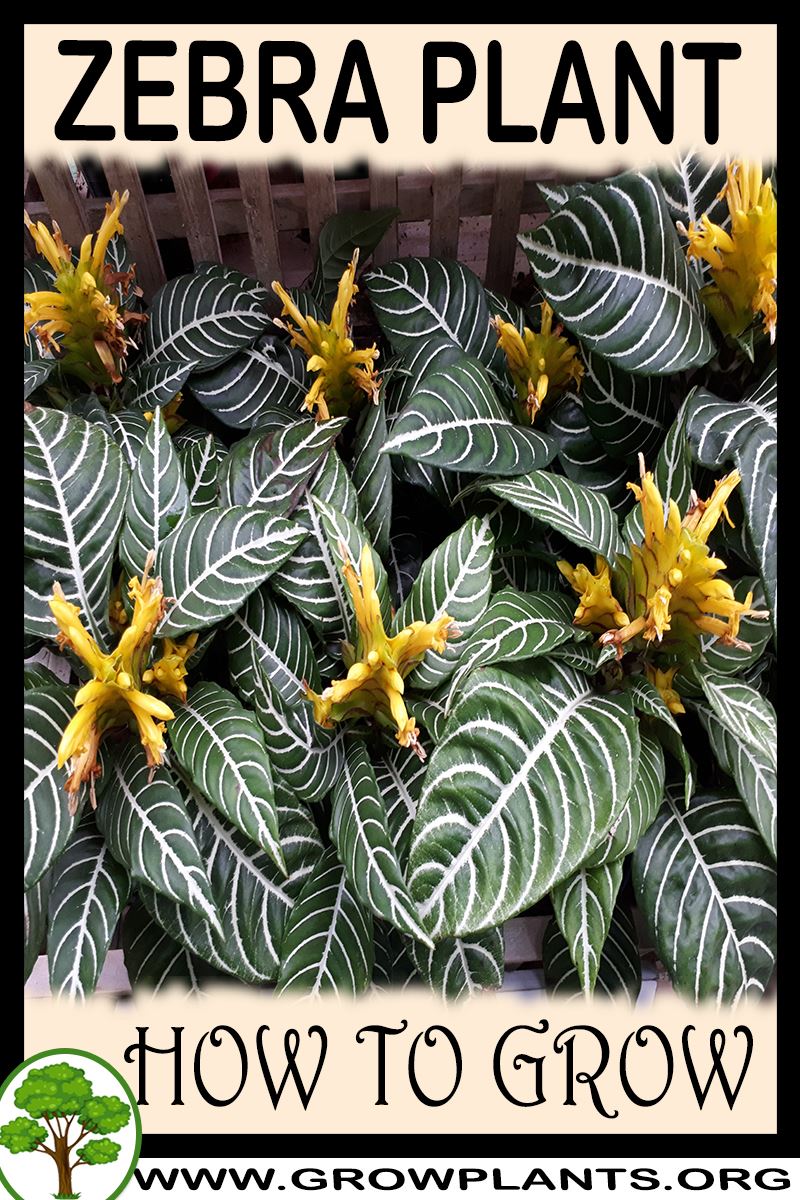
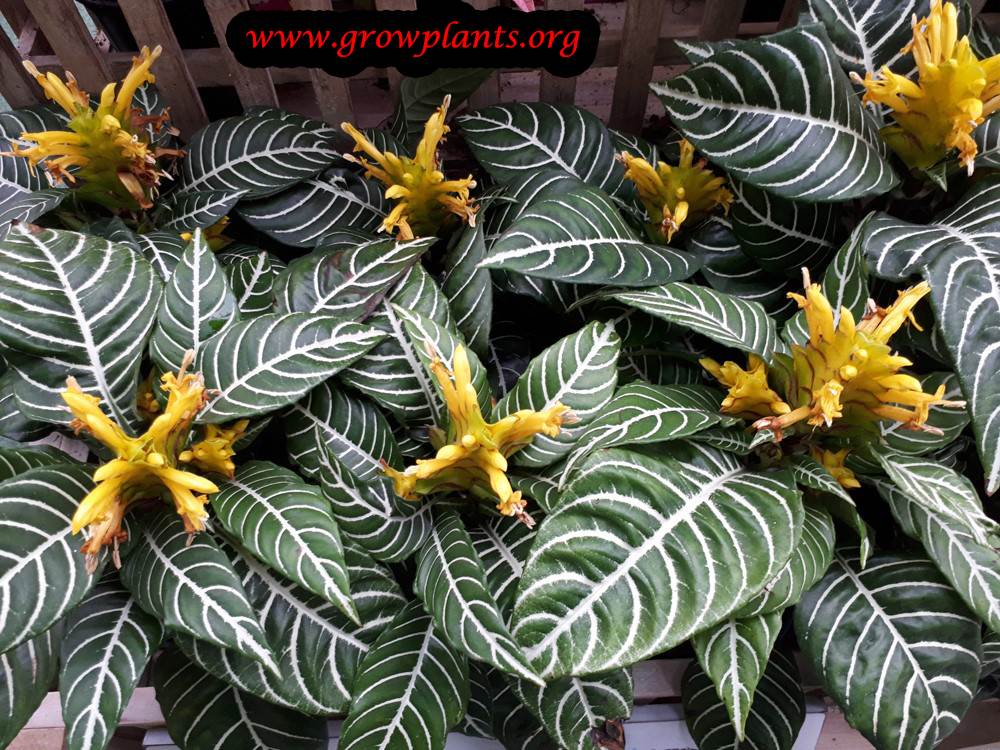
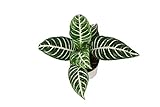
Overview: Zebra plant is an evergreen tropical shrub 0.4-1 m tall, grown chiefly for its glossy dark-green leaves with bold white veins. It is a popular ornamental indoor plant that also produces yellow flower bracts.
Quick Specifications
| Specification | Attribute |
|---|---|
| Plant Type / Life Cycle | Perennial (shrub) |
| Foliage Type | Evergreen |
| Mature Size | 0.4-1 m (16-40 in) |
| Growth Rate | Moderate to Slow |
| Hardiness | USDA zone 13+ (tropical / indoors) |
Growth Form & Structure
- Height & Spread: 0.4-1 m (16-40 in); well suited to pots and as a houseplant.
- Growth Habit & Form: Compact, upright evergreen shrub.
- Lifespan & Maturity: Perennial; grows at a moderate to slow pace and can be reset from cuttings as it becomes leggy.
Anatomy & Physical Features
- Leaves & Foliage: Large glossy green leaves (20-50 cm) with striking white veins – the plant’s main ornamental feature.
- Flower Characteristics: Bright yellow bracts at the base of yellow flowers (see the Bloom accordion).
Primary Uses & Landscape Value
- Functional & Ornamental Roles: Grown as a foliage houseplant and container plant for its bold variegated leaves and yellow bracts.
Care Guide: Planting, Soil & Watering
Overview: Zebra plant is a tropical understory houseplant that needs warmth (above 15°C), high humidity and a rich, loose, well-draining yet moisture-retentive mix. Keep it evenly moist but never soggy.
Quick Care Requirements
| Requirement | Ideal Condition |
|---|---|
| Planting Season | Year-round in warm or indoor conditions |
| Growth Rate | Slow to Moderate |
| Soil Type | Rich, loose, well-draining, moisture-retentive |
| Water Need | Moderate (keep evenly moist) |
Planting & Establishment
- Best Planting Season: Plant or repot at any time of year in warm, indoor conditions.
- How to Plant:
- Hole Preparation: Settle the plant into a loose, rich mix in a pot with free drainage.
- Soil Amendments: Use a peat- or compost-based mix opened up with perlite for aeration.
- Planting Depth: Set the crown at the surface so the base is not buried.
- Growth Speed & Expectations: Slow to moderate, grown mainly for its striking white-veined foliage.
Soil, Watering & Drainage Care
- Soil Mix & Drainage Needs: An airy, moisture-retentive mix with good drainage keeps the roots damp without rotting.
- Watering Schedule & Technique:
- Young / Newly Planted: Keep the mix evenly moist while the plant settles in.
- Established: Water when the top centimetre dries, keep humidity high and warmth steady.
- Seasonal Adjustments: Less water in cooler winter conditions; protect from cold drafts year-round.
Climate, Light & Hardiness
Aphelandra squarrosa, the zebra plant, is a strictly tropical foliage-and-bract plant that wants warm, humid conditions and bright, indirect light rather than direct sun. Per site data it belongs to zone 13+ and should be kept above about 15 °C (59 °F); it is highly cold-sensitive and grown as a houseplant outside the true tropics.
Quick Climate Specifications
| Climate Zones | Tropical (grown as a houseplant in cooler climates) |
|---|---|
| USDA Hardiness Zones | 13+ (site data) |
| Optimal Temp Range | Warm room conditions, roughly 20–25 °C (68–77 °F) |
| Cold Damage Begins | Below about 15 °C (59 °F) per site data |
| Approx. Survival Minimum | Chilling injury sets in as it approaches 15 °C (59 °F); no frost tolerance |
| Frost Tolerance | None |
| Light Conditions | Full shade to bright indirect light - no harsh direct sun |
| Wind Tolerance | Low (avoid drafts and heater/AC airflow) |
Sunlight & Light Exposure
Optimal Light Setup
Bright, indirect light indoors keeps the white-veined leaves bold without scorching; the site data also lists it as tolerating full shade. An east- or north-facing window is ideal.
Shade & Heat Management
Harsh direct sun bleaches and burns the foliage; keep it off hot window glass while still giving it good ambient light for the yellow bracts to form.
Best Exposure / Orientation
Indoors an east or north aspect suits it; outdoors in the tropics grow it in dappled shade.
Temperature Extremes & Hardiness
USDA Hardiness & Regional Limits
Site data places it at zone 13+, meaning only the warmest frost-free tropics suit it outdoors; everywhere colder it is a houseplant, because even brief cold ends outdoor culture.
Cold Damage & Winter Protection
Keep it above about 15 °C (59 °F); the site data flags it as cold-sensitive, and cool air causes leaf drop. In winter keep it well away from cold glass, drafts and unheated rooms.
Frost Sensitivity
None - any frost is fatal.
Extreme Heat Tolerance
Warmth is welcome, but heat combined with dry air makes the leaves wilt and drop; humidity must keep pace with temperature.
Wind, Humidity & Microclimate
Humidity Preferences
High humidity is essential; this rainforest plant reacts to dry air with leaf-edge browning and leaf drop.
Dry-Air Tolerance
Low - dry indoor air is a common cause of failure.
Wind Tolerance
Low; avoid drafts and the direct airflow of heaters and air conditioners, which dry and chill it.
Rainfall & Seasonal Moisture
Adapted to warm, humid, evenly moist tropical conditions with no cold season.
Microclimate Recommendations
Give it a warm, humid, draft-free spot - a humidity tray or a grouping of plants helps - kept reliably above 15 °C.
Growing in Pots, Balconies & Indoors
The zebra plant (Aphelandra squarrosa) is a striking tropical houseplant, and the grower confirms it grows well indoors and in containers. Grown for its bold white-veined leaves and yellow flower bracts, it thrives in the warm, bright-but-indirect light of a room, though it does demand steady warmth and humidity.
Quick Details
- Container Size: A modest pot (about 5-10 L / 1.3-2.6 gal); it stays fairly compact
- Indoor Suitability: A genuine houseplant – give it warmth, bright indirect light and humidity, out of direct sun
- Best Spot: Bright, filtered light or light shade; avoid harsh direct sun and cold drafts
- Soil & Drainage: Peat- or coir-based mix with perlite; moisture-retentive but free-draining
- Watering in Pots: Keep evenly moist and never bone-dry; ease off a little in the cooler, darker months
Indoors & On the Windowsill
- A true houseplant: The grower confirms it grows well indoors. It likes warmth (no cold drafts), bright indirect light and moist air.
- Humidity matters: Dry indoor air causes leaf drop and brown edges – a pebble tray, grouping plants or misting all help.
- Watering rhythm: Keep the soil consistently moist in growth; let the top just dry before watering again, but never let it wilt.
On a Balcony or Patio
- Warm shade only: Outdoors in warm weather it wants a sheltered, shaded spot – direct sun scorches the leaves and wind dries them.
- Not frost-hardy: Bring it back indoors well before nights cool; it is a tropical plant that resents chill.
Choosing the Pot, Soil & Long-Term Care
- Pot & drainage: Good drainage holes and no standing saucer to avoid root rot; plastic or glazed pots hold the moisture it likes.
- Potting mix: Peat or coir with perlite, enriched with organic matter.
- Feeding: Feed regularly through the growing season to support its leaves and bracts, as pot nutrients leach.
- Repotting: Pot on every couple of years into fresh mix and prune back after flowering to keep it bushy.
Growing this plant in a greenhouse
A greenhouse can give zebra plant frost protection and cold protection. In the right climate it may also be kept growing through winter, depending on how much warmth and light are provided.
Greenhouse at a glance
| Greenhouse suitability | Conditional - depends on your climate |
|---|---|
| Main benefits | frost protection, cold protection |
| Season extension | earlier spring & later autumn |
| Outdoor protection advisable below | about 15°C |
| Maintain greenhouse minimum | around 15°C for active growth |
| Suitable types | heated greenhouse, polycarbonate greenhouse, lean-to |
| Heating | Heating is recommended in cold climates for continuous growth. |
Related greenhouse guides
- Greenhouses: How to Choose the Right Greenhouse
- Best Greenhouse Heaters
- Greenhouse Climate Control: Temperature, Ventilation and Humidity
- Best Lean-To Greenhouses
Fertilizing & Feeding
A light-to-moderate feeder: give balanced, container-appropriate feeding through the bright active season, keep it light because this plant is salt-sensitive, and pause feeding in low-light rest and after repotting.
Quick Fertilizing Specs
| Feeding Level | Light-to-moderate feeder |
|---|---|
| Main Nutrient Priority | Balanced feeding with adequate nitrogen for foliage |
| Best Feeding Period | Through the bright, warm active growing season |
| Organic Options | Worm castings or a gentle organic liquid feed |
| Reduce/Stop Feeding | Pause feeding in low-light winter and after repotting |
| Micronutrients | Iron and manganese support leaf color; a complete fertilizer usually supplies them |
| Soil pH | Slightly acidic to near neutral |
Feeding by Growth Stage
Settling in after repotting
Let roots settle into fresh mix before feeding resumes.
| Nutrient direction | None – fresh potting mix already carries nutrients, so withhold feeding at first. |
|---|---|
| Timing | For the early period after repotting into fresh mix. |
| Frequency | No feeding until the plant is rooted in and actively growing. |
| Fertilizer types | No feeding at this stage; hold off fertilizing until new growth appears. |
| Precautions | Do not fertilize immediately after repotting; fresh mix supplies enough for now. |
Active growth
Fuel lush, well-marked foliage during active growth.
| Nutrient direction | A balanced complete fertilizer with adequate nitrogen supports the bold striped leaves. |
|---|---|
| Timing | Through the warm, brighter months of active growth. |
| Frequency | Light, regular feeding while the plant is actively growing. |
| Fertilizer types | A balanced complete houseplant fertilizer, A dilute liquid feed during active growth |
| Routine trace nutrients | iron, manganese |
| Precautions | This plant is salt-sensitive; keep feeding light and flush the pot with plain water periodically to prevent salt buildup. |
Low-light slowdown
Let the plant coast through low-light, cooler months.
| Nutrient direction | None – withhold fertilizer while light and growth are low. |
|---|---|
| Timing | During low-light winter months and any rest. |
| Frequency | No feeding while growth is stalled; resume as light and growth return. |
| Fertilizer types | No feeding at this stage; hold off fertilizing until active growth resumes. |
| Precautions | Do not fertilize a plant that is not actively growing in low light. |
Nutrient Deficiency Signs & Corrections
Older, lower leaves fade to pale green or uniform yellow and overall growth slows.
| Possible causes | low available soil nitrogen, nitrogen leaching from heavy watering or rain, thin soil low in organic matter |
|---|---|
| Appears first on | older, lower leaves |
| What to check | recent feeding history, soil organic matter, watering and drainage |
| Possible correction | Apply a nitrogen-containing complete fertilizer and build soil organic matter, then water evenly. |
Youngest leaves yellow between the veins while the veins themselves stay green.
| Possible causes | high soil pH reducing iron and manganese availability, waterlogged or poorly drained roots, genuinely low micronutrient supply |
|---|---|
| Appears first on | new, young leaves |
| What to check | soil pH and drainage, watering habits, whether symptoms are on the newest growth |
| Possible correction | Correct soil pH if high, improve drainage, and apply a chelated iron or manganese product per its label. |
Leaf margins brown or scorch and growth stalls despite adequate watering.
| Possible causes | fertilizer salt buildup in the root zone, under-watering that concentrates salts, excessive or too-frequent feeding |
|---|---|
| Appears first on | leaf margins and tips |
| What to check | recent fertilizer amounts, watering consistency, drainage, especially in containers |
| Possible correction | Ease off feeding, water thoroughly to flush accumulated salts, then return to lighter feeding. |
Pruning, Training & Seasonal Maintenance
Zebra plant (Aphelandra squarrosa) is a tender tropical grown indoors for its white-veined leaves and yellow flower bracts; pruning is about keeping it bushy and countering its tendency to go leggy and shed lower leaves. The key cut comes after the bract display fades — cut the flowered stem back to a strong lower leaf pair to force side-shoots. Warm, humid conditions (above about 15°C) are needed for good regrowth, and the pieces you remove root readily as replacements.
Quick Pruning & Maintenance Specs
| Pruning Tolerance | Moderate–High – cuts back to force bushiness |
| Primary Pruning Window | Right after the flower bracts fade |
| Secondary Maintenance Window | Any time in active growth, for pinching and tidying |
| Typical Frequency | Once after flowering, plus occasional pinching |
| Main Objective | Keep bushy, prevent legginess, remove tired leaves |
| Young Plant Priority | Pinch tips to branch early |
| Mature Plant Priority | Cut back leggy flowered stems; remove old lower leaves |
| Best Tool Type | Precision snips or bypass secateurs |
| Avoid Heavy Pruning During | Cold or low-light spells, when regrowth is slow |
Pruning by Plant Age & Size
Newly Established
Once settled, pinch the growing tip to start branching; remove only damaged leaves.
Young / Formative
No structural framework — build a bushy, multi-stem shape by pinching tips; there is no woody training.
Mature / Established
After bloom, cut leggy stems back hard to a low leaf pair to renew a compact, leafy plant, and remove yellowing lower leaves.
Seasonal Pruning Schedule
Post-Flowering
Cut the spent bract and its stem back to two or three leaf pairs; this both tidies the plant and triggers new shoots — the main renewal cut.
Active Growth (warm months)
Pinch tips to keep it dense and remove faded leaves.
Ongoing Sanitary
Promptly remove the brown, crisped lower leaves it tends to drop.
Structural Pruning & Training
Control legginess by cutting back after flowering; there is no in-ground framework to build. Keep the plant to a compact size in scale with its pot.
Special Growth to Remove
Spent flower bracts and old or yellowed lower leaves. The prunings root readily as stem-tip cuttings, so save them for replacements. There are no suckers, runners or woody stems to manage.
Container & Small-Space Pruning
This is essentially a container plant — cut back after bloom to keep it compact, pinch through the growing season, and re-start a bare, leggy specimen from stem-tip cuttings taken while pruning. In-ground advice does not apply.
Tools
Precision snips for leaves and soft tips; bypass secateurs for firmer main stems when cutting back after flowering. Nothing larger is needed.
Tool Hygiene & Disease Risk
Routine — use clean, sharp snips. The main indoor troubles (leaf drop, mealybugs, mites) are cultural or pest problems, not pruning-borne diseases, so cut-to-cut sterilising is unnecessary.
Cut Placement & Technique
Cut just above a healthy pair of leaves so new shoots break from that node; take tip cuttings from the removed pieces to propagate.
Heavy Pruning & Rejuvenation
Tolerated — a bare, leggy plant can be cut back to a few low leaf pairs after flowering to rejuvenate, provided it is kept warm and humid so it resprouts. Combine with propagating cuttings as insurance.
Post-Pruning Care
Keep it warm, humid and out of cold draughts after cutting back, and maintain even moisture (it hates drying out). No heavy feeding is needed to force regrowth.
Common Pruning Mistakes
- Never cutting back, so it becomes a bare stem with a tuft on top.
- Cutting back in a cold, dark spot where it cannot resprout.
- Letting it dry out after pruning, triggering more leaf drop.
- Removing the flower bract too early if you actually want the display.
When NOT to Prune
In cold or very low light, when the plant is barely growing, and when it is stressed from dryness or a recent move.
Recommended Tools (by task)
- precision_snips — for leaves, faded bracts and soft tip-pinching.
- bypass_secateurs — for the firmer main-stem cutback after flowering.
Propagation Guide
The zebra plant is usually increased from soft stem-tip cuttings taken in spring, which is faster and more reliable indoors than the seldom-available seed; the site lists seed and vegetative propagation. It is somewhat sensitive, so warmth and humidity matter — overall moderate difficulty.
Quick Propagation Specs
| Best Propagation Method | Soft stem-tip cuttings |
| Alternative Methods | Seed (rarely available) |
| Propagation Difficulty | Moderate |
| Seed True-to-Type | Cuttings are the usual and more reliable route |
| Vegetative True-to-Type | Yes |
| Best Propagation Season | Spring, into the warm months |
Stem Cuttings
Cutting Type & Timing
Take soft shoot-tip cuttings, ideally from young side shoots that follow after cutting back, in spring or early summer.
Cutting Preparation & Rooting Setup
Use a tip cutting with two or three leaves, reducing large leaves to cut water loss. Insert into a moist, free-draining mix and keep it warm — above about 20°C (68°F), never below roughly 15°C (59°F) — in high humidity, for example under a propagator lid or clear bag. Rooting hormone is beneficial for these soft cuttings but not essential.
Rooting & After-Care
Keep humidity high and warmth steady while the cutting roots, then wean it gradually to normal room air; sudden dry air or cold checks this sensitive plant.
Growing from Seed
Germination Conditions
Where fresh seed is available, sow into a warm, humid, sterile mix kept around 20–25°C (68–77°F). Seed is seldom offered, so cuttings remain the standard method.
Bloom & Flower Guide
Quick Details
- Bloom Season: Mainly spring and autumn indoors
- Time to First Bloom: Blooms on established, well-grown plants; good light and warmth through the growing season set it up to flower
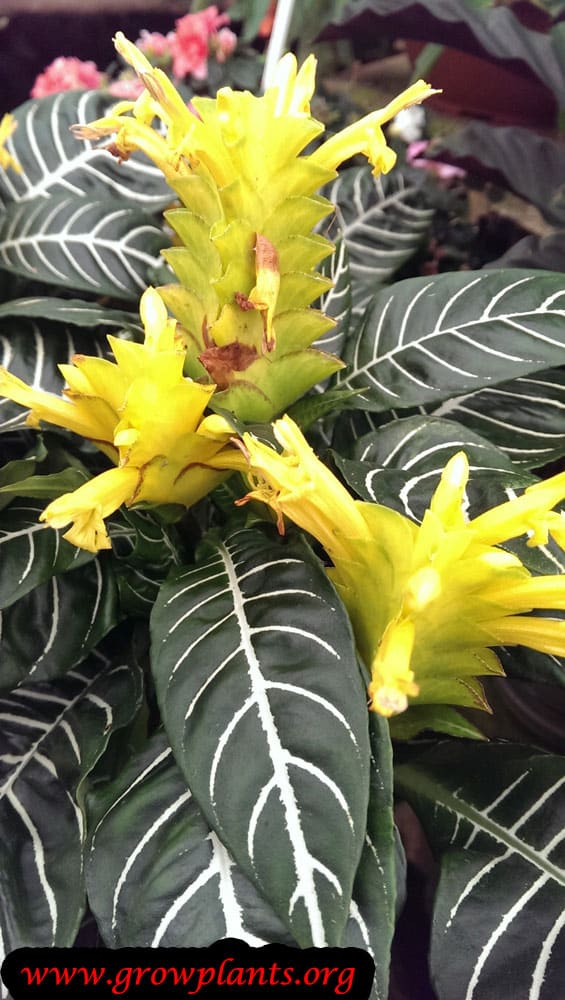
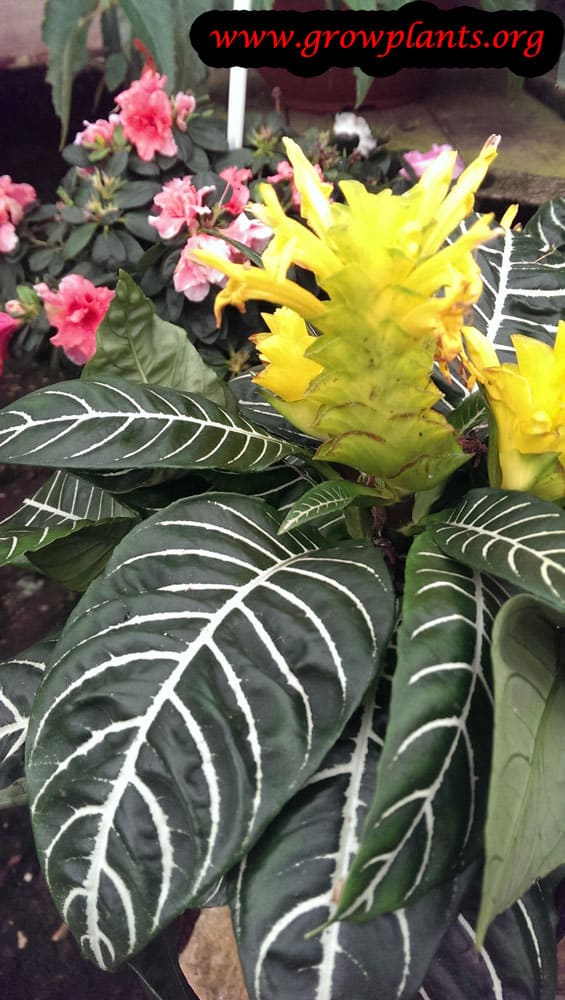
- Flower Appearance: A striking cone of overlapping bright-yellow bracts, from which short-lived yellow tubular flowers emerge
- Edibility: Ornamental – grown as a houseplant for its bracts and leaves, which are not eaten (the plant is non-toxic)
Detailed Blooming Overview
The zebra plant is loved for its glossy, white-veined leaves, but its bloom is the real showpiece: a tall four-sided cone of waxy yellow bracts that lasts for several weeks. The true flowers are slender yellow tubes that peek out between the bracts and are short-lived, while the colourful bracts carry the display long after.
Flower Characteristics
- Bright yellow bracts stacked into a cone-shaped head, forming the base and body of the display.
- Short-lived yellow tubular flowers emerge from between the bracts.
Bloom Care & Thinning
- To encourage bloom: Bright indirect light, warmth, steady moisture and high humidity through the growing season give the best chance of a flower cone.
- After flowering: Once the bract cone fades, cut it back to a strong pair of leaves to keep the plant bushy and set up the next flush.
Pests, Diseases & Troubleshooting
Overview: The zebra plant is a beautiful but famously fussy tropical houseplant whose troubles are mostly abiotic: it is notorious for sudden leaf drop triggered by low humidity, drafts, temperature swings and uneven watering. Its main pests are spider mites (in dry indoor air), aphids, mealybugs, scale and fungus gnats, and its diseases centre on root/stem rot from overwatering and Botrytis on the bracts. Consistent warmth, high humidity and careful, even watering matter far more than any pesticide here.
Quick Troubleshooting Overview
| Issue / Pest | Main Symptom | Primary Solution |
|---|---|---|
| Leaf drop | Sudden dropping of leaves | Warmth, high humidity, steady watering, no drafts |
| Spider mites | Stippled bronzed leaves, webbing | Raise humidity, hose down, oil on undersides |
| Mealybugs / scale | Cottony tufts or brown bumps, honeydew | Wipe off, isolate, horticultural oil |
| Root & stem rot | Wilting in wet mix, black stem base | Free-draining mix, water then let top dry |
| Brown leaf tips | Crisp scorched tips and margins | Raise humidity, flush salts, even watering |
Common Pests & Management
- Spider mites (Tetranychus urticae):
- Symptoms: Fine pale stippling, bronzing and dulling of the glossy leaves with faint webbing on undersides, thriving in the warm, dry indoor air this plant is often kept in.
- Prevention & Control: Raise humidity (a chronic need for this plant anyway), sponge and hose the foliage, and introduce predatory mites; horticultural oil or insecticidal soap on the undersides controls outbreaks.
- Aphids (Aphidoidea):
- Symptoms: Clusters of soft insects on tender new shoots and the flower bracts, with honeydew, sooty mould and distorted young growth.
- Prevention & Control: Wipe or rinse off, encourage beneficials where feasible, and treat persistent colonies with insecticidal soap or oil.
- Mealybugs (Pseudococcus spp.):
- Symptoms: White cottony tufts in leaf axils, along veins and in the crown, with honeydew and sooty mould; growth stunts and leaves distort.
- Prevention & Control: Dab off with an alcohol-dipped cotton bud, isolate the plant, and treat repeatedly with horticultural oil or insecticidal soap to catch crawlers.
- Scale insects (Coccidae / Diaspididae):
- Symptoms: Brown limpet-like bumps on stems and leaf undersides with honeydew and sooty mould; leaves yellow and growth slows.
- Prevention & Control: Scrape off, prune heavily infested growth, and smother with horticultural oil; keep new plants isolated until clean.
- Fungus gnats (Sciaridae):
- Symptoms: Small dark flies running over the soil surface and around the plant; larvae in constantly moist mix nibble fine roots, weakening seedlings and cuttings.
- Prevention & Control: Let the surface dry between waterings, use yellow sticky traps, and top-dress with grit or apply a Bacillus thuringiensis var. israelensis or beneficial-nematode drench.
Diseases & Fungal Issues
- Root & stem rot (Pythium / Phytophthora / Rhizoctonia spp.):
- Symptoms: Wilting despite moist soil, blackened stem base and browned, mushy roots from overwatering or poor drainage — a common way this plant is lost.
- Treatment & Management: Grow in a free-draining mix, water thoroughly then let the top dry, and never leave it standing in water; discard badly rotted plants and take cuttings from healthy growth.
- Botrytis / grey mould (Botrytis cinerea):
- Symptoms: Grey-brown fuzzy mould on the showy yellow bracts and soft leaves in cool, damp, stagnant air; blooms and tissue rot.
- Treatment & Management: Improve airflow, avoid wetting the bracts and foliage, and remove faded flowers and dead leaves promptly.
- Fungal / bacterial leaf spot ((various)):
- Symptoms: Brown or water-soaked spots on leaves in humid, wet, poorly ventilated conditions, sometimes with yellow halos.
- Treatment & Management: Keep foliage dry, improve airflow, remove affected leaves, and avoid overhead watering; a copper product can be used if leaf spot persists.
Growing Difficulties & Abiotic Problems
- Leaf drop (the classic problem):
- Cause & Symptoms: The zebra plant is notoriously prone to sudden leaf drop from low humidity, cold drafts, temperature swings, and either over- or under-watering.
- Correction Strategy: Keep it warm and out of drafts, maintain high humidity (pebble tray or humidifier), and water consistently — keeping the mix evenly moist but never soggy or bone-dry.
- Brown, crisp leaf tips & margins:
- Cause & Symptoms: Dry air, salt build-up or under-watering scorches the leaf tips and edges.
- Correction Strategy: Raise humidity, flush the mix periodically with clean water, feed lightly, and keep watering even.
- Wilting / limp leaves:
- Cause & Symptoms: Both drought and waterlogging cause wilting; the roots fail if the mix stays soggy, while drying out collapses the large leaves.
- Correction Strategy: Check the mix and correct watering to a steady, even regime; ensure the pot drains freely.
- Failure to rebloom / legginess:
- Cause & Symptoms: After flowering the plant tends to grow leggy and may not rebloom without enough light and feeding.
- Correction Strategy: Give bright indirect light, feed during active growth, and cut back after flowering to encourage bushy, bloom-capable regrowth.
What Helps — Products & Tools
The most valuable ‘tools’ are a humidifier or pebble tray, a free-draining mix, and a steady watering routine. Where pests appear, suitable types are horticultural oil or insecticidal soap for mites, mealybugs, scale and aphids, yellow sticky traps and a Bt israelensis/nematode drench for fungus gnats, and a copper product for persistent leaf spot; correct watering and humidity — not sprays — solve the leaf drop and rot problems.