
Plant Profile & Key Characteristics
Overview: Ledebouria violacea (silver squill) is a small evergreen bulbous succulent (geophyte) of only about 5-15 cm, grown as an ornamental foliage and houseplant for its silver-spotted leaves. It is a slow-growing, drought-tolerant perennial hardy to USDA zones 10-12.
Quick Specifications
| Specification | Attribute |
|---|---|
| Plant Type / Life Cycle | Perennial (bulbous geophyte) |
| Foliage Type | Evergreen |
| Mature Size | 5-15 cm tall (2-6 in) |
| Growth Rate | Slow |
| Root System | Bulbous (geophyte) |
| Toxicity | Toxic (source notes the plant is poisonous; keep away from pets and children) |
| Hardiness | USDA zones 10-12 |
Growth Form & Structure
- Height & Spread: A low plant of about 5-15 cm (2-6 in); clumps up slowly by offsets and is ideal for small pots.
- Growth Habit & Form: Clumping bulbous succulent forming rosettes of upright leaves above partly exposed bulbs.
- Lifespan & Maturity: Slow-growing but long-lived, gradually forming a colony of bulbs.
Anatomy & Physical Features
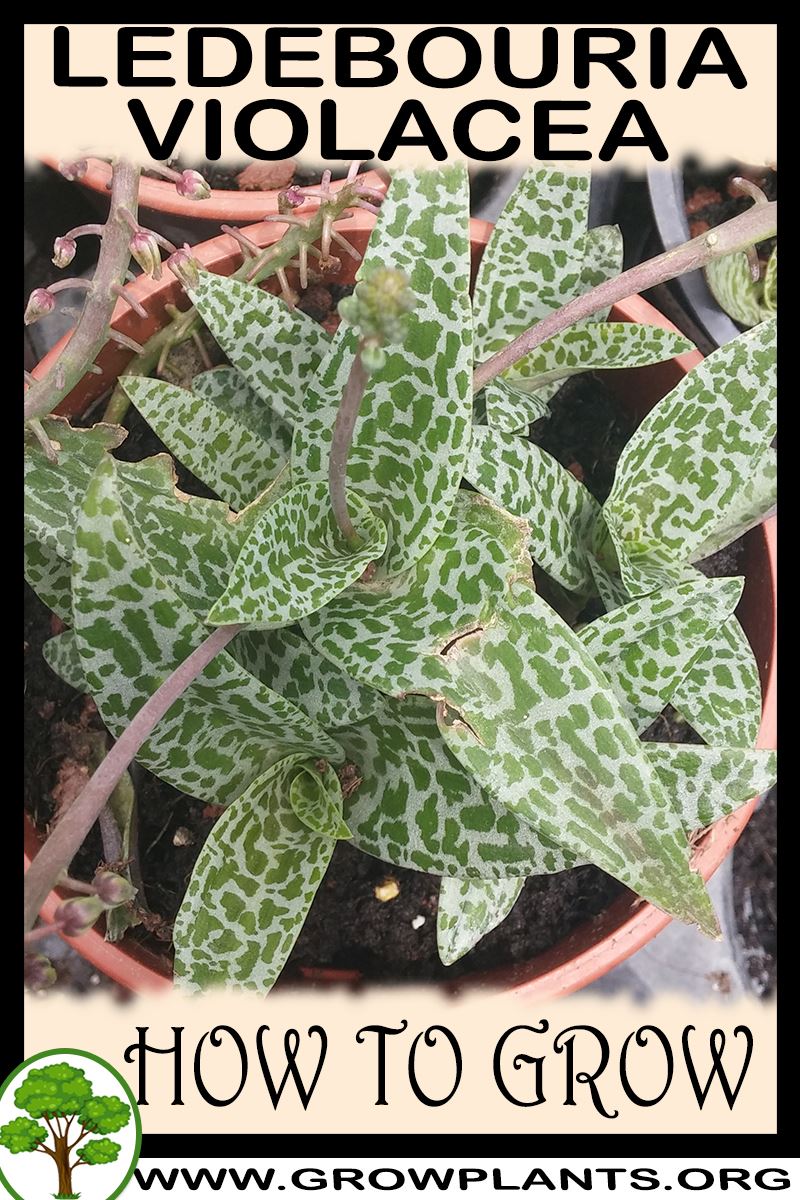
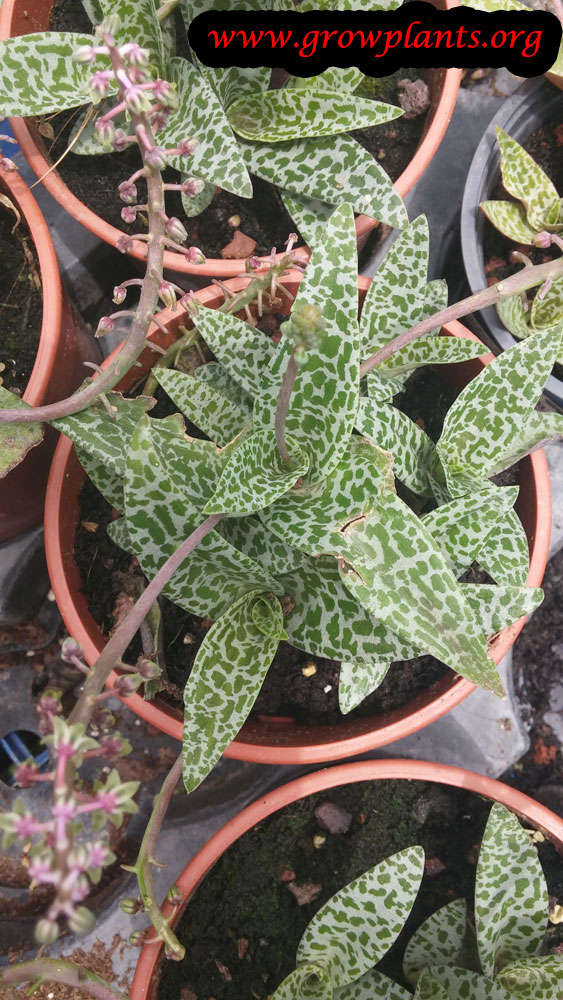
- Leaves & Foliage: Silver-green leaves patterned with darker green spots and a purple underside; linear and pointed at the tip.
- Flower Characteristics: Small green-purple bell-shaped flowers held in an inflorescence on slender stems.
Primary Uses & Landscape Value
- Functional & Ornamental Roles: Ornamental foliage plant for pots, rockeries and as a houseplant; drought-tolerant and easy to grow.
Care Guide: Planting, Soil & Watering
Overview: This drought-tolerant succulent bulb grows best in bright shade in Mediterranean or subtropical conditions and makes an easy houseplant (hardiness zone 10-12). It needs a sharply drained, gritty soil and only small amounts of water.
Quick Care Requirements
| Requirement | Ideal Condition |
|---|---|
| Planting Season | Warm season, from spring through autumn (frost-free) |
| Growth Rate | Slow |
| Soil Type | Well-draining, gritty or sandy succulent mix |
| Water Need | Low; let the soil dry out between waterings |
Planting & Establishment
- Best Planting Season: Plant during the warm season, spring through autumn, in a frost-free spot.
- How to Plant:
- Hole Preparation: Set the bulb so its neck sits at or just above the soil surface.
- Soil Amendments: Blend in coarse grit or sand to guarantee fast drainage.
- Planting Depth: Keep the bulb shoulder exposed at the surface – do not bury it deeply.
- Growth Speed & Expectations: A slow grower staying compact at about 5-15 cm (2-6 in).
Soil, Watering & Drainage Care
- Soil Mix & Drainage Needs: Use a gritty cactus or succulent mix; excellent drainage is essential to prevent bulb rot.
- Watering Schedule & Technique:
- Young / Newly Planted: Water lightly once it is settled in.
- Established: Water sparingly, always allowing the soil to dry out completely between waterings.
- Seasonal Adjustments: Give little to no water during winter dormancy.
Climate, Light & Hardiness
Ledebouria violacea is a bulbous succulent geophyte suited to Mediterranean and subtropical climates or life as a houseplant. It prefers half shade to full shade and needs frost-free conditions year-round.
Quick Climate Specifications
| Climate Zones | Mediterranean, subtropics, or indoor as a houseplant |
| USDA Hardiness Zones | 10-12 |
| Frost Tolerance | None |
| Light Conditions | Half Shade / Full Shade |
Sunlight & Light Exposure
Optimal Light Setup
This small bulb succulent grows best in half shade to full shade rather than strong direct sun, similar to its habit as a woodland-margin and understory geophyte in habitat.
Shade & Heat Management
In hot, sunny climates a shadier position helps protect the fleshy, patterned leaves from scorching.
Best Exposure / Orientation
A bright but shaded spot, such as under larger plants or on an east-facing windowsill indoors, suits it well.
Temperature Extremes & Hardiness
USDA Hardiness & Regional Limits
Outdoor culture is reliable from about USDA zone 10 through 12; outside this range it needs to be grown as a houseplant.
Cold Damage & Winter Protection
The plant requires frost-free conditions; move container specimens indoors or under cover before any frost risk.
Frost Sensitivity
Frost tolerance is essentially none, so it is not suited to gardens with freezing winters unless grown as a protected houseplant.
Wind, Humidity & Microclimate
Microclimate Recommendations
Well-drained soil is important in any climate; in colder regions, grow it in a container that can be brought indoors for winter rather than planting it directly in the ground.
Growing in Pots, Balconies & Indoors
Ledebouria violacea (silver squill) is a small bulb-forming succulent grown for its beautifully spotted, silver-and-green leaves with purple undersides – a tough, drought-tolerant little houseplant that thrives on a bright indoor sill or in a shallow pot on a warm patio.
Quick Details
- Container Size: A small or shallow pot about 30% wider than the bulbs; these 5-15 cm (2-6 in) plants clump slowly and like a snug pot
- Indoor Suitability: A good, easy houseplant for a bright spot
- Best Spot: Bright indirect light to light shade; a little gentle sun deepens the leaf colour
- Soil & Drainage: Free-draining, gritty succulent mix; strong drainage holes
- Watering in Pots: Small amounts – let the mix dry between waterings, and keep it drier while dormant
Indoors & On the Windowsill
- An easy houseplant: The grower confirms yes – it grows happily indoors in a bright spot with a little sun and very careful watering. A ready-made cactus and succulent soil mix provides that structure without mixing it yourself.
- Light indoors: It tolerates part to full shade if the shade is bright, but the silver leaf markings show best with good light.
- Overwintering: Tender (hardiness zone 10-12), so in cold regions keep it as an indoor pot plant over winter.
- Keep out of reach: The plant and its bulbs are poisonous – keep it away from children and pets, and never eat any part.
On a Balcony or Patio
- Warm-season outdoors: It enjoys a bright, sheltered balcony or patio in the warm months, in part shade to a little sun.
- Heat & watering: Pots dry fast against warm walls – water only when the mix is dry, and shelter from heavy rain so the bulbs never sit wet.
- Bring it in: Return it indoors before cold nights.
Choosing the Pot, Soil & Long-Term Care
- Pot & drainage: Choose a pot only about 30% wider than the root ball – an oversized pot holds wet soil around the roots. Rather than starting big, pot up every few years as it fills out; the mix loses structure over time, though a sharp, sandy mix that never sits wet can go five years or more between changes. Use strong drainage holes and skip a standing water saucer to avoid root rot.
- Pot material: Terracotta breathes and dries fast, which suits these rot-prone succulents; glazed or plastic pots hold moisture longer, so water even more sparingly.
- Potting mix: A gritty, free-draining mix – sandy or cactus/succulent mix, or peat/coir with perlite, with coarse lava grit at the base.
- Feeding: Feed only lightly – a dilute low-strength feed once or so during active growth, as frequent watering leaches nutrients from pots faster than from open ground.
- Watch for rot: Overwatering is the one real danger – in a rainy spot stand the pot in lava grit so water drains straight through, and always let the mix dry before watering again.
Fertilizing & Feeding
A very light feeder: an occasional dilute, low-nitrogen feeding while the plant is in active growth is all it needs, and feeding is stopped during dormancy.
Quick Fertilizing Specs
| Feeding Level | Very light feeder |
|---|---|
| Main Nutrient Priority | A little nitrogen for slow, compact growth; avoid rich feeding |
| Best Feeding Period | During active growth only |
| Organic Options | A little compost or worm castings worked into a gritty, well-drained mix |
| Reduce/Stop Feeding | Stop feeding during dormancy and cool, low-light periods |
| Micronutrients | Usually adequate in a complete fertilizer; correct only a diagnosed deficiency |
| Soil pH | Slightly acidic to near neutral |
Feeding by Growth Stage
Active growth
Support steady, compact growth while the succulent is actively growing.
| Nutrient direction | A dilute, low-nitrogen complete fertilizer; succulents grow slowly and take very little feeding. |
|---|---|
| Timing | While the plant is in active growth. |
| Frequency | Occasional light feeding during active growth is plenty. |
| Fertilizer types | A dilute balanced or low-nitrogen complete fertilizer, A cactus and succulent fertilizer |
| Precautions | Feed sparingly; overfeeding forces soft, weak growth and can burn the roots. |
Dormancy / rest period
Let the plant rest without pushing growth during its dormant period.
| Nutrient direction | None – withhold fertilizer while the plant is dormant. |
|---|---|
| Timing | During the plant’s dormant rest period, and whenever growth stops. |
| Frequency | No feeding during dormancy; resume only when active growth returns. |
| Fertilizer types | No feeding at this stage; hold off fertilizing until active growth resumes. |
| Precautions | Do not fertilize a resting succulent; feeding now wastes nutrients and risks salt buildup and rot. |
Nutrient Deficiency Signs & Corrections
Soft, mushy or scorched growth, browning leaf tips, or sudden collapse after feeding.
| Possible causes | excess fertilizer and salt buildup in the root zone, overwatering combined with feeding, feeding while the plant is dormant |
|---|---|
| Appears first on | root zone and lower leaves |
| What to check | recent feeding and watering, drainage and container conditions, whether the plant is in active growth or dormant |
| Possible correction | Ease off feeding, flush the mix with water to leach accumulated salts, and feed only lightly during active growth. |
Older leaves fade to pale green and growth becomes weak and stunted.
| Possible causes | depleted nitrogen in an old, spent mix, never feeding over a long period, nutrients leached by frequent watering |
|---|---|
| Appears first on | older, lower leaves |
| What to check | age of the potting mix, feeding history, watering frequency and drainage |
| Possible correction | Refresh the mix or apply a dilute low-nitrogen complete fertilizer during active growth. |
New leaves yellow between the green veins while older leaves stay greener.
| Possible causes | iron or manganese made unavailable by an overly wet mix, high soil pH limiting micronutrient uptake, cold, soggy roots reducing uptake |
|---|---|
| Appears first on | newest leaves |
| What to check | drainage and how wet the mix stays, soil pH, root health |
| Possible correction | Improve drainage and correct pH; if it persists, apply a chelated iron or manganese product per its label. |
Pruning, Training & Seasonal Maintenance
Ledebouria violacea is a small, slow-growing bulbous (geophyte) succulent, only 5–15cm tall, grown as a rosette of patterned leaves. It tolerates only minimal, sanitary pruning — there is no framework to train and no canopy to shape. The entire task is removing spent leaves and old flower stems as they die back, which can be done at any time of year since the plant has no strict dormant season under typical warm-climate or indoor culture.
Quick Pruning & Maintenance Specs
| Pruning Tolerance | Low |
| Primary Pruning Window | All year, as needed |
| Typical Frequency | Occasional spot removal of spent leaves/flower stems |
| Main Objective | Remove dead leaves and spent flower stems for appearance and plant health |
| Young Plant Priority | Leave undisturbed; no training needed for a small rosette |
| Mature Plant Priority | Tidy spent foliage; let bulb offsets fill out the clump |
| Best Tool Type | Precision snips |
Pruning by Plant Age & Size
Newly Established
Do not prune; allow the small bulb to establish undisturbed.
Young / Formative
No structural training applies — the plant grows as a single low rosette from a bulb, with no stems or canopy to shape.
Mature / Established
As the bulb offsets and forms a clump, simply remove individual dead or damaged leaves and spent flower stems as they appear; the clump itself is left to fill in.
Seasonal Pruning Schedule
| Ongoing Sanitary | Objective: tidy the plant and reduce rot risk. Remove: dead or yellowed leaves and spent flower stems, whenever seen. Do not remove: green, turgid leaves. Response: cleaner rosette; no flowering impact since removal is only of already-spent growth. |
Special Growth to Remove
Dead leaves and spent flower stems only. This is a small bulb, not a grafted or suckering plant, so there are no rootstock suckers, watersprouts, or runners to manage.
Container & Small-Space Pruning
Almost always grown in containers given its small mature size. As bulb offsets crowd a pot over time, thin or divide the clump at repotting rather than trying to control size through cutting — there is no foliage mass to prune back the way there would be on a larger plant.
Tools
Precision snips only — cuts here are always small, soft leaf and flower-stem material.
Tool Hygiene & Disease Risk
Routine: clean, sharp tools are sufficient. Reported pests (aphids, snails, slugs) are not spread through pruning cuts.
Cut Placement & Technique
Cut spent leaves and flower stems close to their base at the bulb without disturbing neighboring leaves or the bulb itself.
Heavy Pruning & Rejuvenation
Not applicable — this is a small single-rosette geophyte with no woody structure to rejuvenate; hard pruning is neither needed nor possible in the way it would be on a shrub.
Post-Pruning Care
None beyond normal care; light spent-leaf removal does not warrant extra watering, feeding, or wound treatment.
Common Pruning Mistakes
Cutting into the bulb or healthy green leaves in an attempt to “shape” the plant — there is no shape to impose on a rosette geophyte beyond removing what is already dead.
When NOT to Prune
Avoid disturbing the plant with cutting or division right after transplanting, while it is settling in.
Recommended Tools (by task)
- precision_snips – for removing spent leaves and flower stems close to the bulb
Propagation Guide
Ledebouria violacea is most easily and quickly propagated by separating the small offset bulbs that form naturally around the base of the parent bulb, since seed, while usable and generally true to the species, takes longer to reach a similar size. Propagation is easy either way, and vegetative propagation is not required to keep the plant true.
Quick Propagation Specs
| Best Propagation Method | Bulb offset division |
| Alternative Methods | Seed |
| Propagation Difficulty | Easy |
| Seed True-to-Type | Usually true-to-type |
| Vegetative True-to-Type | Yes |
| Best Propagation Season | Spring through autumn, during active growth |
| Seed Sowing Depth | Shallow – seed just covered |
Growing from Seed
Sowing Season
Spring through autumn, matching the plant’s active growing period.
Sowing Depth & Orientation
Sow on the surface of a gritty, free-draining mix and cover only lightly.
Germination Conditions
Keep the mix lightly moist and in a warm, bright spot out of direct hot sun; germination is gradual rather than fast.
Seedling Care
Grow seedlings on with light, regular moisture until small bulbs form, then treat as young plants, allowing the medium to dry slightly between waterings once established.
Division, Offsets, Pups & Suckers
This species forms offset bulbs readily around the base of the parent bulb. Once an offset has its own roots, it can be separated and potted individually in well-drained soil; do this while the plant is in active growth (spring to autumn) rather than during its rest period.
Bloom & Flower Guide
Quick Details
- Bloom Season: Spring into summer
- Flower Appearance: Small, bell-shaped, green-and-purple flowers held in a slender spike on an upright stem
- Edibility: Not edible – Ledebouria is toxic; keep the flowers, bulb and all parts away from children and pets
Detailed Blooming Overview
Silver Squill sends up slim flower spikes in spring and summer, lined with many small, nodding, green-and-purple bells. The blooms are dainty rather than showy – the plant is grown mainly for its silver-mottled, spotted foliage – and while they attract small pollinators, every part of the plant, including the flowers and the bulb, contains toxic compounds and must not be eaten.
Flower Characteristics
- Small, bell-shaped flowers in green and purple tones.
- Carried in a loose spike (raceme) on an upright stem.
- Grown chiefly for the foliage; the bloom is a modest bonus.
Bloom Care & Thinning
- Managing the bloom: The flowers are undemanding; trim spent spikes once they fade to tidy the plant.
- Encouraging bloom: A bright spot and a distinct cooler, drier rest period help trigger flowering.
- Safety: All parts are toxic if eaten – site the plant out of reach of children and pets, and wash your hands after handling.
Pests, Diseases & Troubleshooting
Overview: Ledebouria are small bulbous plants from seasonally dry grasslands, grown for their patterned leaves; like most bulbous succulent-type plants they are largely trouble-free and their real risk is bulb and root rot from over-watering. Insect problems are the usual indoor sap-suckers – mealybugs above all – and are easily managed by inspection and restraint with the watering can.
Quick Troubleshooting Overview
| Issue / Pest | Main Symptom | Primary Solution |
|---|---|---|
| Mealybugs | White cottony tufts in leaf bases and on bulbs/roots | Wipe with alcohol; horticultural oil; check roots |
| Scale | Brown limpet bumps on leaves and bulb neck | Scrape off; oil spray |
| Spider mites | Fine stippling, webbing in hot dry air | Raise humidity; hose; miticidal oil |
| Fungus gnats | Small black flies from soil; larvae at roots | Let soil dry; sticky traps; BTi |
| Bulb / root rot | Soft, mushy, foul bulb; yellow collapse | Cut back watering; gritty mix; remove rot |
| Aphids (on flower spikes) | Sticky, distorted flower stems | Water jet; soap |
Common Pests & Management
- Mealybugs (incl. root mealybugs) (Pseudococcus / Rhizoecus spp.):
- Symptoms: White cottony tufts nestled in the leaf bases, around the bulb neck, and – critically – on the roots and bulb underground (root mealybugs), where they sap vigour unseen; leaves pale and growth stalls.
- Prevention & Control: Inspect the bulb and roots at repotting. Wipe visible clusters with an alcohol-dipped cotton swab and drench the rootball with a systemic-type or horticultural-oil solution for root mealybugs. Isolate new plants and keep the soil on the dry side.
- Scale insects (Coccidae / Diaspididae):
- Symptoms: Small brown, tan or waxy limpet-like bumps clamped on the leaves and bulb neck, sucking sap and leaving honeydew; they do not move once settled.
- Prevention & Control: Scrape off with a fingernail or swab and treat with horticultural oil to smother remaining crawlers. Repeat every couple of weeks until clear.
- Two-spotted spider mite (Tetranychus urticae):
- Symptoms: Fine pale speckling of the leaves and delicate webbing in hot, dry indoor air; leaves dull and dry out.
- Prevention & Control: Raise humidity, hose or wipe the foliage, and use a horticultural oil or insecticidal soap; predatory mites work in a warm room.
- Fungus gnats (Bradysia / Sciaridae):
- Symptoms: Small dark flies drifting up from the pot; their larvae feed on roots and organic matter in soil kept too wet, weakening young plants.
- Prevention & Control: Let the top of the mix dry fully between waterings, use a grittier free-draining mix, catch adults on yellow sticky traps, and drench with Bacillus thuringiensis israelensis (BTi) for larvae.
Diseases & Fungal Issues
- Bulb & root rot (Fusarium / Pythium / Rhizoctonia spp.):
- Symptoms: The main killer: the bulb turns soft, mushy and foul-smelling and the leaves yellow and collapse, always tied to soggy, poorly drained soil and over-watering, especially during the plant’s dormant rest.
- Treatment & Management: Prevent by using a gritty, free-draining succulent mix, watering sparingly and much less during dormancy, and never leaving the pot in standing water. Cut away any rot into clean firm tissue, dust with sulphur, and re-root in dry mix.
- Leaf fungal spots (Various leaf-spot fungi):
- Symptoms: Occasional brown or black spots on leaves kept too wet or in stagnant, humid air.
- Treatment & Management: Improve airflow, avoid wetting the foliage, remove affected leaves, and ease off watering – chemical treatment is rarely needed.
Growing Difficulties & Abiotic Problems
- Over-watering rot:
- Cause & Symptoms: Yellowing, softening and bulb collapse from too-frequent watering or heavy soil, the commonest cause of failure.
- Correction Strategy: Water only when the mix is dry, reduce sharply in dormancy, and grow in a gritty mix in a pot with good drainage.
- Etiolation / faded pattern:
- Cause & Symptoms: Stretched, pale leaves with washed-out markings from too little light.
- Correction Strategy: Give bright light (some direct sun), which keeps the leaves compact and the silver-and-green patterning strong.
- Failure to rest / non-flowering:
- Cause & Symptoms: Weak growth and shy flowering when kept watered and warm year-round.
- Correction Strategy: Allow a cooler, drier dormant rest so the bulb can build up and flower well in the next cycle.
What Helps – Products & Tools
This is a low-input plant – restraint with water does most of the work. Keep horticultural (neem) oil and insecticidal soap for mealybugs, scale and mites, a systemic drench or oil for stubborn root mealybugs, yellow sticky traps plus BTi for fungus gnats, and sulphur powder to dress rot cuts. A gritty, free-draining mix is the best ‘product’ of all.