Plant Profile & Key Characteristics
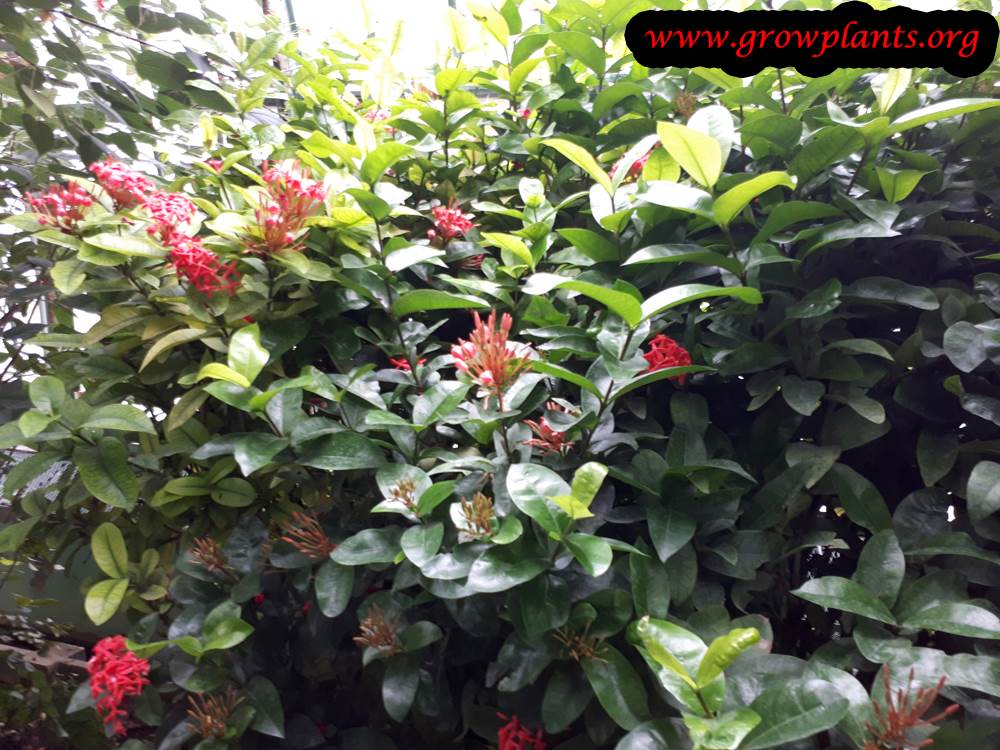
Overview: Ixora (jungle geranium / jungle flame) is an evergreen tropical shrub, or small tree, growing 1-2 m as a shrub and 3-4 m as a tree, grown as an ornamental for its glossy foliage and dense clusters of small flowers. It is a popular flowering hedge in warm climates.
Quick Specifications
| Specification | Attribute |
|---|---|
| Plant Type / Life Cycle | Perennial (woody shrub / small tree) |
| Foliage Type | Evergreen |
| Mature Size | Shrub 1-2 m (40-80 in); as a tree 3-4 m (10-12 ft) |
| Growth Rate | Fast to moderate |
| Hardiness | USDA zone 9+ |
Growth Form & Structure
- Height & Spread: 1-2 m as a shrub (up to 3-4 m as a small tree) in ground; also grown in planters and containers.
- Growth Habit & Form: Dense, rounded evergreen shrub that clips well into a hedge, or trained as a small tree.
- Lifespan & Maturity: Long-lived woody plant; steady growth in warm, frost-free conditions.
Anatomy & Physical Features
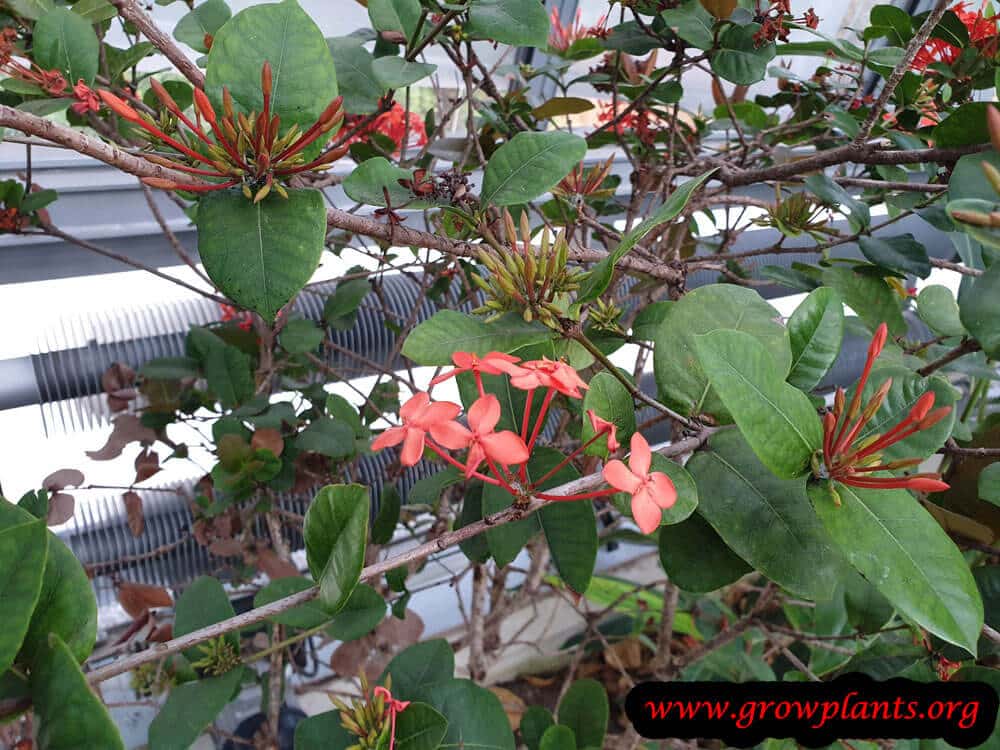
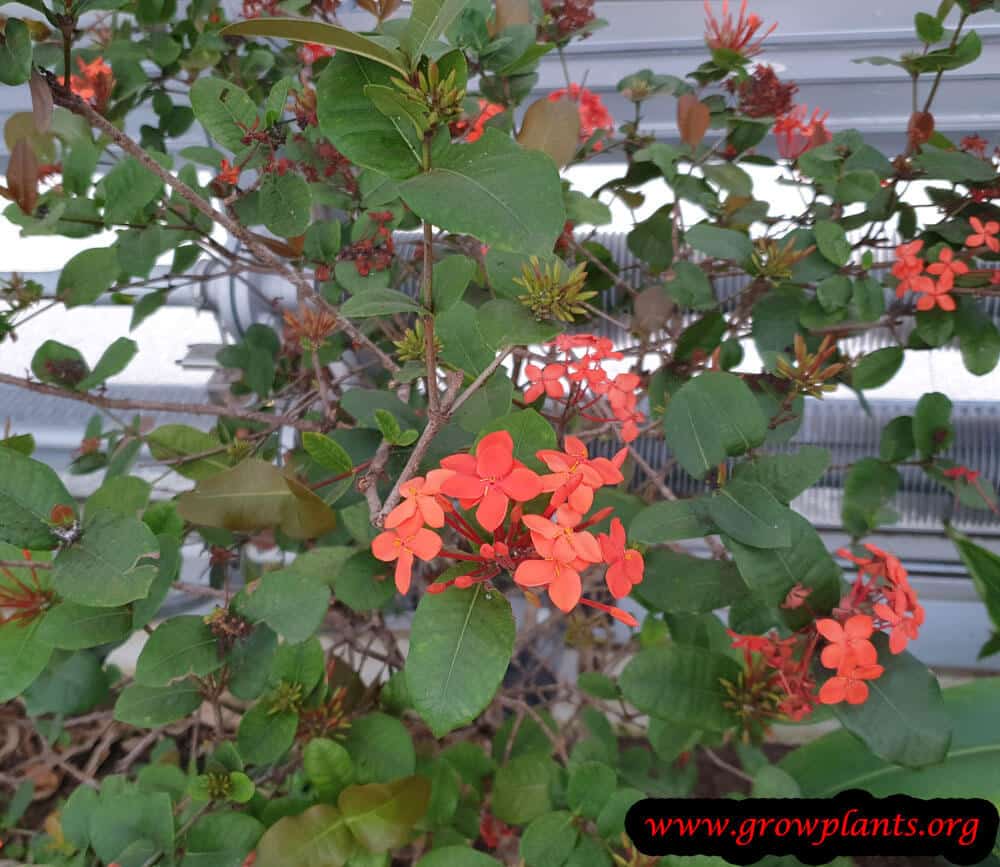
- Leaves & Foliage: Glossy, elliptic leaves in shades of dark to light green.
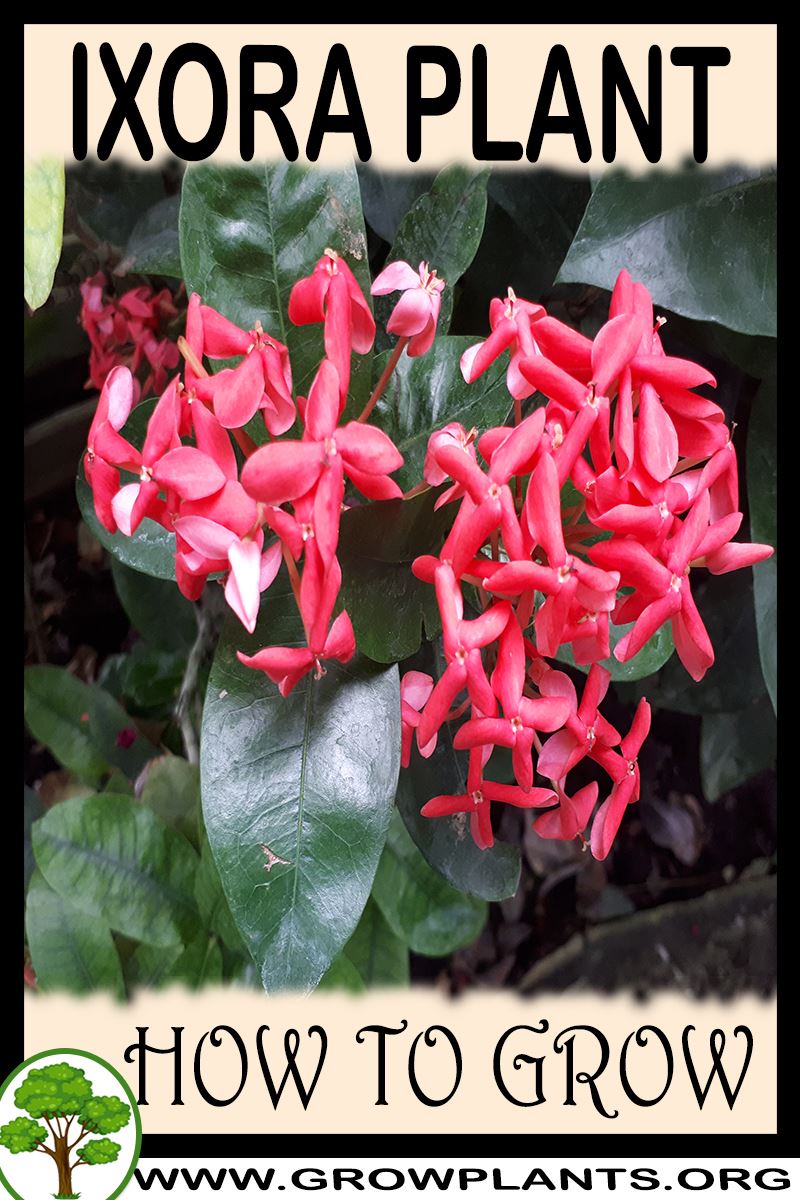
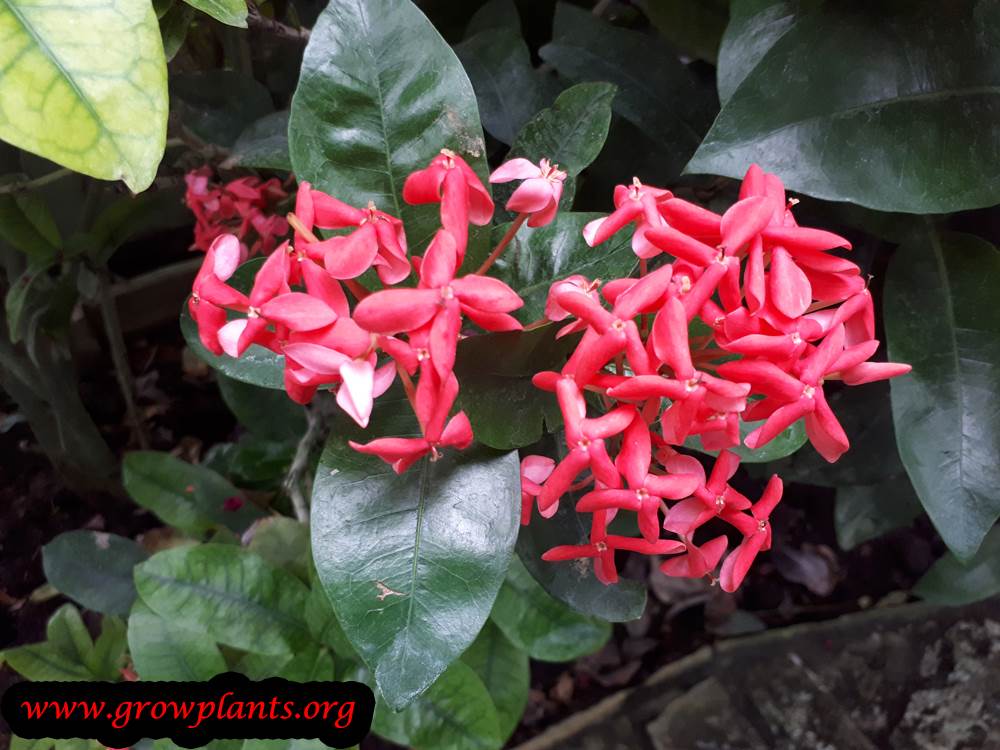
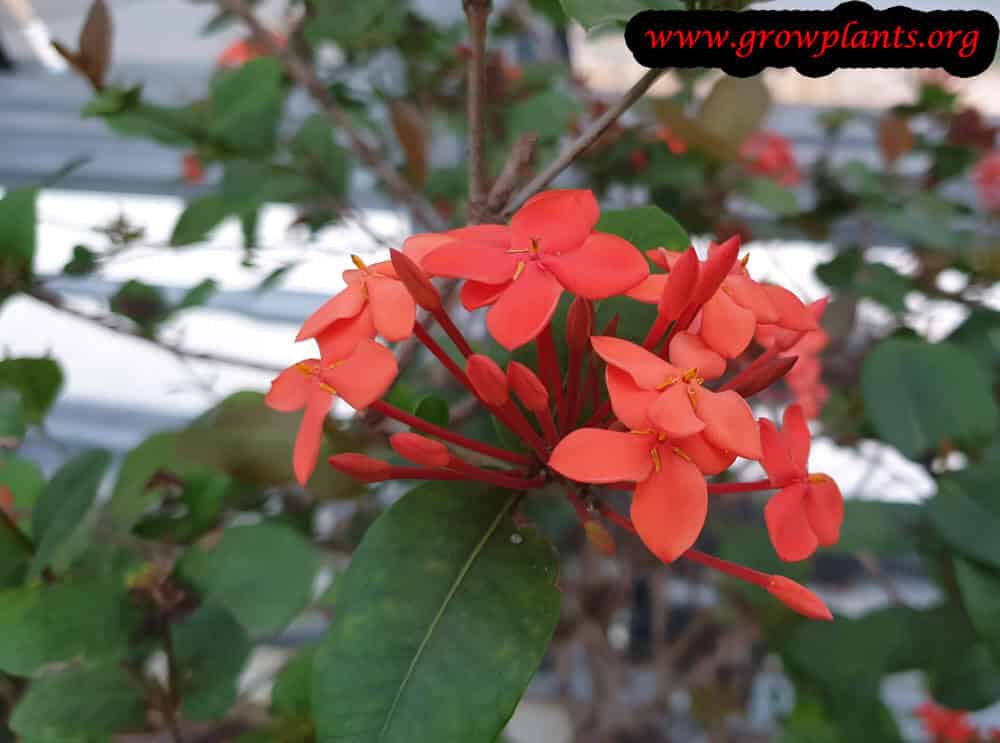
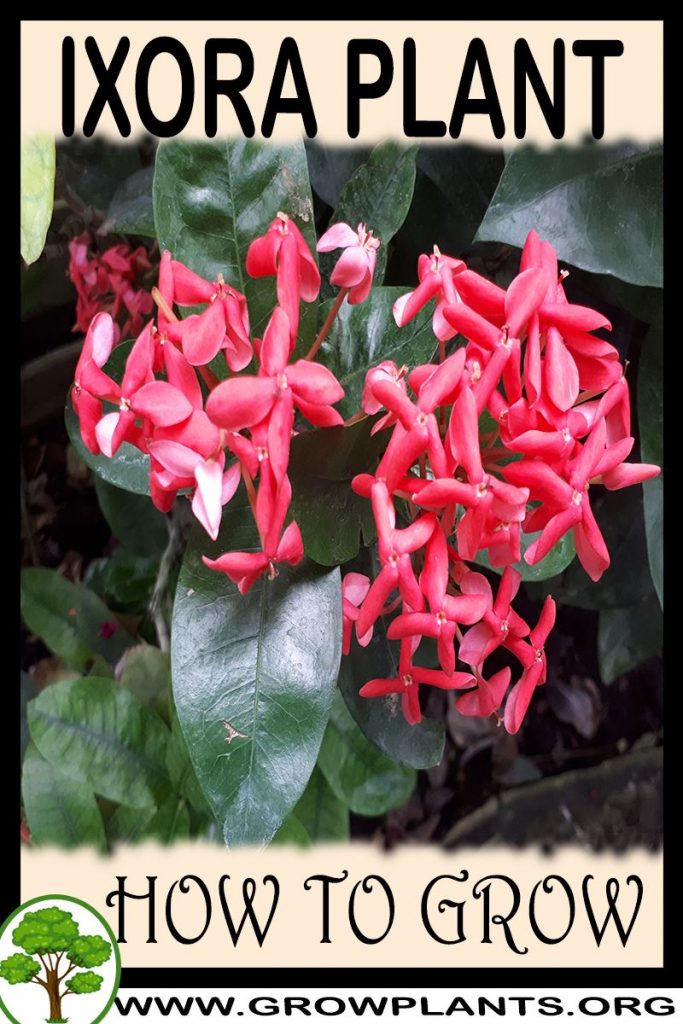
- Flower Characteristics: Small, tubular, cross-shaped flowers in dense rounded clusters, in yellow, red, pink, orange, peach or white (full detail in the Bloom guide).
Primary Uses & Landscape Value
- Functional & Ornamental Roles: Ornamental flowering shrub, hedge or screen and container plant for tropical borders; attracts butterflies and other pollinators.
Care Guide: Planting, Soil & Watering
Overview: Ixora is a tropical evergreen shrub for warm, frost-free conditions, flowering best in full sun in rich, well-drained, mulched soil. Like many tropical evergreens it prefers slightly acidic soil and shows yellowing leaves when the ground is too alkaline.
Quick Care Requirements
| Requirement | Ideal Condition |
|---|---|
| Planting Season | In spring through autumn (year-round in the tropics) |
| Growth Rate | Moderate to fast |
| Soil Type | Rich, organic, well-draining and mulched |
| Soil pH | Slightly acidic |
| Water Need | Moderate; keep evenly moist, not waterlogged |
Planting & Establishment
- Best Planting Season: Plant from spring through autumn in warm weather; in frost-free tropical areas it can go in year-round.
- How to Plant:
- Hole Preparation: Dig a hole a little wider than the root ball in rich, well-drained soil.
- Soil Amendments: Work in plenty of organic matter or compost; acidic amendments such as peat suit its liking for slightly acid soil.
- Planting Depth: Set the root ball at the level it grew, firm gently, and mulch to conserve moisture and warmth.
- Growth Speed & Expectations: A moderate to fast grower reaching 1-2 m as a shrub (to 3-4 m as a small tree); prune after flowering to keep it shapely.
Soil, Watering & Drainage Care
- Soil Mix & Drainage Needs: Needs rich but free-draining, acidic soil; in containers use an ericaceous or acidic potting mix and keep it evenly moist, never soggy.
- Watering Schedule & Technique:
- Young / Newly Planted: Water regularly to keep the root zone evenly moist while establishing.
- Established: Water when the surface begins to dry, keeping the soil consistently moist.
- Seasonal Adjustments: More in heat, less in cooler months; protect from frost.
Climate, Light & Hardiness
Ixora (jungle geranium) is a warm-climate shrub or small tree suited to tropical, subtropical, and mediterranean climates, hardy in USDA zone 9 and warmer. It grows well in full sun to half shade, though it flowers most heavily with more sun.
Quick Climate Specifications
| Climate Zones | Tropical, subtropical, mediterranean |
|---|---|
| USDA Hardiness Zones | 9+ |
| Frost Tolerance | Low |
| Light Conditions | Full sun to half shade (more sun gives better flowering) |
Sunlight & Light Exposure
Optimal Light Setup
Full sun for the heaviest flowering; half shade is tolerated but with reduced bloom.
Direct Sun Requirement
Thrives in strong direct sun.
Shade & Heat Management
Half shade is an option in intense heat, though flowering is reduced.
Best Exposure / Orientation
An open, sunny site gives the best floral display.
Temperature Extremes & Hardiness
USDA Hardiness & Regional Limits
Hardy only in zone 9 and warmer - a true warm-climate species not suited to regions with regular freezes.
Cold Damage & Winter Protection
Frost damage is likely; in marginal areas, site it in a warm, sheltered microclimate, mulch the root zone, and consider container culture that can be moved indoors for winter.
Frost Sensitivity
Low tolerance.
Extreme Heat Tolerance
Well suited to the heat of tropical and subtropical climates.
Wind, Humidity & Microclimate
Rainfall & Seasonal Moisture
Grown with an average amount of water in well-drained, rich soil; not documented as drought tolerant.
Microclimate Recommendations
A warm, sunny, sheltered site; mulch helps retain soil moisture and moderate root-zone temperature.
Growing in Pots, Balconies & Indoors
Ixora is a glossy tropical shrub prized for its dense flower heads. The grower confirms it is not a houseplant; grown as a shrub it stays 1-2 m and takes very well to a sunny patio container, though it can reach small-tree size in the ground. A pot lets you overwinter it in cold climates.
Quick Details
- Container Size: Medium to large – a good pot for a 1-2 m shrub, kept compact by pruning; larger if allowed to grow on.
- Indoor Suitability: No – not a houseplant.
- Best Spot: Full sun to part shade, but the more sun the better the flowering.
- Soil & Drainage: Rich, free-draining, slightly acid mix.
- Watering in Pots: Even, moderate moisture; keep it steady in the warm season.
Indoors & On the Windowsill
- Not a houseplant: The grower says no – it is a sun-loving flowering shrub that needs stronger light than a room provides.
- Sunny patio shrub: In a container it makes a superb flowering plant for a bright, warm balcony or patio, clipped to keep it bushy.
- Overwintering: It is frost-tender – in cold climates move the pot to a bright, warm, frost-free spot for the cold season.
On a Balcony or Patio
- Sun, wind and heat: Give it your sunniest, most open spot; walls and railings throw back heat and wind dries pots fast, so check moisture daily in hot weather and stake tall stems on an exposed balcony. A drip irrigation kit with a timer can take over that watering check automatically.
- Feed for flowers: In a pot it flowers best with steady warmth, strong light and regular feeding through the growing season.
Choosing the Pot, Soil & Long-Term Care
- Pot & drainage: Choose a pot with strong drainage holes and skip a standing-water saucer, which invites root rot; terracotta breathes and dries quickly, while glazed or plastic hold moisture longer.
- Potting mix: Fill with a well-aerated, organic-rich medium – a good potting mix, or peat/coir blended with perlite or vermiculite for drainage.
- Feeding: Container plants run through nutrients fast because watering washes them out, so feed a little more often through the growing season than you would in open ground.
- Repotting: Refresh the mix or pot up every couple of years, pruning lightly after flowering to keep it dense and in scale.
Fertilizing & Feeding
A moderate feeder: this flowering shrub or small tree rewards steady balanced nutrition through its warm-season growth and bloom, and is a common candidate for iron or manganese chlorosis where soils run alkaline.
Quick Fertilizing Specs
| Feeding Level | Moderate feeder |
|---|---|
| Main Nutrient Priority | Balanced feeding with adequate nitrogen to support both foliage and the clustered flower heads |
| Best Feeding Period | Spring through the summer and autumn bloom season |
| Organic Options | Rich soil, compost, and a maintained mulch layer |
| Reduce/Stop Feeding | Reduce feeding as growth slows toward the cooler edge of its climate range |
| Micronutrients | Iron and manganese availability can drop in alkaline soil and cause chlorosis; correct only diagnosed issues |
| Soil pH | Prefers slightly acidic soil; chlorosis is more likely as soil turns alkaline |
Feeding by Growth Stage
Spring growth flush
Build the leafy framework and new stems that will carry this season’s flower clusters.
| Nutrient direction | A balanced, complete fertilizer with adequate nitrogen supports vigorous new growth on this rich-soil-loving shrub. |
|---|---|
| Timing | As new growth resumes in spring, or year-round in genuinely tropical conditions. |
| Frequency | Regular light-to-moderate feedings through this growth phase suit a shrub that is being used for hedging. |
| Fertilizer types | A balanced complete fertilizer formulated for flowering shrubs, Rich organic matter and a refreshed mulch layer |
| Precautions | Keep the root zone consistently moist when feeding; this species dislikes drying out between waterings, which can worsen nutrient uptake problems. |
Summer–autumn cluster bloom
Sustain the dense clusters of yellow, red, pink, orange, peach, or white flowers through the main bloom season.
| Nutrient direction | Continue balanced feeding; a high-phosphorus product is not needed to drive better flowering. |
|---|---|
| Timing | Through summer and into autumn while flower clusters are forming and opening. |
| Frequency | Maintain a steady, moderate feeding rhythm through the bloom season. |
| Fertilizer types | A balanced complete fertilizer, A chelated iron or manganese product only if chlorosis is confirmed |
| Precautions | Watch for yellowing between the veins on new leaves, a common sign of chlorosis in this genus on alkaline soil, before assuming a general feeding problem. |
Cool-season slowdown
Let growth rest where cooler winter conditions bring active growth to a near stop.
| Nutrient direction | None – withhold fertilizer while the plant is not actively growing. |
|---|---|
| Timing | During any cooler winter period at the edge of this shrub’s climate range. |
| Frequency | No feeding at this stage. |
| Fertilizer types | No feeding at this stage; do not fertilize until active growth resumes in spring. |
| Precautions | Do not fertilize during a genuine winter slowdown; feeding now wastes nutrients and can encourage tender growth that is easily damaged by cold. |
Nutrient Deficiency Signs & Corrections
New leaves turn yellow while the veins remain distinctly green.
| Possible causes | alkaline soil pH limiting iron availability, waterlogged or compacted soil, root damage from overwatering |
|---|---|
| Appears first on | youngest, newest leaves |
| What to check | soil pH, drainage around the root zone, recent watering pattern |
| Possible correction | Lower soil pH where practical and apply a chelated iron product per its label. |
Interveinal yellowing spreads across young to mid-canopy leaves, sometimes alongside iron symptoms.
| Possible causes | alkaline or overlimed soil, poor drainage, cool soil temperatures slowing uptake |
|---|---|
| Appears first on | young to middle-aged leaves |
| What to check | soil pH, recent liming or soil amendments, root zone drainage |
| Possible correction | Correct soil pH where practical and apply a chelated manganese product per its label. |
Overall pale foliage, weak stem growth, and fewer flower clusters than expected.
| Possible causes | low soil nitrogen, root competition from nearby hedge plants, leaching in sandy or fast-draining soil |
|---|---|
| Appears first on | older, lower leaves and overall vigor |
| What to check | recent feeding history, soil type and drainage, hedge spacing and root competition |
| Possible correction | Apply a balanced complete fertilizer with adequate nitrogen and refresh organic matter around the root zone. |
Pruning, Training & Seasonal Maintenance
Ixora is a woody evergreen shrub (or small tree with training) that tolerates moderate to fairly hard pruning, and it is commonly kept as a clipped hedge as well as a loose specimen. Because its cross-shaped flowers form in clusters on the current season’s new growth, the timing and style of pruning directly affects bloom: frequent, all-over shearing keeps a tight outline but continually removes the shoot tips that would flower, while selective shaping right after a bloom flush – best in autumn following the summer-autumn display – lets the plant recover its structure without permanently sacrificing flowering.
Quick Pruning & Maintenance Specs
| Pruning Tolerance | Moderate to High |
| Primary Pruning Window | After each bloom flush, especially autumn following the main summer-autumn display |
| Secondary Maintenance Window | Light shaping in spring |
| Typical Frequency | 1-2 times a year for a specimen shrub; more frequent shearing only if grown as a formal hedge |
| Main Objective | Shape and size control, with a real flowering trade-off if kept as a sheared hedge |
| Young Plant Priority | Build an open, multi-stem shrub or train a single leader if a small-tree form is wanted |
| Mature Plant Priority | Selective thinning, renewal of leggy interior growth |
| Best Tool Type | Bypass secateurs and loppers; hedge shears only for a formal clipped hedge |
| Avoid Heavy Pruning During | Active summer-autumn bloom, and the coldest part of winter near the zone 9 limit |
Pruning by Plant Age & Size
Newly Established
Minimal – remove only damaged growth and let the plant establish before any shaping.
Young / Formative
Open-center, multi-stem shrub training suits most plantings; where a small-tree form is wanted, select and maintain a single leader and remove low competing shoots.
Mature / Established
Maintain shape with selective thinning cuts, renew leggy interior stems, and control height and spread as needed.
Seasonal Pruning Schedule
Post-Flowering (after the summer-autumn bloom, into autumn): the main pruning window; remove spent flower clusters, crossing or awkward growth and leggy stems, but avoid cutting developing buds during active bloom; new growth that follows has a full season to mature before the next flush.
Ongoing Sanitary: light, year-round removal of dead or damaged twigs.
Flowering & Fruiting Wood
Flowers form in terminal clusters on current-season growth, which is why hedge-style shearing reduces bloom – it repeatedly removes the shoot tips before they can flower. Where flowering display matters more than a tight formal outline, use selective thinning cuts instead of all-over shearing, and time major cuts for right after a flush finishes so new wood has a full season to mature and re-flower.
Structural Pruning & Training
Select and space branches for an open framework (specimen use) or maintain a clipped outline (hedge use, at the cost of flowering). Remove crossing or rubbing interior growth, control height and spread by heading back leggy shoots to a lower node, and thin the canopy to improve light penetration and interior flowering rather than pushing bloom only to the outer surface.
Special Growth to Remove
- Leggy, etiolated interior shoots reaching for light
- Occasional basal shoots on multi-stem specimens – retain for a fuller shrub, remove if training a small-tree form
- Dead or winter-damaged tips in marginal zone 9 sites
Container & Small-Space Pruning
As a container specimen, keep it to shrub form rather than the 3-4m tree size with light annual shaping. More frequent light tip pruning keeps container plants bushier and more compact than the equivalent in-ground shrub.
Tools
Bypass secateurs for most shaping and thinning cuts; loppers for thicker older wood on mature specimens; hedge shears only if intentionally maintaining Ixora as a clipped formal hedge, accepting reduced bloom.
Tool Hygiene & Disease Risk
Routine – clean, sharp tools; no major transmissible pathogen is singled out for routine pruning cuts on this species.
Cut Placement & Technique
Favor thinning cuts (removing a stem to its point of origin or a lateral) over indiscriminate heading when flowering is the priority. If hedging, shear with a slightly tapered profile, wider at the base, for even light and to reduce dieback low in the hedge.
Heavy Pruning & Rejuvenation
Tolerates a fairly hard cutback to renew an overgrown or leggy specimen. Expect a flush of vegetative regrowth and a temporary drop in flowering while new wood matures; stagger a hard rejuvenation across the plant, or accept a season of reduced bloom.
Post-Pruning Care
Water normally; avoid forcing extra feeding right after a hard cut since the plant is already channeling energy into regrowth. Watch newly exposed interior stems for sunburn on a canopy that has been opened up significantly.
Common Pruning Mistakes
- Routine hard shearing into a tight ball, stripping off the terminal buds that would have flowered
- Pruning during active summer-autumn bloom and losing the current flush
- Leaving a dense, unthinned canopy that pushes flowering to the outer surface only
When NOT to Prune
Avoid major pruning during the summer-autumn bloom period if flowering display is the priority, and hold off on hard pruning going into the coldest part of winter in zone 9 areas near its hardiness limit.
Recommended Tools (by task)
| bypass_secateurs | Shaping cuts and removing spent flower clusters or thin stems on young to mature shrubs |
| loppers | Thicker older wood when renewal-pruning a leggy mature specimen |
| hedge_shears | Only if Ixora is kept as a clipped formal hedge, understanding this trades bloom for a tight outline |
Pruning Troubleshooting
| Problem | Possible Cause | What to Check | Corrective Action |
| Little to no flowering after pruning | Hedge-style shearing removed the terminal growth that carries flower buds | Whether the plant is regularly clipped into a tight formal shape | Switch to selective thinning cuts; time major cuts to right after a bloom flush |
| Dense growth with sparse interior foliage | Canopy never thinned, light only reaching the outer surface | Interior stem density and light penetration | Thin select interior stems to open the canopy |
| Dieback after a hard rejuvenation cut | Cut made late in the season ahead of a cool snap in a marginal zone-9 site | Timing of the hard prune relative to the cool season | Reserve hard rejuvenation for a period with a full warm season ahead to recover |
| Sparse growth low on a clipped hedge | Hedge sheared with straight sides shading the lower canopy | Hedge profile shape | Taper the hedge wider at the base than the top |
Propagation Guide
Ixora is best increased from semi-hardwood stem cuttings, which preserve the flower color of a particular plant and are more dependable than seed, which germinates slowly and unevenly and won’t reliably reproduce a named color form. It is not necessary to graft, but cuttings can be slow to root, so overall difficulty is moderate.
Quick Propagation Specs
| Best Propagation Method | Semi-hardwood stem cuttings |
| Alternative Methods | Air layering; seed (species only) |
| Propagation Difficulty | Moderate |
| Seed True-to-Type | Variable – hybrids and named flower colors do not come true from seed |
| Vegetative True-to-Type | Yes |
| Best Propagation Season | Warm months, spring to summer (year-round in the tropics, matching the site’s planting season note) |
| Seed Germination Time | Slow and erratic, often several weeks to a few months |
| Cutting Rooting Time | Several weeks, sometimes up to 2–3 months |
| Germination Temperature | 24–29°C (75–85°F) |
| Seed Sowing Depth | Shallow, just covered |
Growing from Seed
Seed Handling & Viability
Viability declines fairly quickly, so sow fresh seed where possible.
Sowing Season
Warm months; in the tropics sowing is possible year-round, per the site.
Sowing Depth
Shallow, lightly covered.
Germination Conditions
Warm and humid; germination is often slow and irregular over several weeks to a few months.
Seedling Care
Seedlings grow slowly at first and, for named color forms, will not necessarily match the parent’s flower color.
Stem Cuttings
Cutting Type
Semi-hardwood tip cuttings, about 10–15cm (4–6in).
Best Timing
Warm season – spring to summer, or year-round in consistently warm/tropical conditions.
Cutting Preparation
Remove the lower leaves, retaining a few upper leaves to sustain the cutting while it roots.
Rooting Setup
A well-drained mix with high humidity (mist or a covered propagator); bottom heat around 24–27°C (75–80°F) improves and speeds rooting.
Rooting Hormone
Beneficial – Ixora roots relatively slowly, and hormone treatment improves success and evenness.
Rooting Time
Typically several weeks, sometimes up to 2–3 months.
Air & Ground Layering
Useful for larger stems or when a bigger plant is wanted faster than cuttings allow. Wound or girdle a pencil-thick semi-hardwood branch, wrap in moist sphagnum moss and plastic, and start during the warm season; rooting can take 1–3 months before the new plant is severed and potted on.
Bloom & Flower Guide
Quick Details
- Bloom Season: Summer into autumn (nearly year-round in warm tropical conditions)
- Time to First Bloom: Flowers young and repeatedly once given warmth
- Flower Appearance: Dense, rounded trusses of small, cross-shaped, long-tubed flowers in yellow, red, pink, orange, peach or white
- Edibility: Grown as an ornamental — the flowers are not eaten
Detailed Blooming Overview
Ixora, the jungle flame, carries big domed clusters of small flowers, each a slender tube flaring into a four-part cross. In warm climates it is almost ever-blooming, and the bright trusses are a strong draw for butterflies.
Flower Characteristics
- Four spreading lobes on a long, narrow tube.
- Packed into tight, rounded clusters.
- Colours span yellow, red, pink, orange, peach and white.
Bloom Care & Thinning
- Site for best flowering: Warmth, full sun to light shade and moist, acid soil bring the heaviest bloom.
- Managing the bloom: Remove spent trusses to encourage more, and prune lightly to keep the plant bushy and floriferous.
- Pollination: Worked by butterflies and other long-tongued insects.
Fruit & Uses
Ixora is grown as an ornamental shrub or small hedge, not as a food crop, but two minor edible uses are traditionally reported: the sweet nectar at the base of the tubular flowers is sucked as a treat (a folk practice especially with children), and the small ripe fruit is occasionally eaten. These are casual, small-quantity uses rather than a real harvest – the flowers and fruit are eaten raw, with no cooking involved.
Quick Edible Specs
| Edible Parts | Flowers (nectar), ripe fruit |
|---|---|
| Main Use(s) | Casual/folk snack (nectar-sucking); fruit eaten fresh; flowers occasionally used as a garnish |
| Eaten Raw or Cooked | Raw only |
| Preparation Required | None – use only fully open flowers and fully ripe (soft, deep-coloured) fruit |
| Harvest Season | Through the summer/autumn bloom season (see Blooming for exact months) |
| Storage | Not applicable – eaten fresh, not stored |
| Safety/Toxicity Caveat | Not documented as toxic, but this is a minor folk use rather than a verified food crop – eat only small amounts and avoid unripe fruit or any other plant part |
Flowers & Flower Buds
The clustered, cross-shaped flowers (yellow, red, pink, orange, peach or white) hold a small amount of nectar at the base of the narrow flower tube. The traditional way to enjoy it is to pick a fully open flower and gently draw out the tube to taste the sweetness, similar to how honeysuckle nectar is sampled. Flowers are occasionally used whole as a colourful, mildly sweet garnish rather than a cooked ingredient.
Fruit
Ixora produces small berry-like fruit that ripen to a deep red or near-black colour and soften slightly when ready. Only fully ripe fruit is picked and eaten fresh, off the shrub; there is no established culinary preparation beyond eating it out of hand in small quantity.
Preparation, Uses & Safety
Both the nectar and the fruit are consumed raw and fresh; no cooking, soaking or other processing is used or needed. Because this is a casual, traditional practice rather than a cultivated or scientifically confirmed food source, treat it as a curiosity rather than a reliable edible – take only small amounts, use only flowers and fruit (not leaves, stems or roots), and avoid the plant entirely if there is any uncertainty about identification or ripeness. Various parts of Ixora have separate traditional medicinal uses, but no health claims are made here.
Pests, Diseases & Troubleshooting
Overview: Ixora is a tropical evergreen shrub grown for its bright flower clusters; sap-feeders such as aphids, scale and mealybugs are the common insect pests, but by far its most characteristic problem is iron and manganese chlorosis in alkaline soil, which yellows the foliage. Acidic, well-drained soil, steady warmth and good airflow keep it healthy.
Quick Troubleshooting Overview
| Issue / Pest | Main Symptom | Primary Solution |
|---|---|---|
| Iron / manganese chlorosis | Yellow leaves with green veins (new growth) | Acidify soil, chelated iron/manganese |
| Aphids | Sticky honeydew, distorted new tips | Rinse off, insecticidal soap, predators |
| Scale insects | Bumps on stems/leaves, sooty mold | Prune, horticultural oil |
| Mealybugs | White cottony tufts in leaf axils | Alcohol swab, neem/soap |
| Spider mites | Fine stippling, webbing in hot dry air | Raise humidity, hose foliage, oil |
| Leaf spot / sooty mold | Brown spots; black coating on leaves | Airflow, control sap-feeders, copper if needed |
Common Pests & Management
- Aphids (Aphis spp.):
- Symptoms: Soft green or dark insects clustering on tender new shoots and flower buds, causing distortion, honeydew and sooty mold.
- Prevention & Control: Rinse off with water, pinch badly infested tips, and encourage ladybirds and lacewings. Insecticidal soap or neem controls colonies; avoid excess nitrogen that fuels soft growth.
- Scale insects (Coccus / Aspidiotus spp.):
- Symptoms: Small brown, tan or white immobile bumps along stems and leaf veins; they suck sap, weaken the shrub and drop honeydew that blackens leaves with sooty mold.
- Prevention & Control: Scrape off light clusters and prune out heavily infested stems, then spray horticultural oil to smother crawlers, repeating to catch successive generations. Encourage parasitic wasps and predatory beetles.
- Mealybugs (Planococcus / Pseudococcus spp.):
- Symptoms: White, cottony, waxy masses in leaf axils, on flower clusters and stems; sap-feeding weakens growth and produces honeydew.
- Prevention & Control: Dab clusters with an alcohol swab and wash the plant, then apply neem or insecticidal soap into the crevices, repeating as needed. Control ants, which farm and protect mealybugs.
- Spider mites (Tetranychus urticae):
- Symptoms: Fine pale stippling on the leaves and delicate webbing beneath in hot, dry, dusty conditions; foliage bronzes and drops.
- Prevention & Control: Raise humidity and hose the foliage regularly. Horticultural oil or insecticidal soap knocks back heavy populations; predatory mites give good control.
- Whiteflies (Bemisia / Aleurodicus spp.):
- Symptoms: Tiny white flies rising when disturbed; nymphs on leaf undersides suck sap and produce honeydew and sooty mold.
- Prevention & Control: Hang yellow sticky traps, rinse leaf undersides, and improve airflow. Insecticidal soap or light horticultural oil in the evening controls active infestations.
Diseases & Fungal Issues
- Leaf spot & anthracnose (Cercospora / Colletotrichum spp.):
- Symptoms: Brown or black spots and blotches on the leaves, sometimes with yellow halos or dead margins, spreading in warm, wet, humid weather.
- Treatment & Management: Remove spotted leaves and fallen debris, water at the base to keep foliage dry, and improve spacing and airflow. Copper fungicide protects new growth under persistent disease pressure.
- Sooty mold (Capnodium spp.):
- Symptoms: A black, soot-like coating over leaves and stems that grows on the honeydew excreted by aphids, scale, mealybugs and whitefly, blocking light and dulling the plant.
- Treatment & Management: The mold itself is harmless – control the sap-feeding insects producing the honeydew and the sooty mold weathers away. Wipe or hose off heavy deposits on prized plants.
- Root rot (Phytophthora / Pythium spp.):
- Symptoms: Wilting, yellowing and dieback with dark, decayed roots in heavy, waterlogged soil.
- Treatment & Management: Plant in well-drained, acidic soil, water deeply but let the surface dry between waterings, and avoid low, wet spots. Remove severely affected plants and improve drainage before replanting.
Growing Difficulties & Abiotic Problems
- Iron / manganese chlorosis:
- Cause & Symptoms: Ixora is notoriously prone to micronutrient chlorosis in alkaline or high-pH soil: the newest leaves turn yellow while the veins stay green (iron) or show blotchy interveinal yellowing (manganese).
- Correction Strategy: Grow in acidic, well-drained soil and lower high pH with elemental sulfur or an acidifying fertilizer; apply chelated iron and manganese for a quicker green-up, and mulch to keep the root zone cool and evenly moist. This is the single most important thing to get right with Ixora.
- Bud and flower drop:
- Cause & Symptoms: Sudden temperature drops, cold draughts, drought stress or a change in conditions cause buds and flowers to drop before opening.
- Correction Strategy: Keep the plant warm and out of cold winds, maintain even moisture, and avoid moving it while in bud; steady conditions give reliable flowering.
- Cold, sunburn and salt damage:
- Cause & Symptoms: Ixora is frost-tender; cold blackens foliage, harsh reflected sun can scorch leaves, and salty soil or spray burns the leaf margins.
- Correction Strategy: Protect from frost and cold wind, give bright light but shelter from the fiercest reflected heat, and flush salts from the root zone with deep watering in coastal or heavily fertilized situations.
What Helps – Products & Tools
The two essentials for Ixora are a soil acidifier (elemental sulfur or acidifying fertilizer) and chelated iron and manganese for chlorosis; for insects use insecticidal soap, neem or horticultural oil against aphids, scale, mealybugs, whitefly and mites, with copper fungicide for leaf spot. Mulch and even watering underpin it all. Follow labels and spray oils in the evening to protect pollinators.