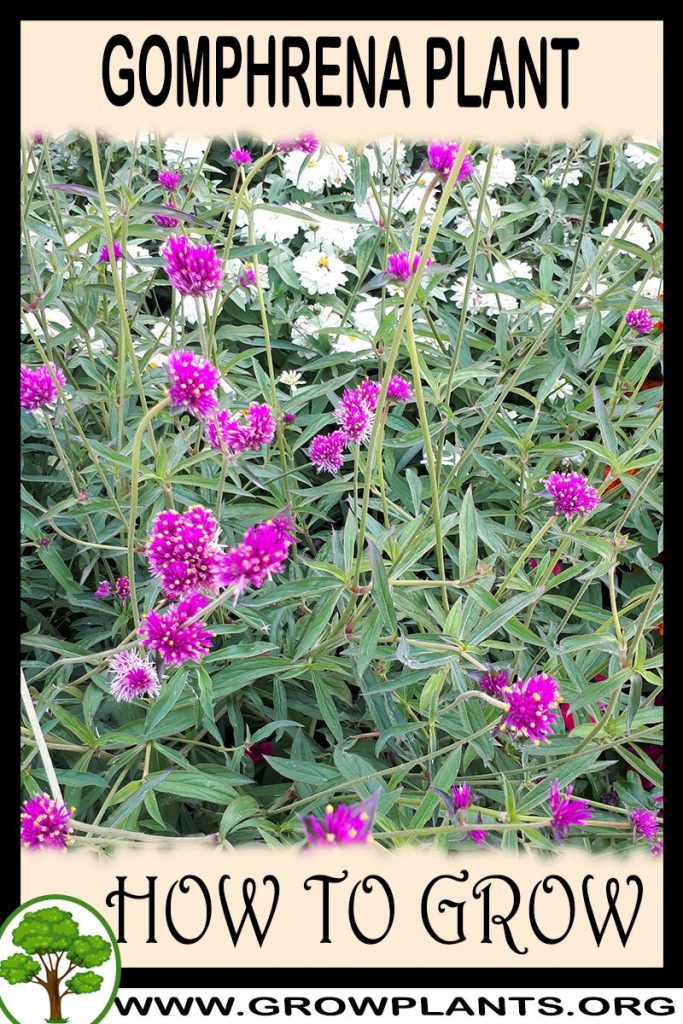
Plant Profile & Key Characteristics
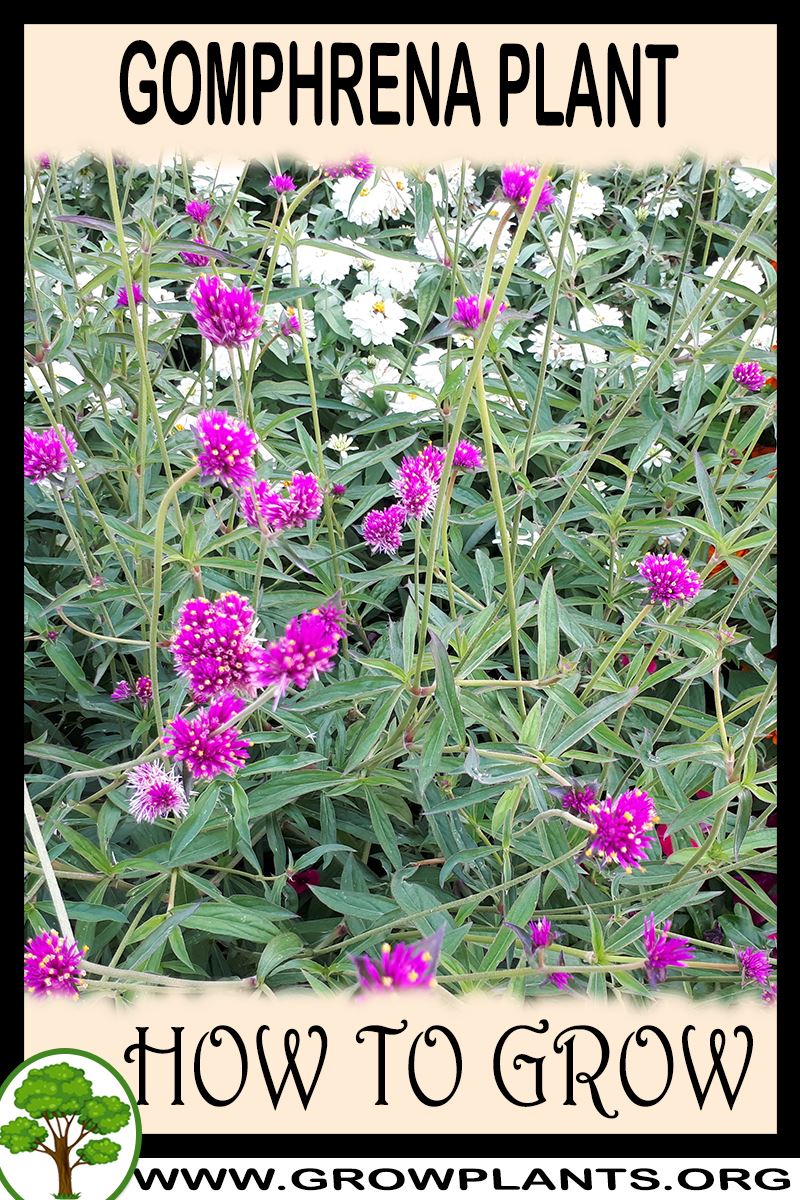
Overview: A bushy, upright herbaceous plant reaching about 20–60 cm (8–24 in) tall, a tender perennial most often grown as an annual. It is prized as a heat- and drought-tolerant ornamental and long-lasting cut flower, with edible leaves and flowers.
Quick Specifications
| Specification | Attribute |
|---|---|
| Plant Type / Life Cycle | Perennial, most often grown as an annual |
| Foliage Type | Evergreen where grown as a perennial |
| Mature Size | 20–60 cm (8–24 in) tall |
| Growth Rate | Moderate to fast |
| Toxicity | Non-toxic / edible |
| Hardiness | Grown as a warm-season annual (USDA 2+); perennial in USDA 10+ |
Growth Form & Structure
- Height & Spread: Reaches 20–60 cm (8–24 in) tall in the ground; stays compact and free-flowering in pots, planters and window boxes.
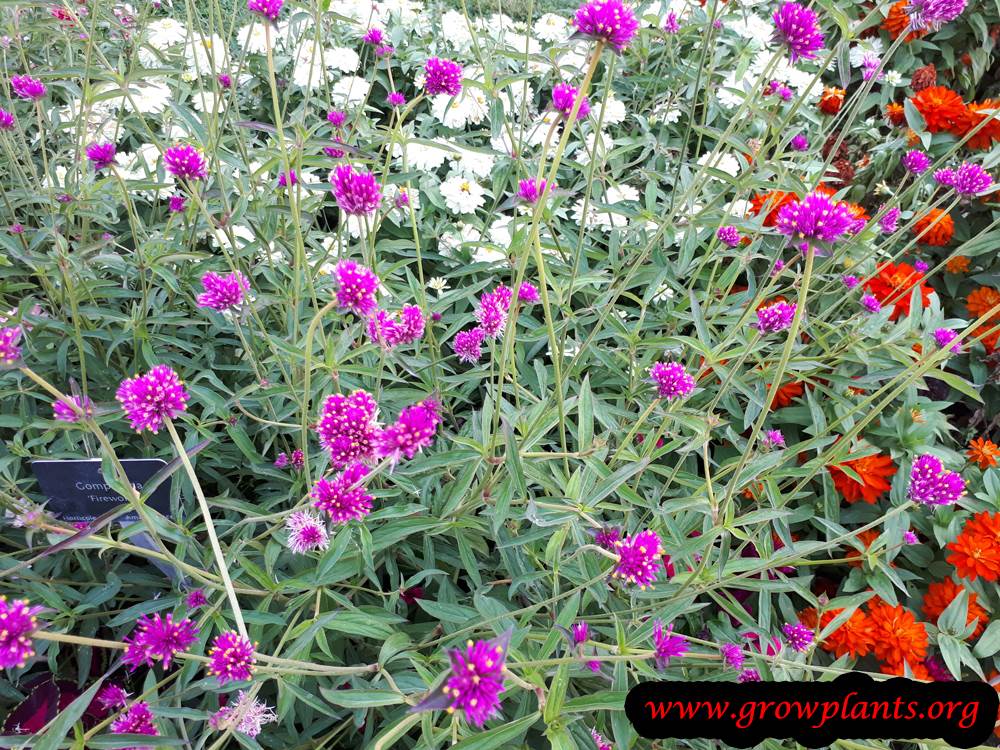
- Growth Habit & Form: Bushy, well-branched herbaceous plant with erect stems bearing rounded flower heads held above the foliage.
- Lifespan & Maturity: Fast to reach flowering size in a single warm season; blooms continuously through summer into autumn.
Anatomy & Physical Features
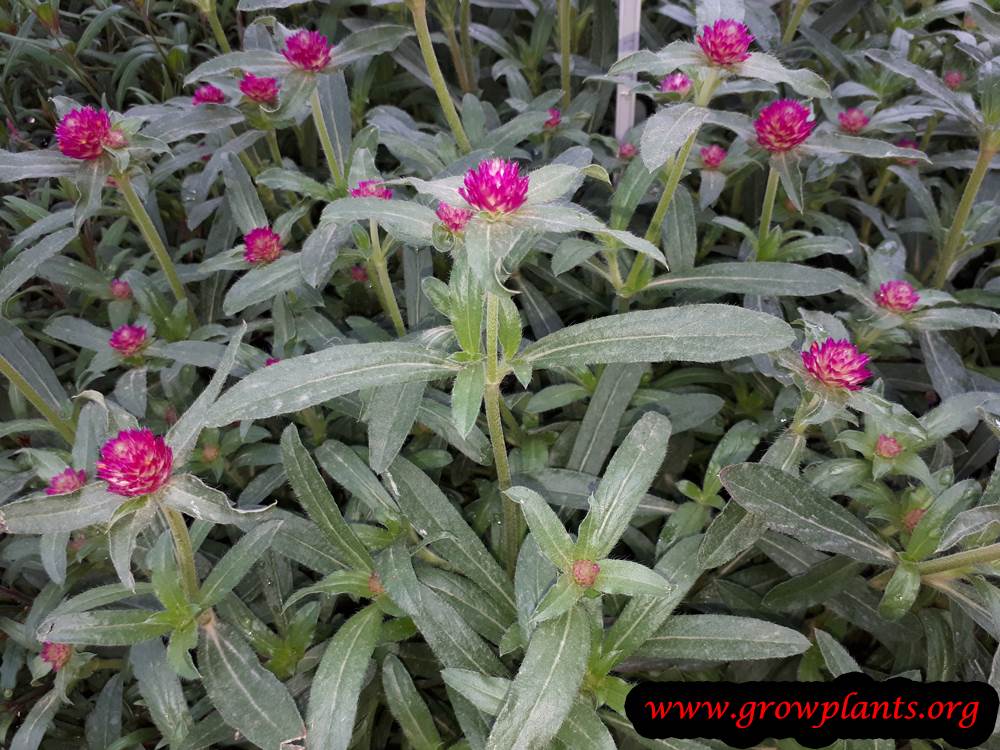
- Leaves & Foliage: Green linear to elliptic leaves, softly hairy, borne in opposite pairs along the stems.
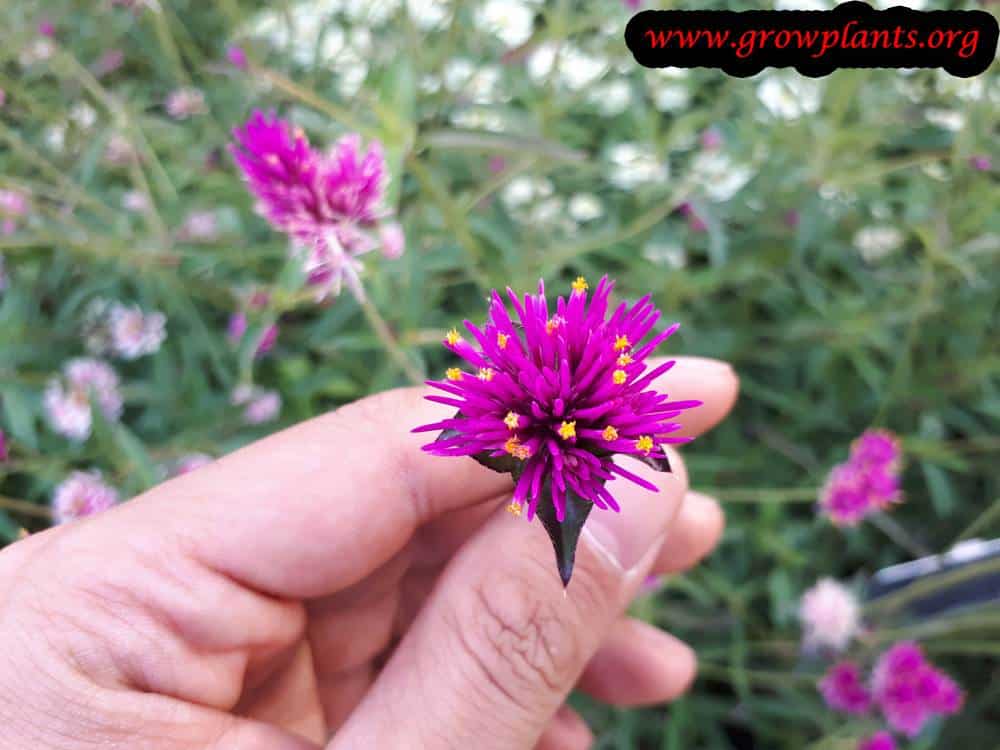
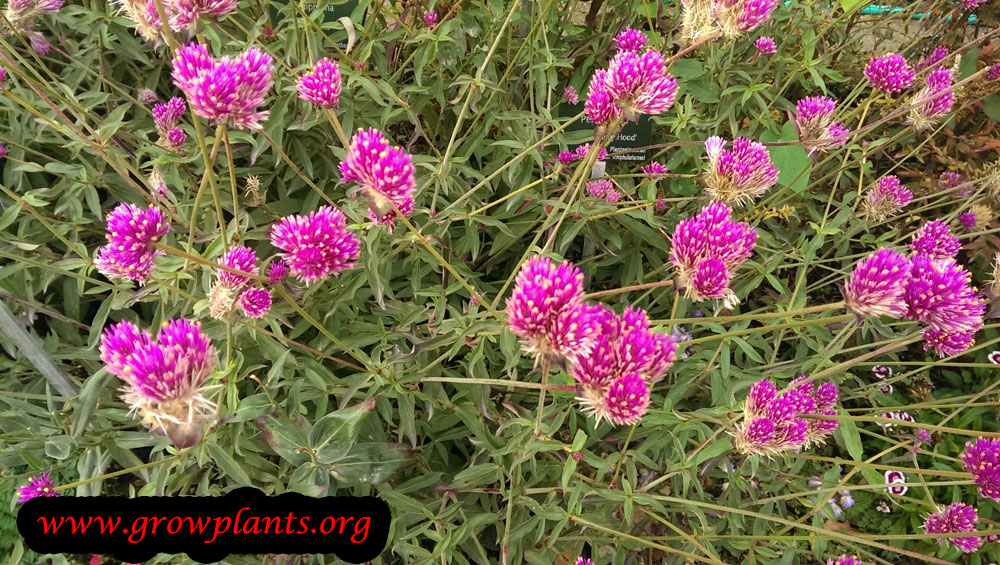
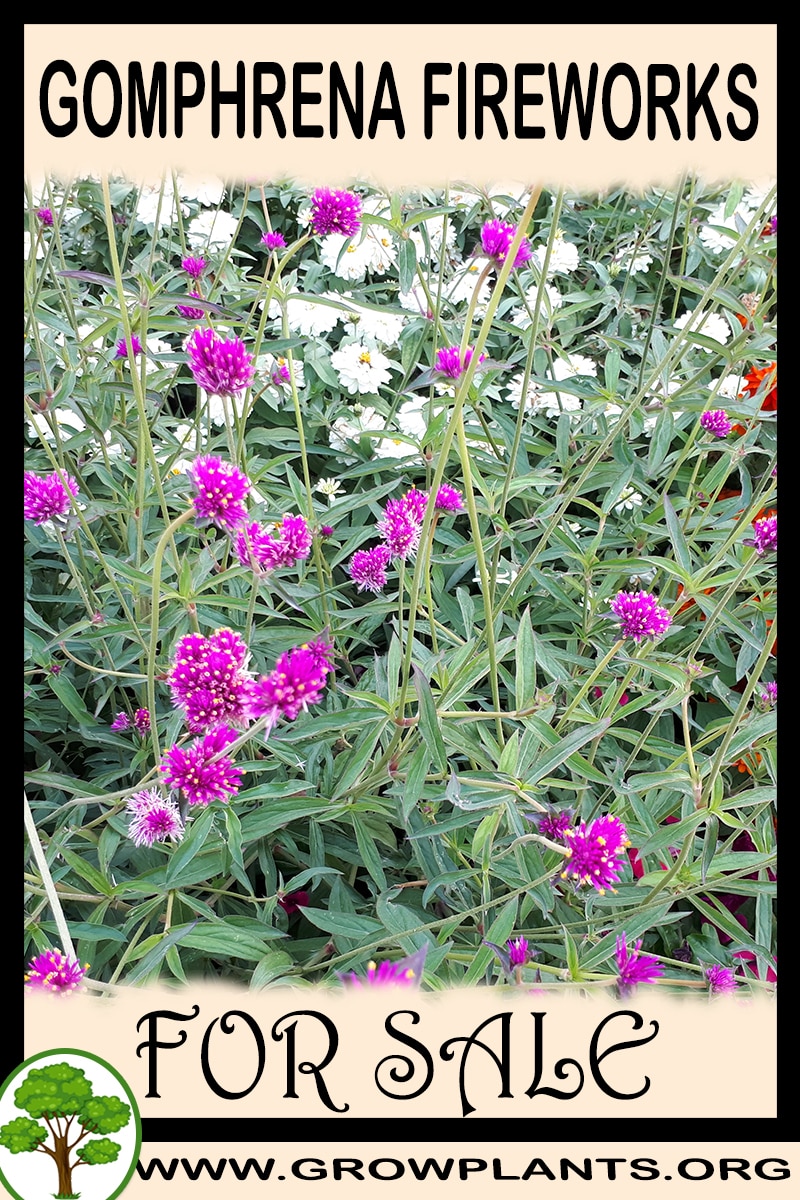
- Flower Characteristics: Rounded, clover-like flower heads of stiff, papery bracts that hold their colour when dried; colour varies by variety.
Primary Uses & Landscape Value
- Edible Uses: Young leaves are eaten cooked, and the flowers are used to make a herbal tea / beverage.
- Functional & Ornamental Roles: Ornamental bedding and container plant, pollinator-friendly border, and a popular fresh or dried (everlasting) cut flower.
Care Guide: Planting, Soil & Watering
Overview: Gomphrena (globe amaranth) is a heat-loving, drought-tolerant plant that thrives in full sun and sharply drained soil. It is undemanding about soil richness but will not tolerate wet feet, so moderate, even moisture with good drainage suits it best.
Quick Care Requirements
| Requirement | Ideal Condition |
|---|---|
| Planting Season | In spring, after the last frost, once the soil has warmed |
| Growth Rate | Moderate to Fast |
| Soil Type | Light and well-draining; tolerates poor to average fertility |
| Water Need | Moderate; let the top few centimetres dry between waterings (drought tolerant) |
Planting & Establishment
- Best Planting Season: Plant in spring after the last frost; in frost-free zones it can also be set out through summer, where it behaves as a short-lived perennial.
- How to Plant:
- Hole Preparation: Dig a hole just wider than the root ball and no deeper, so the plant sits at the level it grew in its pot; space plants to keep airflow around the mounded foliage.
- Soil Amendments: Work a little compost into lean soil for structure, but avoid over-rich beds — too much nitrogen gives lush leaves at the expense of the pompon flowers, so the priority is free drainage.
- Planting Depth: Set the root ball so the crown sits at soil level; do not bury the stem, which invites rot at the base.
- Growth Speed & Expectations: Moderate to fast in warm weather, quickly forming a bushy, free-flowering mound over a single season.
Soil, Watering & Drainage Care
- Soil Mix & Drainage Needs: Any light, freely draining soil, or a standard well-drained potting mix in containers; the key is that water never pools around the roots, as soggy soil causes root and stem rot.
- Watering Schedule & Technique:
- Young / Newly Planted: Keep the soil evenly moist while seedlings and transplants establish, watering when the surface begins to dry.
- Established: Water deeply but infrequently once established, letting the top few centimetres dry out first — the plant is genuinely drought tolerant and resents constant wetness.
- Seasonal Adjustments: Water more often during hot, dry spells; ease off after rain and as growth slows in autumn.
Climate, Light & Hardiness
Gomphrena grows in tropical, Mediterranean, subtropical, and temperate climates as a heat-loving, drought-tolerant plant, and can be grown from USDA zone 2 upward as a warm-season annual. In frost-free or near frost-free climates it can behave as a short-lived perennial, but it is killed by frost and will not persist outdoors through freezing winters.
Quick Climate Specifications
| Climate Zones | Tropical, Mediterranean, subtropical, temperate |
|---|---|
| USDA Hardiness Zones | 2+ (grown as a warm-season annual; killed by frost) |
| Frost Tolerance | None |
| Light Conditions | Full Sun |
Sunlight & Light Exposure
Optimal Light Setup
Grow in full sun for the strongest flowering and most compact habit; too much shade leads to leggy growth and fewer blooms.
Temperature Extremes & Hardiness
USDA Hardiness & Regional Limits
Behaves as a perennial in mild, frost-free climates (roughly USDA zone 9 and warmer); where winters bring hard freezes it will not survive outdoors and is best treated as an annual or grown in containers that can be moved under cover.
Frost Sensitivity
Frost kills the plant outright; in climates with freezing winters it is grown strictly as a warm-season annual, planted after the last frost and removed (or left to die back) at the first frost of autumn.
Extreme Heat Tolerance
Highly heat- and drought-tolerant once established, making it well suited to hot summer climates.
Wind, Humidity & Microclimate
Rainfall & Seasonal Moisture
Prefers a relatively dry climate or well-drained conditions in wetter regions; it does not need consistent moisture to perform well.
Growing in Pots, Balconies & Indoors
Gomphrena (globe amaranth) is a compact, heat-loving flowering plant (20-60 cm / 8-24 in) that excels as a balcony, patio and container plant rather than a true houseplant. It needs strong, direct light to flower well, so indoors only a very sunny windowsill will do.
Quick Details
- Container Size: A 5-10 L (1-2 gal) pot suits one plant or a small group (general guidance)
- Indoor Suitability: Not a deep-room houseplant; a compact plant can grow on a very bright, sunny sill
- Best Spot: Full sun – a warm, sheltered balcony or patio is ideal
- Soil & Drainage: Light, free-draining mix; add perlite or coarse sand
- Watering in Pots: An average amount – let the top of the mix dry between waterings; pots dry faster than open ground
Indoors & On the Windowsill
- Houseplant limits: The grower does not rate it as a room houseplant – away from a window the light is too weak for good flowering.
- Windowsill growing: On the sunniest sill you have, a compact plant can grow and bloom; the more direct sun, the better.
- As a tender plant: It is grown as an annual (or tender perennial in frost-free areas), so in cold climates a potted plant can be kept going on a bright sill past the first frosts.
On a Balcony or Patio
- Light & wind: Give it the sunniest, warmest spot; it shrugs off heat well. On an exposed balcony shelter it from strong wind, and check moisture often as reflected heat from walls and paving dries pots quickly.
Choosing the Pot, Soil & Long-Term Care
- Pot & drainage: Any pot with strong drainage holes; skip a standing saucer to avoid root rot. Terracotta breathes and dries fast, which suits this drought-tolerant plant.
- Potting mix: Use a well-aerated, organic-rich mix – potting compost with perlite or vermiculite (or peat/coir blended with grit) so water drains freely.
- Feeding: Potted plants are fed more often than those in the ground because nutrients wash out with each watering – a balanced liquid feed through the growing season keeps them going.
Fertilizing & Feeding
A light feeder across the genus: an occasional light balanced feeding through the active growing season is plenty, whether the plant is grown as a tender perennial in frost-free areas or, as is most common, treated as a warm-season annual.
Quick Fertilizing Specs
| Feeding Level | Light feeder |
|---|---|
| Main Nutrient Priority | Balanced feeding with adequate nitrogen to support foliage and the colorful pompon blooms |
| Best Feeding Period | From establishment through the summer-into-autumn bloom season |
| Organic Options | Compost or well-rotted organic matter worked into well-drained soil |
| Reduce/Stop Feeding | Taper off feeding as flowering fades, whether the plant is heading into winter dormancy as a perennial or completing its lifecycle as an annual |
| Micronutrients | Micronutrient needs are usually met by a complete fertilizer and organic matter; correct only a diagnosed issue |
| Soil pH | Adaptable, doing best in well-drained soil rather than any particular pH |
Feeding by Growth Stage
Establishment after planting
Help young Gomphrena plants root out into well-drained soil, whichever species or form is being grown.
| Nutrient direction | A light, balanced feeding eases the transition, leaning on organic matter rather than heavy fertilizer. |
|---|---|
| Timing | At planting out, or soon after seedlings are transplanted from late winter into spring. |
| Frequency | A light feeding at planting is usually enough to get the plant established. |
| Fertilizer types | A balanced, complete fertilizer used lightly, Compost or organic matter mixed into the planting hole |
| Precautions | Avoid rich soil or heavy feeding at planting; Gomphrena establishes best in lean, well-drained conditions, and overfeeding invites weak, floppy stems. |
Summer into autumn bloom
Sustain the long run of colorful pompon blooms through summer and into autumn.
| Nutrient direction | Occasional light balanced feeding keeps flowering steady without pushing soft, leafy growth at the expense of blooms. |
|---|---|
| Timing | Through the summer bloom season into autumn. |
| Frequency | An occasional light feeding through the active bloom period is enough; this is not a hungry plant. |
| Fertilizer types | A balanced, complete fertilizer applied sparingly, A light top-dressing of compost if the soil is lean |
| Precautions | Skip extra phosphorus for more blooms – Gomphrena flowers reliably on balanced feeding, and excess nitrogen produces floppy stems and fewer flowers. |
Winter dormancy or end-of-season decline
Let the plant rest through cool weather as a perennial, or complete its natural cycle at season’s end as an annual, without pushing new growth.
| Nutrient direction | No supplemental feeding is needed once active growth stops for the season. |
|---|---|
| Timing | Through winter dormancy where the plant persists as a perennial, or as cooler weather ends an annual planting’s cycle. |
| Frequency | No feeding at this stage. |
| Fertilizer types | No feeding at this stage; hold off fertilizing until active growth resumes, or for the remainder of the season if grown as an annual. |
| Precautions | Withhold fertilizer now; feeding a plant that is not in active growth wastes nutrients and risks salt buildup. |
Nutrient Deficiency Signs & Corrections
Older, lower leaves turn pale green to yellow and overall growth and flowering slow.
| Possible causes | low available soil nitrogen, nitrogen leaching after heavy rain or watering, thin, low-organic-matter soil |
|---|---|
| Appears first on | older, lower leaves |
| What to check | recent feeding history, soil organic matter level, watering and drainage |
| Possible correction | Apply a balanced complete fertilizer and work organic matter into the soil, then water evenly. |
New leaves turn yellow between the veins while the veins themselves stay green.
| Possible causes | naturally alkaline or high-pH well-drained soil that ties up iron, waterlogged or compacted roots limiting uptake, excess phosphorus interfering with iron availability |
|---|---|
| Appears first on | newest leaves |
| What to check | soil drainage and pH tendency, recent phosphorus-heavy feeding, root health |
| Possible correction | Improve drainage and work toward a more neutral pH, or apply a chelated iron product per its label. |
Lush, dark green foliage with few pompon blooms and soft, sprawling stems.
| Possible causes | excess nitrogen from over-fertilizing, insufficient sun exposure reducing flower initiation, overly rich or moisture-retentive soil |
|---|---|
| Appears first on | new growth and flower buds |
| What to check | recent feeding amounts and frequency, hours of direct sun the bed receives, soil richness and drainage |
| Possible correction | Ease off feeding and rely on lean, well-drained soil; balanced feeding used sparingly restores blooming better than extra fertilizer. |
Pruning, Training & Seasonal Maintenance
Gomphrena (globe amaranth) is a soft-stemmed, evergreen tender perennial in frost-free and subtropical climates, but is treated as an annual bedding plant wherever winters are cold enough to kill it back – the appropriate pruning approach depends on which of these two ways it is being grown. In both cases pruning tolerance and need are low: an early pinch encourages branching, and deadheading keeps the pompon flowers coming through summer and autumn on new growth rather than old wood. Where the plant persists as a perennial, an additional light early-spring cutback keeps the clump renewed; where it is grown as an annual, no such cutback is needed because the plant is replaced each year.
Quick Pruning & Maintenance Specs
| Pruning Tolerance | Low – minimal pruning required in either annual or perennial culture |
| Primary Pruning Window | 2–3 weeks after planting/new growth (tip-pinch); additionally early spring for perennial specimens (renewal cutback) |
| Secondary Maintenance Window | Summer through autumn while in bloom (deadheading) |
| Typical Frequency | Annual culture: one pinch plus ongoing deadheading. Perennial culture: add one spring cutback per year |
| Main Objective | Compact branching habit and sustained flowering; clump renewal only where grown as a perennial |
| Young Plant Priority | Pinch the growing tip once established, to force lateral shoots |
| Mature Plant Priority | Deadhead through the season; perennial specimens also get a light spring cutback |
| Best Tool Type | Fingers or precision snips; light bypass secateurs for a perennial specimen’s spring cutback |
| Avoid Heavy Pruning During | Peak flowering flushes – and not applicable at all where the plant is grown as a true annual |
Pruning by Plant Age & Size
Newly Established
Leave newly planted specimens alone apart from removing damaged foliage, regardless of whether they will be grown as annual or perennial.
Young / Formative
No formal structural training applies to this low mounding genus; a single tip pinch once established is the only formative step, encouraging a fuller branched habit.
Mature / Established
In annual culture, ongoing deadheading is the only task for the rest of the single season. In perennial culture, add a light early-spring cutback each year to keep the clump from becoming sparse or sprawling.
Seasonal Pruning Schedule
Pre-Growth/Early-Spring
Objective (perennial specimens only): renew the clump. Remove straggly or winter-worn growth; leave healthy basal shoots. Expected response: denser regrowth and fuller flowering for the coming season. Not applicable where the plant is grown as an annual and replanted from seed or seedling each year.
Ongoing Sanitary
Objective: sustain bloom and limit self-seeding (the genus is flagged as an invasive spreader in the garden). Deadhead spent flower heads back to the next leaf node through summer and autumn in either annual or perennial culture. Expected response: continuous new flowers; unchecked seed set increases volunteer seedlings the following season.
Special Growth to Remove
Spent flower heads, removed promptly for continued bloom and to curb self-seeding. Straggly winter growth on perennial specimens only. No suckers, watersprouts or grafted growth apply – the genus is not typically grafted and is entirely herbaceous.
Container & Small-Space Pruning
Well suited to containers in either lifecycle. Pinch a little earlier and more thoroughly than in-ground plantings to keep growth proportionate to the pot; on a perennial specimen carried over in a container, the spring cutback should be slightly harder to offset the restricted root run.
Tools
Fingertip pinching and precision snips cover pinching and deadheading in both forms of culture; light bypass secateurs suit the thicker basal stems of an established perennial’s spring cutback. No saw, loppers or hedge shears are appropriate.
Tool Hygiene & Disease Risk
Routine – no significant pruning-transmissible disease is documented for the genus; ordinary clean, dry tools are sufficient.
Cut Placement & Technique
Pinch just above a leaf pair. Deadhead by cutting the flower stem above the next leaf node. On a perennial’s spring cutback, cut to a point with visible healthy basal growth, not into bare crown tissue.
Heavy Pruning & Rejuvenation
Where grown as a perennial: a light annual cutback of roughly a third of the top growth in early spring is enough to rejuvenate the clump. Where grown as an annual: not applicable – the plant is replaced each season rather than rejuvenated.
Post-Pruning Care
A light watering after pinching or a spring cutback is enough; avoid extra feeding purely for maintenance pruning, since this is already a vigorous grower.
Common Pruning Mistakes
Applying a hard perennial-style cutback to plants that are actually being grown as annuals, which achieves nothing since the whole plant will be replaced; skipping deadheads and losing both bloom continuity and seed control; shearing into a formal shape, which suits neither the annual nor the perennial growth habit.
When Not to Prune
Avoid a spring renewal cutback once a perennial specimen is already in active bud; avoid a hard pinch-back late in the season on annual plantings, when too little growing time remains for new stems to flower.
Recommended Tools (by task)
| Task | Plant Stage | Tool Category | Why |
| Tip-pinching young growth | Young, newly established | precision_snips | Clean cut on soft stems without bruising the growing point |
| Spring renewal cutback (perennial culture only) | Mature perennial clump | bypass_secateurs | Handles thicker basal stems of a persisting clump cleanly |
| Deadheading through the season | Flowering, all season | precision_snips | Precise cut above the leaf node without disturbing nearby buds |
Propagation Guide
Across the genus Gomphrena, seed is the most practical and widely-used propagation method, suiting both the many annual bedding forms and the perennial evergreen species/cultivars. Seed generally comes true to type for wild species but can be variable for named color selections, and vegetative propagation via cuttings is a useful (though not essential) option for maintaining a specific perennial plant or color form. Difficulty is generally easy.
Quick Propagation Specs
| Best Propagation Method | Seed |
| Alternative Methods | Softwood stem cuttings (for perennial evergreen species/cultivars) |
| Propagation Difficulty | Easy |
| Seed True-to-Type | Usually true-to-type for wild species; Variable for named cultivars/color series |
| Vegetative True-to-Type | Yes (cuttings reproduce the exact parent plant/color) |
| Best Propagation Season | End of winter to spring, and also through summer for perennial forms |
| Seed Germination Time | Roughly 1–3 weeks, sometimes slower and uneven |
| Cutting Rooting Time | Typically a few weeks under warm, humid conditions |
| Germination Temperature | 20–25°C (68–77°F) |
| Seed Sowing Depth | Shallow – press into the surface and cover only very lightly |
Growing from Seed
Seed Handling & Viability
Gomphrena seed is a small fruit enclosed in a papery calyx, typical of the amaranth family; fresh, well-dried seed gives the most reliable results across the genus.
Sowing Season
Sow from late winter through spring; perennial species/forms can also be sown into summer.
Sowing Depth & Orientation
Sow shallowly and cover only lightly – this fine seed emerges poorly from depth.
Germination Conditions
Keep warm (about 20–25°C / 68–77°F) and evenly moist until germination.
Germination Time
Typically one to three weeks, sometimes slower and uneven.
Seedling Care
Thin or prick out seedlings once true leaves appear, and harden off before planting out. Many gomphrena self-sow readily once established, which is consistent with the site’s note that the genus can be invasive.
Stem Cuttings
Cutting Type
Softwood tip cuttings from actively growing, non-flowering shoots – most relevant to perennial evergreen species and named perennial cultivars.
Best Timing
During active growth in spring or summer.
Cutting Preparation
Take a short tip cutting, strip the lower leaves, and cut just below a node.
Rooting Setup
Insert into a free-draining, moisture-retentive mix, keeping it humid and warm until roots form.
Rooting Hormone
Optional – can help speed and even out rooting but is not required.
Rooting Time
Usually a few weeks, though timing varies with warmth, humidity and species.
Bloom & Edible Flower Guide
Quick Details
- Bloom Season: Summer through autumn
- Time to First Bloom: In its first season, roughly 10-12 weeks from sowing; usually grown as an annual
- Flower Appearance: Small flowers in rounded, clover-like pompons across purple, magenta, red, yellow, orange, pink or white, the colour coming mostly from papery bracts
- Edibility: The flower heads are edible and are traditionally steeped as a mild tea
Detailed Blooming Overview
Gomphrena (globe amaranth) is grown for its long-lasting pompon heads. Each rounded head is made up of many tiny true flowers wrapped in papery bracts, which is why the colour holds so well even after cutting and drying. It blooms freely from summer into autumn, tolerates drought, and is a magnet for pollinators.
Flower Characteristics
- Rounded pompon heads in a wide colour range on wiry upright stems
- The papery bracts keep their colour, making it a classic everlasting or dried flower
- Long lasting as a cut flower and attractive to bees and butterflies
Bloom Care & Thinning
- Managing the bloom: deadhead spent heads to encourage a steady succession of new flushes; for drying, cut the stems when the heads are firm and fully coloured
- Site & watering: full sun and free-draining soil give the best flowering, and once established it blooms well even in dry conditions
- Pollination: the nectar-rich heads are a reliable draw for bees and butterflies
- Using the flowers: the dried heads can be steeped as a mild herbal tea
Bloom Health & Protection
- Powdery mildew: in humid, crowded plantings a white bloom can appear on foliage and buds; better spacing and airflow help, and a sulfur-based fungicide is an option if it takes hold
- Grey mould (botrytis): in damp weather flower heads may spot and rot, so avoiding overhead watering and removing affected heads keeps it in check
Fruit & Uses
Gomphrena (globe amaranth) is grown mainly as an ornamental and cut flower in a wide range of colours, but the pompon-shaped flowerheads and young leaves are also edible. Flowers are used fresh as a garnish or dried for herbal tea, while the leaves are cooked rather than eaten raw.
Quick Edible Specs
| Edible Parts | Flowers; young leaves |
|---|---|
| Main Use(s) | Culinary (herbal tea, garnish); traditional (non-medical) folk note for coughs |
| Eaten Raw or Cooked | Flowers: raw as garnish or infused as tea; Leaves: cooked |
| Preparation Required | Flowers: none for garnish, steep for tea; Leaves: cook |
| Harvest Season | Leaves: Spring/Summer; Flowers: Summer/Autumn (bloom period) |
| Time to First Harvest | Leaves once the plant is established; flowers picked continuously through the bloom season |
| Storage | Flowerheads are classic “everlasting flowers” and dry well while keeping their colour, making them easy to store for later tea use |
| Safety/Toxicity Caveat | Cook the leaves rather than eating large amounts raw, as with other edible Amaranthaceae greens |
Flowers & Flower Buds
Small flowers, in whichever colour the plant produces, form dense, papery pompon flowerheads from summer into autumn. Pick at peak colour for fresh garnish use, or dry whole heads to steep later as tea; the fibrous texture makes the flowerhead better suited to steeping or garnish than to eating outright.
Leaves & Greens
Leaves are green, linear to elliptic. Once the plant is established, young leaves at the base of the stems are harvested and cooked as a green; older foliage toughens once the plant is in full bloom.
Preparation, Uses & Safety
Flowers: use fresh as a garnish or dry and steep a flowerhead or two (roughly a teaspoon of dried petals) in hot water for several minutes, then strain. Leaves: cook before eating. Traditional folk use also notes the flowers for coughs, offered here only as a traditional note, not a health claim.
Pests, Diseases & Troubleshooting
Overview: Globe amaranth (Gomphrena) is one of the toughest, most heat- and drought-tolerant summer annuals, and it is largely free of serious enemies. This entry is at genus level, so the shared globe-amaranth profile applies across species and cultivars. Nearly all of its troubles trace back to two situations — sap-sucking insects that build up in hot, dry, dusty air, and fungal problems that appear when plants are crowded, watered overhead, or grown in soil that stays wet. Lead with cultural control: full sun, generous spacing for airflow, lean well-drained soil, and watering at the base.
Quick Troubleshooting Overview
| Issue / Pest | Main Symptom | Primary Solution |
|---|---|---|
| Aphids | Clusters on soft new growth and buds; sticky honeydew and sooty mould | Blast off with water, protect ladybirds and lacewings, insecticidal soap if needed |
| Spider mites | Fine pale stippling and faint webbing in hot, dry spells | Hose foliage, raise humidity, release predatory mites, horticultural oil |
| Leaf miners | Pale winding tunnels or blotches inside the leaf | Pick off mined leaves, use floating row cover, yellow sticky traps |
| Powdery mildew | White powdery film on leaves in crowded, humid conditions | Space plants, improve airflow, potassium bicarbonate or sulphur spray |
| Damping-off | Seedlings topple and rot at the soil line | Sterile mix, sow thinly, avoid overwatering and cold wet soil |
| Leaf spot | Small tan-to-brown spots, sometimes with darker margins | Remove debris, keep foliage dry, copper only if it spreads |
Common Pests & Management
- Aphids (Aphis and Myzus spp.):
- Symptoms: Soft-bodied green, black or grey insects massed on tender shoot tips, buds and the undersides of young leaves. They excrete honeydew that turns leaves shiny and sticky, followed by black sooty mould; heavy feeding puckers and distorts new growth.
- Prevention & Control: Dislodge colonies with a firm jet of water and repeat every few days. Avoid pushing lush growth with excess nitrogen. Encourage ladybirds, lacewings and hoverflies. If populations persist, treat with insecticidal soap or a light horticultural oil, coating the undersides of leaves.
- Two-spotted spider mite (Tetranychus urticae):
- Symptoms: The classic pest of Gomphrena in hot, dry conditions. Leaves lose colour to a fine sandy stippling, dull and bronze, and fine webbing appears at leaf axils and tips; mites are just visible as moving specks on the undersides.
- Prevention & Control: Mites thrive on dusty, drought-stressed plants, so keep plants adequately watered and hose the foliage to knock down numbers and raise humidity. Release predatory mites (Phytoseiulus, Amblyseius) in gardens and greenhouses. Use insecticidal soap or horticultural oil for hot spots; avoid broad-spectrum insecticides that kill mite predators.
- Leaf miners (Liriomyza spp.):
- Symptoms: Thin, pale, winding trails or blotches etched between the leaf surfaces where larvae feed. Damage is mostly cosmetic but heavy mining reduces vigour on young plants.
- Prevention & Control: Pick off and destroy mined leaves as they appear to break the cycle. Protect seedlings with floating row cover, and hang yellow sticky traps to monitor and reduce egg-laying adults. Parasitic wasps usually keep them in check outdoors, so avoid needless spraying.
- Whiteflies (Trialeurodes vaporariorum, Bemisia spp.):
- Symptoms: Tiny white moth-like insects that fly up in clouds when foliage is disturbed; larvae feed on leaf undersides, causing yellowing, honeydew and sooty mould. Mainly a problem under cover or in still, warm sites.
- Prevention & Control: Monitor with yellow sticky traps and inspect leaf undersides. Improve airflow, and introduce Encarsia formosa in greenhouses. Insecticidal soap or horticultural oil applied to the undersides gives good control when needed.
- Caterpillars (loopers, cutworms and armyworms):
- Symptoms: Irregular chewed holes in leaves and, with cutworms, young seedlings severed at the base overnight. Look for green or brown caterpillars and dark frass pellets.
- Prevention & Control: Hand-pick at dusk when they feed, and place cardboard collars around transplants to foil cutworms. Encourage birds and predatory insects. For persistent outbreaks, a targeted Bacillus thuringiensis (Bt) spray controls young caterpillars without harming beneficials.
Diseases & Fungal Issues
- Powdery mildew (Erysiphe / Podosphaera spp.):
- Symptoms: A dusty white coating on upper leaf surfaces, worst on crowded plants and in humid air with poor circulation; badly affected leaves yellow and drop.
- Treatment & Management: Space plants generously and site them in full sun with good airflow. Remove affected leaves at the first sign. Water at the base and keep foliage dry. Sprays of potassium bicarbonate, sulphur or a light horticultural oil are effective when applied early and repeated.
- Leaf spot (Cercospora and other fungi):
- Symptoms: Small circular tan-to-brown spots, sometimes with darker margins or a yellow halo, that may merge in wet weather and cause leaves to yellow and shed.
- Treatment & Management: Remove and destroy spotted leaves and old debris where spores overwinter. Avoid overhead watering and wetting the foliage late in the day. A copper-based fungicide can be used if spotting spreads on valued plants.
- Damping-off (Pythium, Rhizoctonia, Fusarium):
- Symptoms: Seeds fail to emerge, or young seedlings collapse with a pinched, water-soaked stem at the soil line. The single most common cause of failure when raising Gomphrena from seed.
- Treatment & Management: Sow into a fresh sterile seed mix in clean trays, sow thinly, and provide bright light and gentle airflow. Keep the mix moist but never waterlogged, and avoid cold, wet compost. Do not sow too deep. There is no cure once seedlings collapse — prevention is everything.
- Grey mould (Botrytis cinerea):
- Symptoms: Fuzzy grey-brown mould on fading flowers, and on stems and leaves in cool, damp, still conditions; tissue turns soft and brown.
- Treatment & Management: Remove spent flowers and any mouldy tissue promptly, improve ventilation, and avoid overhead watering. It is chiefly a wet-weather and greenhouse problem; sanitation and airflow usually solve it without chemicals.
Growing Difficulties & Abiotic Problems
- Root rot from overwatering / poor drainage:
- Cause & Symptoms: Gomphrena resents wet feet. In heavy or poorly drained soil the plant wilts despite moist soil, lower leaves yellow, and the roots turn brown and mushy.
- Correction Strategy: Grow in free-draining soil or add grit and compost; in containers use a gritty mix and never let pots stand in water. Let the surface dry between waterings and water less in cool or cloudy spells.
- Leggy, floppy growth in low light:
- Cause & Symptoms: In shade or crowded conditions plants stretch, flower poorly and lean, with widely spaced weak stems.
- Correction Strategy: Grow in full sun. Pinch young plants once to encourage branching, and give each plant room. Avoid over-feeding with nitrogen, which promotes soft, sprawling growth.
- Cold and frost sensitivity:
- Cause & Symptoms: A warm-season plant that is damaged by frost and sulks in cold, wet soil; growth stalls and seedlings rot in a cold start.
- Correction Strategy: Transplant only after the soil has warmed and all danger of frost has passed. Protect from early cold snaps, and lift or resow tender perennial species where winters are cold.
- Nutrient deficiency / chlorosis in poor soil:
- Cause & Symptoms: Pale, uniformly yellowing leaves and weak growth on very lean or waterlogged soils; usually minor in this undemanding plant.
- Correction Strategy: Feed lightly with a balanced fertiliser during active growth; avoid heavy feeding, which reduces flowering and invites pests. Correct drainage first, as waterlogging mimics and worsens nutrient problems.
What Helps — Products & Tools
For globe amaranth the useful kit is simple: insecticidal soap and horticultural / neem oil for aphids, mites and whitefly; yellow sticky traps for leaf miners and whitefly monitoring; potassium bicarbonate or sulphur fungicide for powdery mildew; a copper fungicide in reserve for stubborn leaf spot; Bacillus thuringiensis (Bt) for caterpillars; and a sterile seed-starting mix to prevent damping-off. Always follow the label, and spray oils and soaps in the cool of evening to protect bees.