
Sticky traps are one of the simplest, lowest-cost tools for staying ahead of plant pests — not by killing an infestation, but by telling you one is starting. This guide helps you choose and use monitoring traps: the colours, formats and where to place them. It is a monitoring guide, not a treatment plan — for control, see our plant pests & protection guides.
As an Amazon Associate GrowPlants earns from qualifying purchases. We recommend product types that genuinely suit the task; prices and availability are set by Amazon. GrowPlants does not sell these products.
Monitoring vs treatment
Sticky traps mainly detect and track pests: they catch flying adults so you notice a problem early and can see whether numbers are rising or falling. They also remove some adults, and in small or enclosed spaces heavy trapping can help suppress a population — but they do not reach eggs or the immature stages hidden on leaf undersides, so treat them as an early-warning and support tool alongside proper control, not a stand-alone cure.
Trap colours — and why colour matters
Different pests are drawn to different colours, so colour guides which pests a trap catches best. It is a tendency, not a rule — most traps catch a range of flying insects, just in different proportions.
Yellow sticky traps
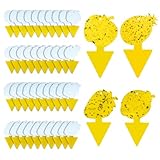
The most versatile colour. Yellow is commonly useful for monitoring whiteflies, fungus gnats, winged aphids, leaf miners and many other flying pests, which makes it the default choice for general greenhouse and houseplant monitoring.


Blue sticky traps
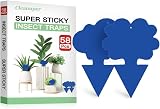
Blue is particularly associated with thrips monitoring, and is often used where thrips are the main concern. Blue traps still catch other insects too — the colour simply shifts the balance toward thrips.


Formats: cards, stakes, hanging traps and rolls
- Cards — flat rectangles, the most common format; hang them or clip them near the canopy.
- Stake-mounted traps — small traps on a spike that push into a pot, ideal for houseplants and fungus gnats at soil level.
- Hanging traps — cards or shapes with hooks/ties for suspending among foliage or from greenhouse wires.
- Rolls / ribbons — long sticky tape you cut to length, economical for greenhouses and larger areas.


Greenhouse and indoor use
Enclosed spaces are where traps shine: pests concentrate, and there are fewer beneficial insects to catch by accident. In greenhouses, space traps through the crop and just above the canopy; indoors, a stake trap in a pot quickly confirms whether those little flies are fungus gnats. In both, traps give you a running count you can act on.
Placement
- Position traps at or just above canopy height, and raise them as plants grow.
- For soil pests like fungus gnats, place stake traps low, near the soil surface.
- Spread several traps around a collection or greenhouse rather than relying on one.
- Keep them where you’ll see them, so checking becomes routine.
Replacement
Replace traps once they are covered in insects or dust, or the surface stops feeling tacky — a full or dried-out trap stops catching. How fast that happens depends on pest numbers and conditions, so check regularly and swap as needed.
Interpreting your catches
The value of a trap is the information. A few insects is normal background; a sudden jump signals a building problem and a cue to inspect closely and act. Comparing this week’s catch with last week’s tells you whether a pest is increasing or whether your control is working. Note which pests you’re catching, too, since that guides the response.
Limitations
- They catch flying adults, not eggs, larvae or the young stages hidden under leaves.
- They rarely clear an infestation on their own.
- They can catch beneficial insects as well, so use them thoughtfully where you’re relying on natural enemies or pollinators.
- Colour preferences are tendencies, not guarantees of which pest you’ll catch.
Sticky traps at a glance
| Trap | Best for | Typical use |
|---|---|---|
| Yellow card | Whitefly, fungus gnats, aphids, leaf miners, general | Greenhouse & houseplant monitoring |
| Blue card | Thrips (plus other flyers) | Where thrips are the main concern |
| Stake trap | Fungus gnats at soil level | Pushed into houseplant pots |
| Hanging trap | Mixed flying pests | Suspended in foliage / on wires |
| Roll / ribbon | Larger areas, economy | Greenhouses, cut to length |
FAQ
Do sticky traps get rid of pests? They mainly monitor and reduce adult numbers; they work best alongside proper control rather than on their own.
Yellow or blue? Yellow for general monitoring (whitefly, fungus gnats, aphids); blue if thrips are your main concern.
Where do I put stake traps for fungus gnats? Low, at the soil surface in the pot, where the adults emerge and fly.
Related guides
As an Amazon Associate GrowPlants earns from qualifying purchases. GrowPlants does not sell these products.