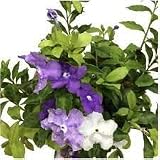
Few garden shrubs earn their common name as literally as this one. Brunfelsia pauciflora opens its fragrant flowers a deep blue-purple, and as each bloom ages the colour drains out of it until it is white. Because the bush does not open all its flowers at once, you are looking at three generations of flower on the same plant at the same time — the newest still purple, the middle ones paling, the oldest white. That is yesterday, today and tomorrow.
The Flowers
The blooms are the whole reason to grow it. Each flower has five petals joined at the base, giving a slightly wrinkled, flared face, and they are fragrant — a mature plant in full bloom will scent a courtyard or a patio on a warm evening.
Flowering runs through spring and summer, with the main display in summer. Because the colour shift happens as each individual flower ages, the effect is at its best when the plant is flowering heavily: a bush covered in purple, lavender and white simultaneously. If your plant produces only a thin scatter of flowers, the effect is largely lost — which is why light and feeding matter more here than on a shrub grown for foliage.
What It Needs to Grow Well
The requirements are short and there is no trick to them:
- Light: full sun to half shade.
- Soil: well-draining and rich.
- Water: an average amount — steady moisture, never waterlogged.
- Temperature: frost free. This is the hard limit.
It grows in tropical, subtropical and Mediterranean climates, and is hardy in zone 8 and above. It is a perennial that may be evergreen or deciduous depending on how mild your winter is — in a warm garden it holds its green to light-green elliptic leaves (4–12 cm) year round, while a cooler winter will push it to drop some or all of them. Leaf drop in winter in a marginal climate is normal behaviour, not a sign that the plant is failing.
It is not a houseplant — do not expect it to perform indoors. It does, however, grow well in a planter, flowerpot or container, which is the sensible route if you are at the cold edge of its range and want to move it under cover for the worst of the winter.
Shrub or Small Tree? Decide Early
At 1–3 m (40–120 in, roughly 3–9 ft) and a medium growth rate, Brunfelsia can be either a multi-stemmed shrub or a small standard tree. Which one you get is entirely a pruning decision, and it is one you should make while the plant is young.
- For a small tree: select and keep one main branch as a leader from the start, removing competing stems at the base as they appear. Once the trunk is established, let the head branch out at the height you want.
- For a shrub: leave multiple stems and let it fill out from the base.
The reason to decide early is simple: converting a mature multi-stemmed bush into a single-trunk tree means removing large, established limbs, which leaves big wounds and a lopsided plant for a season or two. Choosing the form at the start costs you nothing.
Ongoing Pruning
After the form is set, pruning is just for design — shaping, size control, and removing dead flowers and dead branches. The main pruning season is autumn to winter, after the flowering season has finished. Pruning then, rather than in spring, protects the coming display: you are cutting back before the plant builds the growth that will carry next season’s flowers, instead of cutting that growth off.
Deadheading spent flowers as you go keeps the bush looking clean during the long bloom period and stops it putting resources into seed you probably do not need.
Propagation: Seeds or Cuttings
Both methods work and both are genuinely easy. No grafting is needed. Spring is the right time for either.
From seed
- Sow in spring, placing the seed about 1 cm deep.
- Cover with soil, but not too tightly — compacted soil over the seed makes emergence harder than it needs to be.
- Keep the soil moist with an average amount of water.
- Give the seedlings full sun to half shade, in rich, well-drained soil.
From cuttings
Cuttings can be rooted in water or in soil, and the key difference from seed-raising is shade. An unrooted cutting has no root system to replace the water its leaves lose, so full sun will dry it out before it can root. Keep cuttings in shade with light — bright but not direct.
- In water: stand the cutting in water and change the water every few days. Stagnant water loses oxygen and the cut end rots instead of callusing.
- In soil: use moist soil, keep it in shade, and use a rooting hormone if you have one to speed things up and improve the strike rate.
Cuttings have one practical advantage worth knowing: they reproduce the parent exactly, so if you have seen a particular plant flowering well, a cutting from it gives you the same plant rather than a variable seedling.
Planting and Routine Care
Plant out in spring or summer, once frost is past, into rich, well-draining soil in a full sun to half shade position. Day-to-day care is undemanding: average watering, a prune for shape, dead flowers and dead branches removed, and regular checks for pests. There is no special feeding regime or soil treatment to worry about.
The one thing worth being deliberate about is drainage. “Well-draining” appears first in this plant’s requirements for a reason — it wants consistent moisture but will not tolerate sitting in wet soil, and in a container that means real drainage holes and a mix that does not compact into mud over a season.
Pests and Problems
The usual pests are whitefly, spider mite and aphids — all three are sap-feeders, and all three are easiest to deal with early.
- Whitefly sit on the undersides of leaves and lift off in a cloud when you disturb the plant. They weaken growth and leave sticky honeydew that turns sooty black.
- Spider mite is the dry-conditions pest: fine stippling on the leaves, then a bronzed look, and fine webbing at the shoot tips in a bad case. It builds fastest on plants that are hot and dry, so a stressed, under-watered Brunfelsia is the most likely victim.
- Aphids cluster on soft new growth and distort it.
Inspect leaf undersides and new shoots regularly. On a shrub this size a physical knock-back — a firm spray of water — plus an insecticidal soap treatment handles all three, provided you catch them before they colonise the whole plant.
Important: Toxic to Dogs and Cats
This is the one thing you must know before planting. The yesterday, today and tomorrow plant is poisonous to dogs and cats. A pet that has eaten any part of it should be treated immediately — contact a vet straight away rather than waiting to see whether symptoms develop.
That does not mean you cannot grow it, but it does mean placement matters. Keep it away from areas where dogs dig, chew or play, pick up and dispose of prunings and fallen material rather than leaving them on the lawn, and think twice about it as a low container plant on a patio a puppy has the run of.
For the full plant profile see our Yesterday today and tomorrow plant growing page.
See also: rooting hormone for cuttings
See also: using rooting hormone
Not sure which pruning approach applies? See our guide to choosing the right pruning method.