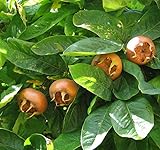
The medlar (Mespilus germanica) is one of those fruits that almost disappeared from gardens and is now creeping back, largely because gardeners have rediscovered that it does something no other hardy fruit does. It is a deciduous tree or shrub of the genus Mespilus, grown both for the edible fruit and as an ornamental – white five-petalled flowers in clusters, oval leaves in shades of light to dark green, and a distinctive brown-yellow fruit, 2-4 cm across, round with an open crown at the end where the calyx flares out. The flavour is usually described as close to quince, and some people taste pears in it.
It suits temperate gardens and cool Mediterranean or subtropical ones, and grows in hardiness zones 6 to 10a – or zone 10b with careful management.
Why a medlar needs a cool winter
A medlar requires a cool winter. This is not about frost hardiness; it is about dormancy. Like most deciduous temperate fruit trees, the medlar counts accumulated cold through winter and only releases its flower buds once that requirement has been met. Give it a mild winter and the tree does not die – it simply breaks bud unevenly and late, flowers poorly, and sets little or no fruit. That is why the same tree that thrives in zone 6 struggles in zone 10b unless the site is deliberately chosen for the coolest possible winter conditions.
If you garden at the warm limit of the range, expect lighter crops than in a properly cold-wintered climate.
Size, form and where to plant
A medlar reaches 3-8 m (10-24 feet), and grows at a medium pace. It can be kept considerably smaller and grown as a shrub instead of a tree, and this is entirely a matter of how you prune it in the first few years rather than a matter of variety.
Give it full sun. The tree needs an average amount of water, and will tolerate a generous amount, but it is not a plant for a dry, baked corner if you want decent fruit.
Planting season
Plant from winter through to spring – the end of winter into early spring is the sweet spot. Summer planting is possible but much less advisable, because a newly planted tree in summer is asked to establish roots at exactly the moment it is losing most water through its leaves.
Bare-root trees are stricter still: they must go in between winter and early spring. Plant a bare-root medlar later than that and it may well die, because it has no root hairs and no soil ball to draw on, and it needs to root out while it is still dormant and demand is low.
Grafted tree, seedling or sucker?
You can start a medlar from a plant, from seed, or from suckers thrown up around an established tree. All three work. The question is what kind of fruit you want.
Grafting or vegetative propagation is not strictly necessary, but it is recommended if fruit quality matters to you: grafted trees give bigger, sweeter fruit with fewer seeds. A seedling medlar is a genetic lottery – it will fruit, but it may produce smaller, seedier, less sweet fruit than the parent, because the seed carries a reshuffled set of genes rather than a copy.
Use seed for rootstocks, hedging or cheap numbers; buy grafted when you want reliable dessert-quality fruit from a single tree.
Growing medlar from seed
Medlar seed will not germinate without a cold period first. The embryo is dormant, and only a sustained spell of winter cold breaks that dormancy – which is why medlar seed sown in spring on a warm windowsill typically does nothing at all.
- Sow in autumn, outdoors, directly into the ground and leave the seeds there over winter. This is the simplest method: the winter does the work for you, and a spell of frost improves germination.
- Or give the seeds an artificial cold period in a cold place before sowing, then sow in spring.
- Keep the soil moist, with an average amount of water, and place seeds in full sun.
- Once the cold requirement has been satisfied, the seeds need warmth to actually germinate – above about 15°C (59°F). That is why germination happens in spring rather than during the cold spell itself.
Whichever route you take, expect to wait. Starting from seed is worth doing, but a seedling still needs the usual 2-3 years before it bears.
Fruiting, harvest and bletting
A medlar begins to bear roughly 2-3 years after planting, and the harvest runs from summer into autumn.
Here is the part that catches people out. Some cultivars cannot be eaten straight off the tree – they need to be bletted, which is a period of softening after picking, or ripened artificially. A hard, freshly picked medlar of these types is astringent and unpleasant. Bletting lets the flesh soften and the astringency break down, turning the fruit sweet, brown-fleshed and spoonable. It is the same principle as leaving an unripe persimmon on a windowsill: the fruit is not spoiling, it is completing a ripening process that the tree does not finish on its own.
Do not confuse a bletted medlar with a rotten one: a bletted fruit softens evenly and smells sweet, while a rotten one goes mouldy in patches.
What to do with the fruit
- Eaten raw, once soft
- Baked
- Jams and jellies
- Juice
- Cakes
Pruning: timing and purpose
The main pruning season is from the end of autumn into the beginning of winter. If the tree is carrying only a light crop, it is better to prune after the fruiting season instead – there is no point removing wood you have not yet harvested from.
What to take out:
- Dead and weak branches – they will never carry decent fruit and they are where disease starts.
- Crossing branches – two branches rubbing together create a wound and an entry point for infection.
- Old stems, and enough of the overall branch count to keep the canopy open.
- Excess buds, if you want larger fruit. Thinning buds concentrates the same amount of the tree’s resources into fewer fruits, which is the entire mechanism behind bigger fruit.
Throughout, the aim is that every fruit gets enough light. A congested medlar produces a lot of small, poorly ripened fruit in the shaded interior.
Deciding tree or shrub
The first few years of pruning determine the plant’s final form, so decide early:
- For a tree: on a young plant, remove all the side branches along the lower trunk, forcing the plant to put its energy upwards and build a single clear stem.
- For a shrub: cut the top of the main trunk. Removing the leading shoot releases the buds below it and induces multiple side branches from low down.
Pests, diseases and winter sanitation
The main pests of the tree are aphids, borers and mites. On the fruit, add birds and fruit fly to that list.
The most useful piece of husbandry is seasonal hygiene. If the tree has been attacked, then at the beginning of winter collect all the fallen leaves and fruit from the ground and cut out every infected branch. This matters because fungal spores and overwintering pests survive in exactly that debris and in infected wood, and re-infect the tree the following spring. Clearing it in winter, while the tree is bare and easy to work on, breaks the cycle – it is far more effective than spraying a tree in full leaf later on.
Growing a medlar in a container
Medlars grow well in containers, provided you accept that a potted tree must be kept small. They are not houseplants and should not be grown indoors.
The most reliable approach is to pot up gradually rather than starting large:
- Start with a container 20-50% larger than the root ball. Use the higher percentage for small plants and the lower percentage for large ones.
- When the roots fill that container, move up one size again. Repeat until the tree reaches the size you want it to stay.
- Once the tree is at its final size, refresh part of the soil periodically instead of potting on, because potting compost loses its structure and viability over time.
Why go gradually? A small root system sitting in a huge volume of compost stays wet, because there are not enough roots to draw the water out – and constantly wet compost is what kills container fruit trees. Stepping up in stages keeps the moisture balance right.
Drainage is critical. Make sure the container has holes, use a peat-based mix, and consider a layer of lava grit or similar coarse material at the bottom. If you stand the pot in a saucer, let the saucer fill when you water, but make sure it dries out the same day – water standing around the roots overnight is the fastest route to root rot.
For the full plant profile see our Medlar plant growing page.
See also: fruit tree grafting · grafting tools & supplies
See also: how to graft fruit trees · grafting tools
For general seed-starting technique, see our seed germination guide.