Almost every problem people have with amaryllis comes down to one thing: they treat it as a flower when it is really a bulb with a yearly cycle. Get the cycle right – growth, bloom, leaf, dormancy, storage – and the plant repeats reliably for years. Get it wrong and you have a healthy green thing that stubbornly refuses to flower.
Amaryllis or Hippeastrum?
The name is a genuine muddle worth clearing up first. Botanically, Amaryllis means Amaryllis belladonna. But when almost anyone says “amaryllis” – the big trumpet-flowered bulb sold in boxes, the one in this guide – they mean Hippeastrum. Everything below applies to Hippeastrum, and it is what you will be sold under the amaryllis name.
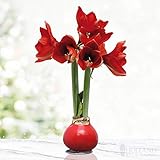
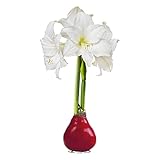
It is a herbaceous geophyte: a perennial that is deciduous, dying back to the bulb and regrowing. Leaves are green and linear, growing as a connected group like a spike. The flowers are trumpet-shaped and come in pink, white, red, purple, yellow, orange and bordeaux, often more than one colour on the same flower, sometimes with a darker band edging the petals like an outline. Double-flowered forms exist too. The whole plant stands 20–70 cm (8–28 in) and grows at a slow to medium rate.
 Amaryllis Apple Blossom Growing Kit-Includes: Big Apple Blossom Bulb, Plastic Pot and Saucer, and
 Black Pearl Amaryllis Holiday Gift Growing Kit, Includes: Big Black Pearl Bulb, Plastic Pot
A boxed amaryllis bulb kit is the easiest way to get started, pot and all: As an Amazon Associate we earn from qualifying purchases.
Where it can stay in the ground, and where it cannot
This is the fork in the road for amaryllis care:
- Hardiness zones 9–11: the bulb can live permanently in the soil. In warm climates it can be kept in the garden and even watered through the year, and it may behave as an evergreen rather than dying back.
- Hardiness zones 4–9: the bulb must be lifted and kept indoors over winter. A frozen bulb is a dead bulb.
Zone 9 straddles the two because it sits near the boundary – winter lows around −6.7°C (20°F) – so whether you can leave bulbs out depends on your particular garden. In zones colder than 10a, mulch in autumn: it buys real insulation for anything left in the ground.
Planting an amaryllis bulb
Best planting time is spring in zones 4–9, spring to summer in 10a, late winter to spring (and possibly on into early autumn) in 10b, and all year in zone 11. In hot climates late winter is the natural start. Avoid planting through summer into autumn – that is the wrong end of the cycle, and the bulb has no season ahead of it to establish.
- Dig a hole far larger than the bulb – three to five times its size. You are preparing a pocket of soil, not just a slot.
- Mix humus and organic matter (and some fertilizer) into light, well-drained soil, and return it to the hole. Drainage is not negotiable for a bulb.
- Set the bulb in and cover it so that the top of the bulb stays exposed – roughly the top 2 cm (1 in) above soil level. Burying the neck is one of the most common causes of rot.
- Water in, and keep watering modest from here.
If you need to move an established plant, transplant during dormancy, not while it is in growth.
Water, light and feeding
Water: a small amount for most of the year, increasing slightly during the blooming season. Amaryllis is far more often killed by generosity than by neglect – the bulb is a water store, and sitting in wet soil it rots.
Light: it will grow in anything from full shade to full sun. But it blooms in proportion to light. Full sun gives the best flowering, half shade gives reduced flowering, and in full shade it will rarely bloom at all. This is the single most important care fact about the plant.
Feeding: fertilize in spring after the last frost, and ideally before the flower stems start to rise. Feeding after the buds have already formed does far less for this year’s display – the flower was built with last season’s stored energy. In autumn, add mulch, particularly anywhere colder than zone 10a.
Why your amaryllis will not rebloom
Failure to flower is by far the commonest amaryllis complaint, and the cause is almost always one of two things: a watering problem, or not enough sun.
The logic is worth understanding. An amaryllis flower is not made in the weeks before it appears; it is made from energy the leaves banked during the previous growing season and stored in the bulb. So:
- If the plant sat in low light while it had leaves, the bulb never charged, and there is nothing to spend on a flower stem.
- If it was overwatered, the roots and bulb base suffered and the same shortfall follows.
- If the leaves were cut off early – while still green – you removed the plant’s factory before it finished the year’s work.
The fix is a season long, not a week long: give the plant strong light for the whole period it is in leaf, water sparingly, feed in spring, and let the foliage die back on its own schedule.
Growing amaryllis indoors
Amaryllis makes a good houseplant, with one honest caveat: indoors it can grow all year, but it may simply not bloom. Give it well-drained soil, a small amount of water, and as much light as you can manage.
The practical technique is to move it. When the leaf spike starts to grow after dormancy, put the plant out in full sun for about a month. That exposure is what triggers and fuels blooming. Once it is in flower you can bring it back indoors and enjoy it where you want it – the flower is already made and will not be harmed by the move.
Lifting and storing the bulb
In cold climates, lift the bulb before winter rather than gambling on it.
- Wait until the leaves have died back naturally.
- Lift the bulb and clean off loose soil.
- Store somewhere cool, dry and dark. Dry is the operative word.
- Check the bulbs every few days rather than forgetting them until spring.
The usual storage failure is rot. It comes from moisture – either mould developing in storage or the bulb never having been stored in the right conditions to begin with. If you find a soft or rotten patch, cut the infected part away, put the bulb in a paper bag (paper breathes; plastic sweats), and keep checking every few days. A bulb caught early often survives; a bulb left in a damp bag does not.
Propagation by bulb division
Division is the recommended way to increase amaryllis, and for some cultivars it is the only way – a number of them are sterile, producing seed that is simply not viable.
You can divide at any time of year, but autumn to mid-winter is best. The signal is the foliage: the moment the leaves die back, you can lift and divide. There is no technique to it – the offsets simply separate from the mother bulb. Each one is a genetic copy, so the flower colour is guaranteed to match the parent.
Growing amaryllis from seed
Seed works, but understand what you are signing up for: the flower colour may differ from the mother plant, and it takes several years to reach blooming size. Use it for experimenting, not for reproducing a favourite.
- Soak the seeds in water, changing the water every few hours.
- After 1–3 days of soaking, sow them.
- Lay the seed on the soil surface and cover it only very lightly – do not press it down.
- Give full sun, well-drained soil, and keep the soil moist at all times; do not let it dry out.
Pruning
Prune in summer to autumn, cutting all the leaves – but only once they have finished, at the end of the cycle. Through the year, remove dead leaves and spent flower stems as they appear; the spent stem is doing nothing but drawing on the bulb.
Pests and diseases
The threats are almost all subterranean, which is why they are noticed late: borers, nematodes, bulb mites and bulb flies. Each attacks the bulb itself rather than the foliage, so the visible symptom is usually a plant that weakens or fails to come up. Inspect bulbs whenever you lift, divide or store them – that handling is your only real chance to catch an infestation, and it is another argument for the every-few-days check during storage.
The honest drawback
The main difficulty with amaryllis is not care but calendar: it has a short season of interest. In cold climates it blooms in spring to summer, in hot climates in winter to spring, and for the rest of the year it is leaves or nothing. Plan for that – grow it in pots you can move, or site it where something else takes over when it retreats.
For the full plant profile see our Amaryllis plant growing page.
For the equipment that makes propagating easier (heat mats, humidity domes, rooting hormone), see our propagation equipment guide.