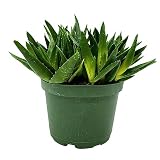
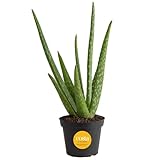
Aloe black gem is a small, slow, dark-leaved succulent grown entirely for its foliage. You will also see it sold as Alworthia Black Gem — the name Alworthia marks it as a cross between Aloe and the closely related Haworthia, and that mixed parentage explains a lot about how it behaves: it has the fleshy, lightly toothed leaves of an aloe on a compact, clustering, shade-tolerant plant that suits a windowsill far better than most true aloes do.
What the plant looks like, and how big it really gets
The leaves are fleshy, roughly triangular and taper to a cone, with fine spines along the edges on some plants. Colour is the whole point: leaves run from green to deep red, and most plants show both at once. The red is a stress pigment — strong light, cool nights and lean, dry conditions bring it out, while a plant kept in soft shade and well fed stays plain green.
Size varies with growing conditions more than with variety. Leaves are commonly 5 to 10 cm on compact plants and reach 10 to 25 cm (4 to 10 inches) on well-grown ones, with the whole plant often no more than 10 to 15 cm across when young or grown hard. The flower spike is the tallest thing on the plant at 20 to 40 cm (8 to 16 inches).
Is there a dwarf Aloe black gem?
No — “dwarf Aloe black gem” is simply ordinary Aloe black gem, sold small. It is a naturally small, slow-growing plant, so a young or tightly potted specimen with 5 to 10 cm leaves and a 10 to 15 cm body looks like a distinct miniature form when it is nothing of the kind. Care it exactly as you would any other Aloe black gem; it does not need different treatment, and it does not stay that size forever.
Light: the trade-off nobody mentions
Aloe black gem will grow in full sun, half shade or even full shade, which makes it unusually forgiving. But shade costs you two things:
- It flowers far less, or not at all.
- It becomes noticeably more prone to pests. Soft, etiolated growth produced in low light is thinner-skinned and easier for aphids to feed on, and shade usually comes with stiller, damper air — which is precisely what slugs and snails want.
Half shade to full sun is the sweet spot: enough light for colour and bloom, without the scorch risk of moving a shade-grown plant straight into blazing summer sun. If you do move a plant into stronger light, do it over a couple of weeks rather than in one step.
Watering and soil — the two things that kill it
This is a drought-tolerant succulent and it wants a small amount of water, with the soil allowed to dry out almost completely between waterings. Do not overwater. The leaves are the plant’s water store; when the roots sit wet, those fleshy leaves are the first tissue to rot, and Alworthia leaves are noticeably more rot-prone than a tough garden aloe’s.
Soil must be sandy and sharply drained. In a container, the recipe that works is mostly inert material — coarse sand, lava grit and similar — with only a little organic matter mixed in. Organic matter holds water and collapses over time, and both of those work against you here.
Growing it in a pot or indoors
Containers suit this plant well, and indoor culture is genuinely viable. A few specifics:
- Pot size: choose a container about 50% larger than the root ball. Oversized pots hold a reservoir of wet soil the small root system cannot use, and that is a rot risk rather than a growth advantage.
- Mix: sandy, gritty and inert, with a little organic matter.
- Feeding: once a year is enough. This is a slow grower and forcing it with fertilizer produces soft growth that colours poorly and attracts pests.
- Indoors: yes, provided you give it real light. Expect that an indoor plant may never bloom — that is the normal outcome, not a fault in your care.
Flowering
The flowers are orange, cone-shaped, and carried on an inflorescence on a stalk well above the foliage. Bloom timing is not tightly seasonal: summer is the main flowering period, but plants bloom sporadically through the year, most often in winter in warm climates and in summer in cooler ones. What actually triggers it is adequate light — a plant in deep shade or a dim room simply will not perform.
Once the spike is spent, cut it off at the base. Leaving a dead stalk on a small succulent gives rot somewhere to start.
Propagation: offsets, cuttings and seed
Daughter plants (offsets)
This is the easiest and most reliable route. The plant produces daughter plants around the base; separate them once they have at least 2 or 3 leaves of their own. Smaller than that and they have too little stored water and root to survive on their own. From that point, treat a division exactly like an adult plant — same soil, same restrained watering, same light.
Cuttings
Both stem and leaf cuttings work. The critical step is the one people skip:
- Take the cutting with a clean cut.
- Leave it to callus until the cut surface has healed over before it touches soil. A fresh wound in damp soil is an open door for rot, and that is the usual reason cuttings fail.
- Insert into sandy, well-drained soil.
- Water lightly and let the mix go almost dry between waterings.
Leaf cuttings deserve extra caution: leaves are more vulnerable to pests and rot more easily than stems. Sterilizing the soil first — a few minutes in a microwave is enough for a small batch — removes the fungi and soil pests that would otherwise get to the cutting before it roots.
Seed
Seed is possible but slow, and it is not the route to a plant that matches the parent. Sow in spring, when germination rates are highest, into a light, well-drained mix. Store seed until sowing in a dark, dry place at room temperature — warmth plus damp in storage is what ruins succulent seed.
Grafting is not necessary for this plant at all; offsets and cuttings are so straightforward that there is no reason for it.
Cold tolerance and planting season
Aloe black gem grows outdoors year-round in hardiness zone 10b and above, and in zone 10a with proper overwinter protection. It is best kept frost free, though it will survive light frost. Anywhere colder, grow it in a pot you can move indoors.
- Zone 11+: plant at any time of year.
- Zone 10b: plant from spring through autumn.
- Zone 10a: plant in spring only, so the plant has the full season to establish before its first cold spell.
It also grows happily in desert, Mediterranean, subtropical and tropical climates, or indoors as a houseplant anywhere.
Pests, pruning and common mistakes
Expect aphids, slugs and snails. Aphids cluster on the newest growth and in the crown where leaves overlap; slugs and snails rasp shallow scars into the fleshy leaves, usually overnight and usually on plants kept in shade or on damp ground. Because the damage is permanent on a slow-growing succulent — a scarred leaf stays scarred for years — prevention beats treatment. Keep the plant in decent light, keep the soil surface dry between waterings, and clear away debris where slugs shelter.
Pruning is minimal and can be done at any time of year: remove dead leaves, old stems and spent flower stalks. The one practical nuisance to be aware of is the spines along the leaf edges — they are small, but they make repotting and cleaning out dead leaves an operation for gloves or tweezers.
Finally, do not eat it. Aloe black gem is not edible. Despite the aloe name, its uses are purely ornamental: as a houseplant, in containers, or as a low ground cover in frost-free gardens where its dark red-green rosettes spread into a mat.
For the full plant profile see our Aloe black gem growing page.