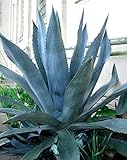
Agave is easy to keep alive and easy to misunderstand. It is a succulent that asks for very little water, a great deal of sun and sharp drainage — and then, after years of steady growth, it flowers once, spectacularly, and dies. Almost every question gardeners ask about agave comes back to that one habit, so it is worth starting there.
Is agave a cactus? And is it a tree?
No to both. Agave is a succulent, not a cactus, and not a tree either — it is a herbaceous succulent that forms a rosette of thick leaves at ground level, with no woody trunk. The tall “trunk” people photograph is a flower stalk, not a stem.
The distinction is more than pedantry. All cacti are succulents, but cacti are a single plant family with their own structure and their own way of running photosynthesis and gas exchange; agave arrived at a similar drought-proof design from a completely different family. In the garden it matters because agave is not a desert-only plant: it grows in desert, subtropical, Mediterranean, tropical and temperate climates, in hardiness zone 6 and warmer — and with the right winter care, in zone 5.
 Miracle-Gro Indoor Potting Mix for Cactus & Succulent, 8 qt. (2-Pack)
 Back to the Roots 100% Organic Succulent & Cacti Mix (6 Quart) | Made
Agave needs sharp drainage to avoid rot — a dedicated cactus/succulent mix is the simplest fix: As an Amazon Associate we earn from qualifying purchases.
Size varies enormously by species. The rosette can be anywhere from 0.2 to 4 m (0.8–12 ft) across, and the flower stalk from 0.5 to 8 m (2–24 ft) tall. Read the label before you plant: the difference between the small and the large end of that range is the difference between a container plant and something that will eventually own a corner of the garden.
Why the plant dies after blooming
Agave is monocarpic: it flowers once in its life and then dies. It spends years storing sugars and water in those fleshy leaves, and when it finally blooms it spends the entire reserve on a single enormous stalk. There is nothing left afterwards, which is why the rosette collapses even though it looks healthy the season before.
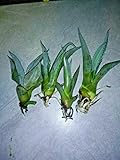
The plant’s answer to this is vegetative reproduction. Before it dies it usually produces daughter plants — pups around the base — that carry on in its place. That is the whole reason the common name “century plant” is misleading: the individual rosette is short lived by tree standards, but the clump is effectively permanent.
The failure mode is worth flagging: sometimes a plant blooms without producing the next generation, and then you simply lose it. If you value the plant, do not remove every pup — leave at least one in place, or root a few in pots as insurance long before the plant looks like flowering.
When does agave bloom?
Bloom season is summer, occasionally running into autumn, and the display lasts about two months. The flowers are yellow, carried up the stalk, and they open from the bottom upwards — the lowest flowers first, the tip last. That sequence is what stretches the show over weeks rather than days.
How long you wait is the harder question. An agave must reach maturity first, which takes a minimum of five years, and in practice many plants bloom at around 10–15 years. It can be sooner or later, and it depends partly on whether you are growing a single plant or a group. Climate matters too: an agave grown somewhere colder than its native range grows its leaves more slowly and takes several more years to reach flowering size.
If your agave is not blooming, the answer is almost always that it is not old enough yet. There is no reliable trick to force it, and there is little reason to want one — the bloom is the end of that rosette’s life.
“Agave fruit” and the edible parts
Agave fruit forms in autumn, on plants that may take 5–10 years to reach that point, and after fruiting the plant dies. The true fruit is not edible, and when people talk about eating “agave fruit” they nearly always mean something else: the heart of the plant, the rounded core left once you cut away the leaves. That heart is edible in some agave species and not in others, and it needs at least five years of growth before it is worth harvesting.
Other edible parts, again species-dependent:
- Leaves — edible in species such as Blue agave and Agave americana, roasted or cooked rather than raw. They can be harvested at any time of year once the plant is established. Cut at the base of the leaf.
- Basal rosette — edible in those same species, again after at least five years.
- Flower nectar — edible and used as a sugar substitute, though not every agave species produces nectar suitable for eating.
The rule underneath all of this: edibility is a species question, not an agave question. Identify what you actually have before eating any part of it.
Soil, water and light
Agave needs well-drained soil, sandy for preference, and only a small amount of water. Let the soil dry between waterings and err on the dry side; overwatering is the single most common way to kill one. A plant that has stored water in its leaves has no mechanism for getting rid of an excess, so a saturated root zone rots from below while the leaves still look fine.
The plant genuinely dislikes sitting in a puddle and may die if it does. In a rainy area, plant above the surrounding grade — a raised bed, a mound or a slope — so that surface water runs away from the crown rather than collecting round it.
Light is full sun to half shade, with the exact tolerance depending on species. Feeding is minimal: fertilizer once a year is enough. Growth is slow in any case, and pushing an agave with feed and water produces soft growth rather than a better plant.
Planting and winter protection
Planting season follows the zone: spring in cold zones 5–8, spring to summer in 9–10a, spring to autumn in 10b, and year round in zone 11 and above. In a hot climate, autumn planting is often kinder than spring, since the plant establishes before the next summer’s heat. Choose the site for drainage first and everything else second.
Agave prefers a frost-free position, but the cold itself is only half the problem — cold combined with wet is what does the damage. While the plant is young, add mulch over the root zone in a cold winter to buffer the temperature swings; established plants handle winter far better than newly planted ones.
Propagation: pups, leaf cuttings and seed
Grafting is irrelevant here, but there is one case where vegetative propagation is compulsory: variegated cultivars. Variegation does not come true from seed, so a variegata form must be raised from a daughter plant or a cutting if you want the same markings.
Cuttings and daughter plants
- Detach a leaf, or cut at the base of the leaf, using your hands rather than a blade where you can — a clean tear at the natural join separates better than a slice through the tissue.
- Wait at least 24 hours before planting, and a few days for a thicker stem cut, until the wound tissue has healed over. Planting an open wet wound into soil is an invitation to rot; the callus is the plant’s own seal.
- Set the cutting into well-drained soil.
- Water every few days to two weeks — let it dry between waterings, but not bone dry.
- Expect roots in a few weeks to a month.
Late spring to early summer is the best window outdoors, when warmth speeds up rooting; indoors you can do it at any time of year.
From seed
Sowing is not difficult, though starting from a cutting or a bought plant is easier and much faster. Sow in spring, into well-drained, slightly moist soil, at about 0.2 cm deep, covering only lightly — the seed needs light to germinate, so burying it defeats the purpose. Small pots are better than a large tray, and the usual rule applies from day one: do not overwater.
Pruning
Pruning can be done all year, though autumn is a convenient time. There are three jobs: trim dead leaves, remove the spent mother plant after it flowers, and cut down the bloom stalk.
The important restraint is not to tidy too early. As a leaf ages and dies, the plant is actively withdrawing nutrients from it and moving them back into the rosette. Cut a fading leaf off while it is still yellowing and you throw that away; wait until it is genuinely dead and you lose nothing. The exception is a diseased leaf, which should come off promptly regardless.
After flowering, take out the dead mother rosette and the stalk properly rather than leaving them to slump — the point is to give the daughter plants room and light to take over the space.
Pests and problems
The serious pest is the agave snout weevil. The adult bores into the base of the plant to lay eggs and the larvae hollow out the crown from inside, so the first thing you notice is the centre of the rosette wilting and the leaves folding down while the plant looks otherwise intact. By then the core is usually gone. Remove and destroy affected plants rather than leaving them as a breeding site for the rest of the collection.
Snails and slugs graze the leaves, scarring the surface permanently — agave leaves do not heal, so damage stays visible for the life of the plant.
Two non-pest problems round out the list: the sharp, spine-tipped leaves, which make placement near paths and doorways a real safety decision, and — as above — a plant that blooms without leaving offsets behind.
For the full plant profile see our Agave plant growing page.
For the equipment that makes propagating easier (heat mats, humidity domes, rooting hormone), see our propagation equipment guide.