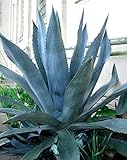
Agave attenuata – the foxtail agave or lion’s tail – is one of the easiest succulents to keep alive and one of the most misunderstood in the long run. The confusion is almost always the same: the plant blooms, everyone admires the arching flower spike, and then the rosette dies and the owner assumes they killed it. They did not. That is simply how this plant works, and understanding it is what turns a single agave into a permanent colony.
The plant dies after it flowers – plan for it
Agave attenuata is monocarpic: each rosette flowers once, and then that rosette dies. Flowering usually comes 3 to 10 years after the plant starts out, sometimes sooner and sometimes later, and it happens in summer, rarely in autumn. The bloom itself is the reason people grow it: a long, arching stalk of yellow flowers that curls over like a fox’s tail, rising 1.5–2 m (5–6 ft) and sometimes taller, well clear of a rosette that is only 0.3–0.9 m (1–3 ft) across.
 Miracle-Gro Indoor Potting Mix for Cactus & Succulent, 8 qt. (2-Pack)
 Back to the Roots 100% Organic Succulent & Cacti Mix (6 Quart) | Made
Rooting Agave attenuata pups or cuttings works best in a gritty, fast-draining mix: As an Amazon Associate we earn from qualifying purchases.
The continuity comes from daughter plants, or pups. A healthy agave produces offsets around its base long before it flowers, and those pups take over when the mother rosette goes. So the correct response to a flowering agave is not panic – it is to make sure there are pups in place, then let the display run its course and clear the mother out afterwards.
Timing varies with how many rosettes you have: a single isolated plant and a clump behave differently, and the 3–10 year range reflects that. Conditions matter too – in a climate colder than its native range, leaf growth slows and flowering may be delayed by several years.
Buying: look under the plant, not at it
The most useful check when buying Agave attenuata is to look for daughter plants at the base. A large plant is closer to flowering – that is its main attraction and its main risk. A big rosette with no pups may bloom soon, look spectacular, and then die leaving you with nothing; a big rosette with several pups gives you the flower and the next generation. A small plant is the opposite trade: several years before it blooms, but plenty of time to establish and offset first. Seed is the cheapest entry point, from around $3–4 a packet, and the slowest.
Propagating from pups and cuttings – the reliable method
Cuttings are the recommended route: easier than seed and, crucially, they guarantee you get the same plant you are cutting from. The method:
- Find a small plant still attached to the mother – a pup around the base.
- Wait until it has a woody stem. This is the step people skip. A pup with soft tissue has no reserves to live on while it roots; a woody stem does.
- Cut it free from the parent.
- Let the cut surface heal for about two weeks before planting. Do not shorten this. An open wound placed into damp soil is an invitation to rot, and a callused one is not – this single waiting period is the difference between most successes and most failures with succulent cuttings.
- Plant it into well-drained soil, deep enough that it will not fall over. A cutting that rocks in the wind snaps off the fragile new roots as fast as it makes them.
- Keep the soil moist while it roots, then move on to normal, sparing agave watering.
Late spring to early summer is the best window outdoors, but cuttings can be taken indoors at any time of year given warmth and light.
Leaf cuttings
Agave attenuata can also be propagated from a leaf. Detach the leaf, or cut at the very base of the leaf, using your hands rather than a blade – a clean tear at the natural junction heals better than a cut across live tissue.
- Leave the leaf to dry and callus for at least 24 hours. If you did not detach it cleanly at the base, or if you are working with a piece of stem, allow several days for the tissue to heal properly.
- Set it into well-drained soil.
- Water every few days to every two weeks, letting the soil dry between waterings but never becoming bone dry.
- Roots appear over a few weeks to a month. Resist the urge to tug at it in the meantime.
Growing Agave attenuata from seed
Seed is genuinely easy for this species – just slower, and it will not reproduce a variegated parent.
- Sow in spring.
- Use well-drained soil in full sun.
- Make a shallow hole and set the seed about 0.5 cm below the surface, then cover it.
- Wet the soil but do not overwater – keep it lightly moist until germination, no more.
- Once seedlings are up, move gradually to the adult watering regime rather than switching abruptly.
Variegated Agave attenuata
Variegated forms carry stripes running the length of the leaf, either down the centre or along the margins, in white with green or yellow with green. They need exactly the same care as the plain green form – no extra feeding, no special protection.
What they do need is the right start. Variegation does not come true from seed, so a variegated agave must be raised from a daughter plant or a cutting taken from a variegated parent. Sow the seed of one and you will get ordinary green agaves.
Soil, drainage and where to plant
Give Agave attenuata well-drained soil, preferably sandy, and a position in full sun to half shade. It will also cope in shade if the spot is bright, though growth is slower.
Drainage is the whole game. This plant will die if it sits in a puddle – the succulent leaves already carry its water reserve, so saturated roots bring no benefit and rot arrives quickly. On a rainy or heavy site, do not simply improve the soil: raise the plant above ground level, in a mound or a raised bed, so water drains away from the crown by gravity.
Frost-free conditions suit it best. It grows well in hardiness zone 10 and up – winter minimums around −1 °C (30 °F) – and can be carried through zone 9, where lows reach roughly −6 °C (20 °F), with deliberate overwintering care. Mulch around young plants before a cold winter; the growing point at the centre of the rosette is what you are protecting.
Planting season follows the same logic: spring in zone 9, spring to summer in zone 10a, spring to autumn in zone 10b, and all year in zone 11 and warmer.
Watering and feeding
Water sparingly. Agave attenuata needs only a small amount of water, and should be allowed to dry out between waterings. Overwatering is by far the most common way to kill it, and the symptoms – soft, discoloured, collapsing leaves – look enough like neglect that people respond by watering more. Feed once a year; that is all it asks. It is drought tolerant and a slow grower by nature, and pushing it with fertiliser produces soft growth rather than a better plant.
Pruning: wait until the leaf is truly dead
Pruning can be done at any time of year, and there are only three things to remove:
- Dead leaves at the base of the rosette.
- The spent flower stalk after blooming.
- The dead mother plant, once it has finished, so the daughter plants have room and light to grow into.
The important refinement is when to cut an ageing leaf. As a lower leaf declines, the plant withdraws its nutrients back into the rosette. Cut it off while it is still fading and you throw those nutrients away; wait until it is fully dead and you get them back. So tidy for appearance by all means, but let the leaf finish first. The one exception is a leaf that is diseased or infested – remove that immediately, whatever state it is in.
Transplanting an established plant
- Dig around the plant and lift it with as much root as you can keep. Some root loss is unavoidable, so aim to minimise it rather than eliminate it.
- Take the sand and soil around the roots with the plant. Keeping the root ball intact preserves the fine roots that do the actual work.
- At the new site, dig a hole larger than the one it came out of, and put some of that sand back into the base – it keeps the new root zone open and well aerated.
- Set the plant in, backfill, and make sure it is stable and will not topple. A large rosette is top-heavy and catches the wind.
- If the plant starts to decline afterwards, cut the leaves back and let it push out new ones. A reduced root system cannot support a full head of leaves; removing the demand lets the roots re-establish and the rosette rebuild from the centre.
Pests and problems
- Agave snout weevil – the serious one. The adult bores into the base of the plant to lay eggs, and the grubs destroy the crown from the inside, usually with bacterial rot following behind. The first visible sign is a rosette whose leaves suddenly wilt and collapse outward while the centre goes soft, and by then it is generally too late for that plant. Remove infested plants rather than letting them serve as a nursery for the next generation.
- Snails and slugs – they graze the leaf surface, leaving scars that never heal on an evergreen plant. Damage is worst on young plants and pups.
- Rot – not a pest but the most frequent cause of death. Trace it back to drainage and watering, not to disease.
- Sharp leaves – the practical nuisance of the species. Think about placement before planting near paths or where children play.
For the full plant profile see our Agave attenuata growing page.