Plant Profile & Key Characteristics
Overview: Vitis vinifera (grapevine) is a woody deciduous perennial climber reaching 2–10 m, grown mainly for its edible fruit and leaves. It also serves as an ornamental for hedging and summer shade.
Quick Specifications
| Specification | Attribute |
|---|---|
| Plant Type / Life Cycle | Perennial (woody climber) |
| Foliage Type | Deciduous |
| Mature Size | 2–10 m (6–30 ft) long |
| Growth Rate | Fast to Moderate |
| Root System | Deep, extensive woody root |
| Toxicity | Non-toxic / edible (fruit and leaves) |
| Hardiness | USDA zones 4–11 (to 12a with the right cultivar) |
Growth Form & Structure
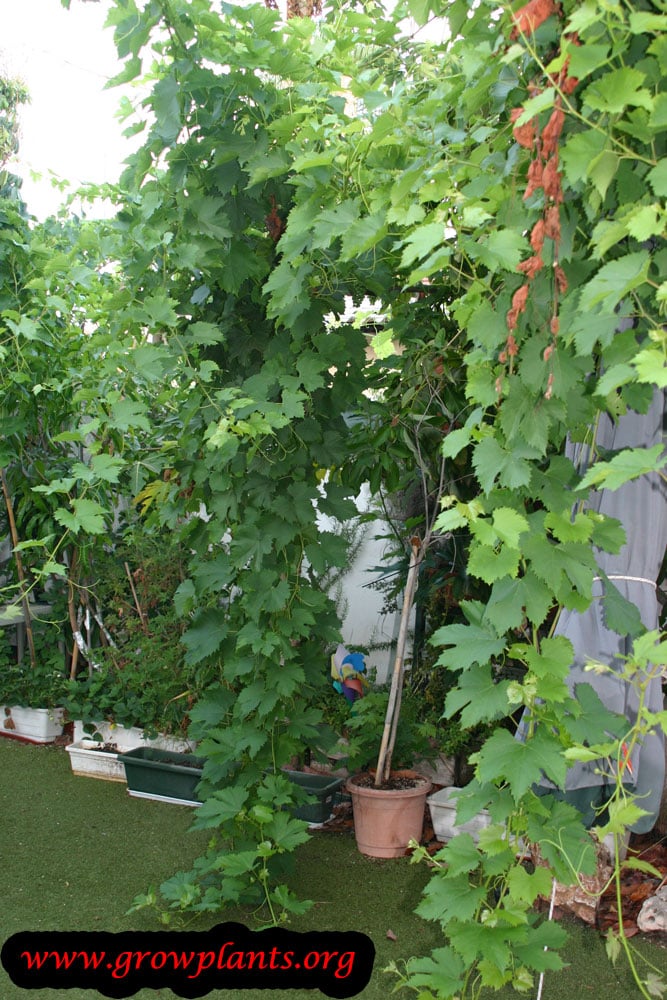
- Height & Spread: Climbs 2–10 m on a trellis in the ground; can be container-grown in a 25–50 L (5–10 gal) pot with regular soil renewal and heavier feeding.
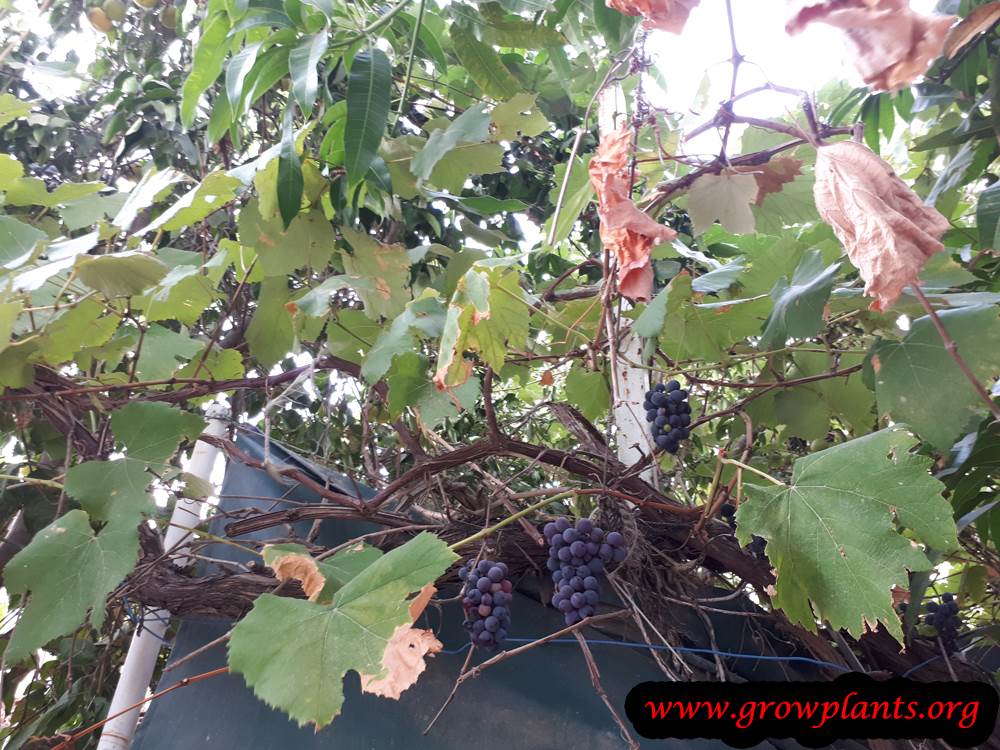
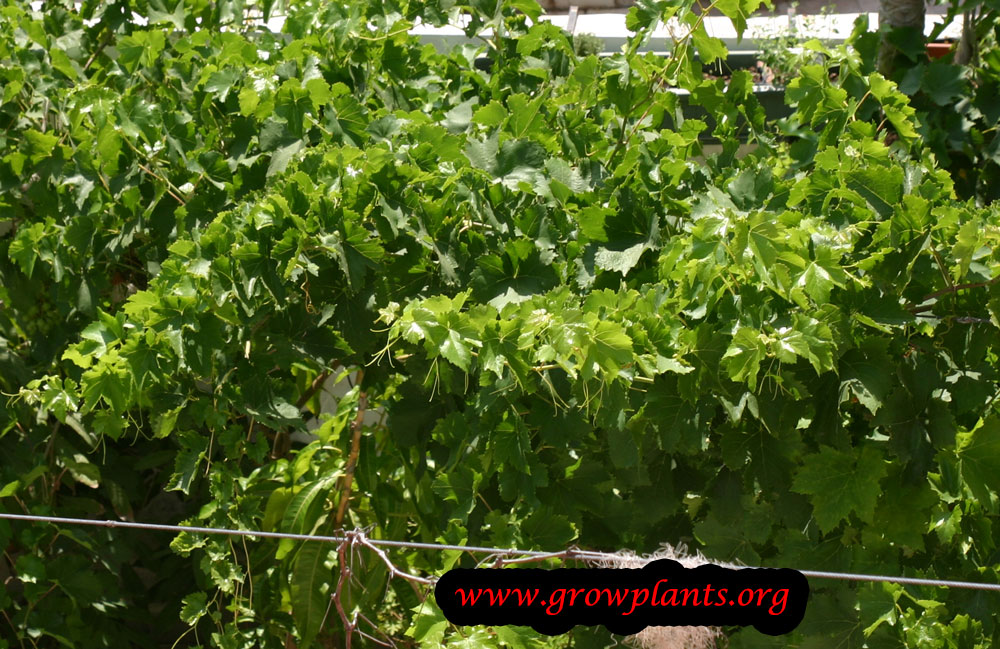
- Growth Habit & Form: Vigorous tendril-climbing vine trained on wires or a pergola; fruit is carried on new season’s stems, so it is pruned hard each year.
- Lifespan & Maturity: Long-lived; begins bearing fruit in about 2–3 years (4–6 years from seed).
Anatomy & Physical Features
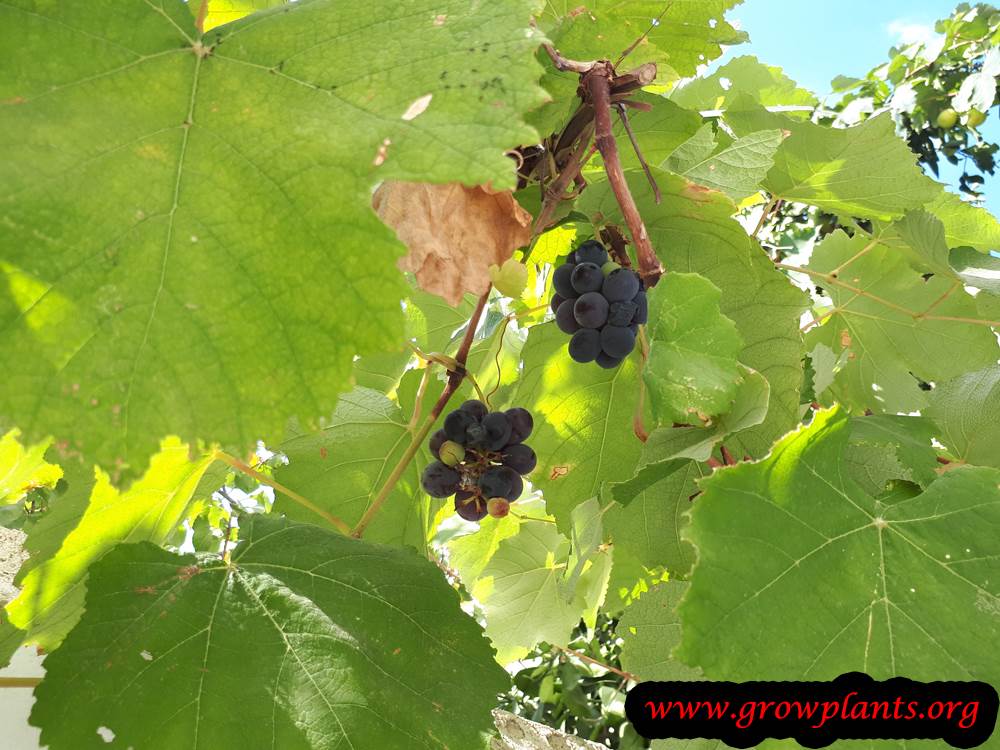
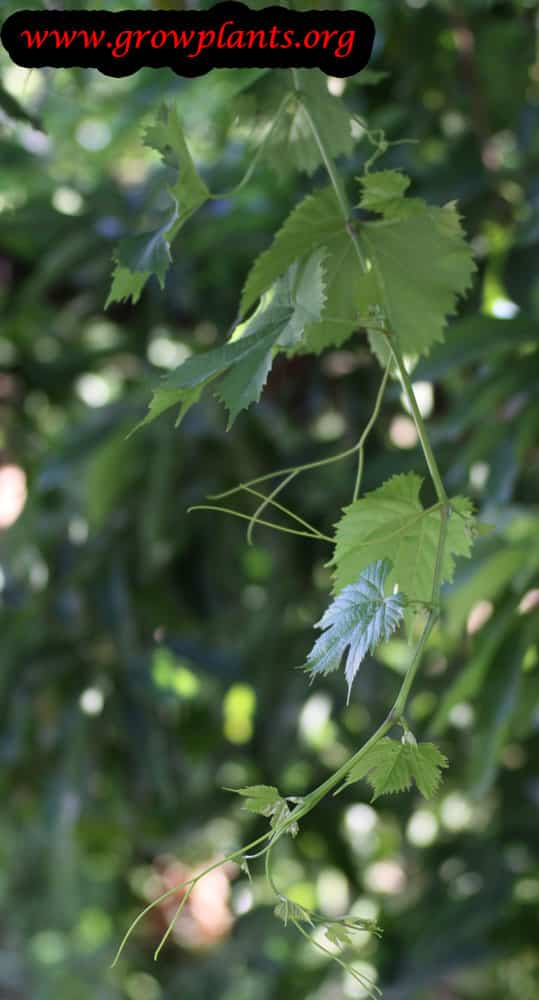
- Leaves & Foliage: Large lobed (3–5 lobes) green leaves 4–15 cm with prominent veins and serrated edges.
- Flower Characteristics: Small green flowers in clusters, largely self-pollinating.
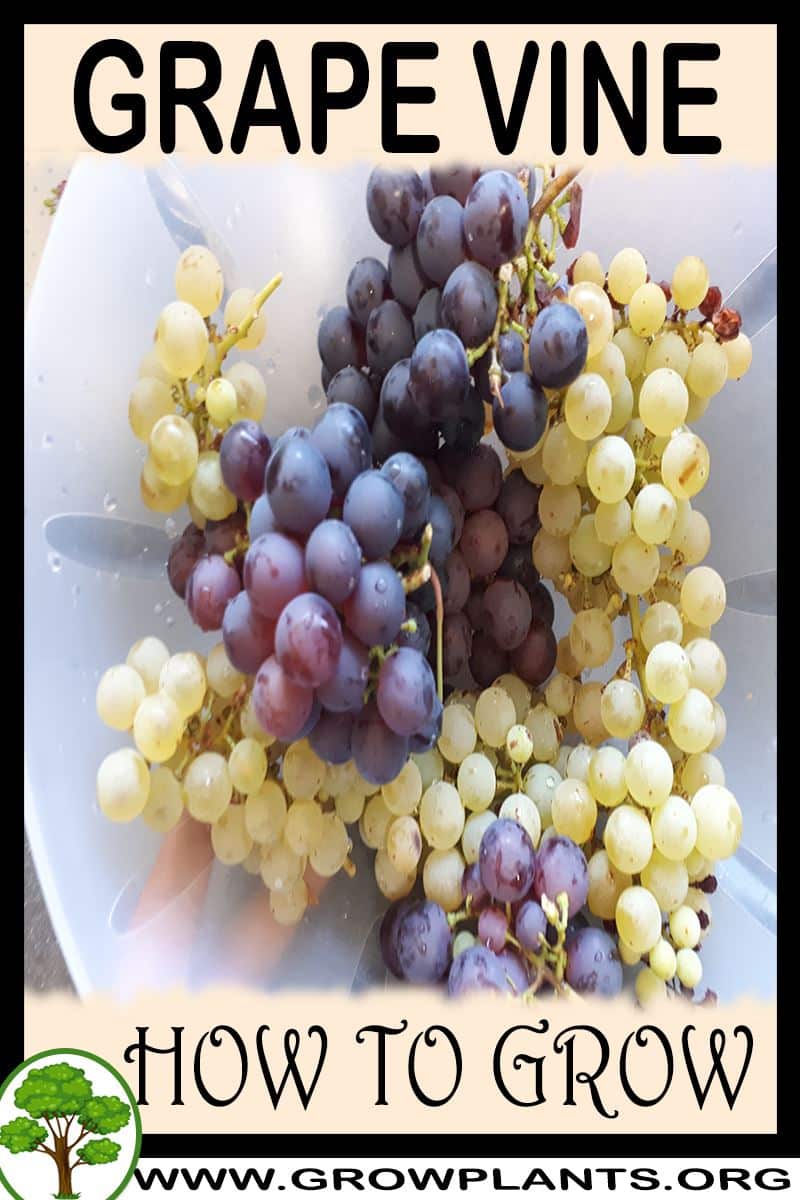
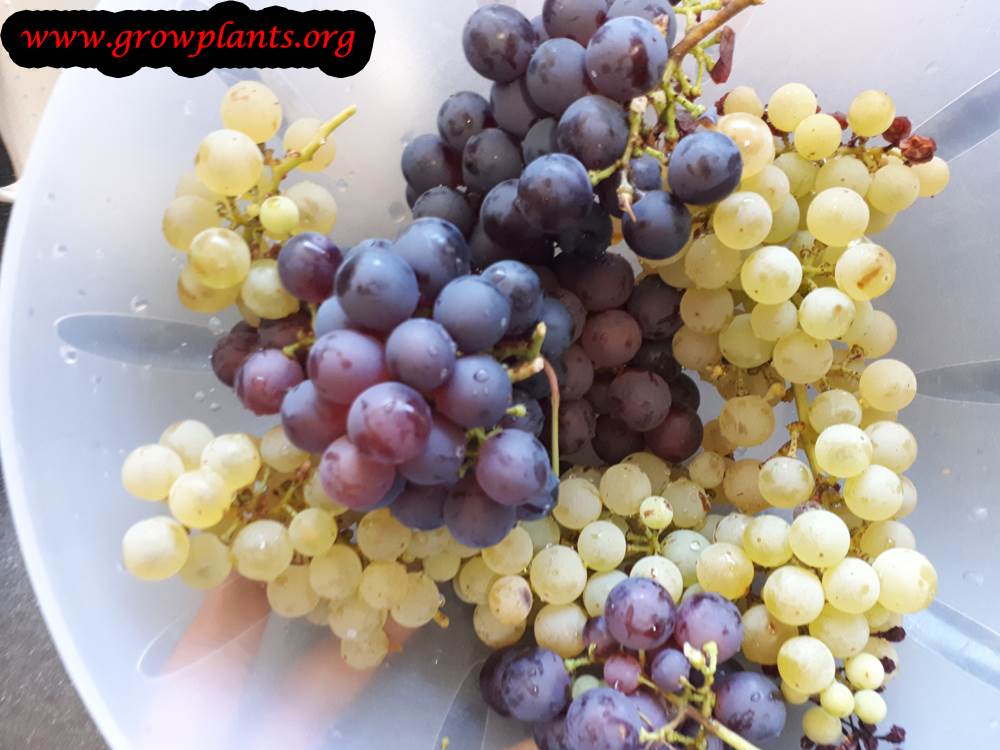
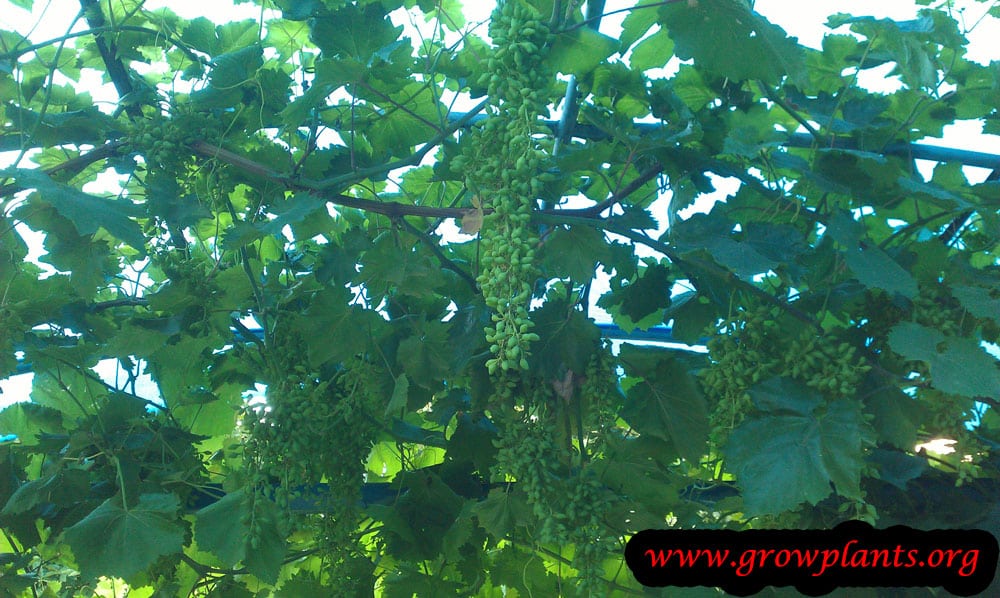
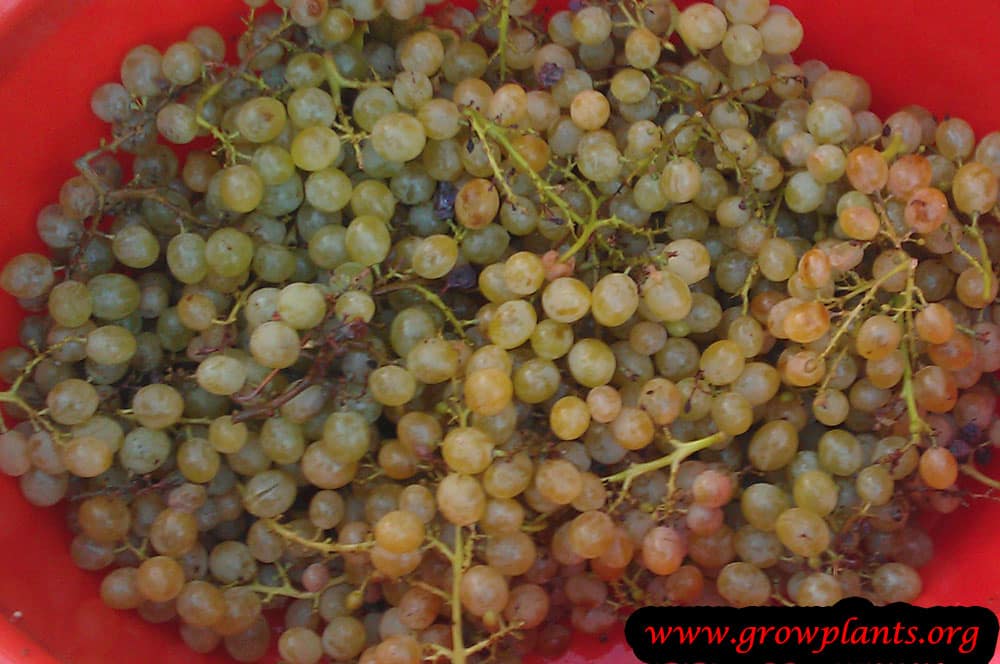
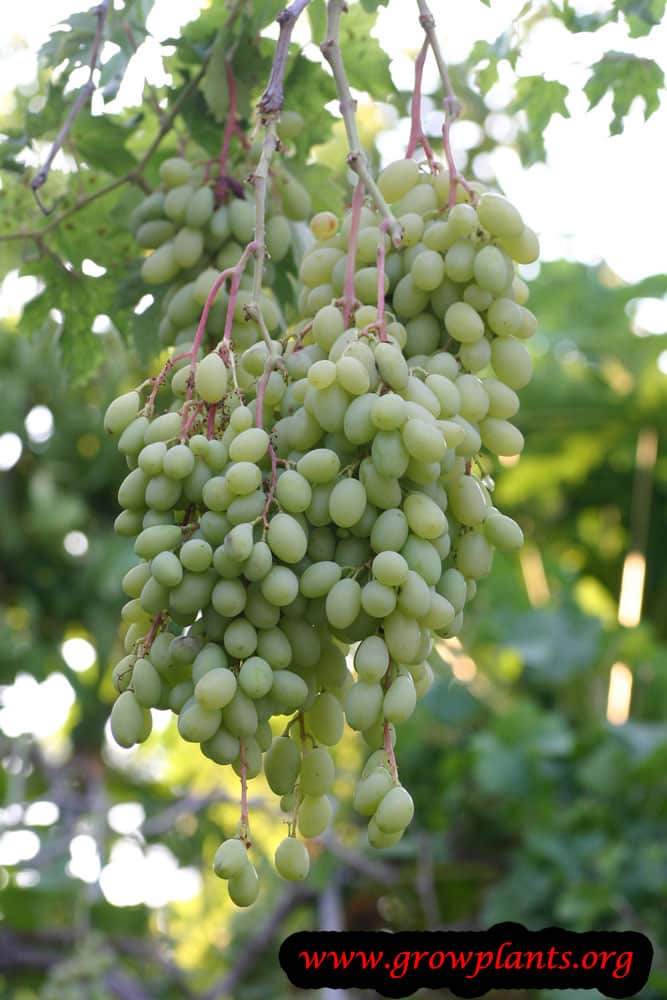
- Fruit Profile: Grapes in clusters with purple, pink, green or yellow skin and sweet or tart green-to-purple flesh.
Primary Uses & Landscape Value
- Edible Uses: Fruit eaten fresh or made into wine, juice and cakes; young leaves are used cooked as stuffed vine leaves and can be preserved or frozen.
- Functional & Ornamental Roles: Productive fruit crop that doubles as an ornamental climber for hedging and summer shade over a pergola.
Care Guide: Planting, Soil & Watering
Overview: Grapevine (Vitis vinifera) is a vigorous deciduous climber (zone 4-11) for full sun that grows in a wide range of well-drained soils on a sturdy trellis or support. Water needs are moderate and vary by cultivar – some are very drought tolerant once established.
Quick Care Requirements
| Requirement | Ideal Condition |
|---|---|
| Planting Season | In the dormant-to-warm season – winter to spring in cold zones, extending into summer or autumn in warm zones |
| Growth Rate | Moderate to Fast |
| Soil Type | Well-draining, on a trellis or support |
| Water Need | Low to Moderate (some cultivars drought tolerant) |
Planting & Establishment
- Best Planting Season: Plant while dormant from winter to spring in colder zones (4-10a); in warm zones (10b-12a) planting can extend into summer or autumn. Set up a trellis or support first.
- How to Plant:
- Hole Preparation: Dig a generous hole in loosened, free-draining soil at the foot of the support; note some cultivars are grafted for pest resistance or difficult soils.
- Soil Amendments: Work in compost and ensure sharp drainage; feed once a year rather than heavily.
- Planting Depth: Set the root ball level with the surface; if grafted, keep the graft union above soil level.
- Growth Speed & Expectations: A fast-to-moderate climber reaching 2-10 m (6-30 ft); it begins fruiting in about 2-3 years.
Soil, Watering & Drainage Care
- Soil Mix & Drainage Needs: Grows in most soils provided they drain freely; grapes dislike waterlogged roots, so avoid heavy, wet ground.
- Watering Schedule & Technique:
- Young / Newly Planted: Water regularly to establish the vine through its first seasons.
- Established: Water moderately and deeply; many cultivars become drought tolerant and some crop on as little as 80-100 mm of water a year.
- Seasonal Adjustments: Most water during the growing and fruiting season; little to none while dormant in winter.
Climate, Light & Hardiness
Grape vine is a deciduous vine adapted to Mediterranean, desert, subtropical, and temperate climates, with USDA hardiness spanning zone 4 through 11 (zone 12a possible with the right cultivar and care). It needs full sun for the best fruit yield, though half shade is tolerated with reduced production.
Quick Climate Specifications
| Climate Zones | Mediterranean, desert, subtropics, temperate |
|---|---|
| USDA Hardiness Zones | 4–11 (up to 12a with suitable cultivar and care) |
| Frost Tolerance | High |
| Light Conditions | Full Sun (preferred); Half Shade tolerated with reduced yield |
Sunlight & Light Exposure
Full sun is strongly preferred for the best fruit yield and quality; the site notes that half shade is tolerated but reduces production.
Temperature Extremes & Hardiness
USDA Hardiness & Regional Limits
Hardy across a very broad range, from cold–winter zone 4 through hot zone 11, and even zone 12a with the right cultivar and care - among the most climate–adaptable fruiting vines.
Cold Damage & Winter Protection
As a deciduous vine it goes fully dormant for winter; planting timing itself shifts by climate - winter to spring planting in zone 4–10a, and winter through summer (even autumn) in the warmer zone 10b–12a range.
Chilling Requirement
As a temperate deciduous fruiting vine, grapes generally need some winter chill for even dormancy break and fruiting; cold tolerance and chill needs vary by cultivar.
Wind, Humidity & Microclimate
Rainfall & Seasonal Moisture
Highly adaptable: some cultivars need only average to ample water, while others are notably drought–tolerant and can be grown in desert conditions on as little as roughly 80–100 mm of water per year.
Growing in Pots, Balconies & Indoors
Grape vine (Vitis vinifera) is not a true houseplant, but the grower notes it can be grown on a window ledge, and it does very well in a large container on a sunny balcony or patio. Expect a smaller crop than a ground vine, limited by pot size, and plan on annual pruning to a set framework.
Quick Details
- Container Size: Minimum 25 L (5 gal), up to 50 L (10 gal), by cultivar
- Indoor Suitability: Not a deep-room houseplant; workable on a very sunny window ledge
- Best Spot: Full sun (part shade gives a lighter crop)
- Soil & Drainage: Deep, free-draining, fertile mix
- Watering in Pots: Moderate to generous; some cultivars are quite drought-tolerant
Indoors & On the Windowsill
- Not a deep-indoor plant: The grower marks it No as a houseplant, but adds it can be grown on a window ledge with strong direct sun.
- Windowsill growing: Pick the brightest, sunniest sill; a compact or trained vine can be kept small with hard annual pruning.
On a Balcony or Patio
- Light & support: Full sun and a trellis or wires; anchor the heavy pot against wind.
- Watering & heat: Containers dry fast against warm walls – water deeply in the growing season; some cultivars tolerate lean watering.
- Overwintering: Vines are hardy, but pot roots need shelter in hard frost. Feed more than a ground vine, as nutrients leach from pots.
Choosing the Pot, Soil & Long-Term Care
- Pot & drainage: A 25-50 L (5-10 gal) pot with strong drainage holes; skip a standing-water saucer to avoid root rot. Terracotta breathes and dries fast, while glazed or plastic holds moisture longer.
- Potting mix: A well-aerated, organic-rich mix – peat or coir blended with perlite or vermiculite for free drainage.
- Feeding: Potted plants run their soil down fast as nutrients leach out, so feed more often than plants in open ground during active growth.
- Repotting: Refresh the mix or pot up about every two years; on established plants, lightly prune the root ball and top growth to keep them balanced.
Grower’s Container Tip
- Container & pruning routine: Use a pot of at least 25 L (5 gal), up to about 50 L (10 gal) depending on the cultivar. Every few years, once the root ball fills the container, either move up to a larger pot or root-prune and cut the branches back. Decide the trunk height you want and prune back to that same framework each year in the depths of the cold season. Feed more than a ground vine, and accept a smaller crop limited by the pot size.
Fertilizing & Feeding
A vigorous, deep-rooted deciduous vine that establishes with a nitrogen-forward feed, then shifts toward balanced and potassium-leaning nutrition once it is cropping, since fruit quality and sugar development depend on adequate potassium.
Quick Fertilizing Specs
| Feeding Level | Moderate |
|---|---|
| young_feeding | A newly planted or newly grafted vine benefits from a nitrogen-forward feed to help it establish a strong trunk and trellis framework. |
| mature_feeding | A cropping vine shifts toward a balanced-to-potassium feed to support fruit fill, flavor, and consistent ripening. |
| Main Nutrient Priority | Nitrogen drives early trunk and cane establishment; potassium becomes the priority on bearing vines, since it strongly influences fruit quality and sugar development. |
| Best Feeding Period | Feed in spring as growth resumes, easing back once fruit is ripening so late-season growth does not compete with the crop. |
| Organic Options | Compost or aged manure worked around the root zone in early spring suits vines well and builds soil structure over time. |
| Micronutrients | A complete vine or fruiting-plant fertilizer that includes iron and manganese helps prevent the pale new growth common on grapes in high-pH soils. |
| Soil pH | Tolerates a range of well-drained soils; strongly alkaline soil is a frequent trigger for iron chlorosis in this species. |
| Reduce/Stop Feeding | Ease off nitrogen as fruit begins ripening, and reduce feeding overall once the vine goes dormant after leaf drop. |
Feeding by Growth Stage
Establishment
Help a newly planted or newly grafted vine build a strong trunk and root system before it is trained onto its trellis.
| Nutrient direction | A nitrogen-forward, balanced feed to support root and trunk development |
|---|---|
| Timing | The first growing seasons after planting, while the permanent trunk and cordons are being trained. |
| Frequency | Light, regular feeding through the growing season supports steady establishment without forcing weak, overly soft growth. |
| Fertilizer types | A balanced or nitrogen-forward fertilizer suited to young grapevines, Compost or aged manure worked into the planting area |
| Routine trace nutrients | iron, manganese |
| Precautions | Grafted vines should be fed with care not to bury or wet the graft union, and a vine grown in a container needs more attentive feeding than the same vine planted in open ground. |
Vegetative Growth
Support cane and canopy growth on young, non-bearing or lightly bearing vines as they fill out their trellis.
| Nutrient direction | A nitrogen-emphasis feed to fuel cane extension and canopy development |
|---|---|
| Timing | Spring into early summer while shoots are actively extending. |
| Frequency | Regular feeding through the spring growth flush, tapering as canes mature and the canopy fills in. |
| Fertilizer types | A nitrogen-forward vine or fruiting-plant fertilizer applied in spring, A balanced complete fertilizer as an alternative on already-fertile soils |
| Routine trace nutrients | iron, manganese, zinc |
| Precautions | Overly vigorous canopy growth from excess nitrogen shades developing fruit and can worsen fungal disease pressure, so keep feeding proportionate to the vine’s size. |
Fruiting
Support fruit fill, flavor development, and even ripening on mature, bearing vines.
| Nutrient direction | A balanced feed shifting toward potassium as clusters develop and ripen |
|---|---|
| Timing | From fruit set through harvest on mature, cropping vines. |
| Frequency | Moderate feeding through fruit development, reduced sharply once ripening begins. |
| Fertilizer types | A balanced fruiting-plant fertilizer with a potassium lean, A potassium-supplemented feed for vines carrying a heavy crop |
| Routine trace nutrients | iron, manganese, zinc |
| Precautions | Feeding heavily once fruit is ripening favors leafy growth and can delay or unevenly stagger ripening across a cluster. |
Nutrient Deficiency Signs & Corrections
New leaves emerge pale yellow with the veins remaining distinctly green.
| Possible causes | Alkaline or high-pH soil limiting iron availability to the roots, Waterlogged or poorly aerated soil restricting root function, An iron shortfall in the feeding program |
|---|---|
| Appears first on | Newest growth at the shoot tips first |
| What to check | Test or estimate the soil pH around the root zone, Check drainage and recent watering history, Confirm the fertilizer being used supplies iron |
| Possible correction | Work to lower soil pH toward the vine’s preferred range and apply a chelated iron product per its label if new growth stays pale. |
Leaf margins scorch or turn brown, most noticeable on older leaves during fruit ripening, sometimes alongside uneven ripening within a cluster.
| Possible causes | Insufficient potassium relative to the vine’s crop load, Sandy or fast-draining soil that readily leaches potassium, Excess nitrogen crowding out potassium uptake |
|---|---|
| Appears first on | Older leaf margins first |
| What to check | Review whether potassium has been included in recent feeding, Assess soil type and how readily it drains and leaches nutrients, Compare the balance of nitrogen versus potassium in the fertilizer used |
| Possible correction | Shift toward a more potassium-forward feed as fruit develops and correct any nitrogen-heavy imbalance. |
Older leaves show yellowing between the veins while the veins stay green, sometimes progressing to marginal leaf scorch later in the season.
| Possible causes | Magnesium shortage in the soil or feeding program, Excess potassium applications crowding out magnesium uptake, Sandy, fast-leaching soil low in magnesium |
|---|---|
| Appears first on | Older, lower leaves first |
| What to check | Review the balance of potassium versus magnesium in recent feeding, Assess soil type and its tendency to leach nutrients, Rule out ordinary late-season leaf aging |
| Possible correction | Include magnesium in the feeding program, or apply a chelated magnesium product per its label if the pattern persists and potassium levels are already adequate. |
Pruning, Training & Seasonal Maintenance
Grape must be pruned hard every dormant winter — it is the single most important operation for the vine. It fruits on shoots that grow in spring from buds on one-year-old canes, so each winter you remove roughly 85–90% of the previous year’s wood and retain only a small number of renewal canes or spurs on a chosen training system (cane/Guyot or spur/cordon). Summer canopy management — shoot thinning and leaf removal near the bunches — then improves ripening and disease control. Keeping the vine small also makes harvest and pruning manageable.
Pruning & the Edible Harvest
The edible crop is the bunch, carried on current-season shoots that grow from buds on one-year-old canes. Dormant cane or spur pruning is the single most important operation: by choosing how many buds to retain and where, it directly sets the entire coming crop. Retaining too many buds over-crops and weakens the vine; too few sacrifices yield; old grey wood will not fruit at all.
Quick Pruning & Maintenance Specs
| Pruning Tolerance | High — severe annual renewal is required |
| Primary Pruning Window | Dormant winter (leafless) |
| Secondary Maintenance Window | Summer — shoot thinning, leaf pulling near fruit, tipping |
| Typical Frequency | Heavy once a year (winter) plus summer canopy work |
| Main Objective | Renew fruiting wood and balance the crop to vine capacity |
| Young Plant Priority | Establish the trunk and the cordon or head on the trellis |
| Mature Plant Priority | Annual cane or spur renewal; keep the vine small and open |
| Best Tool Type | Bypass secateurs; loppers/saw for old trunk wood; ties for training |
| Avoid Heavy Pruning During | Wet weather (trunk-disease spores) and at bud-break |
Pruning by Plant Age & Size
Newly Established
In the first year, grow a single strong shoot to become the trunk, remove competing shoots, and tie it to the trellis. Expect little or no fruit while structure forms.
Young / Formative
Establish the training system: take the trunk to the wire, then form either two renewal canes each side (cane/Guyot) or a permanent cordon carrying spurs (spur pruning). Remove everything else.
Mature / Established
Every dormant season cut back to the chosen framework. For spur pruning, shorten each spur to 2–3 buds. For cane pruning, select 1–2 pencil-thick, well-placed one-year canes per side (each roughly 8–15 buds) plus renewal spurs, and remove the rest.
Seasonal Pruning Schedule
Dormant / Winter (main)
Objective: renew fruiting wood and set the crop level. Remove about 85–90% of last year’s canes; retain only selected one-year canes or spurs. Do NOT keep old grey wood as fruiting wood — it will not fruit. Response: vigorous fruitful spring shoots. Impact: this cut determines the entire coming crop.
Summer Canopy Management
Objective: light, airflow and ripening. Thin excess and shaded shoots, pull a few leaves around the bunches, and tip runaway shoots; some cultivars have leaves cleared near ripening bunches. Do NOT strip so much that the fruit is sunburnt.
Ongoing Sanitary
Remove mildew-affected shoots and mummified bunches; grapes carry a large pest and disease load, so sanitation matters.
Flowering & Fruiting Wood
This is critical for grapes: they fruit on the current season’s shoots, which arise from buds on one-year-old canes (last summer’s growth, now dormant). Two-year-old and older wood does not fruit directly. You must therefore retain enough well-placed one-year canes or spurs and remove the old wood; leaving too many buds over-crops and weakens the vine, while leaving too few reduces yield. Winter timing, before bud-break, is essential because the buds you leave are next season’s crop.
Structural Pruning & Training
Build and maintain the trunk plus cordon or head on a trellis, rub off trunk suckers, and renew canes every year. Keep the vine compact and open for easy harvest and good light.
Special Growth to Remove
Rub off trunk suckers and remove any rootstock suckers below the graft union on grafted vines. Remove water-shoots from old wood unless one is needed to renew a cordon arm.
Container & Small-Space Pruning
A small cultivar can crop in a 25–50 L pot. Set a short trunk and spur-prune to a couple of buds each winter, expect a limited crop scaled to the container, and refresh soil and trim roots in midwinter.
Tools
Bypass secateurs handle the annual canes; loppers and a pruning saw deal with old trunk and cordon wood; soft ties secure canes to the wire. Selective home pruning does not use hedge shears (only some commercial spur systems are machine-hedged).
Tool Hygiene & Disease Risk
Risk level: Increased. Routine dormant cuts are low-risk, but large cuts on old wood are entry points for trunk diseases such as Eutypa and Botryosphaeria, whose spores spread in rain. Prune in dry weather, make clean cuts, and disinfect after cutting cankered wood. Winter bleeding from cuts is harmless.
Cut Placement & Technique
Cut spurs just above a bud, angled away from it; leave a small stub above the top retained bud on a cane; remove old wood cleanly at the cordon; and cut to outward buds to keep the row open.
Heavy Pruning & Rejuvenation
Grape is built for severe pruning — an overgrown vine can be cut back to the trunk or old cordon and retrained from new shoots over a season or two. You may forgo a crop while re-establishing the fruiting wood.
Post-Pruning Care
Little is needed after routine winter pruning. Tie new canes before bud-break and watch the emerging canopy for downy and powdery mildew, managing it (for example with sulfur) through summer.
Common Pruning Mistakes
- Leaving too much old wood, so the vine makes leaves but little fruit.
- Retaining too many buds, causing over-cropping and small bunches.
- Pruning in wet weather and opening the vine to trunk disease.
- Skipping summer canopy work, leaving a shaded, disease-prone canopy.
When NOT to Prune
Do not make structural cuts in wet weather (disease spores) or at bud-break (shoots knock off), and keep growing-season work to light canopy management rather than major cuts.
Recommended Tools (by task)
- bypass_secateurs — the annual cane and spur cuts.
- loppers — old cordon and trunk wood during renewal.
- soft_ties_stakes — train and secure canes to the trellis wires.
Pruning Troubleshooting
| Problem | Possible Cause | What to Check | Corrective Action |
| Lots of leafy growth, few bunches | Too much old wood retained, or fruiting attempted on old wood | Whether fruiting canes are one-year wood | Renew to one-year canes/spurs; remove old grey wood |
| Small, uneven bunches | Over-cropping from too many buds retained | Bud/cane count left at pruning | Reduce retained buds; balance to vine vigour |
| Rot and mildew in the canopy | Dense, shaded canopy with poor airflow | Summer shoot density and leaf cover on bunches | Thin shoots, pull leaves near bunches, improve airflow |
| Dieback from large old-wood cuts | Trunk disease entering wounds (often wet-weather pruning) | Weather at pruning; cankers on old wood | Prune in dry weather; disinfect; cut back to clean wood |
Propagation Guide
Grapevine is easiest and most reliably reproduced from dormant hardwood cuttings, which root readily and keep the cultivar exactly. Seed is variable and much slower, and in phylloxera or difficult-soil districts vines are grafted onto resistant rootstocks — but for a home grower the cutting route makes grape propagation Easy.
Quick Propagation Specs
| Best Propagation Method | Dormant hardwood cuttings from one-year-old canes |
| Alternative Methods | Layering (bury a cane); grafting onto resistant rootstock; seed (breeding only) |
| Propagation Difficulty | Easy |
| Seed True-to-Type | No — seedlings are variable |
| Vegetative True-to-Type | Yes (cuttings, layers and grafts keep the cultivar) |
| Best Propagation Season | End of winter to the beginning of spring (possible year-round in the right conditions) |
| Cutting Rooting Time | 2–6 weeks, timed from the growth of the first leaf |
Growing from Seed
True-to-Type Note
Grape seedlings do not come true and vary from the parent, so seed is used only for breeding. It is also much slower to reach fruiting than a cutting-grown vine.
Dormancy & Pre-Sowing Treatment
Grape seed is dormant and germinates far better after a period of cold, moist stratification.
Stem Cuttings
Cutting Type & Timing
Take hardwood cuttings from well-ripened one-year-old canes at the end of winter to the beginning of spring; with the right conditions they can be taken at other times of year.
Rooting Setup
Keep the cuttings moist and treat them like an established vine as they root.
Rooting Hormone
Grape hardwood cuttings root readily, so rooting hormone is optional rather than necessary.
Rooting Time
Roots typically form 2–6 weeks after the first leaf begins to grow.
Grafting & Budding
Why Grafting Is Used
Grafting is not needed to reproduce the fruit — cuttings already do that — but some cultivars are grafted onto resistant rootstocks to give protection from soil pests such as phylloxera or to suit a difficult soil.
Rootstock
Choose a rootstock matched to the local pest pressure and soil, then bench- or field-graft the wanted cultivar onto it.
Air & Ground Layering
Grapevine layers very easily: bend a long, flexible cane down to the ground and cover a section with soil while it stays attached to the parent. It roots along the buried portion and is then severed and lifted as a new, true-to-type vine.
Bloom & Flower Guide
Quick Details
- Bloom Season: Late spring into early summer
- Time to First Bloom: Usually in its second or third year, once the vine is established
- Flower Appearance: Small green flowers in tight clusters, each cluster the beginning of a future bunch
- Edibility: The flowers are not eaten — grapes are grown for their fruit and their leaves
Detailed Blooming Overview
Grape flowers are modest — tiny and green, packed into the cluster that will become a bunch — but they are the whole point of the season’s set. They open in late spring to early summer, and each pollinated flower becomes a grape.
Flower Characteristics
- Small green flowers borne in tight clusters that will develop into bunches.
Bloom Care & Thinning
- Pollination and set: Unlike most fruit, grapes are mostly self-pollinating and helped along by wind; bees play only a minor role, so a good set does not depend on pollinators.
- Thinning the bloom: In a vine’s first few years it pays to thin some flower clusters, so the young plant builds structure rather than overcropping.
Bloom Health & Protection
- Powdery mildew and botrytis at flowering: Both can infect the blossoms in damp weather and spoil the set; good airflow, careful canopy management and, if needed, a sulphur-based fungicide help keep the bloom clean.
Fruit & Uses
The grapevine is grown for two edible parts: the fruit (grapes) and the young leaves. Grapes are eaten fresh and made into wine, juice and cakes, while the tender leaves are cooked as stuffed vine leaves.
Quick Edible Specs
| Edible Parts | Fruit (grapes); young leaves |
|---|---|
| Main Use(s) | Culinary – grapes eaten fresh and made into wine, juice and cakes; young leaves cooked (stuffed vine leaves) |
| Eaten Raw or Cooked | Grapes eaten raw; leaves eaten cooked |
| Preparation Required | Grapes: none. Leaves: pick young, remove the leaf stalk, then cook (often after blanching or brining) |
| Harvest Season | Grapes: spring to autumn depending on cultivar. Leaves: spring to summer, while young |
| Time to First Harvest | A few years to first fruit (see Propagation) |
| Storage | Leaves can be preserved (brined) or frozen for later use |
Fruit
Grape skins may be purple, pink, green or yellow, with purple or green flesh; purple grapes can be sweet or sour depending on cultivar. Harvest runs from spring through autumn according to the cultivar. Ripe grapes are eaten fresh and pressed for wine and juice or used in cakes. Protect ripening bunches from birds (see Pests & Diseases).
Leaves & Greens
Young but fully grown leaves (about 4–15 cm) are the ones used in cooking; they are cut at the base of the leaf and the leaf stalk is removed. Older leaves can be used but are more fibrous and need different handling. Because the best leaves are the young ones of spring and summer, leaf-picking is done early and competes little with the later fruit harvest, though removing many leaves reduces the canopy shading the bunches.
Preparation, Uses & Safety
Grapes are eaten raw or processed into wine, juice and cakes. Grape leaves are cooked – classically as stuffed vine leaves – and can be kept brined or frozen so they are available out of season. The leaves are eaten cooked rather than raw.
Pests, Diseases & Troubleshooting
Overview: Grapevines carry one of the richest pest and disease loads of any fruit crop; powdery and downy mildew, botrytis bunch rot, and a range of insects can all reduce a crop. Success rests on an open, well-pruned canopy, strict sanitation, and a preventive rather than reactive mindset – most fungal diseases must be stopped before they start.
Quick Troubleshooting Overview
| Issue / Pest | Main Symptom | Primary Solution |
|---|---|---|
| Powdery mildew | Grey-white dust on leaves and berries | Open canopy; sulfur or potassium-bicarbonate program |
| Downy mildew | Oily yellow spots, white down beneath | Airflow; copper fungicide; avoid leaf wetness |
| Botrytis bunch rot | Grey fuzzy mold rotting ripe clusters | Leaf-thin around fruit; remove damaged berries |
| Grape berry moth | Webbed, holed, rotting berries | Pheromone traps; Bt; sanitation |
| Phylloxera | Vine decline, root galls | Grow on resistant rootstock |
| Birds & wasps | Pecked, hollowed ripe berries | Netting; bag clusters; remove wasp nests |
Common Pests & Management
- Grape phylloxera (Daktulosphaira vitifoliae):
- Symptoms: A root- and leaf-feeding aphid-like insect; on roots it forms galls that slowly starve and kill own-rooted European vines, causing gradual decline and weak growth. Leaf galls appear as wart-like bumps on undersides.
- Prevention & Control: The classic and decisive control is to grow vines grafted onto resistant American rootstock. Keep vines vigorous, avoid moving soil between sites, and choose certified clean stock; there is no rescue spray for infested roots.
- Grape berry / vine moths (Paralobesia viteana / Lobesia botrana):
- Symptoms: Caterpillars web and bore into flower clusters and ripening berries, which then rot; you see silk, entry holes, and clusters of shriveled, moldy fruit.
- Prevention & Control: Hang pheromone traps to time control, remove and destroy infested clusters, and clear leaf litter over winter. Bacillus thuringiensis or spinosad, applied to target young larvae, gives selective control.
- Mealybugs (Planococcus ficus / Pseudococcus spp.):
- Symptoms: White cottony insects on trunks, under bark, and in clusters, with honeydew and sooty mold; they are important because they transmit grapevine leafroll viruses.
- Prevention & Control: Control the ants that tend and spread them, remove loose bark harboring colonies, and encourage Cryptolaemus and parasitic wasps. Horticultural oil helps; manage promptly because of the virus risk.
- Spider mites & leafhoppers (Tetranychus / Erythroneura spp.):
- Symptoms: Mites cause bronzing and stippling in hot, dusty sites; leafhoppers cause pale flecking and scorch on leaf margins, and are prolific in warm weather.
- Prevention & Control: Reduce dust, avoid over-fertilizing, and support predatory mites and Anagrus wasps by leaving some ground cover. Hose foliage; horticultural oil or insecticidal soap treats hotspots.
- Japanese beetle (Popillia japonica):
- Symptoms: Adults skeletonize leaves, chewing the tissue between veins to leave a lacy framework, and can defoliate vines in outbreak years.
- Prevention & Control: Hand-pick in the cool of the morning into soapy water, avoid lure traps that draw more beetles in, and support healthy vines that tolerate some loss. Neem or targeted sprays help under heavy pressure.
Diseases & Fungal Issues
- Powdery mildew (Erysiphe necator):
- Symptoms: A greyish-white powdery coating on leaves, shoots, and berries; infected berries crack, fail to ripen evenly, and develop a netted scarring. It thrives in warm, shaded, humid canopies and, unlike most fungi, needs no free water.
- Treatment & Management: Prune and leaf-thin for an open, sunlit canopy, choose an airy site, and grow resistant varieties where possible. Run a preventive program of sulfur, potassium bicarbonate, or an oil, beginning early and repeating through the susceptible period.
- Downy mildew (Plasmopara viticola):
- Symptoms: Oily, pale-yellow blotches on upper leaf surfaces with a white, downy growth beneath in humid weather; shoots and young berries brown and shrivel.
- Treatment & Management: Avoid prolonged leaf wetness by opening the canopy and watering at the base, and remove infected leaves and mummies. Copper-based fungicides used preventively during warm, wet spells give control.
- Botrytis bunch rot / gray mold (Botrytis cinerea):
- Symptoms: A grey, fuzzy mold that rots ripening and split berries, spreading through tight clusters in humid conditions and turning fruit to a soft, moldy mass.
- Treatment & Management: Leaf-thin around the fruit zone for airflow and light, avoid injuries and overhead watering, and remove damaged or split berries promptly. Harvest ripe fruit without delay; a botrytis-specific fungicide is used where pressure is chronic.
- Black rot (Guignardia bidwellii):
- Symptoms: Tan leaf spots with dark borders, then hard, black, shriveled mummified berries that persist on the vine.
- Treatment & Management: Remove and destroy mummified berries and infected leaves, which harbor next season’s spores, and improve airflow. Preventive fungicide from early shoot growth through fruit set controls it in wet regions.
- Pierce’s disease (Xylella fastidiosa):
- Symptoms: Progressive leaf scorch with a distinct green border, patchy cane maturation, and vine decline over a season or two; spread by sharpshooter leafhoppers in warm climates.
- Treatment & Management: There is no cure. Remove infected vines, manage sharpshooter vectors and their weedy hosts, and plant tolerant varieties in high-risk warm regions.
Growing Difficulties & Abiotic Problems
- Sunburn of berries:
- Cause & Symptoms: Brown, sunken patches on the sun-exposed side of clusters after sudden heat or over-aggressive leaf removal.
- Correction Strategy: Retain a light dappled canopy over the fruit zone rather than fully stripping leaves, and increase irrigation during heat spikes. Acclimate exposure gradually.
- Magnesium / potassium deficiency:
- Cause & Symptoms: Interveinal yellowing on older leaves (magnesium) or scorched, cupped leaf margins and poor sugar (potassium), common on light or acidic soils.
- Correction Strategy: Confirm with foliage symptoms and correct with Epsom salts for magnesium or a potassium feed, and maintain organic matter. Keep soil pH in a reasonable range for uptake.
- Poor fruit set / water berry:
- Cause & Symptoms: Straggly clusters or shriveling of individual berries near harvest, from weather at flowering, vine imbalance, or erratic watering.
- Correction Strategy: Keep watering even, avoid excess nitrogen that pushes leafy growth over fruit, and balance crop load by pruning and thinning. Shelter from cold, wet weather at bloom.
What Helps – Products & Tools
For grapes the core toolkit is preventive fungicides – sulfur or potassium bicarbonate for powdery mildew, copper for downy mildew, and a botrytis-specific product where rot is chronic; plus horticultural oil and insecticidal soap for mites, mealybugs, and leafhoppers, Bt or spinosad for berry moths, pheromone traps for monitoring, and bird netting for ripening fruit. Resistant varieties and grafted rootstock prevent the worst problems. Spray in the evening to spare bees and follow the label.