
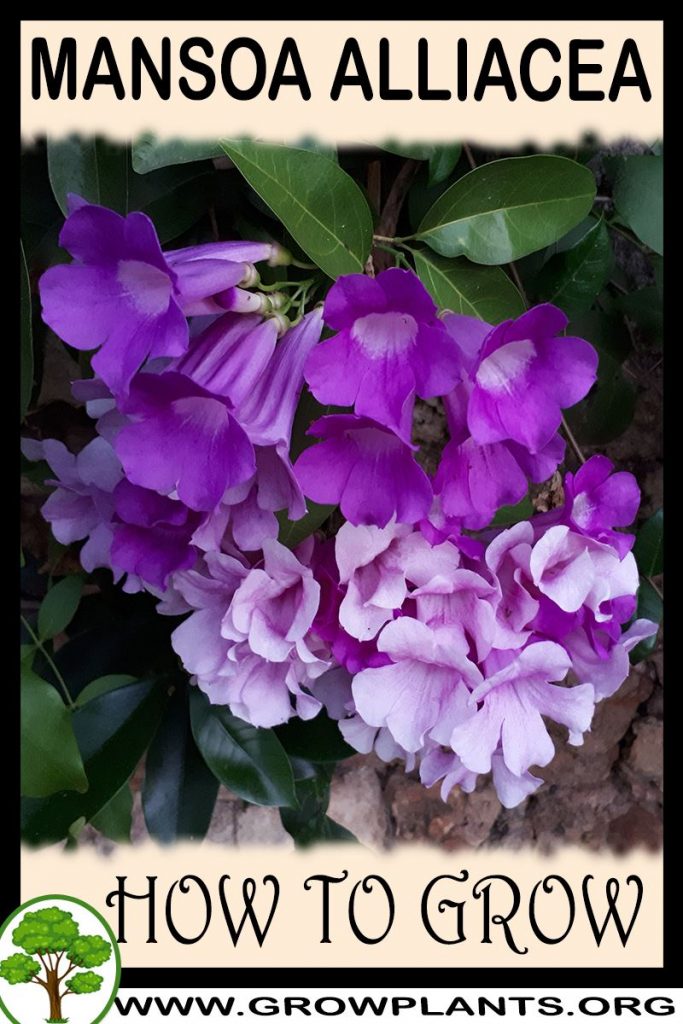
Plant Profile & Key Characteristics
Overview: Mansoa alliacea (garlic vine) is an evergreen tropical climber 1.5-2.5 m whose crushed leaves smell of garlic; grown as an ornamental flowering vine and screening/hedge plant.
Quick Specifications
| Specification | Attribute |
|---|---|
| Plant Type / Life Cycle | Perennial (evergreen) |
| Foliage Type | Evergreen |
| Mature Size | 1.5-2.5 m (5-8 ft) |
| Growth Rate | Fast to moderate |
| Toxicity | Non-toxic; garlic-scented leaves used as a seasoning |
| Hardiness | USDA 9+ |
Growth Form & Structure
- Height & Spread: 1.5-2.5 m (5-8 ft) climbing; suits containers and can be grown indoors.
- Growth Habit & Form: Twining evergreen vine, trained on trellises or grown as a hedge/screen.
- Lifespan & Maturity: Fast-to-moderate growth; long-lived perennial.
Anatomy & Physical Features
- Leaves & Foliage: Green, elliptic, pointed leaves that smell of garlic when crushed.
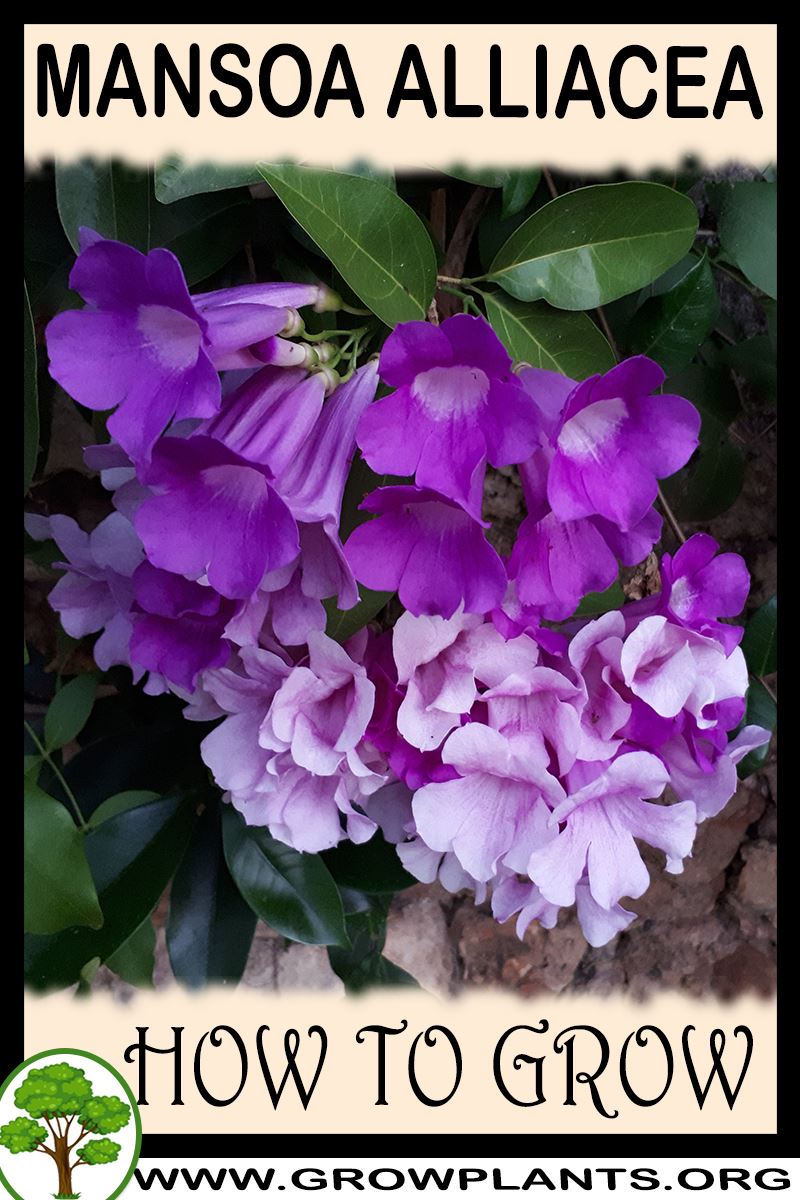
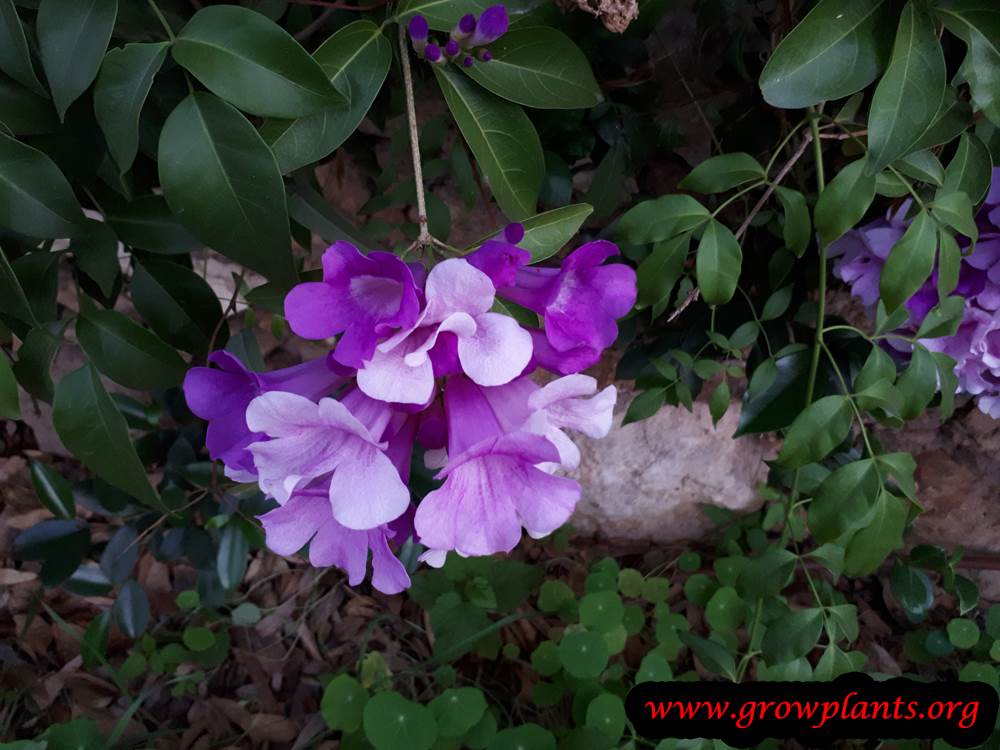
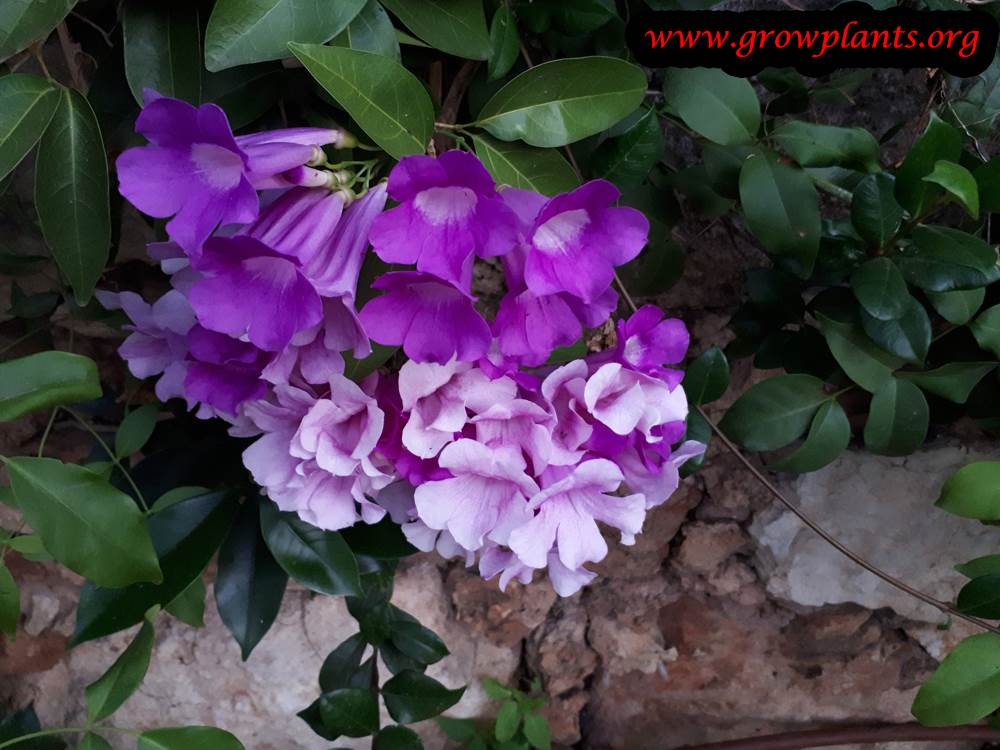
- Flower Characteristics: Trumpet-shaped flowers fading from purple-pink to white (see Bloom guide).
Primary Uses & Landscape Value
- Edible Uses: Aromatic leaves used as a garlic-flavour seasoning.
- Functional & Ornamental Roles: Ornamental flowering vine, screen/hedge; container and houseplant.
Care Guide: Planting, Soil & Watering
Overview: Garlic vine (Mansoa alliacea) is a fast- to medium-growing evergreen climber (zone 9+) that grows well in full sun through to shade and wants well-draining soil. It likes moderate to generous watering while in active growth but should not sit waterlogged.
Quick Care Requirements
| Requirement | Ideal Condition |
|---|---|
| Planting Season | Spring through autumn |
| Growth Rate | Fast to Moderate |
| Soil Type | Well-draining |
| Water Need | Moderate to High with good drainage |
Planting & Establishment
- Best Planting Season: Plant in spring, summer or autumn.
- How to Plant:
- Hole Preparation: Dig a hole wider than the root ball beside a support or trellis the vine can climb.
- Soil Amendments: Blend compost or organic matter into the backfill while keeping the mix free-draining.
- Planting Depth: Set the root ball level with the soil surface, firm gently and mulch.
- Growth Speed & Expectations: Fast to medium — reaches about 1.5–2.5 m (5–8 ft) and can be trained as a hedge or screen.
Soil, Watering & Drainage Care
- Soil Mix & Drainage Needs: Well-draining soil is key; in containers use a good potting mix with drainage holes to prevent root rot.
- Watering Schedule & Technique:
- Young / Newly Planted: Keep the soil evenly moist while roots establish.
- Established: Water moderately to generously, allowing the surface to dry slightly between waterings.
- Seasonal Adjustments: More in summer heat, less in cool weather.
Climate, Light & Hardiness
Mansoa alliacea (Garlic vine) grows in temperate, mediterranean, subtropical, or tropical climates and is flexible on light, tolerating full sun through to full shade as long as shaded spots still receive reasonable light. The site rates its cold tolerance to approximately zone 9 and above.
Quick Climate Specifications
| Climate Zones | Temperate, mediterranean, subtropical, and tropical climates |
|---|---|
| USDA Hardiness Zones | Approximately 9 and above |
| Frost Tolerance | Low |
| Light Conditions | Full Sun, Half Shade, or Full Shade (with adequate light) |
Sunlight & Light Exposure
Optimal Light Setup
Adapts to a wide range of light from full sun to full shade, provided shaded positions still get reasonably bright ambient light.
Temperature Extremes & Hardiness
USDA Hardiness & Regional Limits
Reliable outdoor culture is rated from approximately zone 9 upward.
Cold Damage & Winter Protection
As a tropical-origin vine, protect from frost, especially while young; a sheltered site helps at the cooler edge of its range.
Frost Sensitivity
Frost can damage or kill top growth; site in a warm, protected spot in marginal zone 9 gardens.
Wind, Humidity & Microclimate
Microclimate Recommendations
A warm, humid, sheltered microclimate suits this tropical-origin vine best outside its core range.
Growing in Pots, Balconies & Indoors
Garlic vine is listed by the grower as suitable both indoors and in containers. This tropical flowering climber (1.5-2.5 m / 5-8 ft) tolerates a wide light range – full sun through to full shade with good ambient light – so it adapts well to a bright indoor spot, patio or balcony, given something to climb.
Quick Details
- Container Size: A pot of about 20-30 L (5-8 gal) with a trellis or hoop
- Indoor Suitability: Suitable indoors in a bright spot with support for the stems
- Best Spot: Full sun to shade; bright, indirect light indoors
- Soil & Drainage: Free-draining, organic-rich mix
- Watering in Pots: Keep evenly moist in growth; it likes average to generous water
Indoors & On the Windowsill
- A houseplant option: The grower rates it suitable indoors – give it bright light and a support to twine around; it flowers best with some direct sun.
- Windowsill / support: Provide a small trellis or moss pole; its garlic-scented leaves are a talking point in a bright room.
- Overwintering: Tender – a pot lets you keep it warm and bright indoors through cold spells.
On a Balcony or Patio
- Light & wind: Happy in sun or part shade on a sheltered balcony; give it a firm support and shelter from cold wind.
- Practicalities: Prune after flowering to keep it tidy; pots dry quickly in warm, bright spots.
Choosing the Pot, Soil & Long-Term Care
- Pot & drainage: A 20-30 L pot with strong drainage holes; skip a standing-water saucer to avoid root rot. Terracotta breathes and dries faster; glazed or plastic holds moisture longer.
- Potting mix: A light, aerated, organic-rich mix – potting compost or peat/coir with added perlite or vermiculite for drainage.
- Feeding: Nutrients wash out of pots faster than open ground, so feed potted garlic vine more often – a balanced liquid feed through the active growing season.
- Repotting: Refresh the top layer of mix each year and renew it or pot up every couple of years; lightly trim the roots and top growth when you do.
Fertilizing & Feeding
A moderate feeder that rewards steady, balanced nutrition with fuller foliage and a heavier flush of purple-pink to white trumpet flowers.
Quick Fertilizing Specs
| Feeding Level | Moderate feeder |
|---|---|
| Main Nutrient Priority | Balanced feeding with adequate nitrogen for foliage and potassium support for flowering |
| Best Feeding Period | Spring through the warm growing season |
| Organic Options | Compost or aged manure worked into well-drained soil |
| Reduce/Stop Feeding | Taper off feeding as growth slows toward the cooler part of the year |
| Micronutrients | Usually met by a complete fertilizer; correct only a diagnosed deficiency |
| Soil pH | Tolerates a range, doing best in well-drained soil |
Feeding by Growth Stage
Establishing after planting
Help new roots settle in well-drained soil and start the vine climbing its support.
| Nutrient direction | A balanced fertilizer with adequate nitrogen supports early root and stem development. |
|---|---|
| Timing | The first growing season after planting. |
| Frequency | A light feeding at planting, repeated as new growth establishes. |
| Fertilizer types | A balanced complete fertilizer, Compost worked into the planting area |
| Precautions | Avoid heavy feeding immediately after planting; let roots establish before pushing top growth. |
Active vine growth
Build out the elliptic, pointed foliage and climbing framework ahead of the flowering flush.
| Nutrient direction | A balanced, nitrogen-leaning feeding supports steady leafy growth on the climbing stems. |
|---|---|
| Timing | Spring into early summer as the vine is actively extending. |
| Frequency | Several light feedings through this period of active growth. |
| Fertilizer types | A balanced complete fertilizer, A nitrogen-forward feed for foliage growth |
| Precautions | Avoid pushing excess nitrogen once flower buds begin forming, as it can favor leaves over blooms. |
Trumpet-flower bloom
Support a heavy flush of purple-pink to white trumpet flowers.
| Nutrient direction | A balanced fertilizer with proportionally more potassium supports strong flowering. |
|---|---|
| Timing | As flower buds form through the bloom period. |
| Frequency | A light feeding as buds form, easing off once flowering is underway. |
| Fertilizer types | A balanced fertilizer formulated for flowering vines, A potassium-inclusive bloom feed |
| Precautions | Avoid heavy nitrogen feeding during bloom, which can favor foliage growth at the expense of flowers. |
Nutrient Deficiency Signs & Corrections
Older leaves fade to pale green or yellow and overall vine growth slows.
| Possible causes | low available soil nitrogen, nitrogen leaching from frequent watering, thin, low-organic-matter soil |
|---|---|
| Appears first on | older, lower leaves |
| What to check | recent feeding history, soil organic matter, watering and drainage |
| Possible correction | Apply a balanced fertilizer with available nitrogen and build soil organic matter. |
Interveinal yellowing shows on older leaves while the veins remain green.
| Possible causes | low soil magnesium, heavy potassium feeding competing with magnesium uptake, leaching in light, well-drained soils |
|---|---|
| Appears first on | older, lower leaves |
| What to check | soil magnesium status, how potassium-heavy recent feeding has been, soil texture and leaching |
| Possible correction | Apply a labeled magnesium source such as Epsom salt or a dolomitic amendment and rebalance feeding. |
Leaf margins scorch or brown and flowering is noticeably lighter than expected.
| Possible causes | low soil potassium, inconsistent watering limiting nutrient uptake, heavy nitrogen feeding diluting potassium relative to growth |
|---|---|
| Appears first on | margins of older leaves |
| What to check | watering consistency, recent fertilizer balance, bloom performance compared to prior seasons |
| Possible correction | Shift toward a more balanced or potassium-inclusive fertilizer and maintain even watering. |
Pruning, Training & Seasonal Maintenance
Garlic vine is a moderate-sized twining climber that blooms in dense flushes of trumpet flowers rather than continuously, resting between flushes before the next round. It tolerates regular pruning well and its main objective is training onto a support while encouraging repeat flowering, rather than heavy structural work. Autumn–winter cutback keeps the vine within bounds ahead of the spring–summer bloom season, while light deadheading/tidying after each bloom flush during the season itself helps prompt the next one.
Quick Pruning & Maintenance Specs
| Pruning Tolerance | Moderate–High |
| Primary Pruning Window | Autumn – winter |
| Secondary Maintenance Window | Light tidying/deadheading after each bloom flush, spring–summer |
| Typical Frequency | One seasonal shaping cutback plus after-flush tidying |
| Main Objective | Train onto support, encourage repeat bloom flushes, control size |
| Young Plant Priority | Tie in leading stems to a trellis, fence or pergola |
| Mature Plant Priority | Shape and thin after the dormant season; tidy after each bloom flush |
| Best Tool Type | Bypass secateurs / precision snips |
| Avoid Heavy Pruning During | An active bloom flush |
Pruning by Plant Age & Size
Newly Established
Remove only damaged growth; direct young twining stems onto their support so they take hold before growth speeds up.
Young / Formative
Train onto a trellis, fence or pergola – no formal leader/vase system applies to this twining habit. Because the species stays relatively compact for a vine (roughly 1.5–2.5m), it can also be kept as a large, loosely trained container specimen rather than requiring a permanent structure.
Mature / Established
Shape and thin congested growth in autumn/winter, then lightly tidy spent flower clusters and any straggly growth after each bloom flush through the growing season.
Seasonal Pruning Schedule
Autumn / Winter
- Objective: shape and control size ahead of the spring–summer bloom season.
- Remove: overlong or crossing stems, thin congested growth.
- Do not remove: the full framework on a young or newly trellised plant – build it gradually.
- Expected response: renewed growth that carries the coming bloom flushes.
After Each Bloom Flush
- Objective: tidy spent flowers and encourage the next flush.
- Remove: faded flower clusters and any straggly stems from that flush.
- Do not remove: unopened buds still forming for the current or next flush.
- Expected response: the plant typically rests briefly, then produces a further flush of bloom.
Structural Pruning & Training
Tie in and direct twining stems onto their support as the main structural task; thin out crossing or overly dense growth in the dormant season so light reaches the interior and future flower flushes are not confined to the outer surface only.
Special Growth to Remove
- Spent flower clusters after each flush.
- Straggly, non-productive stems that detract from a tidy trellis coverage.
Container & Small-Space Pruning
Given its compact size for a vine and documented ability to grow indoors, garlic vine suits container culture well. Pinch and lightly cut back more often than an in-ground plant to keep it in proportion to a pot, and provide a small trellis or hoop even in containers since it is a twining climber rather than a self-supporting shrub.
Tools
Bypass secateurs or precision snips cover this vine’s cuts – stems stay slender enough that loppers or a saw are not normally needed.
Tool Hygiene & Disease Risk
Routine care – keep tools clean and sharp; no significant transmissible disease is documented for this species.
Cut Placement & Technique
Deadhead spent flower clusters just behind the faded bloom; use thinning cuts on congested stems back to their point of origin rather than shearing the surface.
Heavy Pruning & Rejuvenation
Tolerates a fairly hard cutback to renew an overgrown specimen, with regrowth typical of this fast-to-medium growing species; expect a pause in flowering while the plant rebuilds before its next flush.
Post-Pruning Care
Water normally after cutting back; this species also appreciates slightly more water than many of its climbing relatives, so do not let a newly pruned plant dry out while it regrows. No extra feeding is required for routine maintenance cuts.
Common Pruning Mistakes
- Deadheading or cutting hard in the middle of an active bloom flush, cutting the display short.
- Leaving the vine untied until it collapses or tangles over neighbouring plants.
- Growing it in a container without any support, despite its twining habit.
When Not to Prune
Avoid cutting back or deadheading mid-flush if you want to see that display through to its natural end; wait until the flush has finished fading.
Recommended Tools (by task)
- bypass_secateurs – shaping cuts, thinning, and stem work.
- precision_snips – deadheading spent flower clusters after each flush.
- soft_ties_stakes – training stems onto a trellis, hoop or pergola, including in containers.
Propagation Guide
The most practical way to propagate garlic vine is from semi-hardwood stem cuttings, which root reliably with warmth and humidity; air or ground layering also works well for this vigorous climber. Seed propagation is possible but is rarely used in cultivation and reliable viability/germination information is not well established, so cuttings remain the recommended route. Overall this is an easy to moderate plant to propagate.
Quick Propagation Specs
| Best Propagation Method | Semi-hardwood stem cuttings |
| Alternative Methods | Air/ground layering |
| Propagation Difficulty | Easy to Moderate |
| Vegetative True-to-Type | Yes |
| Best Propagation Season | Warm growing season (spring to summer) |
| Cutting Rooting Time | Typically a few weeks under warm, humid conditions |
| Grafting Required | No |
Stem Cuttings
Cutting Type
Semi-hardwood stem sections with a couple of nodes.
Best Timing
Warm growing season.
Cutting Preparation
Remove the lower leaves and cut just below a node.
Rooting Setup
A well-drained, humid propagating mix; bottom warmth is beneficial.
Rooting Hormone
Optional, may improve consistency.
Rooting Time
Typically a few weeks.
Air & Ground Layering
As a vigorous climber, semi-mature stems can be air-layered or pinned to soil (ground layering) at a node; light wounding at the layering point can help. Keep the layering medium consistently moist; rooting generally takes some weeks before the layer can be severed and potted up.
Bloom & Flower Guide
Quick Details
- Bloom Season: Spring and summer, often with a second flush
- Flower Appearance: Trumpet-shaped flowers opening purple-pink and fading toward white, in showy clusters
- Edibility: Grown as an ornamental; the foliage smells strongly of garlic and is sometimes used as a flavouring, but the flowers are ornamental, not a food
Detailed Blooming Overview
Garlic vine puts on a striking show of trumpet flowers that open deep purple-pink and pale to near-white with age, so a single cluster carries several shades at once. Bruise any part and you catch the garlic scent that gives it its name.
Flower Characteristics
- Trumpet-shaped flowers, purple-pink fading to white, borne in clusters.
Bloom Care & Thinning
- Encouraging bloom: Full sun to part shade and well-drained soil bring the best display; it flowers on established growth, often twice a year.
- Managing the display: Cut back after flowering to shape and encourage the next flush.
Bloom Health & Protection
- Aphids on buds: Aphids may cluster on soft buds and shoots; neem oil or insecticidal soap helps.
Pests, Diseases & Troubleshooting
Overview: The garlic vine (Mansoa alliacea) is a vigorous tropical Bignoniaceae climber that is largely pest-free — its garlic-scented foliage seems to deter many insects — with occasional sap-suckers such as aphids, mealybugs, spider mites, whiteflies and scale appearing on stressed or crowded plants, plus leaf spot and root rot in wet or airless conditions. It responds to warmth, sun, airflow and free-draining soil, with light organic controls if pests appear.
Quick Troubleshooting Overview
| Issue / Pest | Main Symptom | Primary Solution |
|---|---|---|
| Aphids | Clusters on new tips; curling and honeydew | Hose off, insecticidal soap or neem |
| Mealybugs | White cottony fluff in leaf axils and stems | Alcohol swab, insecticidal soap, repeat weekly |
| Spider mites | Fine stippling and webbing in hot dry air | Raise humidity, rinse, insecticidal soap or miticide |
| Whiteflies | Small white flies rising when disturbed; yellowing | Sticky traps, insecticidal soap or neem |
| Leaf spot | Brown spots on leaves in humid, crowded conditions | Airflow, remove affected leaves, copper if severe |
| Root rot | Yellowing, wilting, soft roots in soggy soil | Improve drainage, reduce watering |
Common Pests & Management
- Aphids (Aphis / Myzus spp.):
- Symptoms: Green or dark clusters on soft new shoots and flower buds, causing curling and distortion with sticky honeydew, usually only on lush, stressed or over-fed growth.
- Prevention & Control: Rinse off with water and treat with insecticidal soap or neem oil if needed; ladybirds and lacewings clear them quickly outdoors.
- Mealybugs (Planococcus citri):
- Symptoms: White cottony blobs in leaf axils and along stems, with honeydew and sooty mould; more common on container-grown or indoor plants.
- Prevention & Control: Spot-treat with alcohol on a cotton bud, then spray insecticidal soap or neem oil weekly until clear, checking hidden crevices.
- Spider mites (Tetranychus urticae):
- Symptoms: In hot, dry conditions leaves show fine pale stippling and light webbing on the undersides, dulling and yellowing.
- Prevention & Control: Raise humidity and airflow, rinse the foliage, and apply insecticidal soap or a miticide if needed, covering leaf undersides.
- Whiteflies (Trialeurodes / Bemisia spp.):
- Symptoms: Tiny white flies lift off when disturbed; nymphs on leaf undersides suck sap and secrete honeydew, yellowing foliage.
- Prevention & Control: Hang yellow sticky traps and spray insecticidal soap or neem to the undersides, repeating regularly.
- Scale insects (Coccidae / Diaspididae):
- Symptoms: Occasional brown or tan bumps on stems and leaf undersides with honeydew from soft scale.
- Prevention & Control: Scrape off, swab with alcohol, and apply horticultural oil; prune out heavily infested stems.
Diseases & Fungal Issues
- Fungal leaf spot (Cercospora / Alternaria):
- Symptoms: Brown or dark spots and blotches on leaves in humid, crowded, poorly ventilated conditions, sometimes with yellow haloes.
- Treatment & Management: Improve airflow and spacing, avoid overhead watering, and remove affected leaves; a copper fungicide can be used if spread is active.
- Powdery mildew (Erysiphaceae):
- Symptoms: A white powdery film on leaves in humid but still conditions, causing yellowing and leaf drop.
- Treatment & Management: Open up the vine for airflow, avoid overcrowding, and treat with sulphur or potassium bicarbonate where persistent.
- Root rot (Phytophthora / Pythium):
- Symptoms: Yellowing, wilting and soft, dark roots when soil or compost stays waterlogged.
- Treatment & Management: Provide sharp drainage, water only as the surface dries, and never leave containers standing in water; repot rotting plants into fresh airy mix.
Growing Difficulties & Abiotic Problems
- Overwatering / poor drainage:
- Cause & Symptoms: Yellowing lower leaves and wilting despite wet soil in heavy or waterlogged ground.
- Correction Strategy: Use free-draining soil, water when the surface begins to dry, and improve drainage for in-ground plants.
- Poor flowering:
- Cause & Symptoms: Vigorous leafy growth with few of the characteristic purple flower flushes, from too little light or excess nitrogen.
- Correction Strategy: Grow in full sun to bright light and feed with a bloom-oriented (higher-potassium) fertiliser rather than high nitrogen.
- Cold damage:
- Cause & Symptoms: Blackened, scorched growth after exposure to cold below its tropical comfort range.
- Correction Strategy: Site in a warm, sheltered spot and protect or bring under cover before cold snaps.
What Helps – Products & Tools
Care is mostly cultural — sun, warmth, airflow and free-draining soil; the plant is naturally fairly pest-resistant. Useful products are insecticidal soap and neem oil for aphids, mealybugs, mites and whiteflies, yellow sticky traps for whitefly, horticultural oil for scale, and a copper fungicide or sulphur/potassium bicarbonate for leaf spot and mildew.