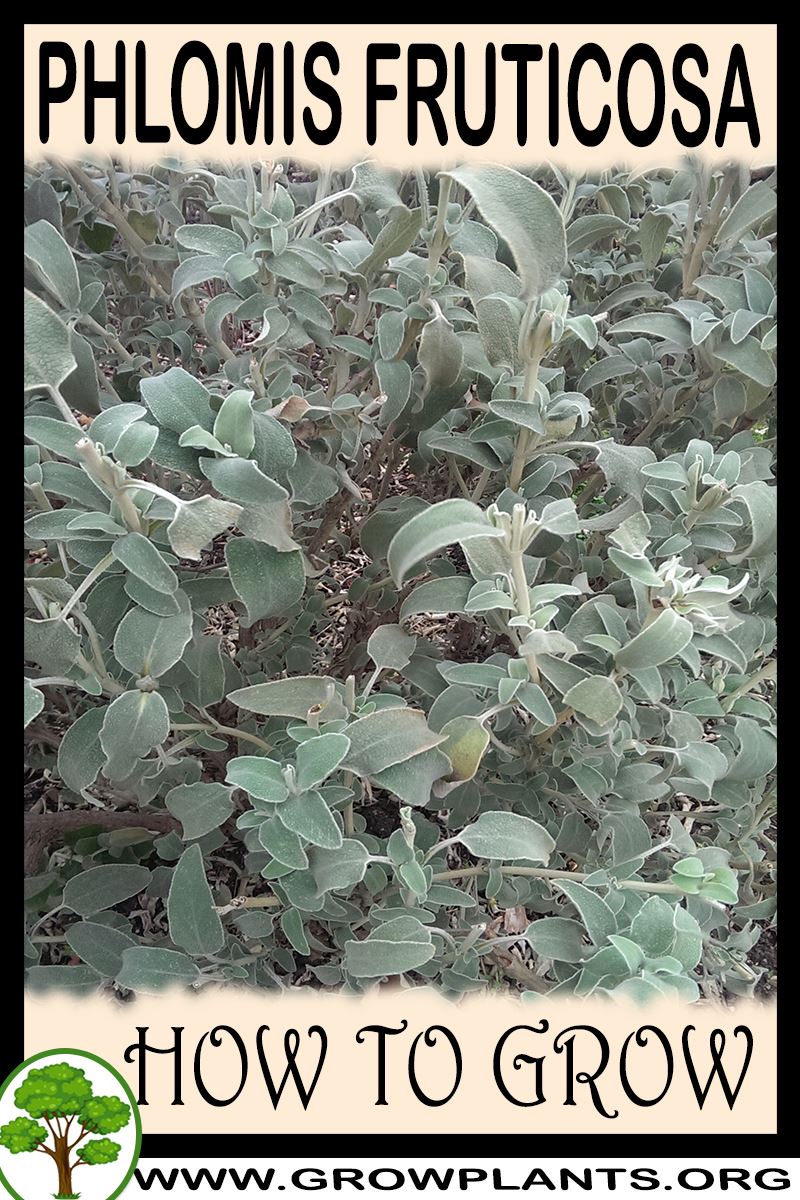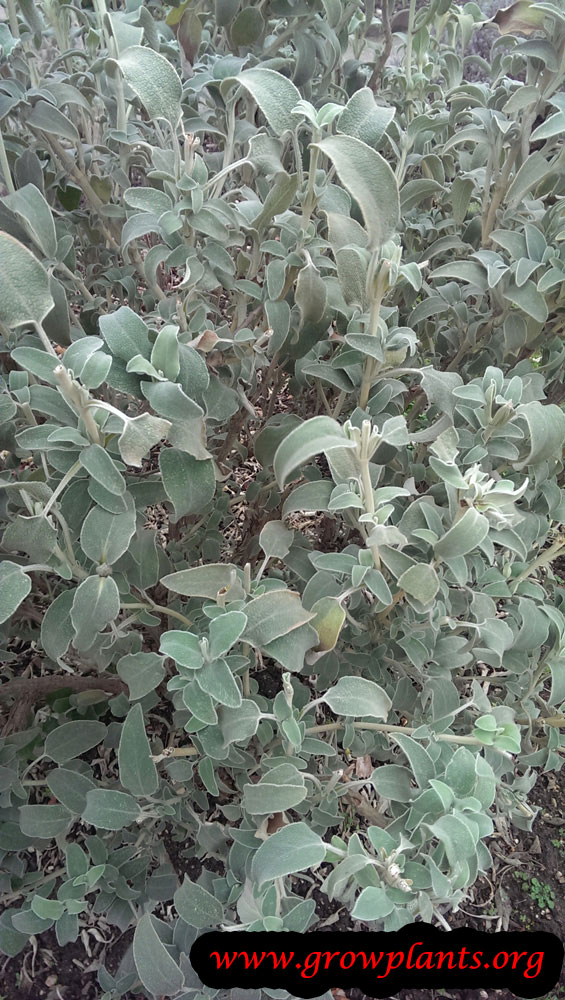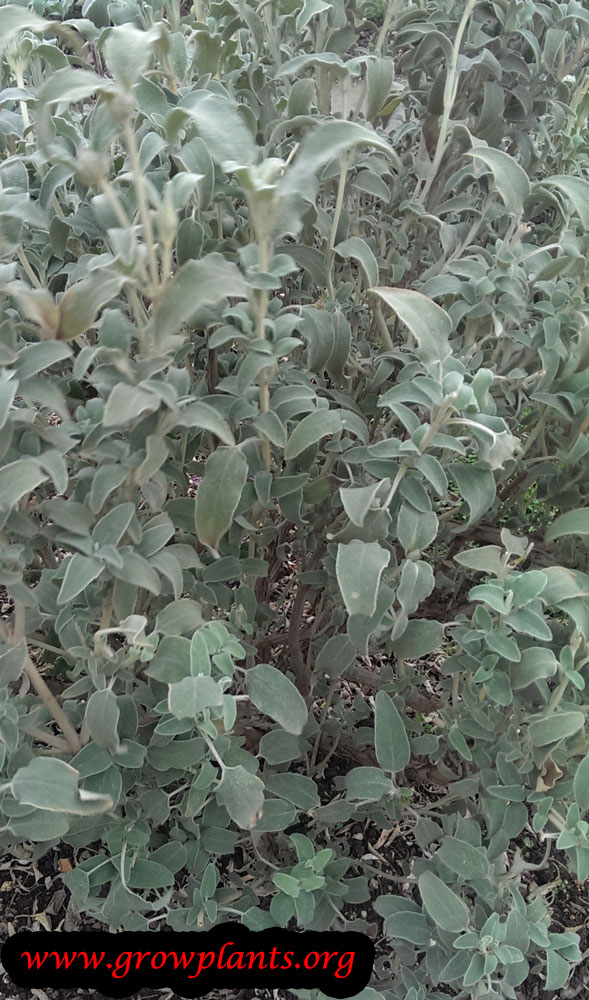


Plant Profile & Key Characteristics
Overview: An evergreen Mediterranean shrub 0.5-1.5 m (20-60 in) tall with aromatic grey-green sage-like foliage. It is grown as an ornamental, drought-tolerant plant for hot, sunny gardens, carrying whorls of hooded yellow flowers.
Quick Specifications
| Specification | Attribute |
|---|---|
| Plant Type / Life Cycle | Perennial (evergreen shrub) |
| Foliage Type | Evergreen |
| Mature Size | 0.5-1.5 m (20-60 in / 1.6-5 ft) tall |
| Growth Rate | Fast to moderate |
| Hardiness | USDA zones 7-11 |
Growth Form & Structure
- Height & Spread: A rounded shrub 0.5-1.5 m (20-60 in) tall and roughly as wide; also grown in large containers, and tolerant of poor, dry soils.
- Growth Habit & Form: Bushy, mounded evergreen shrub with soft-woody stems, spreading readily where conditions suit it.
- Lifespan & Maturity: A long-lived, quick-establishing perennial shrub kept dense by occasional trimming.
Anatomy & Physical Features
- Leaves & Foliage: Aromatic, felted grey-green oval leaves resembling those of sage.
- Flower Characteristics: Fragrant hooded yellow flowers in tiered whorls along the stems, forming ball-like clusters.
Primary Uses & Landscape Value
- Functional & Ornamental Roles: A drought-tolerant ornamental for Mediterranean, gravel and pollinator gardens; the aromatic foliage and long-lasting seed-heads add year-round structure.
Care Guide: Planting, Soil & Watering
Overview: Jerusalem sage is a tough, drought-tolerant Mediterranean subshrub that thrives in full sun to light shade in light, sharply drained soil. Once established it needs little water and prefers to stay on the dry side.
Quick Care Requirements
| Requirement | Ideal Condition |
|---|---|
| Planting Season | Spring, summer or autumn in mild, frost-free conditions |
| Growth Rate | Fast to moderate |
| Soil Type | Light, gritty, sharply drained; tolerates poor, dry soil |
| Water Need | Low — drought-tolerant, let the soil dry well between waterings |
Planting & Establishment
- Best Planting Season: Plant in spring, summer or autumn while conditions stay above about 10°C and frost-free.
- How to Plant:
- Hole Preparation: Dig a hole as deep as and a little wider than the root ball on a freely draining site, ideally a sunny slope or raised bed.
- Soil Amendments: Add grit or coarse sand to improve drainage rather than rich organic matter, which it does not need.
- Planting Depth: Set the root ball level with the surface, keeping the crown at soil level to avoid crown rot.
- Growth Speed & Expectations: Expect fast-to-moderate growth to a rounded subshrub 0.5–1.5 m tall and wide.
Soil, Watering & Drainage Care
- Soil Mix & Drainage Needs: Sharp drainage is essential — it rots in heavy, wet soil; in a container use a gritty, free-draining mix.
- Watering Schedule & Technique:
- Young / Newly Planted: Water occasionally to settle young plants in during their first season.
- Established: Water deeply but infrequently, letting the soil dry out well between waterings.
- Seasonal Adjustments: It needs almost no water in cool, wet weather; give an occasional deep soak only in prolonged summer drought.
Climate, Light & Hardiness
Phlomis fruticosa (Jerusalem sage) is a classic Mediterranean-climate shrub that thrives in full sun to half shade with modest water needs. It is moderately cold hardy and well suited to dry, sunny, drought-prone conditions.
Quick Climate Specifications
| Climate Zones | Mediterranean, Subtropics, Temperate |
|---|---|
| USDA Hardiness Zones | 7–11 |
| Approx. Survival Minimum | Established plants generally tolerate brief dips to around 10°C (50°F) and somewhat below without serious harm; a cautious approach is recommended near the cold edge of its zone range |
| Frost Tolerance | Moderate |
| Light Conditions | Full Sun / Half Shade |
Sunlight & Light Exposure
Optimal Light Setup
Full sun brings out the best flowering and compact form; half shade is tolerated but growth may be looser.
Temperature Extremes & Hardiness
USDA Hardiness & Regional Limits
Hardy across zones 7–11, making it a reliable perennial shrub through much of the Mediterranean and warm-temperate world.
Cold Damage & Winter Protection
Site notes point to roughly 10°C (50°F) as a comfort threshold; colder snaps near the bottom of its hardiness range can cause some dieback of soft growth even if the plant survives overall.
Frost Sensitivity
Tolerates light, occasional frost typical of zone 7–8 winters, but prolonged hard freezes can damage or kill stems.
Wind, Humidity & Microclimate
Dry-Air Tolerance
Naturally suited to dry Mediterranean air and low humidity, consistent with its drought-tolerant, fragrant-leaved habit.
Wind Tolerance
Generally tolerant of open, breezy Mediterranean-type sites once established.
Growing in Pots, Balconies & Indoors
Jerusalem sage (Phlomis fruticosa) is an evergreen, sun-loving Mediterranean shrub (0.5-1.5 m) with grey woolly leaves and yellow whorled flowers. The grower says it is not a houseplant but can be grown in a container – it makes a fine drought-tolerant patio or balcony shrub outdoors.
Quick Details
- Container Size: A medium-to-large pot for its shrubby, spreading habit
- Indoor Suitability: Not a houseplant – an outdoor sun-lover
- Best Spot: Full sun to half shade, outdoors
- Soil & Drainage: Gritty, free-draining mix – it dislikes winter wet
- Watering in Pots: Small to average amount – let it dry between waterings
Indoors & On the Windowsill
- Not a houseplant: The grower confirms it will not grow indoors; it is an outdoor Mediterranean shrub.
- Windowsill: Only a very sunny sill would suit it briefly – it truly belongs outside in full sun.
On a Balcony or Patio
- Light, wind & heat: Give it the brightest spot it will tolerate; walls and railings reflect heat and dry pots quickly, so check moisture often and shelter or stake exposed growth.
- Sun & drought: A hot, sunny, well-drained spot is ideal; wall heat and fast-drying pots suit this drought-tolerant shrub – avoid keeping it wet.
Choosing the Pot, Soil & Long-Term Care
- Pot & drainage: A medium-to-large pot with strong holes; add grit for sharp drainage. Use strong drainage holes and skip a standing-water saucer to avoid root rot. Terracotta breathes and dries faster; glazed or plastic holds moisture longer.
- Potting mix: A gritty, free-draining mix with only a little organic matter.
- Feeding: Feed sparingly – it thrives on lean soil.
- Repotting: Refresh the mix and pot up about every two years; for perennials, lightly root- and top-prune the plant when you do.
Fertilizing & Feeding
A light feeder true to its Mediterranean, drought-tolerant nature: an occasional light balanced feeding in spring is usually enough to support the fragrant gray-green foliage and yellow whorled flowers, with rich soil or heavy fertilizer generally unnecessary.
Quick Fertilizing Specs
| Feeding Level | Light feeder |
|---|---|
| Main Nutrient Priority | Balanced feeding, kept light, ahead of and during bloom |
| Best Feeding Period | Spring as new growth and flower spikes begin |
| Organic Options | A light top-dressing of compost is optional rather than essential |
| Reduce/Stop Feeding | Ease off feeding through the hot, dry summer and again in winter |
| Micronutrients | Rarely an issue for this low-input, drought-tolerant shrub |
| Soil pH | Tolerates a wide range and prefers lean, well-drained soil |
Feeding by Growth Stage
Spring growth flush
Support fresh gray-green foliage and the emerging flower spikes without pushing lush, floppy growth on this drought-tolerant shrub.
| Nutrient direction | A light, balanced fertilizer is generally enough; this plant thrives on lean soil and rarely needs heavy feeding. |
|---|---|
| Timing | Spring as new growth resumes. |
| Frequency | A single light feeding at the start of spring growth is usually sufficient. |
| Fertilizer types | A balanced, light-strength fertilizer, An optional light compost top-dressing |
| Precautions | Avoid rich soil or heavy feeding, which can produce lax growth that flops and reduces this shrub’s natural drought tolerance. |
Spring to summer bloom
Sustain the fragrant yellow, whorled flower clusters through their bloom period.
| Nutrient direction | Feeding needs are minimal during bloom; balanced nutrition already in the soil generally carries the plant through flowering without added phosphorus. |
|---|---|
| Timing | Spring into summer while flower spikes are open. |
| Frequency | Feeding is rarely needed during bloom beyond what was applied earlier in spring. |
| Fertilizer types | A light balanced fertilizer only if growth looks thin |
| Precautions | Resist the urge to add a high-phosphorus bloom booster; balanced nutrition and full sun drive this shrub’s flowering, not extra phosphorus. |
Hot dry summer and winter rest
Let this drought-tolerant shrub coast through its low-growth periods without unnecessary fertilizer.
| Nutrient direction | None – a resting, drought-tolerant shrub in the heat of summer or through winter does not need feeding. |
|---|---|
| Timing | The hottest, driest part of summer and again through winter. |
| Frequency | No feeding during these rest periods; resume light feeding as spring growth resumes. |
| Fertilizer types | No feeding at this stage – the plant is resting through heat or cold. |
| Precautions | Do not fertilize during summer heat stress or winter dormancy; feeding now wastes nutrients and can encourage tender growth at the wrong time. |
Nutrient Deficiency Signs & Corrections
Pale, washed-out gray-green foliage and thin, sparse growth beyond what is typical for this shrub.
| Possible causes | very lean or depleted soil, nitrogen leaching after unusually heavy rain, root competition from nearby aggressive plants |
|---|---|
| Appears first on | older, lower leaves |
| What to check | how long since any feeding, soil fertility and organic matter, competing nearby vegetation |
| Possible correction | Apply a light balanced fertilizer once, then monitor before repeating, since this plant rarely needs ongoing feeding. |
Wilting, yellowing, or dieback despite this being a drought-tolerant shrub, often with soft or blackened stem bases.
| Possible causes | waterlogged or poorly drained soil, root rot from excess irrigation, planting site that collects water |
|---|---|
| Appears first on | lower stems and older leaves |
| What to check | soil drainage, recent watering frequency, whether the site pools water after rain |
| Possible correction | Reduce watering, improve drainage, and avoid fertilizing further until the plant shows active recovery growth. |
New leaves emerge pale yellow with the veins remaining green.
| Possible causes | high soil pH limiting iron availability, waterlogged roots reducing uptake, compacted, poorly aerated soil |
|---|---|
| Appears first on | newest growth |
| What to check | soil drainage and pH, how compacted the planting site is, recent transplant stress |
| Possible correction | Improve drainage and soil aeration first, then apply a chelated iron product per its label if needed. |
Pruning, Training & Seasonal Maintenance
Jerusalem sage is a fast-to-medium growing, drought-tolerant Mediterranean subshrub that becomes woody, sparse, and floppy at the base within a few years if left untrimmed – but, like many Mediterranean subshrubs (lavender, rosemary), it does not reliably resprout from hard cuts into bare old wood. The safest and most effective approach is a moderate trim into live, leafy growth right after flowering, done every year so a drastic rejuvenation cut into old wood is never needed.
Quick Pruning & Maintenance Specs
| Pruning Tolerance | Moderate (into live wood only – not into bare old wood) |
| Primary Pruning Window | Post-flowering (mid–late summer) |
| Secondary Maintenance Window | Light spring tidy of any frost- or winter-damaged tips |
| Typical Frequency | One light-to-moderate trim per year |
| Main Objective | Prevent a bare, leggy base; deadhead; keep the mound compact |
| Young Plant Priority | Pinch tips early to build a bushy, multi-stemmed base |
| Mature Plant Priority | Regular light trims into leafy growth so the plant never needs cutting into bare wood |
| Best Tool Type | Bypass secateurs for deadheading; light hedge shears for the overall post-bloom trim |
| Avoid Heavy Pruning During | Peak bloom, summer drought stress, and late autumn close to frost in zone-7 margins |
Pruning by Plant Age & Size
Newly Established
Pinch growing tips to encourage a bushy, multi-stemmed base rather than a few long, floppy shoots.
Young / Formative
No formal training system – this is an informal, rounded Mediterranean subshrub. The formative goal is simply a full, many-stemmed framework achieved through early pinching, not staking or a fixed shape.
Mature / Established
Trim into leafy growth every summer after flowering, removing roughly a third of each stem’s length and all spent flower spikes; never let the plant go several years untouched, since catching up later would mean cutting into old wood the plant may not recover from.
Seasonal Pruning Schedule
Post-Flowering (Summer)
Objective: deadhead and lightly shape while leaving plenty of leafy growth on every stem. Remove: spent yellow flower spikes and the leggiest stem tips, cut back into live leafy wood. Do not remove: growth so far back that it enters bare, leafless old wood. Expected response: fresh compact foliage over the remaining growing season. Flowering impact: removes the current season’s spent spikes and sets up a fuller display next spring–summer.
Pre-Growth/Early-Spring
Objective: tidy any tips damaged by winter cold, especially near the cooler edge of its zone 7–11 range. Remove: clearly dead or frost-blackened tips only. Do not remove: stems that still show green/live tissue – wait to see what has survived before cutting further.
Structural Pruning & Training
The structural priority is height and spread control through regular light trimming, aimed specifically at preventing the bare, woody, gappy base this species develops without maintenance. Canopy thinning is not needed – dense, twiggy growth is the plant’s natural, desirable habit.
Special Growth to Remove
Deadhead spent flower spikes after bloom. Because this species is noted as self-seeding/invasive in the garden, also watch for and remove unwanted volunteer seedlings around the parent plant – this is a garden-management task rather than a plant-health one.
Container & Small-Space Pruning
In a pot, trim slightly more often than an in-ground plant, since restricted roots can make top growth stretch and flop faster; the same rule applies – keep every cut in live leafy wood, since a container plant that has gone bare at the base is just as unlikely to resprout from hard wood as one in open ground.
Tools
Bypass secateurs for deadheading and any selective renewal cuts; light hedge shears are appropriate for the general post-bloom shaping trim, since this is a small, rounded mound rather than a plant needing individually selected cuts.
Tool Hygiene & Disease Risk
Routine – keep tools clean and sharp. The only recorded pest is aphids, which are not spread by pruning cuts.
Cut Placement & Technique
Always cut back into live, leafy wood, never into bare leafless stems. Deadhead just above a leaf pair below the spent flower spike; remove any dead wood back to its point of origin.
Heavy Pruning & Rejuvenation
NOT reliably tolerated. Like lavender and rosemary, Jerusalem sage often fails to resprout from a hard cut into old, bare wood. If a plant has already become woody and gappy from neglect, renew it gradually over two to three seasons by trimming hard only where live growth remains, rather than cutting the whole plant back at once – and be prepared that a badly overgrown, bare-based plant may simply need replacing.
Post-Pruning Care
Avoid extra water or feeding after the post-bloom trim – this is a drought-tolerant species that performs best in lean conditions, and added inputs can push soft growth. Ensure any regrowth has time to harden off well before the first autumn frost near the cooler edge of its range.
Common Pruning Mistakes
Leaving the plant untrimmed for years and then cutting hard into bare old wood, which this species may not recover from; pruning too late in autumn and forcing tender growth just before frost in zone-7 margins; deadheading so aggressively during peak bloom that the display is cut short while pollinators are still using it.
When NOT to Prune
Avoid pruning during peak bloom while flowers are still attracting pollinators, during summer drought stress, late in autumn close to frost in zone-7 margins, and at any time into bare, leafless old wood.
Recommended Tools (by task)
- bypass_secateurs – deadheading and any selective renewal cuts into live wood.
- hedge_shears – the annual all-over post-bloom shaping trim of this small, rounded mound.
Pruning Troubleshooting
| Problem | Possible Cause | What to Check | Corrective Action |
| Bare, leggy base with few leaves | Years without regular post-bloom trimming | Trim history and age of the plant | Begin light annual trims into live wood; do not hard-cut into old wood to fix it |
| Plant fails to resprout after a hard cut | Cut made into bare, leafless old wood | Where on the stem the cut was made | In future, always leave live leafy growth on every stem; replace the plant if it does not recover |
| Reduced flowering | Overcrowding from self-sown seedlings | Volunteer seedlings crowding the parent plant | Thin unwanted self-sown seedlings, given this species’ noted self-seeding tendency |
Propagation Guide
Jerusalem sage is easiest to raise from seed, which fits with the site’s note that it can behave invasively – it self-sows freely once established; semi-hardwood stem cuttings are a reliable vegetative alternative and grafting is not needed. As a straight species (not a named cultivar), overall difficulty is Easy.
Quick Propagation Specs
| Best Propagation Method | Seed |
| Alternative Methods | Semi-Hardwood Stem Cuttings |
| Propagation Difficulty | Easy |
| Seed True-to-Type | Usually true-to-type (species) |
| Vegetative True-to-Type | Yes |
| Best Propagation Season | Seed in spring; cuttings in summer |
Growing from Seed
Sow fresh seed in a free-draining, gritty mix; like many Mediterranean shrubs, Phlomis fruticosa needs no special dormancy-breaking treatment and germinates within a few weeks under warm conditions. Since this plant is noted as tending to self-sow readily, deadhead spent flower spikes where volunteer seedlings are not wanted.
Stem Cuttings
Best Timing
Take semi-hardwood cuttings in summer from healthy, non-flowering shoots.
Cutting Preparation
Select firm, current-season growth that has begun to harden.
Rooting Setup
Root in a very free-draining, gritty compost – as a drought-tolerant Mediterranean shrub, this plant is prone to rot in a wet or waterlogged cutting medium, so err on the side of sharp drainage.
Rooting Hormone
Optional; can improve consistency but is not essential.
Bloom & Flower Guide
Quick Details
- Bloom Season: Spring to summer
- Flower Appearance: Bright yellow hooded (two-lipped) flowers gathered into rounded whorls along the stems
- Edibility: Ornamental – grown as a fragrant, drought-tolerant flowering shrub
Detailed Blooming Overview
Jerusalem sage is a Mediterranean shrub grown for its striking early-summer bloom. Whorls of clear yellow, hooded flowers stack up the stems in evenly spaced ‘ball’ clusters, sitting above soft grey-green sage-scented foliage. It thrives in sun and dry, well-drained ground, and the nectar-rich flowers are a magnet for bees. Even after the petals drop, the seed-head whorls stay decorative.
Flower Characteristics
- Yellow two-lipped flowers, larger lip below, in rounded whorls that create tiers along the stem.
- Nectar-rich and very attractive to bees.
Bloom Care & Thinning
- After flowering: Leave the architectural seed whorls for interest, or trim stems back to shape the shrub and encourage bushy regrowth.
Pests, Diseases & Troubleshooting
Overview: Jerusalem sage is an aromatic, grey-woolly Mediterranean subshrub that is remarkably pest- and disease-resistant – its felted, scented leaves deter browsing insects and it thrives on neglect in lean, dry soil. Its one genuine weakness is root rot in heavy, wet or winter-cold ground. Occasional aphids or mites appear only on soft, over-fed or sheltered growth.
Quick Troubleshooting Overview
| Issue / Pest | Main Symptom | Primary Solution |
|---|---|---|
| Root rot | Wilting, blackening base in wet soil | Sharp drainage, lean soil, avoid winter wet |
| Aphids | Minor clusters on soft new tips | Water jet; rarely needs more |
| Powdery mildew | White film in humid, shaded, damp air | Full sun, airflow, avoid overhead water |
| Legginess | Sprawling, bare-based woody plant | Prune after flowering; avoid rich soil/shade |
Common Pests & Management
- Aphids (Aphidoidea spp.):
- Symptoms: Small soft-bodied green, black or grey insects clustered on soft new shoot tips of over-fed plants; causes curled, distorted foliage, sticky honeydew and sooty mould. Look-alikes: whitefly (which flies up when disturbed).
- Prevention & Control: Encourage ladybirds, lacewings and parasitic wasps; blast colonies off with a firm jet of water; remove badly infested tips. Persistent outbreaks respond to insecticidal soap or a light horticultural oil applied to leaf undersides in the cool of the evening to protect pollinators.
- Two-spotted spider mite (Tetranychus urticae):
- Symptoms: Fine pale stippling on leaves, faint webbing on undersides and leaf axils, and a dusty bronzed look in warm dry conditions. Tiny moving specks visible with a hand lens.
- Prevention & Control: Raise humidity and hose foliage regularly, as mites thrive in hot dry air; introduce predatory mites (Phytoseiulus persimilis) under cover. Treat hotspots with insecticidal soap or horticultural oil, ensuring thorough coverage of leaf undersides.
- Leafhoppers (Cicadellidae spp.):
- Symptoms: Pale stippling or flecking on leaves and small wedge-shaped insects that hop or fly off when disturbed; minor on this tough shrub.
- Prevention & Control: Rarely need action on an established plant – encourage predators and tolerate light feeding. A jet of water or insecticidal soap deals with any heavy patch.
Diseases & Fungal Issues
- Root & crown rot (Phytophthora / Rhizoctonia spp.):
- Symptoms: Wilting, yellowing and a blackening stem base, chiefly in heavy, wet or cold soil – the main way this Mediterranean plant is lost.
- Treatment & Management: Plant in sharply drained, lean soil in full sun, avoid winter waterlogging, and never overwater; raised beds or gravelly ground suit it best.
- Powdery mildew (Erysiphe / Golovinomyces spp.):
- Symptoms: A white powdery film on leaves in humid, crowded or shaded, poorly ventilated conditions.
- Treatment & Management: Grow in full sun with good airflow, avoid overhead watering, and prune to open the plant; sulfur or potassium bicarbonate only if persistent.
Growing Difficulties & Abiotic Problems
- Root rot (overwatering):
- Cause & Symptoms: Waterlogged, airless roots in heavy, wet or winter-cold ground lead to soft brown roots, wilting despite wet soil, yellowing lower leaves and collapse; Pythium and Phytophthora water-moulds move in.
- Correction Strategy: Let the top of the mix dry before rewatering; improve drainage and use a free-draining medium; never leave the pot standing in water. Repot into fresh gritty mix, trimming away any blackened roots.
- Legginess & sprawl:
- Cause & Symptoms: Rich soil, shade or lack of pruning makes the subshrub flop open and go bare and woody at the base.
- Correction Strategy: Grow hard in lean soil and full sun, and shear back by a third after flowering to keep it dense and compact.
- Frost damage:
- Cause & Symptoms: Hard frost can scorch or kill top-growth in colder gardens.
- Correction Strategy: Give a sheltered, sunny, well-drained spot; leave old growth over winter for protection and tidy in spring.
What Helps – Products & Tools
This is a plant that wants lean living, not products – sharp drainage and full sun prevent nearly every issue. If pests flare on soft growth, insecticidal soap or a light horticultural oil is enough; sulfur or potassium bicarbonate covers the rare mildew. The most useful ‘tool’ is a pair of shears for the post-flowering trim.