Plant Profile & Key Characteristics
Overview: Evergreen to semi-deciduous shrub or small tree reaching 1-3 m, grown for its edible, vitamin-C-rich red cherry-like fruit and as an ornamental. Bears clusters of small pink flowers.
Quick Specifications
| Specification | Attribute |
|---|---|
| Plant Type / Life Cycle | Perennial (evergreen to semi-deciduous shrub/small tree) |
| Foliage Type | Evergreen to semi-deciduous |
| Mature Size | 1-3 m (3-10 ft) |
| Growth Rate | Slow |
| Toxicity | Non-toxic – fruit edible |
| Hardiness | USDA zone 10b+ |
Growth Form & Structure
- Height & Spread: 1-3 m; grows in containers.
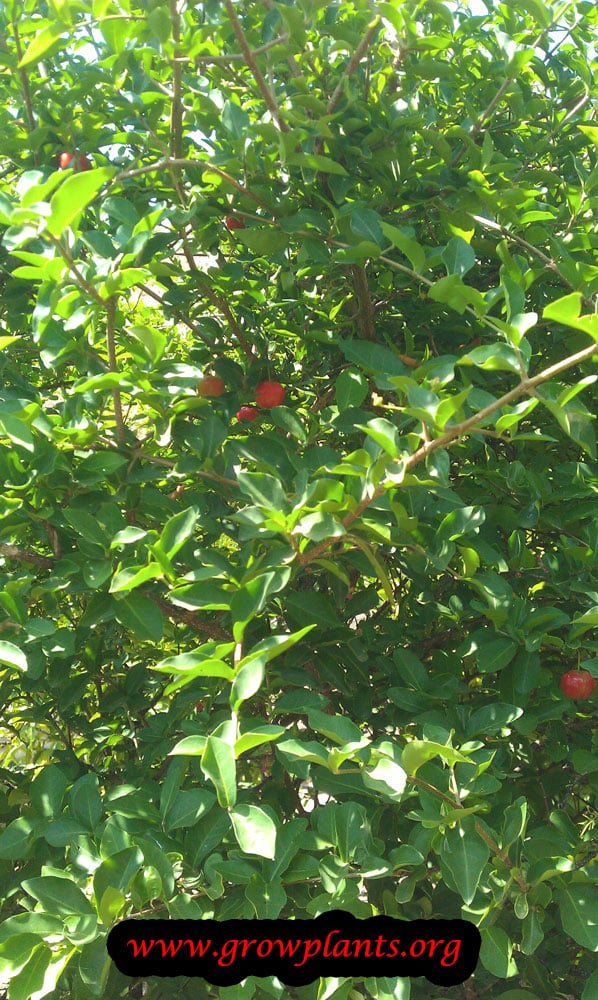
- Growth Habit & Form: Bushy shrub or small tree.
- Lifespan & Maturity: Long-lived; begins bearing in about 2-3 years.
Anatomy & Physical Features
- Leaves & Foliage: Green leaves.
- Flower Characteristics: Small pink, five-petalled flowers 1-2 cm, in clusters of 3-5.
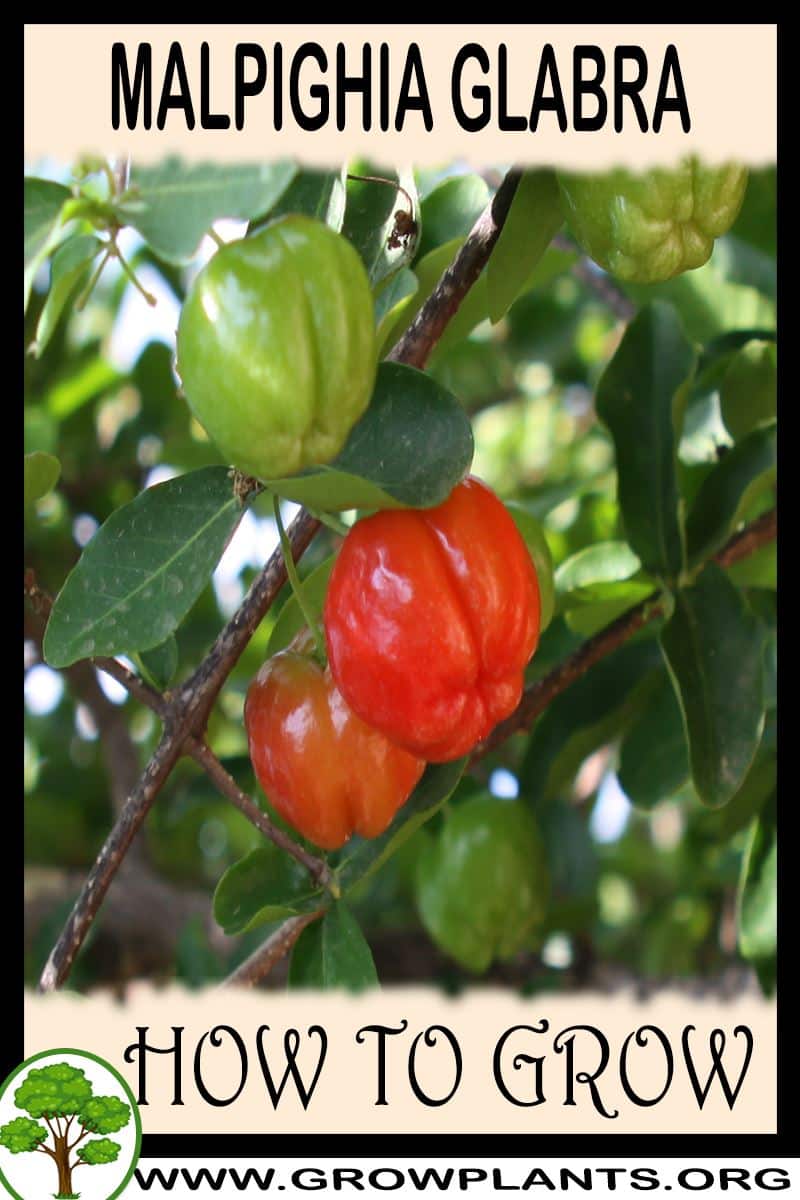
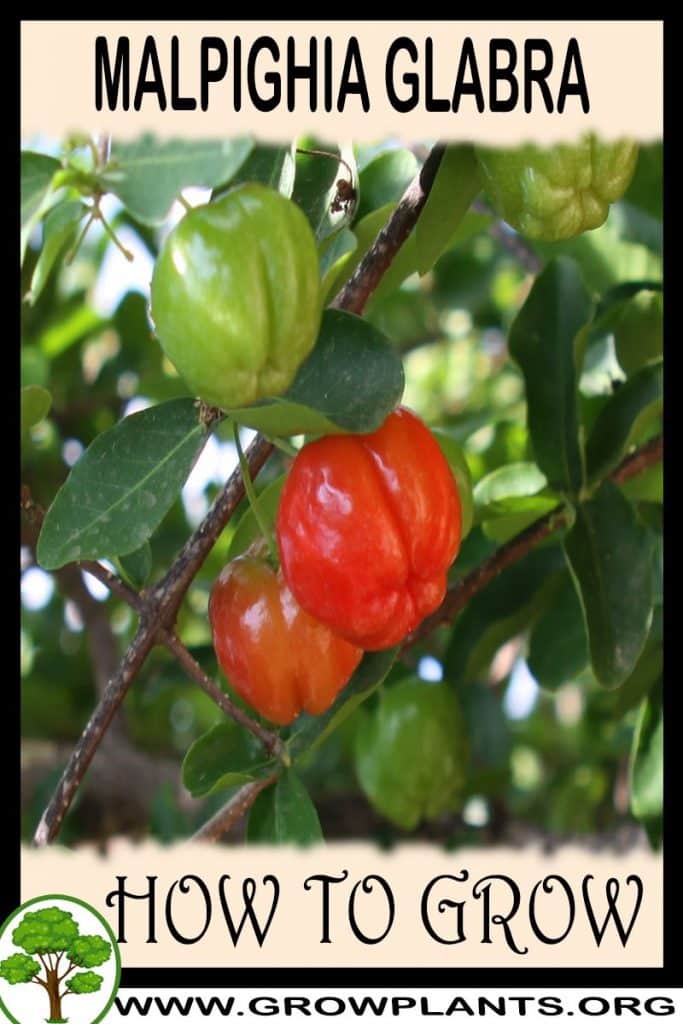
- Fruit Profile: Red, cherry-like fruit, juicy and very high in vitamin C.
Primary Uses & Landscape Value
- Edible Uses: Fruit eaten raw or juiced.
- Functional & Ornamental Roles: Fruiting and ornamental shrub that can be hedged.
Care Guide: Planting, Soil & Watering
Overview: Acerola (Malphighia glabra) is a slow-growing, frost-tender evergreen shrub or small tree for warm gardens (zone 10b+) in full sun to part shade. It grows best in a fertile, well-drained soil with steady moderate watering, and it dislikes strong wind and cold.
Quick Care Requirements
| Requirement | Ideal Condition |
|---|---|
| Planting Season | Warm season, spring to autumn |
| Growth Rate | Slow |
| Soil Type | Fertile, well-drained |
| Water Need | Moderate |
Planting & Establishment
- Best Planting Season: Through the warm season, spring to autumn, in a sheltered frost-free spot (hardiness zone 10b+).
- How to Plant:
- Hole Preparation: Dig a hole about the depth of the root ball and twice as wide in a warm, wind-sheltered position.
- Soil Amendments: Work compost or well-rotted organic matter into the backfill to build a fertile, free-draining soil.
- Planting Depth: Set the root collar level with the soil surface; do not bury the stem, and mulch afterwards.
- Growth Speed & Expectations: A slow grower; expect the first fruit about 2–3 years after planting.
Soil, Watering & Drainage Care
- Soil Mix & Drainage Needs: A fertile, free-draining soil suits it best; avoid waterlogging. It can be grown in a container with a rich, free-draining mix and drainage holes.
- Watering Schedule & Technique:
- Young / Newly Planted: Water every few days for the first weeks so the root zone never dries out completely.
- Established: Water deeply, then let the top few centimetres dry before watering again; keep it steadily moist through fruiting.
- Seasonal Adjustments: Cut back in winter and water more often during hot, dry spells.
Climate, Light & Hardiness
Malpighia glabra is a tropical-to-subtropical evergreen-to-semi-deciduous shrub or small tree for tropical, Mediterranean, and subtropical climates in full sun to half shade, best kept frost-free. It is sensitive to both cold and wind, so a warm, sheltered site matters.
Quick Climate Specifications
| Climate Zones | Tropical, Mediterranean, Subtropical |
|---|---|
| USDA Hardiness Zones | 10b+ |
| Approx. Survival Minimum | approximately 1.7°C (35°F) at the zone 10b boundary, briefly, for an established plant |
| Frost Tolerance | Low (site data specifies frost-free preferred) |
| Light Conditions | Full Sun / Half Shade |
| Wind Tolerance | Low |
Sunlight & Light Exposure
Optimal Light Setup
Full sun to half shade.
Direct Sun Requirement
Beneficial but flexible.
Best Exposure / Orientation
A warm, sunny, wind-sheltered site.
Temperature Extremes & Hardiness
USDA Hardiness & Regional Limits
Zone 10b+, with site data specifically noting sensitivity to cold weather.
Cold Damage & Winter Protection
Best kept frost-free; protect from cold, especially while young.
Frost Sensitivity
Low frost tolerance; site data flags it as cold-sensitive.
Extreme Heat Tolerance
Good in genuinely warm climates.
Wind, Humidity & Microclimate
Wind Tolerance
Low – site data specifically notes sensitivity to wind; provide shelter from strong or persistent wind.
Microclimate Recommendations
A warm, sunny, wind-sheltered, frost-free site is important for this species.
Growing in Pots, Balconies & Indoors
Barbados cherry (Malpighia glabra) is a compact shrub of 1-3 m (3-10 ft). The grower confirms it grows well in a container but is not a houseplant, and notes it is sensitive to wind – so give it a sheltered spot outdoors.
Quick Details
- Container Size: A 20-40 L (5-10 gal) pot suits this compact shrub
- Indoor Suitability: Not a houseplant; grow it outdoors
- Best Spot: Full sun to half shade, sheltered from wind
- Soil & Drainage: Rich, free-draining mix
- Watering in Pots: Average – keep evenly moist, never waterlogged
Indoors & On the Windowsill
- Houseplant limits: Although compact, the grower does not class it as a houseplant – it fruits best with strong light. A very bright, sunny windowsill is the closest indoor option, but a sunny outdoor spot is far better.
- Overwintering: Its small size makes it easy to move to a bright, frost-free spot for the cool season in cold climates.
On a Balcony or Patio
- Light & wind: Give it a bright, sheltered position, as it dislikes wind. Pots dry fast, so check moisture regularly.
Choosing the Pot, Soil & Long-Term Care
- Pot & drainage: Use a pot with plenty of drainage holes; skip a standing water saucer to avoid root rot. Terracotta breathes and dries faster, while glazed or plastic pots hold moisture longer.
- Potting mix: A well-aerated, organic-rich mix – peat or coir blended with perlite or vermiculite for drainage.
- Feeding: Potted plants need feeding more often than those in the ground, as nutrients leach out with each watering – feed lightly through the active growing season.
- Repotting: Refresh the mix or pot up about every two years; for an established specimen, replace part of the soil and lightly prune the roots and top growth.
Fertilizing & Feeding
Malpighia glabra is a slow-growing, compact shrub-to-small-tree grown both for its clustered pink flowers and its cherry-like red fruit; it carries feeding well on a moderate, steady schedule and responds poorly to any single heavy application.
Quick Fertilizing Specs
| Feeding Level | Moderate; a slow, compact grower that only needs steady, restrained feeding. |
|---|---|
| Main Nutrient Priority | Balanced nutrition through most of the growing season, shifting toward potassium as flowering and fruiting get underway. |
| Best Feeding Period | Through the warm, frost-free growing season while the plant is actively putting out new growth. |
| Organic Options | Working compost or aged manure into the root zone suits this plant well and buffers against over-feeding. |
| Reduce/Stop Feeding | Ease off as cooler weather approaches so new growth has time to harden before any cold snap. |
Feeding by Growth Stage
Newly planted
Help a young Malpighia glabra settle into a sheltered, frost-free planting site and begin rooting out before facing wind or weather stress.
| Nutrient direction | Light, balanced nutrition focused on root establishment rather than pushing top growth. |
|---|---|
| Timing | In the weeks right after planting, once the site is confirmed frost-free and sheltered from strong wind. |
| Frequency | A single light feeding at planting is usually enough while roots are still spreading. |
| Fertilizer types | A balanced complete fertilizer applied lightly, Compost worked into the planting hole |
| Precautions | Avoid pushing soft new growth right away, since this plant is sensitive to wind and won’t yet have the root system to support it. |
Young tree, building structure
Support the shrub as it fills out its framework of branches ahead of its first bloom and fruit cycle.
| Nutrient direction | A nitrogen-leaning but still balanced feed to encourage steady branching and leaf cover. |
|---|---|
| Timing | Through the main warm-season growth flush. |
| Frequency | Regular light feedings spaced through the growing season suit this slow grower better than infrequent heavy ones. |
| Fertilizer types | A balanced, nitrogen-forward complete fertilizer, For containers, a diluted balanced liquid feed |
| Routine trace nutrients | iron, manganese, zinc |
| Precautions | Taper feeding well before the cool season so new growth has time to harden; tender new shoots are the most cold- and wind-damaged. |
Established, approaching first bloom
Carry an established plant through its clustered pink flowering and toward its first cherry-like fruit.
| Nutrient direction | Balanced nutrition that supports both the ongoing branch framework and the coming flower flush. |
|---|---|
| Timing | From the start of the flowering flush through early fruit set. |
| Frequency | Steady, moderate feeding through this period supports flowering without forcing excess soft growth. |
| Fertilizer types | A balanced complete fertilizer with routine trace elements |
| Routine trace nutrients | iron, manganese, zinc |
| Precautions | Sheltering the plant from strong wind matters as much as feeding for a good flower and fruit set. |
Mature and bearing
Support an established Malpighia glabra through repeat flushes of pink bloom and red, cherry-like fruit typical of a mature plant.
| Nutrient direction | Balanced feeding shifting toward potassium as fruit develops and ripens. |
|---|---|
| Timing | Across the bloom-to-harvest cycle during the frost-free growing season. |
| Frequency | Moderate, evenly spaced feedings through bloom and fruit development suit this plant better than one heavy dose. |
| Fertilizer types | A balanced to potassium-leaning complete fruiting fertilizer |
| Routine trace nutrients | iron, manganese, zinc |
| Precautions | Bird pressure on the ripe fruit is common and worth managing with netting; it isn’t a feeding problem. |
Nutrient Deficiency Signs & Corrections
Leaves yellow between the veins while the veins stay green.
| Possible causes | High soil pH tying up iron, Waterlogged or compacted soil limiting uptake, A genuine iron shortage in the soil |
|---|---|
| Appears first on | New growth toward the shoot tips. |
| What to check | Soil pH and drainage, Whether only new leaves are affected, Recent watering pattern |
| Possible correction | Correct drainage and soil pH first, then apply a chelated iron product per its label if yellowing continues. |
The plant flowers but sets little fruit, or flowering itself is sparse.
| Possible causes | Excess nitrogen favoring leafy growth over flowers, Insufficient sun since this plant wants full sun to half shade, A boron shortage affecting fruit set, Strong wind disrupting pollination |
|---|---|
| Appears first on | The current season’s flower clusters. |
| What to check | Recent nitrogen-heavy feeding, Sun exposure at the site, Wind exposure during bloom |
| Possible correction | Ease back on nitrogen, confirm adequate sun and wind shelter, and consider a boron-containing product per its label if the pattern persists. |
New growth is sparse, undersized, or pale rather than a healthy deep green.
| Possible causes | A general nutrient shortfall on poor soil, Root stress from wind rocking the young plant, Cold-damaged tissue being mistaken for a nutrient problem |
|---|---|
| Appears first on | New shoots across the plant. |
| What to check | Recent cold exposure, Whether the plant is staked or sheltered from wind, Feeding history |
| Possible correction | Address any wind or cold stress first, then resume a light balanced feeding once new growth is clearly healthy again. |
Pruning, Training & Seasonal Maintenance
Malpighia glabra tolerates light-to-moderate pruning and flowers repeatedly on new growth through spring, summer and often into autumn in frost-free areas, so the main objective is opening a wind-sensitive, congested canopy rather than heavy shaping. Because this shrub is genuinely cold-sensitive (frost-free only) and responds to cuts with a flush of tender new growth, the safest window is late winter, once the coldest weather has passed but before the main spring flush begins – not autumn, when the plant may still be actively flowering and any stimulated new growth would go into winter unhardened.
Quick Pruning & Maintenance Specs
| Pruning Tolerance | Light–Moderate |
| Primary Pruning Window | Late winter, after cold risk passes and before the spring flush |
| Secondary Maintenance Window | Light interior thinning after a fruiting flush, in frost-free climates only |
| Typical Frequency | 1x/year structural, plus light spot maintenance |
| Main Objective | Open crossing interior growth; manage wind exposure |
| Young Plant Priority | Build a balanced, wind-firm framework of well-spaced stems |
| Mature Plant Priority | Thin branches that cross or rub without removing bearing wood |
| Best Tool Type | Bypass secateurs |
| Avoid Heavy Pruning During | Autumn, and any period the plant is in active bloom |
Pruning by Plant Age & Size
Newly Established
Minimal – remove only damaged or wind-broken growth while the plant is slow to establish (this is a slow-growing species).
Young / Formative
No formal training system is needed; lightly select for a balanced, open habit that will stand up to wind, since sensitivity to wind is a noted difficulty for this species.
Mature / Established
Thin out crossing and rubbing branches in the canopy interior; because the plant is small (1–3 m) and slow-growing, keep cuts light and infrequent.
Seasonal Pruning Schedule
Pre-Growth/Late Winter
Objective: shape and thin before the main spring flush. Remove: dead, wind-damaged, or crossing wood. Do not remove: large amounts of healthy wood at once – this is a slow grower and recovers slowly. Expected response: a manageable new flush that has the whole growing season to harden off. Flowering/fruiting impact: minimal, since bloom has not yet started.
Flowering & Fruiting Wood
This species flowers repeatedly on current-season growth across an extended spring–summer–autumn bloom period rather than on old wood, so any pruning during that window removes flowers and developing fruit directly. Time structural cuts for before the bloom period starts, not during or after it, to avoid sacrificing part of the crop.
Structural Pruning & Training
Focus on removing branches that cross or rub in the interior; because the species is wind-sensitive, avoid opening the canopy so much that remaining branches are more exposed and prone to breakage.
Container & Small-Space Pruning
Grows well in a container. Because it is naturally slow and compact (1–3 m), container specimens need only light size-maintenance pruning rather than aggressive height control; watch that a windy balcony or patio position does not stress an already wind-sensitive plant.
Tools
Bypass secateurs for essentially all cuts – stems stay small on this slow-growing, compact shrub, so loppers or a saw are rarely needed.
Tool Hygiene & Disease Risk
Routine risk – only aphids are reported as a pest, with no noted disease transmission concern, so clean, sharp tools are enough.
Cut Placement & Technique
Use clean bypass cuts just outside the branch collar; avoid flush cuts, which heal slowly on this slow-growing species.
Heavy Pruning & Rejuvenation
Not well documented as tolerating hard rejuvenation pruning, and its slow growth rate means recovery from a severe cut would be correspondingly slow; treat any size reduction as a light, gradual thinning over successive late-winter sessions rather than a single hard cut-back.
Post-Pruning Care
Protect fresh cuts from cold snaps immediately after late-winter pruning; water normally (this species takes an average amount of water) and avoid fertilizing purely to force regrowth.
Common Pruning Mistakes
- Pruning in autumn because it ‘looks dormant’, when the plant may still be flowering and any new growth will go into winter unhardened.
- Hard-pruning a slow-growing plant expecting a fast recovery.
- Opening the canopy too aggressively on a wind-sensitive shrub, increasing breakage risk.
When NOT to Prune
Avoid pruning during the extended spring–autumn bloom period, since flowers and fruit form continuously on new growth; avoid autumn pruning specifically, since it stimulates tender growth heading into the cold season on a frost-free-only species.
Recommended Tools (by task)
- bypass_secateurs – the only tool needed for nearly all cuts on this small, slow-growing shrub’s fine wood.
- blade_disinfectant – light precaution when moving between plants, given aphid presence, though disease risk itself is low.
Pruning Troubleshooting
| Problem | Possible Cause | What to Check | Corrective Action |
| Reduced flowering/fruit | Pruned during the active bloom period | Timing of the last prune versus bloom season | Shift structural pruning to late winter, before bloom starts |
| Cold-damaged new growth | Pruned in autumn, forcing a tender flush before winter | Whether recent cuts triggered new soft growth | Move pruning earlier or later, away from autumn |
| Broken branches | Wind exposure on an over-thinned canopy | Density of remaining canopy and site exposure | Leave more interior growth intact for wind buffering |
Propagation Guide
Malpighia glabra is most commonly and reliably propagated from semi-hardwood cuttings, which root readily, while seed works but tends to germinate slowly and unevenly and will not reproduce a seedless cultivar; vegetative propagation is therefore necessary for seedless selections, as the site notes. Overall propagation is Easy by cuttings, Moderate by seed.
Quick Propagation Specs
| Best Propagation Method | Semi-hardwood stem cuttings |
| Alternative Methods | Seed (species-type only); grafting for named or seedless cultivars |
| Propagation Difficulty | Easy by cuttings, Moderate by seed |
| Seed True-to-Type | Variable; seedless cultivars produce few or no viable seeds and cannot be reproduced this way |
| Vegetative True-to-Type | Yes |
| Best Propagation Season | Spring through autumn, matching the site’s planting season |
| Cutting Rooting Time | Often roots within a few weeks under warm, humid conditions |
Growing from Seed
Seed Handling & Viability
Clean seed of surrounding fruit pulp before sowing; the site does not specify a storage method for this species.
Germination Conditions
Warm, consistently moist conditions.
Germination Time
Germination is often slow and irregular, typically taking several weeks to a couple of months.
Seedling Care
Seedlings vary in fruit quality and cannot reproduce a seedless cultivar, so they are best used for rootstock or as new, unnamed plants rather than for a specific desired fruit type.
Stem Cuttings
Cutting Type
Semi-hardwood cuttings from healthy current-season growth.
Best Timing
Spring through autumn, during active growth.
Cutting Preparation
Trim just below a node and remove the lower leaves before rooting.
Rooting Setup
A free-draining rooting mix kept warm and humid, such as under mist or a humidity cover.
Rooting Hormone
Optional – this species is reported to root readily from cuttings even without it, though hormone can speed and improve consistency.
Rooting Time
Often within a few weeks under warm, humid conditions.
Grafting & Budding
Why Grafting Is Used
To reproduce named or seedless cultivars exactly, since the site notes some cultivars have seedless fruit and cannot be grown true from seed.
Preferred Grafting Methods
As with related fruiting shrubs, side-veneer or cleft grafting onto vigorous seedling rootstock is typically used.
Rootstock
Seedling rootstock of the species.
Scion Selection
Wood from a proven, healthy plant of the desired cultivar.
Best Grafting Season
During active growth, spring to summer.
Graft Aftercare
Keep the graft union protected and humid until it has visibly taken and new growth begins.
Bloom & Flower Guide
Quick Details
- Bloom Season: Spring through autumn, often in several flushes
- Flower Appearance: Pink five-petaled flowers, 1-2 cm, in small clusters of three to five
- Edibility: The flower is not eaten; the plant is grown for its vitamin-C-rich edible fruit
Detailed Blooming Overview
Acerola flowers in flushes through the warm months, each flush of pink five-petaled blooms followed within a few weeks by its cherry-like fruit. The flowers appear in small clusters of three to five.
Flower Characteristics
- Pink flowers with five petals, 1-2 cm across.
- Borne in small clusters of three to five.
Bloom Care & Thinning
- Pollination: Bees, with some self-pollination; large native solitary bees (such as Centris oil-bees) are the most effective pollinators.
Fruit & Uses
Malpighia glabra, commonly known as Acerola, is grown for its bright red, cherry-like fruit, the plant’s only edible part. Ripe fruit is eaten fresh out of hand or juiced.
Quick Edible Specs
| Edible Parts | Fruit |
| Main Use(s) | Culinary – fresh eating, juice |
| Eaten Raw or Cooked | Raw |
| Preparation Required | None (some cultivars are seedless) |
| Harvest Season | Summer, autumn |
| Time to First Harvest | A few years for young plants; see Propagation for details |
| Safety/Toxicity Caveat | None noted |
Fruit
The fruit is red and cherry-shaped; ripe, fully coloured fruit is picked by hand through summer and autumn. Because the thin skin bruises and spoils quickly, ripe fruit is generally eaten or processed soon after picking — fresh out of hand or pressed into juice. Some grafted cultivars produce seedless fruit, making them easier to eat fresh (see Propagation); netting the tree during fruiting helps protect the ripening crop from birds.
Preparation, Uses & Safety
Fruit is eaten fresh as a cherry-like snack or juiced; no cooking or other processing is required. No toxic parts or safety cautions are noted.
Pests, Diseases & Troubleshooting
Overview: Barbados cherry (acerola) is a subtropical fruiting shrub that is fairly resilient but troubled by root-knot nematodes below ground and by aphids, scale and whitefly above, with birds taking the ripe fruit and Cercospora leaf spot and root rot the main diseases. Good drainage, sanitation and nematode-free soil are the foundations of healthy plants.
Quick Troubleshooting Overview
| Issue / Pest | Main Symptom | Primary Solution |
|---|---|---|
| Root-knot nematodes | Stunting, wilting, galled swollen roots | Nematode-free stock; organic matter; resistant rootstock |
| Aphids | Curled tips, honeydew, sooty mould | Hose off; predators; insecticidal soap |
| Scale & whitefly | Brown bumps / white flies; sticky leaves | Scrape; sticky traps; horticultural oil |
| Birds | Ripe cherries stripped | Netting as fruit colours; harvest promptly |
| Leaf spot (Cercospora) | Brown spots, yellowing, leaf drop | Airflow; remove leaves; copper if severe |
| Root rot | Wilting, decline in wet soil | Improve drainage; avoid waterlogging |
Common Pests & Management
- Root-knot nematodes (Meloidogyne spp.):
- Symptoms: Below-ground pests that cause stunting, wilting in heat, yellowing and poor vigour despite good care; roots show characteristic knotty galls and swellings that impair water and nutrient uptake.
- Prevention & Control: Plant only nematode-free nursery stock into clean or solarised soil, build up soil organic matter and beneficial microbes, mulch and keep plants well watered to mask damage, rotate or use resistant rootstocks, and avoid moving infested soil; there is no easy cure once established.
- Aphids (Aphis / Myzus spp.):
- Symptoms: Colonies on soft new shoots and flower clusters cause curling, stunting and sticky honeydew with sooty mould.
- Prevention & Control: Hose off, encourage ladybirds and lacewings, and use insecticidal soap for heavy colonies; avoid excess nitrogen.
- Scale insects (Coccus / Diaspididae spp.):
- Symptoms: Brown or waxy bumps on stems and leaf undersides suck sap, yellowing foliage and producing honeydew.
- Prevention & Control: Scrape off, prune out encrusted wood, and apply horticultural oil to smother crawlers; conserve parasitoid wasps.
- Whitefly (Bemisia / Trialeurodes spp.):
- Symptoms: Tiny white flies clouding up from leaf undersides, sucking sap and leaving honeydew and sooty mould.
- Prevention & Control: Use yellow sticky traps and insecticidal soap or neem on leaf undersides, and remove heavily infested lower leaves.
- Fruit-piercing / weevils & fruit flies (Curculionidae / Anastrepha spp.):
- Symptoms: Damage to developing and ripe fruit from weevils or fruit-fly maggots in warm regions, causing blemished, dropping fruit.
- Prevention & Control: Practise sanitation by collecting fallen fruit, use bait traps for fruit flies, harvest promptly, and bag fruit where practical.
Diseases & Fungal Issues
- Cercospora leaf spot (Cercospora / Pseudocercospora):
- Symptoms: Small brown to greyish spots with darker margins on leaves, sometimes merging and causing yellowing and leaf drop in warm, wet, humid conditions.
- Treatment & Management: Rake up and destroy fallen leaves, improve airflow by pruning, avoid overhead watering, and use a copper fungicide only for severe recurring spread.
- Scab / anthracnose (Elsinoe / Colletotrichum):
- Symptoms: Scabby corky spots on fruit and dark sunken lesions on leaves and fruit in wet weather, blemishing the crop.
- Treatment & Management: Improve airflow, remove infected fruit and debris, avoid wetting foliage, and apply a protectant copper fungicide under high humidity.
- Root & crown rot (Phytophthora / Pythium):
- Symptoms: Wilting, canopy thinning, yellowing and dark rotted roots in heavy or waterlogged soil.
- Treatment & Management: Plant in free-draining soil, avoid overwatering and standing water, keep mulch off the trunk, and remove severely affected plants.
Growing Difficulties & Abiotic Problems
- Birds stripping fruit:
- Cause & Symptoms: Ripe cherries removed rapidly as they colour, since birds relish the soft red fruit.
- Correction Strategy: Net plants as the fruit begins to ripen and harvest promptly; the fruit is very perishable, so pick as it colours.
- Overwatering & poor drainage:
- Cause & Symptoms: Yellowing, wilting and root decline in soggy soil; acerola likes moisture but not waterlogging.
- Correction Strategy: Water regularly but in free-draining soil, avoid standing water, and improve heavy soils with organic matter.
- Iron & micronutrient chlorosis:
- Cause & Symptoms: Interveinal yellowing of young leaves on alkaline soils where iron and other micronutrients are locked up.
- Correction Strategy: Keep soil slightly acidic, add organic matter, and correct with chelated iron and foliar micronutrients as needed.
- Cold & wind damage:
- Cause & Symptoms: Leaf drop and dieback from cold on this frost-tender subtropical shrub, and fruit drop under moisture stress.
- Correction Strategy: Site in a warm, sheltered, frost-free position or grow in a container to move under cover, and water evenly to reduce fruit drop.
What Helps – Products & Tools
Start with clean, nematode-free stock and good drainage. Use insecticidal soap or neem for aphids and whitefly, horticultural oil for scale, bird netting for the fruit, and copper fungicide for leaf spot and scab. Organic matter and mulch build the soil life that keeps nematodes in check.