

Plant Profile & Key Characteristics
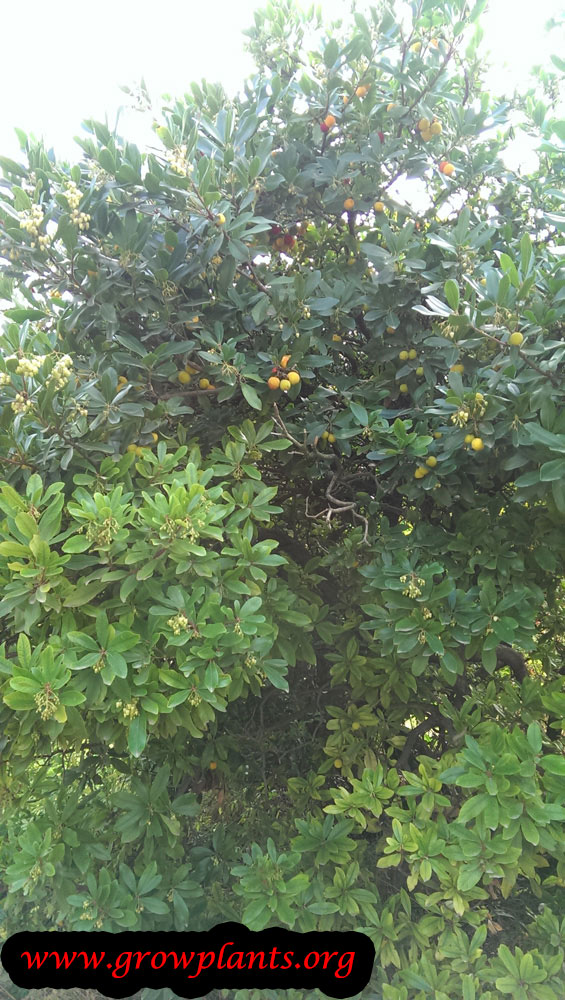
Overview: The strawberry tree (Arbutus unedo) is an evergreen shrub or small tree reaching 2-6 m, valued equally as an ornamental and for its edible red fruit. It flowers and fruits at the same time in the cooler part of the year, so bell-shaped blooms and ripening berries often appear together.
Quick Specifications
| Specification | Attribute |
|---|---|
| Plant Type / Life Cycle | Perennial |
| Foliage Type | Evergreen |
| Mature Size | 2-6 m tall (6-20 ft) |
| Growth Rate | Moderate |
| Toxicity | Non-toxic – fruit is edible |
| Hardiness | USDA zones 7-11 |
Growth Form & Structure
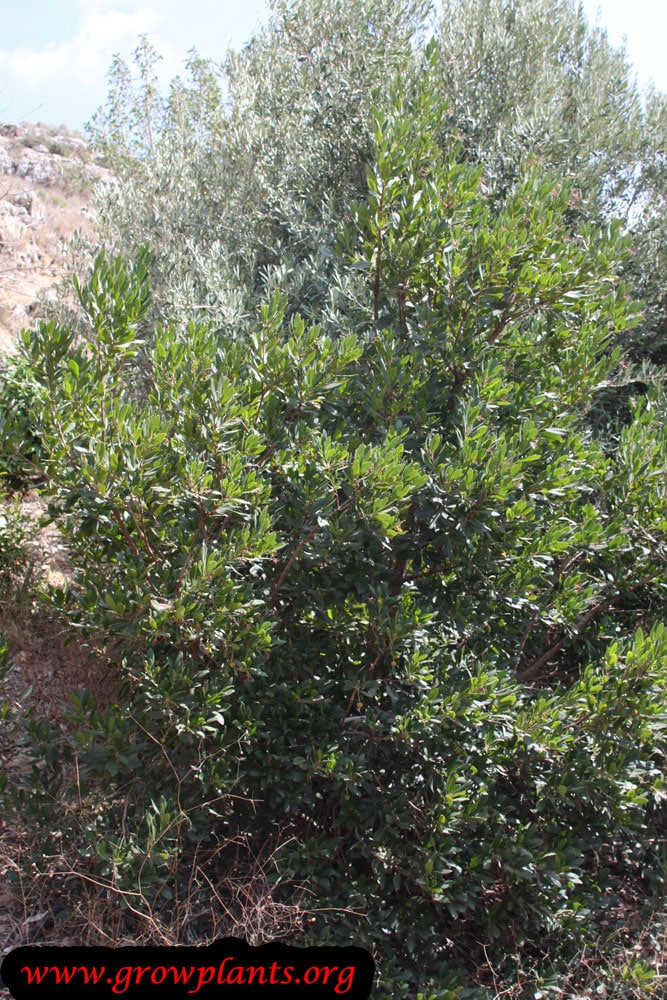
- Height & Spread: 2-6 m (6-20 ft) in the ground; readily kept smaller in a large container or trained as a single-trunk small tree.
- Growth Habit & Form: Densely branched evergreen shrub that can be pruned up to a rounded small tree with a short trunk.
- Lifespan & Maturity: Long-lived perennial; begins bearing fruit about 2-4 years from planting.
Anatomy & Physical Features
- Trunk & Bark: Mature stems develop attractive rough, reddish-brown shredding bark.
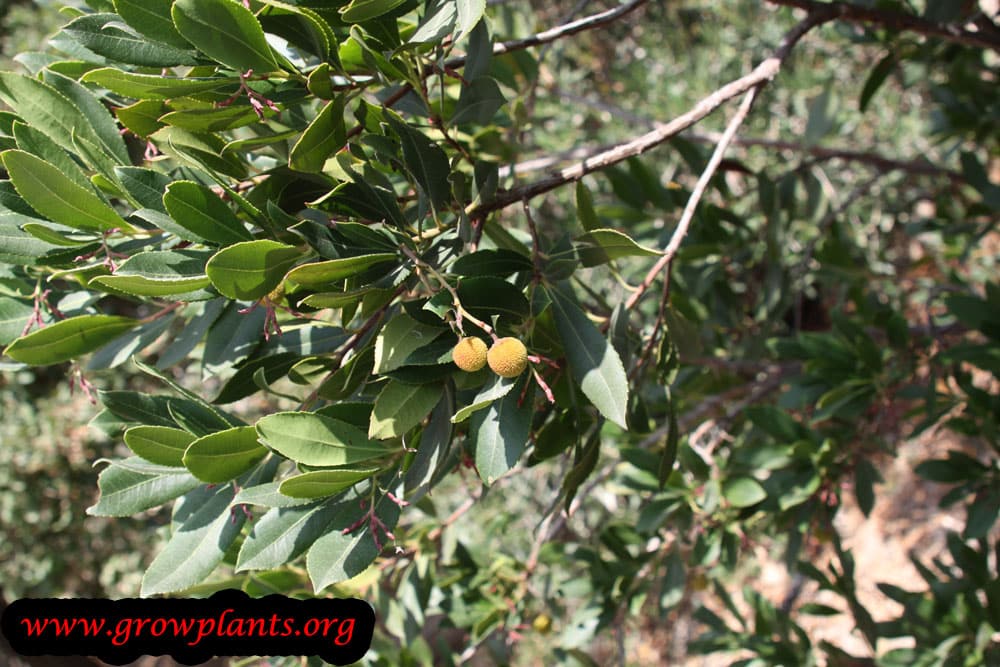
- Leaves & Foliage: Glossy deep-green leaves with serrated (toothed) margins, leathery in texture.
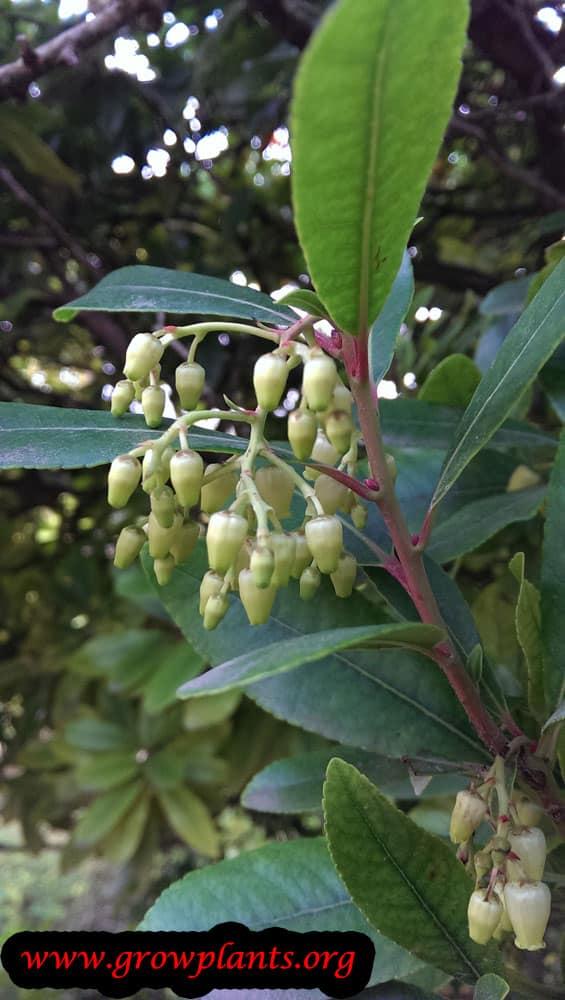
- Flower Characteristics: Small white bell-shaped flowers borne in drooping clusters, attractive to bees.
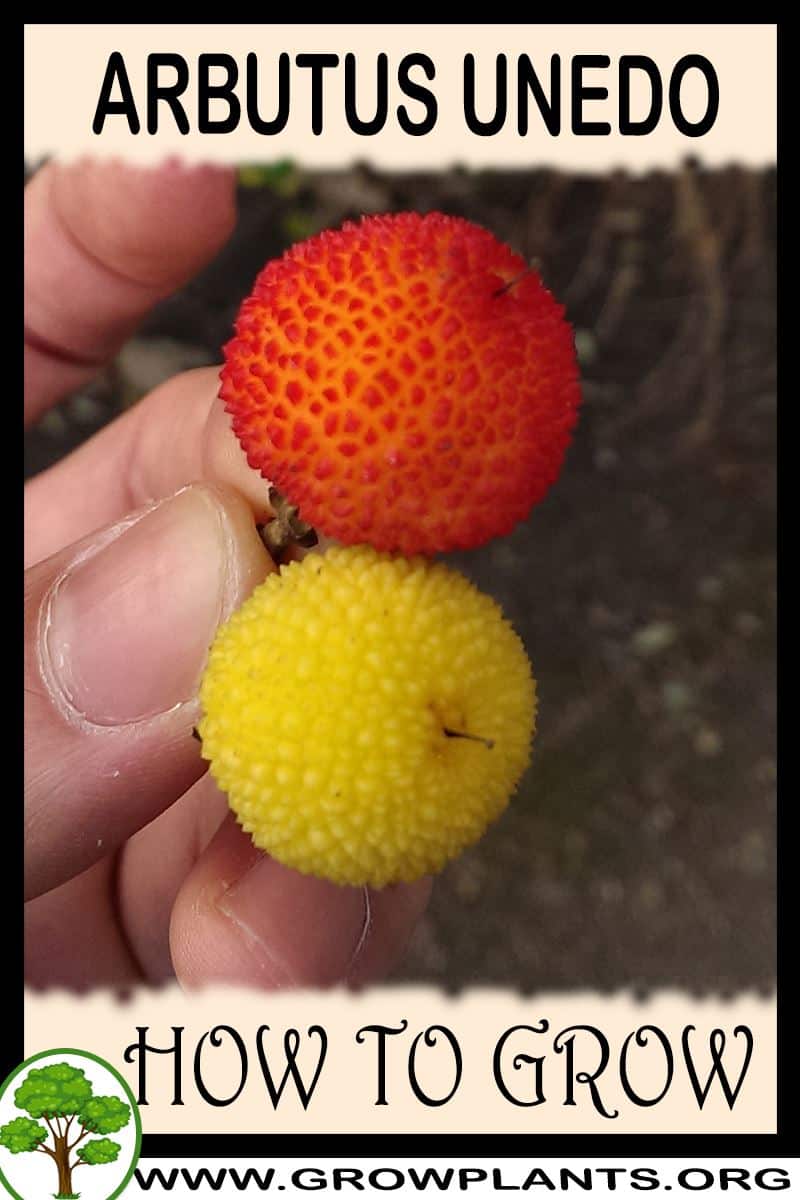
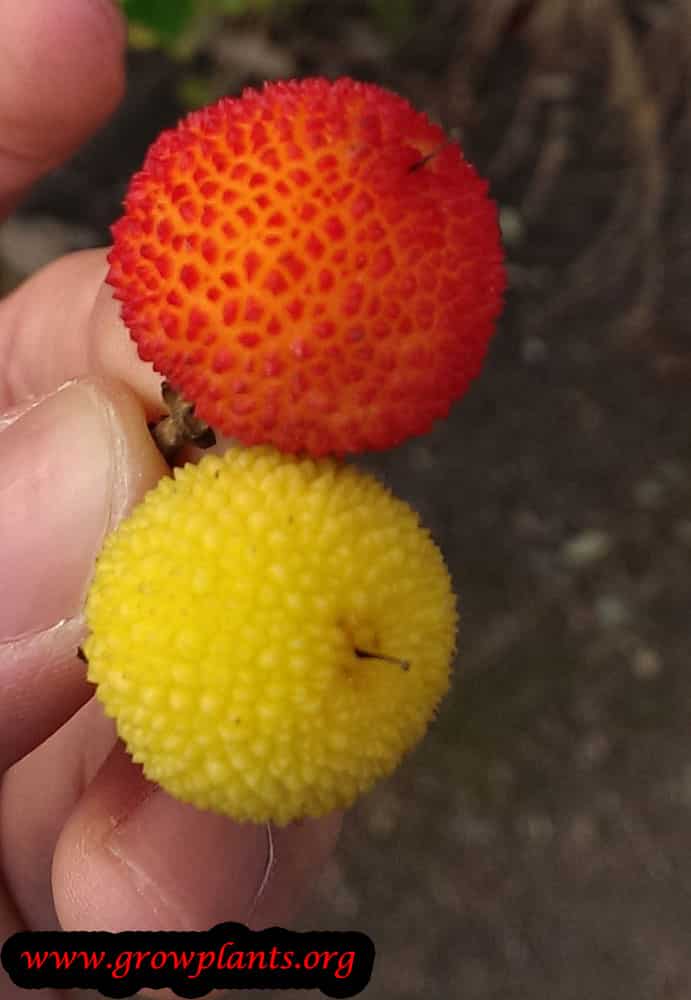
- Fruit Profile: Round warty-skinned berry that ripens from yellow to red; skin roughens then softens when ripe, with tiny inconspicuous seeds.
Primary Uses & Landscape Value
- Edible Uses: Fruit eaten fresh or made into jams, juice and cakes.
- Functional & Ornamental Roles: Evergreen ornamental specimen or screen, bee/pollinator plant; tolerant of Mediterranean and coastal conditions.
Care Guide: Planting, Soil & Watering
Overview: The strawberry tree is a tough Mediterranean evergreen that thrives in full sun to part shade and sharply drained soil. It needs only light-to-moderate moisture once established and resents waterlogged ground far more than dry spells.
Quick Care Requirements
| Requirement | Ideal Condition |
|---|---|
| Planting Season | In spring or summer in cooler zones (7-10a); in autumn to winter in warm zones (10b-11) |
| Growth Rate | Moderate |
| Soil Type | Well-draining; tolerant of poor and rocky ground |
| Water Need | Low to Moderate; let the soil dry between waterings |
Planting & Establishment
- Best Planting Season: Plant in spring or summer where winters are cold (zones 7-10a) so roots establish before frost; in frost-free zones (10b-11) plant in the cooler autumn-to-winter window.
- How to Plant:
- Hole Preparation: Dig a hole as deep as the root ball and about twice as wide, loosening the sides so young roots can spread; make sure the site drains freely.
- Soil Amendments: Work a little compost or organic matter into poor soil, and mix grit or coarse material into heavy ground to sharpen drainage.
- Planting Depth: Set the plant so the top of the root ball sits level with the surrounding soil, keeping the root collar at grade and never burying the stem.
- Growth Speed & Expectations: A moderate grower that steadily builds into a 2-6 m (6-20 ft) shrub or small tree.
Soil, Watering & Drainage Care
- Soil Mix & Drainage Needs: Give it fast-draining soil; it tolerates poor, rocky ground but rots in soggy conditions. In pots, use a free-draining mix with plenty of drainage holes.
- Watering Schedule & Technique:
- Young / Newly Planted: Water regularly through the first season to settle the roots, keeping the soil lightly moist but never saturated.
- Established: Once established, water deeply but infrequently, letting the top few cm dry out between waterings, as it is quite drought tolerant.
- Seasonal Adjustments: Reduce watering in cool, wet winters and water more often during prolonged summer heat.
Climate, Light & Hardiness
Arbutus unedo (strawberry tree) is a temperate-to-Mediterranean-to-subtropical shrub or small tree for full sun to half shade, and is the most cold-hardy species in this batch, needing at least a minimum cool winter to grow and flower well. It tolerates real winter cold that would damage the tropical species covered elsewhere in this set.
Quick Climate Specifications
| Climate Zones | Temperate, Mediterranean, Subtropical |
|---|---|
| USDA Hardiness Zones | approximately 7–11 |
| Approx. Survival Minimum | approximately −17.8°C (0°F) at the zone 7 boundary, for an established plant |
| Frost Tolerance | High |
| Light Conditions | Full Sun / Half Shade |
Sunlight & Light Exposure
Optimal Light Setup
Full sun for the best flowering and fruiting; half shade is tolerated.
Direct Sun Requirement
Beneficial but not strict.
Best Exposure / Orientation
An open, sunny, well-drained site.
Temperature Extremes & Hardiness
USDA Hardiness & Regional Limits
Zone 7–11 is the widest, coldest-tolerant range in this batch, reflecting a genuinely temperate-adapted species that is also grown in Mediterranean and subtropical gardens.
Cold Damage & Winter Protection
Site data specifies it needs at minimum a cool winter to perform well; little winter protection is needed within its broad hardiness range.
Frost Sensitivity
Low – among the most frost-hardy species in this set.
Extreme Heat Tolerance
Good; grows successfully into warm Mediterranean and subtropical summers as well as cooler temperate ones.
Wind, Humidity & Microclimate
Dry-Air Tolerance
Good, in keeping with its Mediterranean-climate adaptability.
Rainfall & Seasonal Moisture
Adaptable across temperate, Mediterranean, and subtropical rainfall regimes; needs well-drained soil.
Microclimate Recommendations
Ordinary sunny, well-drained garden conditions suit it across a very wide climate range.
Growing in Pots, Balconies & Indoors
The strawberry tree (Arbutus unedo) is a compact evergreen of 2-6 m (6-20 ft) that takes well to containers. The grower confirms it is pot-suitable but not a houseplant – it makes a handsome, hardy patio plant that can be kept trimmed.
Quick Details
- Container Size: A roomy tub (30-50 L / 8-13 gal), potted up as it grows
- Indoor Suitability: Not a houseplant; grow it outdoors
- Best Spot: Full sun to half shade
- Soil & Drainage: Free-draining mix; it is drought-tolerant once established
- Watering in Pots: Small to average – let the top of the mix dry between waterings
Indoors & On the Windowsill
- Houseplant limits: Not a houseplant – it is an outdoor evergreen that needs real sun and fresh air.
- Hardiness: Being fairly cold-hardy, it usually needs no winter shelter; a pot simply lets you place it where its flowers and fruit are enjoyed.
On a Balcony or Patio
- Light & exposure: Give it a bright, sunny position; it tolerates some wind and coastal conditions. Pots dry faster than open ground, so check moisture in hot spells.
Choosing the Pot, Soil & Long-Term Care
- Pot & drainage: Use a pot with plenty of drainage holes; skip a standing water saucer to avoid root rot. Terracotta breathes and dries faster, while glazed or plastic pots hold moisture longer.
- Potting mix: A well-aerated, organic-rich mix – peat or coir blended with perlite or vermiculite for drainage.
- Feeding: Potted plants need feeding more often than those in the ground, as nutrients leach out with each watering – feed lightly through the active growing season.
- Repotting: Refresh the mix or pot up about every two years; for an established specimen, replace part of the soil and lightly prune the roots and top growth.
Fertilizing & Feeding
Strawberry tree is a moderate feeder that does best on well-drained soil; because it flowers and fruits at the same time each year – this year’s flowers opening alongside last year’s ripening fruit – steady, balanced feeding through the growing season supports both stages at once.
Quick Fertilizing Specs
| Feeding Level | Moderate. |
|---|---|
| young_feeding | Nitrogen-forward feeding to build a strong single-trunk framework. |
| mature_feeding | Balanced feeding, shifting toward potassium as fruit develops. |
| Main Nutrient Priority | Balanced feeding that supports flowering and fruit ripening happening together. |
| Best Feeding Period | The active growing season; this tree needs only a mild winter chill to keep cycling through bloom and fruit. |
| Soil pH | Prefers well-drained soil; watch for interveinal yellowing if soil pH runs high. |
| Organic Options | Compost or organic matter worked into well-drained soil. |
| Reduce/Stop Feeding | Ease off as growth slows heading into the cooler part of the year. |
Feeding by Growth Stage
Newly planted
Help a newly planted strawberry tree root into well-drained soil before pushing top growth.
| Nutrient direction | Keep feeding light while the tree focuses on rooting in; organic matter worked into the planting soil is usually enough. |
|---|---|
| Timing | At planting and through the first flush of new roots. |
| Frequency | Skip fertilizer right at planting; introduce light feeding only once new growth shows the tree has rooted in. |
| Fertilizer types | Compost or organic matter worked into the planting hole, A light, balanced fertilizer once new growth appears |
| Precautions | Avoid feeding right at planting, since a stressed, unrooted tree is easily set back by fertilizer salts. |
Young tree, before it fruits
Build a strong single-trunk framework, whether grown as a specimen tree or a large multi-stemmed shrub, and support container-grown specimens getting established in a pot.
| Nutrient direction | A nitrogen-forward feed supports steady branch and canopy growth while the tree is shaping up. |
|---|---|
| Timing | Through the growing season for the first several years before regular fruiting begins. |
| Frequency | Feed lightly and regularly through the growing season, easing off as growth slows toward the cooler months. |
| Fertilizer types | A nitrogen-forward, balanced fertilizer through the growing season, For container-grown trees, a diluted balanced liquid feed |
| Routine trace nutrients | iron, manganese, zinc |
| Precautions | Avoid pushing overly soft, tender new growth with heavy feeding, which can draw in aphids. |
Established tree approaching bearing age
Support the shift toward the white, bell-shaped flowers that open as the previous year’s fruit is still ripening.
| Nutrient direction | Shift toward a balanced feed as the tree matures toward its overlapping flower-and-fruit cycle. |
|---|---|
| Timing | As the tree matures and approaches its first flowering and fruiting season. |
| Frequency | Continue steady, moderate feeding through the growing season. |
| Fertilizer types | A balanced fertilizer through the growing season, Organic matter or mulch to maintain steady soil fertility |
| Routine trace nutrients | iron, manganese, zinc |
| Precautions | Keep feeding steady rather than heavy while the tree settles into its mature flowering-and-fruiting rhythm. |
Mature, fruit-bearing tree
Support flowers and the round, edible, rough-skinned fruit at the same time, since this tree carries both stages together for much of the year.
| Nutrient direction | A balanced feed shifting toward potassium support while fruit is ripening toward its soft-rind stage. |
|---|---|
| Timing | Through the growing season, since flowering and fruit ripening overlap across autumn and winter. |
| Frequency | Feed steadily through the growing season, tapering off as growth slows in the cooler months. |
| Fertilizer types | A balanced-to-potassium-leaning fertilizer through the growing and fruiting season, Mulch and organic matter maintained around the root zone |
| Routine trace nutrients | iron, manganese, zinc |
| Precautions | Net or otherwise protect ripening fruit from birds, and keep fertilizer away from the trunk itself. |
Nutrient Deficiency Signs & Corrections
New leaves yellowing between dark green veins.
| Possible causes | Iron becoming less available in high-pH or alkaline soil, Waterlogged or poorly drained soil limiting root uptake, Root stress in compacted planting sites |
|---|---|
| Appears first on | Newest leaves and shoot tips. |
| What to check | Soil pH, Drainage and how quickly water moves through the root zone, Whether only the newest growth is affected |
| Possible correction | Correct soil pH and drainage first; if chlorosis persists, apply a chelated iron product per its label. |
Pale foliage and slowed shoot growth in a young or newly planted tree.
| Possible causes | Insufficient nitrogen for the current growth stage, Poor soil fertility at the planting site, Root stress from recent transplanting |
|---|---|
| Appears first on | Older leaves first, spreading to new growth if it continues. |
| What to check | Recent feeding history, Shoot length compared with prior seasons, How recently the tree was planted or transplanted |
| Possible correction | Step up to a nitrogen-forward feeding through the growing season and reassess the following season. |
Fruit that stays small, hard, or slow to soften as it ripens.
| Possible causes | Low soil potassium limiting fruit development, Feeding that stayed nitrogen-heavy rather than shifting toward potassium as fruit ripened, Inconsistent soil moisture during the long ripening period |
|---|---|
| Appears first on | Developing fruit. |
| What to check | Whether feeding shifted toward potassium as fruit began ripening, Soil moisture consistency, Fruit size and softening compared with prior seasons |
| Possible correction | Shift toward a potassium-leaning feed as fruit ripens and keep soil moisture consistent. |
Pruning, Training & Seasonal Maintenance
Arbutus unedo (strawberry tree) is naturally a multi-stemmed, fire-adapted Mediterranean shrub that resprouts readily from its base, so – unlike many broadleaf evergreens – it tolerates hard cutting back and is often kept as a dense shrub or informal hedge rather than trained to a single trunk. Its main scheduling quirk is that autumn/winter flowers open at the same time the previous year’s fruit is still ripening on the plant, so the safest time for anything beyond light trims is after that fruit drops, before the next autumn bloom cycle begins.
Quick Pruning & Maintenance Specs
| Pruning Tolerance | Moderate to High (unusually high for an evergreen broadleaf, due to basal resprouting) |
| Primary Pruning Window | Late winter/early spring, after old fruit has dropped and before autumn re-bloom |
| Secondary Maintenance Window | Light sanitary trims year-round |
| Typical Frequency | Annual shape/renewal cut if grown as hedge or shrub; occasional for tree-form specimens |
| Main Objective | Shrub form: density and renewal; Tree form: single clean trunk |
| Young Plant Priority | Decide shrub vs tree form early – tree form needs early competing-trunk removal |
| Mature Plant Priority | Renewal thinning (shrub) or crossing/dead-wood removal (tree) |
| Best Tool Type | Bypass secateurs and loppers; hedge shears only if formally hedged |
| Avoid Heavy Pruning During | Autumn/winter, while flowers and the previous year’s fruit are both on the plant |
Pruning by Plant Age & Size
Newly Established
Remove only damaged growth; decide within the first couple of seasons whether the plant will be kept multi-stemmed (its natural habit) or trained to a single trunk.
Young / Formative
Tree form: select one leader and remove competing basal stems as they resprout, repeating over a season or two since this species suckers readily from the base. Shrub/hedge form: no leader selection needed – simply tip young growth to encourage branching and density.
Mature / Established
Shrub/hedge form: renewal-prune by removing some of the oldest stems at the base every few years to keep the plant from becoming leggy. Tree form: remove any basal resprouts that appear (the plant will keep trying to revert to multi-stem habit) and thin crossing wood.
Seasonal Pruning Schedule
Late Winter / Early Spring (Post-Fruit)
- Objective: structural cuts, renewal thinning, or hedge shaping
- Remove: oldest stems (renewal), competing trunks (tree form), dead/crossing wood
- Do not remove: developing buds for the coming autumn bloom
- Expected response: vigorous basal and lateral resprouting
- Flowering/fruiting impact: minimal – this window is between fruiting cycles
Ongoing Sanitary
- Objective: remove aphid-damaged or dead twigs whenever seen
- Remove: dead or pest-damaged tips
- Do not remove: ripening fruit or open flowers in autumn/winter
- Expected response: none intended
- Flowering/fruiting impact: none if kept light
Flowering & Fruiting Wood
Flowers form on the current season’s growth and open in autumn/winter, at which point the previous year’s fruit (which set from the prior autumn’s flowers) is often still ripening on the same branches – a well-known feature of this species. Because two reproductive cycles can overlap physically on the plant, pruning during autumn/winter risks removing both an unripe crop and the flowers that will become next year’s crop; the post-fruit, pre-bloom window avoids both.
Structural Pruning & Training
Renewal pruning is the main structural technique for shrub/hedge specimens – remove the oldest 20-30% of basal stems periodically to maintain density and vigor. For tree-form specimens, ongoing removal of basal resprouts is needed since the species’ instinct is to sucker from the base.
Special Growth to Remove
Basal shoots/suckers – retain them if a multi-stem shrub or hedge is wanted (this is the plant’s natural habit), remove them if a clean single trunk is the goal. This species is not typically grafted for garden use, so rootstock suckers are not a factor.
Container & Small-Space Pruning
Container specimens benefit from the same renewal approach at a smaller scale – remove the oldest stems to keep the plant compact and tip young growth to control size, since a containerized root system cannot support the full in-ground spread. Expect a stronger, more crowded resprouting response to any hard cut in a pot than in open ground, so thin the resulting regrowth rather than leaving it dense.
Tools
- Bypass secateurs and loppers for stem removal and renewal cuts
- Hedge shears only if the plant is being formally maintained as a sheared hedge – otherwise avoid, since selective renewal cuts keep it healthier long-term
- Pruning saw for thick old basal stems on a mature shrub
Tool Hygiene & Disease Risk
Routine. Aphids are the species’ listed pest and are not tool-transmitted; clean, sharp tools are sufficient.
Cut Placement & Technique
Remove basal stems as close to ground level as possible (cane-at-base style) for renewal cuts; use thinning cuts back to a junction elsewhere rather than heading cuts, which create dense, twiggy regrowth.
Heavy Pruning & Rejuvenation
Well tolerated compared to most evergreen broadleaf shrubs – Arbutus unedo can be cut back hard and will resprout from the base thanks to its lignotuber-forming habit. A full rejuvenation (cutting most stems back to 30-60cm) can be done on an overgrown shrub in late winter/early spring, with flowering resuming within a season or two as new growth matures.
Post-Pruning Care
After a hard renewal cut, water moderately to support the vigorous resprout (small to average water needs otherwise) and expect a flush of basal growth that will need thinning the following year to avoid an overly dense regrowth.
Common Pruning Mistakes
Shearing the whole plant into a formal shape every year, which removes flowering/fruiting wood repeatedly and produces a twiggy shell with little bloom; pruning in autumn/winter and accidentally stripping the overlapping flower/fruit display that is this species’ signature feature.
When NOT to Prune
During autumn/winter while flowers and the previous year’s fruit are both present on the plant.
Recommended Tools (by task)
- loppers – removing thick old basal stems during renewal pruning of a mature shrub
- bypass_secateurs – shaping and tipping young growth or container specimens
- hedge_shears – only where the plant is deliberately kept as a clipped hedge
Pruning Troubleshooting
| Problem | Possible Cause | What to Check | Corrective Action |
| Little to no flower/fruit despite healthy growth | Repeated shearing removing flowering wood | Whether the plant is sheared annually as a formal hedge | Switch to selective renewal cuts instead of shearing |
| Shrub becomes bare and leggy at the base | No renewal pruning done for several years | Age and thickness of the oldest basal stems | Remove the oldest 20-30% of stems at the base to trigger fresh basal growth |
| Excess dense, twiggy regrowth after a hard cut | Heading cuts rather than thinning, or an especially vigorous resprout response | Density of new shoots at cut points | Thin the regrowth the following season rather than repeatedly heading it |
Propagation Guide
Arbutus unedo can be grown from seed, which the site lists as a standard route, but vegetative propagation is regarded as the better choice specifically for improving fruit quality rather than being required to grow the plant at all. Propagation is moderate in difficulty: seed germination can be slow and uneven, while rooting cuttings takes some care but is a realistic home option.
Quick Propagation Specs
| Best Propagation Method | Seed (for general planting); cuttings for improved fruiting selections |
| Alternative Methods | Semi-hardwood cuttings |
| Propagation Difficulty | Moderate |
| Seed True-to-Type | Usually true-to-type |
| Vegetative True-to-Type | Yes |
| Best Propagation Season | Spring–summer in hardiness zones 7–10a; autumn–winter in zones 10b–11 |
| Seed Sowing Depth | Surface-sow or barely cover – the seeds are very small |
Growing from Seed
Seed Handling & Viability
Seed sits as tiny, barely noticeable seeds inside the round edible fruit; clean off the pulp before sowing.
Dormancy & Pre-Sowing Treatment
A period of cool, moist stratification before sowing can improve germination evenness, though it is a general precaution for this genus rather than a documented requirement for this exact species.
Sowing Season
Sow to match this species’ planting season: spring into summer in hardiness zones 7–10a, or autumn into winter in zones 10b–11.
Sowing Depth & Orientation
Surface-sow or cover only lightly, since the seed is very small.
Germination Conditions
Keep the medium lightly moist and well-drained, matching this species’ preference for a small to average amount of water and good drainage.
Germination Time
Germination time is not documented here; allow a cautious, potentially uneven timeline typical of this genus.
Seedling Care
Grow seedlings in full sun to half shade in well-drained soil.
Stem Cuttings
Best Timing
Semi-hardwood cuttings are the usual approach for this genus, generally taken during the growing season.
Cutting Preparation
Select healthy, partially firm current-season growth rather than fully soft or fully woody stems.
Rooting Setup
Root cuttings in a well-drained medium under humid conditions, consistent with this species’ overall well-drained-soil requirement.
Rooting Hormone
Rooting hormone can be beneficial for improving strike rate but is not documented as strictly necessary.
Rooting Time
Rooting time is not documented; allow several weeks and expect some variability.
Bloom & Flower Guide
Quick Details
- Bloom Season: Autumn to winter
- Flower Appearance: White bell- or urn-shaped flowers in hanging clusters
- Edibility: The flower is not eaten; grown as an ornamental and for its edible fruit
Detailed Blooming Overview
The strawberry tree flowers in autumn, often while the previous season’s red fruit is still ripening, so flowers and fruit hang on the tree at the same time. The blooms are small white urns in drooping clusters.
Flower Characteristics
- White bell- to urn-shaped flowers in hanging clusters.
Bloom Care & Thinning
- Pollination: Mainly bees; a valuable late-season nectar source.
Fruit & Uses
Strawberry tree is grown for its round, strawberry-like fruit, eaten fresh once fully ripe and soft, or made into jams, juice and cake. The rough-looking peel is edible too, softening as the fruit ripens.
Quick Edible Specs
| Edible Parts | Fruit (including peel) |
| Main Use(s) | Fresh eating, jams, juice, cake |
| Eaten Raw or Cooked | Raw when ripe; also cooked into jams/preserves |
| Preparation Required | None to eat fresh; wait for full ripeness |
| Harvest Season | Autumn–winter, about a year after flowering |
| Time to First Harvest | A few years after planting |
| Storage | Best eaten fresh soon after picking; process into jam/juice for longer keeping |
| Safety/Toxicity Caveat | Seeds are tiny and not noticeable; no known toxicity in the ripe fruit |
Fruit
The round fruit has small, barely noticeable seeds and a rough-looking surface that becomes soft and fully edible once ripe, along with the flesh. Fruit ripens roughly a year after flowering and is harvested in autumn and winter, then eaten fresh or used for jams, juice and cake.
Preparation, Uses & Safety
Fresh fruit needs no preparation beyond full ripening. It is a traditional source for jams, juices and cakes, and in some regions is also fermented into liqueurs – a well-known cultural use, not a site-sourced instruction here. No specific toxicity is noted for the ripe fruit; enjoy in normal food quantities like other soft fruit.
Pests, Diseases & Troubleshooting
Overview: Strawberry trees are tough, broadly pest-resistant Mediterranean evergreens, but they are prone to sap-sucking insects on new growth and to fungal leaf and fruit spots in humid conditions; their single most serious threat is root and collar rot on heavy or poorly drained soils. Arbutus unedo is the hardiest, most trouble-free of the group and tolerates coastal exposure and some lime. Manage them culturally first — sharp drainage, good air movement, and restraint with water and nitrogen do far more than any spray.
Quick Troubleshooting Overview
| Issue / Pest | Main Symptom | Primary Solution |
|---|---|---|
| Aphids | Sticky new shoots, curled leaf tips, sooty mould | Blast off with water, encourage ladybirds, insecticidal soap |
| Scale insects | Brown/white bumps on stems and leaf undersides, honeydew | Prune out, horticultural oil in the cool of the day |
| Thrips | Silvery stippling and distortion on young leaves | Sticky traps, encourage predators, spinosad if severe |
| Spider mites | Fine pale speckling, webbing in hot dry spells | Raise humidity, hose foliage, horticultural oil |
| Anthracnose / leaf spot | Dark blotches and spots on leaves and fruit | Rake up litter, improve airflow, copper fungicide |
| Phytophthora root rot | Wilting, dieback, dark rotten collar in wet soil | Improve drainage, cut watering, avoid deep planting |
Common Pests & Management
- Aphids (Aphis / Myzus spp.):
- Symptoms: Clusters of soft green, brown or black insects on the tender new shoots and flower trusses, causing curled or puckered tips, a sticky honeydew film, and blackish sooty mould on leaves below. Ants farming them are a giveaway.
- Prevention & Control: Knock colonies off with a firm jet of water and squash small outbreaks by hand. Protect and attract ladybirds, lacewings and hoverflies by avoiding broad-spectrum sprays. If numbers climb, treat with insecticidal soap or a light horticultural oil, coating the shoot tips and leaf undersides.
- Scale insects (Coccidae / Diaspididae):
- Symptoms: Immobile brown, tan or white waxy bumps stuck along stems, leaf midribs and undersides. Soft scales excrete honeydew that fuels sooty mould; heavy infestations cause yellowing and thin, weak growth.
- Prevention & Control: Scrub light infestations off with a soft brush or prune out badly encrusted twigs. Conserve natural parasitic wasps and predatory beetles. For persistent scale, apply horticultural oil to smother crawlers and adults, spraying in the cool of the evening and repeating as label directs.
- Thrips (Thysanoptera):
- Symptoms: Tiny slender insects that rasp young foliage, leaving silvery-grey stippling, flecking and slight leaf distortion, sometimes with black specks of frass. Worst in warm, dry, sheltered spots.
- Prevention & Control: Hang blue or yellow sticky traps to monitor and reduce adults, and keep the plant vigorous with even watering. Encourage predatory mites and minute pirate bugs. Treat serious cases with spinosad or insecticidal soap, targeting new growth.
- Spider mites (Tetranychus urticae):
- Symptoms: Extremely fine pale speckling that gives leaves a dull, sandblasted look, with delicate webbing on undersides and tips during hot, dusty, dry weather. Leaves may bronze and drop.
- Prevention & Control: Raise humidity and hose down the foliage, including undersides, to disrupt colonies and dust. Introduce or protect predatory mites. Where mites persist, use horticultural oil or insecticidal soap, and avoid drought-stressing the tree.
- Leaf gall / gall mites (Eriophyidae):
- Symptoms: Localised swellings, blisters or curled thickened patches on leaves caused by microscopic gall-forming mites or midges. Largely cosmetic and rarely a threat to established trees.
- Prevention & Control: Simply pick off and destroy affected leaves and rake up fallen litter to break the cycle. No spraying is usually warranted; a healthy, well-watered tree shrugs galls off.
Diseases & Fungal Issues
- Anthracnose (Colletotrichum spp.):
- Symptoms: Irregular dark brown to black blotches on leaves, often along veins and margins, plus sunken lesions on fruit in wet, humid weather. Bad attacks cause leaf drop and twig dieback.
- Treatment & Management: Rake up and bin infected leaves and mummified fruit to remove the spore source. Prune to open the canopy for air movement and avoid overhead watering. In persistently wet climates apply a copper-based fungicide, following the label.
- Leaf spot / scab (Septoria / Elsinoë mattirolianum):
- Symptoms: Small round reddish-brown to grey spots, sometimes with darker margins or a scabby fruit surface, scattered across leaves. Mostly disfiguring rather than fatal.
- Treatment & Management: Improve airflow, clear leaf litter, and keep foliage dry when watering. Feed and water evenly for strong growth. Copper fungicide can be used preventively where the disease recurs seriously each humid season.
- Phytophthora root & collar rot (Phytophthora cinnamomi):
- Symptoms: General wilting, sparse yellowing foliage, branch dieback and poor vigour despite adequate water, with a dark, decayed, sometimes sour-smelling collar and roots. The classic killer of strawberry trees on wet ground.
- Treatment & Management: Prevention is everything: plant high in sharply drained soil, never bury the crown, and let the soil dry between waterings. Remove severely affected trees. Improve drainage and reduce irrigation; phosphonate treatments may help protect valuable specimens but cannot fix waterlogging.
- Botryosphaeria canker / dieback (Botryosphaeria / Diplodia spp.):
- Symptoms: Sunken, cracked or discoloured bark, wilting of individual branches and progressive dieback, usually entering through pruning wounds or drought-stressed tissue.
- Treatment & Management: Prune out affected wood well below the canker in dry weather, disinfecting tools between cuts. Keep the tree unstressed with sound watering and mulch. There is no spray cure; vigour and clean pruning are the defence.
Growing Difficulties & Abiotic Problems
- Waterlogging & overwatering:
- Cause & Symptoms: Heavy, compacted or poorly drained soil and frequent irrigation starve roots of oxygen, causing yellowing, wilting and opening the door to Phytophthora. Strawberry trees demand free drainage.
- Correction Strategy: Plant on a mound or slope in gritty, free-draining soil, water deeply but infrequently once established, and let the surface dry between soakings. Correct compaction and never leave the tree standing in wet ground.
- Chlorosis (nutrient / pH):
- Cause & Symptoms: Although Arbutus tolerates lime better than most of its family, very alkaline or waterlogged soils can lock up iron and manganese, yellowing young leaves while veins stay green.
- Correction Strategy: Confirm drainage first, then mulch with organic matter and, if needed, apply chelated iron. Avoid heavy liming; a light acidic mulch helps keep trace elements available.
- Sunscald & frost damage:
- Cause & Symptoms: Young thin bark can scorch in fierce sun, and hard frosts damage soft new growth and (on tender hybrids) foliage tips, causing browning and dieback.
- Correction Strategy: Shade or wrap trunks of young trees in intense heat, site in a sheltered spot in cold areas, and delay pruning until frost risk passes so new growth hardens properly.
- Fruit and flower drop:
- Cause & Symptoms: Sudden swings in water, heat spells or wind can cause the tree to shed some flowers or immature fruit — often normal self-thinning rather than disease.
- Correction Strategy: Keep soil moisture steady with mulch and even deep watering, shelter from drying winds, and accept a degree of natural drop; established trees crop reliably once settled.
What Helps — Products & Tools
For this tree, keep to gentle tools: a strong water jet and insecticidal soap for aphids and thrips, horticultural / neem oil for scale and spider mites (sprayed in the cool of the evening to protect pollinators), blue or yellow sticky traps for monitoring, and copper fungicide for anthracnose and leaf spot in wet seasons. The best insurance against root rot is cultural — sharp drainage and restrained watering rather than any product. Chelated iron corrects lime-induced chlorosis.