

Plant Profile & Key Characteristics
Overview: A large deciduous tropical tree reaching 20-40 m (60-120 ft), with very large leaves and fragrant sprays of small white flowers. It is grown as an ornamental and shade tree (and, at small scale, as bonsai), and is world-famous for its durable timber.
Quick Specifications
| Specification | Attribute |
|---|---|
| Plant Type / Life Cycle | Woody perennial (large tree) |
| Foliage Type | Deciduous (drops leaves in the dry season) |
| Mature Size | 20-40 m (60-120 ft) tall |
| Growth Rate | Fast |
| Hardiness | USDA zones 12 and warmer (dry tropics) |
Growth Form & Structure
- Height and Spread: A big landscape tree of 20-40 m (60-120 ft) needing ample room; not suited to pot culture at full size, though young plants are trained as bonsai.
- Growth Habit and Form: Tall, straight-trunked tree with a broad, spreading crown of very large leaves.
- Lifespan and Maturity: A fast-growing, long-lived tree that demands generous space to develop its full stature.
Anatomy & Physical Features
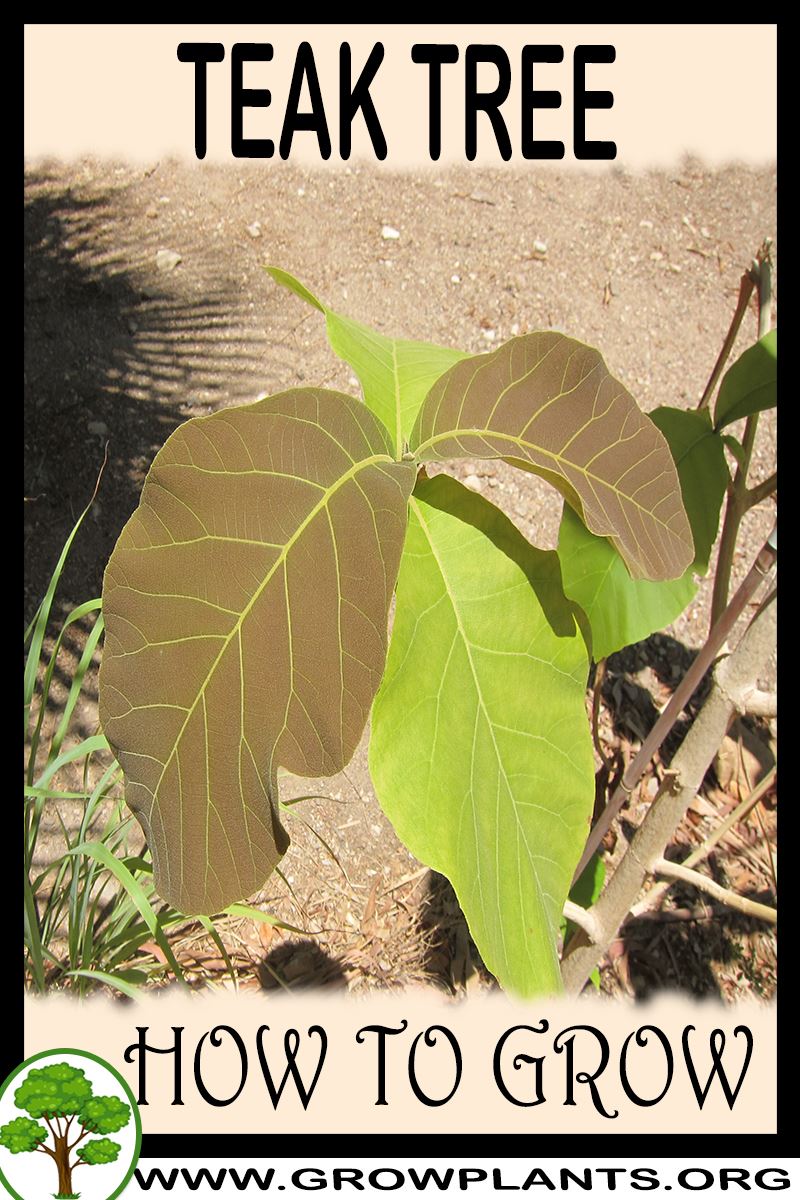
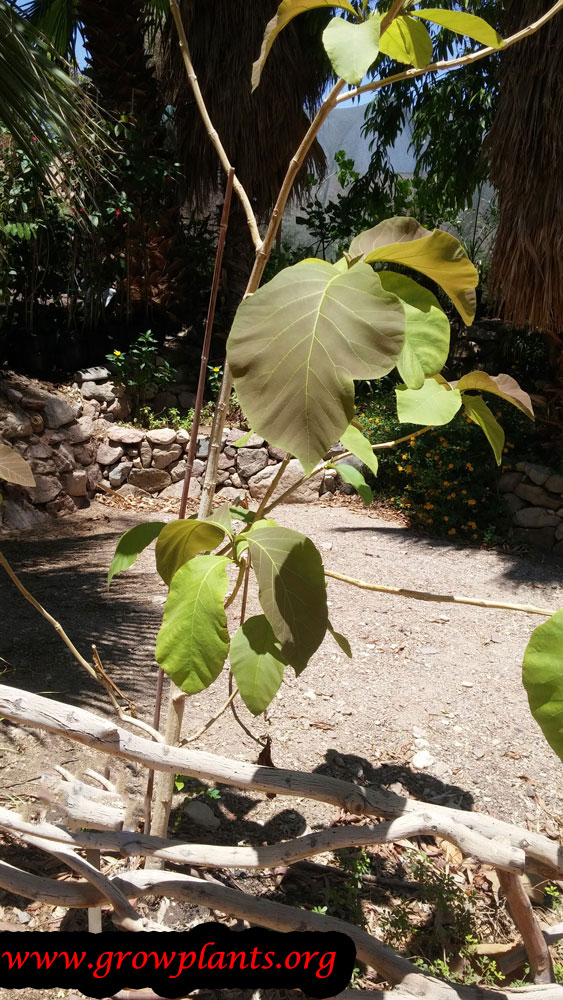
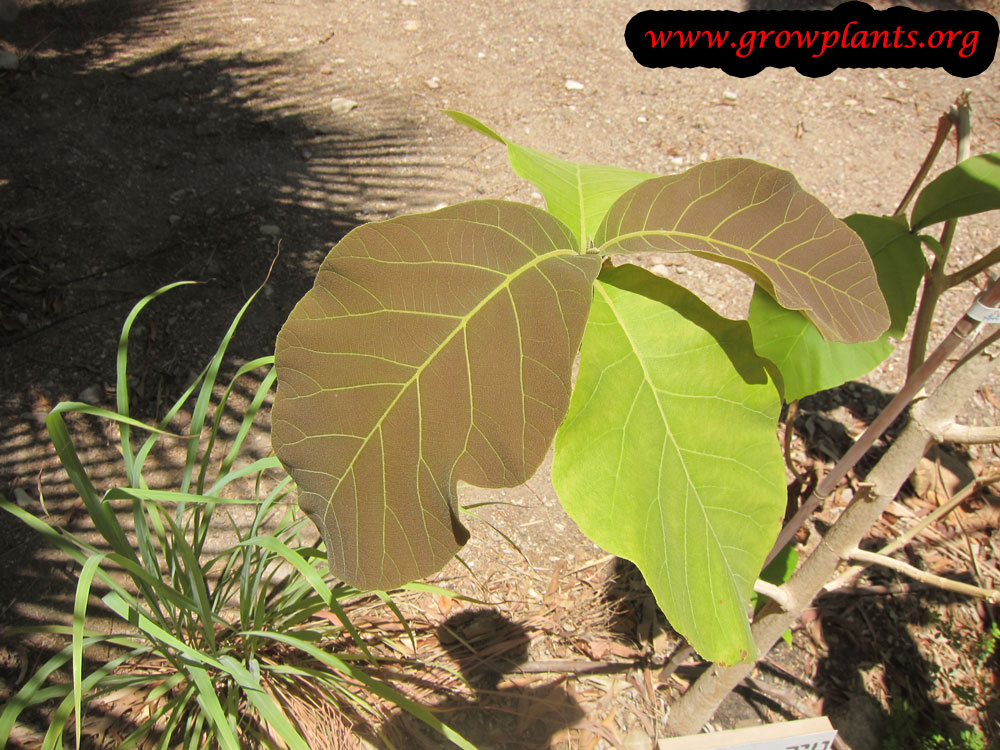
- Leaves and Foliage: Very large, elliptic green leaves, coppery purple-green when young.
- Flower Characteristics: Small, fragrant white flowers carried in large branched sprays.
Primary Uses & Landscape Value
- Functional and Ornamental Roles: Ornamental and shade tree for large tropical landscapes, and a bonsai subject; also the source of prized, weather-resistant teak timber.
Note: Botanical name: Tectona grandis.
Care Guide: Planting, Soil & Watering
Overview: Teak is a large, fast-growing deciduous tree for hot, dry tropical climates (hardiness zone 12 and up), thriving in full sun and deep, well-drained soil. It takes moderate, regular watering while young and needs a great deal of room to reach its full size.
Quick Care Requirements
| Requirement | Ideal Condition |
|---|---|
| Planting Season | Spring, summer or autumn |
| Growth Rate | Fast |
| Soil Type | Deep, well-drained soil |
| Water Need | Moderate |
Planting & Establishment
- Best Planting Season: Plant in the warm season — spring, summer or autumn — in a frost-free tropical setting (zone 12 and up).
- How to Plant:
- Hole Preparation: Dig a generous hole two to three times the width of the root ball to give the vigorous roots loose soil to spread into.
- Soil Amendments: Mix compost or organic matter into the backfill and ensure the site drains freely; teak dislikes waterlogged ground.
- Planting Depth: Plant with the root collar level with the surrounding soil, not buried.
- Growth Speed & Expectations: Grows fast and becomes very large (up to 20–40 m), so give it plenty of space well away from structures.
Soil, Watering & Drainage Care
- Soil Mix & Drainage Needs: Deep, well-drained soil is ideal; teak will not thrive in heavy, waterlogged conditions. It is a large landscape tree and is not suited to container growing.
- Watering Schedule & Technique:
- Young / Newly Planted: Water regularly through the establishment period to build a strong root system, keeping the soil moist but not saturated.
- Established: Water moderately and deeply, allowing the surface to dry between waterings; mature trees tolerate seasonal dryness.
- Seasonal Adjustments: Water more during the dry season while young, and less as cooler or wetter weather sets in.
Climate, Light & Hardiness
Teak is a strictly tropical deciduous tree, native to dry tropical climates, that needs full sun and consistently warm conditions year-round. It has very limited cold tolerance and is only suited to essentially frost-free zones.
Quick Climate Specifications
| Climate Zones | Dry Tropical |
|---|---|
| USDA Hardiness Zones | 12+ |
| Frost Tolerance | Very Low |
| Light Conditions | Full Sun |
Sunlight & Light Exposure
Optimal Light Setup
Requires full sun for healthy growth.
Temperature Extremes & Hardiness
USDA Hardiness & Regional Limits
Suited to outdoor growing only in USDA zone 12 and warmer, reflecting its origin in dry tropical forest climates with no meaningful winter cold.
Cold Damage & Winter Protection
Sheds its leaves annually as part of a normal dry-season deciduous cycle rather than in response to cold; it is not adapted to genuinely cold winters at all.
Frost Sensitivity
Frost-sensitive with essentially no cold tolerance; it is not a candidate for outdoor culture anywhere frost occurs.
Extreme Heat Tolerance
Well adapted to hot tropical conditions, including a pronounced dry season.
Wind, Humidity & Microclimate
Rainfall & Seasonal Moisture
Tolerates an average water regime and, being native to dry tropical forest, copes with a seasonal dry period better than many rainforest species.
Growing in Pots, Balconies & Indoors
Teak is a large tree (20-40 m), so it is not a long-term container or indoor plant. It is a huge timber tree that needs a great deal of space; the grower marks it as neither a houseplant nor a pot plant.
Quick Details
- Container Size: Not suited to containers long term
- Indoor Suitability: Not a houseplant – a full-size tree
- Best Spot: Full sun, open ground
- Soil & Drainage: a light, aerated potting mix – peat or coir blended with perlite or vermiculite, plus some organic matter/compost (for young/bonsai plants)
- Watering in Pots: Frequent while young in a tub – pots dry fast; avoid waterlogging
Indoors & On the Windowsill
- Not a houseplant: The grower marks it as unsuitable indoors – it is a full-size tree that needs open ground and full light.
On a Balcony or Patio
- Not for pots: The grower does not recommend container growing – it simply gets too large.
- Young plants: A large tub can hold a sapling for a short spell, but plan its final position in open ground with room to spread.
Choosing the Pot, Soil & Long-Term Care
- Young / bonsai only: If you grow it in a pot at all, keep it to the juvenile stage in a large, free-draining tub with drainage holes.
- Potting mix: a light, aerated potting mix – peat or coir blended with perlite or vermiculite, plus some organic matter/compost.
- Feeding & watering: Potted plants exhaust their feed faster because water washes nutrients out, so feed a little more often than plants in open ground during active growth; potted trees also dry out fast, so water more attentively than one in the ground.
- Repotting: Refresh the top of the mix each growing season and pot up or divide roughly every couple of years, trimming crowded roots – but recognise that a vigorous tree will soon need the open ground.
Fertilizing & Feeding
A moderate feeder: this fast-growing tree responds well to steady feeding while establishing and through its warm-season growth flush, then rests without feeding during its dry-season leaf drop.
Quick Fertilizing Specs
| Feeding Level | Moderate feeder during establishment and active growth |
|---|---|
| Main Nutrient Priority | Balanced feeding with adequate nitrogen to support fast canopy growth |
| Best Feeding Period | The warm, wet part of the growing season |
| Organic Options | Compost or well-rotted organic matter worked into the root zone |
| Reduce/Stop Feeding | Ease off and then stop feeding as the dry season and leaf drop approach |
| Micronutrients | Usually met by a complete fertilizer; correct only a diagnosed deficiency |
| Soil pH | Prefers well-drained soil; tolerates a range of pH |
Feeding by Growth Stage
Establishment after planting
Help a newly planted teak tree build roots and establish quickly.
| Nutrient direction | A balanced, nitrogen-forward fertilizer supports fast establishment growth. |
|---|---|
| Timing | The growing season during the first year or two after planting. |
| Frequency | Light, regular feedings through the warm growing season, tapering off as the tree fills in. |
| Fertilizer types | A balanced complete fertilizer, Compost or well-rotted organic matter worked into the planting area |
| Precautions | Keep feeding moderate; excess nitrogen on a fast grower can produce weak, overextended shoots. |
Warm-season growth flush
Support vigorous canopy growth during the warm, wet part of the year.
| Nutrient direction | Balanced feeding with adequate nitrogen sustains the strong seasonal growth flush. |
|---|---|
| Timing | Through the warm, actively growing part of the season. |
| Frequency | An occasional feeding through the growth flush is usually enough for an established tree. |
| Fertilizer types | A balanced complete fertilizer, A top-dressing of compost or organic mulch |
| Precautions | Avoid feeding late in this stage so new growth has time to harden off before the dry season. |
Dry-season leaf drop and rest
Let the tree rest through its natural dry-season leaf drop without pushing new growth.
| Nutrient direction | None – withhold fertilizer while the tree is leafless and resting. |
|---|---|
| Timing | During the dry season while the tree is bare and dormant. |
| Frequency | No feeding during this dry-season rest. |
| Fertilizer types | No feeding at this stage; do not fertilize until new growth resumes with the return of rain. |
| Precautions | Do not fertilize while the tree is dormant and leafless; there is no active growth to use the nutrients. |
Nutrient Deficiency Signs & Corrections
Older leaves fade to pale green or yellow and the seasonal growth flush is weak.
| Possible causes | low available soil nitrogen, nitrogen leaching from heavy seasonal rain, poor, thin, or eroded soil |
|---|---|
| Appears first on | older, lower leaves |
| What to check | recent feeding history, soil organic matter, growth rate compared to a typical season |
| Possible correction | Apply a nitrogen-containing balanced fertilizer during the active growth flush and improve soil organic matter. |
New leaves turn yellow while the veins remain distinctly green.
| Possible causes | high or alkaline soil pH tying up available iron, poorly drained soil limiting root uptake, naturally low soil iron |
|---|---|
| Appears first on | newest growth at branch tips |
| What to check | soil pH, soil drainage, overall root health |
| Possible correction | Correct pH toward neutral where testing warrants it and apply a chelated iron product per its label. |
Leaf margins brown or scorch and growth stalls despite adequate watering.
| Possible causes | fertilizer salt buildup in the root zone, under-watering that concentrates salts, excessive or too-frequent feeding for a fast grower |
|---|---|
| Appears first on | leaf margins and tips |
| What to check | recent fertilizer amounts and frequency, watering consistency, soil drainage |
| Possible correction | Ease off feeding, water deeply to help flush accumulated salts, then return to lighter, less frequent feeding. |
Pruning, Training & Seasonal Maintenance
Teak eventually becomes a very large tree, so pruning matters most while it is young: the objective is a single clean leader with low competing branches removed early, mirroring the "formative pruning" used in teak plantations to produce a straight, knot-free trunk. Established specimens need comparatively little intervention — mainly deadwood and clearance — and pruning has little effect on this tree’s fragrant summer flowering, which occurs on new growth regardless. The safest window is the tree’s dry-season leafless rest period, which the source data places in summer for this growing region but which shifts with local monsoon timing elsewhere.
Quick Pruning & Maintenance Specs
| Pruning Tolerance | Moderate while young; Low to Moderate once established |
| Primary Pruning Window | The tree’s dry, leafless rest period (observed as summer in this growing region) |
| Main Objective | Single clean leader/trunk while young; deadwood and clearance once mature |
| Young Plant Priority | Remove low, competing branches to establish one dominant leader and a clean lower trunk |
| Mature Plant Priority | Deadwood removal and clearance for a tree that ultimately reaches 20-40 m |
| Best Tool Type | Bypass secateurs and loppers while young; pruning saw and pole pruner as it matures |
| Avoid Heavy Pruning During | Active leaf flush at the start of the growing season |
Pruning by Plant Age & Size
Newly Established
Remove only damaged or dead growth; allow the young tree to establish roots before any formative cuts.
Young / Formative
Select a single dominant leader and remove low, competing lateral branches as they appear — this is the same "singling" principle used to grow teak for a straight, clean bole in plantation settings, and in a landscape setting it produces a stronger, better-clearanced shade tree.
Mature / Established
Once the framework is set, work is limited to deadwood removal and occasional clearance pruning, given the tree’s very large eventual size.
Structural Pruning & Training
The main structural task is establishing one dominant leader early — fast growth can otherwise produce multiple competing upright stems from the same area, a weak-fork risk in a tree this large. Low branches are generally removed for clearance rather than retained, consistent with this species’ natural tendency to self-prune its lower limbs as the canopy closes.
Tools
Bypass secateurs for young shoots, loppers for small to medium branches during formative singling. Given the tree’s eventual 20-40 m height, a pruning saw and pole pruner are genuinely needed for structural and clearance work as it matures.
Tool Hygiene & Disease Risk
Routine: no significant transmissible disease is documented for this species in the available data. Clean, sharp tools are sufficient for ordinary maintenance cuts.
Cut Placement & Technique
Cut just outside the branch collar, never flush. When removing a competing leader or low branch, cut fully back to its point of origin rather than leaving a stub.
Heavy Pruning & Rejuvenation
Not well suited to hard rejuvenation pruning once mature — this is a large forest-type tree, not a coppicing ornamental shrub, and heavy cuts on an older specimen are best avoided in favor of steady formative work while young.
Post-Pruning Care
No feeding is needed after pruning. Monitor cuts on young trees to confirm the selected leader remains dominant and no new competing stem takes over.
Common Pruning Mistakes
Leaving multiple competing leaders untrained while the tree is young and fast-growing; delaying low-branch removal until limbs are large, creating bigger wounds than necessary; heavy pruning during the flush of new leaf growth.
When NOT to Prune
Avoid heavy pruning during the active leaf-flush at the start of the growing season, and avoid major cuts in the first year or two after transplanting.
Recommended Tools (by task)
- bypass_secateurs — young shoots and light formative work.
- loppers — low branch removal and leader selection while stems are still slender.
- pruning_saw — structural cuts and deadwood removal as the tree matures.
- pole_pruner — clearance and deadwood removal once the tree approaches its mature 20-40 m height.
Pruning Troubleshooting
| Problem | Possible Cause | What to Check | Corrective Action |
| Two or more upright stems competing near the top | Fast growth produced a co-dominant leader that was not corrected when young | Union angle and relative vigor of the competing stems | Remove or subordinate the weaker stem as early as possible; on an older tree, consult an arborist before removing a large one |
Propagation Guide
Teak is traditionally raised from seed, though germination is notoriously slow and uneven because of the hard, corky fruit wall, so nursery seed is usually given a wetting-and-drying pretreatment first. For plantation-style uniformity, teak is also widely propagated vegetatively from root/stump cuttings taken from young nursery seedlings, matching the site’s listed vegetative reproduction option; overall difficulty is moderate, mainly due to the seed’s slow, erratic germination.
Quick Propagation Specs
| Best Propagation Method | Seed (pretreated) |
| Alternative Methods | Root/stump cuttings; coppice shoot cuttings |
| Propagation Difficulty | Moderate |
| Seed True-to-Type | Usually true-to-type, though growth and form can vary between seedlings |
| Vegetative True-to-Type | Yes |
| Best Propagation Season | Start of the warm/rainy season, matching the site’s spring/summer/autumn planting window |
| Seed Germination Time | Slow and often uneven, from several weeks to a couple of months, with germination sometimes continuing over an extended period |
| Germination Temperature | Warm, roughly 25–30°C (77–86°F) |
| Seed Sowing Depth | Shallow, seed laid on its side or lightly covered in nursery beds |
Growing from Seed
Seed Handling & Viability
Each hard, corky fruit contains one to a few true seeds; viability across a seed lot can be inconsistent.
Dormancy & Pre-Sowing Treatment
The tough fruit wall causes dormancy; the traditional pretreatment alternates soaking the fruit in water for around a day with sun-drying, repeated over one to two weeks, to soften the wall and improve and hasten germination. Mechanical nicking/scarification of the fruit wall is an alternative.
Sowing Season
Start of the warm or rainy season.
Sowing Depth & Orientation
Shallow sowing in raised nursery beds, with the fruit laid on its side or only lightly covered.
Germination Conditions
Warm, consistently moist nursery beds favor germination.
Germination Time
Slow and irregular; seedlings can continue emerging over several weeks to a couple of months.
Seedling Care
Seedlings are typically grown on in nursery beds and gradually hardened off before field planting.
Stem Cuttings
Cutting Type
Root/stump cuttings taken from young nursery seedlings (a short root-and-shoot section, called a "stump"), or coppice shoot cuttings from cut-back stock plants.
Best Timing
Dormant or dry season, when nursery stumps are traditionally lifted and prepared.
Cutting Preparation
Trim the seedling’s roots and stem down to a short stump with most side roots and leaves removed.
Rooting Setup
Planted directly into nursery beds or the final planting site rather than a closed propagating case.
Rooting Hormone
Not typically necessary for stump cuttings; optional for softer coppice cuttings.
Rooting Time
New shoots and roots typically develop within a few weeks.
Bloom & Flower Guide
Quick Details
- Bloom Season: Summer, typically in the wet season
- Time to First Bloom: A tree of some years’ maturity before it flowers freely
- Flower Appearance: Many small, fragrant white flowers held in large, branched airy clusters above the canopy
- Edibility: Not eaten – grown as a shade, timber and ornamental tree
Detailed Blooming Overview
Teak is best known as a magnificent timber and shade tree, but in summer a mature specimen crowns itself with large, airy sprays of many small, fragrant white flowers held above the big leaves. Only a small proportion of these flowers go on to set seed. The bloom is a soft, foamy display rather than a bold one, and the flowers are worked by bees and other insects.
Flower Characteristics
- Small, fragrant white flowers, many to a large branched cluster.
- Held in airy panicles above the foliage.
- Insect-pollinated, especially by bees.
Bloom Care & Thinning
- Managing the bloom: No thinning is needed; simply let the tree flower and, if grown for looks, enjoy the display.
- As a bonsai: Flowering is unlikely on dwarfed specimens, which are grown for form and foliage.
- Pollination: Bees and other insects do the work; no intervention is needed.
Pests, Diseases & Troubleshooting
Overview: Teak is a large tropical hardwood whose foliage supports two well-known specialist defoliators – the teak defoliator and the teak skeletonizer – along with leaf rust and, on seedlings, damping-off. Established trees tolerate defoliation well; the key protection is at the nursery and young-plantation stage.
Quick Troubleshooting Overview
| Issue / Pest | Main Symptom | Primary Solution |
|---|---|---|
| Teak defoliator | Leaves stripped by caterpillars | Bt spray on young larvae |
| Teak skeletonizer | Leaf tissue skeletonised | Bt, remove webbed leaves |
| Leaf rust | Rusty pustules on leaf underside | Airflow, sulphur if severe |
| Termites / stem borers | Tunnelled or ring-barked wood | Keep trees vigorous |
| Damping-off | Seedling collapse at soil line | Clean media, avoid overwatering |
Common Pests & Management
- Teak Defoliator (Hyblaea puera):
- Symptoms: The dominant pest of teak: caterpillars feed gregariously and can strip whole crowns in periodic outbreaks, especially on young flush growth after the first rains of the wet season.
- Prevention & Control: Encourage the many natural enemies (parasitic wasps, birds, viral disease) that normally crash outbreaks. In nurseries and young plantations, target early-instar larvae with Bacillus thuringiensis (Bt), which spares beneficials; mature trees usually re-flush and recover.
- Teak Skeletonizer (Eutectona machaeralis):
- Symptoms: Larvae feed under a web on the leaf surface, skeletonising the tissue between veins so leaves turn brown and papery; often builds up later in the season after defoliator peaks.
- Prevention & Control: Remove and destroy webbed leaves where practical and conserve natural enemies. Bacillus thuringiensis (Bt) applied to young larvae gives selective control in nurseries and young stands.
- Scale Insects (Coccoidea):
- Symptoms: Small immobile brown, tan or waxy white bumps clamped to stems, twigs and leaf undersides. They exude honeydew that blackens with sooty mould; heavy infestations cause yellowing, dieback and reduced vigour.
- Prevention & Control: Scrub off light infestations with a soft brush or a cotton bud dipped in dilute alcohol, and prune out badly encrusted twigs. Conserve predatory ladybirds and parasitic wasps. Smother the vulnerable crawler stage with horticultural oil, timing repeat sprays for when young scales are active.
- Mealybugs (Pseudococcidae):
- Symptoms: White cottony masses tucked in leaf axils, growing points and along veins; feeding weakens the plant and leaves sticky honeydew followed by sooty mould. Some species also attack roots.
- Prevention & Control: Dab visible colonies with a cotton bud dipped in dilute alcohol and isolate affected plants. Avoid over-feeding with nitrogen. Encourage predators such as the mealybug destroyer ladybird, and treat with insecticidal soap or horticultural/neem oil, repeating until clear.
Diseases & Fungal Issues
- Rust (Pucciniales):
- Symptoms: Powdery orange, brown or rusty pustules on leaf undersides with yellow flecks above; heavy infection causes early leaf yellowing and drop.
- Treatment & Management: Remove and destroy infected leaves and avoid wetting foliage. Space plants for airflow and choose resistant types where available. Sulphur fungicides applied early can check spread when the disease is recurrent.
- Fungal Leaf Spot (Cercospora / Colletotrichum spp.):
- Symptoms: Brown, tan or black spots, often with a yellow halo or concentric rings, that enlarge and merge in warm humid weather; severe spotting causes leaves to yellow and fall.
- Treatment & Management: Remove and destroy spotted leaves and fallen litter to reduce spores, and avoid overhead watering. Improve spacing and airflow. Copper-based fungicides can protect new growth if the problem recurs each season.
- Damping-off (Pythium / Rhizoctonia spp.):
- Symptoms: Seedlings rot and collapse at the soil line in nurseries, worst in crowded, over-wet, poorly drained seedbeds.
- Treatment & Management: Use clean, free-draining media, sow thinly, avoid overwatering, and provide airflow. Remove collapsed seedlings promptly; a biological drench (Trichoderma) helps protect the rest.
Growing Difficulties & Abiotic Problems
- Waterlogging & Poor Drainage:
- Cause & Symptoms: Stunted, yellowing plants with root dieback in heavy soils that stay wet, as saturated ground starves the roots of oxygen and invites rot.
- Correction Strategy: Improve soil structure with organic matter, plant on mounds or raised beds where drainage is poor, and avoid compacting wet soil. Match watering to the weather so the ground is never continuously saturated.
- Frost & Cold Damage:
- Cause & Symptoms: Blackened, water-soaked, limp new growth and leaf tips after a cold snap; this tender or tropical plant is damaged or killed by frost and by prolonged cold.
- Correction Strategy: Site in a warm, sheltered spot, delay planting until the cold has passed, and protect with fleece or bring container plants under cover when frost threatens. Avoid feeding late so growth hardens off before cold weather.
- Sunscald / Leaf Scorch:
- Cause & Symptoms: Bleached, tan or brown dead patches on the most exposed leaves or bark, appearing after a sudden move into strong sun, intense heat, or reflected heat, especially on soft or previously shaded growth.
- Correction Strategy: Acclimatise plants gradually to stronger light, provide light shade during fierce afternoon heat, and keep roots evenly moist so the plant can transpire. Site sensitive plants where they escape the harshest midday and reflected sun.
What Helps – Products & Tools
In nurseries and young plantations the caterpillar defoliators are best met with Bacillus thuringiensis (Bt), which is selective and pollinator-safe; a sulphur fungicide can check leaf rust and copper the leaf spots if severe. Mature teak generally needs no treatment as natural enemies regulate outbreaks.