Plant Profile & Key Characteristics
Overview: A thorny deciduous shrub about 0.7-1.5 m (28-60 in) tall, grown for its edible dark berries and ornamental habit. It is a hardy temperate-climate shrub used for fruit and as a barrier planting.
Quick Specifications
| Specification | Attribute |
|---|---|
| Plant Type / Life Cycle | Perennial |
| Foliage Type | Deciduous |
| Mature Size | 0.7-1.5 m (28-60 in) tall |
| Growth Rate | Moderate |
| Hardiness | USDA zone 6-8 |
Growth Form & Structure
- Height & Spread: 0.7-1.5 m (28-60 in) tall; can also be grown in containers.
- Growth Habit & Form: Thorny, twiggy shrub clothed in small linear leaves.
- Lifespan & Maturity: Moderate-growing woody shrub; begins bearing fruit in about 2-3 years.
Anatomy & Physical Features
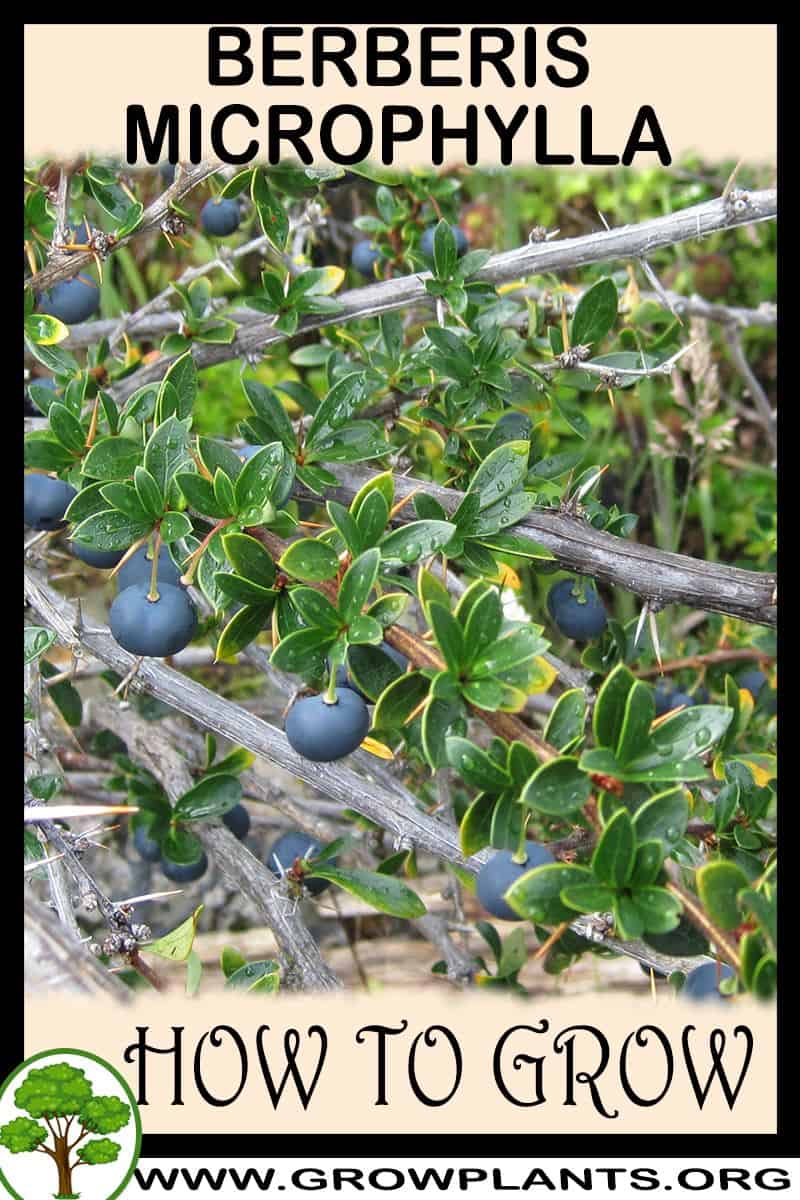
- Leaves & Foliage: Small green linear leaves; the stems are spiny.
- Flower Characteristics: Yellow bell- to trumpet-shaped flowers borne on the stems (full detail in the Bloom section).
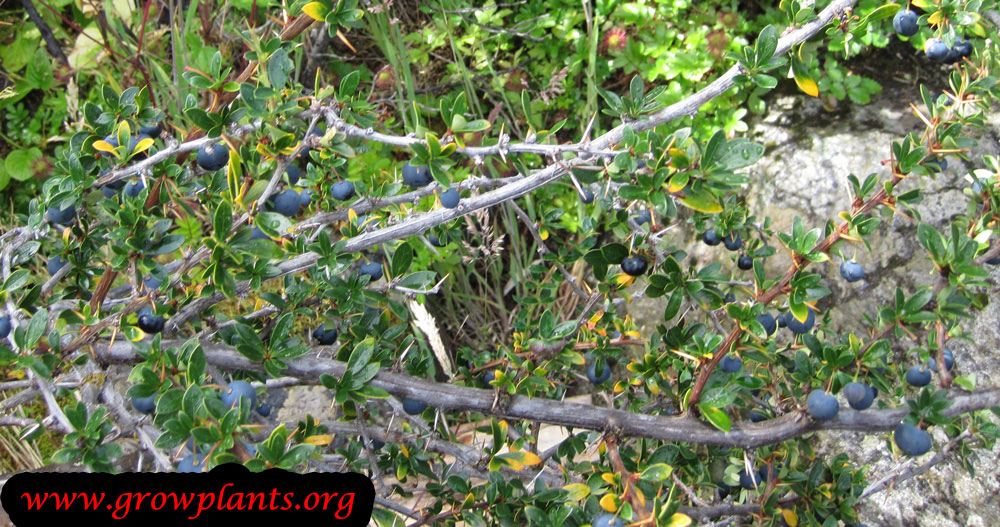
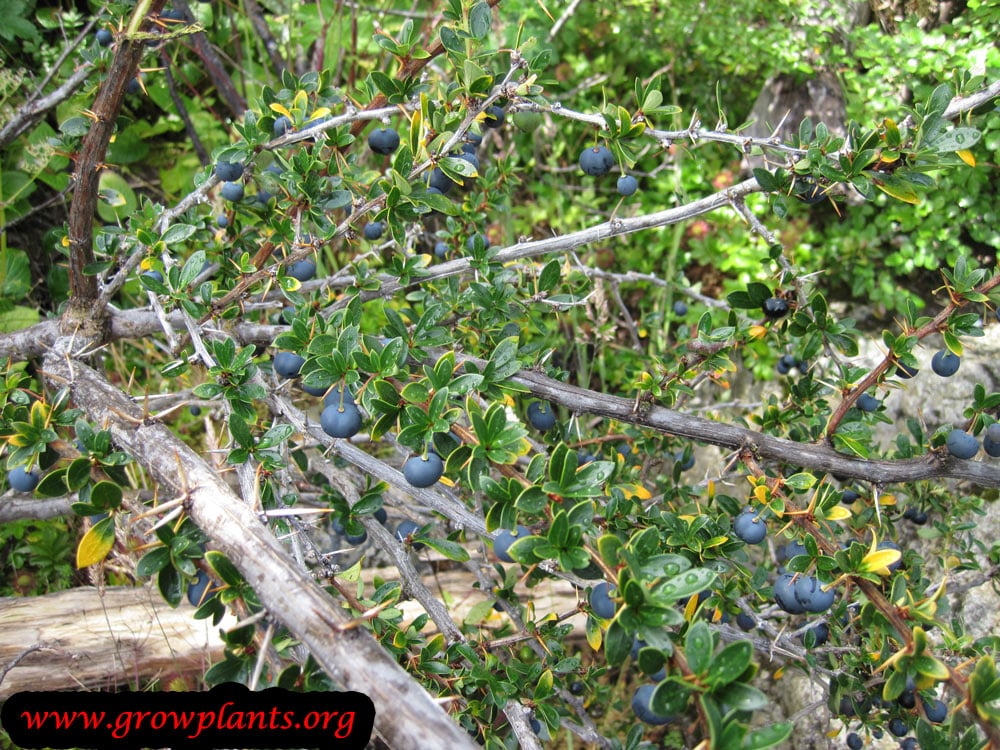
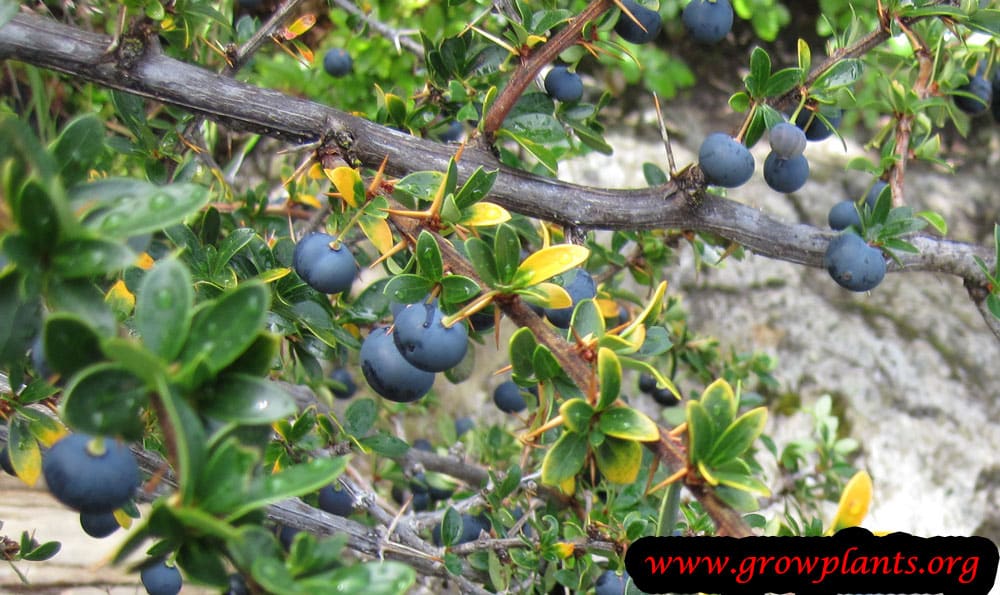
- Fruit Profile: Purple-black rounded berries with a small crown at the tip (full detail in the Fruit section).
Primary Uses & Landscape Value
- Edible Uses: Berries eaten raw or made into jams, juice and beverages.
- Functional & Ornamental Roles: Fruiting and ornamental shrub; the thorny habit suits barrier and hedge plantings.
Care Guide: Planting, Soil & Watering
Overview: Calafate (Berberis microphylla) is a hardy, deciduous, thorny shrub for temperate climates that needs winter chilling and grows best in full sun to part shade in a moist but well-drained, acidic soil. A surface mulch keeps its roots cool and moist, and it benefits from iron to prevent chlorosis on less-acid ground.
Quick Care Requirements
| Requirement | Ideal Condition |
|---|---|
| Planting Season | In the dormant season – winter to early spring |
| Growth Rate | Moderate |
| Soil Type | Moist but well-draining, kept mulched |
| Soil pH | Acidic – this species prefers acid soil; supplement iron (e.g. chelated iron) to prevent leaf chlorosis |
| Water Need | Moderate to high – keep evenly moist, not waterlogged |
Planting & Establishment
- Best Planting Season: Plant while dormant, in winter or early spring, so the roots establish before growth resumes.
- How to Plant:
- Hole Preparation: Dig a hole about twice the width of the root ball to loosen the surrounding soil.
- Soil Amendments: Work in organic matter or compost; on non-acidic ground add acidifying material and iron, and apply a surface mulch to conserve moisture.
- Planting Depth: Set the shrub at the same depth it grew in its pot, keeping the root collar at soil level.
- Growth Speed & Expectations: Moderate; a thorny shrub reaching about 0.7–1.5 m (28–60 in) – wear gloves when handling it.
Soil, Watering & Drainage Care
- Soil Mix & Drainage Needs: Wants a well-drained, acidic soil kept cool and moist by mulch; avoid waterlogging, which rots the roots.
- Watering Schedule & Technique:
- Young / Newly Planted: Water regularly to keep the root zone consistently moist while establishing.
- Established: Water moderately to generously, letting the top few cm dry before watering again; mulch reduces how often you need to water.
- Seasonal Adjustments: More in the warm, dry season; much less over the cold, dormant winter.
Climate, Light & Hardiness
Berberis microphylla is a temperate-climate shrub grown in full sun to half shade, native to the cold, windy far south of South America. It is a genuinely cold-hardy deciduous shrub, rated by the site to USDA zone 6–8, with a real winter chilling requirement rather than a subtropical growth pattern.
Quick Climate Specifications
| Climate Zones | Temperate climates |
|---|---|
| USDA Hardiness Zones | Zone 6–8 |
| Optimal Temp Range | approximately 10–24°C (50–75°F) during the growing season |
| Cold Damage Begins | Not sharply defined in source data; as a deciduous zone 6–8 shrub it is not expected to show damage from typical winter cold once dormant |
| Approx. Survival Minimum | approximately −20 to −23°C (−4 to −9°F) briefly, dormant established plant, consistent with zone 6 |
| Frost Tolerance | High |
| Light Conditions | Full sun / half shade |
| Wind Tolerance | High (native to windswept Patagonian habitats) |
| Salt / Coastal Tolerance | Not established in source data |
Sunlight & Light Exposure
Optimal Light Setup
Full sun to half shade both suit this shrub, with full sun generally supporting the best flowering and fruiting.
Direct Sun Requirement
Not strictly required - the site lists half shade as an acceptable alternative to full sun.
Shade & Heat Management
Some afternoon shade can help in the warmer end of its range, though this is primarily a cool-temperate species rather than a heat-tolerant one.
Best Exposure / Orientation
Open, exposed sites are tolerated well given its native windswept habitat; no special wind shelter is needed.
Temperature Extremes & Hardiness
USDA Hardiness & Regional Limits
The site rates this species to zone 6–8, reflecting genuine cold-climate hardiness rather than the frost-tenderness typical of subtropical shrubs. It is a deciduous, dormancy-dependent plant, and the site’s care notes specifically mention a chilling-hours requirement.
Cold Damage & Winter Protection
Dormant, established plants tolerate hard winter cold within zone 6–8 with no special protection; young plants benefit from mulch through their first winters.
Frost Sensitivity
Frost tolerance is high once dormant; spring frost after leaf-out can still damage tender new growth and flowers, as with most deciduous temperate shrubs.
Extreme Heat Tolerance
Best suited to temperate climates; it is not documented here as heat-tolerant, and hot, dry summers outside its natural range may stress the plant.
Chilling Requirement
The site’s care overview lists “Chilling hours” as a requirement, confirming this shrub needs a genuine cold winter dormancy period; an exact chill-hour figure is not given in the source data, so plan for a full temperate winter rather than a specific count.
Wind, Humidity & Microclimate
Humidity Preferences
Adaptable to typical temperate-climate humidity; no special humidity requirement is documented.
Wind Tolerance
High - native to the exposed, windy habitats of southern Patagonia, so it tolerates open, wind-exposed planting sites well.
Rainfall & Seasonal Moisture
Suited to temperate climates with reasonably distributed rainfall through the growing season; the site notes average to fairly heavy watering.
Microclimate Recommendations
Little special microclimate management is needed within its zone 6–8 range; toward the warmer edge, some afternoon shade and consistent moisture help it cope with summer heat.
Growing in Pots, Balconies & Indoors
The calafate (Berberis microphylla) is a hardy, spiny shrub of 0.7-1.5 m (28-60 in), not a houseplant, but it takes well to a large pot on a sunny balcony, patio or terrace. It likes full sun to half shade and, being cold-hardy, is happiest staying outdoors year-round where it gets its natural winter chill.
Quick Details
- Container Size: A roomy pot sized to the shrub, potted up in stages as it fills out
- Indoor Suitability: Not a houseplant – a hardy outdoor shrub that needs winter cold
- Best Spot: Full sun to half shade outdoors
- Soil & Drainage: Free-draining, organic-rich mix; strong drainage holes
- Watering in Pots: Average to generous – keep evenly moist as pots dry faster; never waterlogged
Indoors & On the Windowsill
- Houseplant limits: The grower marks it as no for indoor growing – it is a hardy fruiting shrub that needs open sun and a cold winter to crop, which a warm room can’t supply.
- Keep it outdoors: Rather than bringing it in, leave the pot outside through winter so it gets the chill it needs; its spines also make it awkward as a houseplant.
On a Balcony or Patio
- Light & wind: Give it a bright, open spot. Walls and paving reflect heat, so pots dry quickly – check moisture in warm weather. Its thorns mean placing it clear of walkways.
- Practicalities: A filled pot is heavy – stand it where you can water freely and let drainage run off.
Choosing the Pot, Soil & Long-Term Care
- Pot & drainage: Use a pot with strong drainage holes; skip a standing water saucer to avoid root rot. Terracotta breathes and dries faster, while glazed or plastic pots hold moisture longer.
- Potting mix: A well-aerated, organic-rich mix – peat or coir opened up with perlite or vermiculite.
- Feeding: Potted plants need feeding more often than those in the ground because nutrients leach out with every watering – feed through the growing season.
- Repotting: Refresh the mix and pot up about every two years, giving perennials a light root and top prune to keep them in balance with the pot.
Fertilizing & Feeding
Calafate is a moderate feeder that does best with an acid-shrub feeding approach – nitrogen-leaning while it builds its branch framework, then balanced-to-potassium support through bloom and fruiting.
Quick Fertilizing Specs
| Feeding Level | Moderate |
|---|---|
| young_feeding | Nitrogen-leaning feeding to build a strong branch framework. |
| mature_feeding | Balanced-to-potassium feeding through bloom and fruiting. |
| Main Nutrient Priority | Nitrogen while establishing, then balanced-to-potassium through bloom and fruit development. |
| Best Feeding Period | Active growing season, from spring growth through fruiting. |
| Organic Options | Mulch and acid-shrub organic matter worked around the base. |
| Micronutrients | This acid-loving shrub can show iron chlorosis if soil drifts alkaline; a chelated iron product corrects it. |
| Soil pH | Prefers acidic soil. |
| Reduce/Stop Feeding | Ease back once berries are fully ripe and the shrub heads into its winter rest. |
Feeding by Growth Stage
Newly Planted Calafate (Berberis microphylla)
Establish roots in acidic, well-drained soil ahead of vegetative growth.
| Nutrient direction | Light, balanced feeding suited to an acid-loving shrub, worked in alongside mulch. |
|---|---|
| Timing | After planting, once new growth begins during the cooler establishment season. |
| Frequency | A light feeding as the shrub settles in, then easing into its regular seasonal rhythm. |
| Fertilizer types | A balanced fertilizer formulated for acid-loving shrubs, Mulch worked around the base to help maintain soil acidity and moisture |
| Precautions | Keep mulch in place to protect roots and maintain the acidic soil this thorny shrub prefers, and avoid working fertilizer in too close to the thorny stems. |
Vegetative Growth
Support steady branch and leaf development ahead of spring flowering.
| Nutrient direction | Nitrogen-leaning feeding to build a strong framework of branches. |
|---|---|
| Timing | Through the active growing season leading up to spring bloom. |
| Frequency | Regular light feedings during active growth, easing back as the shrub approaches bloom. |
| Fertilizer types | An acid-shrub or berry-formulated fertilizer with a nitrogen lean, Mulch refreshed to maintain soil acidity |
| Precautions | Watch for pale new growth on alkaline soils, since this shrub’s preference for acid soil makes it prone to iron chlorosis if soil pH drifts upward. |
Flowering and Fruiting
Support the shift from yellow bell-shaped blooms into a full set of purple-black berries.
| Nutrient direction | Balanced feeding through bloom, shifting toward potassium support as berries develop. |
|---|---|
| Timing | From spring bloom through fruit development and ripening. |
| Frequency | Feed through the active flowering and fruiting period, easing back once fruit is fully ripe. |
| Fertilizer types | A balanced-to-potassium acid-shrub fertilizer as berries develop, Mulch to help maintain even soil moisture through fruiting |
| Precautions | Keep soil moisture consistent through fruiting, and ease back on feeding once berries are close to full ripeness. |
Nutrient Deficiency Signs & Corrections
New leaves turn yellow between the veins while the veins themselves stay green.
| Possible causes | Soil pH drifting too alkaline for this acid-loving shrub, Poorly drained soil limiting root uptake, True iron deficiency in depleted soil |
|---|---|
| Appears first on | Newest growth at branch tips |
| What to check | Soil pH, Drainage around the root zone, Recent mulch and soil amendment history |
| Possible correction | Lower soil pH with acidifying mulch or amendments and apply a chelated iron product per its label if yellowing persists. |
Pale overall foliage and weak new branch growth.
| Possible causes | Insufficient nitrogen feeding for the growth stage, Nutrient leaching from sandy or heavily mulched soil, Root stress from poor drainage |
|---|---|
| Appears first on | Older leaves first, spreading through the shrub |
| What to check | Recent feeding history, Soil drainage and type, Root health |
| Possible correction | Return to a nitrogen-leaning feeding appropriate to the growth stage and check that drainage isn’t washing nutrients away. |
Good flowering but few berries develop afterward.
| Possible causes | Insufficient pollinator activity during bloom, Feeding too heavily skewed toward nitrogen at bloom time, Water stress during flowering and fruit set |
|---|---|
| Appears first on | Whole-plant pattern rather than a single branch |
| What to check | Pollinator activity during bloom, Recent feeding balance, Soil moisture consistency during bloom |
| Possible correction | Balance feeding rather than leaning on nitrogen at bloom time, and keep soil moisture consistent through flowering and fruit set. |
Pruning, Training & Seasonal Maintenance
Berberis microphylla (calafate) is a small, dense, thorny deciduous shrub that tolerates moderate pruning and mainly needs renewal thinning rather than a formal training system. Winter dormancy is the safest window for sanitary work – removing dead and weak canes – since the plant is leafless and any thorny interior wood is easiest to see and reach then; because this shrub flowers on wood formed the previous season, any heavier shaping cuts meant to preserve next spring’s yellow bloom and the berry crop that follows are best held until just after flowering instead of done as part of the winter pass.
Quick Pruning & Maintenance Specs
| Pruning Tolerance | Moderate |
| Primary Pruning Window | Winter dormancy – sanitary/renewal cuts (dead, weak, oldest canes) |
| Secondary Maintenance Window | Immediately after spring flowering – shaping cuts that would otherwise remove flower buds |
| Typical Frequency | Annual light renewal pass |
| Main Objective | Remove dead/weak/oldest wood, keep the dense thorny growth manageable, preserve next season’s flowering wood |
| Young Plant Priority | Light shaping only; let the shrub build a full multi-stem base |
| Mature Plant Priority | Renewal – remove the oldest canes at the base on rotation |
| Best Tool Type | Bypass secateurs for thin canes, loppers for older basal wood |
| Avoid Heavy Pruning During | Active bloom, if a full berry crop is wanted that year |
Pruning by Plant Age & Size
Newly Established
Remove only damaged or dead growth after planting; this compact shrub (mature size roughly 0.7–1.5m) needs little intervention while young.
Young / Formative
No leader/central-framework training – this is a multi-stem shrub, so formative work is limited to removing any obviously weak or crossing young canes and letting the rest fill out into its natural dense, thorny form.
Mature / Established
Renewal priority: on rotation, remove some of the oldest, least productive canes at the base each winter to make room for vigorous replacement growth, rather than shearing the whole shrub’s surface.
Seasonal Pruning Schedule
Dormant / Winter
Objective: sanitation and renewal while the shrub is leafless and dormant. What to remove: dead wood, clearly weak or damaged canes, and a portion of the oldest basal canes for renewal. What NOT to remove: a large share of last season’s healthy new wood, since that is what will flower in spring. Expected response: stronger new canes from the base; impact on flowering is minimal if kept to genuinely dead/weak/oldest wood, but larger if pruning strays into shaping cuts on healthy one-year wood.
Post-Flowering
Objective: any size or shape correction that would otherwise remove developing flower buds. What to remove: overlong or awkwardly placed shoots, done once bloom has finished so the coming berry set isn’t sacrificed. What NOT to remove: don’t wait so long that you’re cutting into wood already carrying developing berries if a harvest is wanted. Expected response: the shrub redirects energy into ripening the existing fruit and building next season’s flowering wood.
Flowering & Fruiting Wood
Like most Berberis, this species flowers on wood formed during the previous growing season, not on the current year’s brand-new shoots. That means winter pruning that removes a lot of one-year-old wood directly reduces the coming spring’s bloom and the summer berry crop, while a light winter pass limited to dead/weak/oldest wood costs little; if maximizing the berry harvest matters more than a tidy winter silhouette, save shaping cuts for right after flowering instead.
Structural Pruning & Training
No formal leader or espalier training – this is a naturally dense, arching multi-stem shrub. The relevant structural work is renewal pruning (removing some of the oldest canes at the base each year to keep the shrub productive rather than woody and congested) and thinning where the thorny growth has become impenetrable, done with care given the thorns.
Special Growth to Remove
Dead and clearly weak or diseased branches, the source’s own core guidance for this plant. On mature shrubs, a portion of the oldest basal canes removed on rotation as renewal pruning; excess low, congested thorny growth at the base can also be thinned for easier access, while leaving enough young cane structure for next year’s bloom.
Container & Small-Space Pruning
Suitable for container growing given its compact mature size; in a pot, prune a little more conservatively than in the ground, since a container-grown shrub has less root reserve to regrow from after a hard renewal cut, and prioritize light, more frequent thinning over an occasional heavy one.
Tools
Bypass secateurs for thin, current-season canes; loppers for the thicker basal wood removed in renewal pruning. No saw is needed on a shrub this size, and no hedge shears – shearing this species (despite its dense, hedge-like look) removes flowering wood indiscriminately and should be avoided for a plant grown for bloom and berries.
Tool Hygiene & Disease Risk
Increased: this species is noted as susceptible to a virus, so disinfecting blades between plants (and between cuts on any visibly affected specimen) is worth the extra step, more so than for a plant with only routine tool-hygiene needs.
Cut Placement & Technique
Remove selected old canes with a cut at the base rather than heading them partway up, which keeps the renewal response coming from ground level rather than producing a stubby regrowth flush partway up the cane. Work carefully around the thorns, choosing cut angles and hand position before committing to each cut rather than reaching blind into the dense growth.
Heavy Pruning & Rejuvenation
An overgrown or neglected shrub tolerates renewal rejuvenation, but it is best staged – removing roughly a third of the oldest canes at the base each winter over two to three years – rather than cutting the whole shrub down at once, which would sacrifice several years of bloom and berries in one go for a plant that fruits reliably by its second or third year.
Post-Pruning Care
No extra fertilizing is needed right after pruning; this species already benefits from acidic, iron-available soil and regular mulch as its base care, which supports the regrowth pruning stimulates without adding more. Keep an eye on new basal shoots for aphids, a known pest here.
Common Pruning Mistakes
Shearing the shrub’s outer surface as if it were a formal hedge, which removes the previous season’s flowering wood indiscriminately and cuts the berry crop; removing all the oldest canes in a single winter instead of staging renewal over a few years; reaching into the dense thorny growth without planning cuts first.
When NOT to Prune
Avoid heavy shaping cuts during active bloom or while berries are developing if a good harvest is wanted that season; hold non-sanitary cuts until just after flowering instead of doing them in the winter dormant pass.
Recommended Tools (by task)
| Young shrub or thin current-season canes | bypass_secateurs | Clean cuts on thin wood for light shaping and sanitary removal |
| Mature shrub, renewal removal of older basal canes | loppers | Handles the thicker basal wood removed in renewal pruning |
| Any age, cutting near virus-affected or diseased wood | blade_disinfectant | Reduces the risk of spreading the virus this species is noted to carry |
Pruning Troubleshooting
| Problem | Possible Cause | What to Check | Corrective Action |
| Poor flowering/berry set the spring after pruning | Winter pruning removed too much of the previous season’s wood | How much one-year-old wood versus dead/old wood was cut | Limit winter cuts to dead/weak/oldest canes; move shaping cuts to just after bloom |
| Shrub is dense, woody, and bearing poorly at the center | No renewal pruning has been done for several years | Age and thickness of the oldest canes at the base | Begin staged renewal, removing about a third of the oldest canes each winter |
| Dieback or discolored foliage after pruning | Possible virus spread via contaminated tools, or aphid activity on new growth | Tool hygiene used on the last cut; presence of aphids on regrowth | Disinfect tools between plants/cuts; treat aphids on new shoots promptly |
Propagation Guide
Berberis microphylla (Calafate) is best propagated vegetatively, primarily from semi-hardwood stem cuttings, since the site notes that vegetative reproduction is necessary to reliably reproduce the plant; growing from seed is possible for the species but germination tends to be slow and uneven due to the dormancy typical of Berberis seed. Overall propagation difficulty is moderate.
Quick Propagation Specs
| Best Propagation Method | Semi-hardwood stem cuttings |
| Alternative Methods | Seed (species propagation only) |
| Propagation Difficulty | Moderate |
| Seed True-to-Type | Variable – site notes vegetative propagation is necessary |
| Vegetative True-to-Type | Yes |
| Best Propagation Season | Cuttings: mid–late summer; Seed: sown after cleaning, typically with a cold period before spring germination |
| Cutting Rooting Time | Several weeks to a couple of months, roots slowly |
Growing from Seed
Seed Handling & Viability
Clean the pulp from ripe berries before sowing or storing the seed.
Dormancy & Pre-Sowing Treatment
Berberis seed commonly shows some dormancy and often benefits from a period of cool, moist stratification to improve and even out germination.
Sowing Depth & Orientation
Sow shallow, just covering the seed.
Germination Conditions
Germination can be slow and irregular; cool, moist stratification followed by mild spring warmth tends to give the best results.
Seedling Care
Keep young seedlings consistently moist and protected while they establish.
Stem Cuttings
Cutting Type
Semi-hardwood cuttings from partially matured, current-season growth.
Best Timing
Mid–late summer.
Cutting Preparation
Take cuttings from healthy stems, strip the lower leaves, and handle carefully as the plant is thorny.
Rooting Setup
Well-drained propagation mix kept humid (covered or misted) in bright, indirect light.
Rooting Hormone
Beneficial for this woody shrub – can improve and speed rooting, though not strictly required.
Rooting Time
Typically several weeks to a couple of months.
Bloom & Flower Guide
Quick Details
- Bloom Season: Spring
- Time to First Bloom: Usually two to three years after planting, as the shrub establishes
- Flower Appearance: Small yellow bell- to trumpet-shaped flowers on short stems
- Edibility: Grown for its fruit; the flowers themselves are ornamental, not eaten
Detailed Blooming Overview
Calafate greets spring with cheerful yellow bells scattered along its spiny branches. The blossoms are modest in size but freely produced, and they set the stage for the dark, tangy berries this hardy Patagonian shrub is loved for.
Flower Characteristics
- Bright yellow flowers in a bell to shallow-trumpet shape.
- Carried on short stems, dotted along the branches.
Bloom Care & Thinning
- Pollination: bees are the main visitors, and the flowers are also self-fertile, so even a single shrub can set fruit.
- Light: an open, sunny position gives the fullest flowering.
Fruit & Uses
Berberis microphylla, known as calafate, is grown for its small purple-black berries, which are the plant’s only edible part; they are eaten fresh off the bush or cooked down into jams, juice and other beverages.
Quick Edible Specs
| Edible Parts | Fruit (berries) |
|---|---|
| Main Use(s) | Culinary – fresh eating, jams, juice, beverages |
| Eaten Raw or Cooked | Raw for fresh eating; cooked for jam, juice and beverages |
| Preparation Required | None for fresh eating; cook/strain for jam, juice or beverages |
| Harvest Season | Spring / Summer |
| Time to First Harvest | Not immediate – young plants need a few seasons to establish before fruiting well; see this page’s planting/propagation details for the general timeline |
| Storage | Best eaten fresh or processed promptly into jam, juice or preserves for longer storage |
| Safety/Toxicity Caveat | None known for the ripe fruit; the plant is thorny, so handle branches carefully when picking |
Fruit
Berries ripen to a deep purple-black colour, with a small crown-like remnant of the flower left at the tip – a typical calafate feature. They are picked once fully coloured and slightly soft, and can be eaten straight off the bush or cooked into jams, pressed for juice, or used in beverages. Birds are the main competition for the crop, so picking in a timely way once berries ripen helps secure a harvest.
Harvesting
Harvest runs through spring into summer as berries ripen unevenly, so more than one picking pass over the season is normal. Because the plant is thorny, gloves and careful handling are worthwhile when reaching in among the branches.
Preparation, Uses & Safety
Fresh berries need no preparation beyond picking and rinsing. For jams, juice or beverages, the fruit is simply cooked down or pressed – there is no safety-driven reason to cook it, only culinary preference and preservation. No toxicity is noted for the ripe fruit; the only real hazard when harvesting is the plant’s thorns rather than the berries themselves.
Pests, Diseases & Troubleshooting
Overview: Barberries are hardy, spiny shrubs, and their signature problem is barberry rust – Berberis is the alternate host of wheat stem rust, which is why the genus is restricted in some cereal-growing regions. Aphids on new shoots, powdery mildew, and soil-borne wilts and leaf spots make up the rest. Sound siting, airflow and prompt removal of rusted or wilted wood keep it healthy.
Quick Troubleshooting Overview
| Issue / Pest | Main Symptom | Primary Solution |
|---|---|---|
| Barberry rust | Orange-yellow pustules on leaves and stems | Remove infected wood, keep away from cereals, resistant species |
| Barberry aphid | Clustered aphids curling shoot tips, honeydew | Water blast, insecticidal soap, encourage predators |
| Powdery mildew | White coating on leaves | Airflow, avoid overhead water, sulphur spray |
| Verticillium wilt | Branch dieback and wilting, no recovery | Remove affected wood, sanitation; no chemical cure |
| Anthracnose / leaf spot | Dark spots and blotches on leaves | Rake litter, improve airflow, copper if severe |
Common Pests & Management
- Barberry aphid (Liosomaphis berberidis):
- Symptoms: Dense colonies of aphids on new shoots and leaf undersides curl and distort growth, coating it with honeydew and sooty mould.
- Prevention & Control: Dislodge with a water jet, spray insecticidal soap or neem on undersides, encourage ladybirds and lacewings, and avoid heavy nitrogen feeding that pushes soft growth.
- Barberry webworm (Omphalocera dentosa):
- Symptoms: Caterpillars web leaves together and feed within the tied foliage, leaving frass-filled nests and defoliated shoots.
- Prevention & Control: Prune out and destroy webbed nests, handpick larvae, and use Bacillus thuringiensis on young caterpillars where numbers warrant.
- Scale insects (Lepidosaphes / Quadraspidiotus spp.):
- Symptoms: Immobile brown, oyster-shell or grey bumps on stems and twigs, with honeydew from soft scales and gradual branch weakening.
- Prevention & Control: Scrub off light infestations, prune badly encrusted wood, and apply horticultural oil to smother crawlers, timed to the crawler stage; control ants.
- Spider mites (Tetranychus / Oligonychus spp.):
- Symptoms: Fine stippling and bronzing of leaves with faint webbing in hot, dry, dusty conditions.
- Prevention & Control: Hose foliage, reduce dust and drought stress, and treat undersides with insecticidal soap or horticultural oil.
Diseases & Fungal Issues
- Barberry rust (Puccinia graminis / Puccinia berberidis):
- Symptoms: Bright orange to yellow raised pustules (aecia) on leaves, stems and fruit; the fungus alternates between barberry and cereal grasses, so infected shrubs threaten nearby wheat.
- Treatment & Management: Remove and destroy infected shoots, avoid planting susceptible barberries near cereal crops (check local restrictions), improve airflow, and choose rust-resistant species and cultivars; sulphur reduces spread.
- Powdery mildew (Microsphaera berberidis / Erysiphe spp.):
- Symptoms: White powdery film on leaves and shoots, with distortion and early leaf drop in humid, crowded conditions.
- Treatment & Management: Prune for airflow, avoid overhead watering, remove infected leaves, and spray sulphur or potassium bicarbonate.
- Verticillium wilt (Verticillium dahliae):
- Symptoms: Sudden wilting and dieback of individual branches, often with internal vascular streaking; the soil-borne fungus has no cure.
- Treatment & Management: Remove and destroy affected wood, keep the plant vigorous with even water and mulch, avoid replanting susceptible species in infested soil, and sanitise pruning tools.
- Anthracnose / leaf spot (Colletotrichum / Phyllosticta spp.):
- Symptoms: Dark brown to purplish spots and blotches on leaves, sometimes merging and causing early leaf fall in wet seasons.
- Treatment & Management: Rake up and destroy fallen leaves, improve airflow, water at the base, and apply copper only in persistent, damp conditions.
- Bacterial leaf spot / blight (Pseudomonas spp.):
- Symptoms: Angular water-soaked spots that darken, sometimes with yellow halos, spread by splashing water.
- Treatment & Management: Avoid overhead irrigation, prune for airflow, remove affected foliage, and disinfect tools.
Growing Difficulties & Abiotic Problems
- Chlorosis:
- Cause & Symptoms: Poor, compacted or waterlogged soil (or high pH) yellows leaves between green veins.
- Correction Strategy: Improve drainage and soil structure, mulch, and apply iron chelate or a balanced feed if a deficiency is confirmed.
- Dieback from waterlogging:
- Cause & Symptoms: Roots suffocate in heavy, wet soil, causing branch dieback.
- Correction Strategy: Plant in free-draining soil, avoid low wet spots, and never overwater established shrubs.
- Winter / wind scorch:
- Cause & Symptoms: Cold drying winds brown the leaf margins of evergreen types.
- Correction Strategy: Site out of harsh exposed winds and mulch the root zone.
What Helps – Products & Tools
For barberry, keep horticultural oil and insecticidal soap on hand for aphids, scale and mites; a sulphur or potassium-bicarbonate fungicide for powdery mildew and to slow rust; and copper for leaf spots. The most important measures are cultural: prune out rusted and wilted wood, rake litter, and site the shrub away from cereal crops.