Plant Profile & Key Characteristics
Overview: A slow-growing tropical evergreen tree, ultimately 5–20 m tall, with large glossy dark-green leaves. It is prized for its round, dark-purple fruit whose white, segmented flesh is sweet and edible.
Quick Specifications
| Specification | Attribute |
|---|---|
| Plant Type / Life Cycle | Perennial (evergreen tree) |
| Foliage Type | Evergreen |
| Mature Size | 5–20 m (15–60 ft) tall |
| Growth Rate | Slow (very slow) |
| Toxicity | Non-toxic – fruit edible |
| Hardiness | USDA zone 13 and warmer (strictly tropical) |
Growth Form & Structure
- Height & Spread: Reaches 5–20 m with a dense, pyramidal crown; young plants can be grown in containers, even indoors, given warmth and humidity.
- Growth Habit & Form: Slow-growing evergreen tree with a symmetrical, densely leafy pyramidal habit.
- Lifespan & Maturity: Very slow to mature – usually 7–15 years from seed before the first fruit.
Anatomy & Physical Features
- Leaves & Foliage: Large, leathery, glossy dark-green leaves.
- Flower Characteristics: Fleshy red flowers; the tree is self-fertile, setting fruit without cross-pollination.
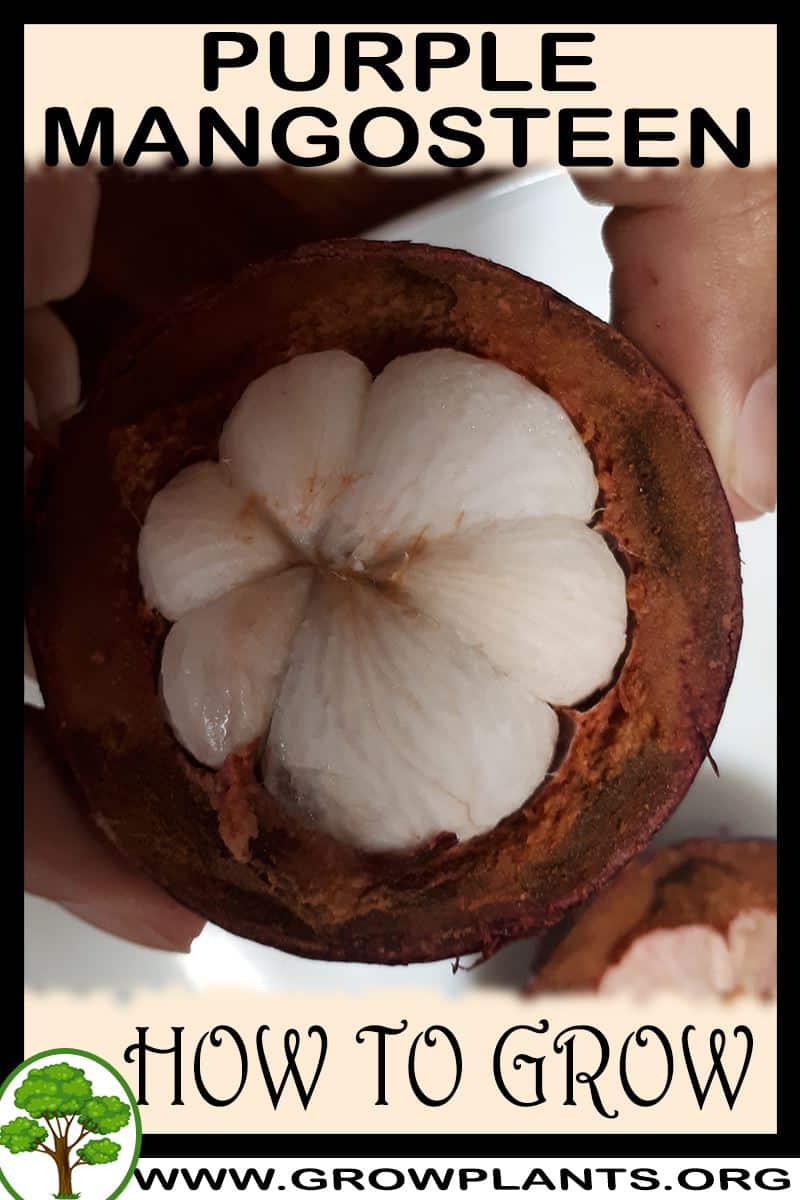
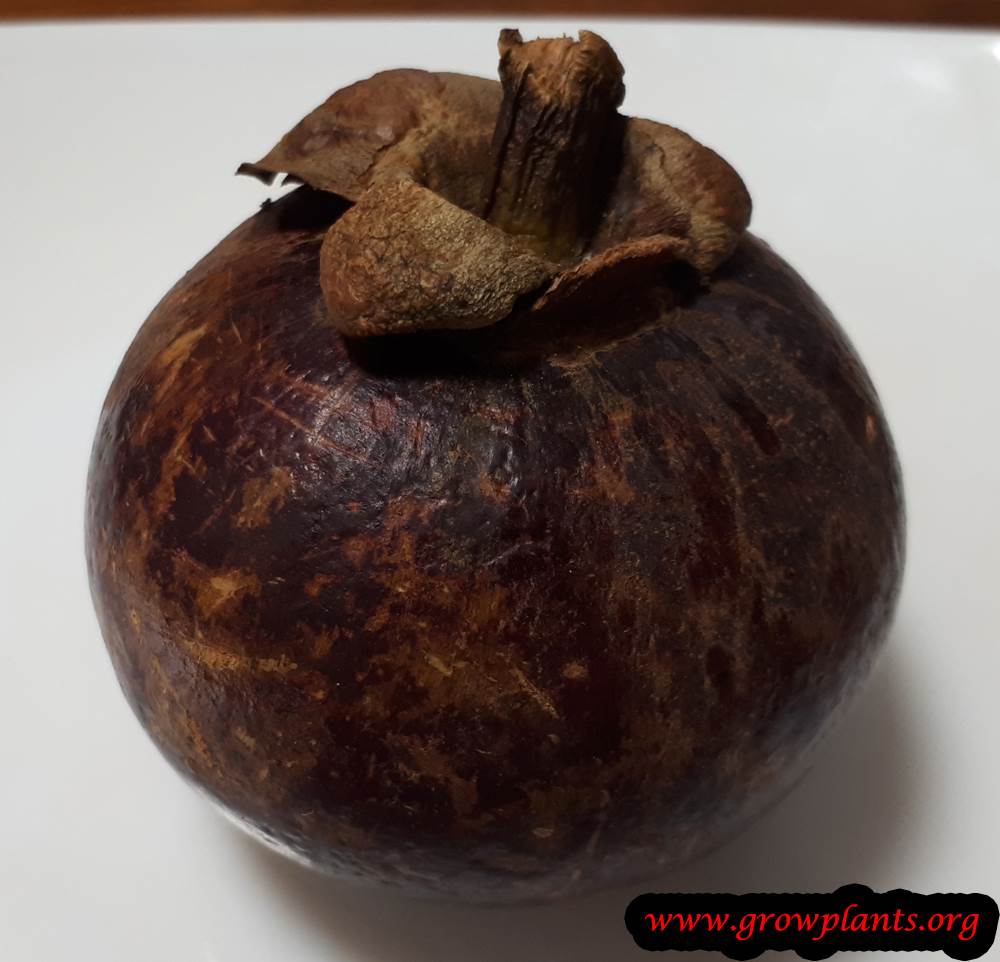
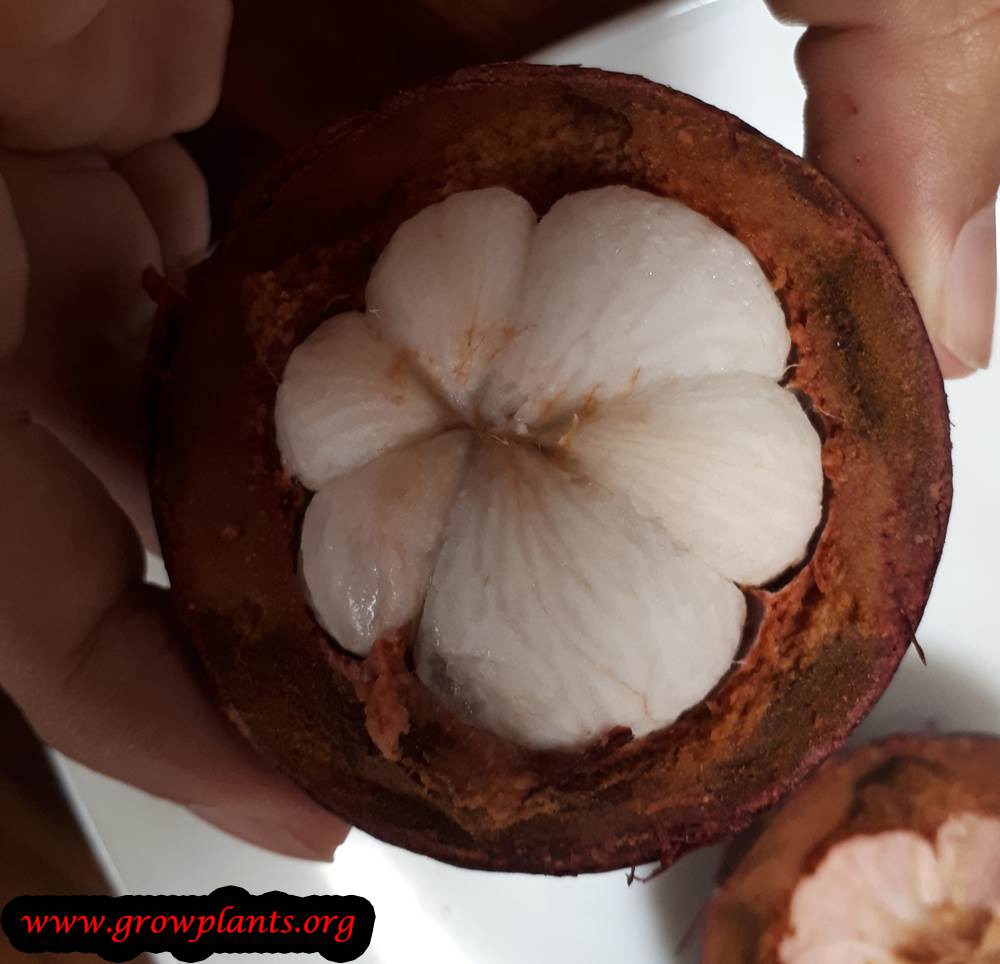
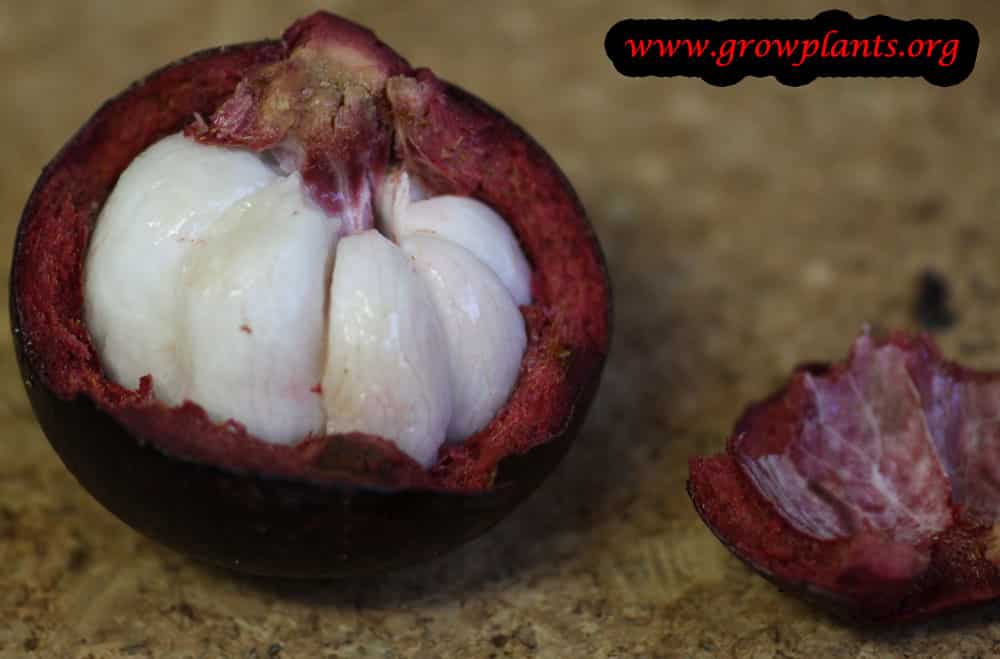
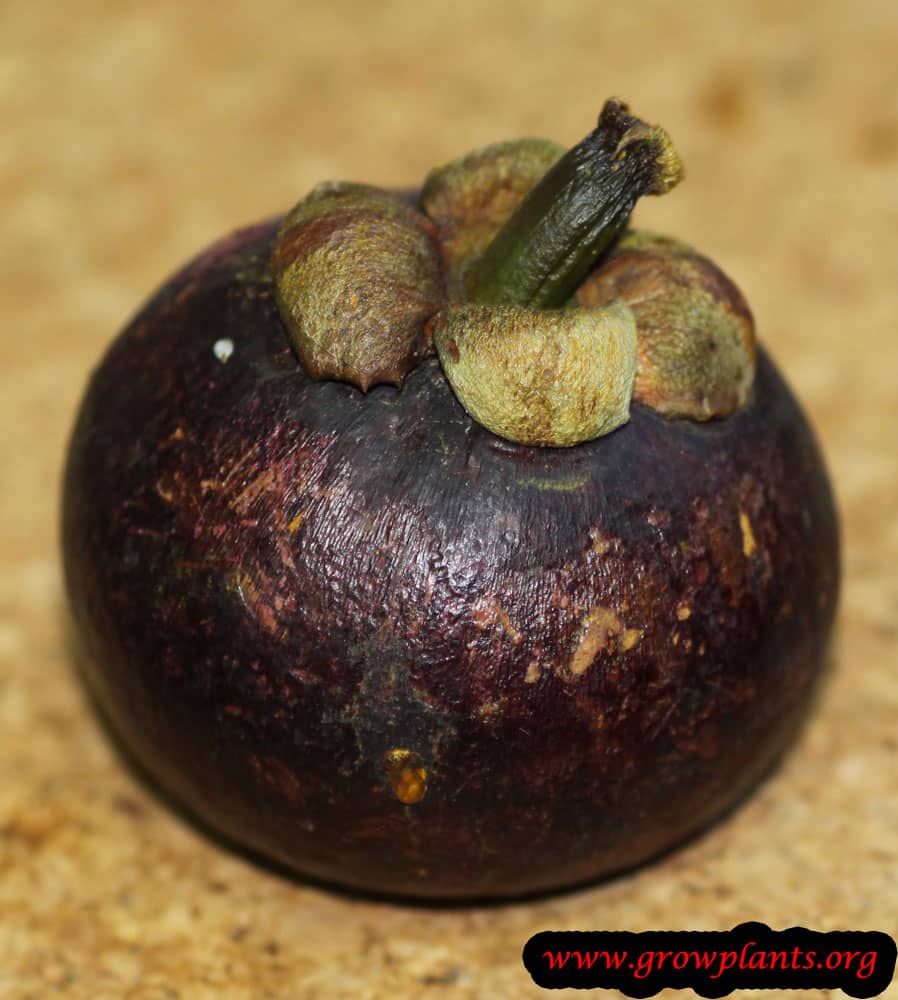
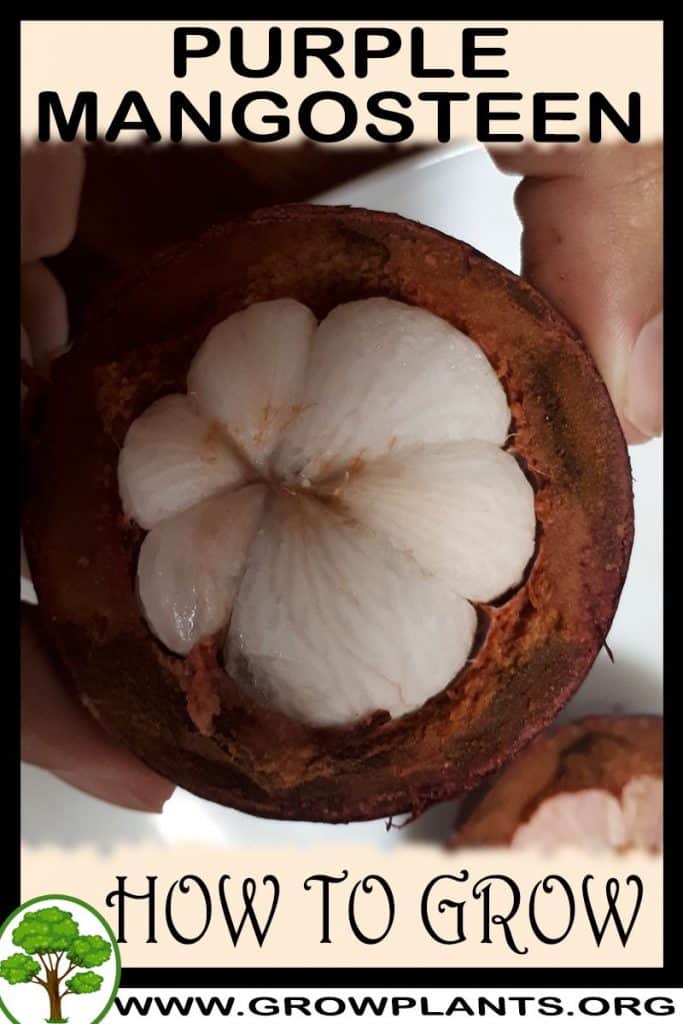
- Fruit Profile: Round fruit with a thick dark-purple rind enclosing white, segmented, sweet, juicy flesh.
Primary Uses & Landscape Value
- Edible Uses: Fruit eaten fresh – the celebrated mangosteen, often called the ‘queen of fruits’.
- Functional & Ornamental Roles: Grown chiefly for fruit in tropical gardens; young specimens make an ornamental container plant.
Care Guide: Planting, Soil & Watering
Overview: Purple mangosteen (Garcinia mangostana) is a strictly tropical fruit tree that demands heat, high humidity and shelter. It needs deep, rich, well-draining but moisture-retentive soil, heavy consistent watering, and shade while young.
Quick Care Requirements
| Requirement | Ideal Condition |
|---|---|
| Planting Season | Year-round in a warm, humid tropical climate |
| Growth Rate | Slow |
| Soil Type | Deep, rich, moisture-retentive yet well-draining, mulched |
| Water Need | High — keep consistently moist, never let it dry out |
Planting & Establishment
- Best Planting Season: Plant year-round in a warm tropical climate; keep the young tree above about 10°C (50°F) at all times.
- How to Plant:
- Hole Preparation: Dig a generous hole wider than the root ball to loosen the deep, rich soil this tree needs.
- Soil Amendments: Blend in plenty of compost and organic matter, and mulch well to hold moisture while keeping drainage open.
- Planting Depth: Set the root collar level with the soil, and provide shade for the young tree, which scorches in direct sun.
- Growth Speed & Expectations: A very slow grower — patience is essential — eventually forming a tree of about 5–20 m (15–60 ft).
Soil, Watering & Drainage Care
- Soil Mix & Drainage Needs: Soil must be rich and moisture-retentive yet still drain, and a thick mulch helps. The tree tolerates neither drying out nor standing water.
- Watering Schedule & Technique:
- Young / Newly Planted: Water generously and often; the soil should stay consistently moist at all times.
- Established: Continue heavy, regular watering; this species is intolerant of drought.
- Seasonal Adjustments: Keep moisture and humidity high year-round, easing only slightly in cooler weather.
Climate, Light & Hardiness
Purple mangosteen (Garcinia mangostana) is a strictly tropical, evergreen fruit tree that needs constant warmth and high humidity, growing only in true tropical climates around USDA zone 13 and warmer. It is one of the most cold-sensitive of all fruit trees - it wants temperatures reliably above about 10 °C (50 °F) - and, as an understorey species, its young trees actually require shade rather than full sun.
Quick Climate Specifications
| Climate Zones | Tropical (humid, lowland) |
|---|---|
| USDA Hardiness Zones | Approximately 13 and warmer |
| Optimal Temp Range | Hot and humid, roughly 25–35 °C (77–95 °F) |
| Cold Damage Begins | Growth and health decline below about 10 °C (50 °F) |
| Approx. Survival Minimum | Very cold-sensitive; damaged by brief exposure near 4–5 °C (39–41 °F) and killed by any frost |
| Frost Tolerance | None |
| Light Conditions | Shade when young; part shade when older |
| Wind Tolerance | Low |
Sunlight & Light Exposure
Optimal Light Setup
An understorey tree: young plants need full or heavy shade, and even mature trees prefer partial shade rather than harsh, exposed sun.
Shade & Heat Management
Shade is essential for establishment - young trees scorch in direct sun - so it is typically grown beneath taller trees or under shade cloth, easing into brighter light only as it matures.
Best Exposure / Orientation
A warm, humid, sheltered, partly shaded position mimicking a tropical forest understorey is ideal; avoid open, sun-baked, exposed sites.
Temperature Extremes & Hardiness
USDA Hardiness & Regional Limits
Restricted to genuinely tropical climates, roughly zone 13 and warmer, where it can grow and fruit year-round. It has essentially no tolerance of cool or temperate conditions, which is the main reason it is so difficult to grow outside the humid tropics.
Cold Damage & Winter Protection
Sustained temperatures below about 10 °C (50 °F) harm growth, and brief exposure to a few degrees above freezing damages the tree; any frost is lethal. It needs a frost-free, consistently warm environment at all times.
Frost Sensitivity
Extremely frost-sensitive with no frost tolerance whatsoever - even a light chill sets it back, and freezing kills it outright.
Extreme Heat Tolerance
It thrives in tropical heat provided humidity stays high; hot, dry conditions with low humidity, however, are stressful and poorly tolerated.
Wind, Humidity & Microclimate
Humidity Preferences
Demands consistently high humidity - a defining requirement - reflecting its humid tropical rainforest origins.
Dry-Air Tolerance
Very poor: dry air stresses the foliage and undermines growth, so arid and low-humidity climates are unsuitable without deliberate humidification.
Wind Tolerance
Low; the broad evergreen leaves and shade-adapted growth are easily damaged by strong or drying wind, so a sheltered site is important.
Microclimate Recommendations
Recreate a warm, humid, sheltered, partly shaded tropical understorey; outside the tropics it needs a heated, humid, protected environment to have any chance of thriving.
Growing in Pots, Balconies & Indoors
Unusually for a fruit tree, the grower marks the purple mangosteen as suitable indoors and in containers – and it genuinely works while young, because it is very slow-growing and actually needs shade in its early years. It ultimately becomes a large tropical tree, but it stays a manageable pot plant for a long time in a warm, humid, shaded spot.
Quick Details
- Container Size: Start small and pot up gradually; a large tub for older plants – it is slow, so it stays in scale for years
- Indoor Suitability: A workable indoor plant while young (grower), given warmth, humidity and shade
- Best Spot: Full shade while young, half shade when older – never harsh direct sun early on
- Soil & Drainage: Rich, free-draining, moisture-retentive mix
- Watering in Pots: Generous – it is thirsty and must never dry out
Indoors & On the Windowsill
- A rare indoor fruit tree (grower): He marks it suitable indoors, and its needs suit a room: it wants shade, not full sun, when young, and it grows very slowly, so it will not outgrow its space quickly. A drip irrigation kit with a timer can take over that watering check automatically.
- Warmth & humidity: It is a strict tropical – keep it warm year-round and humid (a pebble tray or a humid room), away from cold draughts.
- Windowsill limits: Avoid hot, sunny sills that would scorch a young plant; bright, filtered light in a warm room is ideal.
On a Balcony or Patio
- Light & warmth: On a balcony or patio keep it in shade and warmth; it cannot take cold or dry wind.
- Overwintering: In any climate with cool weather, its portability lets you keep it indoors in warmth for much of the year.
- Moisture: Thirsty and pot-grown, it dries fast – check often and keep the mix evenly damp.
Choosing the Pot, Soil & Long-Term Care
- Pot & drainage: Use a pot with strong drainage holes and skip a standing-water saucer to avoid root rot. Terracotta breathes and dries out faster, while glazed or plastic holds moisture longer.
- Potting mix: A well-aerated, organic-rich mix – peat or coir blended with perlite or vermiculite – keeps roots oxygenated in a pot. Lean towards a mix that holds moisture, as it hates drying out.
- Feeding: Potted plants need feeding a little more often than those in open ground, as regular watering leaches nutrients from the mix. Feed lightly but regularly in warmth; growth is slow.
- Long term: Pot up a size only as roots fill in; it is naturally a large tree, so containers are a long-term solution only while it stays slow and young.
Growing this plant in a greenhouse
A greenhouse can give purple mangosteen tree frost protection, cold protection and protection from rain. In the right climate it may also be kept growing through winter, depending on how much warmth and light are provided.
Greenhouse at a glance
| Greenhouse suitability | Conditional - depends on your climate |
|---|---|
| Main benefits | frost protection, cold protection, protection from rain |
| Season extension | earlier spring & later autumn |
| Outdoor protection advisable below | about 10°C |
| Maintain greenhouse minimum | around 10°C for active growth |
| Suitable types | heated greenhouse, glass greenhouse, polycarbonate greenhouse |
| Heating | Heating is recommended in cold climates for continuous growth. |
Related greenhouse guides
- Greenhouses: How to Choose the Right Greenhouse
- Best Greenhouse Heaters
- Greenhouse Climate Control: Temperature, Ventilation and Humidity
- Polycarbonate Greenhouses: What to Look for Before Buying
Fertilizing & Feeding
Mangosteen grows very slowly by nature, so it needs only light, patient feeding; overfeeding will not speed it up and instead risks salt stress on its sensitive roots.
Quick Fertilizing Specs
| Feeding Level | Light |
|---|---|
| young_feeding | Light, balanced feeding while the tree is shaded and establishing; growth stays slow regardless |
| mature_feeding | Light, balanced-to-potassium feeding once the tree is old enough to flower and fruit |
| Main Nutrient Priority | Balanced nutrition throughout; avoid pushing growth with heavy nitrogen |
| Best Feeding Period | During the warm, humid active growing season |
| Soil pH | Prefers moist, well-drained, humus-rich soil; watch for chlorosis on poorly drained sites |
| Micronutrients | Iron and magnesium are worth watching on this species in leached tropical soils |
Feeding by Growth Stage
Newly Planted
Establish roots in warm, humid, well-drained soil while the young tree still needs shade
| Nutrient direction | Very light, balanced feeding to support root establishment without stressing the sensitive young roots |
|---|---|
| Timing | The first growing seasons after planting, while the tree is kept shaded |
| Frequency | Light, infrequent feeding through the warm growing season |
| Fertilizer types | A diluted, balanced complete fertilizer for young tropical fruit trees, A humus-rich mulch layer to hold moisture and feed the soil gently |
| Precautions | Roots are sensitive to fertilizer salts and to drying out; keep the root zone mulched and evenly moist rather than compensating with extra feeding |
Young Tree
Support gradual canopy development through what is naturally a very long juvenile period for this species
| Nutrient direction | Balanced feeding kept on the light side, since this tree grows slowly by nature |
|---|---|
| Timing | Through the many growing seasons before the tree is old enough to bear |
| Frequency | Several light feedings spread across the warm growing season |
| Fertilizer types | A balanced complete fruit-tree fertilizer, diluted for a slow-growing species, Ongoing humus-rich mulch |
| Routine trace nutrients | iron, manganese |
| Precautions | Resist the urge to over-fertilize to speed things up; excess feeding on a naturally slow grower risks salt buildup and root stress rather than faster growth |
Established, Pre-Bearing
Maintain steady, unhurried growth as the tree gradually matures toward its first flowering
| Nutrient direction | Balanced feeding, still light, as the canopy fills out |
|---|---|
| Timing | As the tree approaches the age when it can begin flowering |
| Frequency | Light, regular feeding through the growing season |
| Fertilizer types | A balanced complete fruit-tree fertilizer |
| Routine trace nutrients | iron, manganese |
| Precautions | Maintain consistent humidity and moisture around the root zone; stress from drying out is a bigger risk to this species than under-feeding |
Mature, Bearing
Support fruit development once the tree is finally old enough to flower and fruit, which can continue over an extended season
| Nutrient direction | Balanced feeding with a gentle potassium-leaning shift as fruit develops |
|---|---|
| Timing | Through the warm growing season, tracking the tree’s own extended flowering and fruiting rhythm |
| Frequency | Light, regular feeding through the growing season |
| Fertilizer types | A balanced to lightly potassium-leaning complete fruit-tree fertilizer |
| Routine trace nutrients | iron, manganese |
| Precautions | Fungal issues are a known risk for this species; keep the canopy open and avoid wetting foliage when feeding with liquid products |
Nutrient Deficiency Signs & Corrections
New leaves emerge pale yellow while the veins stay distinctly green
| Possible causes | High soil pH limiting iron availability, Poorly drained or waterlogged soil around the roots, Root stress in a tree that already has a sensitive, slow-growing root system |
|---|---|
| Appears first on | Newest leaves at branch tips |
| What to check | Soil pH and drainage around the root zone, Recent irrigation pattern and any waterlogging, Whether the pattern follows a specific soil area of the planting site |
| Possible correction | Improve drainage first; if pH is confirmed as the cause, apply a chelated iron product per its label |
Overall foliage color is pale to yellow-green with shorter-than-expected new shoot growth
| Possible causes | Insufficient nitrogen in a very light feeding program, Heavy tropical rainfall leaching nutrients away, Naturally slow growth being mistaken for a feeding problem |
|---|---|
| Appears first on | Older leaves lower in the canopy |
| What to check | Shoot growth length compared with a typical season, Recent feeding history, Mulch and organic matter levels around the root zone |
| Possible correction | Resume a nitrogen-forward feeding during the active growing season and rebuild organic matter around the root zone |
Older leaf margins yellow or scorch and fruit development seems sparse for a flowering tree
| Possible causes | Leached, humid tropical soil low in potassium, A feeding program weighted only toward nitrogen, Heavy rainfall washing nutrients past the root zone |
|---|---|
| Appears first on | Older leaves, often starting at the margins |
| What to check | Fruit size and quality compared with a typical season, Leaf margins on older growth for scorch, Recent fertilizer history for a nitrogen-only product |
| Possible correction | Shift toward a balanced to potassium-leaning complete fruit-tree fertilizer around fruit development |
Older leaves show yellowing between the veins while the veins remain green
| Possible causes | Magnesium leaching from heavy tropical rainfall, Sandy or heavily leached soil low in magnesium, Heavy potassium feeding competing with magnesium uptake |
|---|---|
| Appears first on | New growth and, where relevant, developing fruit |
| What to check | Whether yellowing is interveinal and starts on older leaves, Soil texture and rainfall/irrigation pattern, Recent fertilizer history for high-potassium products |
| Possible correction | If confirmed, correct with a chelated magnesium product per its label and improve soil organic matter |
Pruning, Training & Seasonal Maintenance
The true mangosteen is an extremely slow-growing tropical tree that is essentially not pruned in the structural sense – its own care notes limit pruning to weak and dead branches, carried out whenever needed rather than in a fixed season, since it grows in frost-free tropical climates with no strong dormancy. Because this species is already very slow to grow and takes 7–15 years to bear its first fruit, any structural or heavy pruning risks setting back an already long path to maturity and disfiguring the naturally even, pyramidal canopy it depends on.
Quick Pruning & Maintenance Specs
| Pruning Tolerance | Low – sanitation removal of dead/weak wood only, no structural pruning |
| Primary Pruning Window | All year, as dead or weak wood is noticed – no fixed seasonal window in its frost-free range |
| Typical Frequency | Infrequent, only as needed |
| Main Objective | Remove dead or weak branches; preserve the tree’s natural form otherwise |
| Young Plant Priority | No pruning at all; protect the young tree with full shade rather than cutting it |
| Mature Plant Priority | Remove only clearly dead or weak branches as they appear |
| Best Tool Type | Bypass secateurs for small dead twigs; pruning saw only for a larger dead limb |
| Avoid Heavy Pruning During | At any time – this species does not tolerate structural or hard pruning |
Pruning by Plant Age & Size
Newly Established
No pruning whatsoever; young trees need full shade protection, not cutting back, and are especially sensitive to any setback given their very slow growth.
Young / Formative
No structural training system is used – the tree develops its naturally symmetrical, pyramidal single-leader form on its own; the only intervention is removing a dead twig if one appears.
Mature / Established
Remove weak or dead branches as observed; no size or shape control is attempted, and the tree is allowed to reach its natural 5–20m size.
Seasonal Pruning Schedule
| Ongoing Sanitary (all year) | Remove dead or weak branches whenever noticed; there is no dormant season to time this around in its tropical range, and no other pruning is performed |
Flowering & Fruiting Wood
Flowers and fruit form on the tree’s permanent branch framework nearly year-round; this is exactly why pruning is restricted to dead/weak-wood removal – any structural cut would sacrifice future flowering and fruiting sites on a tree that already takes 7–15 years to begin bearing.
Structural Pruning & Training
None practiced. The tree’s naturally even, pyramidal canopy is left undisturbed; there is no thinning, heading, or height-control pruning for this species.
Special Growth to Remove
- Dead branches – remove whenever noticed
- Weak branches – remove if clearly failing, otherwise leave in place
Container & Small-Space Pruning
This species can be grown in a container, and young specimens especially suit pot culture given their need for full shade before transitioning to half shade as they mature. Container-grown young trees need no pruning at all – focus care on shade and humidity rather than any cutting.
Tools
- Bypass secateurs for the rare dead twig
- Pruning saw only if a larger limb has died back, given this tree’s eventual 5–20m size
Tool Hygiene & Disease Risk
Routine – no specific disease risk is documented for this species. Because it is so slow-growing, wounds also heal slowly, so keep any necessary cut as small and clean as possible to minimize the exposed area.
Cut Placement & Technique
Cut just outside the branch collar and avoid flush cuts. Keep every cut to the minimum size necessary, since this slow-growing tree calluses over wounds far more slowly than a fast-growing fruit tree.
Heavy Pruning & Rejuvenation
Not tolerated. This species should never receive hard or rejuvenation pruning – its very slow growth and long 7–15-year path to first fruit mean a heavy cut could set the tree back for years without the quick regrowth response seen in faster fruit trees.
Post-Pruning Care
After removing any dead wood, simply monitor the cut – no feeding push is warranted. Keep young or recently pruned trees shaded and in high humidity per their normal care needs, rather than treating pruning itself as needing special aftercare.
Common Pruning Mistakes
- Attempting to head back or shape the tree, which permanently disfigures its naturally symmetrical pyramidal form and will not regenerate quickly
- Mistaking sparse, slow-flushing canopy growth for dead wood and removing live branches unnecessarily
When NOT to Prune
Do not prune young trees at all beyond a truly dead twig, and never remove living wood on a tree of any age – its very slow growth means there is little margin to recover from an unnecessary cut.
Recommended Tools (by task)
- bypass_secateurs – the occasional small dead twig, the only routine cut this species needs.
- pruning_saw – the rare larger dead limb on a tree that can reach 20m at maturity.
Pruning Troubleshooting
| Problem | Possible Cause | What to Check | Corrective Action |
| Slow or no recovery after a cut | This species’ inherently very slow growth rate, not the cut itself | Whether the cut was truly necessary and kept minimal | Restrict future pruning to only clearly dead or weak wood; avoid any exploratory cuts |
| Sparse canopy mistaken for decline | Naturally slow, unhurried growth habit of the species | Whether wood is actually dead (brittle, no green cambium) versus just slow-flushing | Scratch-test before cutting; leave any branch with living cambium in place |
Propagation Guide
Purple mangosteen is propagated primarily from nucellar/apomictic seed; routine vegetative methods are difficult and nonstandard, so grafting must not be presented as required.
Quick Propagation Specs
| Primary Method | Seed |
| Grafting | Not required for routine propagation |
| Vegetative Propagation | Difficult and nonstandard |
Growing from Seed
Use fresh, mature seed and sow it promptly in a clean, warm, well-drained propagation medium. Protect seedlings from drying and from waterlogged conditions while roots establish.
Bloom & Flower Guide
Quick Details
- Bloom Season: Can flower at any time of year in a suitable tropical climate
- Time to First Bloom: Slow to mature – trees often take many years before they first flower
- Flower Appearance: Red flowers, each showing the young form of the fruit at its centre
- Edibility: Not eaten – the tree is grown for its fruit, and the flowers are ornamental only
Detailed Blooming Overview
Purple mangosteen (Garcinia mangostana) carries fleshy red flowers, and even at the flower stage you can see the miniature outline of the future fruit at the centre of each bloom. In a warm tropical climate the tree can flower at almost any time of year, though it is famously slow to reach flowering age.
Flower Characteristics
- Red flowers, thick and fleshy in texture.
- Each flower already shows the shape of the developing fruit at its heart.
Bloom Care & Thinning
- Pollination: Mangosteen does not need pollination – it sets seed and fruit on its own (apomixis), so no partner tree or pollinator is required.
Fruit & Uses
The white flesh (aril) surrounding the seeds inside the fruit is eaten fresh for its sweet, slightly tart flavour. It is eaten raw with no cooking needed; the thick dark purple rind itself is not eaten and is discarded.
Quick Edible Specs
| Edible Parts | Fruit (white inner flesh) |
|---|---|
| Main Use(s) | Culinary – eaten fresh |
| Eaten Raw or Cooked | Raw |
| Preparation Required | Open/cut the rind away and lift out the white segments; the rind is discarded, not eaten |
| Harvest Season | All year (in a suitable tropical climate) |
| Time to First Harvest | Many years after planting – a slow-growing tree (see Care for detail) |
| Storage | No special handling noted; site data reports no special work required on the fruit |
| Safety/Toxicity Caveat | Only the white flesh is eaten; the rind is bitter and not used as food |
Fruit
The fruit is rounded with a hard, dark purple outer shell that is cut or twisted open to reveal white, segmented flesh surrounding small seeds. The flesh is eaten fresh, straight from the shell, prized for its sweet-tart flavour. In a suitable tropical climate the tree can produce fruit through the year rather than in one short season. The rind is not eaten as food.
Harvesting
Fruit is picked once the rind has coloured fully dark purple and yields slightly to gentle pressure. Site data notes no special work is required on the fruit at harvest.
Preparation, Uses & Safety
Eaten fresh, raw, straight out of the shell – no cooking is involved. Only the white flesh is consumed; the rind is bitter and tannin-rich and is discarded rather than eaten. No toxicity of the edible flesh is reported.
Pests, Diseases & Troubleshooting
Overview: Garcinia mangostana is a slow-growing tropical evergreen that is relatively free of serious insect pests but highly sensitive to water-related root and fruit disorders. Its leathery leaves and thick-rinded fruit resist most chewing pests, so the real risks are sap-suckers on young flush, Phytophthora in wet or poorly drained soil, and physiological fruit disorders from erratic watering. Manage it culturally first: sharp drainage, steady moisture, light shade when young, and warm, frost-free conditions.
Quick Troubleshooting Overview
| Issue / Pest | Main Symptom | Primary Solution |
|---|---|---|
| Thrips | Silvery scarring and distortion on young leaves and fruit | Encourage predators; horticultural oil / spinosad on flush only |
| Scale & mealybugs | Sticky honeydew, black sooty mould on leaves | Wipe off, release beneficials, horticultural oil |
| Spider mites | Fine stippling and webbing in hot, dry air | Raise humidity, hose foliage, miticidal oil |
| Phytophthora root/fruit rot | Wilting, bark canker, oozing; fruit rot | Improve drainage; avoid waterlogging; copper/phosphonate |
| Anthracnose | Dark sunken spots on leaves and fruit | Prune for airflow, sanitation, copper fungicide |
Common Pests & Management
- Thrips (Scirtothrips / Thrips spp.):
- Symptoms: Rasping insects that scar new leaves and the skin of young fruit, leaving silvery, corky patches and distorted growth. Damage concentrates on the tender flush; look for tiny slender insects and black frass on leaf undersides.
- Prevention & Control: Keep trees vigorous and lightly shaded so flushes harden quickly. Conserve predatory mites, lacewings and minute pirate bugs. Hang blue sticky traps to monitor. If populations spike on new growth, spot-treat with spinosad or horticultural oil in the evening to protect pollinators; avoid blanket spraying a tree in flower.
- Soft scale & mealybugs (Coccus spp., Planococcus citri):
- Symptoms: Immobile brown scale bumps along midribs and stems, or white cottony mealybugs in leaf axils and on roots. Both excrete honeydew that fuels black sooty mould and attracts ants.
- Prevention & Control: Wipe small colonies off with a damp cloth or dab mealybugs with alcohol. Control ants that farm and protect them. Release ladybirds, lacewings or parasitic wasps. For heavier infestations, coat thoroughly with horticultural or neem oil, repeating to catch crawlers; a systemic is a last resort on non-bearing trees only.
- Spider mites (Tetranychus spp.):
- Symptoms: Fine pale stippling, bronzing and delicate webbing on leaf undersides, worst on trees stressed by hot, dry air or dusty conditions.
- Prevention & Control: Raise humidity, keep foliage dust-free and hose down the canopy. Conserve predatory mites (Phytoseiulus). Treat persistent outbreaks with a miticidal horticultural oil, covering undersides; rotate modes of action.
- Caterpillars & leaf-eating beetles (Lepidoptera / Chrysomelidae):
- Symptoms: Chewed notches and holes in tender new leaves, with frass; sporadic rather than chronic on established trees.
- Prevention & Control: Hand-pick, and encourage birds and predatory wasps. For flush-eating caterpillars, Bacillus thuringiensis (Bt) is a targeted organic option that spares beneficials.
Diseases & Fungal Issues
- Phytophthora root rot & stem canker (Phytophthora spp.):
- Symptoms: The key killer in wet soils: wilting despite moist ground, dark oozing cankers at the base or on the trunk, root decay and general decline. Fruit in contact with wet mulch can also rot.
- Treatment & Management: Prevention is everything: plant on a raised mound in free-draining soil, never let the root zone waterlog, and keep mulch off the trunk. Remove and destroy cankered wood. Phosphonate (phosphorous acid) or copper drenches help protect suspect trees; correct drainage first.
- Anthracnose (Colletotrichum gloeosporioides):
- Symptoms: Dark, sunken spots on leaves, shoot tips and fruit, sometimes with pink spore masses in humid weather; can cause tip dieback and fruit blemish.
- Treatment & Management: Prune to open the canopy for airflow, remove infected leaves and fruit, and avoid overhead watering. Copper fungicide applied preventively in wet seasons keeps it in check.
- Pink disease & leaf/thread blights (Erythricium salmonicolor, Pestalotiopsis):
- Symptoms: Salmon-pink fungal crust on shaded branches with dieback (pink disease) in very humid tropics; grey-brown leaf blotches from other leaf-blight fungi.
- Treatment & Management: Prune out and burn affected branches back to healthy wood, thin the canopy to reduce humidity, and paint or spray cut surfaces with copper. Improve light penetration.
Growing Difficulties & Abiotic Problems
- Gamboge disorder & translucent flesh (fruit):
- Cause & Symptoms: Yellow gummy latex bleeding into the rind and flesh (gamboge), or glassy, water-soaked translucent segments, both driven by heavy rain or erratic irrigation during fruit development that causes rapid water uptake.
- Correction Strategy: Keep soil moisture steady with mulch and regular deep watering rather than drought-then-flood cycles. Improve drainage so roots are never saturated during ripening. There is no spray cure – even watering is the fix.
- Sunburn & leaf scorch on young trees:
- Cause & Symptoms: Seedlings and young trees are understorey plants that scorch in full tropical sun, showing bleached, brown-edged leaves.
- Correction Strategy: Provide 40-50% shade for the first few years, then acclimatise gradually to more sun. Protect from drying wind and keep well watered while establishing.
- Cold damage:
- Cause & Symptoms: Strictly tropical; growth stalls and leaves blacken or drop below roughly 4-5°C, and hard frost is fatal.
- Correction Strategy: Grow only in frost-free climates or as a large conservatory/greenhouse specimen. Keep above 10°C in winter and shelter from cold drafts.
- Nutrient deficiency & slow establishment:
- Cause & Symptoms: On poor or alkaline soils, leaves yellow (nitrogen, iron, magnesium) and the notoriously slow taproot resents disturbance, causing transplant sulk.
- Correction Strategy: Feed with a balanced fertiliser plus micronutrients; keep soil slightly acidic and rich in organic matter. Plant out young and disturb roots as little as possible.
What Helps – Products & Tools
Reach for horticultural and neem oils and insecticidal soap for scale, mealybugs, mites and thrips; Bacillus thuringiensis (Bt) for leaf-eating caterpillars; and blue or yellow sticky traps for monitoring. On the disease side, copper fungicide and phosphonate (phosphorous acid) drenches address anthracnose and Phytophthora. For fruit, use protein-bait fruit-fly traps and bird netting, plus a balanced fertiliser with iron and magnesium for chlorosis. Always follow the label and spray oils in the evening to protect pollinators.