
Plant Profile & Key Characteristics
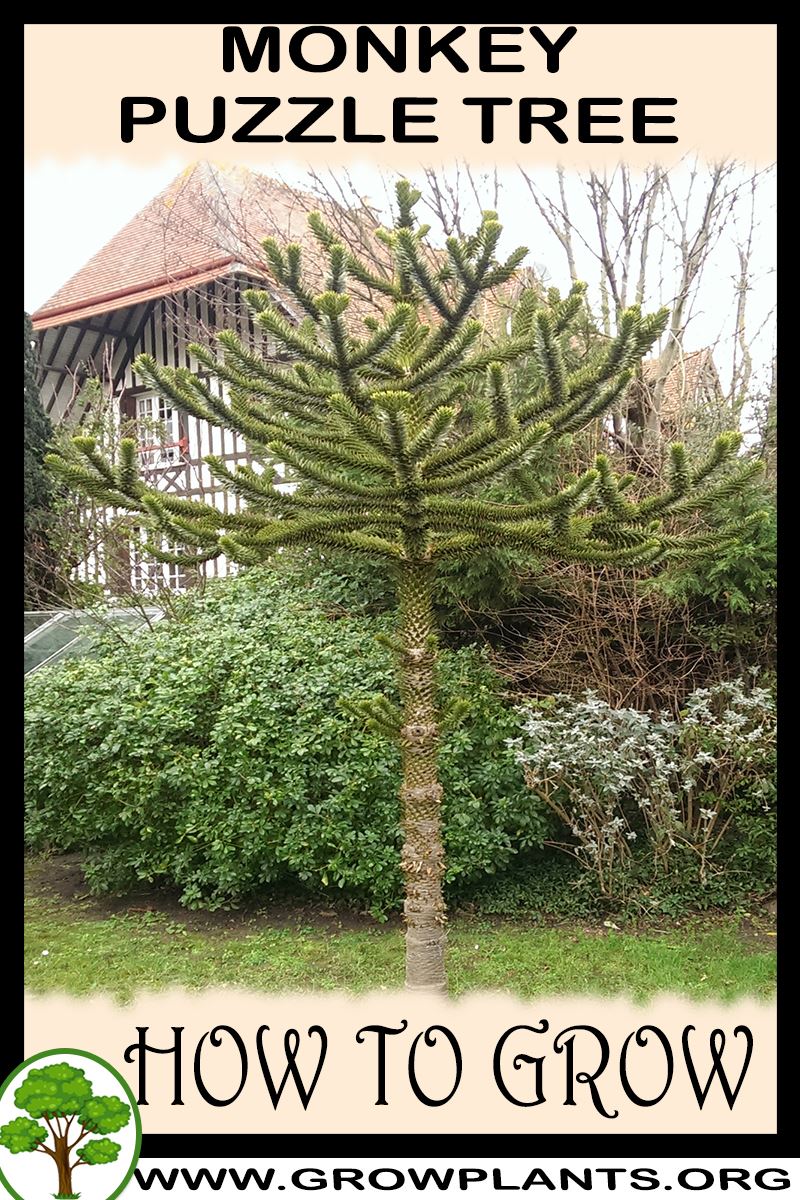
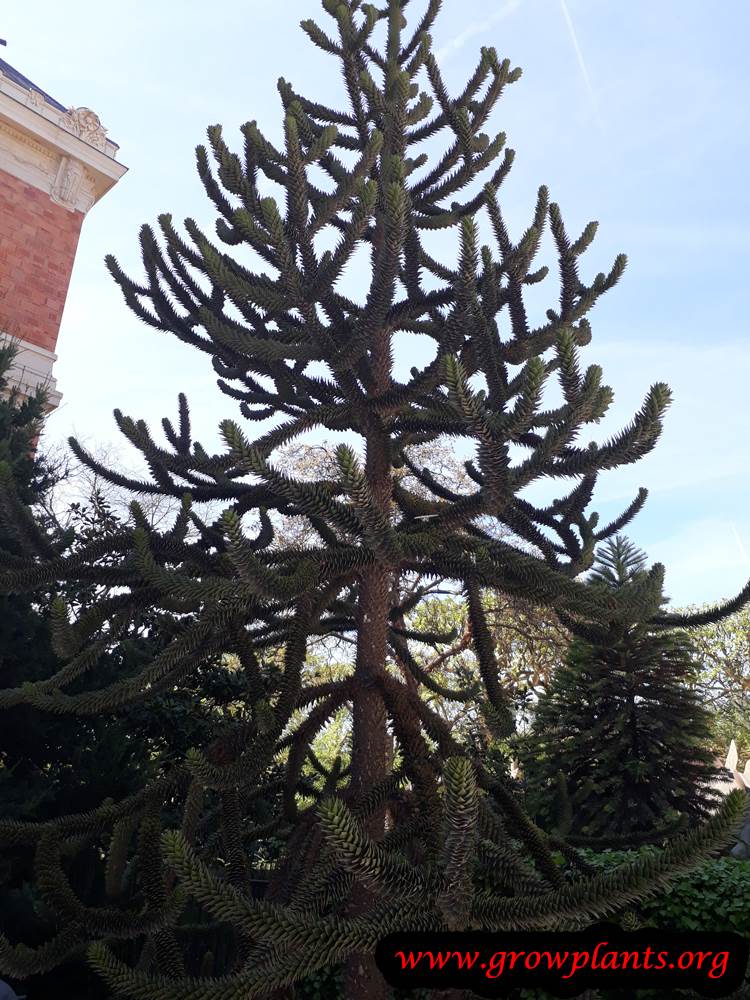
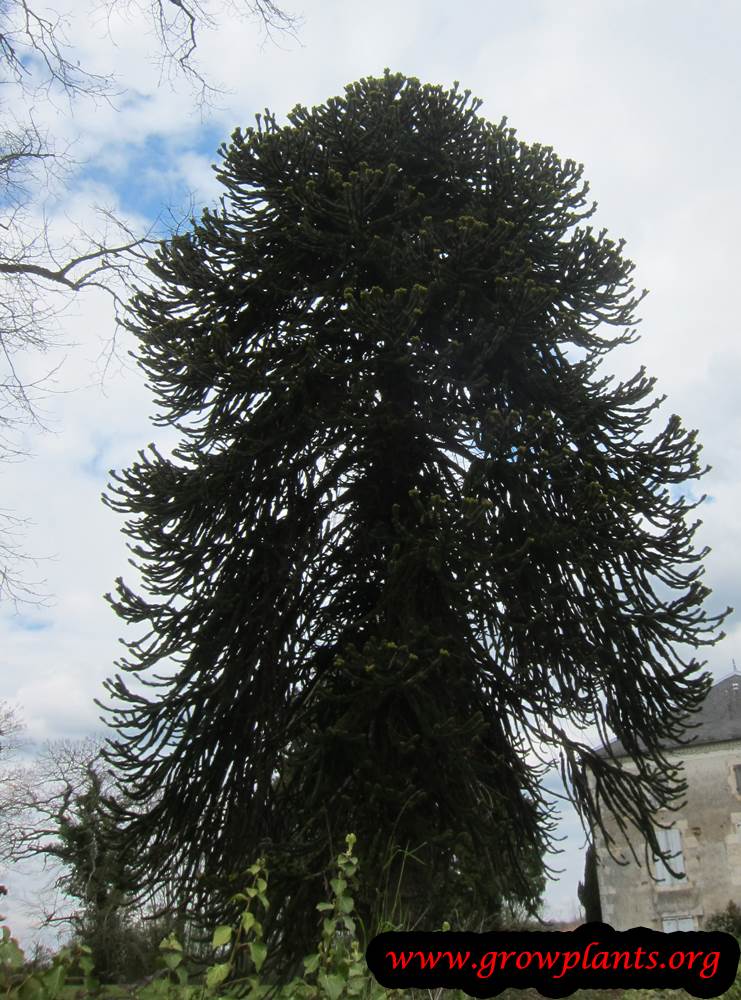
Overview: Monkey puzzle is a large evergreen conifer reaching 30-40 m, with stiff, sharp triangular leaves clothing the branches. It is grown mainly as an ornamental, shade tree and bonsai, and produces edible nuts.
Quick Specifications
| Specification | Attribute |
|---|---|
| Plant Type / Life Cycle | Perennial (evergreen conifer) |
| Foliage Type | Evergreen |
| Mature Size | 30-40 m (100-125 ft) |
| Growth Rate | Slow |
| Hardiness | USDA zones 7-9 |
Growth Form & Structure
- Height & Spread: 30-40 m (100-125 ft); a large tree not suited to container growing.
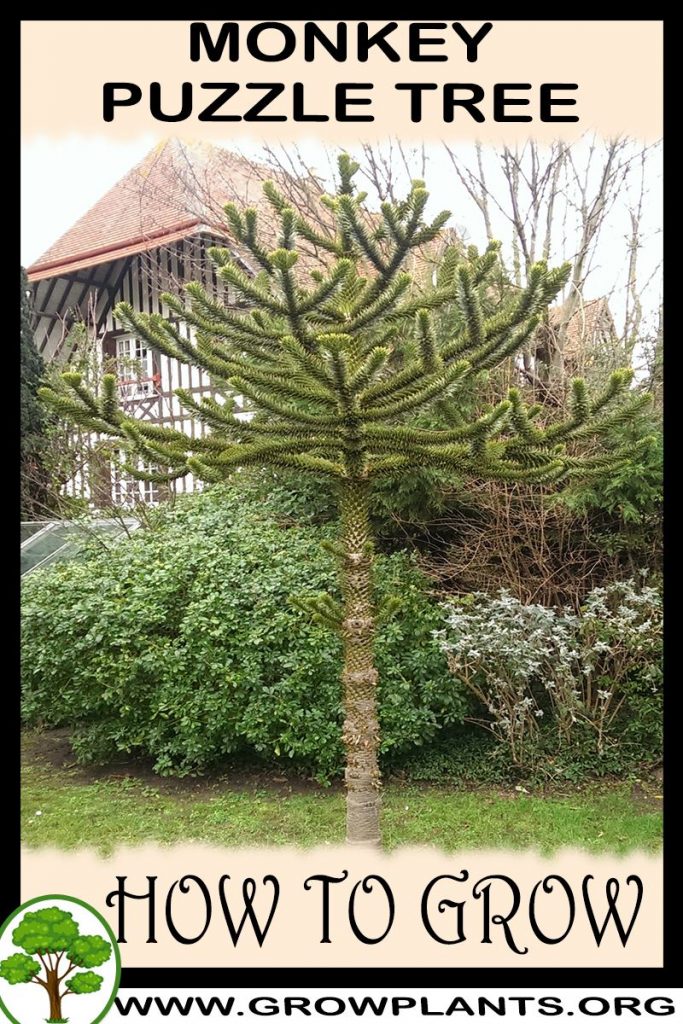
- Growth Habit & Form: Distinctive conifer with a straight trunk and stiff branches densely clothed in sharp leaves.
- Lifespan & Maturity: Very long-lived and slow-growing; nuts appear only after 30-50 years.
Anatomy & Physical Features
- Leaves & Foliage: Dark-to-bright green, stiff, sharp triangular leaves densely covering the branches.
- Flower Characteristics: Small yellow male and female cones, sometimes on the same tree, wind-pollinated (see the Bloom accordion).
- Fruit Profile: Edible nuts in a large cone, yellow-cream with a brown shell (see the Fruit accordion).
Primary Uses & Landscape Value
- Edible Uses: Nuts eaten raw, roasted or made into paste.
- Functional & Ornamental Roles: Grown as a striking ornamental and shade tree, and trained as bonsai.
Care Guide: Planting, Soil & Watering
Overview: Monkey puzzle is a slow-growing temperate conifer that prefers cool summers and grows in deep, fertile, well-draining soil. It likes regular water and dislikes drought.
Quick Care Requirements
| Requirement | Ideal Condition |
|---|---|
| Planting Season | Spring or autumn |
| Growth Rate | Slow |
| Soil Type | Deep, fertile, well-draining |
| Water Need | Moderate to High (keep evenly moist) |
Planting & Establishment
- Best Planting Season: Plant in spring or autumn.
- How to Plant:
- Hole Preparation: Dig a hole wider than the root ball, allowing ample space for a large tree.
- Soil Amendments: Work organic matter into deep, loosened soil for a fertile, free-draining bed.
- Planting Depth: Set the root collar at soil level and firm gently.
- Growth Speed & Expectations: Slow, but eventually a very large, long-lived tree, so plan for its size.
Soil, Watering & Drainage Care
- Soil Mix & Drainage Needs: Deep, fertile soil that holds moisture yet drains freely keeps this cool-climate conifer healthy.
- Watering Schedule & Technique:
- Young / Newly Planted: Water regularly to establish the young tree.
- Established: Water regularly and deeply, keeping the soil evenly moist and avoiding drought.
- Seasonal Adjustments: Less water in cool, damp winters; keep moisture steady through warmer, drier spells.
Climate, Light & Hardiness
Monkey puzzle tree is a cold-hardy conifer suited to temperate climates with cool summers, growing well in full sun to half shade. Site guidance specifically favors cold temperatures and a cool summer over heat for this species.
Quick Climate Specifications
| Climate Zones | Temperate climates |
|---|---|
| USDA Hardiness Zones | 7–9 |
| Frost Tolerance | High |
| Light Conditions | Full sun or half shade |
Sunlight & Light Exposure
Optimal Light Setup
Grows well in full sun to half shade, given ample space for its large mature size.
Temperature Extremes & Hardiness
USDA Hardiness & Regional Limits
Reliably hardy across zone 7–9, reflecting its origin in cool-temperate Andean and Chilean mountain climates.
Cold Damage & Winter Protection
Very cold-hardy; site guidance highlights its preference for cold temperatures and cool summers, and established trees need no winter protection within their hardiness range. It is not well suited to hot subtropical or tropical climates.
Frost Sensitivity
Very frost tolerant.
Wind, Humidity & Microclimate
Rainfall & Seasonal Moisture
Needs consistently generous moisture through the growing season; site guidance calls for a big amount of water, reflecting its native cool, moist mountain habitat.
Microclimate Recommendations
A cool site with reliable moisture and ample space best matches this tree's native cool-temperate mountain climate.
Growing in Pots, Balconies & Indoors
The grower does not treat Monkey puzzle tree (Araucaria araucana) as a houseplant, and it is not suited to long-term pots – it is a slow-growing but eventually enormous tree. A young plant will sit happily in a large tub on a patio for a few years, but it eventually needs the open ground.
Quick Details
- Container Size: Large tub while young only – not a long-term pot plant
- Indoor Suitability: Not an indoor plant – it needs full outdoor light and grows too large
- Best Spot: Full sun to half shade, outdoors
- Soil & Drainage: Well-aerated, free-draining mix
- Watering in Pots: Generous – keep it well watered
Indoors & On the Windowsill
- Houseplant reality: Not a houseplant – it wants full outdoor light and open air, and simply grows too big.
- Windowsill: A young plant or dwarf form belongs outdoors in its pot; indoors it stretches and weakens for lack of light.
- Overwintering: Hardy where it is grown outdoors; a potted young specimen only needs winter shelter in climates colder than it tolerates.
On a Balcony or Patio
- Light & wind: Give it the sunniest, airiest spot. Pots on a balcony or patio dry fast – walls, railings and paving reflect heat – so check moisture often and water more in warm, windy spells. Remember a full pot is heavy and sheds run-off when watered.
- While young only: A large tub works for the first few years; move it into the ground before it becomes root-bound and top-heavy.
Choosing the Pot, Soil & Long-Term Care
- Pot & drainage: A large, stable, deep container. Use a pot with strong drainage holes and skip a standing-water saucer so the roots never sit wet – that is the fastest route to root rot. Terracotta breathes and dries faster, while glazed or plastic pots hold moisture longer.
- Potting mix: Fill with a well-aerated, organic mix – a quality potting mix, or peat/coir loosened with perlite or vermiculite.
- Watering in pots: Generous – keep it well watered; pots dry faster than open ground.
- Feeding: Potted plants need feeding a little more often than those in the ground, as regular watering steadily leaches nutrients away – feed lightly through the growing season.
- Repotting: Refresh the mix and pot up about every couple of years, lightly trimming roots and top growth to keep it in balance.
Fertilizing & Feeding
A light feeder and an inherently slow grower: modest balanced feeding supports young plants, but heavy feeding will not speed up this species’ naturally gradual growth.
Quick Fertilizing Specs
| Feeding Level | Light feeder |
|---|---|
| Main Nutrient Priority | Balanced feeding, mainly to support young trees |
| Best Feeding Period | The growing season, as new growth appears |
| Organic Options | Compost worked into the planting area |
| Reduce/Stop Feeding | Taper off as the tree establishes; a mature tree needs little |
| Micronutrients | Usually unnecessary; correct only a diagnosed issue |
| Soil pH | Tolerates a wide range; consistent moisture and drainage matter more than pH |
Feeding by Growth Stage
Establishment after planting
Help a young monkey puzzle tree establish a deep root system in cool, moist, well-drained soil.
| Nutrient direction | A balanced, modest fertilizer supports steady early growth in this naturally slow-growing species. |
|---|---|
| Timing | During the first growing seasons after planting. |
| Frequency | A light feeding as growth resumes in the growing season is usually enough for a young tree. |
| Fertilizer types | A balanced, general-purpose fertilizer for trees, Compost worked into the planting area |
| Precautions | This is an inherently slow grower: heavy feeding will not meaningfully speed growth and can instead stress the root system or encourage weak, out-of-character growth. |
Established maintenance
Maintain healthy, steady growth on an established tree with minimal routine feeding.
| Nutrient direction | Established trees typically need very little supplemental feeding beyond consistent moisture and reasonable soil. |
|---|---|
| Timing | In the growing season, mainly if foliage looks pale or growth has clearly stalled. |
| Frequency | An occasional light feeding at most; a well-sited mature tree often needs none. |
| Fertilizer types | A balanced, general-purpose fertilizer, used sparingly if at all, A light compost topdressing rather than a synthetic feed |
| Precautions | Prioritize consistent moisture, since this species prefers a generous, steady water supply; feeding cannot compensate for drought stress. |
Nutrient Deficiency Signs & Corrections
Leaves across the canopy look pale to yellow-green and overall growth appears stalled beyond this species’ normally slow pace.
| Possible causes | low soil nitrogen, poor or thin soil, insufficient water reducing overall vigor and nutrient uptake |
|---|---|
| Appears first on | older, lower leaves |
| What to check | feeding history, soil type and organic matter, watering consistency |
| Possible correction | Apply a balanced fertilizer and confirm watering is adequate and consistent for this moisture-loving species. |
New leaves at branch tips emerge yellow while older leaves further back stay a normal green.
| Possible causes | alkaline soil limiting iron availability, waterlogged or poorly drained soil, root stress from recent transplanting |
|---|---|
| Appears first on | newest leaves at branch tips |
| What to check | soil pH, drainage and recent watering, any recent root disturbance |
| Possible correction | Correct drainage and pH first; apply a chelated iron product per its label if yellowing continues. |
Leaves brown or the tree’s growth stalls despite otherwise reasonable care.
| Possible causes | insufficient water, since this species prefers a generous and steady supply, waterlogged soil suffocating roots at the other extreme, the plant’s naturally slow growth being mistaken for a nutrient problem |
|---|---|
| Appears first on | outer or lower foliage first |
| What to check | watering consistency and soil moisture, drainage at the planting site, overall growth rate compared to previous seasons |
| Possible correction | Review watering and drainage before adjusting fertilizer; this slow-growing species is more sensitive to moisture extremes than to nutrient levels. |
Pruning, Training & Seasonal Maintenance
Monkey puzzle tree shares the Araucaria genus’ single-leader, whorled-branch growth habit, so – like its relative Norfolk island pine – it tolerates only light corrective pruning while young and very little thereafter. It is markedly more cold-hardy (zone 7–9, and it actually prefers a cool summer rather than heat) and its leaves are stiff, scale-like, and famously sharp-tipped, which matters for tool choice and hand protection more than for cut timing. Pruning does not meaningfully affect the tree’s cone production, which in any case takes decades to begin; its real purpose is protecting the single growing point while the tree is small enough to correct safely.
Quick Pruning & Maintenance Specs
| Pruning Tolerance | Low |
| Primary Pruning Window | First several years, while young and reachable |
| Secondary Maintenance Window | Any time, for dead/damaged branch removal only |
| Typical Frequency | Occasional, corrective only |
| Main Objective | Protect the single leader and tiered form |
| Young Plant Priority | Remove any competing/co-dominant leader |
| Mature Plant Priority | Remove only dead, broken, or hazardous branches |
| Best Tool Type | Pruning saw or pole pruner, with thick gloves for the spine-tipped foliage; tall mature trees usually need a professional |
| Avoid Heavy Pruning During | Active spring growth flush |
Pruning by Plant Age & Size
Newly Established
Leave alone except for transplant-damaged growth; young trees need their full branch mass while establishing in a cool-summer, temperate site.
Young / Formative
Central-leader training: remove any competing vertical shoot before it rivals the main leader – this species cannot cleanly regrow a replacement leader if the original is lost, so protecting it early is the single most important pruning decision made on this tree. Leave lower whorls in place while the tree is establishing.
Mature / Established
No further structural training; ongoing care is limited to removing dead, broken, or hazardous branches on what becomes a very large tree (30–40m).
Seasonal Pruning Schedule
Ongoing Sanitary
Objective: safety and tidiness. Remove dead or storm-damaged branches as needed year-round on this evergreen conifer. What NOT to remove: the leader, or healthy branches on a young tree. Expected response: clean collar healing; no bearing on the tree’s very slow (30–50 year) path to first cones.
Structural Pruning & Training
- Leader selection: maintain a single dominant vertical stem; remove forks/co-leaders while small.
- Never top this tree for height control – as with Norfolk island pine, the lost growing point will not be cleanly replaced, leaving a permanently disfigured crown.
Special Growth to Remove
Fully dead or damaged branches only, cut at the branch collar.
Tools
- Precision snips or bypass secateurs – removing a competing leader shoot on a young tree; wear thick gloves given the sharp, spine-tipped foliage.
- Pruning saw / pole pruner – dead-branch removal on taller specimens; a certified arborist is usually the safer choice once the tree is large.
Tool Hygiene & Disease Risk
Routine: clean, sharp tools are sufficient; no transmissible disease risk is documented for this species requiring between-cut disinfection.
Cut Placement & Technique
Use thinning cuts back to the branch collar rather than heading cuts; avoid flush cuts and stubs. Never cut or damage the terminal leader bud.
Heavy Pruning & Rejuvenation
Not tolerated. As with Norfolk island pine, losing the leader means the tree cannot regenerate a clean single replacement, resulting in permanent disfigurement. There is no rejuvenation-pruning approach for this species.
Post-Pruning Care
Monitor cuts for pests; no feeding needed for light corrective work. On young trees, confirm a single new leader re-establishes after removing a competitor.
Common Pruning Mistakes
- Damaging or removing the leader, causing permanent multi-headed regrowth.
- Topping the tree for height control.
- Handling the sharp, spine-tipped foliage without gloves.
When NOT to Prune
Never remove or damage the leader. Avoid pruning during the soft spring growth flush. Avoid unsupported elevated work on a mature specimen – a safety issue given the eventual 30–40m size.
Recommended Tools (by task)
- Young tree, competing-leader removal – precision_snips: controlled small cuts that protect the tender leader.
- Mature tree, dead branches out of reach – pole_pruner: removes hazardous deadwood from ground level on a tree that can reach 30–40m.
- Mature tree, larger dead wood within reach – pruning_saw: clean collar cuts on thicker dead branches.
Pruning Troubleshooting
| Problem | Possible Cause | What to Check | Corrective Action |
| Multiple competing vertical tips | Original leader lost or damaged, laterals turned upward to compete | Look for more than one upright leading shoot | On a young tree, select the strongest and remove the rest; on an established mature tree, accept the form – there is no clean correction |
| Lower branch dieback | Usually natural self-shading of the oldest, lowest tier | Confirm dieback is confined to the lowest branches rather than scattered | Remove fully dead branches at the collar; investigate further if dieback appears randomly through the canopy |
Propagation Guide
Monkey puzzle tree is most practically grown from seed, but this species is dioecious – individual trees are either male or female – and a seedling’s sex is not apparent until it matures many years later. Because of this, growers wanting a guaranteed nut-bearing (female) tree without the long wait often rely on vegetative propagation from a known mature female, though cuttings of this genus root slowly and unreliably compared with seed, making seed the easier overall method.
Quick Propagation Specs
| Best Propagation Method | Seed |
| Alternative Methods | Stem cuttings from a known-sex, mature tree |
| Propagation Difficulty | Easy (seed); Difficult (cuttings, slow and inconsistent to root) |
| Seed True-to-Type | Yes for the species, but seedling sex (male or female) cannot be predicted or selected |
| Vegetative True-to-Type | Yes, including the sex of the source tree |
| Best Propagation Season | Spring or autumn |
| Seed Germination Time | Commonly several weeks to a couple of months, sometimes uneven |
| Cutting Rooting Time | Slow, often several months, with inconsistent success |
| Germination Temperature | Roughly 15–20°C (59–68°F), reflecting this species’ cool-temperate origin |
Growing from Seed
Seed Handling & Viability
The large, nut-like seed is best sown reasonably fresh, as viability can decline with drying or prolonged storage.
Sowing Depth & Orientation
Sow the seed on its side and cover lightly; avoid planting too deep.
Germination Conditions
Cool, moist, well-drained conditions in line with this species’ cold-temperate preference.
Germination Time
Typically several weeks to a couple of months, and can be uneven.
Seedling Care
Growth is slow; protect young seedlings from extreme heat and hard frost while they establish.
Stem Cuttings
Cutting Type
As with related Araucaria species, cuttings should come from an upright leader shoot to keep a normal, upright growth habit; side-branch cuttings tend to grow sideways rather than upright.
Best Timing
Warm growing season.
Cutting Preparation
Semi-hardwood tip cutting.
Rooting Setup
Well-drained, humid medium; this genus is known to root slowly and inconsistently from cuttings.
Rooting Hormone
Often used to help improve otherwise difficult rooting.
Rooting Time
Slow and variable, potentially several months, and not every cutting will root.
Bloom & Flower Guide
Quick Details
- Bloom Season: Spring
- Time to First Bloom: Only on large, mature trees, which are usually either male or female
- Flower Appearance: Small yellow male (pollen) cones and separate large rounded female cones
- Edibility: Ornamental / none at the bloom stage – grown as a striking specimen tree
Detailed Blooming Overview
The monkey puzzle is a conifer and bears cones rather than true flowers. Trees are usually either male or female and only cone once mature, so both a male and a female must grow near each other for seed to set. The males carry clusters of yellow pollen cones, while the females develop large, heavy, rounded cones high in the crown.
Flower Characteristics
- Male pollen cones are yellow and cucumber-like in shape.
- Female cones are large, rounded, and held high in the tree.
- Usually dioecious: a tree is typically male or female.
Bloom Care & Thinning
- Nothing to deadhead: The cones need no thinning.
- Pollination: Wind carries the pollen; plant a male and a female nearby if you want seed.
- Patience: Coning comes only with age, and the large female cones take about two years to ripen.
Fruit & Uses
Monkey puzzle tree produces large, edible seeds (“pine nuts”) inside its cones – a well-known traditional food source in its native Chile and Argentina, not just an incidental curiosity. The seeds are eaten raw, roasted, or ground into a paste after the hard nutshell is cracked away.
Quick Edible Specs
| Edible Parts | Seeds (“nuts”) inside the cone |
|---|---|
| Main Use(s) | Culinary – traditional staple-type food; eaten raw, roasted, or as a paste |
| Eaten Raw or Cooked | Either – raw or roasted |
| Preparation Required | Crack/remove the woody nutshell |
| Harvest Season | Summer |
| Time to First Harvest | Very long – commonly 30-50 years; a fruiting (female) tree, and reliable pollination, are needed for nuts to form (see Propagation for grafting/cutting notes) |
| Safety/Toxicity Caveat | None specific to the seed beyond needing to crack the hard shell |
Seeds, Pods & Nuts
The edible part is the seed, yellow-cream in colour and enclosed in a brown, woody nutshell, borne inside a large cone. Because getting nuts reliably can depend on having the right (fruiting) tree, the site’s propagation notes recommend grafting or vegetative reproduction specifically “if you want nuts.”
Harvesting
Cones are gathered from the ground in summer once they’ve fallen or broken apart, and the nutshell is cracked open to reach the seed. Woodpeckers are noted as competition for the crop. First bearing is a long-term prospect, commonly 30-50 years, so this is a multi-generational rather than quick-turnaround harvest.
Preparation, Uses & Safety
Once removed from its shell, the seed is eaten raw, roasted, or worked into a paste; it has traditionally been an important food source for indigenous communities within the tree’s native range. No significant toxicity is noted – the main preparation step is simply cracking the hard shell.
Pests, Diseases & Troubleshooting
Overview: The monkey puzzle tree is a tough, long-lived conifer that is remarkably pest-free thanks to its hard, spiny foliage; its serious threats are diseases of the roots — above all Phytophthora root and collar rot in wet, poorly drained soil, and honey fungus (Armillaria) — both of which can be fatal. Insect pests (scale, aphids) are minor and mainly affect young or container trees. Its key non-living issues are waterlogging, transplant shock and exposure, so correct siting on sharply drained ground is the foundation of a healthy tree.
Quick Troubleshooting Overview
| Issue / Pest | Main Symptom | Primary Solution |
|---|---|---|
| Phytophthora root rot | Crown dieback, yellowing, rotted roots in wet soil | Sharp drainage, correct siting, keep collar dry |
| Honey fungus | Dieback, white fungus under bark, bootlaces | Remove infected roots/stumps, root barrier |
| Scale / mealybugs | Bumps or cottony masses on branchlets | Prune, natural enemies, oil on young trees |
| Transplant shock | Sulking/branch drop after moving | Plant young, minimal root disturbance, patience |
| Wind/salt scorch | Browned foliage on exposed young trees | Shelter until established |
Common Pests & Management
- Scale insects & mealybugs (Coccidae / Pseudococcidae):
- Symptoms: Brown limpet bumps or white cottony masses on the stiff, spiny branchlets, occasionally with sooty mould; usually minor on healthy outdoor trees but more of a problem on young or container specimens.
- Prevention & Control: Prune out heavily infested branchlets, encourage natural enemies, and treat young or potted trees with horticultural oil if needed; established trees rarely require intervention.
- Aphids & adelgids (Aphidoidea / Adelgidae):
- Symptoms: Sap-suckers occasionally on soft new growth with honeydew and sooty mould; minor and cosmetic on this tough conifer.
- Prevention & Control: Hose off, encourage ladybirds and lacewings, and treat only young trees with insecticidal soap if colonies persist.
- Leaf/needle-chewing insects ((various)):
- Symptoms: Occasional chewing damage to the rigid, leathery leaves; the sharp, tough foliage deters most chewers, so damage is usually slight.
- Prevention & Control: Hand-pick where practical; the plant’s armoured foliage means treatment is seldom warranted.
Diseases & Fungal Issues
- Phytophthora root & collar rot (Phytophthora spp.):
- Symptoms: The most serious monkey-puzzle disease: wilting, yellowing and thinning of the crown, dieback from the top or one side, and dark, rotted roots and collar lesions in wet, heavy or poorly drained soil; often fatal.
- Treatment & Management: Plant in deep, free-draining soil on a slope or raised site, never in a wet hollow, keep the collar dry and unmulched at the trunk, and avoid overwatering. There is no cure once advanced, so drainage and correct siting are everything; a phosphonate treatment can help protect valued trees.
- Honey fungus (Armillaria spp.):
- Symptoms: Progressive dieback and death, with white fan-shaped fungal sheets under the bark at the base, black bootlace-like rhizomorphs in the soil, and honey-coloured toadstools in autumn.
- Treatment & Management: Remove and destroy infected stumps and roots (the food base), improve vigour and drainage, and install a physical root barrier to protect neighbouring plants; there is no chemical cure, so removal and barriers are the response.
- Needle blight / leaf spot ((various fungi)):
- Symptoms: Browning of leaves and branchlet tips in wet, humid conditions or on stressed trees, sometimes with dark fruiting bodies.
- Treatment & Management: Improve airflow and vigour, remove affected material, and correct any drainage or root stress; established healthy trees seldom need treatment.
Growing Difficulties & Abiotic Problems
- Root rot from waterlogging:
- Cause & Symptoms: The tree demands sharp drainage and fails in wet, heavy or compacted soil, declining from the top down.
- Correction Strategy: Plant on well-drained ground or a slope, improve heavy soil before planting, and never site in a wet hollow or overwater.
- Transplant shock & slow establishment:
- Cause & Symptoms: Monkey puzzles resent root disturbance and establish slowly, sulking or dropping lower branches after a move.
- Correction Strategy: Plant young, pot-grown specimens, disturb the roots as little as possible, water carefully through establishment, and be patient with slow early growth.
- Lower-branch loss with age:
- Cause & Symptoms: Older trees naturally shed their lower branches, and stress or shade accelerates the loss.
- Correction Strategy: Accept the natural clean-trunked habit of mature trees; keep young trees in good light and health to hold their lower branches as long as possible.
- Wind & salt exposure / scorch:
- Cause & Symptoms: Cold drying winds and coastal salt can brown and scorch the foliage of exposed young trees.
- Correction Strategy: Shelter young trees from harsh, drying and salt-laden winds until well established; mature trees are notably wind-firm.
What Helps — Products & Tools
For this tree, siting and drainage matter far more than any product: plant on well-drained ground, keep the collar dry, and shelter young trees from harsh wind. Where treatment is warranted, suitable types are horticultural oil or insecticidal soap for scale and aphids on young trees, a phosphonate to help protect valued trees against Phytophthora, and physical root barriers plus stump removal for honey fungus. There is no chemical cure for the root diseases, so prevention is paramount.