Plant Profile & Key Characteristics
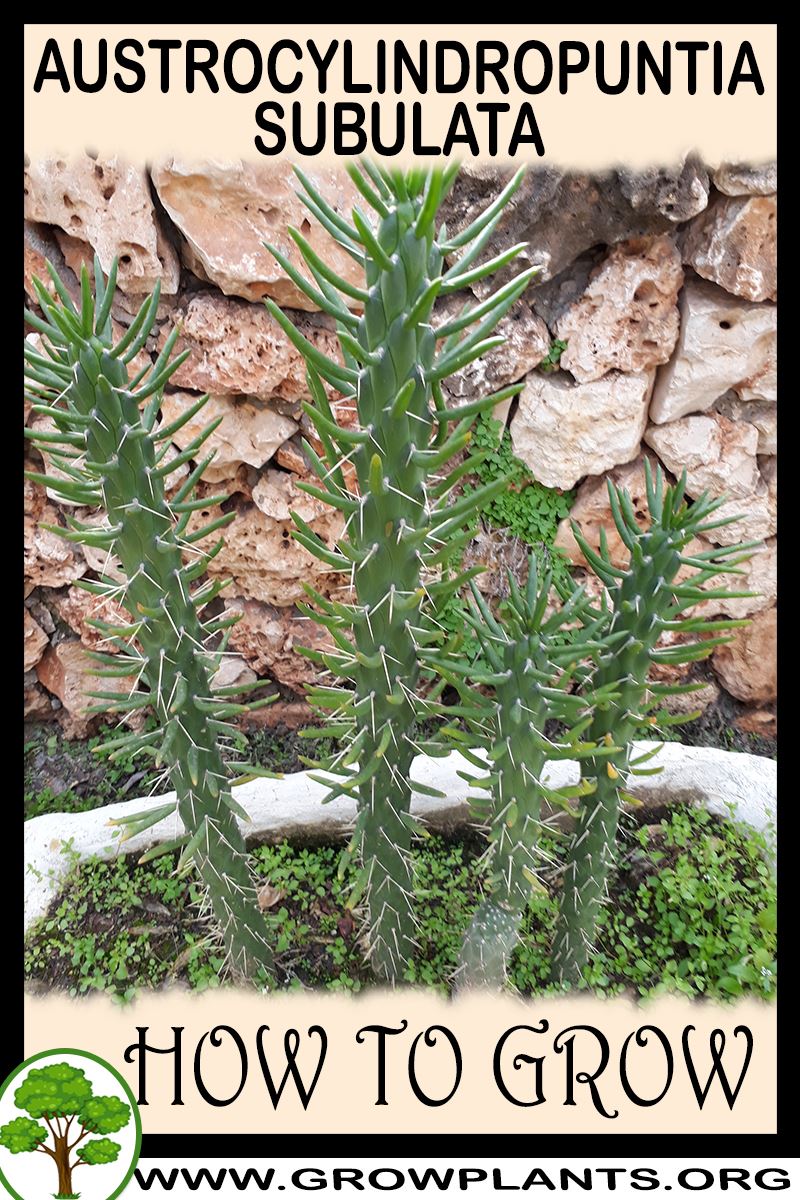
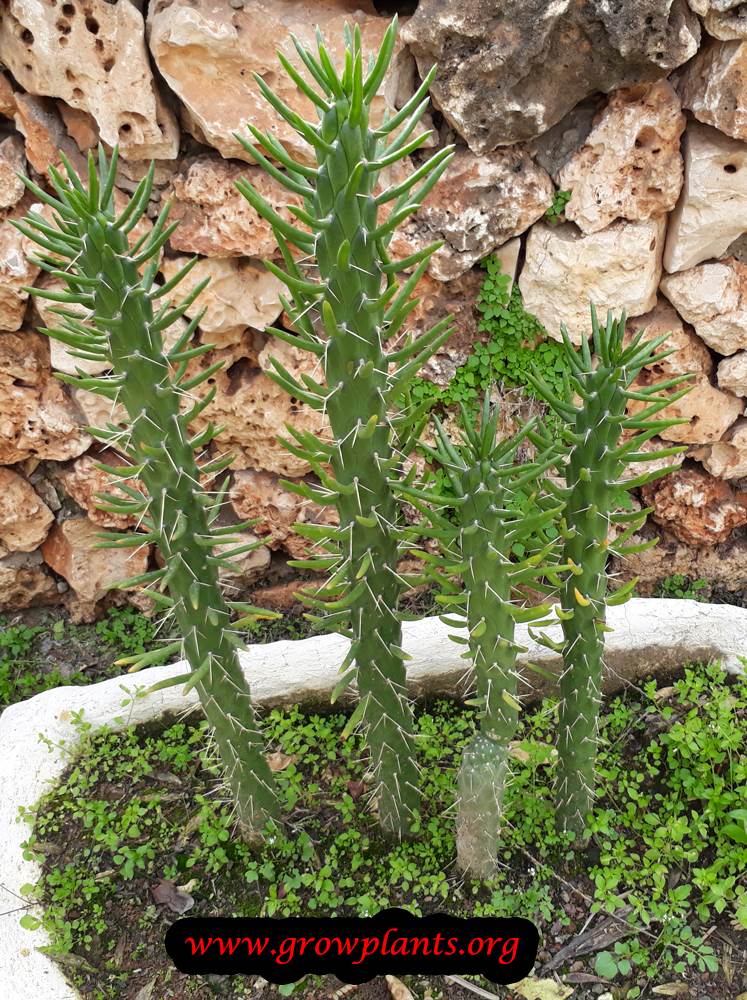
Overview: Austrocylindropuntia subulata (Eve’s needle cactus) is a slow- to moderate-growing evergreen cactus that can reach 0.6-4 m (24-160 in). It is grown as a drought-tolerant ornamental and living-fence plant.
Quick Specifications
| Specification | Attribute |
|---|---|
| Plant Type / Life Cycle | Perennial |
| Foliage Type | Evergreen (succulent) |
| Mature Size | 0.6-4 m (24-160 in) tall |
| Growth Rate | Slow to moderate |
| Root System | Shallow, fibrous and spreading |
| Hardiness | USDA zone 9+ |
Growth Form & Structure
- Height & Spread: 0.6-4 m (24-160 in) tall in the ground; stays compact and can be grown in a container
- Growth Habit & Form: Upright, branching cactus with thick cylindrical green stems
- Lifespan & Maturity: Long-lived; slow to moderate to reach full height
Anatomy & Physical Features
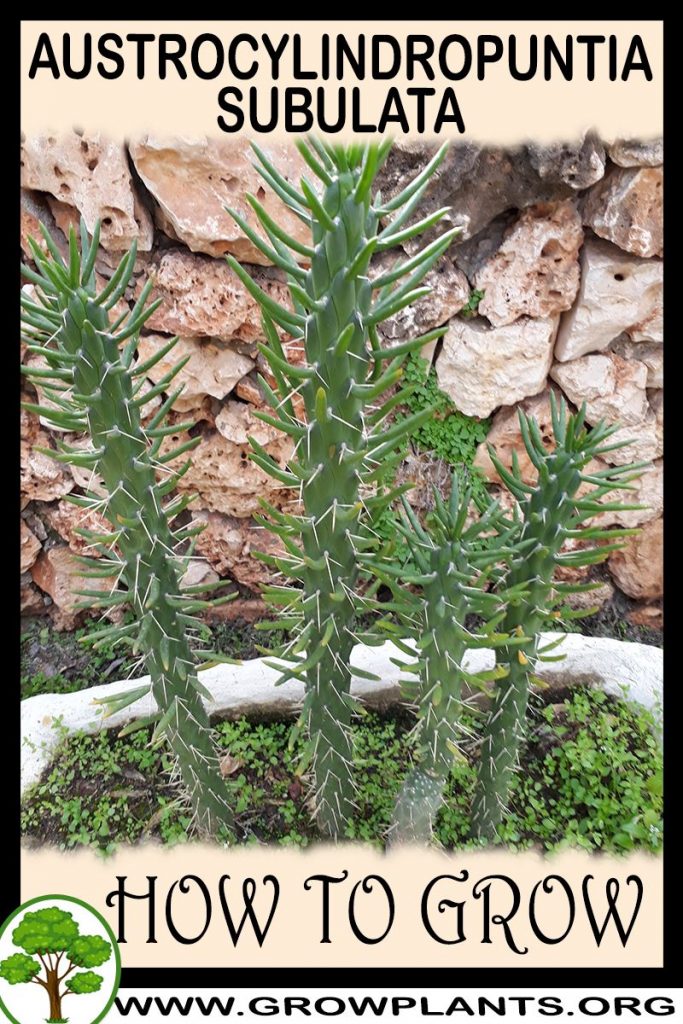
- Leaves & Foliage: Long, awl-shaped (subulate) green leaves that persist on the stems – unusual for a cactus – along with sharp spines
- Flower Characteristics: Red, bowl-shaped flowers (see the Bloom guide)
Primary Uses & Landscape Value
- Functional & Ornamental Roles: Drought-tolerant ornamental, container specimen or living-fence / barrier plant
Care Guide: Planting, Soil & Watering
Overview: Austrocylindropuntia subulata (Eve’s needle cactus) is a drought-tolerant desert cactus that needs full sun and fast-draining, sandy or gritty soil. It stores its own water and requires only occasional deep watering, with dry spells between; wet or heavy soil quickly causes rot.
Quick Care Requirements
| Requirement | Ideal Condition |
|---|---|
| Planting Season | During the warm season, from spring through autumn |
| Growth Rate | Slow to Moderate |
| Soil Type | Very well-draining, gritty or sandy cactus/desert soil |
| Water Need | Low – water deeply but let the soil dry out completely between waterings |
Planting & Establishment
- Best Planting Season: Plant during the warm season, spring through autumn, when the soil is warm and growth is active. Handle carefully – the plant bears spines.
- How to Plant:
- Hole Preparation: Dig a hole about the size of the root ball in a hot, sunny, sharply drained spot.
- Soil Amendments: Blend generous coarse sand, grit or pumice into the backfill to guarantee fast drainage; no rich organic feeding is needed.
- Planting Depth: Set the base at soil level; never bury the stem, which invites rot.
- Growth Speed & Expectations: Slow to moderate, eventually a tall, upright cactus from about 0.6 up to 4 m.
Soil, Watering & Drainage Care
- Soil Mix & Drainage Needs: Use a gritty, extremely free-draining cactus mix; in pots ensure ample drainage holes and add inert material such as lava grit so roots never sit wet.
- Watering Schedule & Technique:
- Young / Newly Planted: Water lightly and infrequently until roots establish, always letting the soil dry first.
- Established: Water deeply but rarely, allowing the soil to dry out fully between waterings.
- Seasonal Adjustments: A little more in peak summer growth; keep nearly dry through cool weather.
Climate, Light & Hardiness
Eve's needle is an upright, drought-tolerant cactus grown in full sun with well-drained soil. The site data lists hardiness zone 9 and warmer; it thrives in heat and dry air but, like most cacti, tolerates cold far better when kept dry.
Quick Climate Specifications
| Climate Zones | Desert, Mediterranean, subtropical, temperate (dry) |
|---|---|
| USDA Hardiness Zones | Approximately zone 9 and warmer |
| Optimal Temp Range | Warm, roughly 20–32°C (68–90°F) |
| Cold Damage Begins | Near 0 to −2°C (32–28°F) |
| Approx. Survival Minimum | Around −5 to −7°C (23–19°F) briefly, only when dry; varies |
| Frost Tolerance | Low to moderate (only when dry) |
| Light Conditions | Full sun |
| Wind Tolerance | Moderate |
Sunlight & Light Exposure
Optimal Light Setup
Full sun keeps the columnar stems firm and upright and encourages flowering; low light causes weak, floppy growth.
Best Exposure / Orientation
A hot, open, sunny position is ideal.
Temperature Extremes & Hardiness
USDA Hardiness & Regional Limits
Grown outdoors from about zone 9 upward; its practical cold limit depends on dry winter conditions.
Cold Damage & Winter Protection
It tolerates brief light frost when dry, but cold combined with soil moisture causes rot and disfiguring marks. Keep it dry and sheltered during frost.
Extreme Heat Tolerance
Excellent - adapted to hot, dry conditions.
Wind, Humidity & Microclimate
Dry-Air Tolerance
Very high; it prefers dry air and resents damp, stagnant conditions.
Microclimate Recommendations
A gritty, sharply drained, sunny site - or a well-drained container that can be kept dry in winter - gives the best results near its cold limit.
Growing in Pots, Balconies & Indoors
Eve’s needle (Austrocylindropuntia subulata) is a vigorous, sun-loving cactus that the grower does not treat as a houseplant, though it grows readily in a pot. It can reach 0.6-4 m (24-160 in), so a container keeps it in check and lets you stand it in the sunniest spot; on a very sunny windowsill a young plant does well.
Quick Details
- Container Size: A pot 20-50% wider than the plant; pot up as it grows
- Indoor Suitability: Not a houseplant; only a very sunny windowsill suits it
- Best Spot: Full sun – the sunniest sill, balcony or patio
- Soil & Drainage: Free-draining cactus/succulent mix over a gravel or lava-rock base; strong drainage holes. A ready-made cactus and succulent soil mix provides that structure without mixing it yourself.
- Watering in Pots: Water sparingly and let the mix dry out between waterings; cut back further in the cool dormant season – pots must never stay wet
Indoors & On the Windowsill
- Not a houseplant: The grower does not recommend it for indoor life; it demands full sun and grows too vigorously for a room.
- Windowsill growing: A young plant can sit on the sunniest windowsill, but it will soon want the light and space of a balcony or patio.
- Overwintering: Frost-tender – shelter the pot in a bright, frost-free place over winter and keep it nearly dry.
On a Balcony or Patio
- Light & wind: Full sun is essential; a warm, sheltered balcony is ideal. The spines are sharp, so place it away from paths and seating.
- Bring it in for winter: Move the pot under cover before frost.
Choosing the Pot, Soil & Long-Term Care
- Pot & drainage: Use a pot only 20-50% larger than the plant – it need not be deep, since the roots run shallow. Add a layer of gravel, lava rock or pebbles in the base, give it strong drainage holes, and never leave it standing in water.
- Potting mix: A free-draining cactus and succulent mix – gritty and well aerated so it dries quickly.
- Feeding: Potted cacti need only light feeding, as nutrients leach out with each watering; a dilute low-nitrogen cactus feed through the warm growing season is enough.
- Repotting: Every few years, once the roots fill the pot or the mix has broken down, refresh the soil and move up one size.
Growing this plant in a greenhouse
A greenhouse can give austrocylindropuntia subulata frost protection, cold protection, humidity control and extra warmth.
Greenhouse at a glance
| Greenhouse suitability | Conditional - depends on your climate |
|---|---|
| Main benefits | frost protection, cold protection, humidity control, extra warmth |
| Outdoor protection advisable below | about 2°C |
| Maintain greenhouse minimum | around 2°C for active growth |
| Suitable types | unheated greenhouse, polycarbonate greenhouse |
| Heating | Heating is optional - useful mainly for winter growing in cold areas. |
Related greenhouse guides
- Greenhouses: How to Choose the Right Greenhouse
- Polycarbonate Greenhouses: What to Look for Before Buying
- Greenhouse Climate Control: Temperature, Ventilation and Humidity
Fertilizing & Feeding
A light feeder: occasional feeding during active summer growth supports sturdy columnar growth, with feeding stopped in the cool dormant season.
Quick Fertilizing Specs
| Feeding Level | Light feeder |
|---|---|
| Main Nutrient Priority | A low-nitrogen cactus feed that supports sturdy, upright columnar growth |
| Best Feeding Period | The warm active growing season |
| Organic Options | A light amount of compost can be worked into the mineral mix for in-ground plantings |
| Reduce/Stop Feeding | Feeding is stopped through the cool dormant season |
| Micronutrients | A complete cactus fertilizer usually covers routine needs |
| Soil pH | Tolerates a wide range in a fast-draining mix |
Feeding by Growth Stage
Warm-season active growth
Support sturdy, upright columnar growth and healthy new growth points without soft, weak growth.
| Nutrient direction | A diluted, low-nitrogen cactus fertilizer favors firm, sturdy growth over soft growth prone to toppling. |
|---|---|
| Timing | Through the warm active growing season. |
| Frequency | Light, occasional feeding during active growth; minimal feeding is needed otherwise. |
| Fertilizer types | A diluted, low-nitrogen cactus or succulent fertilizer, A light compost addition for in-ground plantings |
| Precautions | Feed sparingly – this eventually large, top-heavy species is more prone to weak, unstable growth if overfed. |
Cool-season dormancy
Let the plant rest through cooler weather without pushing new growth it can’t support.
| Nutrient direction | None – withhold fertilizer while the plant is dormant. |
|---|---|
| Timing | Through cool weather or the winter rest period. |
| Frequency | No feeding at this stage; feeding resumes once active growth restarts. |
| Fertilizer types | No feeding at this stage; hold off fertilizing until active growth resumes. |
| Precautions | Withhold fertilizer during dormancy – feeding a resting plant wastes nutrients and risks salt buildup around the roots. |
Nutrient Deficiency Signs & Corrections
Older, lower segments of the column fade to a dull yellow-green and new growth slows.
| Possible causes | low available nitrogen in a very lean mineral mix, nitrogen leached out by watering or rain, a mix that has gone without any organic matter for a long time |
|---|---|
| Appears first on | older, lower parts of the column |
| What to check | feeding history, potting mix composition, watering frequency |
| Possible correction | Apply a diluted, low-nitrogen cactus fertilizer during active growth and consider refreshing the potting mix. |
New growth at the growing tip emerges pale or yellowish while older segments stay green.
| Possible causes | high soil pH limiting iron availability, waterlogged or poorly aerated soil restricting root uptake, a potting mix depleted of micronutrients over time |
|---|---|
| Appears first on | the newest growth at the growing tip |
| What to check | soil drainage and aeration, potting mix age, recent watering habits |
| Possible correction | Improve drainage, correct pH if identified as a cause, and apply a chelated iron product per its label. |
Segment tips or margins brown and dry out despite otherwise adequate care.
| Possible causes | fertilizer salt buildup from infrequent flushing, underwatering that concentrates salts in the mix, feeding more often than the plant can use |
|---|---|
| Appears first on | growing tips and segment margins |
| What to check | recent feeding frequency and strength, time since the mix was last flushed, container or bed drainage |
| Possible correction | Ease off feeding, flush the mix or soil thoroughly with water, then resume only light feeding. |
Pruning, Training & Seasonal Maintenance
Austrocylindropuntia subulata grows as a branching, shrub-to-tree-form cactus made of cylindrical, cone-shaped jointed segments, quite unlike the solitary globes and columns elsewhere in this genus group – its jointed structure means cuts can genuinely be made at segment joints to control size and shape without ending the plant’s growth. Pruning is mainly for size and structure management on this large-growing (up to 4m) species, plus removing dead segments; because the plant is slow to medium growing, changes take time to fill back in, so height and spread control is best done gradually rather than in one severe pass.
Quick Pruning & Maintenance Specs
| Pruning Tolerance | Moderate – jointed segments can be removed at their joints |
| Primary Pruning Window | Spring through autumn, during the plant’s active growing season |
| Typical Frequency | Occasional – size/shape control as the plant matures toward its large eventual size |
| Main Objective | Control height and spread; remove dead segments |
| Young Plant Priority | Minimal – allow branching structure to develop naturally |
| Mature Plant Priority | Remove segments at joints to manage the plant’s eventual large size (up to 4m) |
| Best Tool Type | Loppers or pruning saw for thick basal segments; sterile blade for smaller joints |
| Avoid Heavy Pruning During | Spring/summer bloom period, and cold weather when cuts heal slowly |
Pruning by Plant Age & Size
Newly Established
Minimal pruning; remove only damaged segments while the plant establishes its branching structure.
Young / Formative
No formal training system is needed – the species naturally branches into a shrub/tree form; light removal of awkwardly placed young segments can guide overall shape if desired.
Mature / Established
As the plant approaches its mature size of up to 4m, remove whole segments at their joints to control height and spread, and thin crowded or crossing segments for a more open structure.
Structural Pruning & Training
Because growth is jointed, whole segments can be removed cleanly at the joint without damaging the remaining structure – this genuinely allows height and spread control and crossing-segment thinning, unlike the solitary cacti elsewhere in this batch where no such structural pruning exists.
Special Growth to Remove
- Dead or damaged segments – remove cleanly at the nearest joint.
- Crossing or crowded segments – thin at joints to open the structure as the plant matures.
Container & Small-Space Pruning
Given its eventual size of up to 4m, container culture requires more active height and spread control through joint-level segment removal than the plant would need in open ground; regular size checks prevent it from outgrowing the pot’s stability.
Tools
- Loppers – for thicker, older basal segments that develop woody tissue with age.
- Pruning saw – for the largest basal segments on mature specimens.
- Grafting knife / sterile blade – for smaller joints and cleanup cuts.
Tool Hygiene & Disease Risk
Routine: use clean, sharp tools for each cut; disinfect between plants if disease is suspected, though no specific transmissible pathogen is noted for this species beyond general succulent rot risk at fresh cuts.
Cut Placement & Technique
Cut cleanly at the segment joint rather than through the middle of a segment, which heals faster and more cleanly than a mid-segment cut. Handle cut material carefully – the species is noted as spiny, so heavy gloves are needed throughout.
Heavy Pruning & Rejuvenation
Tolerated at the joint level: an overgrown specimen can have multiple segments removed over one or more seasons to reduce size, since new growth can resume from remaining joints, though very severe reduction in a single session is best avoided given the plant’s slow-to-medium growth rate and the time it takes to fill back in.
Post-Pruning Care
Let cut surfaces dry and callus before watering resumes; keep newly opened, previously shaded interior segments out of intense direct sun for a period to avoid sunburn on tissue that was not previously exposed.
Common Pruning Mistakes
- Cutting through the middle of a segment instead of at the joint, leaving a slower-healing wound.
- Handling cut segments without adequate gloves given the plant’s spines.
- Removing too much canopy at once and exposing previously shaded interior tissue to sunburn.
When NOT to Prune
Avoid heavy pruning during the spring/summer bloom period when red flowers are forming, and avoid cutting in cold or wet weather when joints heal slowly.
Recommended Tools (by task)
- loppers – needed for the thicker, semi-woody basal segments this large shrub-form cactus develops with age.
- pruning_saw – for the largest basal segments when reducing a mature, tree-sized specimen.
- grafting_knife – for smaller joints and dead-tissue cleanup.
Propagation Guide
Eve’s needle cactus roots very easily from stem cuttings — a removed segment will typically callus and root without special treatment — making this one of the simplest cacti to propagate vegetatively. Seed is also viable and produces true species plants, but cuttings are faster and are the standard practical method.
Quick Propagation Specs
| Best Propagation Method | Stem cuttings |
| Alternative Methods | Seed |
| Propagation Difficulty | Easy |
| Seed True-to-Type | Yes (species cactus) |
| Vegetative True-to-Type | Yes |
| Best Propagation Season | Spring through autumn, matching the plant’s planting season |
| Cutting Rooting Time | Typically a few weeks under warm conditions (general guidance for segmented Opuntia-relatives; not specified by the site) |
| Germination Temperature | Roughly 21–27°C (70–80°F) |
| Seed Sowing Depth | Surface-sow or barely cover |
Stem Cuttings
Cutting Type
A single stem segment (joint), ideally removed cleanly at a natural joint.
Best Timing
Warm growing months, spring through autumn.
Cutting Preparation
Let the cut end callus and dry in a shaded spot for several days to a week before planting; handle carefully, as the spines are easily dislodged and irritating.
Rooting Setup
Set the callused segment upright (or lay it) on a gritty, well-drained mix and water sparingly until roots form.
Rooting Hormone
Not necessary.
Rooting Time
Typically a few weeks.
Bloom & Flower Guide
Quick Details
- Bloom Season: Spring to summer.
- Flower Appearance: Red, bowl-shaped (cup-like) flowers.
- Edibility: Ornamental only; not grown as an edible flower.
Detailed Blooming Overview
Eve’s Needle (Austrocylindropuntia subulata) is a fast, upright opuntioid cactus best known for its cylindrical stems and long, needle-like leaves. When it does flower, it opens red, cup-shaped blooms in the warmer months. Flowering is more common on large, well-established plants in a hot, sunny position, so it is often grown as much for its bold form as for its blooms.
Flower Characteristics
- Colour: red.
- Form: open, bowl or cup shape.
- Position: toward the ends of the stems.
Bloom Care & Thinning
- Full sun and heat: the main lever for flowering on this vigorous plant.
- Lean, dry winter rest: restrained winter watering encourages flowering rather than soft, sappy growth.
- Handle with care: the fine glochids make deadheading fiddly – use gloves, though there is little tidying to do.
Fruit & Uses
Eve’s needle cactus is unusual among cacti in keeping fleshy, awl-shaped leaves on its stems, and both these leaves and its fruit are reported edible and eaten raw. Documented culinary use is limited to specialist and grower sources rather than mainstream food literature, so this should be treated as a minor, careful-foraging use rather than an established crop.
Quick Edible Specs
| Edible Parts | Leaves (fleshy, persistent) and fruit |
|---|---|
| Main Use(s) | Occasional raw eating; leaves reported to taste similar to asparagus or young green beans |
| Eaten Raw or Cooked | Raw |
| Preparation Required | Careful removal of spines before handling either part |
| Harvest Season | Leaves available while stems are actively growing; fruit after flowers fade |
| Storage | Best used fresh; not documented for storage |
| Safety/Toxicity Caveat | No toxicity documented, but the stems carry long, sharp spines that are a real injury risk when harvesting either the leaves or the fruit |
Leaves & Greens
The fleshy, awl-shaped, greenish-yellow leaves that persist along the stems for a season or more are reported edible raw, with a taste described as somewhere between asparagus and young green beans. They are picked individually from the stem; because the plant is densely spined, thick gloves or tongs are needed to harvest them without injury.
Fruit
Once the red flowers are spent, the plant forms oblong, dark-green, spineless fruit that is described as tasty and eaten raw straight off the plant. The lack of spines on the fruit itself makes it easier to handle than the leaves or stems.
Harvesting
Take a few leaves at a time rather than stripping a stem bare, since the leaves also help the plant photosynthesize; pick fruit once it has coloured up and softened slightly after flowering.
Preparation, Uses & Safety
Both leaves and fruit are eaten raw with no cooking required; the main safety step is careful de-spining and handling of the stem, since this species carries long, sharp spines capable of causing real puncture injuries. Treat this as an occasional, minor edible use rather than a cultivated food source.
Pests, Diseases & Troubleshooting
Overview: Austrocylindropuntia subulata (Eve’s needle cactus) is a vigorous, near-indestructible opuntioid cactus whose few pests are the standard succulent trio – cochineal, mealybug and scale – while its genuine killer is rot from overwatering, cold-wet soil or poor drainage. Grow it hard and dry in gritty, fast-draining mix with full sun, and problems are rare.
Quick Troubleshooting Overview
| Issue / Pest | Main Symptom | Primary Solution |
|---|---|---|
| Cochineal scale | White cottony masses on pads that bleed deep red when crushed | Blast off with water, then oil/soap; prune badly infested pads |
| Mealybugs (incl. root mealybug) | White fluff in crevices and on roots, weak growth | Alcohol swab, systemic or oil; bare-root and check roots when repotting |
| Scale insects | Hard brown limpet bumps on pads | Scrape off, horticultural oil |
| Spider mites | Fine stippling, bronzing and webbing on stressed plants | Rinse, raise humidity, miticidal soap/oil |
| Rot (the killer) | Soft, brown/black mushy tissue at base or on pads | Cut into clean tissue, dry, re-root; withhold water, improve drainage |
| Etiolation / weak growth | Pale, thin, stretched stems | Move to full sun; reduce feeding |
Common Pests & Management
- Cochineal scale (Dactylopius spp.):
- Symptoms: Conspicuous white, cottony, waxy patches nestled on the pads and joints; crushing them releases a vivid crimson dye – the diagnostic sign. Heavy infestations weaken and disfigure the plant and cause yellowing.
- Prevention & Control: Blast the woolly colonies off with a firm jet of water, then treat with horticultural oil or insecticidal soap to smother survivors; repeat weekly. Prune out and destroy heavily infested pads, and isolate new plants until clean.
- Mealybugs (Pseudococcus / Planococcus spp.):
- Symptoms: White, cottony tufts tucked into areoles, pad junctions and crevices, with sticky honeydew and stunted, distorted growth. Root mealybugs form white waxy deposits on the roots and in the soil, causing unexplained decline.
- Prevention & Control: Swab visible colonies with rubbing alcohol and hose off; for root mealybug, bare-root the plant, wash the roots, and repot in fresh gritty mix. Insecticidal soap, horticultural oil or a systemic drench clears persistent infestations. Always inspect roots when repotting.
- Scale insects (Diaspididae):
- Symptoms: Small, hard, brown or grey limpet-like bumps fixed to the pads and stems; they suck sap, causing yellow spots and general loss of vigour.
- Prevention & Control: Scrape off individual scales with a fingernail or soft brush, then apply horticultural oil to smother the crawlers. Repeat and monitor, as scale is easily reintroduced.
- Spider mites (Tetranychus urticae):
- Symptoms: Fine pale stippling, a rusty-bronze cast at the growing tips and delicate webbing, appearing on hot, dry, sheltered or indoor plants.
- Prevention & Control: Rinse the plant, raise humidity around it, and improve airflow. Treat with insecticidal soap or horticultural oil, repeating to break the fast life cycle in warm conditions.
- Fungus gnats (Bradysia spp.):
- Symptoms: Small dark flies running over the soil surface; larvae in chronically wet mix can nibble roots of seedlings and weaken cuttings.
- Prevention & Control: Let the mix dry thoroughly between waterings, top-dress with grit, and use yellow sticky traps and Bacillus thuringiensis israelensis (Bti) or beneficial nematodes for the larvae.
Diseases & Fungal Issues
- Soft rot / basal rot (Erwinia / Pectobacterium & soil fungi):
- Symptoms: Soft, water-soaked, brown-to-black mushy areas at the base or on pads, often foul-smelling, spreading fast in cold wet conditions or after damage.
- Treatment & Management: Cut well back into clean, firm green tissue with a sterile blade, let the wound callus in dry air, and re-root the healthy top. Discard rotted material and its soil; keep dry and warm during recovery.
- Fungal spots / dry rot (Various fungi):
- Symptoms: Sunken corky or black dry lesions and scabby patches on the pads, usually where water sits or after sunscald or pest damage.
- Treatment & Management: Improve airflow and keep water off the pads; remove badly marked pads. Corky spots are permanent but harmless once dry. A copper fungicide can check spreading fungal lesions.
Growing Difficulties & Abiotic Problems
- Overwatering rot (the main killer):
- Cause & Symptoms: Excess water, cold-wet soil or poor drainage causes the base and roots to rot and the plant to collapse.
- Correction Strategy: Use a gritty, sharply draining cactus mix, water only when the mix is bone dry, and cut watering right back in cool weather. When in doubt, do not water.
- Etiolation (stretching):
- Cause & Symptoms: Insufficient light produces pale, thin, weak, over-stretched stems.
- Correction Strategy: Give full sun (acclimatise gradually to avoid scorch); reduce nitrogen feeding. Etiolated growth will not revert but new growth will be sturdy.
- Sunburn / scald:
- Cause & Symptoms: Sudden exposure to intense sun after shade produces bleached yellow-white or corky brown scarring on the exposed side.
- Correction Strategy: Acclimatise plants gradually when moving them into stronger light; damaged tissue scars permanently but the plant recovers.
- Cold and frost damage:
- Cause & Symptoms: Prolonged cold, especially when wet, causes translucent, mushy, discoloured tissue.
- Correction Strategy: Keep dry and above its minimum temperature in winter; frost tolerance is far higher when the soil is dry.
What Helps – Products & Tools
Cultural control does most of the work: bone-dry gritty mix, full sun, and inspecting roots at repotting. When pests appear, horticultural oil and insecticidal soap cover cochineal, mealybug, scale and mites; a systemic drench tackles stubborn root mealybug; sticky traps and Bti handle fungus gnats; and a copper fungicide checks fungal lesions. Above all, withhold water at the first sign of softness.