
Plant Profile & Key Characteristics
Overview: Zygopetalum is an evergreen epiphytic orchid of 30-60 cm (12-24 in), prized for its long-lasting, richly patterned and fragrant flowers. It is grown as an ornamental and cut flower, typically as a houseplant or in a shaded, humid spot.
Quick Specifications
| Specification | Attribute |
|---|---|
| Plant Type / Life Cycle | Perennial (epiphytic orchid) |
| Foliage Type | Evergreen |
| Mature Size | 30-60 cm tall (12-24 in) |
| Growth Rate | Slow |
| Root System | Epiphytic fleshy roots on pseudobulbs (grown in bark, not soil) |
| Toxicity | Non-toxic |
| Hardiness | USDA zones 11-12 |
Growth Form & Structure
- Height & Spread: Reaches 30-60 cm (12-24 in) in flower; grown in a snug transparent pot of bark or cork so the roots get air, and repotted about yearly.
- Growth Habit & Form: Clumping sympodial orchid, new growths and flower stems rising from pseudobulbs at the leaf bases.
- Lifespan & Maturity: Long-lived; grows slowly, adding a new pseudobulb each year, with individual flowers lasting up to a month.
Anatomy & Physical Features
- Leaves & Foliage: Strap-like, linear to elliptic green leaves arising from the pseudobulbs.
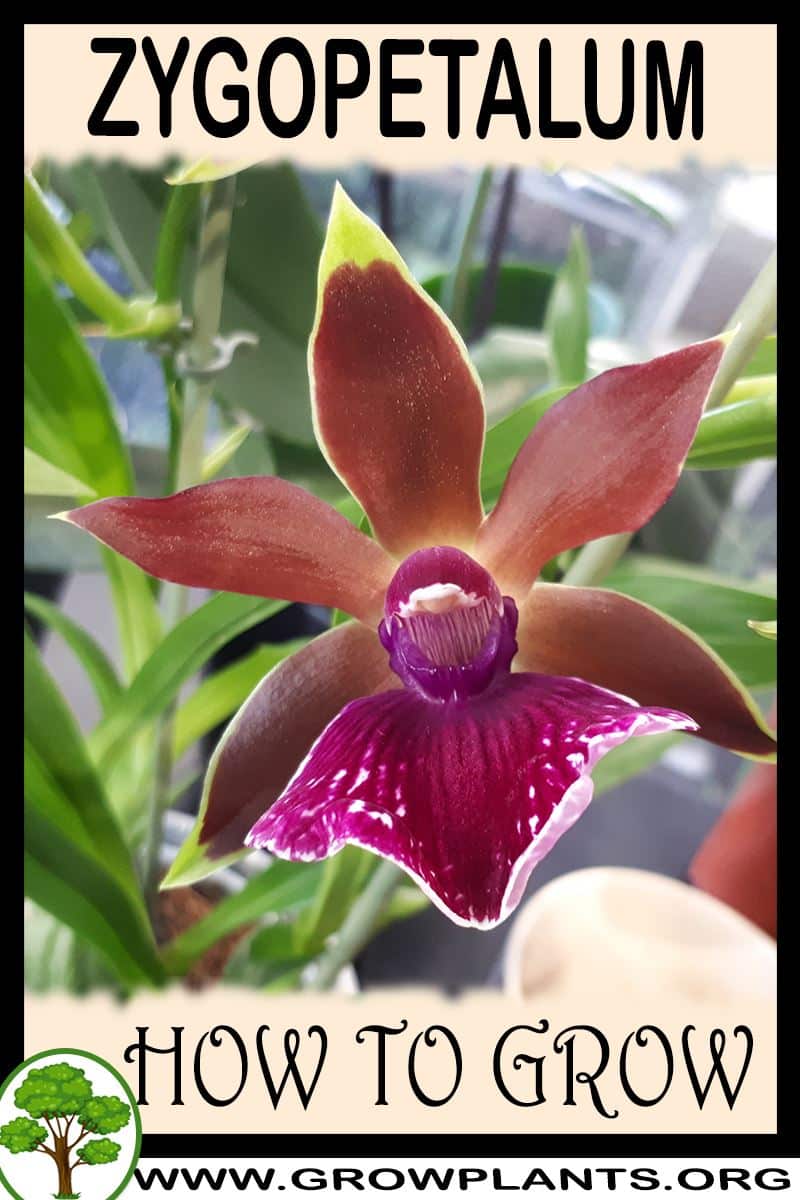
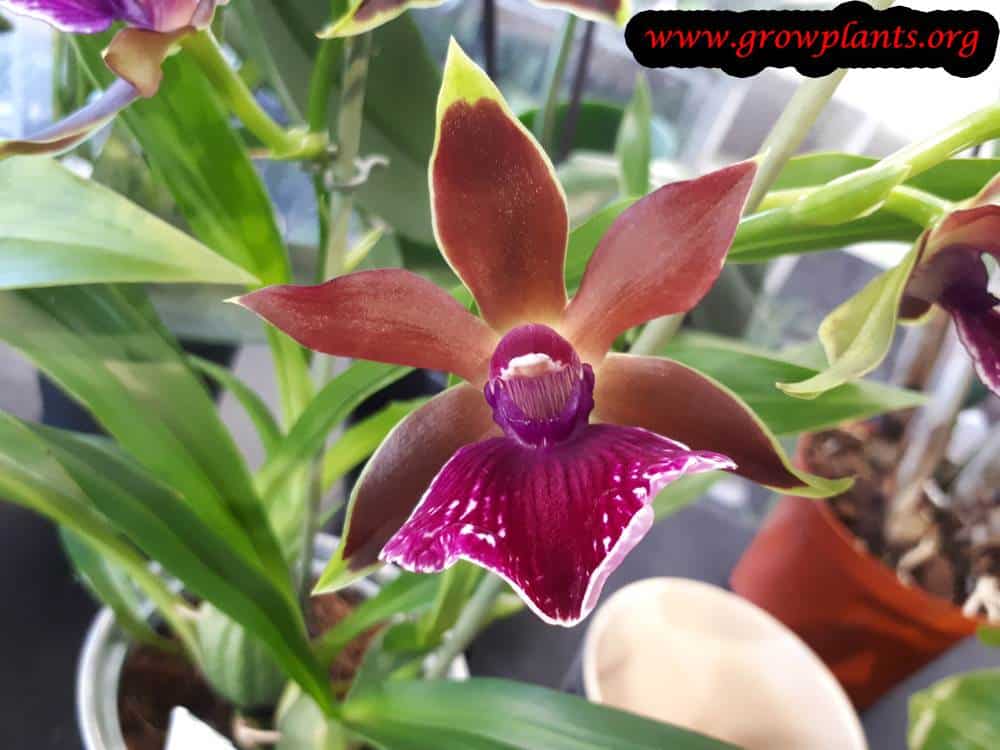
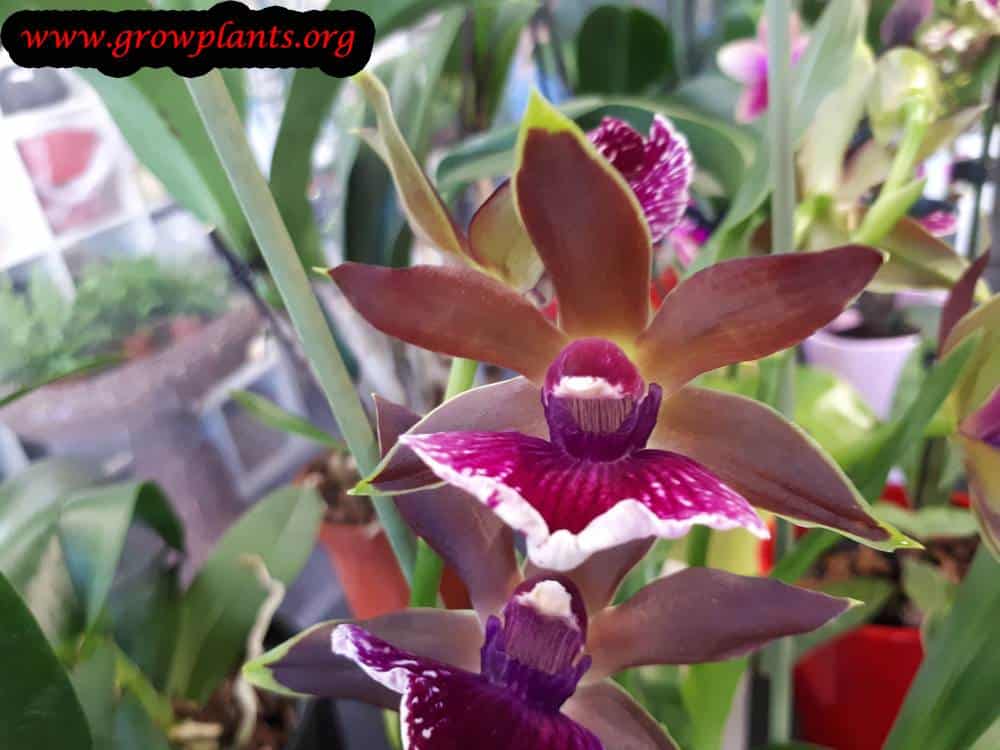
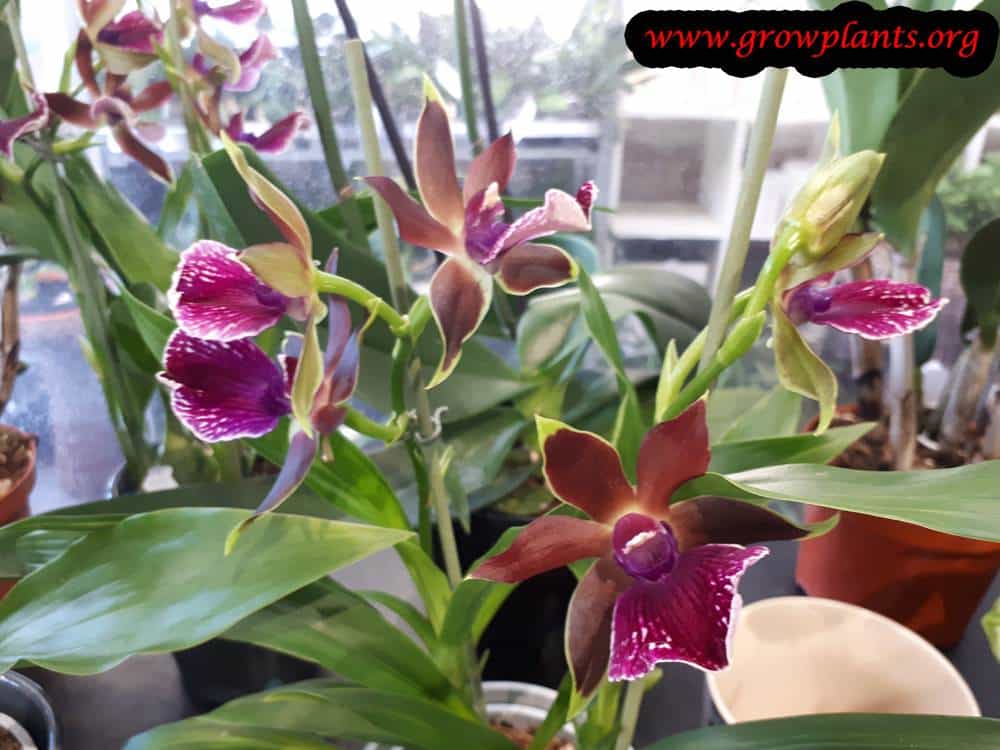
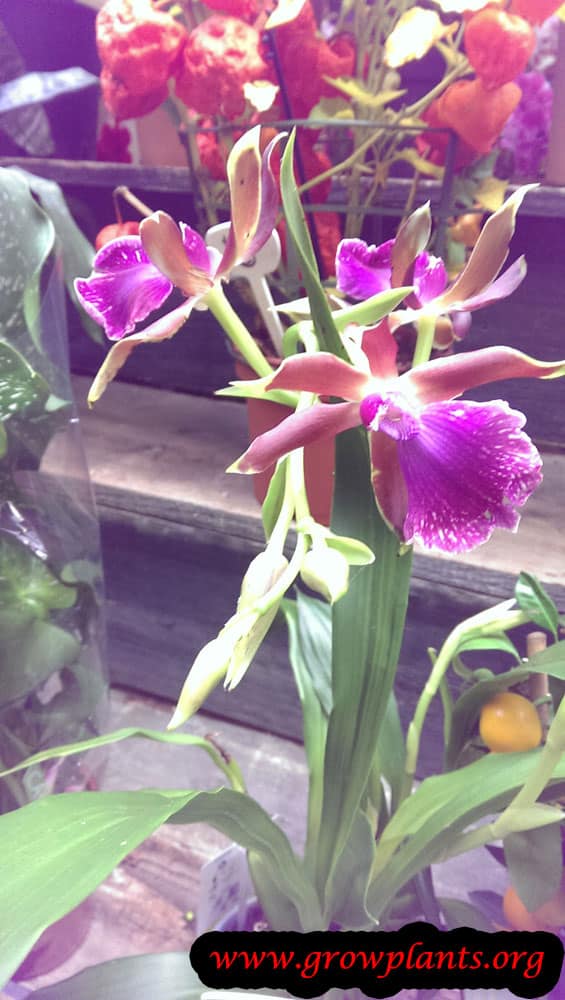
- Flower Characteristics: Fragrant, waxy flowers with five elliptic tepals heavily marked with spots, dots and stripes over an apron-like lip, in blends of green, purple, red and brown; long-lasting.
Primary Uses & Landscape Value
- Functional & Ornamental Roles: Ornamental houseplant and fragrant cut flower.
Care Guide: Planting, Soil & Watering
Overview: Zygopetalum is an epiphytic orchid that grows in coarse bark rather than garden soil, needing bright light, warm days with cooler nights, and humidity above 50%. It takes only modest, careful watering with clean or rainwater and must never sit soggy.
Quick Care Requirements
| Requirement | Ideal Condition |
|---|---|
| Planting Season | Year-round (start in spring where summers are very hot) |
| Growth Rate | Slow |
| Soil Type | Epiphytic – coarse bark or cork orchid mix, not garden soil |
| Water Need | Low to Moderate – moist but never waterlogged; prefers rain or clean water |
Planting & Establishment
- Best Planting Season: Repot or establish at any time of year, ideally as new growth starts; where summers are very hot, begin in spring.
- How to Plant:
- Soil Amendments: Pot in coarse bark or cork chips with pieces of inert material such as Styrofoam added for aeration, and use a transparent pot so the roots get light.
- Planting Depth: Seat the plant so the base of the pseudobulbs sits at the surface of the mix and the roots are anchored in bark, not buried.
- Growth Speed & Expectations: A slow grower to about 30-60 cm; its roots and potting mix need refreshing roughly once a year.
Soil, Watering & Drainage Care
- Soil Mix & Drainage Needs: Use a free-draining bark or cork medium that holds air around the roots, refresh it before it breaks down into acidic compost, and keep humidity above 50%.
- Watering Schedule & Technique:
- Young / Newly Planted: After repotting, water lightly and keep the medium just moist while new roots take hold.
- Established: Water sparingly with clean or rainwater, letting the bark approach dryness between waterings; never leave it standing in water.
- Seasonal Adjustments: Increase slightly during warm active growth and reduce in cool conditions.
Climate, Light & Hardiness
Zygopetalum is a subtropical epiphytic orchid grown outdoors in mild climates or as a houseplant, needing bright indirect light and consistently high humidity. It can briefly tolerate a light frost, unusual among the orchids in this group, but is not reliably frost-hardy.
Quick Climate Specifications
| Climate Zones | Subtropical, mediterranean, or houseplant |
| USDA Hardiness Zones | 11–12 |
| Optimal Temp Range | Day approximately 22–30°C (70–80°F); night approximately 10–20°C (50–65°F) |
| Frost Tolerance | Very Low (can briefly withstand light frost, but not for long) |
| Light Conditions | Full Shade (with plenty of light) |
Sunlight & Light Exposure
Optimal Light Setup
Bright, indirect light suits it best.
Temperature Extremes & Hardiness
USDA Hardiness & Regional Limits
Zone 11–12 reflects a subtropical orchid; unusually for this group it can briefly withstand a light frost, but this is not the same as genuine cold hardiness, and it should still be grown under protection outside mild climates.
Frost Sensitivity
Very low frost tolerance - a brief light frost may be survived, but not prolonged or harder freezes.
Wind, Humidity & Microclimate
Humidity Preferences
Needs humidity above 50%.
Microclimate Recommendations
A bright, humid, sheltered spot with a real day/night temperature difference supports healthy growth and flowering; grow in an open bark/cork mix in a snug pot.
Growing in Pots, Balconies & Indoors
Zygopetalum (Zygopetalum) is a compact orchid (about 30-60 cm) and a genuine houseplant – the grower confirms it grows well indoors, and orchids are almost always grown in a pot rather than open ground. Give it bright, indirect light near a window and it makes a rewarding, long-flowering indoor plant.
Quick Details
- Container Size: A pot only about 20-40% larger than the root ball – orchids like to be snug
- Indoor Suitability: Yes – a true houseplant in bright, indirect light
- Best Spot: Bright, indirect light – a lot of light but out of direct sun
- Soil & Drainage: Never ordinary potting soil – use a coarse, open orchid medium (bark or cork chips) with lots of drainage holes
- Watering in Pots: Water sparingly – let the bark approach dryness between waterings; let excess drain away and never leave the pot standing in water
Indoors & On the Windowsill
- A true houseplant: The grower confirms it thrives indoors – keep it near a bright window but out of harsh, direct midday sun.
- Windowsill growing: An east or shaded-south window is ideal; a clear pot lets you watch the roots and see when to water.
- Overwintering: As a tropical plant it is happiest indoors year round in cool climates – keep it warm, bright and away from cold draughts and frost.
On a Balcony or Patio
- Summering outdoors: It can spend warm spells on a shaded, sheltered balcony or patio in bright but indirect light – protect it from direct sun, drying wind and any chill. Pots and open orchid media dry quickly, so check moisture often.
Choosing the Pot, Soil & Long-Term Care
- Pot & drainage: A snug pot with many holes; a transparent pot is useful for watching the roots. Never let it sit in standing water – the fastest route to rot.
- Medium: A coarse, free-draining orchid mix of bark or cork chips (some more terrestrial types appreciate a little added coir or humus), not garden soil.
- Feeding & water quality: Feed with a dilute orchid fertiliser a few times a year; where possible use rain or distilled water, which orchids prefer.
- Repotting: Refresh the medium about every two years – bark breaks down and loses structure over time – and pot on when roots fill the container.
Fertilizing & Feeding
A light feeder: this fragrant epiphytic orchid grows steadily on dilute, regular balanced feeding through its growth flush, then eases off as pseudobulbs mature toward its cool-triggered bloom.
Quick Fertilizing Specs
| Feeding Level | Light feeder |
|---|---|
| Main Nutrient Priority | A dilute, balanced complete orchid fertilizer rather than a high-phosphorus bloom formula |
| Best Feeding Period | While new pseudobulbs and roots are actively developing, ahead of the autumn or winter bloom |
| Micronutrients | A complete orchid fertilizer generally covers routine needs; correct only a diagnosed deficiency |
| Reduce/Stop Feeding | Feeding is withheld once a pseudobulb has matured and the plant settles toward bloom and rest |
Feeding by Growth Stage
New pseudobulb and root growth
Build the new pseudobulb, its linear leaves, and supporting roots that this season’s fragrant flower spike will eventually come from.
| Nutrient direction | A dilute, nitrogen-leaning balanced fertilizer supports steady new leaf, pseudobulb, and root development. |
|---|---|
| Timing | As soon as a new growth is visible at the base of the most recent pseudobulb. |
| Frequency | Regular light feedings through the active growth phase suit this species better than infrequent heavy ones. |
| Fertilizer types | A balanced, complete orchid fertilizer diluted well below label strength for regular container feeding, An occasional plain-water flush through the bark mix to prevent salt buildup |
| Routine trace nutrients | iron, manganese |
| Precautions | Flush the bark mix with plain water periodically to prevent salt buildup, since this species prefers a smaller amount of water overall. |
Flower spike development and fragrant bloom
Support the flower spike and long-lasting, fragrant blooms once cooler night temperatures and the day-night temperature swing help trigger flowering.
| Nutrient direction | Keep to a balanced fertilizer with adequate potassium rather than a high-phosphorus ‘bloom booster’ – the temperature swing, not extra phosphorus, is what cues flowering. |
|---|---|
| Timing | As a flower spike emerges from the newest mature pseudobulb and while it remains in bloom. |
| Frequency | Continue the same light, regular feeding used during growth while the spike develops; taper off once the pseudobulb has fully matured. |
| Fertilizer types | A balanced, complete orchid fertilizer at the same dilute strength used during active growth |
| Routine trace nutrients | iron, manganese |
| Precautions | Avoid switching to a high-phosphorus ‘bloom booster’ product; it does not improve flowering and can unbalance feeding. |
Rest after pseudobulb maturity
Let the mature pseudobulb hold its reserves and the plant rest before the next new growth begins.
| Nutrient direction | None – withhold fertilizer once the pseudobulb has matured and growth has paused. |
|---|---|
| Timing | After the most recent pseudobulb has fully matured and before the next new growth appears. |
| Frequency | No feeding during this rest period. |
| Fertilizer types | No feeding at this stage; water sparingly to match this species’ preference for a smaller amount of water until new growth resumes. |
| Precautions | Resume feeding once new leaf or root growth is visible at the base of the plant. |
Nutrient Deficiency Signs & Corrections
New leaves and the developing pseudobulb emerge pale yellow-green and undersized.
| Possible causes | insufficient nitrogen during the active growth flush, fertilizer diluted too far or applied too infrequently, roots reduced by an old, broken-down bark mix |
|---|---|
| Appears first on | newest leaves and the developing pseudobulb |
| What to check | feeding routine and dilution during active growth, condition and age of the bark mix, root health at repotting |
| Possible correction | Resume regular light feeding with a balanced fertilizer during active growth and repot into fresh bark if the mix has broken down. |
Flower spikes are weak or short-lived and older leaves show yellowing and browning starting at the tips and margins.
| Possible causes | insufficient potassium reaching a maturing pseudobulb, fertilizer imbalance skewed heavily toward nitrogen, poor root function limiting overall nutrient uptake |
|---|---|
| Appears first on | older leaves and developing flower spikes |
| What to check | balance of the fertilizer used ahead of bloom, root health and mix condition, overall feeding consistency during the growth phase |
| Possible correction | Use a balanced fertilizer with adequate potassium during the growth phase leading up to bloom, and address any underlying root problems. |
Older, lower leaves show yellowing between the veins while the veins remain green.
| Possible causes | magnesium depleted from the bark mix over time, fertilizer salt buildup interfering with nutrient uptake, an old, compacted mix restricting root function |
|---|---|
| Appears first on | older leaves |
| What to check | age and condition of the potting mix, fertilizer and flushing routine, overall root health |
| Possible correction | Flush the mix with plain water to clear built-up salts, consider a fertilizer that includes magnesium, and repot into fresh bark if needed. |
Pruning, Training & Seasonal Maintenance
Zygopetalum is a sympodial pseudobulb orchid whose fragrant flowers arise from the base of a newly maturing pseudobulb, not from older growth, so pruning is grooming-only: the spent spike, fading leaves and rotten roots. This plant blooms mainly in autumn/winter (or longer where day-night temperature swings are pronounced), and the safe cutting window follows once that spike’s flowers — each lasting roughly a month — have fully finished.
Quick Pruning & Maintenance Specs
| Pruning Tolerance | Low |
| Primary Pruning Window | After bloom, once the autumn/winter flower spike is fully finished |
| Secondary Maintenance Window | Root trimming at repotting |
| Typical Frequency | Per-spike, roughly annual given this plant’s slow growth; division infrequent |
| Main Objective | Redirect energy from a spent spike into the next pseudobulb |
| Young Plant Priority | Let new pseudobulbs bulk up fully before dividing |
| Mature Plant Priority | Remove spent spikes at the base; divide only when pot-bound |
| Best Tool Type | Precision snips |
| Avoid Heavy Pruning During | While the spike still carries fresh, long-lasting flowers |
Pruning by Plant Age & Size
Newly Established
A newly potted division should have only dead or rotten roots removed at potting; given slow growth, allow extra settling time before further cuts.
Young / Formative
No structural training applies. Let each new pseudobulb fully mature before it is allowed to flower or be divided.
Mature / Established
Groom spike-by-spike after the autumn/winter bloom; retain firm leafless backbulbs for stored energy, and divide only once the plant has clearly filled its pot.
Seasonal Pruning Schedule
| Stage | Objective | Remove | Do Not Remove | Expected Response / Flowering Impact |
| Post-Flowering | Redirect energy to new growth | Spent flower spike, cut back at the base once flowers (each lasting about a month) have fully faded | The pseudobulb and leaves | Zygopetalum does not rebloom from an old spike, so removing it once finished costs nothing; energy goes into the next pseudobulb |
| Ongoing Sanitary | General hygiene | Fully yellowed leaves; rotten roots at repotting | Green leaves and firm backbulbs | Backbulbs left intact continue supporting the clump |
Special Growth to Remove
- Spent flower spike, cut at the base once flowering is fully finished
- Fully yellowed leaves
- Rotten root tissue, trimmed at repotting
- Backbulbs retained unless being separated for propagation
Container & Small-Space Pruning
Pot only slightly larger than the root ball; check roots yearly but trim only dead/rotten sections rather than routinely.
Tools
- precision snips — spikes, leaves, root trimming
Tool Hygiene & Disease Risk
High-risk. Orchid viruses spread via cutting tools and have no cure; disinfect blades between plants and between cuts.
Cut Placement & Technique
Cut the spike cleanly at the base once fully finished. Trim roots back to firm tissue only.
Heavy Pruning & Rejuvenation
Zygopetalum does not tolerate hard cutting-back of pseudobulbs or foliage. Rejuvenation comes from division at repotting, keeping several pseudobulbs together per section given this plant’s slow growth.
Post-Pruning Care
Let root cuts dry briefly before repotting. Hold off on fertilizer until new root growth is visible; recovery after division can take longer given this plant’s slow growth rate.
Common Pruning Mistakes
- Cutting the spike while flowers, which last about a month, are still fresh
- Dividing into small sections that struggle to re-establish given slow growth
- Removing firm backbulbs rather than keeping them for stored energy
When NOT to Prune
Avoid cutting a spike while it still carries fresh flowers, and avoid dividing more aggressively than the plant’s slow growth can recover from.
Recommended Tools (by task)
- precision_snips — spike removal, leaf trimming and root trimming, the only cuts this plant needs
- blade_disinfectant — to prevent virus transmission between plants and cuts
Propagation Guide
Zygopetalum is most practically propagated by dividing pseudobulb clumps, since the site notes seed is really hard to start even though vegetative propagation is not described as strictly required. Division is Moderate in difficulty, while seed remains Difficult to Specialist and is rarely used by home growers.
Quick Propagation Specs
| Best Propagation Method | Division of pseudobulb clumps |
| Alternative Methods | Seed (really hard per site data; specialist technique) |
| Propagation Difficulty | Moderate (division); Difficult to Specialist (seed) |
| Seed True-to-Type | Variable – many Zygopetalum in cultivation are hybrids |
| Vegetative True-to-Type | Yes |
| Best Propagation Season | Site notes planting is possible all year (start in spring where summers run hot); new growth is most favorable for division |
| Seed Germination Time | Not detailed by the site beyond being really hard; general orchid seed germinates over weeks to months under sterile conditions if attempted |
| Germination Temperature | No reliable species-specific figure; sterile flask culture is typically run around 20–25°C (68–77°F) |
| Seed Sowing Depth | Not applicable – fine orchid seed is surface-sown on sterile medium, not soil |
Division, Offsets & Pups
Divide a clump once it has several pseudobulbs; each division should keep a few pseudobulbs together, including at least one active leafy growth, plus roots – single leafless back bulbs without an active eye are much slower to re-establish.
Pot into a well-drained bark mix as noted in the site’s general care guidance, keep within the plant’s preferred day/night temperature range, and maintain the higher humidity (over 50%, per site data) the genus prefers while the division roots in.
Bloom & Flower Guide
Quick Details
- Bloom Season: Autumn and winter, or longer given the right temperatures and a day-to-night difference
- Flower Appearance: Five elliptic petals with a broad, apron-like lip; green, brown, purple and other colours, usually spotted, striped or blotched, and strongly fragrant
- Edibility: Ornamental — grown for its flowers, not eaten (orchid foliage and flowers are generally non-toxic)
Detailed Blooming Overview
Zygopetalum is grown as much for its powerful, sweet fragrance as for its striking colours. The grower describes five elliptic petals around a broad, apron-shaped, decorated lip, in a wide colour range usually marked with spots, dots or stripes, and notes that each flower can last about a month. Flowering comes mainly in autumn and winter, though it can continue for longer where temperatures and the day-to-night swing are right.
Flower Characteristics
- Five elliptic petals with a broad apron-shaped lip decorated in the centre (grower’s description).
- Typically greenish or brown petals contrasting with a purple-veined lip, and a strong, carrying scent.
- Individual flowers are long-lasting, holding up to a month on the spike.
Bloom Care & Thinning
- Triggering bloom: As the grower notes, cooler autumn and winter conditions with a clear day-to-night temperature difference bring on the flowers.
- After flowering: Cut the finished spike to the base and let the pseudobulbs rebuild.
- While in spike: Keep water off the flowers and leaves to protect the blooms and avoid spotting.
Bloom Health & Protection
- Botrytis petal blight can spot open flowers with small brown or translucent marks in cool, damp, still air — better ventilation and keeping water off the blooms is the first line of defence, with a fungicide only if it spreads.
- Aphids, scale and mealybugs are drawn to soft buds and flower spikes — wiping them off or treating with neem oil or insecticidal soap keeps the flowers clean.
- Bud blast (buds yellowing and dropping before they open) is usually a stress response to sudden changes in temperature, light or humidity, or to dry air — steady conditions while the plant is in spike prevent it.
Pests, Diseases & Troubleshooting
Overview: Zygopetalum orchids are vigorous but soft-growing, so their standout weakness is foliar and root disease – they spot readily with black/fungal leaf spots and rot fast in stale, wet mix. Sap-suckers (spider mites, scale, mealybugs, thrips) and slugs on new growth are the main insects. Bright airflow, dry leaves overnight and an open, well-drained medium prevent most trouble.
Quick Troubleshooting Overview
| Issue / Pest | Main Symptom | Primary Solution |
|---|---|---|
| Black / fungal leaf spot | Black or reddish sunken spots on leaves | Dry foliage, airflow, cut out spots, copper fungicide |
| Root / crown rot | Black mushy roots, yellowing collapse | Open mix, dry-out cycle, cut rot, repot, fungicide drench |
| Spider mites | Silvery-bronze stippling, fine webbing | Raise humidity, wipe undersides, horticultural oil |
| Scale / mealybug | Bumps or cottony tufts, honeydew, sooty mould | Alcohol swab, oil sprays, isolate, repot |
| Slugs / bush snails | Chewed new growth and root tips, slime | Traps, night hand-pick, repot, iron-phosphate bait |
| Leaf-tip burn | Blackened tips from salts / hard water | Low-mineral water, flush mix, feed weakly |
Common Pests & Management
- Spider Mites (Tetranychus / Tenuipalpus spp.):
- Symptoms: Fine silvery-to-bronze stippling and a dull, pewter sheen on the upper leaf, with faint webbing beneath in dry, warm air; leaves weaken and pit.
- Prevention & Control: Raise humidity and keep air moving, wipe or hose leaf undersides, and quarantine new plants. Horticultural oil or insecticidal soap, repeated to catch hatchlings, clears infestations; avoid the hot, dry conditions mites love.
- Scale Insects (Boisduvalia / Coccus spp.):
- Symptoms: Brown or white limpet-like bumps or cottony scales along leaves, sheaths and pseudobulbs; sticky honeydew and sooty mould follow, and growth stalls.
- Prevention & Control: Rub off with an alcohol-dipped swab, remove old sheaths where they hide, and isolate affected plants. Horticultural oil smothers crawlers; repeat every couple of weeks until clear.
- Mealybugs (Pseudococcus / Planococcus spp.):
- Symptoms: White cottony tufts tucked in leaf axils, sheaths and among roots; honeydew, sooty mould and slow decline. They hide deep in the plant.
- Prevention & Control: Spot-treat with an alcohol swab, drench the medium if roots are infested, and repot into fresh mix if severe. Systemic-free options first – oil and soap sprays repeated – and always quarantine new arrivals.
- Slugs, Snails & Bush Snails (Gastropoda):
- Symptoms: Chewed new leaves, notched flower spikes and, critically, grazed root tips and emerging growths; slime trails at night. Tiny bush snails live in the mix.
- Prevention & Control: Keep the growing area tidy, trap with beer or a slice of potato, and hand-pick after dark. Repot to evict bush snails; iron-phosphate bait around pots if pressure persists.
- Thrips (Frankliniella / Thrips spp.):
- Symptoms: Silvery flecking and streaking on petals and buds, deformed or spotted flowers, and pollen scattered on the bloom; a virus-spreading risk.
- Prevention & Control: Monitor with blue sticky cards, remove spent flowers, and isolate infested plants. Spinosad or insecticidal soap in the evening for damaging numbers.
Diseases & Fungal Issues
- Black / Fungal Leaf Spot (Cercospora, Phyllosticta and allies):
- Symptoms: Zygopetalum are notably prone to leaf spotting: black or reddish sunken spots and streaks, often on soft new growth, that can merge and disfigure the fan of leaves.
- Treatment & Management: Keep water off the foliage, especially overnight, give bright airflow, and avoid the soft lush growth that spots easily. Cut out marked leaf sections, sterilise the blade, and use a copper fungicide if spread continues.
- Root & Crown Rot (Pythium / Phytophthora spp.):
- Symptoms: Rapid blackening and collapse of roots and the base of new growths in soggy, stale mix; leaves yellow and pull away easily. ‘Black rot’ can race through a plant.
- Treatment & Management: Grow in an open, fast-draining medium, water thoroughly then let roots approach dryness, and never leave the plant sitting wet and cold. Cut away all rotted tissue to clean, sterilise, and repot; a fungicide drench protects the survivors.
- Bacterial Soft Rot (Erwinia / Dickeya spp.):
- Symptoms: A fast, foul-smelling, water-soaked collapse of leaves and new growth, especially in warm, wet, stagnant conditions.
- Treatment & Management: Improve airflow and reduce leaf wetness immediately, isolate the plant, and cut out infected tissue well into clean growth. A copper spray on the cuts and dry culture help it recover; discard if the crown is lost.
Growing Difficulties & Abiotic Problems
- Leaf-Tip Dieback / Salt & Hard-Water Burn:
- Cause & Symptoms: Accumulated salts from hard water and fertiliser scorch and blacken leaf tips; Zygopetalum are sensitive to mineral build-up.
- Correction Strategy: Water with rain, RO or low-mineral water where possible, flush the mix regularly to leach salts, and feed at reduced strength (‘weakly, weekly’).
- Pleated / Accordion Leaves:
- Cause & Symptoms: Uneven watering and low humidity during the rapid growth of new leaves leave them permanently concertina-pleated.
- Correction Strategy: Keep moisture and humidity steady as new growths develop; the pleating is cosmetic and cannot be reversed, but consistent culture prevents it next time.
- Failure to Flower:
- Cause & Symptoms: Too little light, an interrupted growth cycle or over-potting diverts energy from spikes.
- Correction Strategy: Give bright, filtered light, let each pseudobulb mature fully, and keep to a snug pot with steady feeding and a slight seasonal shift to cue spikes.
What Helps – Products & Tools
For Zygopetalum, favour gentle, contact tools: horticultural oil and insecticidal soap for mites, scale and mealybugs, isopropyl alcohol swabs for spot treatment, blue sticky cards and spinosad for thrips, iron-phosphate bait for slugs, and a copper fungicide for their characteristic leaf spotting. Low-mineral water and an open, fresh medium are as important as any spray.