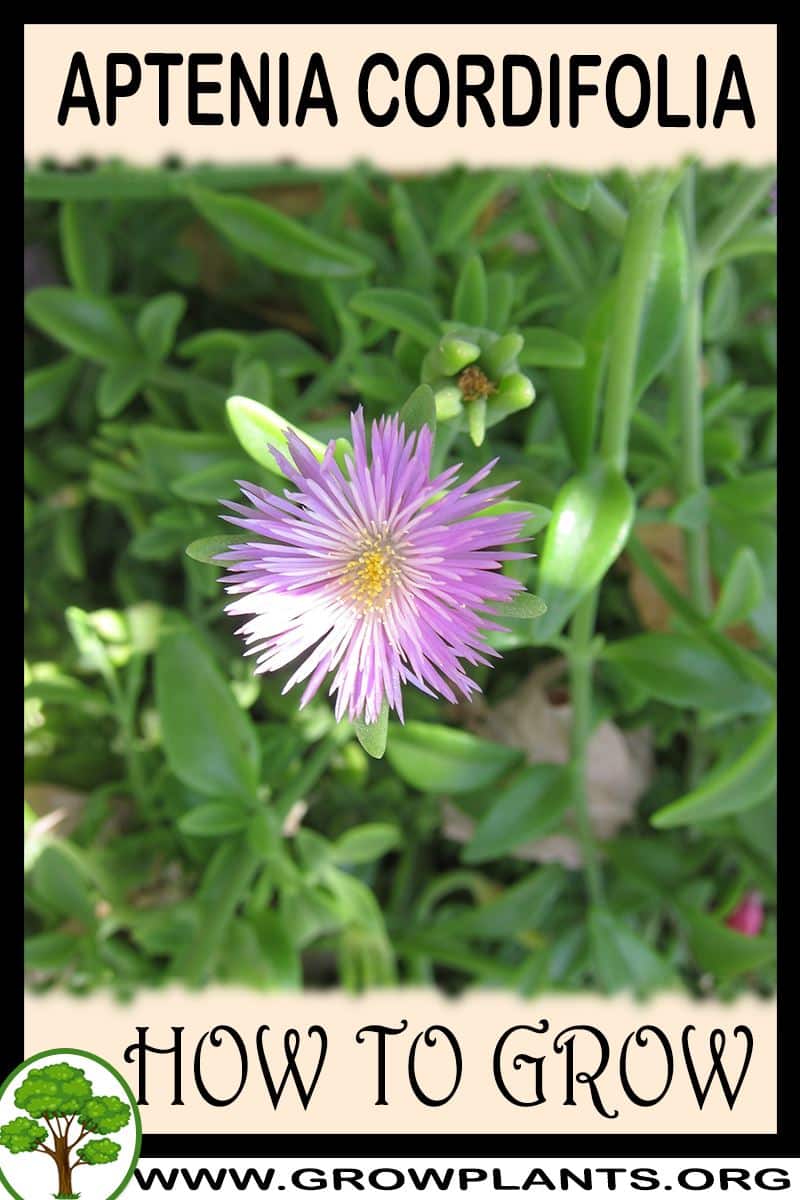

Plant Profile & Key Characteristics
Also known as: Red apple ice plant, Red apple aptenia, Baby sun rose red apple, Baby sun rose, Aptenia baby sunrose
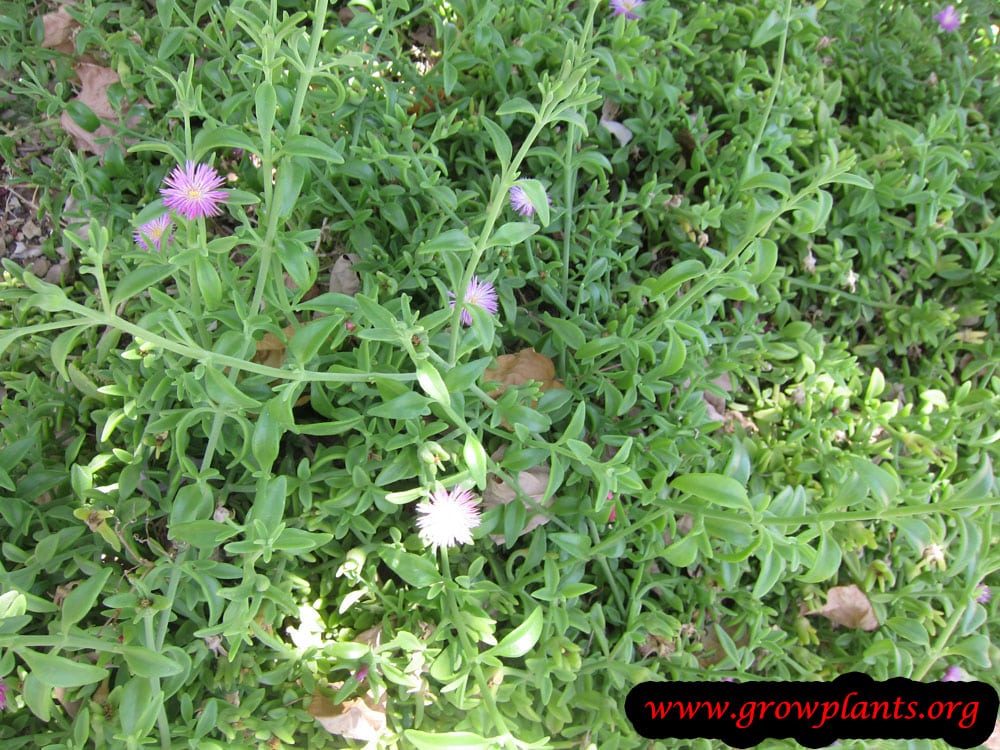
Overview: Aptenia cordifolia (baby sun rose) is an evergreen trailing succulent 20-50 cm tall, with fleshy heart-shaped leaves and small bright flowers. It is a drought-tolerant ornamental groundcover.
Quick Specifications
| Specification | Attribute |
|---|---|
| Plant Type / Life Cycle | Perennial (succulent) |
| Foliage Type | Evergreen |
| Mature Size | 20-50 cm (8-20 in) tall, spreading |
| Growth Rate | Fast to Moderate |
| Root System | Shallow, spreading (roots at stem nodes) |
| Toxicity | Non-toxic / edible leaves |
| Hardiness | USDA zones 9-12 |
Growth Form & Structure
- Height & Spread: Low, 20-50 cm (8-20 in) tall but spreading widely as a mat; also grown in pots and hanging containers.
- Growth Habit & Form: Trailing, mat-forming succulent groundcover that roots where stems touch the soil.
- Lifespan & Maturity: Perennial; kept vigorous by allowing stems to re-root, otherwise it slowly declines.
Anatomy & Physical Features
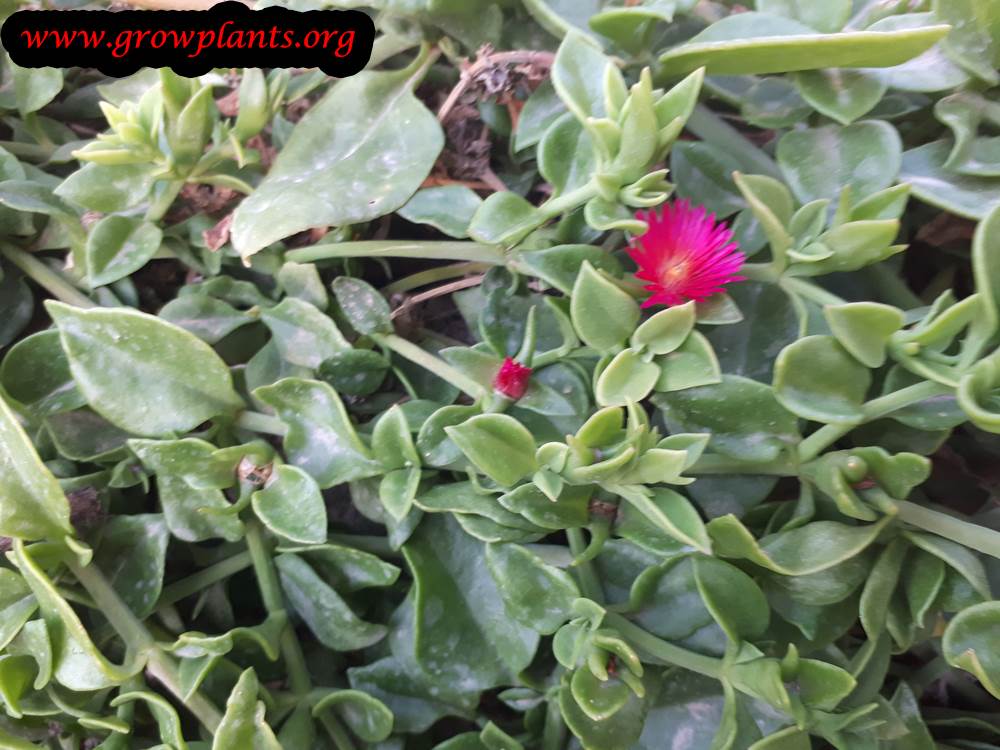
- Leaves & Foliage: Fleshy, green (or yellow/white variegated) heart-shaped to elliptic leaves.
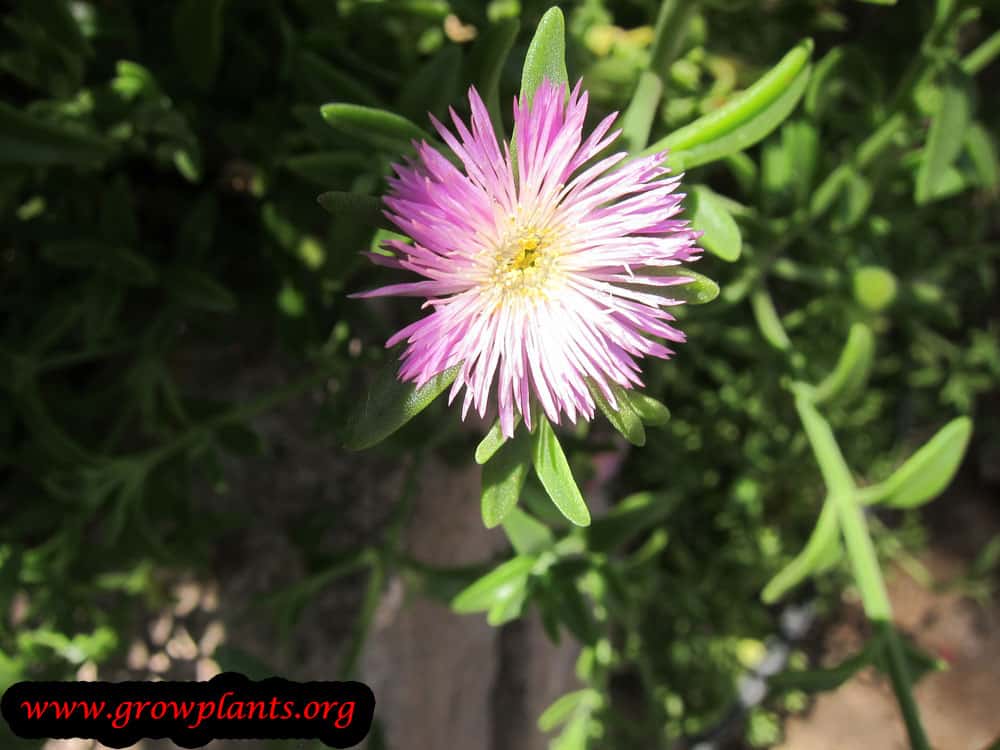
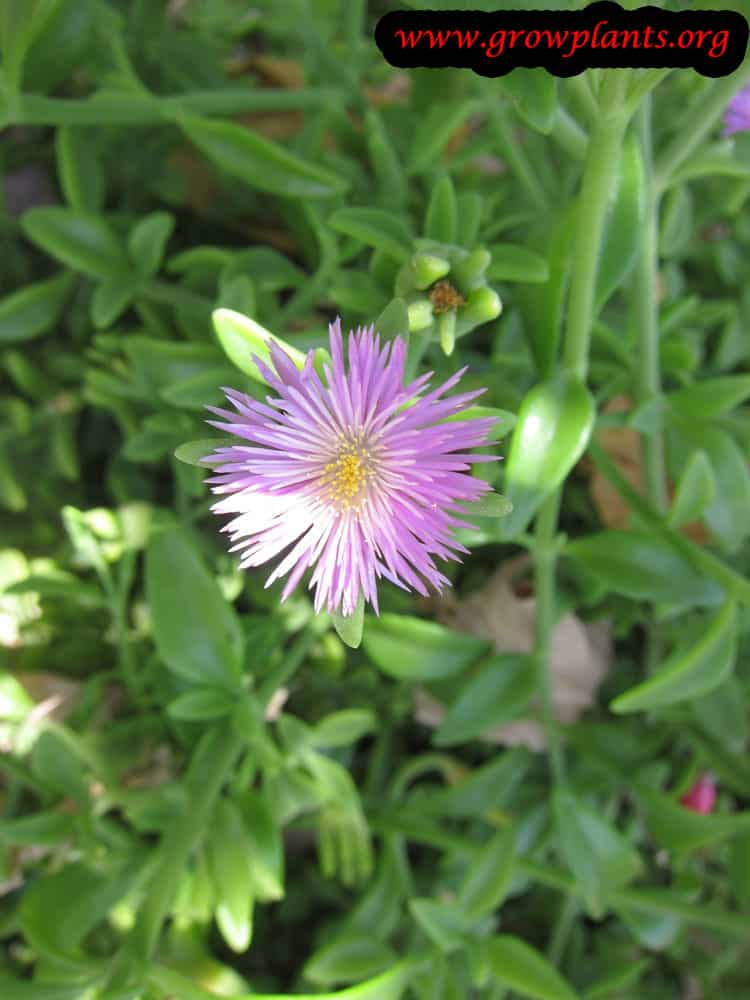
- Flower Characteristics: Small flat, many-petalled flowers in purple, pink, red or white (see the Bloom accordion).
Primary Uses & Landscape Value
- Edible Uses: Leaves are edible cooked.
- Functional & Ornamental Roles: Drought-tolerant groundcover for slopes, rockeries, containers and hanging baskets; also grown indoors with good light.
Care Guide: Planting, Soil & Watering
Overview: Aptenia is a drought-tolerant trailing succulent that grows in sandy, sharply drained soil in full sun. It needs only low water and is very prone to rot if overwatered.
Quick Care Requirements
| Requirement | Ideal Condition |
|---|---|
| Planting Season | Spring–summer in zones 9–10a; spring–autumn in 10b–11; year-round in zone 12 and warmer |
| Growth Rate | Moderate to Fast |
| Soil Type | Sandy, very free-draining |
| Water Need | Low (let the soil dry between waterings) |
Planting & Establishment
- Best Planting Season: Plant in spring–summer in zones 9–10a, spring–autumn in 10b–11, or year-round in zone 12 and warmer; avoid planting in peak summer heat in hot areas.
- How to Plant:
- Hole Preparation: Dig a shallow hole roughly matching the root ball in a sunny, freely draining spot.
- Soil Amendments: Use sandy soil or a cactus-type mix with grit; keep organic matter light.
- Planting Depth: Set the crown at the surface and don’t bury the fleshy stems.
- Growth Speed & Expectations: Fast-spreading, quickly forming a dense trailing ground cover.
Soil, Watering & Drainage Care
- Soil Mix & Drainage Needs: Sandy or gritty, sharply draining soil is essential; the plant collapses in wet, poorly drained ground.
- Watering Schedule & Technique:
- Young / Newly Planted: Give light water to establish, keeping the soil only barely moist.
- Established: Minimal water – it is drought tolerant, so let the soil dry fully between waterings.
- Seasonal Adjustments: Almost no supplemental water in cool or wet weather; avoid any waterlogging.
Climate, Light & Hardiness
Aptenia cordifolia, the baby sun rose or heartleaf iceplant, is a fast-spreading ground-cover succulent for Mediterranean, desert, subtropical, and temperate climates, and it also grows well as a houseplant with plenty of light. It is drought tolerant, adapts to full sun, half shade, or full shade, and survives brief cold down to roughly -3°C (27°F), though it is happiest in mild, frost-free conditions.
Quick Climate Specifications
| Climate Zones | Mediterranean, desert, subtropics, temperate, or indoor as a houseplant |
| USDA Hardiness Zones | 9-12 |
| Approx. Survival Minimum | Roughly -3°C (27°F) for brief periods |
| Frost Tolerance | Low |
| Light Conditions | Full Sun / Half Shade / Full Shade (with plenty of light) |
Sunlight & Light Exposure
Optimal Light Setup
Aptenia cordifolia is adaptable across full sun, half shade, or full shade, though it flowers and spreads most vigorously with strong light.
Best Exposure / Orientation
As a trailing ground cover, it suits open, sunny beds, slopes, and containers; indoors it needs a very bright spot with a lot of light to stay compact and healthy.
Temperature Extremes & Hardiness
USDA Hardiness & Regional Limits
Outdoor culture is reliable from about USDA zone 9 through 12, with planting timing adjusted by zone: spring to summer in zone 9-10a, spring to autumn in 10b-11, and year-round in zone 12 and up.
Cold Damage & Winter Protection
Established plants can tolerate brief cold snaps down to around -3°C (27°F), but sustained or harder freezes will damage or kill the foliage.
Frost Sensitivity
Frost tolerance is low; in the colder parts of its range, plant in spring so it establishes before the following winter.
Wind, Humidity & Microclimate
Rainfall & Seasonal Moisture
It is drought tolerant and adapts to the dry summers typical of Mediterranean and desert climates as well as more evenly distributed temperate rainfall, provided the soil drains well.
Microclimate Recommendations
Sandy, well-drained soil suits it best in any climate; because it spreads by rooting along its stems, it can also be used to stabilize sunny slopes and banks.
Growing in Pots, Balconies & Indoors
Aptenia cordifolia (baby sun rose, heartleaf iceplant) is a fast, trailing succulent ground cover that also makes a cheerful hanging-basket or windowsill plant indoors, given plenty of light. Its heart-shaped leaves are edible. It can be invasive if it escapes into the garden in mild climates, so a pot is a tidy way to enjoy it.
Quick Details
- Container Size: A pot about 50% wider than the root ball (or your desired size); trim the roots and topgrowth if it outgrows it
- Indoor Suitability: A good houseplant only in a very bright spot; superb in a hanging basket
- Best Spot: Full sun to bright light – the more light the better indoors
- Soil & Drainage: Sandy soil, potting mix, or peat with perlite; strong drainage holes
- Watering in Pots: Small to moderate – it is drought-tolerant, so avoid overwatering
Indoors & On the Windowsill
- A bright-spot houseplant: The grower confirms yes – indoors give it as much light as possible, change the soil every few years, water lightly and prune off any dead parts.
- Best as a trailer: Its spreading stems look great cascading from a hanging basket by a sunny window.
- Edible leaves: The leaves are edible, a nice bonus for a windowsill plant.
- Overwintering: Tender to frost (hardiness zone 9-12), so keep it as an indoor or sheltered pot plant over winter in cold areas.
On a Balcony or Patio
- Sun & trailing: It thrives in full sun on a balcony or patio and spills beautifully over the edge of a pot or basket.
- Heat & watering: Tough and drought-tolerant – pots dry fast in reflected heat, but water only when the mix is dry.
- Contain it: Because it roots and spreads vigorously, keeping it in a pot stops it becoming invasive in the garden.
Choosing the Pot, Soil & Long-Term Care
- Pot & drainage: A pot about 50% wider than the root ball; if it outgrows the pot, prune the roots and topgrowth and refresh the mix every few years. Strong drainage holes, no standing saucer.
- Potting mix: Sandy soil, a potting mix, or peat with perlite – all free-draining.
- Pot material: Terracotta breathes and dries fast, which suits these rot-prone succulents; glazed or plastic pots hold moisture longer, so water even more sparingly.
- Feeding: Feed only lightly – a dilute low-strength feed once or so during active growth, as frequent watering leaches nutrients from pots faster than from open ground.
- Watering: Drought-tolerant – water sparingly and never leave it waterlogged.
Fertilizing & Feeding
A very light feeder: an occasional dilute, low-nitrogen feeding while the plant is in active growth is all it needs, and feeding is stopped during dormancy.
Quick Fertilizing Specs
| Feeding Level | Very light feeder |
|---|---|
| Main Nutrient Priority | A little nitrogen for slow, compact growth; avoid rich feeding |
| Best Feeding Period | During active growth only |
| Organic Options | A little compost or worm castings worked into a gritty, well-drained mix |
| Reduce/Stop Feeding | Stop feeding during dormancy and cool, low-light periods |
| Micronutrients | Usually adequate in a complete fertilizer; correct only a diagnosed deficiency |
| Soil pH | Slightly acidic to near neutral |
Feeding by Growth Stage
Active growth
Support steady, compact growth while the succulent is actively growing.
| Nutrient direction | A dilute, low-nitrogen complete fertilizer; succulents grow slowly and take very little feeding. |
|---|---|
| Timing | While the plant is in active growth. |
| Frequency | Occasional light feeding during active growth is plenty. |
| Fertilizer types | A dilute balanced or low-nitrogen complete fertilizer, A cactus and succulent fertilizer |
| Precautions | Feed sparingly; overfeeding forces soft, weak growth and can burn the roots. |
Dormancy / rest period
Let the plant rest without pushing growth during its dormant period.
| Nutrient direction | None – withhold fertilizer while the plant is dormant. |
|---|---|
| Timing | During the plant’s dormant rest period, and whenever growth stops. |
| Frequency | No feeding during dormancy; resume only when active growth returns. |
| Fertilizer types | No feeding at this stage; hold off fertilizing until active growth resumes. |
| Precautions | Do not fertilize a resting succulent; feeding now wastes nutrients and risks salt buildup and rot. |
Nutrient Deficiency Signs & Corrections
Soft, mushy or scorched growth, browning leaf tips, or sudden collapse after feeding.
| Possible causes | excess fertilizer and salt buildup in the root zone, overwatering combined with feeding, feeding while the plant is dormant |
|---|---|
| Appears first on | root zone and lower leaves |
| What to check | recent feeding and watering, drainage and container conditions, whether the plant is in active growth or dormant |
| Possible correction | Ease off feeding, flush the mix with water to leach accumulated salts, and feed only lightly during active growth. |
Older leaves fade to pale green and growth becomes weak and stunted.
| Possible causes | depleted nitrogen in an old, spent mix, never feeding over a long period, nutrients leached by frequent watering |
|---|---|
| Appears first on | older, lower leaves |
| What to check | age of the potting mix, feeding history, watering frequency and drainage |
| Possible correction | Refresh the mix or apply a dilute low-nitrogen complete fertilizer during active growth. |
New leaves yellow between the green veins while older leaves stay greener.
| Possible causes | iron or manganese made unavailable by an overly wet mix, high soil pH limiting micronutrient uptake, cold, soggy roots reducing uptake |
|---|---|
| Appears first on | newest leaves |
| What to check | drainage and how wet the mix stays, soil pH, root health |
| Possible correction | Improve drainage and correct pH; if it persists, apply a chelated iron or manganese product per its label. |
Pruning, Training & Seasonal Maintenance
Aptenia cordifolia (baby sun rose) is a fast- to medium-growing, prostrate, mat-forming succulent subshrub reaching 20–50cm across, spreading and rooting wherever a trailing stem touches soil. Its own care notes are unusually specific: the plant needs to keep producing new rooting points along its stems or it slowly declines, so pruning here is really renewal management — cutting back older, bare, unrooted stems to push fresh low growth that can root and sustain the plant, rather than shaping for its own sake. Because it is reported as spreading aggressively (even invasive in some settings), spread control is the other main objective. A single pruning per year is enough to keep it in bounds; light pinching can be done anytime.
Quick Pruning & Maintenance Specs
| Pruning Tolerance | Moderate to High |
| Primary Pruning Window | Once a year, timed to spring growth flush |
| Secondary Maintenance Window | Any time, for spot spread-control pinching |
| Typical Frequency | One annual cutback plus ad hoc pinching |
| Main Objective | Renew rooting growth, control spread, keep a full (not bare-centered) mat |
| Young Plant Priority | Pinch tips to encourage low, branching, ground-hugging growth that will root readily |
| Mature Plant Priority | Cut back older bare or lifted (non-rooted) stems to force fresh rooting growth; contain spread at the desired edge |
| Best Tool Type | Precision snips / bypass secateurs |
| Avoid Heavy Pruning During | Just before an expected frost (plant is reported hardy only to about -3°C/27°F) and during peak bloom |
Pruning by Plant Age & Size
Newly Established
Minimal pruning; pinch only damaged growth while the young plant roots in and begins to spread.
Young / Formative
Pinch growing tips regularly to encourage low, branching growth that stays in contact with the soil — this is the plant’s natural rooting behavior, not a formal training system, and it builds a denser mat faster than letting single stems run.
Mature / Established
Once a year, cut back stems that have lifted off the soil, lost contact, and stopped rooting, along with any bare, leggy, or overly woody sections, to stimulate fresh low growth that will re-root and refill the mat.
Seasonal Pruning Schedule
| Pre-Growth/Early-Spring | Objective: renew the mat and control size before the main growth flush. Remove: bare, lifted, non-rooting stems and any winter dieback. Do not remove: low stems already in contact with soil and rooting. Response: vigorous fresh regrowth from the cut points; flowering resumes normally on new growth through the following season. |
| Ongoing Sanitary | Objective: tidy appearance and control edges. Remove: dead patches and stems straying beyond the desired planting line, any time. Do not remove: actively flowering stems mid-display. Response: contained spread; no material flowering impact from light edge trims. |
Structural Pruning & Training
Height and spread control are the relevant tasks — this is a groundcover, not a plant with a canopy to thin. Renewal pruning genuinely applies: because the plant relies on continually forming new rooted sections, an annual cutback of older, non-rooting growth functions the same way renewal pruning does on a caning shrub, keeping the planting youthful and full rather than thin and woody at the center.
Special Growth to Remove
Stems that have lifted away from the soil and stopped rooting (these are the closest equivalent to unproductive old wood here) and any growth spreading past the intended edge of the planting. There are no suckers, watersprouts, or basal shoots to manage in the way a woody shrub would have.
Container & Small-Space Pruning
Being a fast, trailing spreader, container specimens need more frequent trimming than in-ground plantings to stop growth from overflowing the pot; unlike in-ground plants, trailing stems in a container rarely reach soil to root, so expect somewhat more legginess and prune back to encourage compact, low growth rather than relying on self-layering. Root-prune lightly at repotting if the roots have filled the container.
Tools
Precision snips for tip pinching; bypass secateurs for the annual cutback of thicker, older stems.
Tool Hygiene & Disease Risk
Routine: clean, sharp tools are enough. Reported pests (snails, slugs) are not spread through pruning cuts, and no specific pathogen risk is noted for this plant.
Cut Placement & Technique
Cut lifted or bare stems back to a point with healthy, low, leafy growth (ideally near a node already in contact with soil) so the plant regrows from a productive point rather than a bare stub.
Heavy Pruning & Rejuvenation
Tolerated: because the plant is fast-growing and freely reroots from cut-back stems, a full renewal cutback in spring is a normal, low-risk practice here (unlike most of the small succulents in this batch, which cannot be hard-pruned at all). Expect a temporary reduction in flowering while the plant regrows, followed by a fuller, more vigorous mat.
Post-Pruning Care
Do not overwater after cutting back — the plant’s own care notes warn against overwatering generally, and freshly cut stems are more vulnerable to rot if kept too wet. No extra fertilizer is needed; regrowth is driven by the plant’s own vigor.
Common Pruning Mistakes
Never cutting back at all, which leads to a bare, woody-centered mat as older stems lose ground contact and decline; pruning right before a cold snap when the plant is only hardy to about -3°C; letting spread go unchecked given its invasive tendency.
When NOT to Prune
Avoid a hard cutback immediately before an expected frost, and avoid cutting during peak bloom if flower display is the priority that season.
Recommended Tools (by task)
- precision_snips – for tip pinching young growth and light edge trims
- bypass_secateurs – for the annual renewal cutback of older, non-rooting stems
Pruning Troubleshooting
| Problem | Possible Cause | What to Check | Corrective Action |
| Bare, thin, or dying-out center | Older stems lifted off the soil and stopped rooting, and were never cut back | Look for woody, leafless stems that are not in contact with soil | Cut these back hard to encourage fresh, low rooting growth |
| Spreading beyond the intended area | No annual containment pruning, fast growth habit | Check how far trailing stems have rooted past the bed edge | Trim back to the line at least once a year; remove rooted runaway sections |
Propagation Guide
Aptenia cordifolia is easiest and fastest to increase from stem cuttings, which root readily in soil or water, and cuttings are required to keep variegated forms true since seed-grown plants won’t reliably come out variegated. Seed is also a viable, straightforward option for the plain green form. Overall this is an easy plant to propagate by any method.
Quick Propagation Specs
| Best Propagation Method | Stem cuttings |
| Alternative Methods | Ground layering (pegging a trailing stem into soil); seed |
| Propagation Difficulty | Easy |
| Seed True-to-Type | Usually true-to-type for plain green plants; variegated forms do not come true from seed |
| Vegetative True-to-Type | Yes |
| Best Propagation Season | Spring is best, though possible year-round in tropical/frost-free conditions |
| Seed Germination Time | 2–4 weeks |
| Seed Sowing Depth | About 0.5 cm (0.25 in) |
Growing from Seed
Seed Handling & Viability
Store seed in a dry, dark spot at room temperature until sowing.
Sowing Season
Spring is preferred; in hardiness zone 9 to early zone 10, spring into summer; in zones 10b–11, spring through autumn; in zone 12 and warmer, year-round – though in already-hot locations, sowing during peak summer heat is best avoided.
Sowing Depth & Orientation
Sow at a shallow depth of about 0.5 cm (0.25 in) into sandy, well-ventilated, well-drained soil in a bright location.
Germination Conditions
Keep the soil moist but not waterlogged – don’t let it dry out, and don’t overwater.
Germination Time
About 2–4 weeks.
Seedling Care
Grow seedlings on in a bright spot with moist, well-ventilated soil.
Stem Cuttings
Cutting Type
Stem cuttings are the standard approach (the site notes leaf cuttings are workable too).
Best Timing
Spring is best, but cuttings can be taken year-round in tropical/warm climates.
Rooting Setup
Cuttings can be rooted in water – don’t leave them sitting in water too long if roots fail to appear – or rooted directly in soil. Either way, keep the medium moist with good drainage and avoid overwatering.
Rooting Hormone
Not indicated as necessary; this species roots readily without it.
Air & Ground Layering
As a trailing subshrub, a stem can be bent over and covered with soil while still attached to the parent plant; kept lightly moist, it forms new roots at the buried section and can then be cut free as an independent plant. The site also notes that repeating this on an established plant helps keep it vigorous, since Aptenia benefits from continually renewing its roots.
Bloom & Edible Flower Guide
Quick Details
- Bloom Season: Spring and summer, with the flowers opening in sunshine
- Time to First Bloom: Usually in the first season, once a young plant is established in a sunny spot
- Flower Appearance: Small, flat, many-petalled daisy-like flowers in purple, pink, red or white
- Edibility: Edible – both the petals and the fleshy heart-shaped leaves are edible and non-toxic
Detailed Blooming Overview
Baby sun rose is a mat-forming iceplant relative that flowers freely through spring and summer. Each bloom is a flat, sparkling rosette of many fine petals – in purple, pink, red or white – that opens in bright sun and closes as the light fades. Both the flowers and the fleshy leaves are edible and non-toxic, so the plant doubles as an easy, colourful ground cover and an occasional garnish for the kitchen.
Flower Characteristics
- Flat, many-petalled flowers with a shimmering, daisy-like look.
- Colours purple, pink, red or white.
- Open in full sun and close in shade or dull weather.
Bloom Care & Thinning
- Encouraging bloom: Full sun and lean, well-drained soil give the most flowers; in too much shade the plant stays leafy and blooms little.
- Managing the bloom: A light trim after the main flush keeps the mat neat and encourages fresh flowers.
- Using the flowers: If you pick petals for the table, take them from plants grown without chemical sprays.
Bloom Health & Protection
- Aphids can gather on the soft buds and new growth; a strong jet of water or a little insecticidal soap keeps them down (use gently if you plan to eat the flowers).
Fruit & Uses
Aptenia cordifolia (Baby Sun Rose) is grown as an edible ground-cover succulent whose fleshy, elliptic leaves and flat, multi-petaled flowers are both eaten. The leaves are used mainly as a cooked pot herb, while the flowers are used raw as a colourful, mildly tangy garnish.
Quick Edible Specs
| Edible Parts | Leaves; flowers |
|---|---|
| Main Use(s) | Culinary – cooked pot herb (leaves); raw edible garnish (flowers) |
| Eaten Raw or Cooked | Leaves: cooked (site-documented use); also used raw in salads by some growers. Flowers: raw |
| Preparation Required | None for raw use; cook leaves if following the traditional pot-herb use |
| Harvest Season | Spring to autumn in cooler hardiness zones (9–10a); year-round in hardiness zone 11+ |
| Time to First Harvest | Once the spreading mat is established and filling out (see Propagation for start-up timing) |
| Safety/Toxicity Caveat | No toxicity is documented for this species; as with other succulent, slightly tangy salad greens, eat leaves in moderate portions since this leaf type can carry natural oxalates |
Leaves & Greens
The edible leaves are green (or variegated with yellow or white on some ornamental forms), fleshy and elliptic. For the table, harvest fully grown young leaves rather than old, tough ones – either pick leaves individually or cut them together with a section of stem. Because the plant roots wherever a trailing stem touches soil, taking leaves repeatedly from an established, spreading clump does not set the plant back the way picking would on a single-stemmed plant. Harvest runs spring through autumn in cooler hardiness zones (9–10a) and can continue year-round in zone 11 and warmer. The site’s own guidance lists the leaves as cooked; they are also commonly eaten raw in salads by growers of related ice-plant species, so raw use is worth trying in a small amount first rather than assuming it.
Flowers & Flower Buds
The daisy-like, multi-petaled flowers (purple, pink, red or white) are also edible. They are used raw, scattered over salads or plated dishes as a decorative, mildly tangy garnish. No cooking or other preparation is described for the flowers.
Harvesting
Picking leaves for the table competes with the plant’s role as an ornamental ground cover, so take only what is needed and spread the harvest across the mat rather than stripping one patch bare; the plant regrows readily through its active growing season. Flowers can be picked as they open, mainly in spring and summer.
Preparation, Uses & Safety
Leaves are used as a cooked pot herb per the site’s own growing notes; raw use in salads is also reported for this and related ice-plant species, so start with a small taste if trying leaves raw. Flowers are used raw as an edible garnish. No specific toxicity is documented for Aptenia cordifolia on this site, but as with other succulent, slightly sour-tasting salad greens, moderate portions are advisable because of naturally occurring oxalates in this leaf type. The site separately notes this species can be invasive where it escapes cultivation – that concerns garden management, not edibility, and is not a safety issue for eating the plant.
Pests, Diseases & Troubleshooting
Overview: Heartleaf iceplant (Aptenia cordifolia) is a tough, drought-hardy succulent groundcover that is genuinely close to pest-free; snails and slugs chewing the fleshy leaves are its most noticeable pest, with occasional mealybugs, aphids and scale. Its real vulnerability is not insects or fungal disease but root and stem rot from overwatering and wet, poorly drained soil. Grown lean and sunny with sharp drainage, it needs almost no pest management at all.
Quick Troubleshooting Overview
| Issue / Pest | Main Symptom | Primary Solution |
|---|---|---|
| Root rot | Blackened, collapsing stems in wet soil | Sharp drainage, water sparingly, full sun |
| Snails & slugs | Chewed fleshy leaves, slime trails | Iron-phosphate bait, hand-pick, morning watering |
| Mealybugs | White cottony tufts, honeydew | Wipe off, beneficials, horticultural oil |
| Aphids | Sticky new growth | Hose off, soap only if persistent |
| Etiolation | Stretched stems, few open flowers | Grow in full sun |
Common Pests & Management
- Snails & slugs (Gastropoda):
- Symptoms: Ragged holes and chewed patches in the fleshy leaves and stems, with tell-tale silvery slime trails, worst in damp, shaded, well-watered spots.
- Prevention & Control: Water in the morning so surfaces dry by night, remove damp hiding places, hand-pick after dark, and set beer traps, copper barriers or low-toxicity iron-phosphate bait.
- Mealybugs (Pseudococcus / Planococcus spp.):
- Symptoms: White cottony tufts in leaf axils, stem joints and around the roots, with honeydew and sooty mould; growth stunts on heavily infested plants.
- Prevention & Control: Dab off with an alcohol-dipped cotton bud, encourage ladybirds and lacewings, and treat persistent colonies with horticultural oil or insecticidal soap.
- Aphids (Aphidoidea):
- Symptoms: Clusters of soft insects on soft new growth and flower buds, with honeydew and sooty mould; usually minor on this tough groundcover.
- Prevention & Control: Hose off with water, encourage beneficials, and use insecticidal soap only if colonies persist.
- Scale insects (Coccidae / Diaspididae):
- Symptoms: Small brown limpet bumps on stems and leaf undersides with honeydew; occasional and rarely serious.
- Prevention & Control: Scrape off, prune out infested growth, and smother with horticultural oil if needed.
Diseases & Fungal Issues
- Root & stem rot (Pythium / Phytophthora / Rhizoctonia spp.):
- Symptoms: Blackening, softening and collapse of stems and roots in wet, heavy or poorly drained soil — by far the main way this succulent is lost, especially in winter wet.
- Treatment & Management: Grow in free-draining, gritty soil or a raised, sunny bank, water sparingly and let the soil dry between waterings, and cut watering right back in cool, wet weather; take cuttings (which root very easily) to replace rotted patches.
- Fungal leaf spot / botrytis (Botrytis / various fungi):
- Symptoms: Occasional brown or grey soft spots on foliage in cool, damp, crowded, humid conditions; minor and secondary to overwatering.
- Treatment & Management: Improve airflow and sun exposure, avoid overhead watering, and remove affected growth; rarely needs more than cultural correction.
Growing Difficulties & Abiotic Problems
- Root rot from overwatering / poor drainage:
- Cause & Symptoms: As a drought-hardy succulent it rots readily if kept wet or grown in heavy soil, particularly over winter.
- Correction Strategy: Plant in sharply drained soil in full sun, water infrequently, and avoid winter wet; containers must drain freely.
- Etiolation / sparse flowering in shade:
- Cause & Symptoms: In too much shade the stems stretch, growth thins, and the bright daisy-like flowers fail to open well.
- Correction Strategy: Grow in full sun for compact, floriferous growth; the flowers open in bright sunshine and stay closed in shade or dull weather.
- Frost damage:
- Cause & Symptoms: Fleshy foliage is damaged by frost, blackening and turning mushy after a hard freeze.
- Correction Strategy: In cold areas grow in containers to shelter over winter, or treat as a warm-season groundcover and replant from easy cuttings.
- Legginess / woody centres:
- Cause & Symptoms: Older plantings can become bare and woody in the middle over time.
- Correction Strategy: Trim regularly and replant vigorous cuttings into gaps to keep the mat dense and fresh.
What Helps — Products & Tools
Very little is needed: sharp drainage, full sun and restrained watering keep this plant healthy. Where warranted, appropriate types are iron-phosphate slug bait, horticultural oil or insecticidal soap for mealybugs, aphids and scale, and improved drainage — not a fungicide — as the real answer to rot. Its cuttings root so easily that replacing a rotted patch is often simpler than treating it.