Plant Profile & Key Characteristics
Also known as: Green wax plant, Wax plant, Hoya rope plant, Hoya carnosa wax plant, Carnosa plant, Hoya wax plant, Hoya orchid, Joya plant, White hoya plant
Overview: An evergreen succulent (epiphytic) climbing vine reaching about 4-10 m (12-30 ft), grown for its thick, waxy foliage and clusters of fragrant, star-shaped ‘wax’ flowers. It is a popular container and hanging houseplant.
Quick Specifications
| Specification | Attribute |
|---|---|
| Plant Type / Life Cycle | Perennial (succulent vine) |
| Foliage Type | Evergreen |
| Mature Size | 4-10 m (12-30 ft) long |
| Growth Rate | Slow to moderate |
| Root System | Epiphytic – fibrous roots plus adventitious air roots along the stems |
| Toxicity | Not for eating – regarded as mildly toxic/irritant if ingested |
| Hardiness | USDA zone 10b+ |
Growth Form & Structure
- Height & Spread: Stems trail or climb to about 4-10 m (12-30 ft); usually grown in containers or hanging baskets and trained on a trellis or left to weep down.
- Growth Habit & Form: Twining, trailing succulent vine that produces adventitious air roots and clings or hangs from support.
- Lifespan & Maturity: Long-lived perennial; plants must reach maturity (often around 5-7 years) before they flower.
Anatomy & Physical Features
- Leaves & Foliage: Fleshy, waxy, elliptic green leaves, some cultivars variegated with pink, yellow or white.
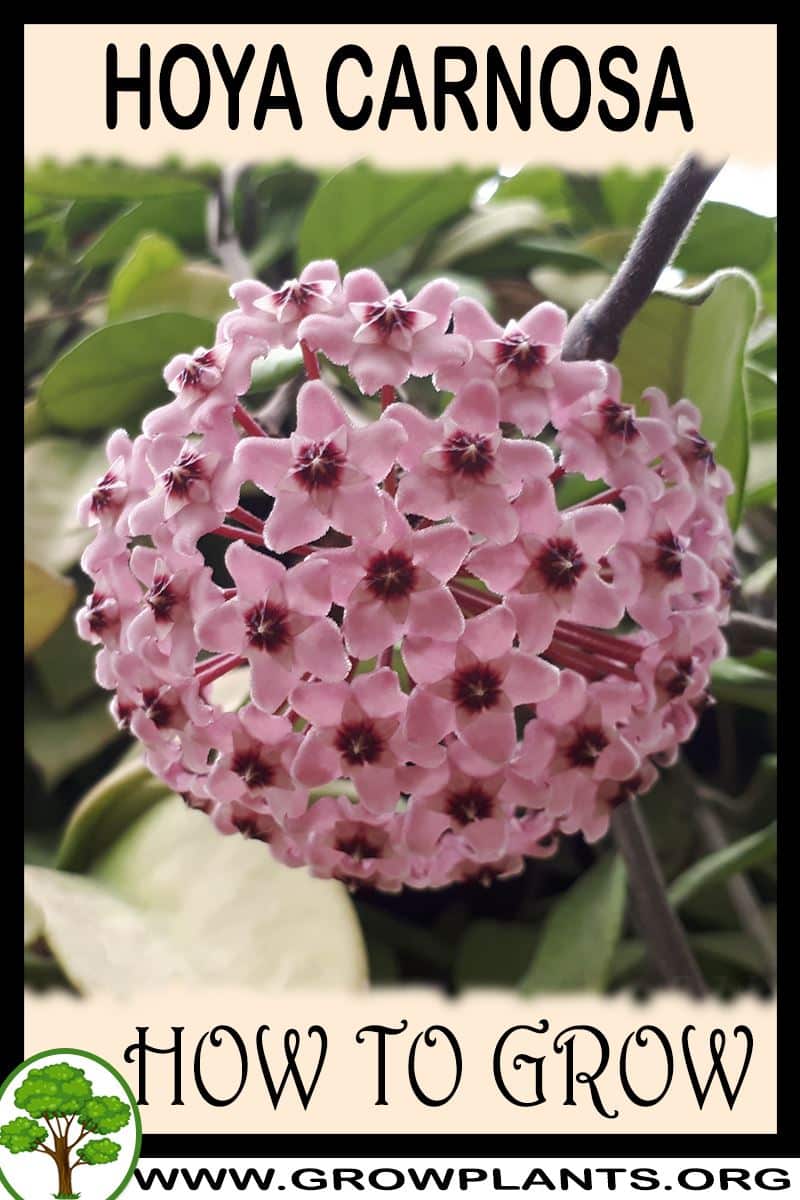
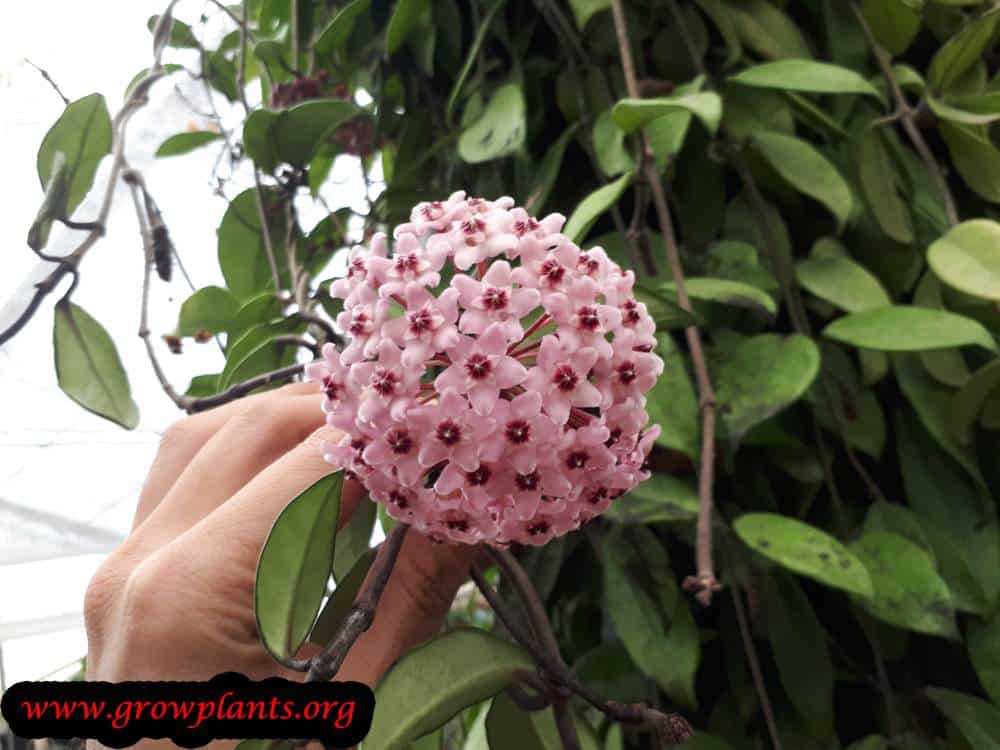
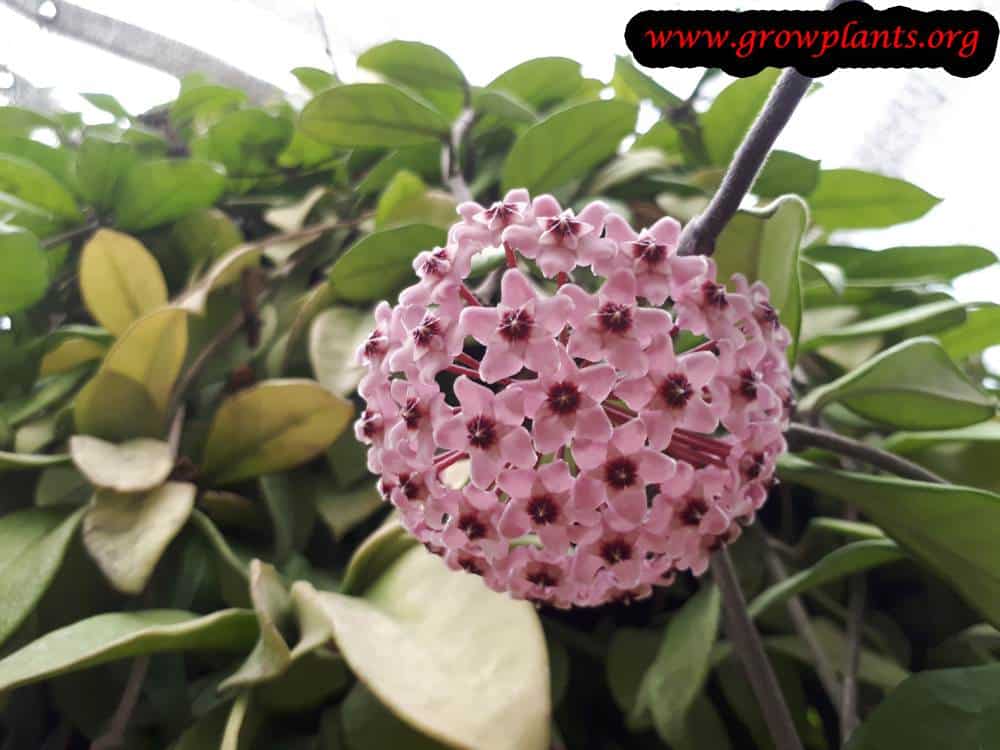
- Flower Characteristics: Fragrant, waxy star-shaped flowers with a central star, in umbel to ball-shaped clusters, in many colours (full detail in the Bloom section).
Primary Uses & Landscape Value
- Functional & Ornamental Roles: Ornamental foliage and flowering houseplant for containers and hanging baskets; grown outdoors on supports only in frost-free climates.
Care Guide: Planting, Soil & Watering
Overview: Hoya carnosa is an epiphytic, succulent-leaved vine that thrives in warm, frost-free conditions (best kept above about 10°C / 50°F) with bright light and high humidity. It wants a loose, airy, fast-draining medium kept lightly moist and allowed to dry a little between waterings, and resents cold, soggy roots.
Quick Care Requirements
| Requirement | Ideal Condition |
|---|---|
| Planting Season | Warm season by zone — spring in zone 10a, spring–summer in 10b, spring–autumn in 11, year-round in 12+ |
| Growth Rate | Slow to Moderate |
| Soil Type | Loose, airy, well-draining mix (e.g. orchid bark, coco chips and perlite) |
| Water Need | Moderate — keep lightly moist but let the top of the mix dry between waterings |
Planting & Establishment
- Best Planting Season: Plant in the warm season once nights are reliably mild — spring in zone 10a (into mid-summer), spring to summer in 10b, spring to autumn in 11 and year-round in 12+. Acclimatise greenhouse-raised plants gradually and avoid moving them outdoors into cold weather.
- How to Plant:
- Hole Preparation: Use a container only a little larger than the root ball — Hoya flower best when slightly pot-bound — or a pocket of loose, chunky medium if grown on a moss pole or mount.
- Soil Amendments: Blend an open, epiphyte-style mix: orchid bark, coco chips or perlite added to a peat or potting base for sharp drainage and plenty of air around the roots.
- Planting Depth: Set the plant at the level it grew, keeping the base of the stem at the surface; burying the stem invites rot.
- Growth Speed & Expectations: Expect slow to moderate growth, quicker in warmth and bright light; plants need several years to mature before they bloom.
Soil, Watering & Drainage Care
- Soil Mix & Drainage Needs: Grow in a light, airy, sharply-draining mix — Hoya hate wet feet. A container with free drainage is preferred over open ground, and extra bark or perlite keeps the mix open and guards against root rot.
- Watering Schedule & Technique:
- Young / Newly Planted: Keep the mix lightly and evenly moist while roots establish, using soft water (rainwater or low-mineral water) and misting the aerial roots.
- Established: Water thoroughly, then let the top of the mix dry before watering again, and ease off before the blooming season; avoid hard, mineral-rich water.
- Seasonal Adjustments: Water more during warm, active growth and much less in cool winter weather, when the plant rests and rots easily if kept wet.
Climate, Light & Hardiness
Hoya carnosa, the classic wax plant, is a tropical-to-subtropical vining succulent grown outdoors in warm, frost-free climates or as a houseplant elsewhere. It needs consistently warm temperatures, high humidity, and bright but filtered light, with half shade generally giving the best balance between healthy foliage and reliable flowering.
Quick Climate Specifications
| Climate Zones | Tropics, subtropics, Mediterranean, or indoor as a houseplant |
| USDA Hardiness Zones | 10b+, and 10a with careful winter protection |
| Optimal Temp Range | Warm, frost-free conditions, preferably above about 10°C (50°F) |
| Frost Tolerance | Very Low |
| Light Conditions | Full Sun (with high humidity) / Half Shade (best overall) / Full Shade (foliage only, poor flowering) |
Sunlight & Light Exposure
Optimal Light Setup
Flowering is best with plenty of bright light - around 75% sun or strong filtered light through a net or window - while half shade is a safer everyday compromise that still supports healthy, variegated foliage.
Direct Sun Requirement
Full sun is tolerated, but leaves are prone to sunburn unless humidity is kept high; introduce strong sun gradually.
Shade & Heat Management
Full shade keeps the plant alive but without enough light it will not flower well, so some bright or filtered light is important even in shadier spots.
Best Exposure / Orientation
A bright window or lightly shaded outdoor spot with strong ambient light suits it best; insufficient light is one of the most common reasons container-grown plants fail to bloom.
Temperature Extremes & Hardiness
USDA Hardiness & Regional Limits
Reliable outdoors from about USDA zone 10b upward, with zone 10a possible given careful winter protection; colder zones require growing it as a houseplant.
Cold Damage & Winter Protection
Best kept frost-free and preferably above roughly 10°C (50°F); a common failure mode is buying a greenhouse-raised plant and exposing it to a colder season too soon after purchase.
Frost Sensitivity
Frost tolerance is very low, and fertilizing is best stopped in cold winter weather since growth slows or stops.
Wind, Humidity & Microclimate
Humidity Preferences
Consistently high humidity (at least around 60%) along with regular misting of its aerial roots supports healthy growth and flowering; low humidity reduces flower production.
Dry-Air Tolerance
Dry-air tolerance is low - keep it away from heaters, ventilators, and air-conditioning drafts, which stress the plant and dry out its aerial roots.
Wind Tolerance
Wind stresses this vine by drying out the aerial roots faster than they can take up moisture, so sheltered positions are preferred over open, breezy sites.
Microclimate Recommendations
Grow in a container in a bright, humid, sheltered spot, and use soft water (rainwater or similarly low-mineral water) both on the soil and sprayed on the aerial roots.
Growing in Pots, Balconies & Indoors
Hoya carnosa (wax plant) is one of the best-loved indoor plants – a waxy-leaved trailing vine that is happiest grown in a pot and trained up a trellis or, better still, hung from above so it cascades down. Although it can climb several metres, it stays manageable in a container and will only flower once it is mature and comfortably root-bound.
Quick Details
- Container Size: Start small – about 5-12 L (1.5-3 gal), only 20-50% wider than the root ball, and pot up gradually; Hoyas flower best a little root-bound
- Indoor Suitability: An excellent houseplant, ideal trained or hung; needs bright light and humidity to bloom
- Best Spot: Bright light, even some direct sun, near (not on) a window; a humid room such as a bathroom suits it well
- Soil & Drainage: Airy and well-drained – peat/coir with perlite or a potting mix, with some lava grit at the base; strong drainage holes, no closed saucer
- Watering in Pots: Average, letting the mix dry between waterings; mist the aerial roots, use soft (rain) water, and ease off before flowering
Indoors & On the Windowsill
- A classic houseplant: The grower confirms yes – give it plenty of light (even some sun), as ordinary artificial room light is not enough; keep it well away from heaters, radiators, air-conditioning and fans, which dry it out.
- Humidity & bathroom: It loves humidity (aim for 60% or more), so a bright bathroom is a great home; because the air is humid there, water the soil less and mist instead.
- Hang it high: Grow it from the ceiling or a high shelf so the stems weep down – easier for the plant and far more striking.
- Flowering indoors: It must mature and fill its pot before it blooms (often several years), so resist over-potting.
- Keep out of reach: The plant is poisonous if eaten – keep it away from children and pets, and never eat any part; simply handling or growing it is fine.
On a Balcony or Patio
- Sheltered & bright: In warm climates it enjoys a bright, sheltered balcony or patio with filtered sun – about 75% sun, or light through netting, gives the best flowers; protect it from strong wind, which dries the foliage and aerial roots.
- Heat & watering: Pots and walls reflect heat and dry quickly – water when the mix has dried, mist the aerial roots, and use soft (rain) water where you can.
- Cold: It is tender (keep above about 10 C / 50 F), so bring it indoors well before cold nights.
Choosing the Pot, Soil & Long-Term Care
- Pot & drainage: Start small and pot up 20-50% at a time as it fills the pot; every repot sets flowering back, so do it only when needed. Use strong drainage holes and skip a closed saucer base.
- Potting mix: Airy and rich – peat or coir with perlite (or a good potting mix) plus some lava grit at the base, topped with organic matter.
- Feeding: Feed once or twice a year, including a spray feed on the aerial roots; a bloom feed with enough nitrogen keeps the leaves green – avoid feeding in cold weather.
- Mature plants: Once large it takes up water and nutrients through its aerial roots, so you can leave the soil undisturbed and simply mist and feed the roots.
Fertilizing & Feeding
A light feeder: an occasional balanced feeding through the warm growing and blooming season is enough, with feeding stopped in cold winter. High-phosphorus bloom boosters are not needed.
Quick Fertilizing Specs
| Feeding Level | Light feeder |
|---|---|
| Main Nutrient Priority | Balanced feeding with adequate nitrogen for foliage and bloom |
| Best Feeding Period | Spring through the warm growing and blooming season |
| Organic Options | A little compost or worm castings; a rich organic mix in the container |
| Reduce/Stop Feeding | Stop feeding in cold winter and during low-light rest |
| Micronutrients | Usually supplied by a complete fertilizer; correct only diagnosed issues |
| Soil pH | Slightly acidic to near neutral |
Feeding by Growth Stage
Spring flush of growth
Fuel healthy vines and fresh, waxy leaves as growth resumes.
| Nutrient direction | A balanced complete fertilizer with adequate nitrogen to support leafy vine growth. |
|---|---|
| Timing | As growth resumes in spring and warm weather. |
| Frequency | A light feeding as active growth begins. |
| Fertilizer types | A balanced complete fertilizer, A dilute liquid fertilizer for containers |
| Precautions | Keep feeding light; this is a modest feeder and rich feeding produces soft, floppy growth. |
Blooming period
Support flowering with steady, balanced nutrition rather than a forced bloom feed.
| Nutrient direction | A balanced complete fertilizer with adequate nitrogen supports both foliage and bloom; extra phosphorus does not force more flowers. |
|---|---|
| Timing | Through the warm blooming season. |
| Frequency | Occasional light feeding while the plant is growing and flowering. |
| Fertilizer types | A balanced complete fertilizer |
| Precautions | Avoid overfeeding and skip high-phosphorus bloom boosters, which are unneeded and can build up salts. |
Cool-season rest
Let the plant coast through cool, low-light winter conditions.
| Nutrient direction | None – withhold fertilizer while growth is slow in cold weather. |
|---|---|
| Timing | During cold winter weather and low-light indoor rest. |
| Frequency | No feeding during this rest; resume when active growth returns. |
| Fertilizer types | No feeding at this stage; hold off fertilizing until active growth resumes. |
| Precautions | Do not fertilize in cold winter; feeding a plant that is not growing risks salt buildup. |
Nutrient Deficiency Signs & Corrections
Older leaves turn pale green or yellow and vine growth slows.
| Possible causes | low available nitrogen in the mix, nitrogen leached by frequent watering, old, spent potting mix |
|---|---|
| Appears first on | older, lower leaves |
| What to check | feeding history, age of the potting mix, watering and drainage |
| Possible correction | Apply a balanced complete fertilizer with adequate nitrogen during active growth and refresh an old mix. |
Brown, scorched leaf edges and stalled growth despite adequate watering.
| Possible causes | fertilizer salt buildup in the container, too-frequent or too-strong feeding, poor drainage concentrating salts |
|---|---|
| Appears first on | leaf margins and tips |
| What to check | recent feeding strength and frequency, container drainage, how often the mix is flushed |
| Possible correction | Ease off feeding, flush the container with water to leach salts, then return to lighter feeding. |
New leaves yellow between the veins while the veins stay green.
| Possible causes | iron made unavailable by a wet mix or high pH, cold, soggy roots slowing uptake, overwatering |
|---|---|
| Appears first on | newest leaves |
| What to check | soil pH, drainage and how wet the mix stays, root health |
| Possible correction | Improve drainage and correct pH; if it persists, apply a chelated iron product per its label. |
Pruning, Training & Seasonal Maintenance
Hoya carnosa, the classic wax plant, is a twining vine reaching 4–10m, often grown as a cultivar with pink-, yellow- or white-variegated leaves. As with other Hoya, flowers form on persistent spurs (peduncles) that rebloom from the same point for years, so pruning is deliberately light. The main objectives are removing dead material, controlling vine length on its support, and — specifically for variegated cultivars — removing any shoots that revert to solid green, since reverted growth is more vigorous and will crowd out the variegated form if left unchecked. The safest general pruning window is right after a bloom flush.
Quick Pruning & Maintenance Specs
| Pruning Tolerance | Low (structural), Moderate (tip pinching) |
| Primary Pruning Window | After a bloom flush, spring–summer |
| Secondary Maintenance Window | Any time, for dead growth or reverted (all-green) shoots on variegated cultivars |
| Typical Frequency | Light touch-up once or twice a year |
| Main Objective | Remove dead growth, manage vine length, preserve flower spurs, remove reversion on variegated forms |
| Young Plant Priority | Pinch tips to build a bushier vine before training onto support |
| Mature Plant Priority | Control vine length; watch for and remove reverted all-green growth on variegated plants |
| Best Tool Type | Precision snips / bypass secateurs |
| Avoid Heavy Pruning During | Active bud set or bloom; cold winter rest below 10°C (50°F) |
Pruning by Plant Age & Size
Newly Established
Remove only damaged or shriveled growth from transplant stress; let the plant settle before shaping.
Young / Formative
Pinch tips to build a fuller vine before training onto a trellis or hanging support; if variegated, inspect new growth for solid-green shoots and remove them promptly while they are small.
Mature / Established
Shorten non-flowering trailing growth to a leaf node to manage size; on variegated cultivars, cut out any vigorous all-green reverted stems back to their point of origin as soon as they are noticed.
Seasonal Pruning Schedule
| Post-Flowering | Objective: light shaping. Remove: individual faded flowers by hand. Do not remove: the peduncle. Response: the same spur reflowers later; no loss if spurs are left intact. |
| Ongoing Sanitary | Objective: plant health and (on variegated forms) maintaining variegation. Remove: dead/yellowed leaves, dead stem tips, and reverted all-green shoots, any time spotted. Do not remove: healthy variegated growth. Response: cleaner, more consistently variegated plant. |
| Dormant/Winter | Objective: protect the plant. Remove: nothing beyond dead material. Do not remove: living growth while below 10°C protection is needed. Response: pruning now only adds stress. |
Flowering & Fruiting Wood
Flowers form on persistent spurs that arise from older wood and rebloom from the same point over multiple seasons. Cutting off a spent flower stalk removes that spur’s future flowers for a year or more. Deadhead only the individual faded flowers, never the woody stalk beneath them.
Structural Pruning & Training
Limited to vine length and spread control on its support; no branching canopy to thin. On variegated cultivars, structural pruning also includes removing reverted growth so it does not outcompete the variegated sections.
Special Growth to Remove
Dead or yellowed leaves and dead stem tips; on variegated plants, reverted all-green shoots (a form of unwanted vigorous growth, similar in principle to a watersprout, that should be removed at its base). Not a grafted plant, so no rootstock suckers; no runners.
Container & Small-Space Pruning
Slightly pot-bound conditions favor flowering, so avoid pairing a hard prune with repotting. In small spaces, regular tip pinching keeps the vine compact on its support without sacrificing spurs the way a later hard cut-back would.
Tools
Precision snips or bypass secateurs for the soft, fleshy stems; soft ties or stakes for training onto a trellis or pole.
Tool Hygiene & Disease Risk
Routine hygiene is sufficient — clean, sharp tools. Aphids, mealybugs and occasional fungal issues are not primarily spread by pruning cuts; good airflow matters more than tool sterilization between cuts.
Cut Placement & Technique
Cut just above a leaf node; when removing a reverted shoot, trace it back to its point of origin on the stem and cut it off cleanly there rather than partway along its length, or it will simply regrow green.
Heavy Pruning & Rejuvenation
Not generally recommended for the vine as a whole. A very overgrown plant can be cut back moderately in spring, spread over more than one season, accepting a flowering delay in the pruned portions while new spurs form.
Post-Pruning Care
No extra fertilizer needed after light pruning — keep to the normal one-to-twice-yearly schedule. Maintain consistent humidity and watering, and wipe tools of the latex sap produced at cuts.
Common Pruning Mistakes
Removing flower spurs mistaken for dead wood; leaving reverted all-green shoots in place until they dominate a variegated plant; hard-pruning the whole vine in one session instead of staging it over seasons.
When NOT to Prune
During active bud set or bloom, and while temperatures are near or below 10°C (50°F) in winter.
Recommended Tools (by task)
- precision_snips – for pinching tips and removing small reverted shoots early
- bypass_secateurs – for shortening established trailing stems or larger reverted growth
- soft_ties_stakes – for training the vine onto support
Pruning Troubleshooting
| Problem | Possible Cause | What to Check | Corrective Action |
| No flowers after a trim | Flower spurs were cut off along with trimmed stems | Look for short, thickened leafless stubs on remaining stems | Leave spurs in place; allow a season or more for new spurs to develop |
| Variegated plant turning mostly green | Reverted all-green shoots left to grow unchecked | Trace vigorous solid-green stems back to their origin point | Cut reverted shoots out completely at the base as soon as seen |
Propagation Guide
Hoya carnosa, the classic wax plant, is easiest to propagate from stem or leaf-node cuttings, which root readily in soil or water; named colour and variegated forms need to be propagated this way since seed is scarce and won’t reliably reproduce them. This is an easy plant to root from cuttings, with seed propagation a slower, more specialist option.
Quick Propagation Specs
| Best Propagation Method | Stem/node cuttings |
| Alternative Methods | Rooting cuttings in water; seed, where obtainable |
| Propagation Difficulty | Easy (cuttings); Specialist (seed) |
| Seed True-to-Type | Cultivar-dependent – variegated/coloured forms are kept true only by cuttings |
| Vegetative True-to-Type | Yes |
| Best Propagation Season | Spring to early summer (cuttings); end of spring to early autumn (seed, sown under cover) |
| Seed Germination Time | 2–5 weeks, sometimes longer |
| Cutting Rooting Time | Several weeks; water-rooted cuttings can be potted on once five or more roots form |
| Germination Temperature | Around 25°C (77°F) by day, cooler at night |
| Seed Sowing Depth | Surface-sown, uncovered |
Growing from Seed
Seed Handling & Viability
Use fresh seed where possible; if holding seed before sowing, keep it dry and dark at room temperature and sow promptly.
Sowing Season
End of spring to early autumn, preferably indoors or in a greenhouse.
Sowing Depth & Orientation
Sow on the surface of moist sphagnum/peat moss, uncovered; enclosing the pot in a plastic bag or clear box maintains humidity and keeps the fine seed from blowing around. Where several seeds are sown together, space them about 5x4cm (2×1.8in) apart, though separate small pots per seed work better.
Germination Conditions
Moist, high-humidity medium, plenty of light, and warmth around 25°C (77°F) by day with a cooler night.
Germination Time
Roughly 2–5 weeks, sometimes longer.
Seedling Care
Keep humidity high and the medium lightly moist; algae often develops on the surface after about the first two months, at which point seedlings should be moved to clean medium.
Stem Cuttings
Cutting Type
Two approaches work: a single leaf detached carefully by hand (take care not to snap it), or a stem section carrying at least a few leaves/nodes – the stem-with-nodes method is the more dependable way to get a new, independently growing plant.
Best Timing
Spring to early summer roots fastest, though a greenhouse or warm indoor spot allows cuttings at other times.
Cutting Preparation
Let the cut surface sit in the shade for a few days until it has healed/callused before inserting it into medium or water.
Rooting Setup
Pot healed cuttings into moist peat soil or peat moss with high humidity and plenty of indirect light, keeping conditions similar to a mature plant’s. Alternatively, root in soft water (rainwater or otherwise low in dissolved minerals); once five or more roots have formed, begin light feeding. Rooting a cutting in water this way is a short-term propagation step – it is not the same as trying to keep a mature plant permanently in water, which the site notes is possible but not recommended, since the water needs regular changing and feeding and will grow algae if it gets light.
Rooting Hormone
Not required – cuttings root well without it.
Rooting Time
Typically several weeks under warm, humid conditions.
Bloom & Flower Guide
Quick Details
- Bloom Season: Mainly summer, sometimes spring, and occasionally autumn
- Time to First Bloom: Often 5 to 7 years from a young plant, and only once it is well established – seed-grown plants can take a decade
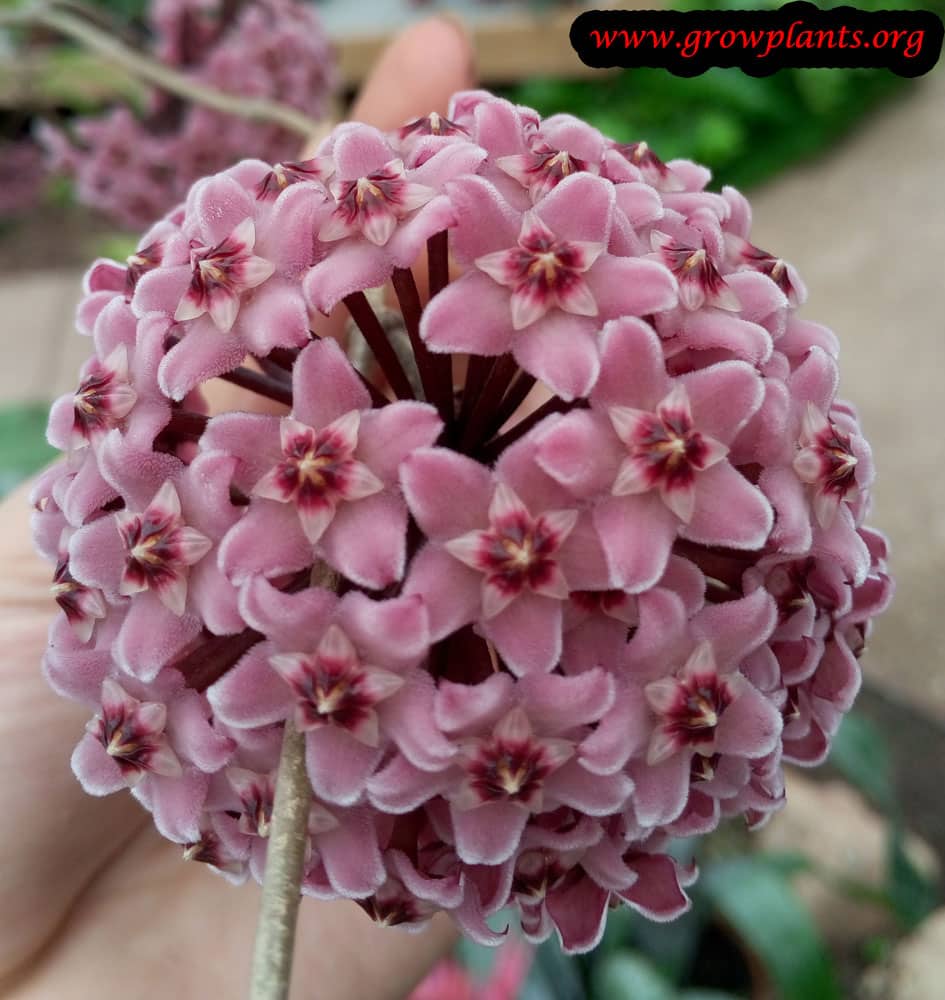
- Flower Appearance: Waxy, star-shaped flowers, each with a smaller star at the centre, gathered into rounded umbels; colours include pink, red, purple, white, green or yellow
- Edibility: Grown as an ornamental; the flowers are not eaten, though they drip sweet nectar
Detailed Blooming Overview
The wax plant is grown as much for its blooms as its foliage. Each flowering umbel carries dozens of waxy, star-in-a-star flowers, often sweetly scented and glistening with nectar. Plants bloom mainly in summer, but only after they have settled in – frequently five to seven years, and longer from seed.
Flower Characteristics
- Waxy star-shaped flowers with a central star, gathered into umbel- to ball-shaped clusters.
- Fragrant, with colours ranging from pink and red to purple, white, green and yellow.
Bloom Care & Thinning
- Never remove the spur: Hoya reblooms from the same short stalk (peduncle) year after year – do not snap it off after flowering.
- Coaxing bloom: Bright indirect light, snug roots and a cool, drier rest are what usually tip a mature plant into flower; if it still refuses, adjust the conditions rather than force it.
Bloom Health & Protection
- Mealybugs and aphids: They favour the flower buds and peduncles; dab or spray with insecticidal soap or neem oil, taking care not to damage the spur.
Pests, Diseases & Troubleshooting
Overview: Wax plants (Hoya) are tough, semi-succulent epiphytes whose thick, waxy leaves shrug off most trouble, but mealybugs are the signature scourge – hiding in leaf axils, along stems and even tucked inside the flower peduncles (the perennial ‘spurs’ that must never be removed). H. carnosa, the classic robust wax plant, is very forgiving but its long-lived flower spurs are a favourite mealybug refuge. Nearly all sap-sucker problems and the fatal root rot trace back to overwatering and stagnant air, so lean, gritty compost and careful watering are the foundation of control.
Quick Troubleshooting Overview
| Issue / Pest | Main Symptom | Primary Solution |
|---|---|---|
| Mealybug | White cottony tufts in leaf axils, stem joints and flower spurs, sticky honeydew, stunted new growth | Dab with 70% alcohol, wash with insecticidal soap, repeat weekly; check roots |
| Scale | Flat brown/tan bumps on stems and leaf undersides, sticky leaves | Scrape off, wipe down, treat with horticultural oil |
| Aphids | Clusters on soft new shoots and developing buds, distortion | Rinse off, insecticidal soap, encourage predators |
| Spider mites | Fine pale stippling and delicate webbing in dry indoor air | Raise humidity, shower foliage, miticide if persistent |
| Sooty mould | Black sooty film coating leaves over honeydew | Control the sap pests feeding above, wipe leaves clean |
| Root / stem rot | Yellowing, soft mushy base, wilting even though the mix is wet | Unpot, cut away rot, repot into dry gritty mix, water less |
Common Pests & Management
- Mealybug (Planococcus citri):
- Symptoms: The number-one Hoya pest: white, cottony, waxy insects clustered in leaf axils, stem joints and flower spurs, producing sticky honeydew and sooty mould, weakening growth and disfiguring blooms. A root-infesting form (root mealybug) leaves white waxy deposits on the rootball and causes unexplained decline.
- Prevention & Control: Spot-treat colonies with a cotton bud dipped in 70% isopropyl alcohol; follow with insecticidal soap or a horticultural/neem oil spray, repeating every 5-7 days to catch hatchlings; isolate new plants; inspect the roots at repotting and rinse or drench with a systemic if root mealybug is present. Never cut off the flower spurs, as mealybugs shelter there but the plant reblooms from them.
- Scale insects (Coccus hesperidum, Saissetia coffeae):
- Symptoms: Brown, tan or blackish limpet-like bumps fixed to stems and the undersides of leaves along the veins; they exude honeydew that fuels sooty mould, and heavy infestations cause yellowing and leaf drop.
- Prevention & Control: Scrape or wipe off with an alcohol-dampened cloth; spray thoroughly with horticultural oil to smother crawlers and adults; repeat and inspect leaf undersides; prune out badly encrusted stems.
- Aphids (Aphis gossypii, Myzus persicae):
- Symptoms: Soft green, yellow or black insects massing on tender new shoots and flower buds, causing curling, sticky honeydew and sooty mould; most damaging to fresh growth and blooms.
- Prevention & Control: Blast off with water, then treat with insecticidal soap or neem; remove badly infested tips; encourage ladybirds and lacewings; check imported new plants first.
- Spider mites (Tetranychus urticae):
- Symptoms: Fine pale speckling (stippling) on the upper leaf surface and gossamer webbing on undersides and between leaves, thriving in hot, dry indoor air; leaves dull and bronze over time.
- Prevention & Control: Raise humidity and shower the foliage; wipe leaves; apply a miticide or repeated horticultural-oil/soap sprays covering leaf undersides; avoid letting the plant sit dry and dusty.
- Thrips (Frankliniella / Thrips spp.):
- Symptoms: Silvery scarring, tiny black frass specks and distorted new leaves and buds; a minor but occasional problem, more troublesome on flowering plants.
- Prevention & Control: Use blue/yellow sticky traps to monitor, remove damaged growth, and treat with insecticidal soap or spinosad if numbers build; isolate affected plants.
Diseases & Fungal Issues
- Root & stem rot (Pythium / Phytophthora spp.):
- Symptoms: The commonest killer of Hoyas: overwatering and poor drainage rot the roots and stem base, so leaves yellow, go limp and drop while the soil stays wet, and the base turns soft, dark and mushy.
- Treatment & Management: Prevent it by using a very free-draining, chunky epiphyte mix and letting the top of the mix dry between waterings; at first sign, unpot, cut away all soft tissue, dust cuts, and re-root healthy vine tips in a barely-moist gritty mix; never leave the pot standing in water.
- Botrytis (grey mould) (Botrytis cinerea):
- Symptoms: Fuzzy grey mould and brown watery rot on flowers, buds and leaves in cool, damp, still air, often starting on fading blooms.
- Treatment & Management: Remove spent flowers and dead material, improve airflow and lower humidity around the plant, and avoid wetting foliage; rarely needs a fungicide if hygiene is good.
- Fungal / bacterial leaf spot (Colletotrichum / Cercospora / bacterial):
- Symptoms: Brown or black spots, sometimes with yellow halos or a water-soaked look, usually where leaves stay wet or air is stagnant.
- Treatment & Management: Remove spotted leaves, keep foliage dry, space and ventilate plants; a copper fungicide helps stubborn fungal spotting, while bacterial spots respond mainly to sanitation and drier conditions.
- Sooty mould (Capnodium spp.):
- Symptoms: A black, soot-like film coating leaves and stems, growing on the honeydew left by mealybugs, scale or aphids; it blocks light rather than infecting tissue.
- Treatment & Management: Eliminate the sap-sucking pests producing the honeydew, then wipe the black film off with a damp cloth; leaves recover once the source is gone.
Growing Difficulties & Abiotic Problems
- Overwatering & root rot:
- Cause & Symptoms: The single biggest cause of Hoya death: soggy, airless compost suffocates and rots the roots, giving limp, yellowing leaves that persist even when the mix is wet.
- Correction Strategy: Grow in a gritty, bark-based free-draining mix in a pot with drainage; water only when the mix has nearly dried, and much less in cool or low-light periods; never leave standing water in the saucer.
- Shrivelled, dropping leaves (underwatering):
- Cause & Symptoms: Wrinkled, soft or curling leaves and dropping foliage when the plant has been left bone-dry too long or roots are damaged.
- Correction Strategy: Check that roots are healthy, then resume even watering; if roots have rotted, re-root healthy cuttings rather than trying to over-water a failing plant back to health.
- Sunburn vs failure to bloom:
- Cause & Symptoms: Harsh direct midday sun bleaches and scorches leaves, while too little light gives lush growth but no flowers, since Hoyas need bright light to bloom.
- Correction Strategy: Give bright, indirect light or gentle morning sun; a few hours of filtered sun encourages blooming without scorching; move gradually to avoid shock.
- Cold damage:
- Cause & Symptoms: Blackened, translucent or mushy patches after exposure below about 10 C / 50 F.
- Correction Strategy: Keep above ~12-15 C, away from cold draughts and winter windowpanes; remove damaged growth once the plant is warm again.
- Edema:
- Cause & Symptoms: Corky bumps and blister-like spots on the undersides of leaves from erratic watering when roots take up water faster than leaves lose it.
- Correction Strategy: Water more evenly, improve light and airflow, and avoid heavy watering in cool, humid, dim conditions; the marks are harmless but permanent on affected leaves.
What Helps – Products & Tools
Keep it simple and cultural: 70% isopropyl alcohol on cotton buds for spot-treating mealybug and scale, backed by insecticidal soap and neem or light horticultural oil for wider coverage; a systemic soil drench is reserved for stubborn root mealybug. Blue/yellow sticky traps monitor thrips and fungus gnats, a copper fungicide handles persistent leaf spot, and – most importantly – a chunky, free-draining epiphyte mix and disciplined watering prevent the root rot that kills most Hoyas.
Frequently Asked Questions
When does Hoya carnosa flower, and what do the flowers look like?
Hoya carnosa blooms mainly in summer, sometimes in spring, and occasionally in autumn, but only once the plant is mature and well established — often 5 to 7 years from a young plant, and even longer from seed. Each flowering spur produces waxy, star-shaped flowers with a smaller star at the centre, gathered into rounded umbels in colours including pink, red, purple, white, green or yellow. Never remove the flower spur (peduncle) after blooming, since it reblooms from the same point year after year.
How do you care for a variegated Hoya carnosa (Hoya carnosa variegata)?
A variegated Hoya carnosa is grown the same way as the plain green form, but it needs extra watching for stems that revert to solid green, since reverted growth is more vigorous and will crowd out the variegated form if left unchecked. On young plants, inspect new growth for solid-green shoots and remove them promptly while they are small; on any plant, trace a reverted shoot back to its point of origin on the stem and cut it off cleanly there, or it will simply regrow green. Variegated cultivars carry leaves marked with pink, yellow or white.
How can I get my Hoya carnosa to bloom?
Give it plenty of bright light, since insufficient light is one of the most common reasons container-grown plants fail to bloom. Keep it in a container only a little larger than its root ball, because Hoya flower best when slightly pot-bound, and aim for humidity of 60% or more. A cool, drier rest period also helps tip a mature plant into flower, and remember it must mature and fill its pot before it blooms, often taking several years.
What is the most common pest on Hoya carnosa, and how do I get rid of it?
Mealybugs are the signature pest of Hoya carnosa, hiding in leaf axils, along stems and even tucked inside the flower peduncles (the perennial ‘spurs’ that must never be removed). Spot-treat colonies with a cotton bud dipped in 70% isopropyl alcohol, then follow with insecticidal soap or a horticultural/neem oil spray, repeating every 5-7 days to catch hatchlings. Never cut off the flower spurs to control them, since mealybugs shelter there but the plant reblooms from them.
Can I just grow Hoya carnosa permanently in a jar of water instead of potting it in soil?
It’s possible but not recommended as a long-term setup. Rooting a cutting in water works well as a short-term propagation step, but keeping a mature plant permanently in water means the water needs regular changing and feeding, and it will grow algae if it gets light.