Plant Profile & Key Characteristics
Overview: An evergreen succulent (epiphytic) climbing vine reaching about 2-4 m (6-12 ft), grown for its thick, waxy foliage and clusters of fragrant, star-shaped ‘wax’ flowers. It is a popular container and hanging houseplant.
Quick Specifications
| Specification | Attribute |
|---|---|
| Plant Type / Life Cycle | Perennial (succulent vine) |
| Foliage Type | Evergreen |
| Mature Size | 2-4 m (6-12 ft) long |
| Growth Rate | Slow to moderate |
| Root System | Epiphytic – fibrous roots plus adventitious air roots along the stems |
| Toxicity | Not for eating – regarded as mildly toxic/irritant if ingested |
| Hardiness | USDA zone 10b+ |
Growth Form & Structure
- Height & Spread: Stems trail or climb to about 2-4 m (6-12 ft); usually grown in containers or hanging baskets and trained on a trellis or left to weep down.
- Growth Habit & Form: Twining, trailing succulent vine that produces adventitious air roots and clings or hangs from support.
- Lifespan & Maturity: Long-lived perennial; plants must reach maturity (often around 5-7 years) before they flower.
Anatomy & Physical Features
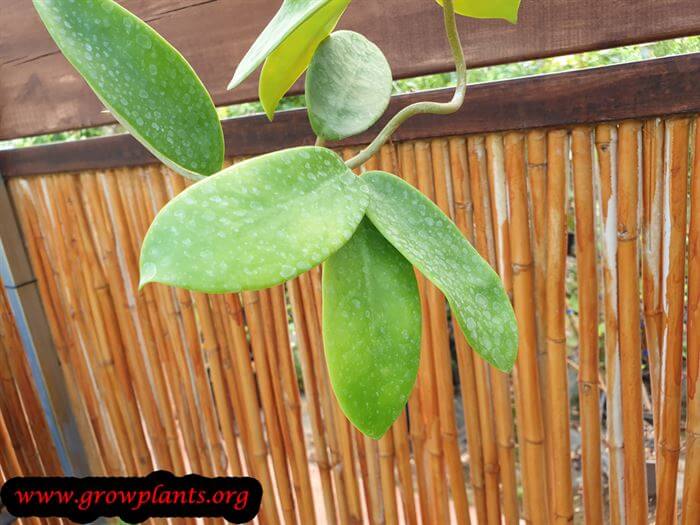
- Leaves & Foliage: Fleshy, waxy, oval green leaves.
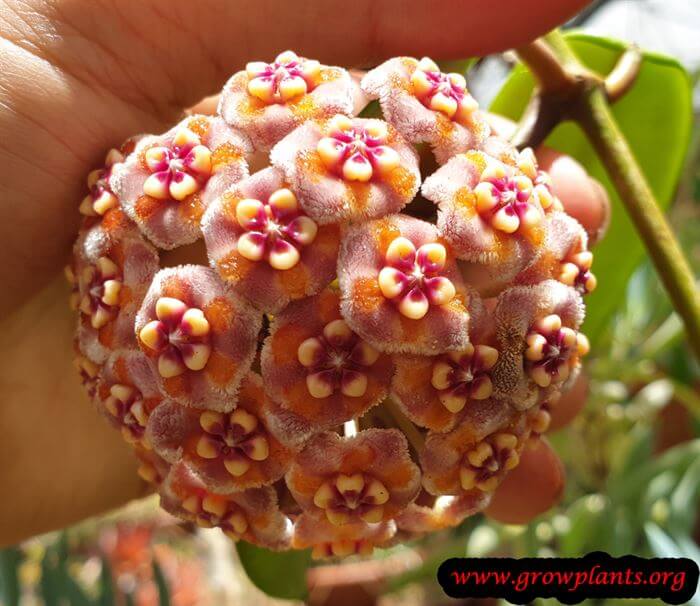
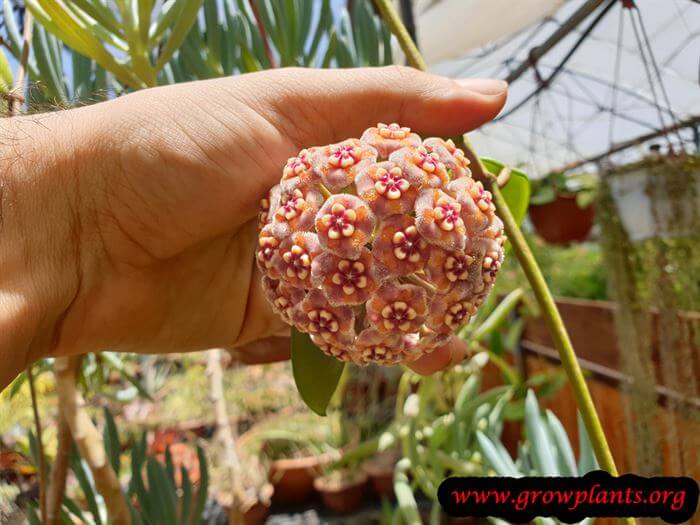
- Flower Characteristics: Fragrant waxy star-shaped flowers in pink, orange, green or red, in umbel to ball-shaped clusters (full detail in the Bloom section).
Primary Uses & Landscape Value
- Functional & Ornamental Roles: Ornamental foliage and flowering houseplant for containers and hanging baskets; trainable as a hedge or groundcover with support, and grown outdoors only in frost-free climates.
Care Guide: Planting, Soil & Watering
Overview: Hoya meliflua is an epiphytic, succulent-leaved vine that thrives in warm, frost-free conditions (best kept above about 10°C / 50°F) with bright light and high humidity. It wants a loose, airy, fast-draining medium kept lightly moist and allowed to dry a little between waterings, and resents cold, soggy roots.
Quick Care Requirements
| Requirement | Ideal Condition |
|---|---|
| Planting Season | Warm season by zone — spring in zone 10a, spring–summer in 10b, spring–autumn in 11, year-round in 12+ |
| Growth Rate | Slow to Moderate |
| Soil Type | Loose, airy, well-draining mix (e.g. orchid bark, coco chips and perlite) |
| Water Need | Moderate — keep lightly moist but let the top of the mix dry between waterings |
Planting & Establishment
- Best Planting Season: Plant in the warm season once nights are reliably mild — spring in zone 10a (into mid-summer), spring to summer in 10b, spring to autumn in 11 and year-round in 12+. Acclimatise greenhouse-raised plants gradually and avoid moving them outdoors into cold weather.
- How to Plant:
- Hole Preparation: Use a container only a little larger than the root ball — Hoya flower best when slightly pot-bound — or a pocket of loose, chunky medium if grown on a moss pole or mount.
- Soil Amendments: Blend an open, epiphyte-style mix: orchid bark, coco chips or perlite added to a peat or potting base for sharp drainage and plenty of air around the roots.
- Planting Depth: Set the plant at the level it grew, keeping the base of the stem at the surface; burying the stem invites rot.
- Growth Speed & Expectations: Expect slow to moderate growth, quicker in warmth and bright light; plants need several years to mature before they bloom.
Soil, Watering & Drainage Care
- Soil Mix & Drainage Needs: Grow in a light, airy, sharply-draining mix — Hoya hate wet feet. A container with free drainage is preferred over open ground, and extra bark or perlite keeps the mix open and guards against root rot.
- Watering Schedule & Technique:
- Young / Newly Planted: Keep the mix lightly and evenly moist while roots establish, using soft water (rainwater or low-mineral water) and misting the aerial roots.
- Established: Water thoroughly, then let the top of the mix dry before watering again, and ease off before the blooming season; avoid hard, mineral-rich water.
- Seasonal Adjustments: Water more during warm, active growth and much less in cool winter weather, when the plant rests and rots easily if kept wet.
Climate, Light & Hardiness
Hoya meliflua is a warm, humid-climate vine best suited to tropical, subtropical, or mild Mediterranean conditions outdoors, or to container/indoor culture wherever winters turn cold. It prefers bright but filtered light rather than harsh full sun, and while a well-established specimen can hold on through mild winters near the top of USDA zone 10a, it has essentially no tolerance for real frost.
Quick Climate Specifications
| Climate Zones | Tropical, subtropical, and mild Mediterranean climates; elsewhere grown as a container or indoor plant |
|---|---|
| USDA Hardiness Zones | 10b and warmer outdoors; established, well-protected plants may overwinter in 10a |
| Cold Damage Begins | Growth stress increases once temperatures fall much below approximately 10°C (50°F) |
| Approx. Survival Minimum | Established, sheltered plants may briefly persist near the cold edge of zone 10a, but any hard frost is likely damaging |
| Frost Tolerance | Very Low |
| Light Conditions | Bright filtered light to half shade; full shade tolerated but reduces flowering |
| Wind Tolerance | Low |
Sunlight & Light Exposure
Optimal Light Setup
Bright, filtered light or half shade gives the best balance of healthy foliage and flowering. Growers who train it up an outdoor tree often choose a deciduous species so the vine gets shade from the canopy in summer and more sun once the leaves drop in winter.
Direct Sun Requirement
Full sun is tolerated, but only where humidity stays high enough to keep the waxy leaves from scorching.
Shade & Heat Management
Full shade is survivable but the plant is unlikely to bloom without meaningfully more light; aim for roughly 75% sun or sun filtered through netting or a window for the best flowering.
Best Exposure/Orientation
Indoors, place it near a bright window rather than a dim interior spot, but keep it away from hot direct glass exposure.
Temperature Extremes & Hardiness
USDA Hardiness & Regional Limits
Outdoor, in-ground culture is realistic from zone 10b upward; a mature, well-sited, protected plant may overwinter in 10a, but this is a stretch rather than the norm.
Cold Damage & Winter Protection
Outside frost-free areas, grow it in a container so it can be moved under cover for winter; the site's own guidance is to keep it generally above about 10°C (50°F) and to provide protection whenever frost threatens.
Frost Sensitivity
Very frost-sensitive as a tropical-to-subtropical vine - avoid any frost exposure entirely.
Extreme Heat Tolerance
Tolerates warm-to-hot conditions reasonably well as long as humidity is kept up and the aerial roots are misted; without enough humidity, hot full sun can scorch the leaves.
Wind, Humidity & Microclimate
Humidity Preferences
Prefers consistently high humidity; indoor growers are advised to maintain at least roughly 60% humidity for good growth and flowering.
Dry-Air Tolerance
Poor - dry air from indoor heaters or air conditioning is noted as a specific problem for this plant, along with the drafts these systems create.
Wind Tolerance
Low; wind is noted to dry out and stress the aerial roots, which the plant relies on for moisture and nutrient uptake.
Rainfall & Seasonal Moisture
Suited to climates with consistent humidity rather than a pronounced dry season, matching its need for steady moisture around the roots and air roots alike.
Microclimate Recommendations
Best sited in a warm, humid, wind-sheltered spot - away from cold drafts, heating vents, and air-conditioning airflow - with container culture allowing it to be moved to shelter when cold weather threatens.
Growing in Pots, Balconies & Indoors
Hoya meliflua is a trailing, epiphytic wax-flower vine and a beautiful houseplant, best shown off as a hanging plant. Indoors it needs plenty of light and high humidity; to actually flower it must mature and have room to grow, so give it a bright position and be patient.
Quick Details
- Container Size: Start small and grow with the plant – about 20-50% larger than the root ball (smaller percentage for bigger plants); roughly 5-12 L (1.5-3 gal), stepping up as it fills the pot
- Indoor Suitability: An excellent houseplant, but needs a very bright spot and high humidity (at least 60%) to thrive and bloom
- Best Spot: Very bright light, even some sun; artificial room light alone is not enough. A humid bathroom with good light works well
- Soil & Drainage: Well-drained and airy – peat/coir with perlite (or potting mix), some lava grit at the base; make drainage holes and skip a saucer
- Watering in Pots: Average, but let it dry between waterings; also mist and water the aerial roots. Soft water (rain or low-mineral) is best
Indoors & On the Windowsill
- Houseplant use: The grower rates it a good indoor plant, but note it only blooms once mature and given room. Choose a spot with lots of light (even some direct sun) – ordinary room light is not enough, so a grow light can help make up the difference – and keep it away from fans, heaters and air-conditioning.
- Humidity & spot: It likes at least 60% humidity, so a bright bathroom is ideal; grow it as a hanging plant from the ceiling. In high humidity use less water. Feed the aerial roots as well as the soil, misting them with soft water.
- Overwintering: Tender – keep it warm indoors year-round in cold climates; never let it sit by a heater or cold draft.
- Safety: The grower notes it is poisonous to humans if eaten (only a problem if ingested) – keep it out of reach of children and pets.
On a Balcony or Patio
- Light & shelter: Outdoors in warm, humid weather it enjoys bright light with a little shade from the fiercest sun (high humidity helps prevent leaf scorch). Hang it where wind will not batter the soft stems, and keep it off cold or drafty spots.
- Practicalities: As a hanging plant, make sure the bracket and pot drain freely; keep it out of heavy rain that would waterlog the mix.
Choosing the Pot, Soil & Long-Term Care
- Pot & drainage: Start at 5-12 L, only 20-50% bigger than the root ball, and pot up as it fills out – transplanting sets back flowering, so do not overpot. Make good drainage holes and, as the grower prefers, use no saucer/bottom under the pot.
- Potting mix: Airy and well-drained – peat/coir with perlite or a quality potting mix, with some lava grit at the base; rich in organic matter and humus on top.
- Feeding: Feed at least once, better twice, a year; use liquid feed on the aerial roots as well as the soil, since soil watering alone is often not enough for this plant.
- Repotting & soil change: The mix loses viability over time and can rot the roots, so refresh it periodically – though a large, established plant that feeds through its aerial roots may not need its soil changed.
Grower’s Container Tip
- Grow it up gradually: Start in a small pot and step up only as the plant fills each one – this suits its slow young growth, and because every transplant checks flowering, minimal disturbance means better blooms.
- Feed the aerial roots: Don’t rely on soil watering alone – regularly mist and liquid-feed the aerial roots with soft rainwater; on a mature plant they do much of the water and nutrient uptake.
Growing this plant in a greenhouse
A greenhouse can give hoya meliflua frost protection, cold protection and a head start for propagation.
Greenhouse at a glance
| Greenhouse suitability | Good - clearly useful |
|---|---|
| Main benefits | frost protection, cold protection, a head start for propagation |
| Outdoor protection advisable below | about 10°C |
| Maintain greenhouse minimum | around 10°C for active growth |
| Suitable types | unheated greenhouse, polycarbonate greenhouse |
| Heating | Heating is optional - useful mainly for winter growing in cold areas. |
Related greenhouse guides
- Greenhouses: How to Choose the Right Greenhouse
- Polycarbonate Greenhouses: What to Look for Before Buying
- Greenhouse Propagation Equipment
- Greenhouse Climate Control: Temperature, Ventilation and Humidity
Fertilizing & Feeding
A light-to-moderate feeder: steady balanced feeding through active growth and bloom supports both healthy vining foliage and good flowering, with a full stop through the cold-season rest.
Quick Fertilizing Specs
| Feeding Level | Light to moderate feeder |
|---|---|
| Main Nutrient Priority | Balanced feeding with adequate nitrogen; a leaf that pales or yellows generally points to a lapse in feeding rather than to any other single cause |
| Best Feeding Period | The warm active growth and flowering season |
| Organic Options | A rich, humus-containing epiphyte or orchid-style mix supplies part of the plant’s ongoing nutrition between feedings |
| Micronutrients | Usually supplied by a complete balanced fertilizer; correct specific deficiencies only once diagnosed |
| Soil pH | A loose, well-drained, organic-rich mix matters more than any specific pH target |
| Reduce/Stop Feeding | Taper off and stop feeding as growth slows heading into the cold season |
Feeding by Growth Stage
Young plant establishment
Help a young Hoya meliflua build a healthy root system and enough foliage to eventually support its larger, climbing or hedging vining growth.
| Nutrient direction | A balanced, nitrogen-leaning feed suited to active vegetative growth rather than a bloom-focused product. |
|---|---|
| Timing | From rooting or potting up through the first stretch of active vine and leaf growth. |
| Frequency | Light, regular feeding through the warm growing season keeps young growth steady without forcing it. |
| Fertilizer types | A balanced houseplant or epiphyte-suitable liquid fertilizer, diluted for young growth |
| Precautions | Feed lightly on both the soil and any exposed air roots; overfeeding tender young roots does more harm than good. This species can take a long stretch to mature enough to flower, so don’t force growth with heavy feeding hoping to speed that up. |
Active growth through flowering
Support vigorous vining growth and healthy, fragrant flowering without favoring one at the expense of the other.
| Nutrient direction | A balanced complete fertilizer with adequate nitrogen supports both leafy growth and good flowering; leaning too far from balanced toward either extreme tends to cost the plant in the other area. |
|---|---|
| Timing | Through the main warm-season growth and bloom period. |
| Frequency | Regular light feeding, applied to the soil and misted onto air roots, tapers off as growth slows toward the cooler months. |
| Fertilizer types | A balanced liquid fertilizer suitable for foliar and air-root application |
| Precautions | Watch for pale or yellowing leaves as a cue that feeding has lapsed too long; avoid feeding right after a repot, since transplant stress on its own can suppress flowering. |
Cool-season rest
Let growth rest through the cold part of the year rather than pushing feeding it can’t use.
| Nutrient direction | None – withhold fertilizer while growth is stalled in cool conditions. |
|---|---|
| Timing | Through the coldest part of the year, whenever growth visibly slows or stops. |
| Frequency | No feeding at this stage. |
| Fertilizer types | No feeding at this stage – resume only once active growth clearly restarts |
| Precautions | Do not fertilize during the cold-season slowdown; unused nutrients just accumulate as salts around roots and air roots that aren’t taking anything up. |
Nutrient Deficiency Signs & Corrections
Leaves – especially older, lower ones – turn uniformly pale to yellow while growth slows overall.
| Possible causes | insufficient nitrogen in the feeding routine for an actively growing vine, root stress from a soggy, poorly drained potting mix limiting uptake, low light reducing how effectively the plant can use available nutrients |
|---|---|
| Appears first on | older, lower leaves |
| What to check | how recently and how consistently the plant has been fed during active growth, light exposure, potting mix drainage and root condition |
| Possible correction | Shift to a nitrogen-forward complete fertilizer during active growth and confirm the plant is getting adequate light. |
Leaf tips and margins brown or crisp even though the plant is watered on a normal schedule.
| Possible causes | mineral buildup from hard tap water or from feeding without periodic flushing, over-strength or too-frequent feeding for the plant’s actual growth rate, insufficient leaching of the potting mix between waterings |
|---|---|
| Appears first on | leaf tips and margins |
| What to check | water source (hard tap water versus soft or rain water), recent feeding strength and frequency, any visible crust or residue on the soil surface |
| Possible correction | Flush the potting mix with clean, low-mineral water, ease back on feeding strength, and prefer soft or rain water where possible. |
Stems stay weak or floppy and flowering comes sparse or undersized relative to how full and healthy the foliage looks.
| Possible causes | low potassium relative to nitrogen in the feeding routine, nutrients leaching out from frequent watering of the air roots and mix, a feeding routine skewed toward vegetative growth without support for blooming |
|---|---|
| Appears first on | flower buds and stem strength generally |
| What to check | the balance of the fertilizer being used relative to the plant’s bloom stage, watering frequency and any leaching from the mix, stem firmness and flower size compared with prior seasons |
| Possible correction | Move toward a balanced, potassium-adequate feed as the plant approaches and moves through its bloom period. |
Pruning, Training & Seasonal Maintenance
Hoya meliflua is the largest of this genus covered here (2–4m), notable for sometimes being trained as a hedge or ground cover with support, rather than left to hang or climb freely. That guided-training use case, combined with a long juvenile period before first bloom (commonly 4–7 years, sometimes longer), shapes the approach: young plants are pruned mainly to build the trained framework, while mature, blooming plants shift to the same rule that governs every Hoya – never cut away the persistent peduncles that rebloom season after season.
Quick Pruning & Maintenance Specs
| Pruning Tolerance | Moderate (vegetative growth only) |
| Primary Pruning Window | After a bloom flush on mature plants; ongoing light training on young plants |
| Secondary Maintenance Window | Any time, for dead leaves/stems |
| Typical Frequency | More frequent shaping if trained as a hedge or ground cover than if left to hang |
| Main Objective | Build and maintain a trained hedge/ground-cover framework; on mature plants, also preserve flower peduncles |
| Young Plant Priority | Establish the trained framework (hedge line or spreading habit) – flowering is years away, so structure comes first |
| Mature Plant Priority | Maintain the trained shape with selective cuts; keep all living peduncles intact once flowering begins |
| Best Tool Type | Precision snips and bypass secateurs – never hedge shears |
| Avoid Heavy Pruning During | Active budding/bloom, and right after repotting or relocation |
Pruning by Plant Age & Size
Newly Established
Limit cuts to damaged tissue from transplant; let the plant settle before starting any training.
Young / Formative
Because first bloom is typically years away, formative pruning here is entirely about structure: pinch tips to encourage lateral branching along a hedge line, or guide spreading growth if used as ground cover, using ties and stakes rather than hard cuts. There are no peduncles yet to protect at this stage, so training can proceed more freely than on a flowering mature plant.
Mature / Established
Once the plant reaches flowering age, shift from framework-building to maintenance: selective thinning and length control around the trained shape, always leaving living peduncles undisturbed.
Flowering & Fruiting Wood
Flowers form on persistent peduncles that rebloom repeatedly once the plant reaches maturity – which, for this species, can take four to seven years or considerably longer from seed. Once a peduncle is established, only the withered flower cluster should be removed, never the stalk itself; cutting it away sacrifices flowers this plant already took years to produce. Remove a peduncle only once it is fully dead or blackened.
Structural Pruning & Training
Suited to guided training as a hedge or ground cover with staking and tying, unlike free-hanging Hoya types. Even so, this remains a soft succulent vine, not a shearing plant – build the shape with selective pinches and cuts at growing tips, not by clipping a uniform hedge face.
Special Growth to Remove
Dead or blackened leaves and stems. On young plants, non-essential wandering growth outside the intended hedge line or spread area can be pinched back to direct the framework; on mature plants, living peduncles are never removed.
Container & Small-Space Pruning
If grown in a container rather than as a garden hedge/ground cover, its larger ultimate size (2–4m) calls for a sturdy support and more regular tip pinching to keep it in bounds; repot modestly as roots fill the pot rather than oversizing, which holds excess moisture and can further delay blooming on an already slow-to-flower plant.
Tools
Precision snips for tip pinching and training cuts; bypass secateurs for thicker basal growth on a mature plant; soft ties and stakes are central here given its use as a trained hedge or ground cover.
Tool Hygiene & Disease Risk
Routine – clean, sharp tools are sufficient; aphids, mealybugs, and fungal issues are the noted risks for this species, worth checking for at cut sites rather than treating every cut as high risk.
Cut Placement & Technique
Pinch tips just above a node to build density along the trained line; cut dead stems back to living tissue, staying clear of any peduncle.
Heavy Pruning & Rejuvenation
Tolerated in moderation on the vegetative framework, especially while young and not yet flowering; once mature and blooming, avoid heavy cuts through peduncle-bearing growth, since this slow-to-mature species takes a long time to rebuild flowering wood.
Post-Pruning Care
Resume normal misting of aerial roots and humidity; check ties/stakes still hold the trained shape after any trim.
Common Pruning Mistakes
- Using hedge shears to clip this into a formal hedge face – it is a soft succulent vine that needs selective cuts, not shearing, and shearing damages stems and invites disease
- Cutting off spent flower peduncles once the plant finally reaches blooming age
- Impatience – assuming a lack of flowers on a young plant means something is wrong and over-pruning in response, when it may simply not be mature enough yet
- Heavy pruning right after a repot or relocation, which already sets back blooming on its own
When NOT to Prune
Not during active bud set or bloom on mature plants, and not right after repotting or moving the plant, both of which already have a documented negative effect on flowering in this species.
Recommended Tools (by task)
- Tip pinching to build or maintain the trained framework – precision_snips: fine, selective cuts, not a uniform shear.
- Cutting thicker vegetative growth on a mature plant – bypass_secateurs: this larger species can develop base growth beyond what snips handle cleanly.
- Training as a hedge line or ground cover – soft_ties_stakes: this species’ documented use as a trained hedge/ground cover, unlike free-hanging Hoya types, depends on guided support rather than shearing.
Propagation Guide
Hoya meliflua is most reliably propagated from stem cuttings rooted in soil or water, or by simple layering (bending a branch into the soil); seed is possible but, since it is hard to source and named forms must be cloned to stay true, cuttings and layering are the practical route for almost every grower. Propagation is easy to moderate, since success depends mainly on maintaining warmth and high humidity while the cutting or seedling establishes.
Quick Propagation Specs
| Best Propagation Method | Stem cuttings (soil or water) |
| Alternative Methods | Ground layering; Seed (fresh, when available) |
| Propagation Difficulty | Easy to Moderate |
| Seed True-to-Type | Cultivar-dependent |
| Vegetative True-to-Type | Yes |
| Best Propagation Season | Spring to early summer for cuttings; seed can be sown from late spring into early autumn |
| Seed Germination Time | 2–5 weeks, sometimes longer |
| Germination Temperature | Around 25°C (77°F) by day, cooler at night |
| Seed Sowing Depth | Surface-sown, not buried |
Growing from Seed
Seed Handling & Viability
Use fresh seed where possible; if it must be held before sowing, store it dry in a dark location.
Sowing Season
End of spring to early autumn, sown indoors or in a greenhouse.
Sowing Depth & Orientation
Sow on the surface of moist sphagnum (peat) moss without burying the seed; cover the pot with a plastic bag, or grow it in a plastic box, to stop wind from moving the seed and to keep humidity up.
Germination Conditions
High humidity and consistently moist medium, at around 25°C (77°F) by day with cooler night temperatures, and plenty of light.
Germination Time
2–5 weeks, though it can take longer depending on conditions.
Seedling Care
Keep the medium moist with high humidity, watering lightly and avoiding overwatering. After roughly the first two months algae can start growing in the pot – move seedlings to a clean, algae-free spot when this happens. Space seedlings around 5×4 cm (2×1.8 in) apart, or better, grow each in its own small pot.
Stem Cuttings
Cutting Type
Stem or leaf cuttings; the site recommends taking a stem section with at least three leaves rather than a single leaf, since a leaf cutting without a stem node will often root but fail to produce a new shoot.
Best Timing
Spring to early summer.
Cutting Preparation
After cutting, let it sit in a shaded spot for a few days to let the cut tissue heal before planting.
Rooting Setup
Moist soil with high humidity; a greenhouse or similarly humid, enclosed space improves results. Cuttings can also be rooted directly in water: let the cut stem sit a few days first, then place it in soft water (rainwater or otherwise low in dissolved minerals), since Hoya roots are sensitive to hard, mineral-heavy water.
Rooting Hormone
Optional; not required by the site’s method.
Rooting Time
Not stated precisely; the site notes that once a water-rooted cutting has grown more than five roots, it is ready to start receiving fertilizer, implying rooting is usually established within a matter of weeks.
Air & Ground Layering
A flexible, still-attached stem can be bent down and covered with soil, kept consistently moist, until it roots; sever and pot up the newly rooted section once it is established, following the same general timing as cuttings.
Cultivar Note
A recognized variant, Hoya meliflua fraterna, has notably larger leaves but similar flowers; since this trait is variety-specific, propagate it vegetatively (cuttings or layering) rather than from seed to keep the larger-leaved form true.
Bloom & Flower Guide
Quick Details
- Bloom Season: Mainly summer, sometimes spring, and rarely into autumn
- Time to First Bloom: A patience plant: typically 5 to 7 years to reach flowering size, and sometimes over 10 years from seed
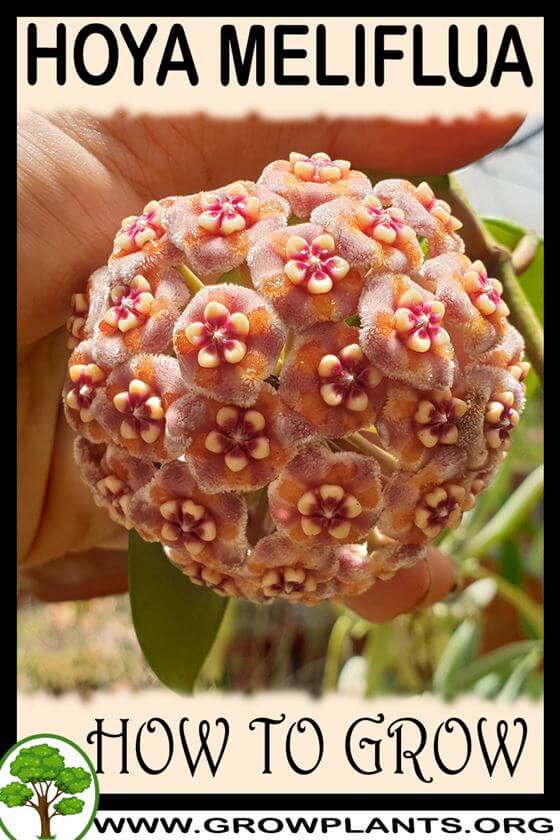
- Flower Appearance: Fragrant, waxy star-shaped flowers with a small central star, in pink, orange, green or red, gathered into umbel-to-ball-shaped clusters
- Edibility: Ornamental only; the flowers are not eaten. The plant is non-toxic.
Detailed Blooming Overview
Hoya meliflua is a scented wax flower that rewards long-term growers. The waxy, star-shaped blooms carry a smaller star at the centre and mass into rounded umbels, mostly in summer. The plant must be mature before it will flower, which usually takes several years, so young plants that have not yet bloomed are simply not old enough.
Flower Characteristics
- Waxy stars with a small inner star, in pink, orange, green or red.
- Clustered into umbel-to-ball-shaped inflorescences.
- Fragrant.
Bloom Care & Thinning
- Getting it to bloom: Give the right conditions consistently – bright indirect light, snug roots and a little dryness between waterings; if it still will not flower, adjust the conditions and give it time to mature.
- Why it may not flower: The most common reason is simply youth; plants raised from seed can take well over a decade to reach blooming size.
- Never cut the spurs: Hoyas rebloom from the same flower spurs, so leave the old peduncles on the plant.
Bloom Health & Protection
- Mealybugs and aphids: These favour the buds and flower spurs; insecticidal soap or neem oil, along with controlling ants, protects the developing blooms.
Pests, Diseases & Troubleshooting
Overview: Wax plants (Hoya) are tough, semi-succulent epiphytes whose thick, waxy leaves shrug off most trouble, but mealybugs are the signature scourge – hiding in leaf axils, along stems and even tucked inside the flower peduncles (the perennial ‘spurs’ that must never be removed). H. meliflua is a robust Philippine species with thick leaves and large flower umbels; it follows the standard wax-plant profile. Nearly all sap-sucker problems and the fatal root rot trace back to overwatering and stagnant air, so lean, gritty compost and careful watering are the foundation of control.
Quick Troubleshooting Overview
| Issue / Pest | Main Symptom | Primary Solution |
|---|---|---|
| Mealybug | White cottony tufts in leaf axils, stem joints and flower spurs, sticky honeydew, stunted new growth | Dab with 70% alcohol, wash with insecticidal soap, repeat weekly; check roots |
| Scale | Flat brown/tan bumps on stems and leaf undersides, sticky leaves | Scrape off, wipe down, treat with horticultural oil |
| Aphids | Clusters on soft new shoots and developing buds, distortion | Rinse off, insecticidal soap, encourage predators |
| Spider mites | Fine pale stippling and delicate webbing in dry indoor air | Raise humidity, shower foliage, miticide if persistent |
| Sooty mould | Black sooty film coating leaves over honeydew | Control the sap pests feeding above, wipe leaves clean |
| Root / stem rot | Yellowing, soft mushy base, wilting even though the mix is wet | Unpot, cut away rot, repot into dry gritty mix, water less |
Common Pests & Management
- Mealybug (Planococcus citri):
- Symptoms: The number-one Hoya pest: white, cottony, waxy insects clustered in leaf axils, stem joints and flower spurs, producing sticky honeydew and sooty mould, weakening growth and disfiguring blooms. A root-infesting form (root mealybug) leaves white waxy deposits on the rootball and causes unexplained decline.
- Prevention & Control: Spot-treat colonies with a cotton bud dipped in 70% isopropyl alcohol; follow with insecticidal soap or a horticultural/neem oil spray, repeating every 5-7 days to catch hatchlings; isolate new plants; inspect the roots at repotting and rinse or drench with a systemic if root mealybug is present. Never cut off the flower spurs, as mealybugs shelter there but the plant reblooms from them.
- Scale insects (Coccus hesperidum, Saissetia coffeae):
- Symptoms: Brown, tan or blackish limpet-like bumps fixed to stems and the undersides of leaves along the veins; they exude honeydew that fuels sooty mould, and heavy infestations cause yellowing and leaf drop.
- Prevention & Control: Scrape or wipe off with an alcohol-dampened cloth; spray thoroughly with horticultural oil to smother crawlers and adults; repeat and inspect leaf undersides; prune out badly encrusted stems.
- Aphids (Aphis gossypii, Myzus persicae):
- Symptoms: Soft green, yellow or black insects massing on tender new shoots and flower buds, causing curling, sticky honeydew and sooty mould; most damaging to fresh growth and blooms.
- Prevention & Control: Blast off with water, then treat with insecticidal soap or neem; remove badly infested tips; encourage ladybirds and lacewings; check imported new plants first.
- Spider mites (Tetranychus urticae):
- Symptoms: Fine pale speckling (stippling) on the upper leaf surface and gossamer webbing on undersides and between leaves, thriving in hot, dry indoor air; leaves dull and bronze over time.
- Prevention & Control: Raise humidity and shower the foliage; wipe leaves; apply a miticide or repeated horticultural-oil/soap sprays covering leaf undersides; avoid letting the plant sit dry and dusty.
- Thrips (Frankliniella / Thrips spp.):
- Symptoms: Silvery scarring, tiny black frass specks and distorted new leaves and buds; a minor but occasional problem, more troublesome on flowering plants.
- Prevention & Control: Use blue/yellow sticky traps to monitor, remove damaged growth, and treat with insecticidal soap or spinosad if numbers build; isolate affected plants.
Diseases & Fungal Issues
- Root & stem rot (Pythium / Phytophthora spp.):
- Symptoms: The commonest killer of Hoyas: overwatering and poor drainage rot the roots and stem base, so leaves yellow, go limp and drop while the soil stays wet, and the base turns soft, dark and mushy.
- Treatment & Management: Prevent it by using a very free-draining, chunky epiphyte mix and letting the top of the mix dry between waterings; at first sign, unpot, cut away all soft tissue, dust cuts, and re-root healthy vine tips in a barely-moist gritty mix; never leave the pot standing in water.
- Botrytis (grey mould) (Botrytis cinerea):
- Symptoms: Fuzzy grey mould and brown watery rot on flowers, buds and leaves in cool, damp, still air, often starting on fading blooms.
- Treatment & Management: Remove spent flowers and dead material, improve airflow and lower humidity around the plant, and avoid wetting foliage; rarely needs a fungicide if hygiene is good.
- Fungal / bacterial leaf spot (Colletotrichum / Cercospora / bacterial):
- Symptoms: Brown or black spots, sometimes with yellow halos or a water-soaked look, usually where leaves stay wet or air is stagnant.
- Treatment & Management: Remove spotted leaves, keep foliage dry, space and ventilate plants; a copper fungicide helps stubborn fungal spotting, while bacterial spots respond mainly to sanitation and drier conditions.
- Sooty mould (Capnodium spp.):
- Symptoms: A black, soot-like film coating leaves and stems, growing on the honeydew left by mealybugs, scale or aphids; it blocks light rather than infecting tissue.
- Treatment & Management: Eliminate the sap-sucking pests producing the honeydew, then wipe the black film off with a damp cloth; leaves recover once the source is gone.
Growing Difficulties & Abiotic Problems
- Overwatering & root rot:
- Cause & Symptoms: The single biggest cause of Hoya death: soggy, airless compost suffocates and rots the roots, giving limp, yellowing leaves that persist even when the mix is wet.
- Correction Strategy: Grow in a gritty, bark-based free-draining mix in a pot with drainage; water only when the mix has nearly dried, and much less in cool or low-light periods; never leave standing water in the saucer.
- Shrivelled, dropping leaves (underwatering):
- Cause & Symptoms: Wrinkled, soft or curling leaves and dropping foliage when the plant has been left bone-dry too long or roots are damaged.
- Correction Strategy: Check that roots are healthy, then resume even watering; if roots have rotted, re-root healthy cuttings rather than trying to over-water a failing plant back to health.
- Sunburn vs failure to bloom:
- Cause & Symptoms: Harsh direct midday sun bleaches and scorches leaves, while too little light gives lush growth but no flowers, since Hoyas need bright light to bloom.
- Correction Strategy: Give bright, indirect light or gentle morning sun; a few hours of filtered sun encourages blooming without scorching; move gradually to avoid shock.
- Cold damage:
- Cause & Symptoms: Blackened, translucent or mushy patches after exposure below about 10 C / 50 F.
- Correction Strategy: Keep above ~12-15 C, away from cold draughts and winter windowpanes; remove damaged growth once the plant is warm again.
- Edema:
- Cause & Symptoms: Corky bumps and blister-like spots on the undersides of leaves from erratic watering when roots take up water faster than leaves lose it.
- Correction Strategy: Water more evenly, improve light and airflow, and avoid heavy watering in cool, humid, dim conditions; the marks are harmless but permanent on affected leaves.
What Helps – Products & Tools
Keep it simple and cultural: 70% isopropyl alcohol on cotton buds for spot-treating mealybug and scale, backed by insecticidal soap and neem or light horticultural oil for wider coverage; a systemic soil drench is reserved for stubborn root mealybug. Blue/yellow sticky traps monitor thrips and fungus gnats, a copper fungicide handles persistent leaf spot, and – most importantly – a chunky, free-draining epiphyte mix and disciplined watering prevent the root rot that kills most Hoyas.
Varieties & Cultivars
- Hoya meliflua fraterna: The leaves are bigger than the usual, flower color can be the same. — Shop Hoya meliflua fraterna on Amazon