Plant Profile & Key Characteristics
A striking evergreen fishtail palm reaching about 6-12 m (20-40 ft), named for the zebra-striped markings on its stems. A frost-tender ornamental perennial; its fruit is toxic and not edible.
Quick Specifications
| Specification | Attribute |
|---|---|
| Plant Type / Life Cycle | Perennial (monocarpic – dies after flowering) |
| Foliage Type | Evergreen |
| Mature Size | 6-12 m tall (20-40 ft) |
| Growth Rate | Moderate to slow |
| Root System | Fibrous, non-woody (as in all palms) |
| Toxicity | Fruit contains calcium-oxalate crystals – an irritant, not edible |
| Hardiness | USDA zone 10+ |
Growth Form & Structure
- Height & Spread: 6-12 m (20-40 ft)
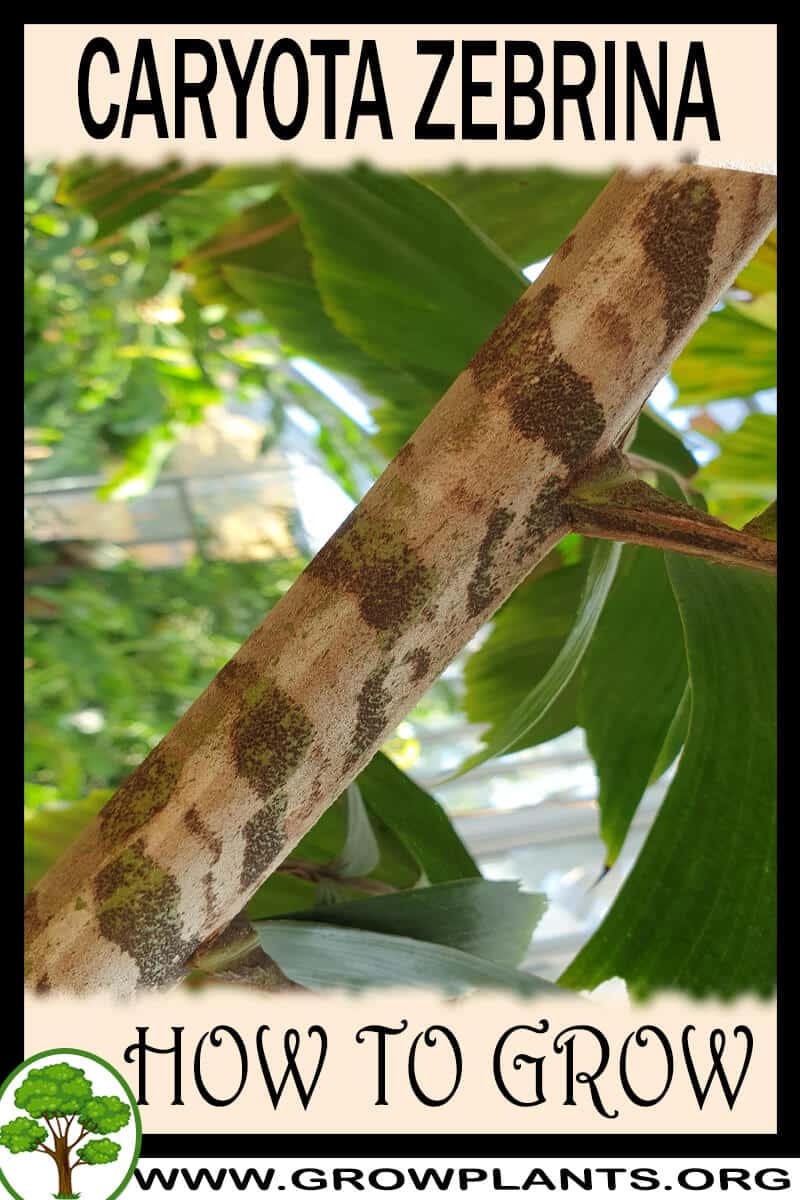
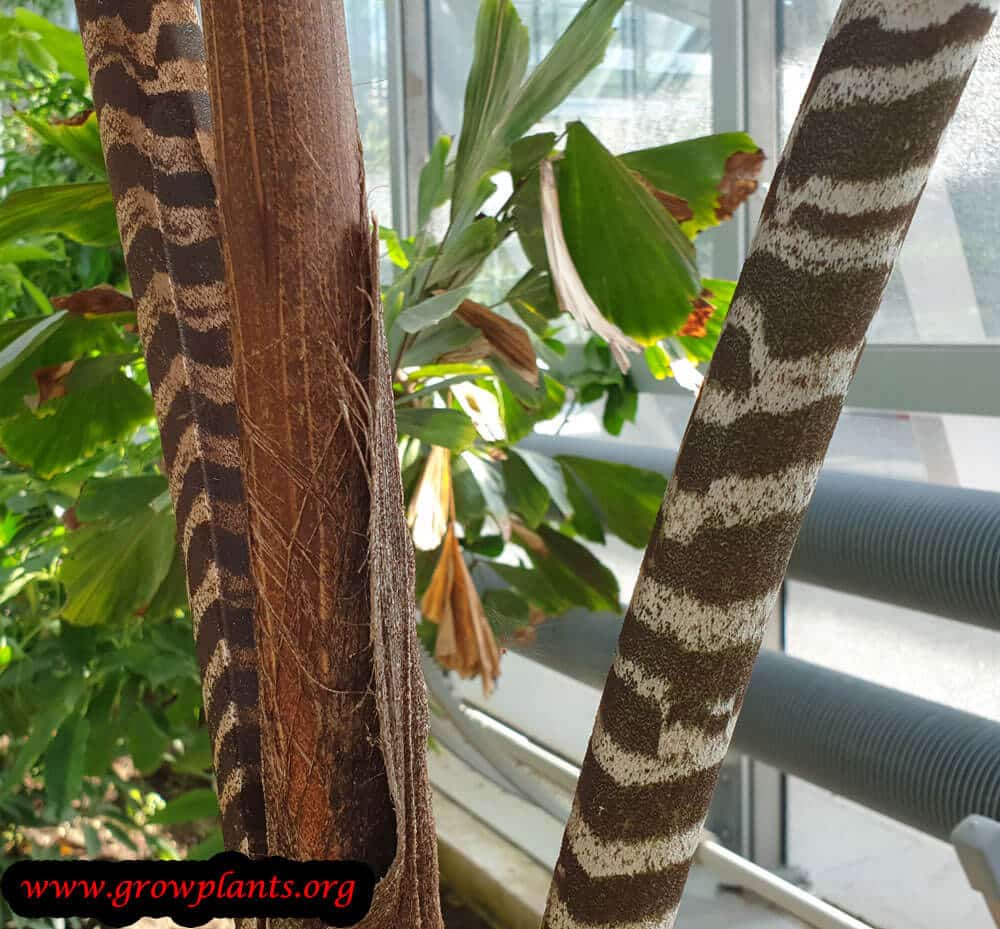
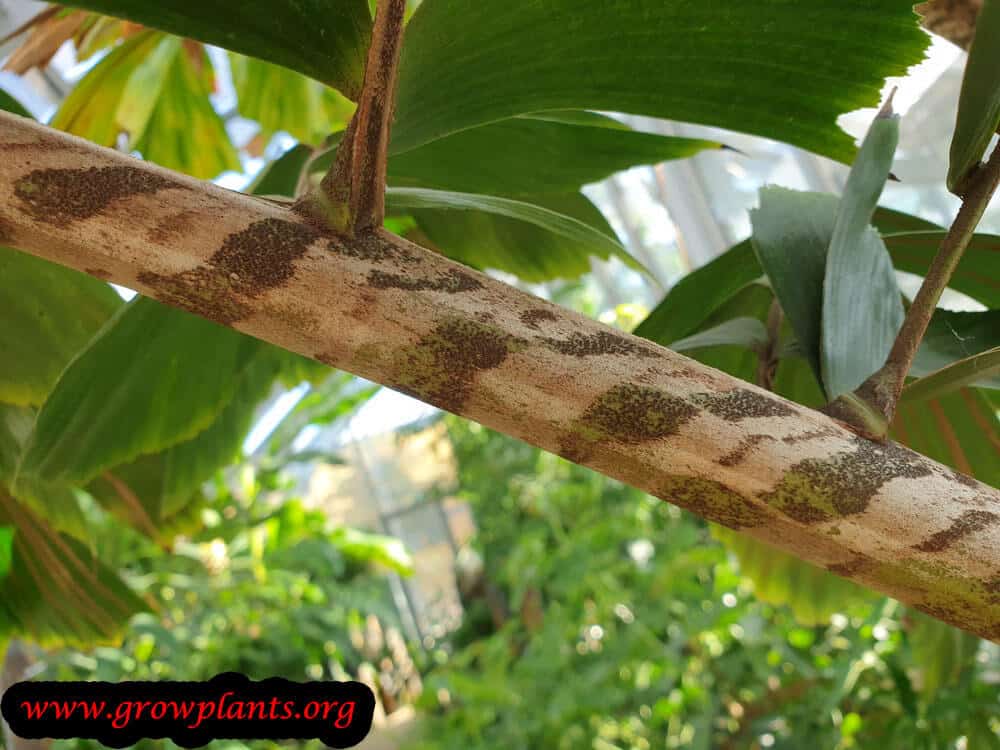
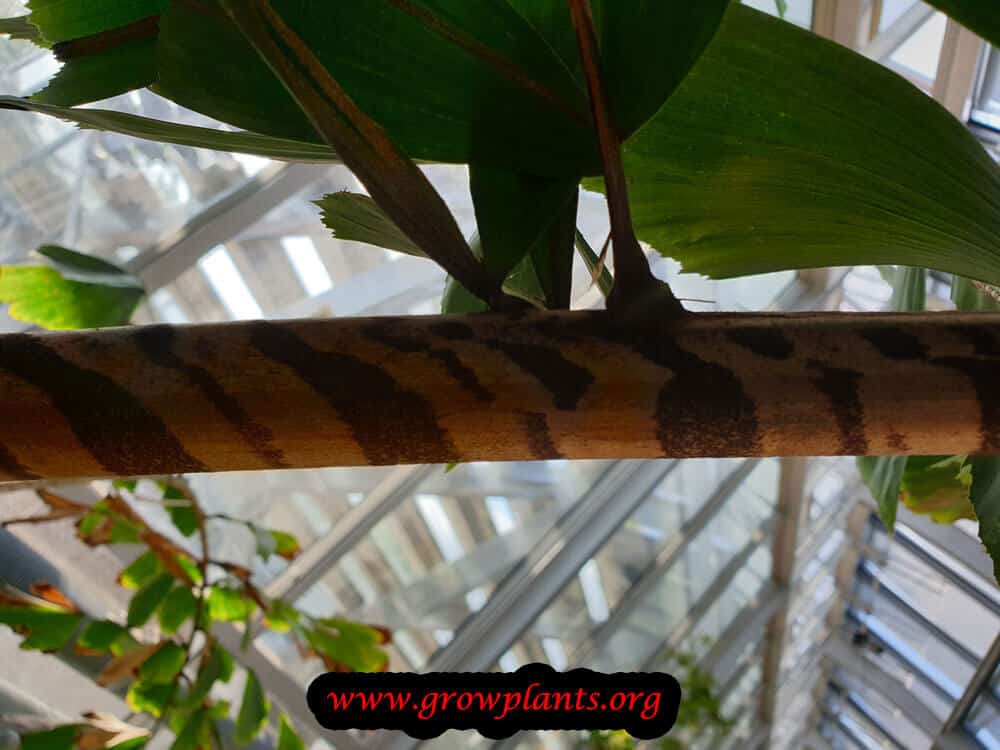
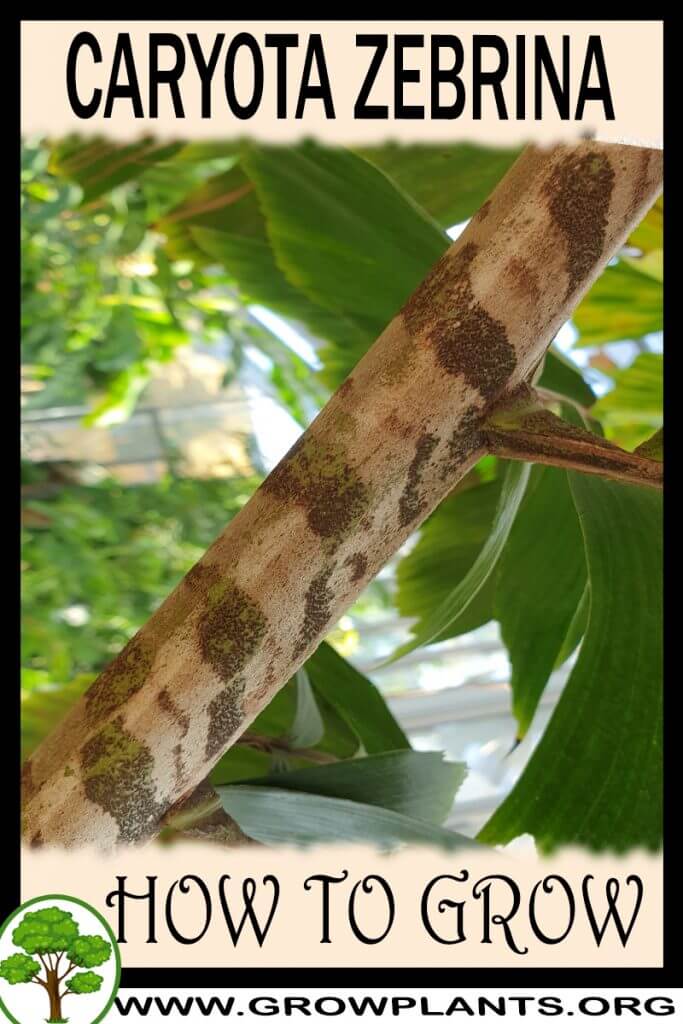
- Growth Habit & Form: Clustering fishtail palm with distinctive black/green/brown zebra-striped stems and a triangular trunk
- Lifespan & Maturity: Monocarpic – flowers from the top downward, then dies
Anatomy & Physical Features
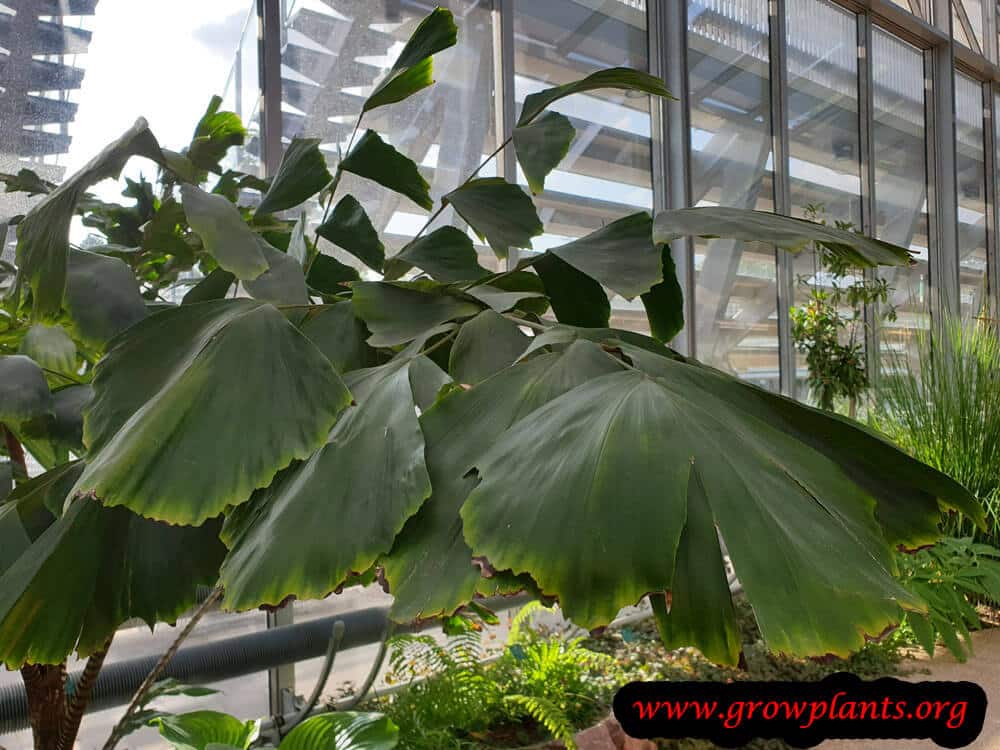
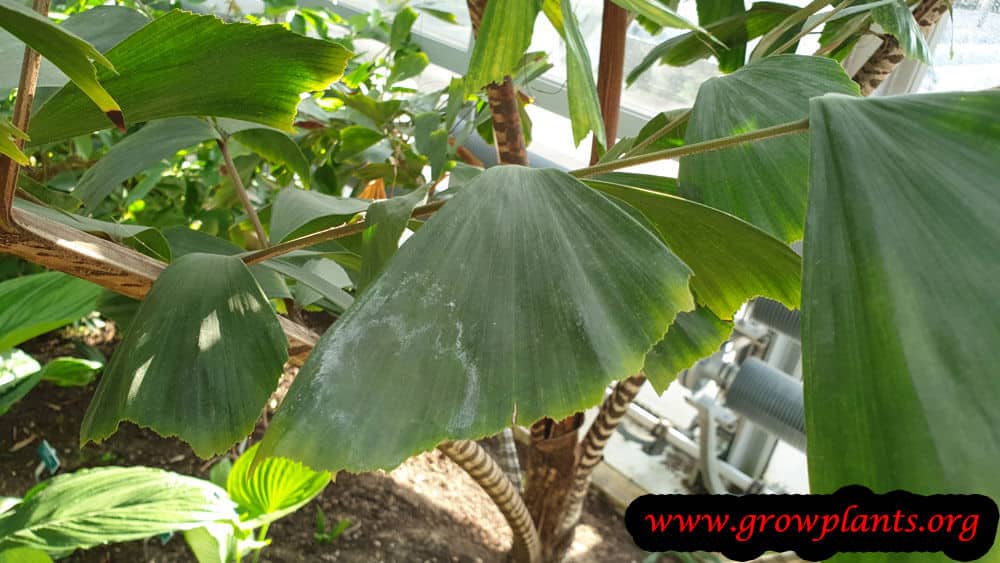
- Trunk & Foliage: Zebra-striped stems; green bipinnate fishtail fronds (about 1 m young to 3 m+ mature)
- Flower Characteristics: Yellow flowers on fronds; separate male and female trees
- Fruit Profile: Oval-to-round red, purple, yellow or black fruit – not edible (irritant)
Primary Uses & Landscape Value
- Functional & Ornamental Roles: Prized ornamental/collector palm grown for its striped stems, for tropical and subtropical landscapes
Care Guide: Planting, Soil & Watering
Overview: A moderate-to-slow-growing tropical palm for full sun to part shade and rich, moist, well-drained soil. It likes plenty of water but needs good drainage, and tolerates only light frost once established.
Quick Care Requirements
| Requirement | Ideal Condition |
|---|---|
| Planting Season | In spring to summer (or autumn in warm climates) |
| Growth Rate | Moderate to slow |
| Soil Type | Rich, moist and well-draining |
| Water Need | Moderate to high – keep consistently moist |
Planting & Establishment
- Best Planting Season: Plant in spring or summer as the soil warms (autumn is fine in warm climates).
- How to Plant:
- Hole Preparation: Dig a hole a little wider than the root ball.
- Soil Amendments: Work in plenty of compost and organic matter for a rich, moisture-retentive yet free-draining soil.
- Planting Depth: Set the root ball at the level it grew, with the crown above the soil.
- Growth Speed & Expectations: Moderate to slow, eventually a tall palm of 6–12 m.
Soil, Watering & Drainage Care
- Soil Mix & Drainage Needs: Rich, humus-filled, well-drained soil; keep it moist but never stagnant. Not suited to long-term container growing.
- Watering Schedule & Technique:
- Young / Newly Planted: Keep evenly moist while establishing.
- Established: Water regularly and generously; do not let it dry out fully.
- Seasonal Adjustments: More in heat, less in cool weather.
Climate, Light & Hardiness
Caryota zebrina is a true tropical-to-subtropical palm that needs consistently warm, humid conditions and grows best in full sun to half shade, with young plants appreciating some shelter. It is reliably hardy only in USDA zone 10 and above, where established specimens may briefly shrug off a light frost but younger palms have very little cold tolerance.
Quick Climate Specifications
| Climate Zones | Tropical, subtropical, Mediterranean, desert (with irrigation and humidity) |
|---|---|
| USDA Hardiness Zones | 10+ |
| Optimal Temp Range | Generally warm, roughly 18–32°C (64–90°F) |
| Cold Damage Begins | Approximately below 5°C (41°F) |
| Approx. Survival Minimum | Around 0°C (32°F) briefly, established plants only |
| Frost Tolerance | Very Low |
| Light Conditions | Full Sun to Half Shade |
Sunlight & Light Exposure
Optimal Light Setup
Mature plants take full sun in humid climates, but juvenile palms and those grown in drier regions do better with half shade to protect the fronds.
Direct Sun Requirement
Not obligatory – full sun is fine for established plants where humidity is adequate, but it is not essential for healthy growth.
Shade & Heat Management
In desert or Mediterranean climates, afternoon shade and higher ambient humidity around the foliage help prevent leaf-tip browning.
Best Exposure / Orientation
A warm, humid spot sheltered from cold drafts and strong drying wind suits this palm best.
Temperature Extremes & Hardiness
USDA Hardiness & Regional Limits
Reliable as a year-round outdoor plant only in USDA zone 10 and warmer; further north it is not a realistic outdoor perennial.
Cold Damage & Winter Protection
Fronds are damaged well before the plant is killed outright; protect young or newly planted palms during any cold snap and keep container specimens under cover once temperatures approach freezing.
Frost Sensitivity
Very low. Site data notes that only an established plant may briefly survive light frost – young palms have essentially no frost tolerance.
Extreme Heat Tolerance
Good, as a genuine tropical palm, provided soil moisture and humidity are maintained through hot spells.
Wind, Humidity & Microclimate
Humidity Preferences
Prefers high humidity, reflecting its origin as a tropical understory palm; in dry climates extra humidity or afternoon shade reduces stress.
Dry-Air Tolerance
Low – arid, dry air can cause leaf-tip browning without added humidity or shelter.
Wind Tolerance
Fronds are relatively delicate for a feather palm; a location sheltered from strong, drying wind is best.
Microclimate Recommendations
A warm, humid, wind-sheltered site with some afternoon shade in hot, dry climates gives the best results; move any container-grown plants under cover before the first risk of frost.
Growing in Pots, Balconies & Indoors
The zebra fishtail palm (Caryota zebrina) is a large tree palm reaching 6-12 m (20-40 ft). The grower marks it as neither a houseplant nor a container plant – it is a landscape palm for the open ground. Only a very young seedling might be held briefly in a large pot before it needs planting out or a greenhouse.
Quick Details
- Container Size: Not recommended – a landscape palm; at most a large tub for a young seedling, short term
- Indoor Suitability: Not suitable – it grows into a 6-12 m tree
- Best Spot: Full sun to half shade, in the ground in a warm climate
- Soil & Drainage: Rich, well-drained soil if a young plant is potted at all
- Watering in Pots: Average to plenty; it likes steady moisture but good drainage
Indoors & On the Windowsill
- Not indoors: The grower marks it unsuitable as a houseplant. Unlike smaller fishtail palms sometimes kept indoors when young, this is a big forest palm that quickly outgrows any room.
- Too large: The grower also marks it unsuitable for pots – it is best planted in open ground in a suitable warm climate.
- Safety: The fruit contains toxic calcium-oxalate crystals that severely irritate skin – handle fruit with care and keep it away from children and pets.
On a Balcony or Patio
- Only while young: A seedling can spend its first year or two in a large tub on a warm, sheltered, part-shaded patio, but plan to plant it out – it will not stay container-sized.
- Practicalities: A big palm becomes heavy and top-heavy; a tub is a short-term nursery stage, not a long-term home.
Choosing the Pot, Soil & Long-Term Care
- Pot & drainage (young plants only): If potting a seedling, use a large, deep, well-drained container – but treat it as temporary.
- Potting mix: Rich, moisture-retentive but free-draining.
- Feeding: Potted plants exhaust and leach nutrients faster than those in the ground, so feed lightly during active growth – more often than you would in open soil.
- Long term: There is no long-term pot culture here – it needs the open ground to reach its natural size.
Growing this plant in a greenhouse
A greenhouse can give caryota zebrina frost protection, cold protection and protection from rain. In the right climate it may also be kept growing through winter, depending on how much warmth and light are provided.
Greenhouse at a glance
| Greenhouse suitability | Conditional - depends on your climate |
|---|---|
| Main benefits | frost protection, cold protection, protection from rain |
| Season extension | earlier spring & later autumn |
| Outdoor protection advisable below | about 5°C |
| Maintain greenhouse minimum | around 5°C for active growth |
| Suitable types | heated greenhouse, glass greenhouse, polycarbonate greenhouse |
| Heating | Heating is optional - useful mainly for winter growing in cold areas. |
Related greenhouse guides
- Greenhouses: How to Choose the Right Greenhouse
- Best Greenhouse Heaters
- Greenhouse Climate Control: Temperature, Ventilation and Humidity
- Polycarbonate Greenhouses: What to Look for Before Buying
Fertilizing & Feeding
A moderate feeder like most palms: feed with a palm-formulated fertilizer through establishment and ongoing growth, since this genus is notably prone to manganese and potassium deficiencies if underfed.
Quick Fertilizing Specs
| Feeding Level | Moderate feeder |
|---|---|
| Main Nutrient Priority | A palm-specific fertilizer with magnesium and potassium alongside balanced nitrogen |
| Best Feeding Period | Through the warm growing season as the crown of fronds develops |
| Organic Options | Mulch maintained over the root zone to buffer nutrients and moisture |
| Reduce/Stop Feeding | Ease off feeding as growth slows in cooler weather |
| Micronutrients | Manganese and magnesium are routinely included in a complete palm fertilizer for this genus |
| Soil pH | Tolerates a wide range in well-drained soil |
Feeding by Growth Stage
Establishment
Help a newly planted palm root in and begin pushing new fronds.
| Nutrient direction | A balanced palm-formulated fertilizer supports steady rooting and early frond growth. |
|---|---|
| Timing | At planting and through the first growing season, mainly in the warmer part of the year. |
| Frequency | A light feeding at planting, renewed as new fronds appear. |
| Fertilizer types | A balanced palm-formulated fertilizer, Mulch maintained over the root zone |
| Precautions | Avoid concentrated fertilizer placed close to young roots, which can burn a newly planted palm. |
Established ongoing growth
Maintain the large pinnate crown of fronds and the striped trunk’s steady growth toward mature size.
| Nutrient direction | A complete palm fertilizer with magnesium and potassium alongside balanced nitrogen supports full, well-colored fronds and helps prevent the deficiencies this genus is prone to. |
|---|---|
| Timing | Through the warm growing season once the palm is established. |
| Frequency | Periodic feeding through the growing season, tapering as growth slows in cooler weather. |
| Fertilizer types | A complete palm-formulated fertilizer with magnesium and potassium |
| Routine trace nutrients | manganese, magnesium |
| Precautions | Use a palm-specific product rather than a generic fertilizer, since palms have distinct trace-nutrient needs. |
Nutrient Deficiency Signs & Corrections
Older fronds develop yellow or orange spotting and necrotic leaflet tips while newer fronds still look normal.
| Possible causes | low soil potassium, common in palms grown in sandy or leached soil, an unbalanced fertilizer history lacking potassium, competition from nearby turf or heavy watering leaching nutrients |
|---|---|
| Appears first on | older, lower fronds |
| What to check | recent fertilizer type and whether it was palm-specific, soil texture and leaching potential, how many older fronds show spotting |
| Possible correction | Switch to a palm-specific fertilizer that supplies potassium and avoid removing marginally deficient fronds too early. |
New emerging fronds come out weak, frizzled, or with dead streaks, a condition sometimes called frizzle top.
| Possible causes | low soil manganese, a well-known issue in this genus, high soil pH limiting manganese availability, poorly drained or compacted soil restricting root uptake |
|---|---|
| Appears first on | the newest emerging fronds |
| What to check | soil pH, drainage and soil compaction, whether a palm-specific fertilizer with manganese has been used |
| Possible correction | Apply a manganese-containing palm fertilizer or a labeled manganese product promptly, since this issue can worsen quickly. |
Older fronds show a broad yellow band along the leaflet margins while the center stays green.
| Possible causes | low soil magnesium, a potassium-heavy feeding history competing with magnesium uptake, leaching in light, sandy soils |
|---|---|
| Appears first on | older, lower fronds |
| What to check | soil magnesium status, recent fertilizer balance between potassium and magnesium, soil texture and drainage |
| Possible correction | Apply a palm fertilizer that includes magnesium and rebalance overall feeding. |
Pruning, Training & Seasonal Maintenance
Caryota zebrina is a single-growing-point palm, so pruning tolerance is low and the rule is simple: remove only fully dead, brown fronds, and never cut green ones, since the palm relies on every living frond for energy and has no side buds to regrow from if the crown is damaged. Fronds are removed mainly in autumn as they die back naturally. There is no structural training, no canopy shaping, and no rejuvenation cutting for this plant – all “pruning” is frond removal and cleanup around the fruit, which is toxic.
Quick Pruning & Maintenance Specs
| Pruning Tolerance | Low – only dead material should ever be cut |
| Primary Pruning Window | Autumn, as fronds naturally die back |
| Typical Frequency | As needed, whenever a frond has fully browned |
| Main Objective | Remove dead fronds; keep the single growing point undamaged |
| Young Plant Priority | Leave all green fronds in place to build trunk and canopy |
| Mature Plant Priority | Remove only fully dead fronds and spent fruit clusters at height |
| Best Tool Type | Pruning saw or pole pruner, depending on frond height |
| Avoid Heavy Pruning During | Always – this species does not tolerate heavy or green-frond pruning at any time |
Pruning by Plant Age & Size
Newly Established
Do not remove any green fronds; a young palm needs its full canopy to build trunk and root reserves.
Young / Formative
No structural training applies – palms grow from a single crown and cannot be shaped by cutting. The only task is removing fronds once they have fully died, never while still green or yellowing.
Mature / Established
At its mature height of 6–12m, remove fully brown, dead fronds as they occur, along with spent fruit clusters if desired; green fronds, even older lower ones that still have some green tissue, should stay on the palm.
Special Growth to Remove
- Fully dead, brown fronds – remove at the base of the frond stem once no green tissue remains
- Spent fruit clusters, mainly for tidiness and because the fruit is toxic – remove with care, avoiding skin contact, once the fruiting stalk has finished
Tools
- Pruning saw – for cutting through the thick base of dead frond stems
- Pole pruner – for reaching dead fronds and fruit clusters on a mature palm well above head height
Tool Hygiene & Disease Risk
Routine: clean, sharp tools are sufficient for frond removal; no specific disease-transmission risk is noted for this species. The main safety concern is the toxic fruit – wear gloves when handling cut fruit clusters or fallen fruit during cleanup.
Cut Placement & Technique
Cut dead fronds at the base of the frond stem rather than leaving long stubs, taking care not to nick the trunk or the growing point at the crown, since damage there cannot be repaired or regrown.
Heavy Pruning & Rejuvenation
Not tolerated. This palm has a single growing point and cannot be cut back or rejuvenated the way a branching shrub or tree can – removing anything beyond fully dead fronds risks permanent damage or loss of the plant.
Post-Pruning Care
No special aftercare is needed after removing a dead frond; water and feed on the plant’s normal schedule rather than in response to pruning.
Common Pruning Mistakes
- Over-pruning by removing green or partially green fronds for a “cleaner” look, which weakens the palm since it cannot regrow lost fronds on demand
- Cutting into or nicking the trunk or crown while removing a dead frond
- Handling fallen or cut fruit without gloves, given its toxicity
When NOT to Prune
Never remove green or yellowing fronds – wait until a frond is fully brown and dead before cutting it.
Recommended Tools (by task)
- Pruning saw – cutting dead frond bases close to the trunk
- Pole pruner – reaching fronds and fruit clusters high on a mature palm
Pruning Troubleshooting
| Problem | Possible Cause | What to Check | Corrective Action |
| Thin, sparse-looking crown | Over-pruning of green or yellowing fronds | Count of remaining green fronds versus what a healthy palm this size should carry | Stop cutting anything but fully dead fronds; allow the canopy to rebuild naturally over subsequent seasons |
| Skin irritation after handling fruit or frond debris | Contact with the toxic fruit or its residue | Whether gloves were worn during cleanup | Wash exposed skin, wear gloves for all future fruit/debris handling |
| No new frond emerging from the crown | Damage to the single growing point | Inspect the crown for wounds, rot, or pest damage rather than assuming a pruning cause | If the growing point is damaged, the palm cannot recover this crown; consult on removal rather than further pruning |
Propagation Guide
Caryota zebrina is propagated mainly from seed, which is true-to-type since it isn’t a cultivated hybrid, though basal suckers can also be used where the clump produces them and offer a faster route to an established plant. Seed germination in palms is typically slow and can be uneven, so overall difficulty is Moderate.
Quick Propagation Specs
| Best Propagation Method | Seed |
| Alternative Methods | Suckers |
| Propagation Difficulty | Moderate |
| Seed True-to-Type | Yes |
| Best Propagation Season | Spring, summer; also autumn in warm climates |
Growing from Seed
Seed Handling & Viability
Seed is taken from the non-edible red, purple, yellow, or black fruit. Wear gloves when cleaning the pulp away, since Caryota fruit pulp contains irritating calcium-oxalate crystals consistent with the toxicity the site itself notes as a growing difficulty; fresh seed generally germinates more readily than seed that has been stored a long time.
Germination Conditions
Sow cleaned seed in a warm, humid environment with good drainage.
Germination Time
Germination is typically slow and can be irregular over an extended period, as is common for palm seed generally.
Division, Offsets, Pups & Suckers
Where the plant produces basal suckers, these can be separated once they have their own roots established and potted on independently; not every sucker will have formed enough of its own root system to survive separation, so it’s worth checking root development before cutting one away from the parent.
Bloom & Flower Guide
Quick Details
- Bloom Season: Spring and summer
- Time to First Bloom: Only when the palm is well established and mature, after many years
- Flower Appearance: Large, branching, pendulous flower clusters bearing dozens of small yellowish flowers
- Edibility: Not eaten; grown as an ornamental palm. The later fruits carry irritating crystals, so handle the plant with care.
Detailed Blooming Overview
Fishtail palms flower quite unlike most houseplants. When mature, the palm produces big, branching, hanging inflorescences that trail down like horse-tails, each carrying dozens of small yellowish flowers. Both male and female flowers are borne on the same plant (it is monoecious), so a single palm can flower and set seed on its own. Caryota is also unusual in being monocarpic from the top down: the palm flowers progressively from the crown downward, and the flowering stem dies once it has fruited, though clustering forms carry on from side shoots.
Flower Characteristics
- Large, branching, pendulous clusters along the upper trunk.
- Dozens of small yellowish flowers per cluster.
- Male and female flowers on the same plant.
Bloom Care & Thinning
- Understanding the habit: Flowering marks the final phase of a stem’s life, so once the top of a single-stemmed palm blooms and fruits, that stem will decline; clumping plants continue from offshoots.
- Handling: The developing fruits contain irritating oxalate crystals, so wear gloves if you clean up fallen flower or fruit debris.
Pests, Diseases & Troubleshooting
Overview: Caryota zebrina (zebra fishtail palm) is a rare Borneo species; species-specific pest data is thin, so this profile follows the well-established Caryota/palm genus pattern. Expect the same sap-sucking pests under cover (spider mites, scale, mealybugs) and moisture-driven crown, leaf and trunk diseases (leaf spot, pink and bud rot, Ganoderma), plus the monocarpic once-flowering life cycle. Being tropical and humidity-loving, it is especially prone to tip burn in dry indoor air; verify local conditions.
Quick Troubleshooting Overview
| Issue / Pest | Main Symptom | Primary Solution |
|---|---|---|
| Spider mites | Stippled, bronzed fronds with fine webbing in dry air | Raise humidity, rinse fronds, horticultural oil |
| Scale / mealybug | Bumps or white cottony masses, honeydew, sooty mold | Wipe/scrape off, prune, oil or systemic indoors |
| Leaf spot / blight | Brown-black spots with yellow halos on fronds | Airflow, no overhead water, remove fronds, copper |
| Ganoderma butt rot | Wilt, decline, shelf-like conks at trunk base | Incurable — remove palm and stump, do not replant there |
| Bud / pink rot | Spear pulls out, mushy brown crown after cold/wet | Keep crown dry, protect from cold, early fungicide drench |
| Monocarpic decline | Old palm flowers top-down then dies | Natural life cycle; keep suckers on clumping types |
Common Pests & Management
- Spider mites (Tetranychus / Oligonychus spp.):
- Symptoms: Fine yellow stippling, dull bronzed fronds and faint webbing along the fishtail leaflets, worst indoors or in hot, dry, low-humidity air; a leading pest of palms grown under cover.
- Prevention & Control: Raise humidity and rinse the fronds regularly, including undersides; wipe indoor plants; introduce predatory mites. Horticultural oil or insecticidal soap controls active infestations — repeat every 5-7 days.
- Scale insects (Coccidae / Diaspididae):
- Symptoms: Brown, tan or white bumps along the frond stalks, midribs and undersides that do not rub off; yellow blotches, weakening, and honeydew with sooty mold from soft scales; a very common palm pest.
- Prevention & Control: Wipe or scrape off accessible scale; prune severely infested fronds; conserve natural enemies. Horticultural oil smothers scale and crawlers; systemic options exist for heavy indoor infestations.
- Mealybugs (Pseudococcus / Planococcus spp.):
- Symptoms: White cottony masses in the crown, leaf bases and along the rachis, with honeydew and sooty mold; troublesome on indoor and greenhouse palms, including at the roots.
- Prevention & Control: Wipe off with alcohol-dipped swabs; wash the crown; isolate affected plants. Neem or horticultural oil and insecticidal soap manage colonies; check the root zone for root mealybug.
- Palm aphids (Cerataphis / Aphididae):
- Symptoms: Clusters of dark, rounded aphids on new fronds and flower/fruit stalks, with honeydew and sooty mold; mostly a cosmetic weakener on stressed palms.
- Prevention & Control: Rinse off with water; encourage beneficials. Insecticidal soap or horticultural oil handles persistent colonies.
Diseases & Fungal Issues
- Fungal leaf spot and leaf blight (Exserohilum / Bipolaris / Helminthosporium spp.):
- Symptoms: Small water-soaked spots that enlarge into brown-to-black lesions with yellow halos, sometimes merging into blighted areas on the fronds; worst in warm, wet, crowded, poorly ventilated conditions.
- Treatment & Management: Avoid overhead watering and wetting the foliage; improve airflow and spacing; remove badly spotted fronds. Copper fungicide checks spread where the problem is persistent, but cultural fixes come first.
- Ganoderma butt rot (Ganoderma zonatum):
- Symptoms: Incurable rot of the lower trunk with wilting, a general decline, and shelf-like (conk) fungal brackets forming at the trunk base; the palm collapses as the internal trunk is destroyed.
- Treatment & Management: There is no cure and no chemical control: remove and destroy affected palms including the stump, and do not replant a palm in the same spot. Avoid trunk wounds, which can invite infection.
- Pink rot (Nalanthamala vermoesenii (Gliocladium)):
- Symptoms: Rotting of the crown, emerging spear and frond bases with pinkish spore masses, stunted or distorted new growth; typically attacks palms already stressed by cold, wounds or poor culture.
- Treatment & Management: Correct the underlying stress (cold, overwatering, nutrient deficiency); remove infected tissue; improve conditions. Fungicide can support recovery, but a vigorous, well-grown palm rarely succumbs.
- Bud/crown rot (Phytophthora / Thielaviopsis):
- Symptoms: The central spear pulls out easily and the bud turns brown and mushy, often after cold, injury or waterlogging; loss of the single growing point can kill a solitary palm.
- Treatment & Management: Keep water out of the crown, especially in cool weather; improve drainage; protect from cold. Drenching the crown with a suitable fungicide early may save the bud if the growing point is still alive.
Growing Difficulties & Abiotic Problems
- Monocarpic (once-flowering) decline:
- Cause & Symptoms: Mature Caryota flower from the top down over several years and then die after the lowest inflorescence fruits — a natural life-cycle end, not a disease; solitary species die entirely, while clustering types survive via suckers.
- Correction Strategy: Recognize top-down flowering as the natural finale rather than a problem to treat; for clustering species keep well-spaced suckers to continue the clump; plan replacements for solitary specimens.
- Cold damage and leaf/tip burn:
- Cause & Symptoms: Browning of frond tips and margins and spotting from cold, low humidity, dry air, fluoride/salts in water, or fertilizer burn; these tropical palms are cold-sensitive and dislike dry indoor air.
- Correction Strategy: Keep warm and draft-free; raise humidity for indoor plants; water with low-fluoride water and flush pots to prevent salt buildup; feed lightly and evenly. Trim only fully browned tissue.
- Root rot from overwatering and nutrient deficiency:
- Cause & Symptoms: Yellowing, wilting and decline from soggy, poorly drained soil, and frizzled or discolored fronds from deficiencies (notably potassium and magnesium) common in palms.
- Correction Strategy: Use a well-drained mix and let the surface dry between waterings; never leave the pot standing in water; feed with a balanced palm fertilizer carrying micronutrients to prevent the classic palm deficiencies.
What Helps — Products & Tools
For fishtail palms, keep horticultural oil and insecticidal soap (spider mites, scale, mealybug, aphids) and raise humidity to deter mites indoors. Use copper fungicide for persistent leaf spot and a suitable fungicide drench for early crown/bud rot; there is no treatment for Ganoderma, so remove affected palms. A balanced palm fertilizer with micronutrients prevents the potassium/magnesium deficiencies palms are prone to, and careful, well-drained watering prevents root and crown rot. (Note: the fruit pulp contains irritating oxalate crystals — wear gloves when handling.)