Plant Profile & Key Characteristics
Overview: A low, creeping evergreen succulent subshrub only 5-20 cm (2-8 in) high but spreading widely into a fleshy mat. Grown as a tough, drought- and salt-tolerant ornamental groundcover, especially for hot, sandy and coastal sites.
Quick Specifications
| Specification | Attribute |
|---|---|
| Plant Type / Life Cycle | Evergreen succulent subshrub (perennial) |
| Foliage Type | Evergreen |
| Mature Size | 5-20 cm (2-8 in) tall, spreading indefinitely |
| Growth Rate | Moderate to fast |
| Root System | Shallow; creeping stems root at the nodes as they spread |
| Toxicity | Non-toxic – sea purslane (S. portulacastrum) is eaten as an edible halophyte |
| Hardiness | USDA zone 9+ |
Growth Form & Structure
- Height & Spread: Hugs the ground at 5-20 cm (2-8 in) and runs out as far as it is given room; spills attractively from pots and baskets.
- Growth Habit & Form: Prostrate, mat-forming succulent with fleshy trailing stems that root as they spread.
- Lifespan & Maturity: Fast-spreading and long-lived groundcover, easily renewed from cuttings.
Anatomy & Physical Features
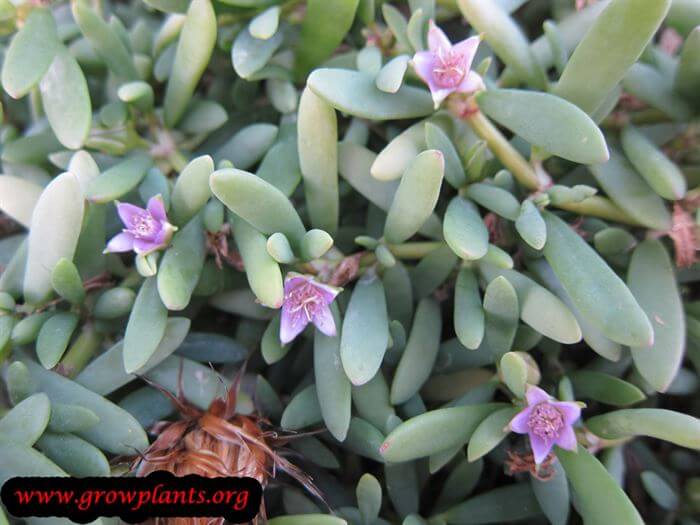
- Leaves & Foliage: Fleshy, linear to spoon-shaped green leaves.
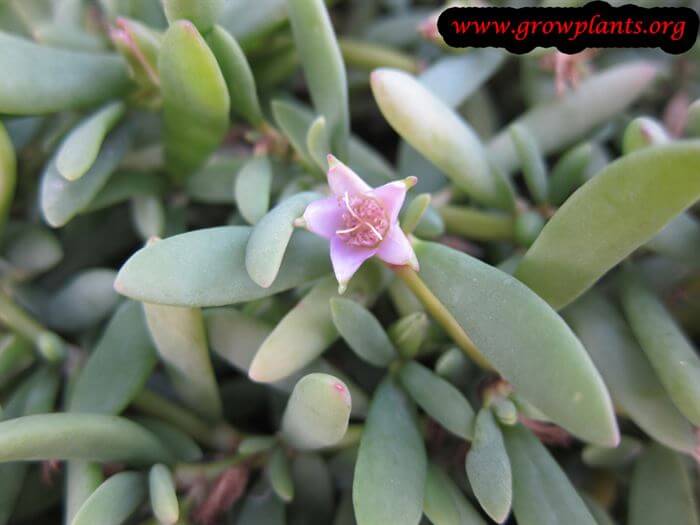
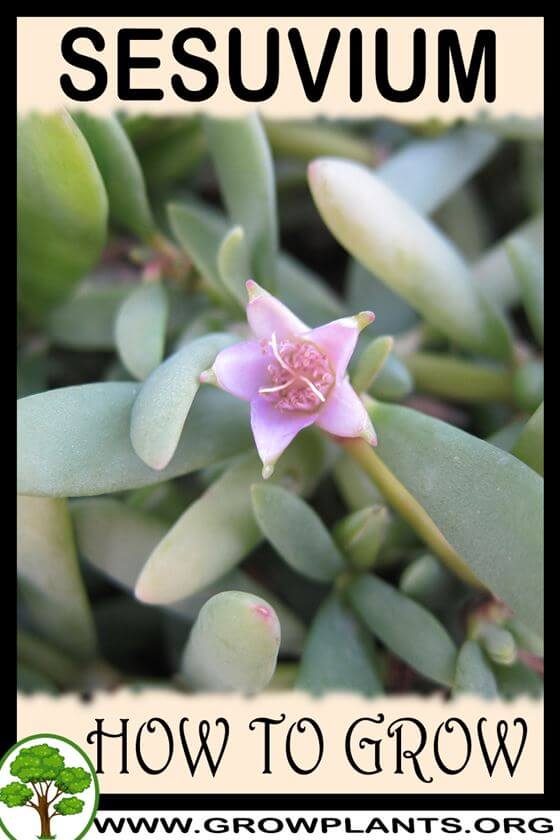
- Flower Characteristics: Small, star-shaped flowers in purple to pink.
Primary Uses & Landscape Value
- Functional & Ornamental Roles: Salt- and drought-tolerant groundcover for coastal, sandy and reclaimed sites; erosion control and an ornamental spiller for containers.
Care Guide: Planting, Soil & Watering
Overview: Sesuvium (Iceplant) is a low, spreading succulent groundcover that grows best in full sun with sandy, sharply drained soil. Its fleshy leaves store water, so it is highly drought- and salt-tolerant and needs only minimal irrigation.
Quick Care Requirements
| Requirement | Ideal Condition |
|---|---|
| Planting Season | In spring, summer or autumn during the warm season |
| Growth Rate | Moderate to fast |
| Soil Type | Sandy, sharply drained soil; tolerates poor and salty soils |
| Water Need | Low — drought-tolerant; let the soil dry between waterings |
Planting & Establishment
- Best Planting Season: Plant during the warm season (spring through autumn); it is hardy in zone 9 and warmer and thrives in hot, sunny coastal conditions.
- How to Plant:
- Hole Preparation: Dig a shallow hole slightly wider than the root ball in free-draining, sandy soil.
- Soil Amendments: Mix coarse sand or grit into heavy soil to sharpen drainage; it thrives in lean, poor soil and needs no rich feeding.
- Planting Depth: Set the plant at its original depth with the fleshy stems resting on the surface — the trailing stems will root as they spread.
- Growth Speed & Expectations: Moderate to fast, wide-spreading growth that quickly carpets the ground; it can be invasive, so contain it where spread is unwanted.
Soil, Watering & Drainage Care
- Soil Mix & Drainage Needs: Use a gritty, sandy, free-draining mix; in containers make sure excess water drains away, as soggy soil rots the succulent stems.
- Watering Schedule & Technique:
- Young / Newly Planted: Water lightly after planting to settle the roots, then let the soil dry before watering again.
- Established: Very drought-tolerant once established — water only occasionally when the soil has fully dried.
- Seasonal Adjustments: A little more water in extreme summer heat; keep it dry through cooler, wetter weather.
Climate, Light & Hardiness
Sesuvium is a low, mat-forming succulent groundcover adapted to warm subtropical, Mediterranean, desert, tropical, and temperate climates, and it is a natural colonizer of beaches and dunes. It wants full sun to half shade, and it is only reliably hardy where winters stay essentially frost-free.
Quick Climate Specifications
| Climate Zones | Subtropical, Mediterranean, Desert, Tropical, Temperate |
|---|---|
| USDA Hardiness Zones | 9+ |
| Cold Damage Begins | Fleshy foliage is damaged by frost and near-freezing temperatures, consistent with its zone 9+ hardiness limit |
| Approx. Survival Minimum | Zone 9 corresponds to a typical average minimum extreme of roughly −6 to −1°C (20–30°F); colder exposure is generally fatal |
| Frost Tolerance | Low |
| Light Conditions | Full Sun / Half Shade |
| Wind Tolerance | High |
| Salt / Coastal Tolerance | High |
Sunlight & Light Exposure
Optimal Light Setup
Full sun gives the densest, most floriferous groundcover; half shade is tolerated but growth becomes looser.
Shade & Heat Management
Handles full desert and coastal sun and heat well once established; part shade in the hottest inland climates can ease stress.
Best Exposure / Orientation
Open, unshaded ground or coastal-facing slopes suit its natural dune and beach habit.
Temperature Extremes & Hardiness
USDA Hardiness & Regional Limits
Hardy outdoors year-round only in USDA zone 9 and warmer; in colder regions it behaves as a warm-season groundcover that is killed back by winter freezes.
Cold Damage & Winter Protection
Frost blackens and kills the fleshy foliage; in marginal areas it needs winter protection or is best treated as a warm-season planting.
Frost Sensitivity
Frost-sensitive succulent tissue; avoid planting in exposed frost pockets.
Wind, Humidity & Microclimate
Humidity Preferences
Naturally adapted to both humid coastal air and dry desert conditions, reflecting its wide native and adapted climate range.
Dry-Air Tolerance
Handles dry air well once established, being a succulent.
Wind Tolerance
High - it naturally grows on open beaches and dunes exposed to strong onshore winds.
Coastal / Salt Tolerance
High - a classic beach and dune groundcover, tolerant of salt spray and saline sandy soils.
Microclimate Recommendations
Well suited to exposed coastal gardens, sandy banks, and other harsh, well-drained sites where many other groundcovers struggle.
Growing in Pots, Balconies & Indoors
Sesuvium (Iceplant) is a low, fast-spreading succulent ground cover with fleshy leaves and pink-to-purple star flowers. The grower does not consider it a houseplant – it wants full sun to half shade – but it grows very happily in pots and troughs, where a container also usefully reins in its invasive, wide-spreading habit.
Quick Details
- Container Size: A wide, shallow pot or trough – it spreads sideways rather than down; a container also helps contain its invasive habit
- Indoor Suitability: Not a deep-room houseplant; only a very bright, sunny sill will keep it compact and flowering
- Best Spot: Full sun to half shade – the sunnier the better
- Soil & Drainage: Sandy, sharply drained mix; strong drainage holes
- Watering in Pots: Small amounts – it is drought-tolerant; let the surface dry before watering again and never leave it waterlogged
Indoors & On the Windowsill
- Houseplant limits: The grower marks it as not suitable as an indoor houseplant – in a room the light is too weak and the trailing stems stretch and go leggy.
- Windowsill growing: On the sunniest sill it can be grown as a trailing succulent; give it direct sun and trim it back to keep it neat, as it grows fast and wide.
On a Balcony or Patio
- Light & spread: A superb sunny-balcony trailer for the edge of a large pot or railing planter, spilling over the sides. Pots dry fast in reflected wall heat, but its drought tolerance takes that in stride – just avoid a soggy pot.
- Keep it contained: Because it is invasive in the open ground, a pot or raised planter is actually the tidiest way to enjoy it; deadhead and shear back to control spread.
Choosing the Pot, Soil & Long-Term Care
- Pot & drainage: A wide, free-draining pot with strong holes; skip a standing water saucer to avoid root rot. Terracotta suits it as it breathes and dries fast.
- Potting mix: A sandy, gritty succulent mix; add perlite for extra drainage. A ready-made cactus and succulent soil mix provides that structure without mixing it yourself.
- Feeding: Undemanding – a light dilute feed once or twice in the growing season is enough, as pots leach nutrients.
- Repotting: Fast growth means it fills a pot quickly; refresh the mix or divide and replant every year or two, trimming back the spreading stems.
Fertilizing & Feeding
A light feeder. This mat-forming iceplant relative thrives in lean, sandy, fast-draining soil and spreads vigorously on its own; a little feeding during its long warm-season growth spurt is enough, and none is needed once growth slows in cooler weather.
Quick Fertilizing Specs
| Feeding Level | Light feeder |
|---|---|
| Main Nutrient Priority | A diluted, low-nitrogen feed; this spreading ground cover already grows fast without extra nitrogen |
| Best Feeding Period | The warm active growing season, spring through autumn |
| Organic Options | A thin topdressing of compost worked into the sandy mix at planting |
| Reduce/Stop Feeding | Stop feeding as growth slows in cool weather |
| Micronutrients | Usually adequate from a complete fertilizer; correct only a diagnosed issue |
| Soil pH | Tolerates a wide range in well-drained sandy soil |
Feeding by Growth Stage
Warm-season spreading growth
Support this fast-spreading ground cover’s mat growth and its long spring-to-autumn bloom without pushing it to become even more vigorous.
| Nutrient direction | A diluted, low-nitrogen complete fertilizer; this plant already spreads readily and has a known tendency to naturalize, so extra nitrogen is rarely useful. |
|---|---|
| Timing | Through the warm active growing season while the mat is spreading and flowering. |
| Frequency | Feed sparingly; a light feeding once new growth is established is usually enough for a full season. |
| Fertilizer types | A diluted, low-nitrogen complete fertilizer, A cactus and succulent fertilizer used at reduced strength, A light topdressing of compost in sandy soil |
| Precautions | Keep feeding light and always apply to moist soil; this vigorous ground cover can become weedy in rich, over-fed beds, and salt can build up quickly in fast-draining sandy soil. |
Cool-season slowdown
Let the mat rest through the cooler part of the year without pushing growth it cannot use.
| Nutrient direction | None – withhold fertilizer while growth has slowed or stopped in cool weather. |
|---|---|
| Timing | Cool weather and any period when the mat is clearly not actively spreading or flowering. |
| Frequency | No feeding at this stage; resume only once warm-season growth returns. |
| Fertilizer types | No feeding at this stage; do not fertilize until active growth resumes. |
| Precautions | Do not fertilize a resting planting; feeding now only encourages unwanted spread and risks salt injury in sandy soil that is watered sparingly. |
Nutrient Deficiency Signs & Corrections
Fleshy leaves fade to pale green and the mat spreads and flowers weakly over a full season.
| Possible causes | very low available nitrogen in lean, sandy soil, nitrogen leaching quickly from fast-draining sandy soil, a planting never fed since establishment |
|---|---|
| Appears first on | older growth throughout the mat |
| What to check | when the planting was last fed, soil texture and drainage, whether pale color is simply this plant’s normal grey-green cast |
| Possible correction | During the warm season apply a single diluted, low-nitrogen feeding to moist soil; avoid overcorrecting an already vigorous spreader. |
Leaf tips brown or the fleshy foliage looks scorched despite regular light watering.
| Possible causes | fertilizer-salt buildup in fast-draining sandy soil, feeding at too high a strength for a lean-feeding succulent ground cover, feeding onto dry soil |
|---|---|
| Appears first on | leaf tips and outer mat edges |
| What to check | how strong and how often recent feeding has been, whether fertilizer was applied to dry soil, any visible salt crust on the sandy surface |
| Possible correction | Ease off feeding, water thoroughly to flush accumulated salts through the fast-draining soil, then return to only light warm-season feeding. |
New growth at the spreading tips turns pale or yellow between the veins while older leaves stay greener.
| Possible causes | iron tied up by overly wet or poorly drained soil, high soil pH reducing iron availability, root stress from soggy conditions limiting uptake |
|---|---|
| Appears first on | new growth at the spreading tips |
| What to check | drainage and how long the soil stays wet, soil pH, root condition for rot from overwatering |
| Possible correction | Improve drainage and let the soil dry properly between waterings; correct pH if high and, only if a true deficiency is confirmed, apply a chelated iron product per its label. |
Pruning, Training & Seasonal Maintenance
Sesuvium (Iceplant) is a fast-spreading, fleshy-leaved succulent groundcover that needs almost no formal pruning – its only strictly routine cut is deadheading – but its documented invasive spreading habit makes size and spread control the real pruning objective in garden use. Because it is evergreen and grows year-round within its hardiness range (zone 9+), trimming can be done any time active growth is underway, and the plant tolerates being cut back hard to rejuvenate a thin or overgrown mat, since low spreading succulents like this resprout readily from remaining stem material.
Quick Pruning & Maintenance Specs
| Pruning Tolerance | Moderate (tolerates cutback well; structural work is minimal) |
| Primary Pruning Window | Active growing season (Spring–Autumn) |
| Secondary Maintenance Window | Any time, for spread control or dead-flower removal |
| Typical Frequency | Occasional shearing-back to control spread; ongoing deadheading |
| Main Objective | Contain spread; renew a thinning mat; remove spent flowers |
| Young Plant Priority | Pinch tips to encourage a denser, fuller mat |
| Mature Plant Priority | Cut back the mat’s edges/height to control its spread |
| Best Tool Type | Precision snips |
| Avoid Heavy Pruning During | Winter or any cold spell near the low end of its hardiness range |
Pruning by Plant Age & Size
Newly Established
Leave the young planting to spread and root in; pinch only if it looks sparse, to encourage lateral branching.
Young / Formative
No structural training applies to a prostrate groundcover – simply pinch stem tips occasionally to thicken the mat before it fills in.
Mature / Established
Once established, this species can “grow widely as long as given” room, and is separately flagged as invasive. The main mature-plant task is trimming back the mat’s spreading edges and, if it becomes patchy or woody at the base, shearing the whole planting back hard to force fresh, denser regrowth.
Seasonal Pruning Schedule
Ongoing Sanitary – Objective: tidiness and repeat flowering. Remove: spent star-shaped flowers and any dead or blackened stem sections. Do not remove: actively growing stem tips. Expected response: continued flower production. Flowering impact: none negative – deadheading simply keeps the display tidy.
Summer Canopy Management – Objective: contain this fast-spreading groundcover within its bed or container. Remove: runners/stems that have crept past the intended edge. Do not remove: the dense interior mat, which provides the groundcover effect. Expected response: vigorous re-spread from the remaining mat given the plant’s fast growth rate, so edge-trimming is an ongoing task rather than a one-time fix. Flowering impact: none.
Structural Pruning & Training
Spread control is the only meaningful structural task. Left unchecked, this species spreads indefinitely as ground cover and is flagged invasive, so periodically shearing back the mat’s perimeter keeps it within bounds. If the center of an older planting becomes woody and sparse, cutting the whole mat back hard encourages denser regrowth from the remaining stems.
Special Growth to Remove
- Runners/stolons that root as they spread – trim these back at the desired bed or container edge to stop the planting from encroaching on neighboring areas, consistent with its documented invasive tendency.
- Spent flowers can be left or removed for tidiness; removing them has no real effect on future bloom since new flowers form continuously on new growth.
Container & Small-Space Pruning
Well suited to containers, where its spreading habit is naturally contained by the pot. Still pinch or trim tips periodically to prevent the trailing stems from becoming sparse and leggy, and don’t hesitate to cut a container specimen back hard if it thins out – it regrows quickly given its fast-to-medium growth rate.
Tools
Precision snips for pinching tips and deadheading the fine flowers and stems. Garden spade for slicing through and lifting rooted runner sections at a bed edge – more effective and cleaner than shears on a spreading, rooting mat like this.
Tool Hygiene & Disease Risk
Routine. Only snails and slugs are a pest concern, with no specific disease risk noted – clean tools are sufficient.
Cut Placement & Technique
Trim runners back to just beyond a rooted node so the remaining piece continues to anchor and fill in behind the cut. When dividing spreading sections for propagation or edge control, slice cleanly through the rooted runner rather than tearing it, to avoid ragged damage to the parent mat.
Heavy Pruning & Rejuvenation
Tolerated well: because this is a low, soft-stemmed spreading succulent rather than a single-point cactus, cutting the whole planting back hard rejuvenates a thin or woody-based mat, and it typically regrows densely from the remaining stem base given its fast-to-medium growth rate.
Post-Pruning Care
Water normally; avoid extra feeding purely because the plant was cut back, since a hard trim already stimulates vigorous regrowth in a fast grower like this. Keep an eye on cut edges in humid conditions for any rot, though no specific disease risk is noted for this species.
Common Pruning Mistakes
- Letting the mat spread unchecked and then being surprised by its documented invasive habit – regular edge-trimming from early on is far easier than reclaiming overrun ground later.
- Pulling rather than cutting runners, which can uproot sections meant to be kept.
- Assuming this succulent groundcover needs the same infrequent, minimal-cut treatment as a cactus, when its fast spread genuinely calls for more frequent maintenance trims.
When NOT to Prune
Avoid a hard cutback during cold weather near the low end of its zone 9+ hardiness range, when the plant is least able to push fast regrowth. Don’t remove healthy interior mat growth just for looks – the dense mat is the groundcover function itself.
Recommended Tools (by task)
- precision_snips: deadheading and fine tip-pinching on the soft, fleshy stems.
- garden_spade: slicing through and lifting rooted runner sections at the bed edge to contain spread or divide for propagation.
Propagation Guide
Sesuvium is most easily and quickly increased from stem cuttings, since this trailing succulent roots readily at the leaf nodes; seed is also a viable option and comes true for the species. Propagation is easy and forgiving, whether started indoors or in the open ground.
Quick Propagation Specs
| Best Propagation Method | Stem cuttings |
| Alternative Methods | Seed; self-rooting of trailing stems where they touch soil |
| Propagation Difficulty | Easy |
| Seed True-to-Type | Yes (species) |
| Vegetative True-to-Type | Yes |
| Best Propagation Season | Spring, summer or autumn |
| Cutting Rooting Time | Typically a couple of weeks in warm conditions |
| Germination Temperature | Warm, roughly 20–25°C (68–77°F) |
| Seed Sowing Depth | Surface-sow or barely cover |
Growing from Seed
Sowing Season
Sow in spring, summer or autumn, matching the plant’s normal planting season.
Germination Conditions
Use a well-drained, sandy mix kept only lightly moist; germination is fastest in warm weather and can be somewhat uneven, so allow patience.
Stem Cuttings
Cutting Type
Short tip cuttings, a few centimeters (an inch or two) long, taken from the fleshy trailing stems.
Cutting Preparation
Strip the lower leaves and let the cut end callus briefly before inserting into a well-drained, sandy or gritty mix, as is typical for fleshy-stemmed succulents.
Rooting Setup
Keep the medium only lightly moist — this species naturally grows with a small amount of water, and an overly wet mix risks rot before roots form.
Rooting Hormone
Not necessary; Sesuvium roots readily from cuttings on its own.
Rooting Time
Typically a couple of weeks under warm conditions.
Runners & Stolons
As a low, spreading ground cover, trailing stems that stay in contact with moist soil will often root on their own at the nodes; once rooted, these self-layered sections can be severed from the mother plant and transplanted.
Bloom & Flower Guide
Quick Details
- Bloom Season: From spring through autumn in warm conditions
- Time to First Bloom: Quick – this fast-growing ground cover flowers within its first season once established
- Flower Appearance: Small, star-shaped flowers in shades of pink to purple
- Edibility: Grown as an ornamental ground cover – the flowers are not eaten
Detailed Blooming Overview
This succulent ice plant spreads as a low mat and studs itself with small, star-shaped flowers through the warm months. The blooms open in bright sunshine and close again in dull weather and toward evening, so the plant looks its best on hot, sunny days. As a tough coastal-type succulent, it flowers most freely in full sun and free-draining ground.
Flower Characteristics
- Small, star-shaped flowers in pink to purple.
- They open in strong sun and close in dull light, scattered across the foliage mat.
Bloom Care & Thinning
- Sun for flowers: Full sun is essential – in shade the plant grows leafy and shy to flower.
- Lean and dry: Free-draining soil and sparing water suit it; over-rich, wet conditions favour foliage over blooms.
- Tidy as needed: Trim back straggly growth after a flush to keep the mat neat and encourage more flowering shoots.
Fruit & Uses
This page covers the genus Sesuvium in general; the edible use described here is best documented for Sesuvium portulacastrum (sea purslane) and may not apply equally to every species in the genus, so confirm identification before eating.
The fleshy, salty leaves of sea purslane-type Sesuvium are the edible part, eaten raw or lightly cooked much like samphire or purslane. No cooking is required for food safety, only for taste and texture.
Quick Edible Specs
| Edible Parts | Leaves (young shoots) |
|---|---|
| Main Use(s) | Culinary – raw salad green or cooked pot-herb, salty/succulent flavour |
| Eaten Raw or Cooked | Both – raw in salads or lightly cooked/sauteed |
| Preparation Required | None required; rinse well, use young leaves for the mildest, least fibrous texture |
| Harvest Season | Spring through autumn, whenever the plant is actively growing |
| Time to First Harvest | Young leaves can be picked once the ground cover is established; see Propagation for how quickly it fills in |
| Storage | Best used fresh; leaves are fleshy and do not store or dry well |
| Safety/Toxicity Caveat | Confirm species identification before eating, since edibility is best established for the sea purslane species of this genus |
Leaves & Greens
The fleshy, linear-to-spoon-shaped leaves are picked young and tender. Their natural salinity comes from growing in sandy, often coastal-type soils, giving a briny flavour reminiscent of sea vegetables. Leaves can be snipped as needed through the growing season; regular light picking encourages new fleshy growth rather than woodier stems.
Harvesting
Pick individual leaves or short shoot tips by hand rather than cutting back the whole plant, so the low, spreading mat keeps producing. There is no single harvest window – leaves can be taken repeatedly through the warm growing season.
Preparation, Uses & Safety
Rinse leaves to remove any grit, then use raw in salads or briefly cooked (steamed or sauteed) as a pot-herb, similar to purslane or samphire. No detoxification step is needed. Because this entry covers the genus broadly, treat any unfamiliar Sesuvium plant with caution and verify it is a recognised edible sea-purslane type before consuming.
Pests, Diseases & Troubleshooting
Overview: Sea purslane is a tough, salt-tolerant succulent groundcover from coastal and saline ground; it is remarkably free of pests and diseases and its main vulnerability is root rot in soil that stays wet without the aeration it expects. Pests are limited to a few sap-suckers and molluscs on lush growth.
Quick Troubleshooting Overview
| Issue / Pest | Main Symptom | Primary Solution |
|---|---|---|
| Aphids | Clusters on soft tips; honeydew, distorted growth | Rinse off; insecticidal soap if needed |
| Slugs & snails | Ragged holes in fleshy leaves; slime trails | Hand-pick; grit/iron-phosphate bait |
| Caterpillars | Chewed leaves and shoots overnight | Hand-pick; Bt if persistent |
| Whitefly | White flies under leaves; sticky honeydew | Sticky traps; insecticidal soap |
| Root rot | Yellowing, softening, collapse in wet soil | Improve drainage; ease off water |
| Leggy / pale growth | Stems stretch, sparse, pale in low light | Give full sun |
Common Pests & Management
- Aphids (Aphis spp.):
- Symptoms: Green or black clusters on the soft new tips and flowers, sucking sap, distorting growth and leaving sticky honeydew; usually a minor issue on this vigorous groundcover.
- Prevention & Control: Hose off or wipe away colonies; insecticidal soap clears heavier numbers. Predators generally keep this plant clean outdoors, so routine spraying is unnecessary.
- Slugs & snails (Gastropoda):
- Symptoms: Ragged holes and grazed patches in the fleshy leaves with silvery slime trails, worst in damp, mild, shaded conditions and overnight, especially on young or lush growth.
- Prevention & Control: Hand-pick after dark, keep the surroundings drier and clear of hiding places, and use grit, copper barriers or iron-phosphate pellets (wildlife-safer) where mollusc pressure is high.
- Caterpillars (Noctuidae / Lepidoptera):
- Symptoms: Chewed leaves and shoots, usually overnight, from various moth or butterfly larvae; damage is sporadic and rarely serious on an established mat.
- Prevention & Control: Hand-pick larvae and encourage birds and predatory insects; Bacillus thuringiensis (Bt) can be used selectively if a heavier infestation develops.
- Whitefly (Trialeurodes / Bemisia spp.):
- Symptoms: Tiny white flies on leaf undersides that lift off when disturbed, with honeydew and sooty mould on lush, sheltered growth.
- Prevention & Control: Use yellow sticky traps and spray insecticidal soap or neem to the undersides in the evening; improve airflow around congested growth.
Diseases & Fungal Issues
- Root & stem rot (Pythium / Phytophthora spp.):
- Symptoms: Yellowing, softening and collapse of stems and roots in soil that stays waterlogged; although salt- and moisture-tolerant, the plant still needs aeration and rots in stagnant, airless wet.
- Treatment & Management: Grow in free-draining soil, avoid waterlogging in containers, and reduce watering in cool weather. Remove rotted portions and re-root healthy stem pieces, which strike very easily in gritty, barely moist mix.
- Fungal leaf spot (Cercospora / Alternaria spp.):
- Symptoms: Small brown or black spots on the leaves in persistently humid or wet conditions; largely cosmetic on a fast-growing groundcover.
- Treatment & Management: Improve airflow and drainage, avoid overhead watering, and remove affected foliage. The plant normally outgrows minor leaf spot without treatment.
Growing Difficulties & Abiotic Problems
- Root rot from poor drainage:
- Cause & Symptoms: Despite its salt and coastal tolerance, sea purslane yellows and collapses if the soil is both wet and airless for long periods.
- Correction Strategy: Provide free-draining, aerated soil and let containers dry between waterings; the plant thrives on lean, sharp ground and tolerates drought far better than stagnant wet.
- Etiolation / legginess:
- Cause & Symptoms: In shade the stems stretch, thin and pale, and the mat becomes sparse and floppy.
- Correction Strategy: Grow in full sun for compact, colourful, dense growth; trim leggy stems to encourage branching and use the trimmings as easy cuttings.
- Salt is not a problem — but frost is:
- Cause & Symptoms: A halophyte, it thrives in salty, coastal ground where most plants fail, but it is frost-tender and blackens in cold.
- Correction Strategy: Exploit its salt tolerance for coastal and reclaimed sites; in frost-prone areas grow it as an annual or protect/overwinter cuttings under cover.
What Helps – Products & Tools
Very little is required: insecticidal soap or neem for the occasional aphid or whitefly, iron-phosphate pellets or grit barriers for slugs and snails, and Bacillus thuringiensis (Bt) if caterpillars become troublesome. Disease is rare and cultural — free-draining, aerated soil is the real preventive tool. This is a plant to enjoy for its toughness rather than to spray.