Plant Profile & Key Characteristics
Overview: Datura innoxia (Devil’s Trumpet) is a fast-growing herbaceous perennial 0.5-2 m tall, evergreen in warm zones and grown as an annual where it freezes. It is grown ornamentally for its large trumpet flowers and has a history of medicinal and hedge use.
Quick Specifications
| Specification | Attribute |
|---|---|
| Plant Type / Life Cycle | Perennial in warm zones (grown as an annual in cool climates) |
| Foliage Type | Evergreen (or annual) |
| Mature Size | Height 0.5-2 m (20-80 in) |
| Growth Rate | Fast |
| Toxicity | Highly toxic / poisonous – all parts (tropane alkaloids) |
| Hardiness | USDA zones 5-10 as annual, 10+ as perennial |
Growth Form & Structure
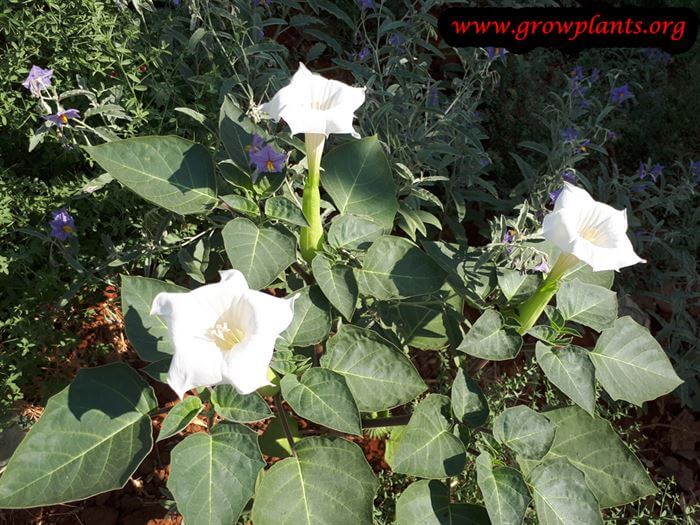
- Height & Spread: A bushy plant 0.5-2 m (20-80 in) tall and roughly as wide; can be grown in a container.
- Growth Habit & Form: Coarse, fast-growing herbaceous to sub-shrubby plant with a spreading, bushy form.
- Lifespan & Maturity: Perennial in frost-free zones, otherwise a vigorous single-season annual; matures quickly.
Anatomy & Physical Features
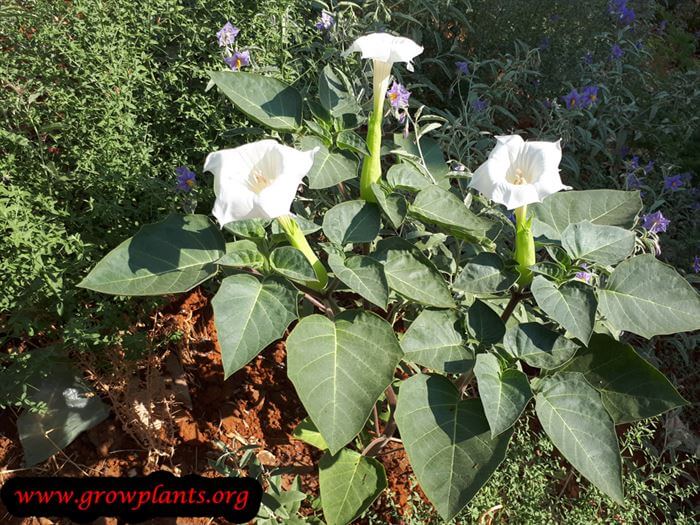
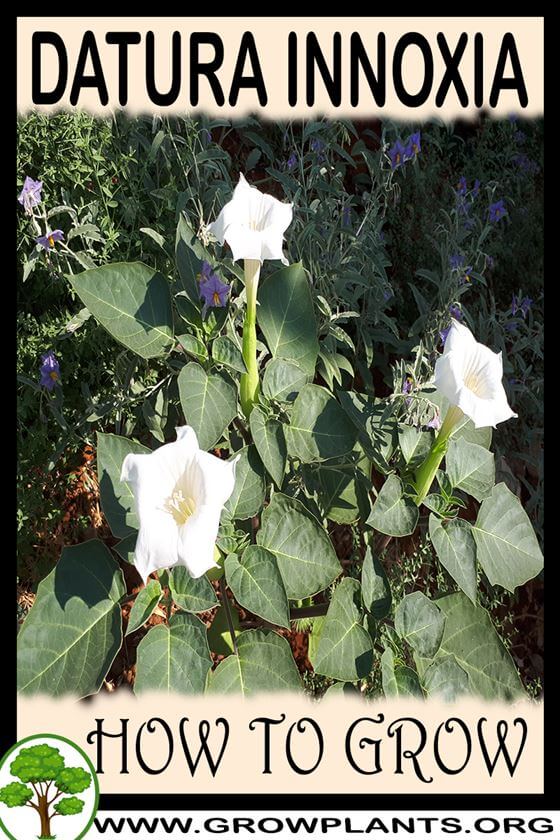
- Leaves & Foliage: Green, deltoid (triangular) leaves with a toothed (dentate) margin.
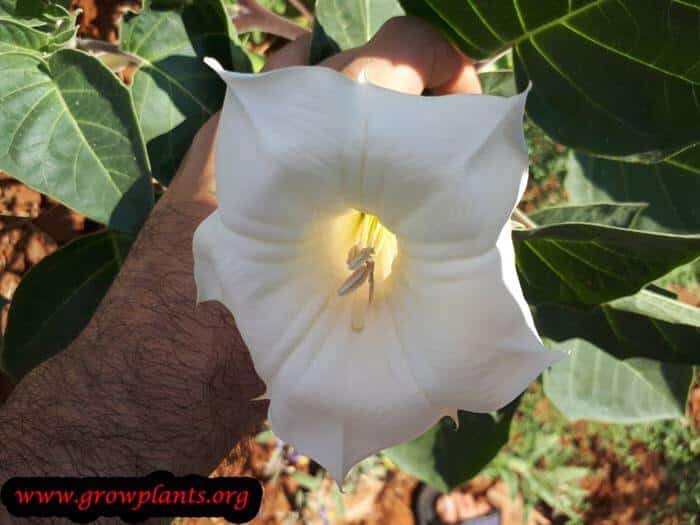
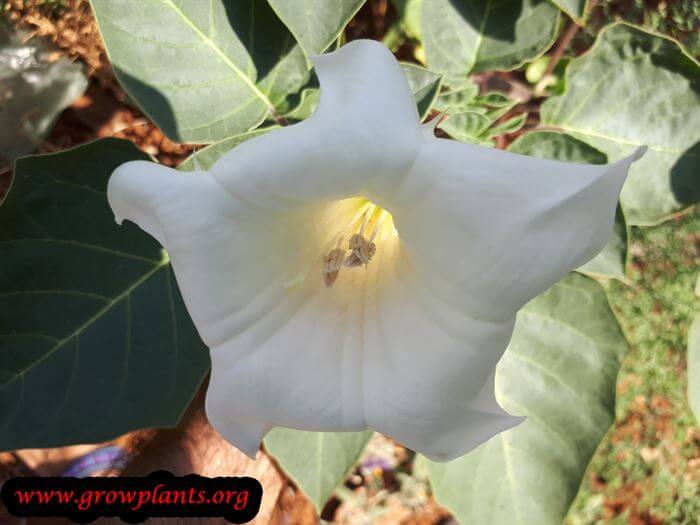
- Flower Characteristics: Large upward-facing white trumpet flowers with fused petals (full detail in the Bloom guide).
Primary Uses & Landscape Value
- Functional & Ornamental Roles: Ornamental flowering plant and informal hedge, with traditional medicinal use; can be invasive.
Care Guide: Planting, Soil & Watering
Overview: Datura is a fast-growing, warmth-loving plant that thrives in full sun with well-drained soil and modest watering. It is drought-tolerant once established but frost-tender, and is grown as an annual where winters are cold.
Quick Care Requirements
| Requirement | Ideal Condition |
|---|---|
| Planting Season | In spring after the last frost (or autumn in warm climates) |
| Growth Rate | Fast |
| Soil Type | Well-draining soil |
| Water Need | Low to Moderate – let the surface dry between waterings |
Planting & Establishment
- Best Planting Season: Plant in spring after frost has passed, or in autumn in frost-free climates.
- How to Plant:
- Hole Preparation: Dig a hole a little wider than the root ball on a well-drained site.
- Soil Amendments: Mix in compost or organic matter to support this hungry, fast grower.
- Planting Depth: Set the root ball level with the soil surface.
- Growth Speed & Expectations: Fast, reaching around 0.5-2 m in a single season.
Soil, Watering & Drainage Care
- Soil Mix & Drainage Needs: Well-drained soil; tolerates moderate drought and dislikes soggy ground.
- Watering Schedule & Technique:
- Young / Newly Planted: Keep lightly moist while the plant establishes.
- Established: Moderate watering, allowing the top of the soil to dry between waterings; avoid waterlogging.
- Seasonal Adjustments: More in summer heat; little in winter (or treat as an annual where frosty).
Climate, Light & Hardiness
Datura innoxia (devil's trumpet) grows readily as a fast, frost-tender plant across mediterranean, desert, subtropical, and temperate climates in full sun to half shade, but persists as a true perennial only where winters stay reliably above about 10°C (50°F). It is hardy as a perennial in USDA zone 10 and warmer, and is grown as a fast-cycling annual well beyond that range, in roughly zones 5–9.
Quick Climate Specifications
| Climate Zones | Mediterranean, Desert, Subtropical, Temperate |
|---|---|
| USDA Hardiness Zones | 10+ as a perennial; commonly grown as an annual in zones 5–9 |
| Cold Damage Begins | approximately 10°C (50°F) |
| Frost Tolerance | Low |
| Light Conditions | Full sun / Half shade |
Sunlight & Light Exposure
Optimal Light Setup
Full sun gives the strongest, most floriferous plants; half shade is well tolerated, especially where summers are intense.
Direct Sun Requirement
Direct sun is preferred for the bulk of the day, though it adapts readily to partial shade without major loss of vigor.
Shade & Heat Management
In the hottest desert and subtropical summers, part-day shade eases heat stress on the large leaves without significantly slowing its fast growth.
Best Exposure / Orientation
An open, sunny to lightly shaded bed with good air movement suits its vigorous, sprawling habit well.
Temperature Extremes & Hardiness
USDA Hardiness & Regional Limits
Survives winter outdoors as a perennial only around zone 10 and above. In cooler zones (roughly 5–9) it is cultivated as a fast annual instead, completing a full growth-to-flower cycle within a single frost-free season rather than surviving the winter.
Cold Damage & Winter Protection
Cold stress and damage begin as temperatures fall toward roughly 10°C (50°F). Where grown as a marginal perennial near zone 10, a sheltered microclimate and winter mulch can improve survival odds.
Frost Sensitivity
Frost-tender: foliage and stems blacken and collapse with freezing temperatures, ending the plant's growth for the season.
Extreme Heat Tolerance
Strong - it is a vigorous, fast-growing plant well suited to hot desert and subtropical summer conditions.
Frost-Free Growing Season
Where grown as an annual, it needs a full frost-free warm season to develop from seed or transplant to flowering size; sow or set out only after the last spring frost, once soil and air temperatures are reliably warm.
Wind, Humidity & Microclimate
Humidity Preferences
Adaptable across a range of humidity levels; not a demanding species in this respect.
Dry-Air Tolerance
Handles the dry air of mediterranean and desert climates comfortably, consistent with its relatively modest water needs.
Rainfall & Seasonal Moisture
Well suited to climates with a distinct dry season, needing only a small to average amount of moisture through the growing period rather than sustained high rainfall.
Microclimate Recommendations
An open, sunny-to-lightly-shaded site with reasonable air movement suits its rapid growth; where grown as a marginal perennial near its zone-10 limit, a warm, sheltered wall-side spot improves winter persistence.
Growing in Pots, Balconies & Indoors
Datura innoxia is a large (0.5-2 m), fast-growing plant with big trumpet flowers – not a houseplant, but it can be grown in a large container on a sunny patio or balcony. Every part is highly poisonous, so site it well away from children and pets and never bring it into a living space where it could be touched or eaten.
Quick Details
- Container Size: A large pot (roughly 20-40 L / 5-10 gal) to support its size
- Indoor Suitability: Not an indoor houseplant – and its toxicity makes indoor growing unwise
- Best Spot: Full sun to half shade, outdoors
- Soil & Drainage: Free-draining, organic-rich mix – potting mix or peat with perlite or vermiculite
- Watering in Pots: Small to average water; let the top of the mix dry between waterings, never waterlogged
Indoors & On the Windowsill
- Houseplant limits: The grower does not grow it indoors; it gets large and, critically, all parts are highly toxic.
- Overwintering: Frost-tender – in cold climates move the pot to a bright, frost-free place over winter, kept on the dry side and well out of reach.
On a Balcony or Patio
- Light & wind: Full sun to part shade; a big plant in a pot is top-heavy, so shelter it from strong wind. Place it where children, pets and passers-by cannot brush against or nibble it.
Choosing the Pot, Soil & Long-Term Care
- Pot & drainage: A large pot with strong drainage holes; skip a standing-water saucer to avoid root rot.
- Potting mix: Free-draining and organic – potting mix or peat with perlite or vermiculite.
- Feeding: Feed periodically, as container nutrients leach with watering.
- Repotting & safety: Pot up in fresh mix every year or two; wear gloves and wash your hands afterwards – the sap and seeds are dangerous.
Growing this plant in a greenhouse
A greenhouse can give datura innoxia frost protection and cold protection.
Greenhouse at a glance
| Greenhouse suitability | Conditional - depends on your climate |
|---|---|
| Main benefits | frost protection, cold protection |
| Season extension | earlier spring & later autumn |
| Outdoor protection advisable below | about 10°C |
| Maintain greenhouse minimum | around 10°C for active growth |
| Suitable types | heated greenhouse, polycarbonate greenhouse |
| Heating | Heating is recommended in cold climates for continuous growth. |
Related greenhouse guides
- Greenhouses: How to Choose the Right Greenhouse
- Best Greenhouse Heaters
- Greenhouse Climate Control: Temperature, Ventilation and Humidity
- Polycarbonate Greenhouses: What to Look for Before Buying
Fertilizing & Feeding
A moderate feeder that grows fast and blooms over a long season, benefiting from balanced feeding through active growth, with none needed once the plant dies back where grown as an annual.
Quick Fertilizing Specs
| Feeding Level | Moderate – a fast grower that benefits from steady balanced feeding through its long bloom season |
|---|---|
| Main Nutrient Priority | Balanced feeding rather than a high-phosphorus “bloom booster,” which this large-flowered species does not need to flower well |
| Best Feeding Period | Through active growth from planting or emergence into the spring-through-autumn bloom period |
| Soil pH | Tolerates a wide range of soil as long as it drains reasonably well |
| Reduce/Stop Feeding | Stop feeding as the plant declines going into cooler weather, especially where it is grown as an annual |
Feeding by Growth Stage
Spring establishment and rapid vegetative growth
Support this fast-growing plant’s deltoid, dentate-edged foliage as it fills out ahead of its large trumpet flowers.
| Nutrient direction | A balanced fertilizer supports the vigorous foliage growth typical of this species without needing to push extra nitrogen. |
|---|---|
| Timing | From spring planting or emergence, or autumn planting in warmer climates, through early vegetative growth. |
| Frequency | A moderate, steady feeding schedule suits this fast-growing plant’s active growth phase. |
| Fertilizer types | A balanced, general-purpose fertilizer, Compost or aged organic matter worked into the planting area |
| Precautions | This plant is poisonous in all parts, so wear gloves when handling it and keep fertilizing and planting areas away from children, pets, and livestock; it can also spread aggressively where conditions favor it. |
Extended trumpet-flower bloom period
Sustain the large, fragrant white trumpet flowers with fused petals through the plant’s long spring-through-autumn bloom season.
| Nutrient direction | Continue balanced feeding through bloom; a high-phosphorus “bloom booster” is not needed to support flowering in this species. |
|---|---|
| Timing | Through the spring, summer, and autumn bloom period. |
| Frequency | Feed at a steady, moderate pace while the plant is actively flowering. |
| Fertilizer types | A balanced fertilizer applied through the growing season, A potassium-inclusive complete fertilizer to support flower and stem quality |
| Precautions | Handle all parts of the plant with care and gloves due to its toxicity, and avoid planting it where children, pets, or foraging animals have easy access. |
Cold-season dieback
Let the plant decline naturally as cooler weather sets in, particularly where it is grown as an annual rather than overwintered as a perennial.
| Nutrient direction | None – withhold fertilizer once the plant begins to decline in cooler weather. |
|---|---|
| Timing | As temperatures drop going into the cooler part of the year. |
| Frequency | No feeding at this stage. |
| Fertilizer types | No feeding at this stage; let the plant die back naturally where grown as an annual |
| Precautions | Do not fertilize during this decline, and dispose of dead plant material carefully given the plant’s toxicity to people and animals. |
Nutrient Deficiency Signs & Corrections
Pale, undersized leaves and reduced overall vigor for what is normally a fast-growing plant.
| Possible causes | Nitrogen-poor soil, Insufficient light for this full-sun to part-shade species, Root stress from poor drainage |
|---|---|
| Appears first on | Older, lower leaves first |
| What to check | Recent feeding history, Light exposure, Soil drainage and moisture |
| Possible correction | Apply a balanced fertilizer during active growth and confirm the plant is getting adequate light. |
Wilting or foliage collapse despite adequate soil moisture, sometimes with blackened stem tissue near the soil line.
| Possible causes | Waterlogged or poorly drained soil, Overwatering, Fungal root disease favored by consistently wet soil |
|---|---|
| Appears first on | Lower stem and root zone, with wilting visible throughout the plant |
| What to check | Soil drainage at the planting site, Recent watering and rainfall, Root and stem condition near the soil line |
| Possible correction | Improve drainage and reduce watering rather than fertilizing, since this pattern usually points to a moisture problem. |
Sticky residue on leaves, curled new growth, or clusters of small insects on stems and buds.
| Possible causes | Aphid infestation on new growth, General plant stress making the plant more attractive to pests, Overcrowded planting reducing airflow |
|---|---|
| Appears first on | New shoots and flower buds |
| What to check | Visible aphids or sticky honeydew residue, Overall plant vigor and recent feeding history, Airflow and spacing around the plant |
| Possible correction | Address the aphid infestation directly rather than fertilizing, and keep the plant on a steady, balanced feeding schedule to support recovery. |
Pruning, Training & Seasonal Maintenance
Datura innoxia (Devil’s trumpet) is a fast-growing, soft-stemmed perennial – grown as an annual in the colder part of its range – that tolerates frequent trimming and pinching throughout the growing season. Because it flowers continuously on new growth rather than on old wood, pruning is used to shape the plant, control its size, and limit self-seeding, not to protect a stored flower crop. Where it persists as a woody-based subshrub (roughly zone 10+), the most impactful cut is a hard cutback in early spring as new growth resumes; in marginal zones (5–9) it is usually grown as an annual and simply removed at frost rather than pruned for longevity.
Quick Pruning & Maintenance Specs
| Pruning Tolerance | High |
| Primary Pruning Window | Early Spring (perennial/subshrub form – hard cutback before new growth) |
| Secondary Maintenance Window | Spring–Summer (ongoing pinching, shaping, deadheading) |
| Typical Frequency | Regular light trims through the growing season |
| Main Objective | Control size and legginess; shape; limit self-seeding |
| Young Plant Priority | Pinch the growing tip to force branching |
| Mature Plant Priority | Cut back leggy stems; remove spent seed pods |
| Best Tool Type | Bypass secateurs (loppers for older basal stems) |
| Avoid Heavy Pruning During | Approach of a frost or cold snap in marginal zones |
Pruning by Plant Age & Size
Newly Established
Let the young plant establish before pinching; remove only damaged growth at this stage.
Young / Formative
Pinch out the main growing tip once the plant has several sets of leaves, to force branching into a fuller, multi-stemmed habit. There is no central-leader or framework training for this sprawling subshrub.
Mature / Established
In warm zones where the plant persists year to year, cut the woody-ish base back hard in early spring to remove winter-worn growth and reset a compact, floriferous shape. In cooler zones where it is grown as an annual, the plant is simply removed at season’s end rather than pruned for longevity.
Seasonal Pruning Schedule
Pre-Growth/Early-Spring (perennial/subshrub zones only) – Objective: rejuvenate and control size before the new season. Remove: frost-damaged, leggy, or bare stems, cutting back to strong lower growth. Do not remove: all top growth at once on a marginal-zone plant that may still be recovering from winter – stage it if uncertain. Expected response: vigorous new shoots, given this species’ fast growth rate. Flowering impact: none negative – flowers form on the new growth this cut promotes.
Summer Canopy Management – Objective: keep the plant shapely and encourage repeat flushes of bloom. Remove: lanky, over-extended stems, and spent trumpet flowers before they set their spiny seed pods. Do not remove: healthy branching wood about to flower. Expected response: fresh branching and continued flowering. Flowering impact: deadheading redirects energy into further blooms and, given this species’ documented invasiveness, curbs self-seeding.
Ongoing Sanitary – Objective: remove damaged foliage as seen. Remove: aphid-damaged or frost-nipped leaves. Do not remove: undamaged foliage. Expected/flowering impact: none beyond tidiness.
Flowering & Fruiting Wood
Datura innoxia flowers on current-season growth, not on older persistent wood – new stem tips produce the large trumpet flowers throughout the warm season. This means pruning does not sacrifice next year’s bloom the way it would on an old-wood shrub: cutting back hard in spring removes no potential flowers and instead produces more of the new growth that flowers, while pruning during peak summer bloom simply removes whichever flowers or buds are present at that moment.
Structural Pruning & Training
Height and spread control matter most for this fast-growing, 0.5–2 m plant, which can flop or sprawl without occasional shaping. Although it is sometimes used as a hedge or screen, avoid shearing it into a tight formal hedge face: flat shearing removes the pendant trumpet flowers borne at the branch tips and leaves a stubby, less floriferous plant. Selective heading cuts back to a healthy node preserve far more of the display while still controlling shape. Thin overly dense growth occasionally to improve airflow through the canopy, which reduces conditions favorable to the aphids this species is prone to.
Special Growth to Remove
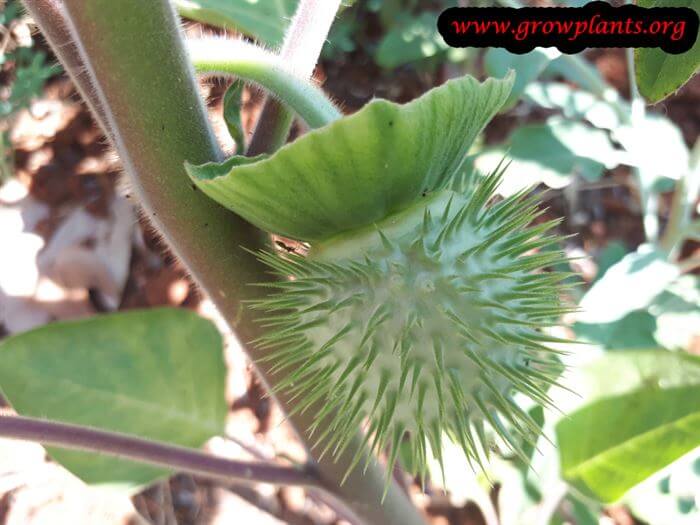
- Spent flowers/seed pods: the spiny seed capsules that follow the trumpet flowers should be removed promptly – this species is invasive, and deadheading before pods mature and split is the main lever for limiting self-seeding.
- Floppy or leggy stems that spoil the plant’s shape can be shortened at any point in the growing season.
Container & Small-Space Pruning
Container growth suits this species, but calls for more frequent pinching than an in-ground specimen to hold its size down – its fast growth rate can quickly overwhelm a pot. Regular tip pruning through summer keeps it compact and bushy rather than tall and top-heavy.
Tools
Precision snips for pinching tips and deadheading. Bypass secateurs for routine stem shaping. Loppers only for the thicker basal stems of an older perennial/subshrub specimen at its spring cutback.
Tool Hygiene & Disease Risk
Routine. Only common aphids are a pest concern, with no specific transmissible disease noted – clean, sharp tools are sufficient.
Cut Placement & Technique
Pinch just above a leaf node or axil to force the buds below it into new branches. For heading or thinning cuts, cut back to a healthy node or side-shoot rather than leaving a bare stub. Because the whole plant is toxic, always wear gloves during any cutting.
Heavy Pruning & Rejuvenation
Tolerated well in the perennial/subshrub form: a hard cutback to roughly 15–30 cm above the base in early spring rejuvenates a leggy, thinned-out specimen, and given this species’ fast growth rate it typically resprouts and returns to flowering within the same season. This does not apply to plants grown strictly as annuals, which are replaced rather than rejuvenated.
Post-Pruning Care
Water normally after cutting back; do not add extra feeding purely because the plant was pruned – a hard cutback already forces vigorous new growth on its own in a fast grower like this. Because every part of Datura innoxia is poisonous, wear gloves when handling cuttings, wash tools and hands afterward, and dispose of prunings – especially any seed pods – rather than composting them, given the species’ documented invasiveness.
Common Pruning Mistakes
- Shearing it into a flat formal hedge face, which strips off the trumpet flowers and leaves a stubby silhouette.
- Letting spent seed pods mature and split, spreading this listed-invasive species by seed.
- Handling cuttings bare-handed – all parts are toxic.
- Doing a hard cutback right as a cold snap approaches in marginal zones, pushing out tender new growth just before it can be damaged by frost.
When NOT to Prune
Avoid a hard cutback immediately before an expected frost or cold snap in zone 5–9 areas where the plant is only marginally perennial – fresh cuts push tender new growth that has no time to harden off. Don’t hard-prune a very newly planted specimen before it has rooted in; light pinching is fine, but hold off on major cutback until it is established.
Recommended Tools (by task)
- bypass_secateurs: routine shaping cuts and removing spent seed pods on semi-woody stems – clean cuts reduce dieback risk on this fast, soft-wooded grower.
- precision_snips: pinching soft young tips to force branching, and deadheading individual flowers.
- loppers: cutting back the thicker basal stems of an established perennial/subshrub specimen during its early-spring rejuvenation.
Propagation Guide
Datura innoxia (Devil’s trumpet) is most easily and reliably raised from seed, the standard method for this fast-growing annual/short-lived perennial, and as a true species it generally comes true from seed when not cross-pollinated by other Datura species; stem cuttings offer a quick way to bulk up an established plant or carry one over winter indoors where it would otherwise be grown as an annual. Propagation is easy, though the plant’s own notes flag it as poisonous and potentially invasive, so seed and self-sown seedlings are worth handling and managing with that in mind.
Quick Propagation Specs
| Best Propagation Method | Seed |
| Alternative Methods | Stem cuttings |
| Propagation Difficulty | Easy |
| Seed True-to-Type | Usually true-to-type (species; may vary if cross-pollinated with other Datura species) |
| Vegetative True-to-Type | Yes |
| Best Propagation Season | Spring, after the last frost (autumn sowing only in warm, frost-free climates, per the plant’s own planting-season note) |
| Seed Germination Time | Often within a couple of weeks, but can be slower and uneven, especially with untreated seed |
| Cutting Rooting Time | Usually within a couple of weeks in warm conditions |
| Germination Temperature | Warm, roughly 20–25°C (68–77°F) |
| Seed Sowing Depth | Shallow, just lightly covered |
Growing from Seed
Seed Handling & Viability
Handle seed and seed pods carefully and wash hands afterward – like the rest of the plant, the seed contains toxic tropane alkaloids (the plant’s own notes flag it as poisonous). Store cleaned, dry seed somewhere cool and dry.
Dormancy & Pre-Sowing Treatment
Datura seed can show some hard-seed-coat dormancy; a light scarification or an overnight soak before sowing may help even out and speed germination, though fresh seed often germinates without any treatment.
Sowing Season
Spring, after the last frost, matching the plant’s own recommended planting season (autumn is only suitable in warm, frost-free climates, as the site notes).
Sowing Depth & Orientation
Sow shallowly, just lightly covered with fine mix – the seed does not need to be buried deeply.
Germination Conditions
Warm (roughly 20–25°C / 68–77°F), kept consistently moist, in a bright spot.
Germination Time
Often within a couple of weeks, but germination can be slower and uneven, especially with untreated seed.
Seedling Care
Because this plant self-sows readily and grows fast, thin and pot on seedlings promptly as they outgrow their first container; given the site’s own caution that it can be invasive, remove unwanted seedlings or spent pods where naturalising is not wanted.
Stem Cuttings
Cutting Type
Softwood or semi-hardwood tip cuttings from healthy, non-flowering shoots.
Best Timing
Spring through summer during active growth, or in autumn to carry a plant over winter indoors in cold climates.
Cutting Preparation
Take a cutting a few nodes long and remove the lower leaves; wear gloves, as the plant’s sap is toxic (per the plant’s own poisonous-plant note).
Rooting Setup
Insert into a free-draining mix and keep warm and humid until roots form.
Rooting Hormone
Optional – not essential, as Datura cuttings generally root readily.
Rooting Time
Usually within a couple of weeks under warm conditions.
Bloom & Flower Guide
Quick Details
- Bloom Season: From spring through autumn in warm conditions
- Time to First Bloom: Fast – grown as an annual it flowers in its first summer, within a few months of sowing
- Flower Appearance: Large, white, trumpet-shaped flowers with fused petals, fragrant in the evening
- Edibility: None – the plant is highly poisonous; do not eat any part, including the flowers
Detailed Blooming Overview
Datura innoxia, one of the devil’s trumpets, carries large white trumpet flowers that open toward evening and release a sweet scent to draw night-flying pollinators. Each bloom is short-lived but they are produced freely all through the warm months. It is a striking ornamental, but every part of it is dangerous, so it is best enjoyed by sight and scent alone.
Flower Characteristics
- Large, upward- or outward-facing white trumpets with fused (merged) petals.
- Fragrant in the evening and night, when the flowers are at their most open.
Bloom Care & Thinning
- Site and season: Full sun and warmth bring the heaviest flowering; the show runs until cold weather ends it.
- Keep it blooming: Removing spent flowers before they set their spiny seed capsules keeps new buds coming and limits self-seeding.
- Pollination: The evening scent and pale, deep trumpets are built for night-flying hawk (sphinx) moths, which are the main pollinators.
- Safety: All parts, including the flowers and nectar, contain tropane alkaloids and are poisonous if eaten. Handle with care, wash your hands afterwards, and keep it well away from children and pets.
Pests, Diseases & Troubleshooting
Datura (thorn apple / moonflower) is a fast, soft-leaved Solanaceae that shares the pest roster of tomatoes and other nightshades: spider mites, whitefly, aphids and hungry hornworm caterpillars, plus mosaic virus and leaf spots. Every part of the plant is highly toxic, so wear gloves and keep it away from children, pets and livestock when handling, pruning or clearing it. Vigorous, unstressed plants shrug off most pests.
Quick Troubleshooting Overview
| Issue / Pest | Main Symptom | Primary Solution |
|---|---|---|
| Spider mites | Fine stippling, bronzing, webbing in hot dry air | Hose foliage, raise humidity, horticultural oil |
| Whitefly | Clouds of white flies, honeydew, yellowing | Yellow sticky traps, insecticidal soap, Encarsia |
| Aphids | Sticky curled tips; spreads virus | Rinse off, beneficials, insecticidal soap |
| Hornworms | Large leaves stripped fast; big green caterpillars | Hand-pick, Bt (spinosad), encourage wasps |
| Leaf miners | Pale winding tunnels inside leaves | Pick mined leaves, sticky traps, tidy debris |
| Tobacco mosaic virus | Mottled, distorted, stunted foliage | Rogue plants, hygiene, control aphids |
Common Pests & Management
- Spider mites (Tetranychus urticae):
- Symptoms: In hot, dry conditions leaves show fine pale stippling, then bronze, dry and curl, with fine webbing on undersides and growing tips; plants weaken quickly under heavy pressure.
- Prevention & Control: Raise humidity and hose down leaf undersides; keep the plant watered and unstressed; introduce predatory mites; treat with horticultural oil or insecticidal soap, avoiding broad-spectrum sprays that flare mite numbers.
- Whitefly (Trialeurodes vaporariorum / Bemisia tabaci):
- Symptoms: Clouds of tiny white flies rise when the plant is disturbed; scale-like nymphs on leaf undersides excrete honeydew, and heavy feeding yellows and weakens foliage while spreading viruses.
- Prevention & Control: Hang yellow sticky traps to monitor and reduce adults; introduce Encarsia parasitic wasps under cover; spray insecticidal soap or horticultural oil on undersides every few days to break the cycle.
- Aphids (Myzus persicae / Aphis spp.):
- Symptoms: Soft green or black insects mass on tips, buds and leaf undersides; growth curls, honeydew turns leaves sticky, and aphids spread mosaic and other viruses.
- Prevention & Control: Dislodge with water; support ladybirds, lacewings and hoverflies; pinch out badly infested tips; treat persistent colonies with insecticidal soap in the evening. Wear gloves – the sap is toxic.
- Hornworms (Manduca sexta / M. quinquemaculata):
- Symptoms: Large green caterpillars with a rear horn strip leaves and soft stems rapidly, leaving bare stalks and dark frass pellets; a few can defoliate a plant.
- Prevention & Control: Hand-pick (wear gloves) and drop into soapy water; encourage parasitic braconid wasps (leave caterpillars carrying white cocoons); spray Bacillus thuringiensis (Bt) or spinosad on young larvae for organic control.
- Leaf miners (Liriomyza spp.):
- Symptoms: Pale, winding tunnels wander inside the leaves as larvae mine between the surfaces; heavy mining reduces vigour and mars the foliage.
- Prevention & Control: Pick off and destroy mined leaves, keep the area weeded, use sticky traps for adult flies, and encourage parasitic wasps; systemic-heavy sprays are rarely justified for cosmetic mining.
- Flea beetles (Epitrix / Phyllotreta spp.):
- Symptoms: Tiny beetles pit young leaves with many small round ‘shot-holes’ and jump when disturbed; worst on seedlings.
- Prevention & Control: Protect young plants with fine mesh, keep them growing strongly, tidy weedy nightshade hosts nearby, and dust or spray only if seedlings are being overwhelmed.
Diseases & Fungal Issues
- Tobacco / tomato mosaic virus (TMV / ToMV):
- Symptoms: Light and dark green mottling, puckering and distortion of leaves, with stunting; symptoms are permanent and cannot be cured.
- Treatment & Management: Remove and destroy infected plants; do not compost; wash hands and disinfect tools after handling (tobacco products can carry TMV); control aphids and avoid working plants when wet.
- Leaf spot (Cercospora / Alternaria spp.):
- Symptoms: Brown or dark angular spots, sometimes with concentric rings or yellow halos, appear on leaves in warm, wet, humid weather and can cause early leaf drop.
- Treatment & Management: Space plants for airflow, avoid overhead watering, remove spotted leaves and clear debris; a copper fungicide can help in wet spells, but sanitation is the main control.
- Southern blight / root rot (Sclerotium rolfsii / Pythium / Phytophthora):
- Symptoms: White fungal threads and a soft rot at the stem base, or general wilting and root decay in warm, waterlogged soil, cause sudden collapse.
- Treatment & Management: Improve drainage, avoid waterlogging and deep mulch piled against stems, rotate planting sites, and remove and destroy affected plants and surrounding soil crust.
Growing Difficulties & Abiotic Problems
- Toxicity (grower safety):
- Cause & Symptoms: All parts – leaves, seeds, flowers, roots – are highly poisonous if ingested and the sap can irritate skin and eyes.
- Correction Strategy: Wear gloves when handling or pruning, wash hands afterwards, keep seeds and prunings away from children, pets and livestock, and site the plant where it will not be nibbled or mistaken for food.
- Wilting from heat/drought:
- Cause & Symptoms: Large soft leaves wilt in fierce midday heat or dry soil, then usually recover as it cools.
- Correction Strategy: Water deeply and consistently, mulch to conserve moisture, and give afternoon shade in the hottest climates; brief midday wilt with moist soil is normal.
- Root rot / overwatering:
- Cause & Symptoms: Soggy soil rots the roots, yellowing and collapsing the plant even without a specific pathogen.
- Correction Strategy: Grow in free-draining soil, let the surface dry between waterings, and avoid standing water; in pots ensure free drainage.
What Helps – Products & Tools
Treat Datura like a nightshade crop: insecticidal soap and light horticultural or neem oil for mites, whitefly and aphids; Bt or spinosad for hornworms; yellow sticky traps for whitefly and leaf-miner flies; and copper fungicide for leaf spot in wet weather. Above all, wear gloves – the plant is toxic – and keep growth vigorous, since healthy plants resist most of these pests.