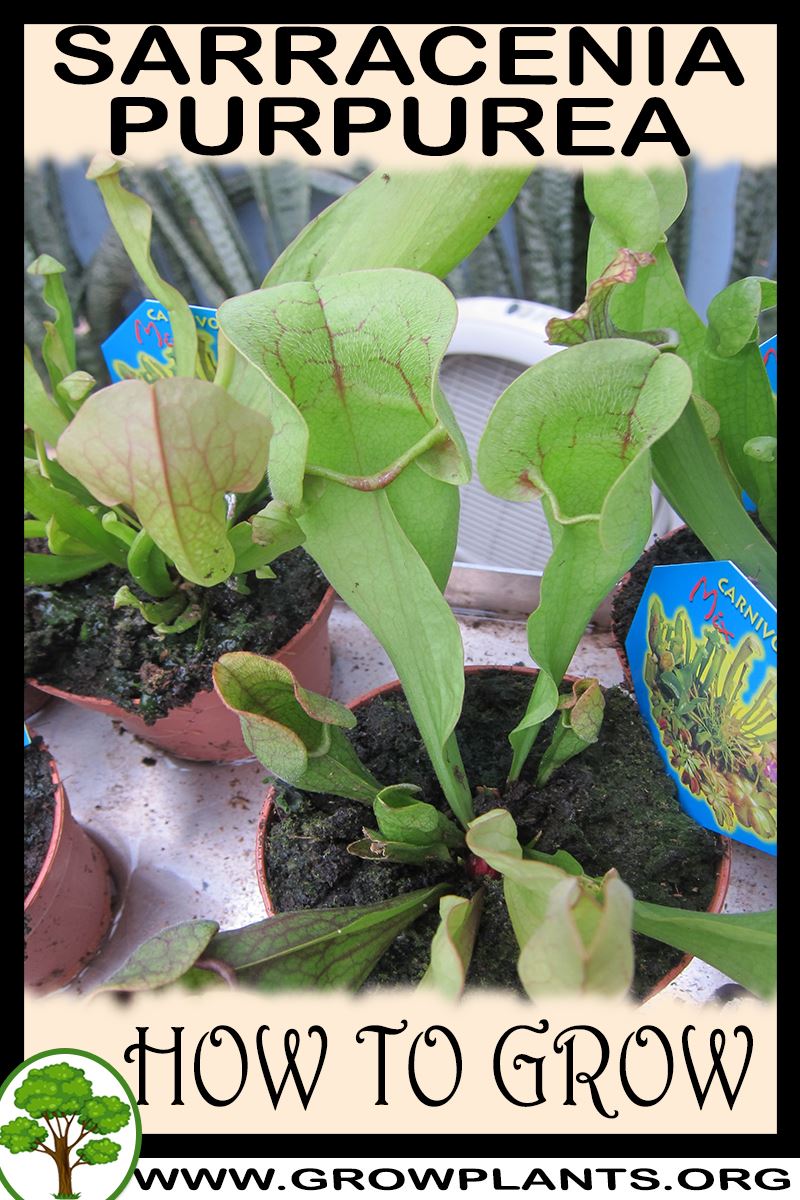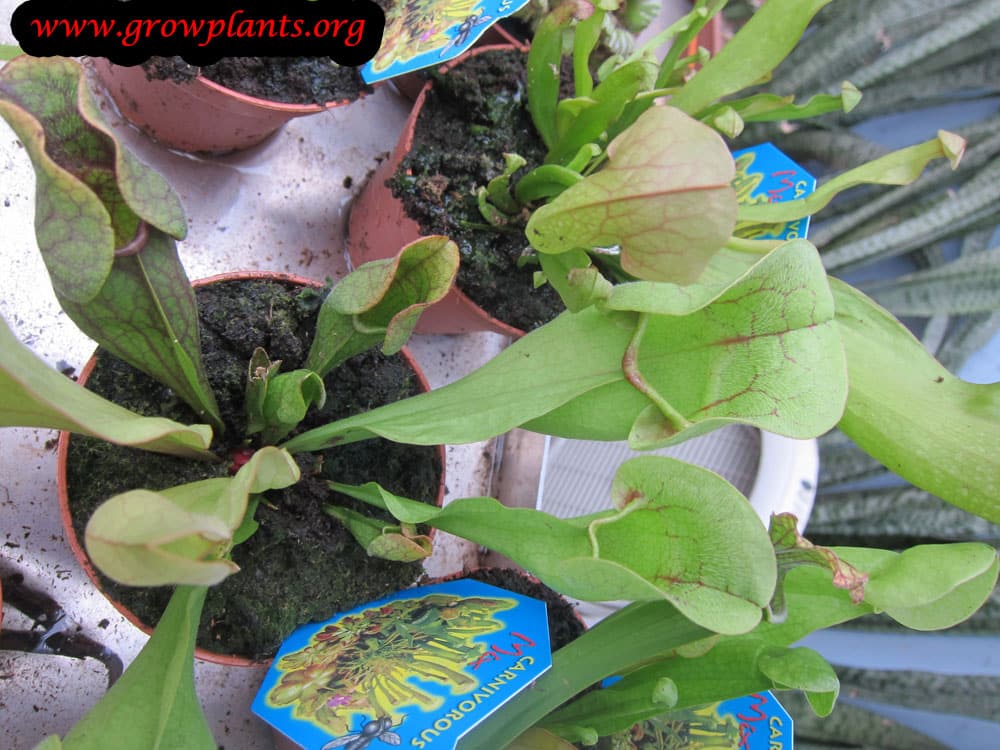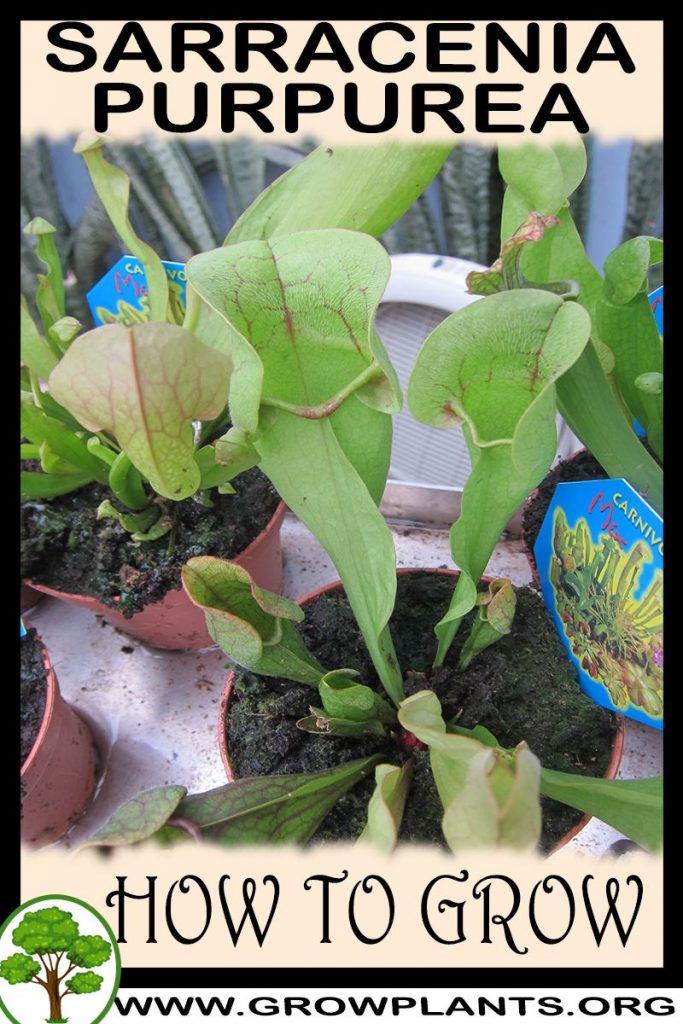
Plant Profile & Key Characteristics
Overview: The purple pitcher plant – a carnivorous bog perennial 20-50 cm (8-20 in) tall with squat, rain-holding purple-red pitchers. It is the hardiest and most widespread pitcher plant, grown as an ornamental for bogs and containers.
Quick Specifications
| Specification | Attribute |
|---|---|
| Plant Type / Life Cycle | Evergreen carnivorous perennial |
| Foliage Type | Evergreen (leaves modified into pitcher traps) |
| Mature Size | 20-50 cm (8-20 in) tall |
| Growth Rate | Moderate |
| Root System | Rhizomatous – grows from a creeping rhizome in wet, acidic bog soil |
| Toxicity | Non-toxic – pitcher plants are listed as non-toxic to cats and dogs |
| Hardiness | USDA zones 4-10 |
Growth Form & Structure
- Height & Spread: In the ground or a pot the pitchers stand 20-50 cm (8-20 in) tall; grows well in a container of wet, acidic bog mix.
- Growth Habit & Form: Low, clump-forming carnivorous perennial spreading by a rhizome, with squat, semi-reclining pitchers that collect rainwater.
- Lifespan & Maturity: A long-lived, very hardy perennial that expands slowly from its rhizome and is dormant in winter.
Anatomy & Physical Features
- Leaves & Foliage: Short, plump green-to-purple pitcher leaves, often red-veined, that hold rainwater and drown insects inside.
- Flower Characteristics: Nodding, umbrella-shaped flowers in red or red-and-green on tall stems above the pitchers.
Primary Uses & Landscape Value
- Functional & Ornamental Roles: Hardy carnivorous ornamental for bog gardens, pond margins and containers, and catches insects.
Care Guide: Planting, Soil & Watering
Overview: Sarracenia purpurea (purple pitcher plant) (Sarracenia purpurea) is a hardy, carnivorous pitcher plant from wet, acidic bogs (hardiness zones 4-10). It thrives in full sun in a permanently wet, nutrient-poor mix of sphagnum moss and perlite, watered only with rainwater and never fed or limed.
Quick Care Requirements
| Requirement | Ideal Condition |
|---|---|
| Planting Season | Spring or autumn |
| Growth Rate | Moderate |
| Soil Type | Nutrient-poor sphagnum moss and perlite (peat-based bog mix) |
| Soil pH | Acidic |
| Water Need | High – keep constantly moist with rainwater; never use tap water, fertiliser or lime |
Planting & Establishment
- Best Planting Season: Plant in spring or autumn so it can establish around its natural summer growth and winter dormancy. Give it the sunniest, most open spot you can.
- How to Plant:
- Hole Preparation: Set it into a shallow planting of pure bog mix; there is no need to dig deep, as the roots are shallow and sit in wet moss.
- Soil Amendments: Use only sphagnum moss with perlite (or a peat-and-sand bog mix) – never add compost, fertiliser or lime, which will kill it.
- Planting Depth: Keep the crown and growing point sitting at the surface of the wet moss, not buried.
- Growth Speed & Expectations: A moderate grower reaching about 20-50 cm (8-20 inches); it needs a cool winter dormancy to stay healthy year after year.
Soil, Watering & Drainage Care
- Soil Mix & Drainage Needs: Grow in a nutrient-poor, acidic sphagnum-and-perlite mix with no drainage of the usual kind – instead stand the pot in a tray so the moss stays permanently saturated.
- Watering Schedule & Technique:
- Young / Newly Planted: Keep the mix constantly wet with rainwater or distilled water while young plants establish.
- Established: Through the growing season stand the pot in 1-3 cm of rainwater so the moss never dries; always use rainwater or distilled water, never tap water.
- Seasonal Adjustments: Keep it wet in the warm growing season, then reduce to just damp during the cool winter dormancy.
Climate, Light & Hardiness
This carnivorous pitcher plant is a bog native of temperate, subtropical and Mediterranean climates that thrives on bright light, constantly wet acidic media and a warm growing season followed by a cool-to-cold winter rest. It grows in full sun to partial shade, and rated for USDA zones 4–10 it endures cold winters as a dormant rhizome, though it genuinely needs that seasonal chill to stay healthy.
Quick Climate Specifications
| Climate Zones | Temperate, subtropical or Mediterranean bog / wetland |
| USDA Hardiness Zones | 4–10 (varies by species and provenance) |
| Optimal Temp Range | Warm growing-season days with cooler nights; a distinct cold winter dormancy |
| Approx. Survival Minimum | Dormant rhizome of hardy forms into the zone 4 range (roughly −34 °C / −29 °F) when protected |
| Frost Tolerance | High for dormant crowns; active pitchers damaged by frost |
| Light Conditions | Full sun to partial shade |
| Wind Tolerance | Moderate |
| Salt / Coastal Tolerance | Not suitable (highly sensitive to salt and dissolved minerals) |
Sunlight & Light Exposure
Optimal Light Setup
Give it as much bright light as possible - full sun produces the sturdiest, most intensely coloured pitchers. It tolerates partial shade, but in deep shade the pitchers grow weak, floppy and poorly coloured.
Direct Sun Requirement
Several hours of direct sun are important for strong growth and the red, white and veined pitcher colours; light alone is rarely the limiting factor as long as the roots stay wet.
Shade & Heat Management
In very hot climates some afternoon shade is tolerated, but because the roots sit in constantly wet media the plant copes with strong sun better than most.
Temperature Extremes & Hardiness
USDA Hardiness & Regional Limits
The site data rates the group for USDA zones 4–10. The purple pitcher plant is the most cold-hardy member of the genus, native to cold northern bogs, and reliably takes the coldest end of the rated range. A warm growing season followed by a cold winter suits it; genuinely tropical, frost-free climates deprive it of the dormancy it needs.
Cold Damage & Winter Protection
Hardy forms over-winter as a dormant rhizome that survives hard freezing, often beneath mulch, snow or ice while the bog stays wet. The plant needs this cool-to-cold rest each year - kept warm year-round it weakens and declines.
Frost Sensitivity
Dormant crowns are frost-hardy, but actively growing pitchers are damaged by frost and simply die back for winter. Container plants are more exposed, so protect the root-zone from deep freezing in pots.
Extreme Heat Tolerance
It handles hot summers provided the bog media never dries out; the constant wetness at the roots buffers heat, but hot, dry air with dry media is quickly damaging.
Wind, Humidity & Microclimate
Humidity Preferences
It appreciates moist air but adapts to ordinary garden humidity as long as the roots stay saturated; the wet bog around the roots matters more than air humidity.
Wind Tolerance
Wind tolerance is moderate; tall pitchers can be bowed or broken by strong gusts, so an open but not exposed position is best.
Coastal / Salt Tolerance
It is highly intolerant of salt and dissolved minerals - salt spray and mineral-laden or saline water are harmful, which is why rainwater or low-mineral water is used. It is not a coastal plant.
Rainfall & Seasonal Moisture
As a bog plant it is adapted to high, year-round moisture and standing wet ground; it thrives in wet climates and must never dry out, while still cycling through a cooler, quieter winter.
Microclimate Recommendations
Grow it in an open, sunny bog, tray or wetland edge that stays permanently wet with rainwater; the ideal microclimate combines bright light, a warm summer and a reliably cool winter.
Growing in Pots, Balconies & Indoors
Sarracenia purpurea is a carnivorous pitcher plant that makes a striking pot and houseplant given very bright light – the grower confirms it can be grown indoors. It grows equally well in a container on a sunny balcony bog tray or on the brightest windowsill, but it has special bog-plant needs that are quite unlike an ordinary potted plant.
Quick Details
- Container Size: A snug, fairly deep pot of about 1-3 L to fit the roots; plastic or glazed pots hold the constant moisture it needs
- Indoor Suitability: A genuine houseplant here (grower) – give it your brightest, sunniest window
- Best Spot: Full sun to half shade; the brighter the light, the better the pitcher colour — a grow light can boost that colour where a window alone falls short
- Soil & Drainage: Nutrient-poor, acidic bog mix – sphagnum moss or peat with perlite or coarse sand; never use garden soil, compost or fertiliser
- Watering in Pots: Keep constantly wet with rainwater, distilled or RO water; stand the pot in a shallow tray of water (the opposite of most potted plants)
Indoors & On the Windowsill
- A true houseplant: The grower confirms it grows indoors – put it on the sunniest sill you have, as it needs strong light to thrive and colour up.
- No feeding: It catches its own insects, so never fertilise it and never use mineral-rich tap water; only rainwater, distilled or reverse-osmosis water.
- Winter rest: Even indoors it needs a cool winter dormancy – a spell in a cooler, brighter spot with less water – to stay healthy and flower the next season.
On a Balcony or Patio
- Light & water tray: It loves full sun outdoors; stand the pot in a saucer or tray of rainwater so it never dries out, and top up often in hot weather.
- Overwintering: It needs its cold rest, so leave it outdoors through a cool winter in mild areas, or shelter the crown from hard, prolonged frost.
Choosing the Pot, Soil & Long-Term Care
- Pot & water: Use a plastic or glazed pot (terracotta wicks minerals and dries out); unlike other plants it should sit in a tray of water so the bog mix stays saturated.
- Potting mix: A nutrient-poor, acidic bog mix – sphagnum moss or peat with perlite or lime-free sand. Never add compost, feed or garden soil, which will kill it.
- Water quality: Only ever rainwater, distilled or RO water – the minerals in tap water build up and harm it.
- Repotting: Refresh the bog mix and divide the rhizome every year or two, in the same low-nutrient medium.
Fertilizing & Feeding
This is a very light feeder adapted to nutrient-poor bogs; it draws nitrogen from the insects it captures and is easily harmed by fertilizer salts in its soil or water.
Quick Fertilizing Specs
| Feeding Level | Light |
|---|---|
| Best Feeding Period | Only during active summer growth, and only where the plant has no access to insects |
| Main Nutrient Priority | Minimal added nutrition; the plant obtains most of its nutrients from trapped insects |
| Organic Options | None recommended; avoid enriched, fertilized, or composted media |
| Soil pH | Strongly acidic, lean, mineral-free medium such as sphagnum moss and perlite |
| Reduce/Stop Feeding | Withhold all feeding through the winter dormancy |
| Micronutrients | Not applicable; avoid adding mineral supplements |
Feeding by Growth Stage
Summer active growth
Support pitcher and leaf growth during the warm season
| Nutrient direction | Minimal; the plant draws most of its nitrogen from the insects it traps, so added nutrients are rarely needed |
|---|---|
| Timing | During the warm summer growing period |
| Frequency | Rarely needs feeding; rely on natural insect capture |
| Fertilizer types | Occasional very dilute foliar feed only where insects are unavailable, Never apply granular or soil fertilizer to the root zone |
| Precautions | Fertilizer salts and mineral-rich water readily scorch the roots and foliage; use only rainwater or distilled water |
Winter dormancy
Allow the required cool winter rest
| Nutrient direction | None – withhold all fertilizer during dormancy |
|---|---|
| Timing | Through the cool winter dormancy |
| Frequency | No feeding at this stage |
| Fertilizer types | No feeding at this stage – do not fertilize during winter dormancy |
| Precautions | Do not fertilize; keep the medium moist with mineral-free rainwater or distilled water until growth resumes |
Nutrient Deficiency Signs & Corrections
Browning leaf and pitcher tips, or sudden collapse of the plant
| Possible causes | Dissolved minerals in tap or hard water, Fertilizer or enriched potting mix in the root zone, Salt buildup in the medium |
|---|---|
| Appears first on | leaf and pitcher tips |
| What to check | water source and purity, whether the medium was fertilized or contains added nutrients, salt crust on the soil surface |
| Possible correction | Switch to rainwater or distilled water and flush the medium thoroughly; never fertilize the root zone |
Pale, weak, floppy growth with small or poorly formed pitchers
| Possible causes | Too little light, Few insects captured, limiting available nitrogen, A dormancy period that was not met |
|---|---|
| Appears first on | new growth |
| What to check | light levels, whether the plant is catching prey, whether it received a cool winter rest |
| Possible correction | Provide bright light and allow natural prey capture; only where insects are absent, a very dilute foliar feed can help |
Pruning, Training & Seasonal Maintenance
Sarracenia purpurea is the squattest, most ground-hugging pitcher plant of the genus, forming a low rosette of short, wide-mouthed pitchers that naturally fill with rainwater and act as passive insect traps. There is no wood to shape, so pruning here is limited to removing spent pitchers and flower stems – and because the pitchers sit low and close together, clearing old growth matters mainly to stop rot from spreading between crowded leaves rather than to manage a tall display. The safest window is late winter, before the new pitchers and the flower bud emerge from the crown.
Quick Pruning & Maintenance Specs
| Pruning Tolerance | Low – leaf/pitcher removal only, no structural cuts |
| Primary Pruning Window | Late winter, before new pitchers emerge |
| Secondary Maintenance Window | All year, spot-removal of individual rotting pitchers |
| Typical Frequency | Ongoing light tidying, plus one thorough clear-out per year |
| Main Objective | Prevent rot spreading through the crowded low rosette; clear spent flower stems |
| Young Plant Priority | Leave all pitchers – a young division needs its full leaf area to establish |
| Mature Plant Priority | Thin out collapsed, water-logged old pitchers pressing on new growth at the crown |
| Best Tool Type | Precision snips |
| Avoid Heavy Pruning During | Emergence of new pitchers and while the flower scape is developing |
Pruning by Plant Age & Size
Newly Established
Remove only pitchers that are clearly dead or rotted; keep every functional pitcher on a young plant to maximize its trapping and photosynthetic surface.
Young / Formative
No structural training applies to this low, rhizomatous rosette; the only task is protecting existing pitchers as the clump spreads.
Mature / Established
In an established clump the older, outer pitchers collapse and fill with debris fastest since they sit closest to the soil; these are the priority to clear so rot doesn’t reach the crown.
Seasonal Pruning Schedule
Dormant / Winter
Objective: clear the previous season’s pitchers before spring growth, and in cold-winter (northern) sites, tidy foliage that has died back with frost. Remove collapsed, blackened or rotting pitchers; leave any still upright and pigmented. Expected response: unobstructed emergence of new pitchers at the crown. Flowering impact: none if the crown bud is left untouched.
Ongoing Sanitary
Objective: remove individual dead or waterlogged-and-rotting pitchers as they occur, at any time of year, since the low, crowded rosette is more prone to trapping debris and moisture against itself than taller species. Leave green pitchers alone. Flowering impact: none.
Post-Flowering
Cut the spent flower stalk at its base once the umbrella-shaped red flower fades. This tidies the crown; next year’s bloom is unaffected, as flowering comes fresh from the rhizome each season.
Special Growth to Remove
- Collapsed or rotting pitchers, especially outer ones pressed against the soil – cut at the base.
- Spent flower stems – remove after the bloom fades.
Container & Small-Space Pruning
This compact, low-growing species suits shallow pots and bog containers well. Because its pitchers sit close together, check under the outer leaves more often than with taller Sarracenia for trapped debris or standing rot, and keep the pitchers’ natural rainwater fill topped up rather than letting them dry between waterings.
Tools
Precision snips only – all growth removed is thin, fibrous, non-woody tissue.
Tool Hygiene & Disease Risk
Routine, tending toward Increased: because the low rosette traps moisture and old pitcher fluid against itself more than upright species, wipe the blade after cutting any rotted pitcher before the next cut to avoid spreading rot through the crowded crown.
Cut Placement & Technique
Cut each pitcher and flower stem close to its base at the rhizome, leaving no stub to decay against neighbouring leaves.
Heavy Pruning & Rejuvenation
No woody rejuvenation applies. The closest equivalent is a full late-winter clear-out of all spent pitchers, well tolerated since the rhizome regrows an entirely fresh rosette each season.
Post-Pruning Care
Keep pitchers naturally filled with rainwater (top up with rainwater or distilled water if needed) and keep the sphagnum/perlite mix constantly moist. Do not feed the soil or roots – this species feeds through trapped prey, not fertilizer.
Common Pruning Mistakes
- Leaving collapsed outer pitchers in place too long, letting rot spread into the crowded crown.
- Cutting back healthy green pitchers for tidiness before they’ve finished trapping.
- Disturbing the low crown bud while clearing surrounding dead leaves.
When NOT to Prune
Avoid removing pitchers that are still green and upright, even if partly discoloured. Avoid cutting during spring pitcher and flower-bud emergence.
Recommended Tools (by task)
- Any age, pitcher/flower-stem removal – precision_snips: clean single-handed cuts through thin fibrous tissue close to the crowded crown without disturbing neighbouring pitchers.
Propagation Guide
Sarracenia purpurea (purple pitcher plant) is most reliably increased by dividing its creeping rhizome in late winter or early spring, which reproduces the parent exactly. Seed also works and gives species plants that are broadly true to type, but pitcher plants cross-pollinate freely, so seed from a mixed collection is often variable and named hybrids or selected clones must be divided rather than sown — overall a Moderate plant to propagate because seed is slow.
Quick Propagation Specs
| Best Propagation Method | Rhizome division |
| Alternative Methods | Seed (species); rhizome cuttings from an older, budding rhizome |
| Propagation Difficulty | Moderate |
| Seed True-to-Type | Species are mostly uniform, but plants hybridise freely so garden-collected seed is often variable |
| Vegetative True-to-Type | Yes — a division reproduces the parent |
| Best Propagation Season | Late winter to early spring for division; divisions and pot-grown plants are set out in spring or autumn |
| Seed Germination Time | Slow and erratic — typically several weeks to a couple of months after chilling |
| Germination Temperature | Warm, roughly 21–29°C (70–85°F) after the cold treatment |
| Seed Sowing Depth | Surface-sow — the seed needs light and is not covered |
Growing from Seed
Seed Handling & Viability
Sow fresh for the best results; if it must be held, keep the seed cool and dry until sowing. Seed reproduces the species reasonably but not the exact form of a named hybrid or clone.
Dormancy & Pre-Sowing Treatment
The seed carries a cold requirement. Give it about 4–6 weeks of cold, moist stratification — for example mixed with damp milled sphagnum in the refrigerator — before moving it to warmth. Without this chilling, germination is poor and uneven.
Sowing Depth & Orientation
Surface-sow onto damp live or milled sphagnum, or a peat-and-perlite mix, and do not cover the seed; light aids germination.
Germination Conditions
Keep the medium constantly moist with rain or distilled water (never hard tap water), in bright light and high humidity, at warm room temperature once the cold treatment is finished.
Germination Time
Expect slow, staggered germination over several weeks to a couple of months.
Seedling Care
Grow the seedlings on standing in a shallow tray of rain water over living sphagnum, in bright light and high humidity; they are slow to reach a full-sized rosette.
Rhizomes, Tubers, Bulbs & Corms
Rhizome Division
As dormancy breaks in late winter or early spring, lift a mature clump and cut the branching rhizome into pieces, each with its own roots and at least one growth point. Pot the divisions into a sphagnum-moss and perlite mix and keep them wet with rain water while they re-establish. Older, bare lengths of rhizome can also be laid on damp sphagnum to force dormant buds before being separated.
Bloom & Flower Guide
Quick Details
- Bloom Season: Late spring to summer – the flowers often open before or alongside the new season’s pitchers.
- Time to First Bloom: On established, mature plants; seedlings take several years to reach flowering size.
- Flower Appearance: Nodding, umbrella-like flowers in red, or red-and-green, held singly on tall, leafless stalks and nodding downward.
- Edibility: Ornamental only – not edible; this is a carnivorous plant grown as a curiosity.
Detailed Blooming Overview
The purple pitcher plant catches insects in its squat, colourful pitchers, but it is also a fine flowerer, raising a single large, nodding red to red-and-green bloom on a tall, bare stalk, typically in spring. The flower is unusual: the style expands into a broad, upside-down umbrella that catches falling pollen, so visiting bees are dusted as they crawl in and out.
Flower Characteristics
- Shape: Large, nodding, solitary flower with an umbrella-like expanded style beneath the petals.
- Colour: nodding, umbrella-like flowers in red, or red-and-green.
- Also known as: purple pitcher plant.
- Pollinators: Chiefly bees, guided by the flower’s umbrella-shaped pollen-catching style.
Bloom Care & Thinning
- Watering during bloom: Keep the pot standing in rainwater or distilled water; never use tap or mineral water, which harms these bog plants.
- Spent stalks: Once the flower fades, trim the tall stalk down unless you want to collect seed.
- Pollination: Bee-pollinated; hand-pollinate with a soft brush if you want to set seed.
Bloom Health & Protection
- Aphids on flower stalks: They can attack the soft emerging bud and stalk; wipe or rinse them off, or use a gentle insecticidal soap sparingly, as these plants dislike harsh chemicals.
- Grey mould (Botrytis): In still, damp air the flowers and crown can develop mould; good airflow and removing faded blooms keeps it in check.
Pests, Diseases & Troubleshooting
Overview: Pitcher plants are surprisingly robust carnivores whose troubles come mainly from their special needs rather than pests. The great majority of failures are cultural – mineral burn from hard tap water, lack of a cold winter dormancy, poor light, or the wrong soil. When pests do strike they are aphids and mealybugs (the two worst), scale, mites, pitcher-plant moth larvae and slugs, plus botrytis on dead tissue. Get the water, light, soil and dormancy right and the plant largely defends itself.
Quick Troubleshooting Overview
| Issue / Pest | Main Symptom | Primary Solution |
|---|---|---|
| Mineral / tap-water burn | Browning tips, weak growth, decline | Use only rain/distilled/RO water |
| Aphids | Distorted, stunted new pitchers | Rinse off, dilute insecticidal soap (test) |
| Mealybugs | White fluff in crown & pitcher bases | Alcohol dab, oil/soap, clean rhizome |
| Pitcher-plant moth | Larvae boring pitchers; collapse | Cut off & destroy affected pitchers |
| Botrytis (grey mould) | Grey fuzz on dead/dormant pitchers | Remove dead tissue, improve airflow |
| No dormancy / low light | Weak, floppy, pale pitchers | Give winter chill & full sun |
Common Pests & Management
- Aphids (Aphis / Myzus spp.):
- Symptoms: Colonies of green or black aphids on soft new pitchers, phyllodia and flower stalks; distorted, stunted new growth and honeydew – one of the commonest pitcher-plant pests.
- Prevention & Control: Rinse gently or wipe off, and encourage natural predators outdoors. Because pitchers can be sensitive, use a dilute insecticidal soap and test on one pitcher first; a systemic is a last resort for heavy, persistent infestations under glass.
- Mealybugs (Pseudococcus / Planococcus spp.):
- Symptoms: White cottony tufts in the crown, rhizome and pitcher bases; slow decline and distorted growth – often hidden and persistent, especially on overwintered or greenhouse plants.
- Prevention & Control: Dab with a cotton bud of dilute alcohol and clean the crown and rhizome; isolate new plants. Treat with dilute insecticidal soap or light horticultural oil (test first), repeating to reach protected crevices.
- Scale insects (Diaspididae / Coccidae):
- Symptoms: Small brown or tan bumps on pitchers and along the rhizome; honeydew on soft scales and gradual weakening.
- Prevention & Control: Scrape off gently and wipe; treat with a light horticultural oil, testing on one pitcher first, and remove heavily encrusted old pitchers.
- Two-spotted spider mite (Tetranychus urticae):
- Symptoms: Fine stippling and a dull, bronzed look to pitchers with faint webbing, mainly on plants kept too dry or under glass.
- Prevention & Control: Raise humidity and keep the plant properly wet at the roots; rinse foliage and use a gentle insecticidal soap if mites persist, testing first.
- Pitcher-plant moth (Exyra spp. (e.g. Exyra semicrocea)):
- Symptoms: Larvae bore into and feed inside the pitchers, which wilt, brown and collapse; entry holes, frass and webbing inside the tube.
- Prevention & Control: Cut off and destroy affected pitchers containing larvae, and hand-pick where practical; outdoor plants in a balanced setting rarely suffer badly. Avoid broad sprays that harm the plant and its captured-prey ecology.
- Slugs and snails (Various spp.):
- Symptoms: Ragged holes and grazed young pitchers and flower stalks, with slime trails in damp conditions.
- Prevention & Control: Clear hiding places and hand-pick after dark; use grit barriers or iron-phosphate pellets sparingly around (not in) the bog. Young spring pitchers are most at risk.
Diseases & Fungal Issues
- Botrytis / grey mould (Botrytis cinerea):
- Symptoms: Fuzzy grey-brown mould on dead, damaged or dormant pitchers in cool, damp, still conditions, spreading into healthy tissue – the main disease of pitcher plants, especially over winter.
- Treatment & Management: Cut away dead and dying pitchers, improve airflow and light, and avoid a stagnant, over-crowded, over-wet winter environment. Keep dormant plants cool but airy; fungicide is a last resort if grey mould spreads despite good hygiene.
- Root and rhizome rot (Pythium / Phytophthora spp.):
- Symptoms: Blackening and softening of the rhizome and roots with collapse of the plant, caused by the wrong (rich or limy) soil, stagnant water or lack of oxygen at the roots.
- Treatment & Management: Grow only in a lime-free peat/sharp-sand (or similar carnivorous) mix, stand in shallow rain/distilled water in the growing season, and let it drain a little for winter. Never use fertiliser or ordinary compost; repot rotting plants into fresh mix after trimming dead tissue.
- Sooty mould (secondary):
- Symptoms: Black sooty film on pitchers where aphids or scale have left honeydew.
- Treatment & Management: Control the sap-sucking pest causing the honeydew and wipe the mould off; it is harmless in itself but signals a pest problem.
Growing Difficulties & Abiotic Problems
- Mineral / hard-water burn – the number-one problem:
- Cause & Symptoms: Browning pitcher tips, weak growth and slow decline from watering with hard tap water or from any fertiliser or lime reaching the roots; pitcher plants cannot tolerate dissolved minerals.
- Correction Strategy: Water and stand the plant only in rain, distilled or reverse-osmosis water, and never add fertiliser or lime to the soil. Flush pots occasionally with clean water; the plant feeds itself by catching insects.
- Lack of winter dormancy:
- Cause & Symptoms: Progressive weakening, failure to thrive and eventual death over a year or two when a temperate pitcher plant is kept warm year-round without a cold rest.
- Correction Strategy: Provide a distinct cool winter dormancy of several months, reducing water and light and allowing pitchers to die back; do not treat it as a warm houseplant.
- Insufficient light:
- Cause & Symptoms: Tall, thin, floppy, pale pitchers with poor red/purple colouring, and few traps.
- Correction Strategy: Grow in full sun (or the brightest possible position); strong light is essential for sturdy, well-coloured pitchers and vigorous growth.
- Wrong soil / fertiliser damage:
- Cause & Symptoms: Sudden decline, rotting roots and burnt growth after potting into ordinary compost or feeding like a normal plant.
- Correction Strategy: Use only a nutrient-poor, lime-free carnivorous mix (peat and sharp sand/perlite), and feed only by letting the pitchers catch prey – never fertilise the soil.
What Helps – Products & Tools
Pitcher plants are watered and fed by their environment, so the most important ‘products’ are rain, distilled or reverse-osmosis water and a lime-free peat/sand mix – never tap water or fertiliser in the soil. For pests, use insecticidal soap or a light horticultural oil for aphids, mealybugs, scale and mites (test first, as pitchers can be sensitive), and hand-pick moth larvae and slugs. Keep sanitation high and remove dead pitchers to prevent botrytis; fungicide is a last resort.