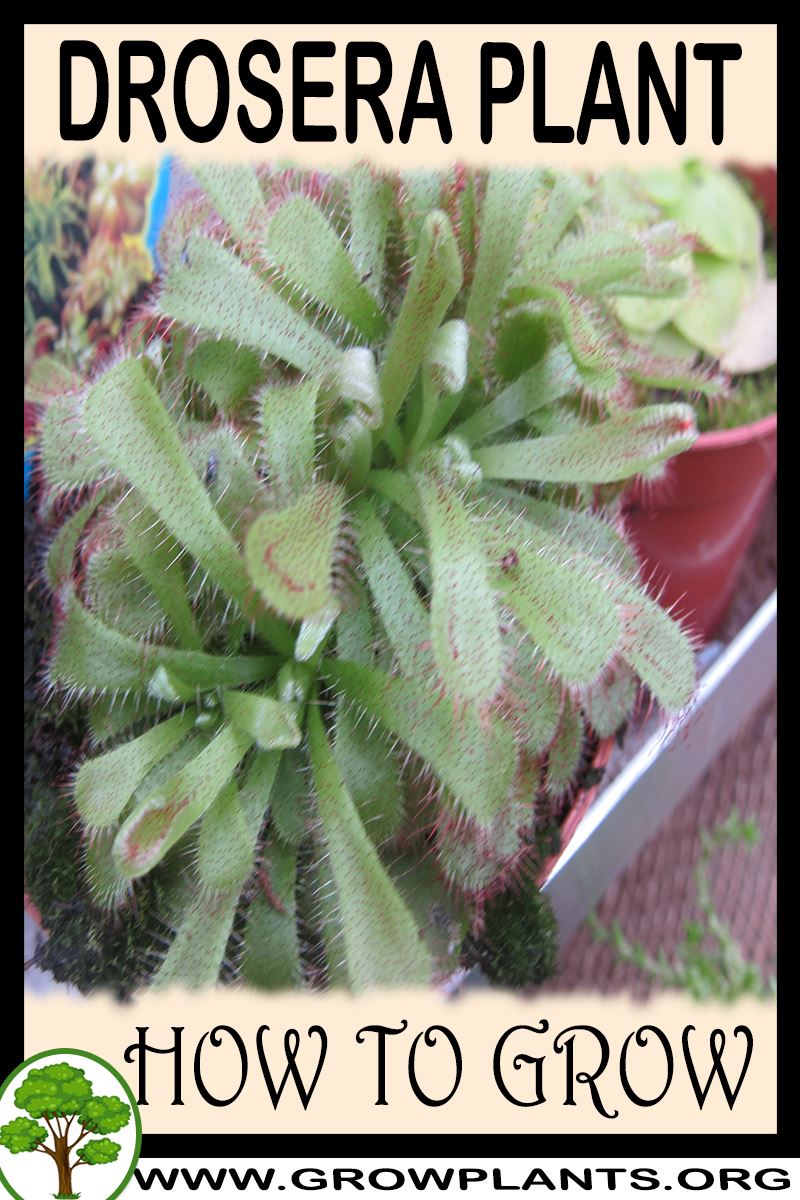

Plant Profile & Key Characteristics
Overview: A small evergreen perennial carnivorous plant reaching just 5-20 cm (2-8 in), forming a low rosette of sticky insect-trapping leaves. Grown as an ornamental curiosity outdoors in mild climates or as a bog-terrarium houseplant.
Quick Specifications
| Specification | Attribute |
|---|---|
| Plant Type / Life Cycle | Perennial (herbaceous carnivorous) |
| Foliage Type | Evergreen |
| Mature Size | 5-20 cm tall (2-8 in); low spreading rosette |
| Growth Rate | Slow to moderate |
| Root System | Fine, shallow fibrous roots (minimal in a carnivorous rosette) |
| Hardiness | USDA zones 9-10 (many species tender) |
Growth Form & Structure
- Height & Spread: 5-20 cm (2-8 in) tall, forming a compact rosette; thrives equally in the ground or in pots and terrariums where the moisture can be controlled.
- Growth Habit & Form: Low herbaceous rosette of leaves radiating from a central crown.
- Lifespan & Maturity: Perennial; reaches its small mature size within a season or two, and many species enter a winter dormancy.
Anatomy & Physical Features
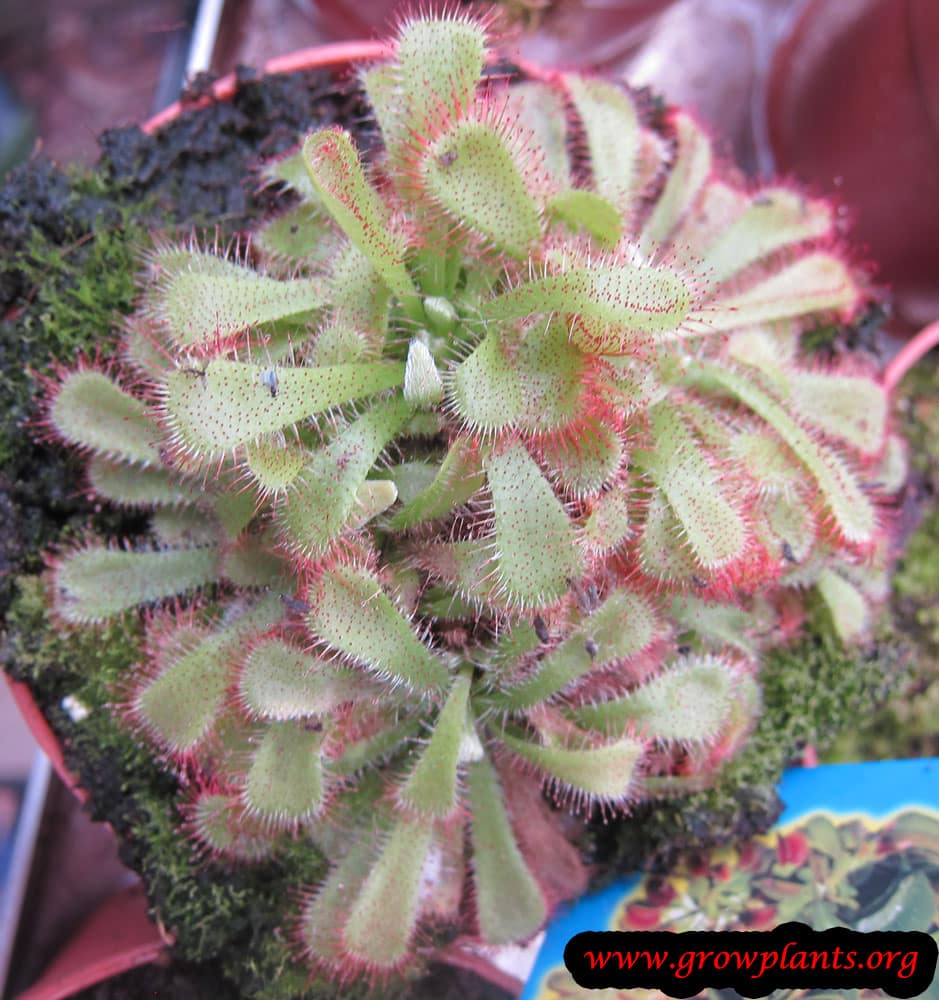
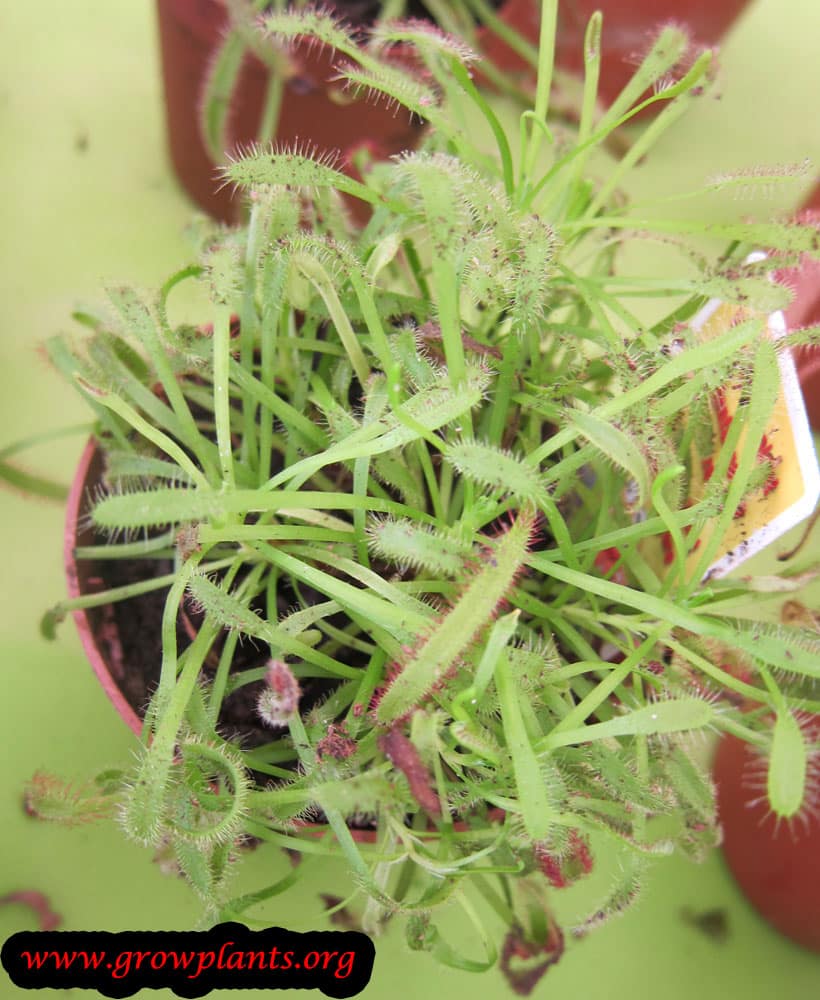
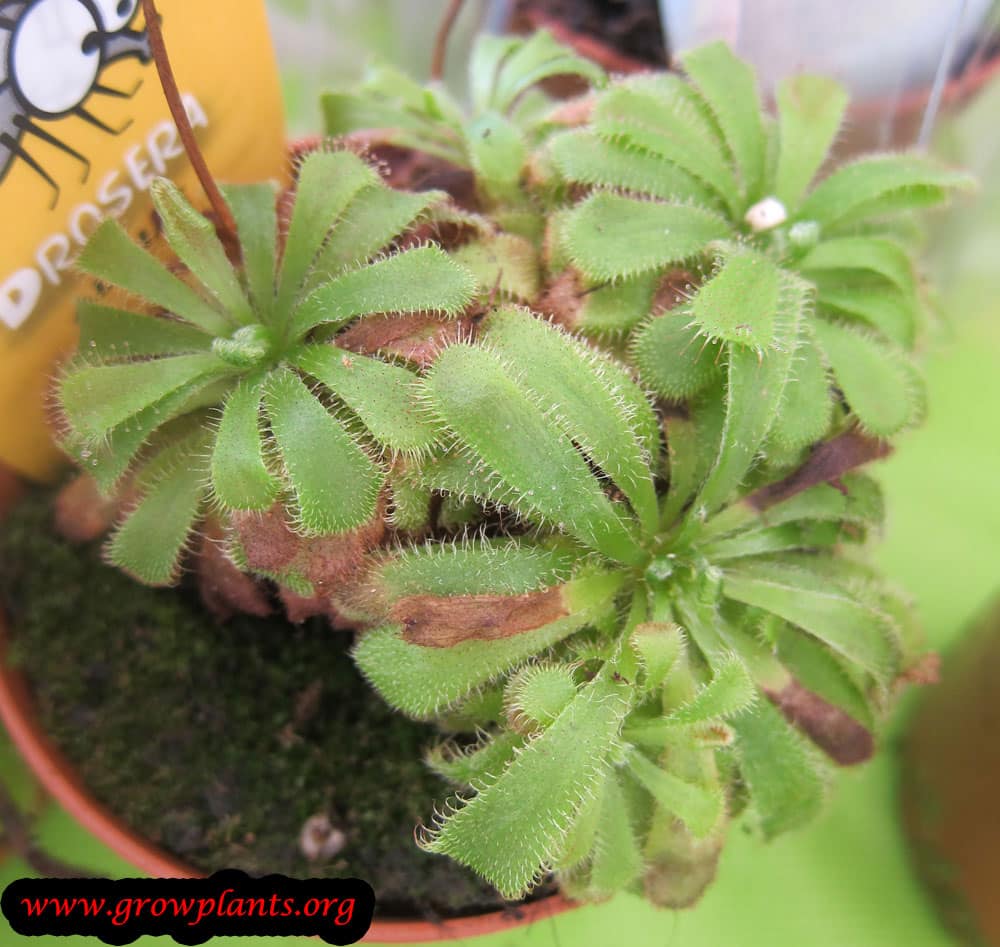
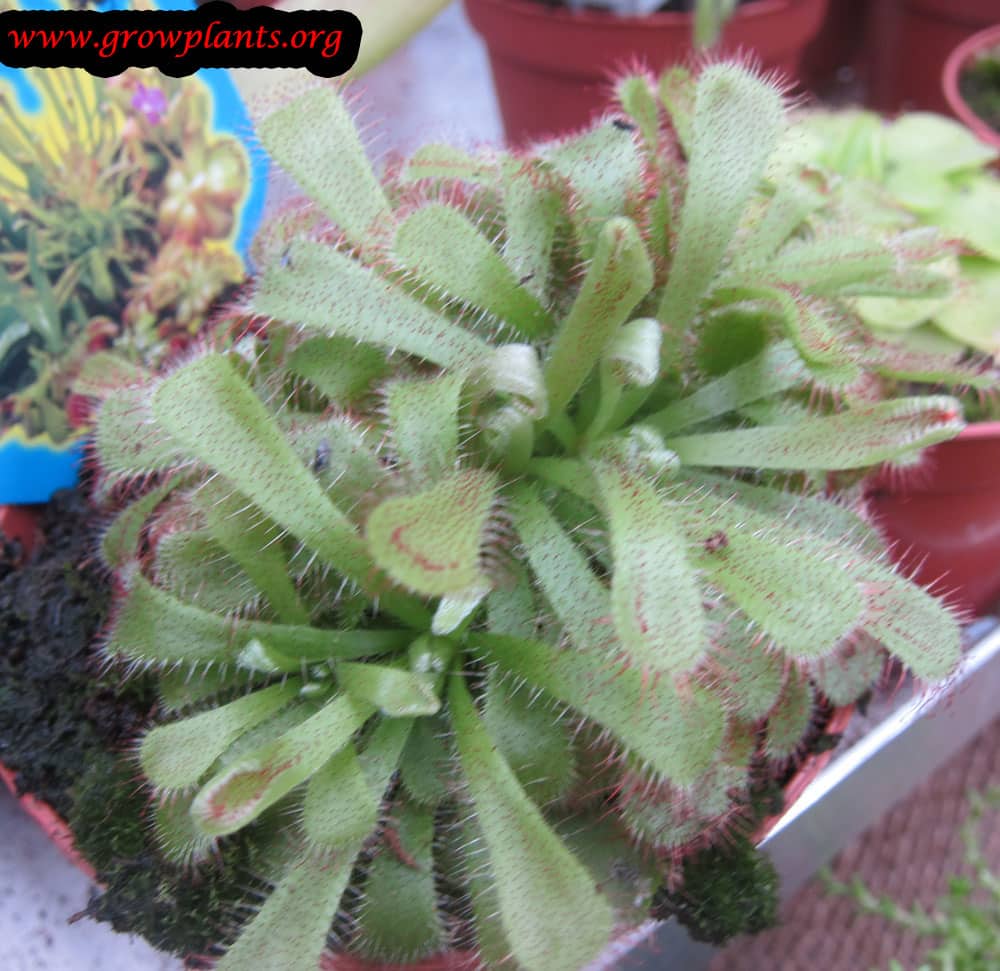
- Leaves & Foliage: Green, red or yellow leaves in a rosette; each leaf is edged with tentacle-like hairs (green, red or white) tipped with a round, glistening, sticky gland that traps and digests insects.
- Flower Characteristics: Five-petalled flowers held above the foliage on a slender stalk, in red, pink, orange, yellow, purple-magenta or white with yellow stamens.
Primary Uses & Landscape Value
- Functional & Ornamental Roles: Grown as a novelty ornamental and natural insect-catcher, well suited to bog gardens, terrariums and bright windowsills.
Care Guide: Planting, Soil & Watering
Overview: Sundew (Drosera) is a carnivorous bog plant for bright light to part shade that needs a lean, acidic, peat-based soil and constant moisture. It gets its nutrients from insects, so it must never be fertilized or watered with hard, mineral-rich water.
Quick Care Requirements
| Requirement | Ideal Condition |
|---|---|
| Planting Season | Warm season — spring to summer |
| Growth Rate | Slow to Moderate |
| Soil Type | Nutrient-poor carnivorous mix — sphagnum moss, peat moss and perlite |
| Soil pH | Acidic (low-nutrient bog soil) |
| Water Need | Moderate to High — keep constantly moist with mineral-free (rain / distilled) water |
Planting & Establishment
- Best Planting Season: Pot up or plant in the warm season, spring through summer, as active growth resumes.
- How to Plant:
- Soil Amendments: Use a dedicated carnivorous mix of sphagnum moss, peat moss and perlite — never garden soil, compost or fertilizer, which will burn the roots.
- Planting Depth: Set the rosette with its crown at the soil surface; keep the growing point uncovered.
- Growth Speed & Expectations: Slow to moderate; expect a small rosette that grows steadily in bright light with humidity around it.
Soil, Watering & Drainage Care
- Soil Mix & Drainage Needs: The peat / sphagnum / perlite mix stays airy yet moisture-retentive; stand the pot in a shallow tray of water so the mix wicks up moisture from below and never dries out.
- Watering Schedule & Technique:
- Young / Newly Planted: Keep the mix wet at all times using only rainwater or distilled water; misting the leaves helps maintain humidity.
- Established: Maintain the tray-watering method so the soil stays consistently moist to wet through the growing season.
- Seasonal Adjustments: Ease off slightly in cool weather, keeping the mix just damp rather than saturated.
Climate, Light & Hardiness
Drosera (sundew) is a carnivorous plant suited to subtropical and Mediterranean climates, hardy outdoors in USDA zones 9 through 10. It needs full sun to half shade and prefers moderate humidity around 40%, tolerating a fairly wide temperature range.
Quick Climate Specifications
| Climate Zones | Subtropical, Mediterranean |
|---|---|
| USDA Hardiness Zones | 9–10 |
| Optimal Temp Range | 5–30°C (41–91°F) |
| Light Conditions | Full Sun to Half Shade |
Sunlight & Light Exposure
Optimal Light Setup
Grow in full sun to half shade for the strongest color and best "dew" production on the leaf tentacles; when grown indoors, place near a bright window and supplement with grow light if needed.
Temperature Extremes & Hardiness
USDA Hardiness & Regional Limits
Hardy outdoors in USDA zones 9 through 10; outside this range it is best grown indoors or in a protected bog garden/terrarium setup.
Cold Damage & Winter Protection
Comfortable growing temperatures range from about 5–30°C (41–91°F); protect from temperatures below this range.
Wind, Humidity & Microclimate
Humidity Preferences
Prefers moderate humidity around 40%, consistent with its native bog and wetland habitats.
Growing in Pots, Balconies & Indoors
Drosera (sundew) is a small carnivorous plant (5-20 cm / 2-8 in) with dewy, insect-catching leaves. The grower notes it is not a general room houseplant but does well on a window, where it gets the bright light it needs – it is a classic candidate for a sunny, humid windowsill or a bright balcony.
Quick Details
- Container Size: A small pot stood in a water tray (general guidance for carnivorous plants)
- Indoor Suitability: Not a deep-room plant; excellent on a bright, sunny windowsill
- Best Spot: Full sun to half shade with high humidity
- Soil & Drainage: Lime-free, nutrient-poor peat/sphagnum mix with sand or perlite – never garden soil or fertiliser
- Watering in Pots: Keep constantly moist; mist the leaves and use only rainwater or distilled water
Indoors & On the Windowsill
- On a window: The grower’s key point – a bright window is where it belongs indoors; give it the strongest light and steady humidity (a covered tray or terrarium helps).
- Feeding: Do not fertilise the soil – the plant feeds itself by catching insects. If none are around, it still copes.
On a Balcony or Patio
- Light & moisture: A bright, sheltered balcony works well in the warm season; keep the tray topped up so the medium never dries, and shade it from the most scorching afternoon heat.
Choosing the Pot, Soil & Long-Term Care
- Pot & water tray (the exception): Unlike most potted plants, a sundew likes wet feet – stand the pot in a shallow tray of rainwater or distilled water so the peaty medium stays saturated. Avoid tap or hard water, which carries damaging minerals.
- Medium: A lime-free, low-nutrient carnivorous-plant mix (peat or sphagnum with sand or perlite). Never use ordinary potting compost or feed.
- Repotting: Refresh the medium every year or two with fresh, lime-free material.
Fertilizing & Feeding
A light feeder in an unusual way: this carnivorous plant meets most of its nutrient needs by capturing insects with its sticky, antenna-tipped leaves rather than through root fertilizer, so conventional soil feeding is minimal to none, with only very light supplemental feeding considered for container specimens that lack access to prey.
Quick Fertilizing Specs
| Feeding Level | Light feeder (nutrient needs met mainly by prey capture, not soil fertilizer) |
|---|---|
| Main Nutrient Priority | Insect capture is the primary nutrient source; soil fertilizer is rarely needed and can injure fine, bog-adapted roots |
| Best Feeding Period | During active growth when the plant is actively catching insects |
| Organic Options | Not applicable – this bog plant is adapted to nutrient-poor sphagnum, perlite, and peat soil and does not need compost or manure |
| Reduce/Stop Feeding | Feeding, if any, stops as growth slows in cooler conditions |
| Micronutrients | Not typically supplemented – the specialized bog soil mix and prey capture meet the plant’s needs |
| Soil pH | Grown in an acidic, nutrient-poor mix of sphagnum, perlite, and peat |
Feeding by Growth Stage
Active growth via prey capture
Support the plant’s rosette of sticky, insect-catching leaves through its main growing period.
| Nutrient direction | Nutrient needs are met mainly by capturing insects on the sticky leaf antennas rather than by root fertilizer; standard fertilizer applied to the soil is rarely needed and can injure the fine, nutrient-sensitive roots adapted to bog conditions. |
|---|---|
| Timing | During the plant’s active growing period when it is producing new sticky leaves. |
| Frequency | Supplemental feeding, when used at all for prey-limited indoor specimens, is kept occasional and light. |
| Fertilizer types | No routine soil fertilizer – prey capture supplies most nutrients, A carnivorous-plant-specific supplemental feed applied sparingly to leaves only for prey-limited indoor specimens |
| Precautions | Never apply standard garden fertilizer to the soil or roots of this bog plant; it is adapted to nutrient-poor conditions and conventional fertilizer salts can damage or kill it. Keep the specialized soil mix and humidity conditions consistent. |
Cooler-season slowdown
Let the plant rest as growth and insect-catching activity slow in cooler conditions.
| Nutrient direction | None – withhold any supplemental feeding while growth is slow. |
|---|---|
| Timing | Whenever temperatures cool and growth visibly slows. |
| Frequency | No feeding at this stage. |
| Fertilizer types | No feeding at this stage – this bog plant should never receive standard soil fertilizer |
| Precautions | Do not fertilize the soil during slow growth; maintain humidity and the specialized sphagnum, perlite, and peat mix instead. |
Nutrient Deficiency Signs & Corrections
Blackened, dying leaves or sudden decline shortly after fertilizer was applied to the soil.
| Possible causes | standard garden fertilizer applied to soil, which this bog plant’s roots cannot tolerate, tap water with high mineral content used instead of low-mineral water, soil mix that has broken down and lost its low-nutrient, well-drained structure |
|---|---|
| Appears first on | whole plant, often rapidly |
| What to check | whether any soil fertilizer was recently applied, water source and mineral content, condition and age of the sphagnum, perlite, and peat mix |
| Possible correction | Flush the soil thoroughly with distilled or low-mineral water, remove any fertilizer residue, and repot into fresh bog mix if the plant does not recover; avoid all future soil fertilizer. |
Leaves with dry or non-sticky antenna tips that fail to catch insects.
| Possible causes | insufficient humidity around the plant, low light reducing sticky secretion production, lack of insect prey, especially for indoor-grown specimens |
|---|---|
| Appears first on | leaf tip antennas |
| What to check | ambient humidity, light exposure, access to small insects or a light supplemental feed |
| Possible correction | Increase humidity and light toward the plant’s preferred full sun to half shade range, and consider light supplemental feeding only if the plant is indoors without insect access. |
Wilting or mushy base despite the plant’s preference for consistently moist conditions.
| Possible causes | waterlogged mix with poor structure, stagnant, non-flowing water in the tray, fungal or bacterial infection following soil fertilizer injury |
|---|---|
| Appears first on | base of the rosette and roots |
| What to check | drainage and structure of the sphagnum, perlite, and peat mix, water freshness, any recent fertilizer exposure |
| Possible correction | Improve mix structure and drainage, refresh standing water regularly, and never apply soil fertilizer, which compounds root stress. |
Pruning, Training & Seasonal Maintenance
Drosera (sundew) is a non-woody carnivorous rosette that needs essentially no shaping – the only real task is removing individual leaves once they blacken and die, which can be done any time of year since leaves senesce continuously from the crown. This tidying protects the crown from rot rather than affecting flowering, size, or structure, and it must never be confused with removing a leaf that is still sticky and actively trapping prey.
Quick Pruning & Maintenance Specs
| Pruning Tolerance | Low (sanitary only) |
| Primary Pruning Window | Year-round, as needed |
| Typical Frequency | Ongoing, whenever a leaf blackens |
| Main Objective | Remove dead/rotting leaves to protect the crown from fungal rot |
| Young Plant Priority | None – do not disturb an establishing rosette |
| Mature Plant Priority | Ongoing dead-leaf removal; remove spent flower scapes |
| Best Tool Type | Fingers or precision snips |
| Avoid Heavy Pruning During | Not applicable – there is no heavy pruning for this plant |
Pruning by Plant Age & Size
Newly Established
Leave alone beyond removing any leaf that arrives already dead; the small rosette needs every functional trap to establish.
Young / Formative
No structural training – Drosera has no framework, only a growing rosette of trap-leaves.
Mature / Established
Routine removal of blackened, collapsed leaves and finished flower scapes; overcrowded clumps are renewed by dividing offsets, not by pruning the parent rosette.
Seasonal Pruning Schedule
Ongoing Sanitary
Objective: prevent rot spreading from a dead leaf into the crown. Remove: fully blackened or collapsed leaves and finished flower scapes. Do not remove: any leaf still producing sticky dew and actively trapping insects, even if it is one of the older leaves in the rosette. Response: a cleaner rosette with no effect on future flowering, since new leaves and scapes emerge continuously from the crown rather than from previously pruned growth.
Special Growth to Remove
- Dead or blackened leaves.
- Spent flower scapes once bloom has finished.
Container & Small-Space Pruning
Drosera is grown almost exclusively in pots or trays over a sphagnum-peat mix with high humidity; the pruning task itself does not change in a container, but the constant moisture means dead leaf debris left in the pot rots and can carry fungal issues to the crown faster than in drier culture, so remove it promptly.
Tools
- Fingers or precision snips – leaves and scapes are thin and soft, no larger tool is ever needed.
Tool Hygiene & Disease Risk
Routine: ordinary clean hands or snips are enough. Because sundews are grown in constant high humidity, a lingering dead leaf seeds fungal rot into the crown faster than on most plants, so prompt removal matters more than tool sterility here.
Cut Placement & Technique
Pinch or snip the dead leaf at its base near the crown; avoid touching or squeezing the sticky, actively trapping leaves nearby, since the mucilage and trap mechanism are easily damaged and slow to regenerate.
Heavy Pruning & Rejuvenation
Not applicable – Drosera does not tolerate or need a hard cutback. A crowded or declining plant is renewed by dividing offsets or starting fresh leaf/root cuttings, not by cutting back the parent rosette.
Post-Pruning Care
No special watering change; keep humidity and moist, nutrient-poor substrate as usual. Do not fertilize the soil to aid recovery – Drosera feeds itself through its traps, not through root feeding.
Common Pruning Mistakes
- Removing leaves that are still sticky and actively catching insects just because they look older.
- Handling healthy leaves and damaging the dew/trap mechanism in the process.
- Leaving dead leaf litter to rot against the crown in the humid growing tray.
When NOT to Prune
Never remove a leaf that is still producing dew and catching insects, even late in its life – it is still actively feeding the plant.
Recommended Tools (by task)
- Removing blackened leaves and spent flower scapes: precision_snips – the only cut this small, soft carnivorous rosette ever needs.
Propagation Guide
Drosera (sundews) are most quickly and reliably increased vegetatively, especially from leaf cuttings, which the site notes is easier than raising them from seed though not strictly necessary. Difficulty is generally easy from leaf cuttings, while seed is a little more exacting because of the fine, dust-like seed these plants produce.
Quick Propagation Specs
| Best Propagation Method | Leaf cuttings |
| Alternative Methods | Division of offshoots; seed |
| Propagation Difficulty | Easy |
| Seed True-to-Type | Usually true-to-type (species) |
| Vegetative True-to-Type | Yes |
| Best Propagation Season | Spring to summer, during active growth |
| Seed Germination Time | Variable, often several weeks and sometimes slow |
| Cutting Rooting Time | New plantlets often appear within several weeks to a couple of months |
| Germination Temperature | Warm, within this plant’s normal growing range of about 5-30°C (41-86°F), leaning to the warmer end for germination |
| Seed Sowing Depth | Surface-sown, left uncovered |
Growing from Seed
Seed Handling & Viability
Drosera seed is fine and dust-like and generally keeps best when sown reasonably fresh rather than stored long-term.
Sowing Depth & Orientation
Sow on the surface of the growing medium and leave uncovered; the seed is too small to bury.
Germination Conditions
Use the same sphagnum, perlite and peat mix this plant is grown in, kept constantly moist with high humidity and bright light; warm conditions toward the upper part of this plant’s normal temperature range help germination.
Germination Time
Germination can be slow and uneven, often taking several weeks or more.
Leaf & Root Cuttings
Leaf cuttings are the standard, fast way to multiply Drosera.
- Take a healthy whole leaf, including the petiole where present, and lay it on or partly insert it into moist, sterile sphagnum, peat and perlite mix, matching this plant’s usual soil.
- Keep humidity high (a covered tray or propagator helps) and provide bright light but not harsh direct sun.
- New plantlets typically form along the leaf or at its cut end over several weeks to a couple of months.
- A number of Drosera species with fleshy roots can also be propagated from root cuttings laid on or just under the surface of moist medium, though this depends on the species having roots substantial enough to use.
Division, Offsets, Pups & Suckers
Many sundews naturally produce offshoot rosettes or plantlets around the base of the parent plant. Once an offshoot has its own roots, it can be gently separated and potted on into the same sphagnum/perlite/peat mix, kept humid until it re-establishes.
Bloom & Flower Guide
Quick Details
- Bloom Season: Summer
- Flower Appearance: Five-petalled flowers with yellow stamens, in red, pink, orange, yellow, purple-magenta or white, on a tall stem
- Edibility: Ornamental only – grown as a curiosity carnivorous plant, not eaten
Detailed Blooming Overview
Sundews are best known for their sticky, insect-catching leaves, but they flower charmingly too. The blooms are carried at the top of a long, arching stalk that lifts them well clear of the dewy traps below – nature’s way of keeping the plant from catching the very insects it needs for pollination. Each five-petalled flower has bright yellow stamens, in a color that varies by species, and tends to open in bright sun.
Flower Characteristics
- Five-petalled flowers with yellow stamens, color varying from red and pink to yellow, purple-magenta or white.
- Held high above the sticky leaves on a tall flower stalk.
Bloom Care & Thinning
- Sun opens the flowers: Blooms open in bright light; many sundews also self-pollinate readily.
- After flowering: Remove spent flower stalks unless you want to collect the fine seed.
Pests, Diseases & Troubleshooting
Overview: Sundews are carnivorous bog plants adapted to nutrient-poor, mineral-free, permanently moist ground, so most of their real trouble is cultural rather than pests: tap-water minerals, stagnant air, and wrong watering cause far more losses than insects. Management is almost entirely preventive – use pure water, bright light, humid but moving air, and never fertilise the soil; the plant feeds itself by catching insects.
Quick Troubleshooting Overview
| Issue / Pest | Main Symptom | Primary Solution |
|---|---|---|
| Aphids | Twisted, stunted new leaves & flower stalks; sticky honeydew | Rinse off, remove infested growth, biological control |
| Fungus gnats | Tiny black flies over wet media; larvae in peat harm roots | Yellow sticky traps; avoid a soggy, airless surface |
| Mealybugs | White cottony tufts in the crown & leaf bases | Dab with cotton bud; isolate plant |
| Botrytis (grey mould) | Fuzzy grey rot spreading from dead leaves | Remove dead tissue; increase airflow |
| Crown / root rot | Collapsing, blackening crown; mushy base | Correct water quality & drainage; cooler, airier conditions |
| Mineral burn | Browning, dying leaves despite good care | Switch to rain / distilled / RO water only |
Common Pests & Management
- Aphids (Aphidoidea):
- Symptoms: Clusters of tiny green, pink or black soft-bodied insects on the growing point, unfurling leaves and flower scapes; they twist and stunt new growth and leave sticky honeydew. Sundew tentacles will trap some aphids but cannot control an infestation.
- Prevention & Control: Blast them off with a gentle stream of pure water and pinch out badly deformed growth. Because sundews are sensitive, avoid soaps and oils; instead rely on repeated rinsing, isolating new plants, and encouraging lacewings/ladybirds outdoors. If a systemic is unavoidable, use a low, imidacloprid-free option sparingly and never near the trap fluid you want to keep.
- Fungus gnats (Bradysia spp.):
- Symptoms: Small dark flies running over the peat surface; the translucent larvae live in the wet media and can chew fine roots and seedlings, weakening young plants. Adults are a nuisance and a sign the surface stays too wet and airless.
- Prevention & Control: Set yellow sticky traps to catch adults, let the very top of the media breathe between top-waterings using the tray method, and top-dress with a thin layer of pure sand or long-fibre sphagnum. A Bacillus thuringiensis israelensis (Bti) or beneficial-nematode drench in pure water controls larvae without harming the plant.
- Mealybugs (Pseudococcidae):
- Symptoms: White, cottony waxy tufts hiding in the crown, leaf axils and among the dewy tentacles; they suck sap and cause stunted, distorted growth. Often arrive on newly bought plants.
- Prevention & Control: Touch each insect with a cotton bud (plain water or a very dilute, well-rinsed treatment), physically remove them, and quarantine new acquisitions. Keep numbers down manually – harsh sprays damage the delicate glandular leaves.
- Spider mites (Tetranychidae):
- Symptoms: Fine stippling, loss of dew, and faint webbing on leaves kept in dry indoor air; the tentacles stop producing mucilage and the plant looks dull. More a symptom of low humidity than a common sundew pest.
- Prevention & Control: Raise humidity and airflow, which sundews want anyway; rinse foliage with pure water. Predatory mites work well in an enclosure. Avoid miticidal oils/soaps that scorch carnivorous foliage.
Diseases & Fungal Issues
- Botrytis / grey mould (Botrytis cinerea):
- Symptoms: Fuzzy grey-brown mould that starts on dead or dying leaves and spent flower stalks, then spreads into healthy tissue and the crown in cool, damp, stagnant conditions – a common killer of dormant or crowded plants.
- Treatment & Management: Snip away all dead leaves and old flower scapes promptly, thin crowded pots, and give steady air movement (a small fan for terrarium plants). Lower humidity slightly during cool spells. Only if severe, apply a light carnivore-safe fungicide; good sanitation usually prevents it.
- Crown & root rot (Pythium / Phytophthora spp.):
- Symptoms: The central crown blackens, softens and pulls away, and roots turn to brown mush – triggered by mineral-laden water, warm stagnant conditions, or standing in stale water for long periods.
- Treatment & Management: This is almost always a culture problem: use only pure water, refresh the tray so water never goes foul, ensure a peat/sand or peat/perlite mix that stays wet but not airless, and keep the crown drier and cooler if rot appears. Rooting a healthy leaf or unaffected crown division is often the best rescue.
Growing Difficulties & Abiotic Problems
- Mineral / water-quality burn:
- Cause & Symptoms: Leaf tips and margins brown, dew stops forming, and the plant slowly declines because tap or spring water salts accumulate in the peat – the single most common cause of sundew death.
- Correction Strategy: Water only with rainwater, distilled or reverse-osmosis water (aim for under about 50 ppm TDS). Flush the pot occasionally with pure water and never let mineral water sit in the tray.
- Loss of dew / no sticky drops:
- Cause & Symptoms: Healthy sundews glisten with mucilage; dew disappears when humidity is too low, air is too dry and moving hard, light is weak, or the plant was recently disturbed or over-fed.
- Correction Strategy: Give bright light, keep humidity moderate-to-high with gentle airflow, and never fertilise the soil. Dew usually returns within days once conditions and pure watering are corrected.
- Fertiliser / rich-soil damage:
- Cause & Symptoms: Rapid browning and collapse after using ordinary potting soil, compost or fertiliser – sundew roots cannot cope with nutrients and salts.
- Correction Strategy: Grow only in a lean carnivorous mix (peat or long-fibre sphagnum with silica sand/perlite). Let the plant catch its own insects; foliar feeding, if ever done, is a tiny amount of dilute fish/orchid food on the traps, not the roots.
- Light & colour problems (etiolation / sunburn):
- Cause & Symptoms: Too little light gives pale, floppy, all-green rosettes that stretch; a sudden move to fierce sun scorches the tender leaves brown. Good colour (reds/pinks) needs strong light built up gradually.
- Correction Strategy: Provide bright light – a sunny windowsill or strong grow light – and acclimatise slowly before any full sun. Balance light with the humidity the plant needs.
- Dormancy confusion (temperate species):
- Cause & Symptoms: Some sundews are temperate and die back to a resting bud (hibernaculum) in winter; growers often mistake natural dormancy for death, or keep a temperate species warm year-round until it weakens. Subtropical species (aliciae, capensis, spatulata) stay evergreen and do not need this.
- Correction Strategy: Identify your species. Temperate types get a cool, bright, less-wet winter rest; subtropical types are kept growing year-round. Do not discard a dormant crown that still has a firm centre.
What Helps – Products & Tools
Reach first for the basics that keep sundews healthy: pure water (rain/distilled/RO), yellow sticky traps for fungus gnats and aphids, Bti or beneficial nematodes for gnat larvae, and long-fibre sphagnum / silica sand for clean top-dressing. Avoid insecticidal soaps and horticultural oils, which scorch the glandular leaves – use physical removal, rinsing and biological controls instead.