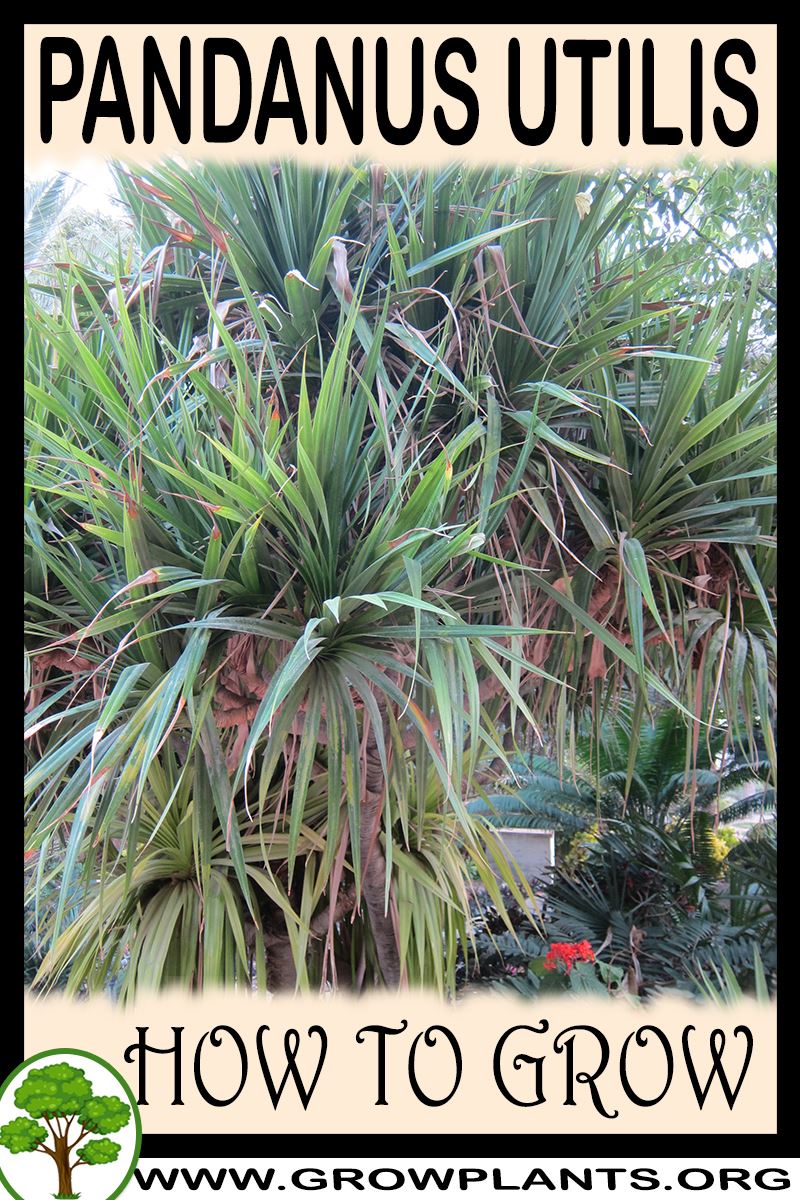
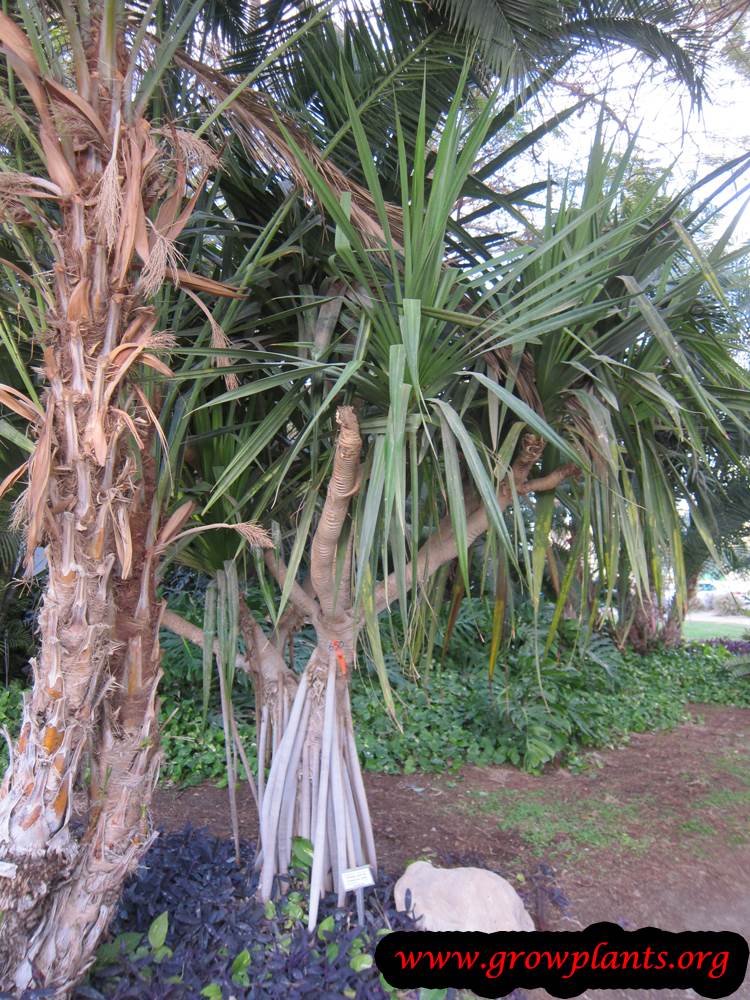
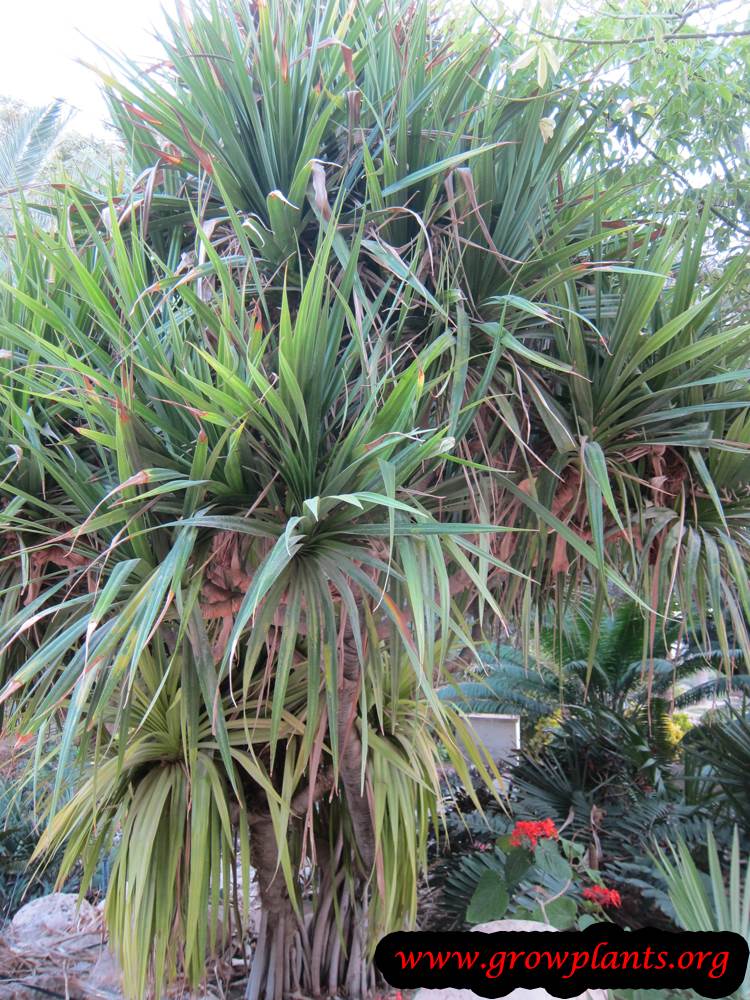
Plant Profile & Key Characteristics
Overview: An evergreen tropical tree of the genus Pandanus (common screwpine) reaching 5-15 m, distinctive for its spiral rosettes of strap-like leaves and stilt-like prop roots. It is grown as a striking architectural ornamental and for its edible fruit.
Quick Specifications
| Specification | Attribute |
|---|---|
| Plant Type / Life Cycle | Perennial tree |
| Foliage Type | Evergreen |
| Mature Size | 5-15 m (15-45 ft) tall |
| Growth Rate | Moderate to slow |
| Root System | Aerial prop (stilt) roots |
| Toxicity | Non-toxic – fruit is edible |
| Hardiness | USDA zone 10b+ |
Growth Form & Structure
- Height & Spread: 5-15 m (15-45 ft), often propped by a cone of aerial roots at the base.
- Growth Habit & Form: Upright tree with branches ending in spiral tufts of leaves, supported by stilt roots.
- Lifespan & Maturity: Long-lived; dioecious, so male and female plants are needed for fruit.
Anatomy & Physical Features
- Leaves & Foliage: Long, spear- or strap-shaped green leaves arranged in spirals.
- Flower Characteristics: Yellow flowers; dioecious, with feathery male flowers and ball-like female flowers on separate plants.
- Fruit Profile: Large, rounded, pineapple-like fruit head that is edible.
Primary Uses & Landscape Value
- Edible Uses: Fruit is edible.
- Functional & Ornamental Roles: Bold architectural ornamental for tropical and coastal landscapes.
Care Guide: Planting, Soil & Watering
Overview: The common screwpine is a tropical evergreen tree that thrives in full sun to part shade in warm, frost-free conditions, tolerating coastal and sandy sites. It likes well-draining soil and only moderate water once established.
Quick Care Requirements
| Requirement | Ideal Condition |
|---|---|
| Planting Season | In the warm season, after frost has passed |
| Growth Rate | Slow to moderate |
| Soil Type | Well-draining; tolerant of sandy soils |
| Water Need | Low to moderate |
Planting & Establishment
- Best Planting Season: Plant during the warm season, spring through autumn; it is frost-tender, so plant only where temperatures stay above freezing (zone 10b+).
- How to Plant:
- Hole Preparation: Dig a hole about twice the width of the root ball to loosen the surrounding soil for the prop-rooted trunk.
- Soil Amendments: Improve drainage with grit or sand on heavy soils, and add some compost for fertility.
- Planting Depth: Set the root ball level with the soil surface; do not bury the trunk base.
- Growth Speed & Expectations: A slow-to-moderate grower eventually reaching 5-15 m.
Soil, Watering & Drainage Care
- Soil Mix & Drainage Needs: Needs free-draining soil and tolerates sand and salt; in containers use a well-draining mix with drainage holes.
- Watering Schedule & Technique:
- Young / Newly Planted: Water regularly to establish, letting the surface dry between waterings.
- Established: Water moderately and deeply; it is fairly drought tolerant once established.
- Seasonal Adjustments: More in summer heat; less in the cool season, and keep frost-free.
Climate, Light & Hardiness
Common screwpine is a warm-climate tree suited to tropical, subtropical, mediterranean, and desert regions, growing in full sun to half shade. It is frost-sensitive and hardy only from USDA zone 10b upward.
Quick Climate Specifications
| Climate Zones | Tropical, Subtropical, Mediterranean, Desert |
|---|---|
| USDA Hardiness Zones | 10b+ |
| Frost Tolerance | Low |
| Light Conditions | Full Sun / Half Shade |
Sunlight & Light Exposure
Optimal Light Setup
Full sun to half shade both suit this tree; full sun favors more compact, sturdy growth.
Temperature Extremes & Hardiness
USDA Hardiness & Regional Limits
Hardy only from USDA zone 10b upward - a warm-climate tree that needs consistently frost-free or near-frost-free conditions to thrive outdoors.
Frost Sensitivity
Frost-sensitive; cold snaps below its zone 10b threshold risk damaging foliage and the growing point.
Wind, Humidity & Microclimate
Wind Tolerance
Coastal tropical screwpines are generally sturdy, wind-firm trees adapted to exposed shoreline conditions, consistent with their native beach and coastal-forest habitat.
Coastal / Salt Tolerance
Naturally a coastal tropical species, it is well suited to seaside plantings within its frost-free hardiness range.
Growing in Pots, Balconies & Indoors
Screw pine is a striking tropical tree that ultimately reaches 5-15 m, so it is a container plant only while young. The grower does not list it as a houseplant; in a big pot it makes a bold patio or conservatory specimen for a few years before it outgrows life in a container.
Quick Details
- Container Size: A large, stable, heavy pot – and even so, only a medium-term home while young
- Indoor Suitability: Not a houseplant; too large long-term, though young plants suit a bright conservatory
- Best Spot: Full sun to part shade with warmth
- Soil & Drainage: Free-draining, organic-rich mix
- Watering in Pots: Small to average; let the surface dry between waterings
Indoors & On the Windowsill
- Too large long-term: The grower does not rate it as a houseplant; it becomes a big tree and only young plants fit indoors, in a bright, warm, roomy spot.
- Overwintering: Frost-tender – in cold climates keep young plants potted and move them into a bright, frost-free room for winter.
- Safety: The long leaves have spiny margins, so place it where people will not brush against it.
On a Balcony or Patio
- Light & wind: Give a young plant a warm, sheltered, bright corner; the big pot needs a firm, level base as it grows top-heavy. Water when the surface dries.
Choosing the Pot, Soil & Long-Term Care
- Pot & drainage: Use a pot with strong drainage holes; skip a standing-water saucer (or empty it promptly) so the roots never sit wet and rot. Terracotta breathes and dries fast; glazed or plastic holds moisture longer.
- Potting mix: A free-draining yet organic-rich mix – a quality potting mix or peat/coir blended with perlite or vermiculite for aeration.
- Feeding: Potted plants exhaust their soil faster than those in the ground – feed through the growing season, since nutrients leach out with every watering.
- Potting on: Move up a pot size as the roots fill out, but accept it will eventually be too large for container life.
Fertilizing & Feeding
A moderate feeder while establishing and building its canopy, easing to lighter, balanced maintenance feeding once the tree is mature and settled into its site.
Quick Fertilizing Specs
| Feeding Level | Moderate feeder |
|---|---|
| Main Nutrient Priority | Balanced feeding, with attention to iron and manganese availability in alkaline soils |
| Best Feeding Period | The main warm-season growing period, heavier during establishment |
| Organic Options | Compost or well-rotted organic matter worked into well-drained soil |
| Micronutrients | Iron and manganese are useful in a complete fertilizer; correct further only if new growth looks pale |
| Soil pH | Tolerates a wide range but shows chlorosis more readily in strongly alkaline soil |
| Reduce/Stop Feeding | Ease off feeding as the tree matures and during the cooler, slower part of the year |
Feeding by Growth Stage
Establishment after planting
Help a newly planted tree root in and begin building its canopy.
| Nutrient direction | A balanced, complete fertilizer supports root establishment and early canopy development. |
|---|---|
| Timing | At planting and through the first period of active root and leaf growth. |
| Frequency | Light, regular feeding while the tree is establishing new roots. |
| Fertilizer types | A balanced complete fertilizer for landscape trees, Compost or well-rotted organic matter worked into well-drained soil |
| Precautions | Avoid heavy feeding right at planting; go easy until new root growth confirms the tree has settled in. |
Active canopy growth
Support steady development of the leaf canopy and, on female plants, healthy fruit formation.
| Nutrient direction | A balanced, complete fertilizer with adequate nitrogen supports strong canopy growth through the main growing season. |
|---|---|
| Timing | Through the main warm-season growing period. |
| Frequency | Regular light feeding through the active growing season, tapering as growth slows. |
| Fertilizer types | A balanced complete fertilizer for landscape trees, A controlled-release product for steady feeding through the season |
| Routine trace nutrients | iron, manganese |
| Precautions | Match feeding to the tree’s actual growth rate; established trees in reasonable soil need only moderate input. |
Mature tree maintenance feeding
Maintain canopy health and vigor on an established tree without pushing unnecessary excess growth.
| Nutrient direction | A lighter, balanced feeding is usually enough to maintain an established tree’s canopy and general health. |
|---|---|
| Timing | During the growing season, easing back in the cooler, slower part of the year. |
| Frequency | An occasional light feeding through the growing season is generally sufficient for a mature, established tree. |
| Fertilizer types | A balanced complete fertilizer for landscape trees, used at a lighter, maintenance level |
| Routine trace nutrients | iron, manganese |
| Precautions | Watch for pale new growth, which can signal a micronutrient need worth investigating rather than simply adding more general fertilizer. |
Nutrient Deficiency Signs & Corrections
New leaves emerge yellow with green veins, sometimes with an overall washed-out look.
| Possible causes | alkaline soil tying up iron or manganese, poorly drained soil, root stress limiting nutrient uptake |
|---|---|
| Appears first on | newest leaves at the growing tips |
| What to check | soil pH if testing is available, soil drainage, root health |
| Possible correction | Improve drainage and soil conditions, and apply a chelated iron or manganese product per its label if chlorosis persists. |
Older leaf margins yellow, brown, or develop spots, sometimes with a general decline in leaf quality.
| Possible causes | low soil potassium, an imbalanced, nitrogen-heavy feeding history, sandy, fast-draining soil that leaches nutrients |
|---|---|
| Appears first on | older, lower leaves |
| What to check | recent feeding balance, soil texture and drainage, overall tree vigor compared to past seasons |
| Possible correction | Shift toward a more balanced or potassium-forward complete fertilizer and improve soil organic matter. |
Canopy thins, growth slows, and lower leaves yellow or drop despite otherwise reasonable care.
| Possible causes | waterlogged or poorly drained soil, overwatering, planting too deep or in a low, wet spot |
|---|---|
| Appears first on | lower and older leaves, with overall canopy decline |
| What to check | soil drainage around the root zone, recent watering and rainfall, planting depth |
| Possible correction | Improve site drainage where possible, adjust watering, and hold off feeding a stressed, waterlogged tree until conditions improve. |
Pruning, Training & Seasonal Maintenance
Pandanus utilis is a slow-to-medium growing evergreen tree with spirally arranged, spine-edged leaves; it also branches and suckers from the base, unlike a true single-crown palm, so there is real scope for shaping beyond simple leaf tidying. It tolerates only light, design-oriented pruning; the main jobs are removing spent lower leaves and choosing which basal suckers/branches to keep. Autumn/winter, outside the main growth push, is the safest window, and pruning has little effect on this dioecious tree’s fruiting since fruit forms only on female plants at branch tips regardless of leaf trimming.
Quick Pruning & Maintenance Specs
| Pruning Tolerance | Low to Moderate |
| Primary Pruning Window | Autumn / Winter |
| Typical Frequency | Occasional – as lower leaves decline or suckers need thinning |
| Main Objective | Remove spent leaves; manage basal suckers and branch number for design |
| Young Plant Priority | Leave the crown intact; decide early whether to keep it single-stemmed or allow clumping suckers |
| Mature Plant Priority | Remove dead/hanging leaves; selectively remove or retain suckers and low branches |
| Best Tool Type | Pruning saw for thick stems/branches; loppers for suckers |
| Avoid Heavy Pruning During | Active spring/summer growth flush |
Pruning by Plant Age & Size
Newly Established
Avoid cutting; let the young plant build its leaf crown and root/prop-root system undisturbed.
Young / Formative
No central-leader training applies. The formative decision is whether to keep a single trunk (removing basal suckers as they appear) or allow a multi-stemmed clumping form (leaving selected suckers to develop).
Mature / Established
Remove fully dead or hanging lower leaves as they senesce, and periodically thin excess basal suckers or crossing branches to keep the desired form and allow light/air into the crown.
Structural Pruning & Training
Because this species branches and suckers (unlike a true palm), branch and sucker selection is the main structural tool: choose and remove competing or crowded branches/suckers early, while cuts are still small, rather than waiting until they are thick stems. Avoid removing prop/stilt roots, which support the trunk and branches.
Special Growth to Remove
- Basal suckers – remove if a clean single-trunk form is wanted, or selectively retain a few for a multi-stemmed clump; do not remove all of them reflexively since clumping is part of this species’ natural habit
- Fully dead, brown, hanging leaves – remove for tidiness and to reduce a build-up of spiny dead material at the base
Container & Small-Space Pruning
In a container, keep to a single trunk by removing suckers promptly to limit spread, and expect slower recovery from any cut given the more limited root run; avoid heavy leaf removal, since a smaller root system supports a smaller functional canopy.
Tools
- Pruning saw for mature branches or a thick sucker base
- Loppers for smaller suckers and branches
- Thick gloves always – leaf margins are spine-edged
Tool Hygiene & Disease Risk
Routine: no significant transmissible disease is noted for this species in its facts; clean, sharp tools between cuts are sufficient.
Cut Placement & Technique
Remove suckers and branches flush at their point of origin rather than leaving stubs; cut dead leaves back close to the trunk without cutting into living tissue, and avoid tearing – the spiny leaf bases can be tough and should be cut, not pulled.
Heavy Pruning & Rejuvenation
This species does not tolerate hard rejuvenation cutting of its crown – over-removing living leaves stresses the single growing point of each stem, similar to the risk seen in true palms. Limit intervention to dead-leaf and sucker/branch management rather than attempting to cut it back hard.
Post-Pruning Care
Water normally after routine leaf/sucker removal; no extra feeding is needed. Watch cut surfaces on thicker branch or sucker removals for any dieback, and keep the area around the base clear of accumulated spiny debris.
Common Pruning Mistakes
- Over-removing green, still-functional leaves rather than only fully dead ones, which stresses the crown
- Letting basal suckers proliferate unchecked when a single clean trunk was intended
- Handling spiny leaves/leaf bases without gloves
When NOT to Prune
Avoid pruning during the main spring/summer growth flush, and avoid heavy cutting on a recently transplanted or stressed specimen.
Pruning Troubleshooting
| Problem | Possible Cause | What to Check | Corrective Action |
| Crowded, congested base | Basal suckers left unmanaged | Number and size of suckers at the base | Thin excess suckers while still small, leaving only the number wanted for the desired form |
| Sparse, stressed-looking crown | Over-removal of green leaves | Whether leaves removed were fully dead/brown or still green | Limit removal strictly to dead, brown leaves; let others senesce naturally |
| No fruit on a mature specimen | Plant is male (dioecious species) | Presence/absence of female flowers (ball-shaped) vs male (feather-like) | Not a pruning issue – confirm sex of the plant; only female plants fruit |
Recommended Tools (by task)
- pruning_saw – removing thick basal suckers or mature branches cleanly
- loppers – smaller suckers and branch removal
Propagation Guide
Pandanus utilis is most easily and commonly propagated by removing rooted basal offsets (suckers) that the plant produces naturally at its base, which grow into new plants quickly and true to type; growing from seed is also possible but is slower and depends on obtaining fresh seed from the fruit. Offset propagation is easy, while seed propagation is more moderate in difficulty.
Quick Propagation Specs
| Best Propagation Method | Basal offsets (suckers) |
| Alternative Methods | Seed |
| Propagation Difficulty | Easy by offsets; moderate by seed |
| Seed True-to-Type | Usually true-to-type |
| Vegetative True-to-Type | Yes |
| Best Propagation Season | Spring through autumn, within the plant’s normal planting window |
Division, Offsets, Pups & Suckers
This species readily produces basal offsets (suckers) at the base of the trunk. Once an offset has developed some roots of its own, it can be carefully removed with those roots intact and potted or planted separately; keep it consistently moist and in a sheltered spot until it is established.
Growing from Seed
Seed comes from the plant’s large fruit and is best sown fresh, since viability in this type of fruit-borne seed tends to decline with storage; germination and early growth are slower than starting from offsets.
Bloom & Flower Guide
Quick Details
- Bloom Season: Spring into summer
- Time to First Bloom: Only mature trees flower, after many years of growth
- Flower Appearance: Yellowish flowers on separate male and female trees – feathery, fragrant male spikes and rounded, ball-like female heads
- Edibility: The flowers are not eaten – grown as an ornamental (its fruit is used, but that is a fruit-stage feature)
Detailed Blooming Overview
The common screwpine is dioecious, so male and female flowers are borne on separate trees. Male trees produce showy, feathery, sweetly fragrant flower spikes cloaked in papery bracts, while female trees carry rounded, ball-like flower heads that later develop into the large knobbly fruit. Only mature specimens flower, and pollination is largely by wind, aided by the scent of the male blooms.
Flower Characteristics
- Male flowers: massed in feathery, fragrant creamy-yellow spikes with papery bracts.
- Female flowers: gathered into rounded, ball-like heads.
- Borne on separate male and female trees (dioecious).
Bloom Care & Thinning
- Pollination: Mainly wind-borne, with the fragrance of the male spikes drawing some insects.
- Managing the bloom: No thinning is needed; both a male and a female tree are required if fruit is wanted.
Fruit & Uses
Pandanus utilis is grown partly for its edible fruit, a large pineapple-like compound drupe made of many woody, wedge-shaped segments. The fibrous, fleshy base of each ripe segment is chewed or sucked for its pulp and juice rather than eaten whole, and only once the fruit is fully ripe.
Quick Edible Specs
| Edible Parts | Fruit (fibrous fleshy base of the ripe segments) |
|---|---|
| Main Use(s) | Fresh fruit pulp/juice, chewed for the fibrous flesh |
| Eaten Raw or Cooked | Raw, when fully ripe (some regional preparations cook or roast the segments) |
| Preparation Required | Peel/separate the woody segments; discard the hard fibrous core and any unripe (pale/hard) segments |
| Harvest Season | Not specified by the site; harvest only once the compound fruit has coloured up and softened at the segment base |
| Time to First Harvest | Not documented; large trees typically take some years to fruit – see Blooming for flowering habit |
| Storage | Best used fresh once ripe; not a long-storage crop |
| Safety/Toxicity Caveat | Only the fully ripe segments are palatable and easy to eat; unripe fruit is hard, fibrous and not worth eating |
Fruit
The tree bears large, rounded compound fruits made up of many wedge-shaped woody segments (phalanges), only on female trees (flowers are dioecious – see Blooming). Ripeness is judged by the fruit softening and colouring from green toward orange/red at the base of the segments. Ripe segments are broken apart by hand, and the fibrous fleshy base of each segment is chewed or sucked for its juice and pulp; the hard fibrous core and any unripe segments are discarded.
Preparation, Uses & Safety
The main use is as a fresh, fibrous fruit chewed for its juice rather than swallowed whole flesh; some regional traditions also roast or cook the ripe segments. There is no specific cooking step required for safety, but only the fully ripe, softened segments should be used – unripe fruit is unpalatably hard and fibrous. The site confirms edibility but gives no further ripeness, harvest, or preparation detail of its own for this species, so the guidance above follows generalized, genus-typical Pandanus fruit handling rather than a species-specific account.
Pests, Diseases & Troubleshooting
Overview: The common screw pine is a tough, leathery-leaved tropical that is largely resistant to pests; when trouble comes it is the standard indoor/greenhouse sap-suckers – scale, mealybugs, and spider mites – plus root rot in soggy soil. Its main ‘problems’ are actually abiotic: brown leaf tips from salt, fluoride, or dry air, and cold damage. Bright light, warmth, and free-draining soil keep it clean.
Quick Troubleshooting Overview
| Issue / Pest | Main Symptom | Primary Solution |
|---|---|---|
| Scale insects | Brown bumps along the strappy leaves; sticky honeydew | Scrape/wipe off; horticultural oil |
| Mealybugs | White cottony tufts in leaf axils and crown | Alcohol swab; insecticidal soap/oil |
| Spider mites | Fine stippling and webbing in dry air | Raise humidity; horticultural oil |
| Root rot | Yellowing, soft base, collapse in wet soil | Improve drainage; ease off watering |
| Brown leaf tips | Crispy brown tips/margins | Flush salts; filtered water; raise humidity |
| Cold damage | Blackened, water-soaked leaves after chill | Keep warm above ~10 °C; shelter from frost |
Common Pests & Management
- Scale insects (Coccus / Aspidiotus spp.):
- Symptoms: Immobile brown, tan, or grey bumps clinging along the long, strap-like leaves and their spiny midribs, with sticky honeydew and sooty mould; heavy scale yellows and weakens the foliage.
- Prevention & Control: Wipe or scrape off with a soft cloth (mind the spiny leaf edges) and treat with horticultural oil or insecticidal soap, covering leaf undersides and midribs. Repeat every 1–2 weeks and isolate the plant while treating.
- Mealybugs (Planococcus / Pseudococcus spp.):
- Symptoms: White cottony waxy tufts tucked into leaf axils and the tight crown, with honeydew, sooty mould, and stunted new growth; they favour the sheltered leaf bases.
- Prevention & Control: Dab colonies with a cotton bud of rubbing alcohol and follow with insecticidal soap or neem/horticultural oil, working into the axils. Check the root ball for a root form at repotting and persist over several weeks.
- Spider mites (Tetranychus urticae):
- Symptoms: Fine pale stippling and a dull, dusty look on the leaves with faint webbing in warm, dry indoor air, most likely on plants near heating.
- Prevention & Control: Raise humidity, shower the foliage periodically, and keep the plant off heat sources. Spray horticultural oil or insecticidal soap on leaf undersides, repeating every 5–7 days; predatory mites help under cover.
- Aphids (Aphis spp.):
- Symptoms: Soft green or black insects on tender new growth, mostly on plants grown outdoors in warm weather, causing sticky, distorted young leaves.
- Prevention & Control: Rinse off with water and wipe survivors; insecticidal soap or a light oil clears larger colonies. Rarely a serious problem on this leathery-leaved plant.
Diseases & Fungal Issues
- Root and crown rot (Pythium / Phytophthora / Rhizoctonia):
- Symptoms: Yellowing lower leaves, a softening base, and collapse in soil kept constantly wet or poorly drained; roots turn brown and mushy instead of firm and white.
- Treatment & Management: Use a free-draining mix and a pot with drainage holes, water only when the surface begins to dry, and never leave it standing in water. Remove rotted roots, repot into fresh mix, and keep warm and slightly drier to recover.
- Leaf spot / anthracnose (Colletotrichum / Cercospora spp.):
- Symptoms: Brown or black spots and blotches, sometimes with yellow halos, on leaves that stay wet in humid, still air; usually minor on this resistant plant.
- Treatment & Management: Remove affected leaves, keep foliage dry, and improve airflow and light. A copper fungicide helps in stubborn cases, though drier foliage and better ventilation normally suffice.
- Sooty mould (secondary):
- Symptoms: A black film over the leaves wherever scale or mealybugs have left honeydew, shading rather than infecting the plant.
- Treatment & Management: Control the sap-suckers first, then wipe the film off with a damp cloth or mild soapy water; it does not return once honeydew stops.
Growing Difficulties & Abiotic Problems
- Brown leaf tips & margins
- Cause & Symptoms: Crispy brown tips and edges on the long leaves from salt build-up in the soil, fluoride or chlorine in tap water, over-fertilising, or persistently dry air.
- Correction Strategy: Flush the soil periodically to leach salts, water with filtered or rainwater if tap water is heavily treated, feed sparingly, and raise humidity. Trim dead tips cosmetically once the cause is corrected.
- Overwatering vs. underwatering
- Cause & Symptoms: Yellowing, soft lower leaves from soggy soil, or browning and folding of leaves when left bone-dry for long spells.
- Correction Strategy: Water thoroughly when the top few centimetres dry, then let excess drain; increase in heat and growth, reduce in cool, dull periods. Consistency prevents both extremes.
- Cold damage
- Cause & Symptoms: Water-soaked, blackening, or collapsing leaves after exposure to cold draughts or temperatures below about 10 °C – this is a warm tropical.
- Correction Strategy: Keep it above roughly 12–15 °C, away from cold windows and draughts, and move outdoor plants under cover before cold snaps. Remove damaged leaves once new growth resumes.
- Light & leaf spines (handling)
- Cause & Symptoms: Pale, weak growth in deep shade; and the leaf margins and midribs bear sharp spines that can scratch when handling or siting the plant.
- Correction Strategy: Give bright light (with some protection from the fiercest midday sun), and wear gloves and site the plant clear of walkways because of its spiny, saw-edged leaves.
What Helps – Products & Tools
Keep a simple kit: horticultural / neem oil and insecticidal soap for scale, mealybugs, and mites, with rubbing alcohol for spot-treating. Most care is cultural – a free-draining mix against rot, filtered water and periodic soil flushing against brown tips, and warmth against cold damage. A copper fungicide is a backup for leaf spot only. Wear gloves for the spiny leaves.