



Plant Profile & Key Characteristics
Overview: Rocket larkspur (Consolida) is an upright herbaceous annual growing 30-60 cm (12-24 in), with finely divided, feathery foliage. It is grown purely as an ornamental for its tall spikes of spurred flowers, and is a valued cut flower.
Quick Specifications
| Specification | Attribute |
|---|---|
| Plant Type / Life Cycle | Annual |
| Mature Size | 30-60 cm (12-24 in) |
| Growth Rate | Moderate to fast |
| Toxicity | Toxic – all parts are poisonous if ingested |
| Hardiness | USDA zones 3-11 |
Growth Form & Structure
- Height & Spread: Slender upright stems of 30-60 cm (12-24 in); suits borders and can be grown in containers.
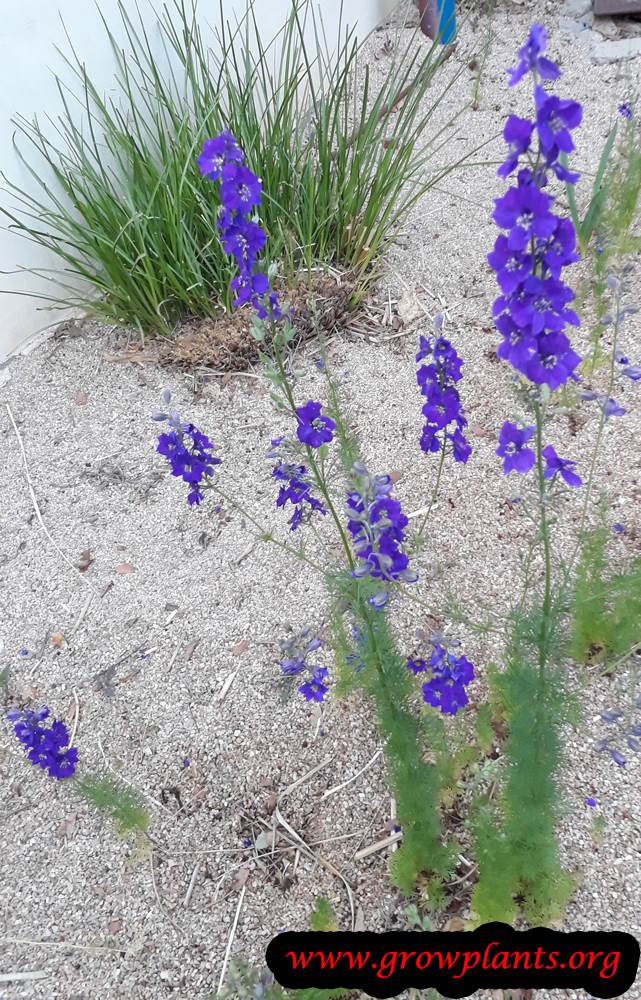
- Growth Habit & Form: Erect, branching herbaceous annual carrying tall flower spikes above ferny foliage.
- Lifespan & Maturity: Completes its life cycle in one season, flowering from spring into summer, then setting seed.
Anatomy & Physical Features
- Leaves & Foliage: Green, finely dissected leaves that are needle-like and feathery.
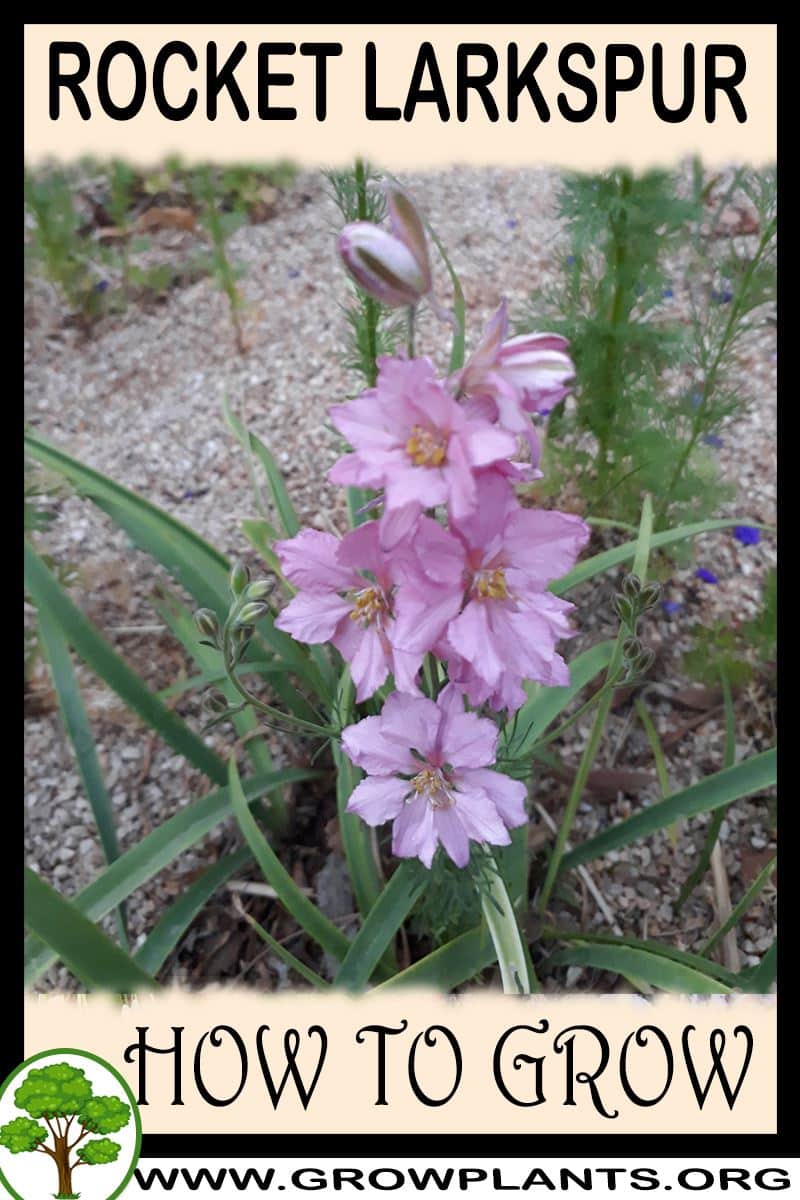
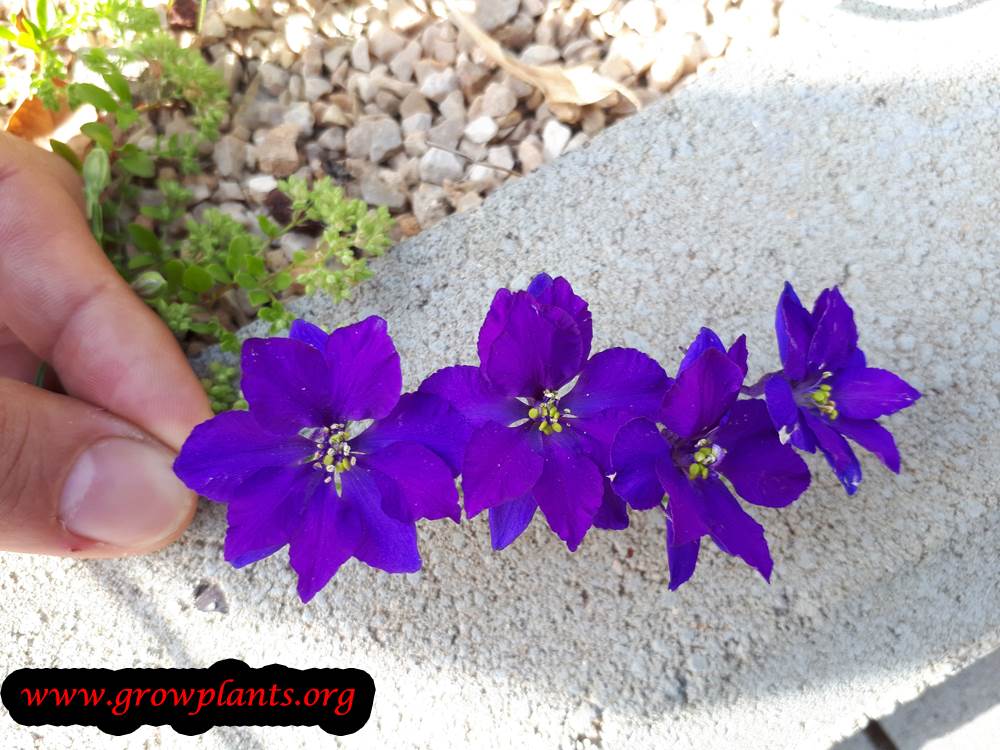
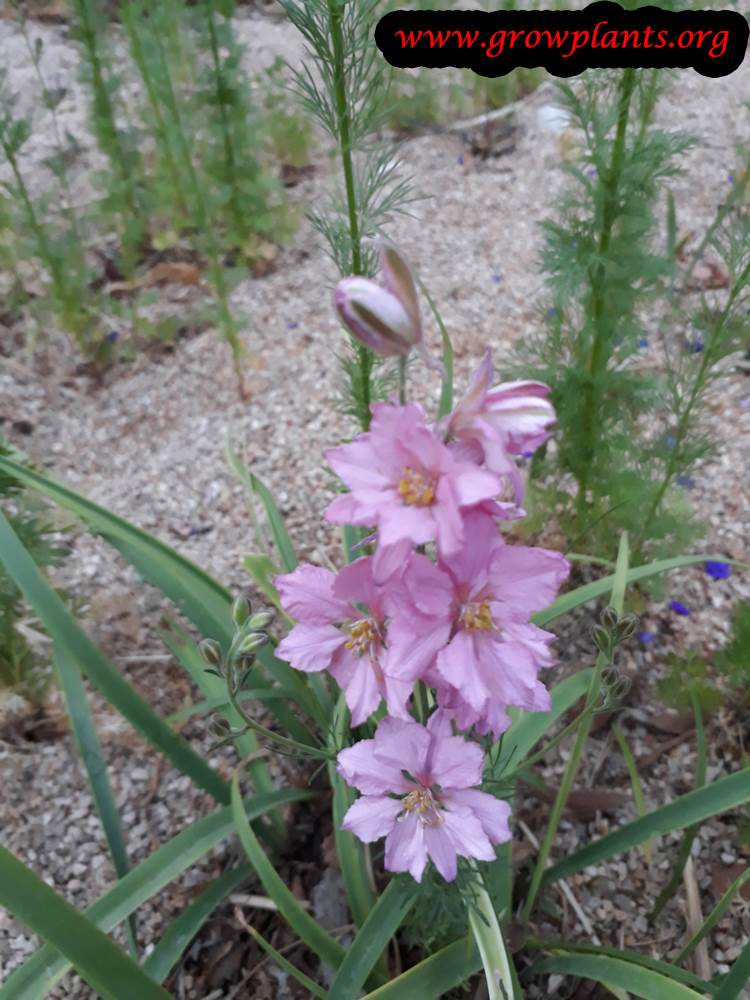
- Flower Characteristics: Star-shaped, spurred (tailed) flowers in blue, purple, pink or white borne on upright spikes.
Primary Uses & Landscape Value
- Functional & Ornamental Roles: Ornamental bedding and border annual, prized as a cut and dried flower; keep away from children and grazing animals because of its toxicity.
Care Guide: Planting, Soil & Watering
Overview: A fast-growing hardy annual for sunny borders. It likes fertile, well-drained soil and steady, moderate moisture, establishing in cool weather and blooming into summer.
Quick Care Requirements
| Requirement | Ideal Condition |
|---|---|
| Planting Season | In the cool season – autumn through early spring |
| Growth Rate | Moderate to Fast |
| Soil Type | Fertile, well-draining |
| Water Need | Moderate – keep evenly moist, not waterlogged |
Planting & Establishment
- Best Planting Season: Plant in autumn, winter or early spring while temperatures are cool; larkspur resents transplanting, so establish it early.
- How to Plant:
- Hole Preparation: Make a hole as deep as the root ball, disturbing the roots as little as possible.
- Soil Amendments: Work in compost for fertility and improved drainage.
- Planting Depth: Set the crown level with the soil surface, not buried.
- Growth Speed & Expectations: Fast to moderate; it quickly reaches flowering size within a single season.
Soil, Watering & Drainage Care
- Soil Mix & Drainage Needs: Well-drained fertile soil; in pots use a quality potting mix with drainage holes to avoid soggy roots.
- Watering Schedule & Technique:
- Young / Newly Planted: Keep consistently moist while it establishes.
- Established: Water when the top few cm dry out; even moisture supports better bloom.
- Seasonal Adjustments: Water more in warm, dry spells and less in cool, wet weather.
Climate, Light & Hardiness
Rocket larkspur (Consolida) is a cool-season hardy annual grown across Mediterranean, desert, subtropical and temperate climates, doing best in full sun through the cooler part of the year. Its site range spans roughly USDA zones 3–11 as a seasonal annual; young autumn-sown plants tolerate frost, while summer heat is what ends the display.
Quick Climate Specifications
| Climate Zones | Mediterranean, desert, subtropical, temperate |
|---|---|
| USDA Hardiness Zones | Approximately 3–11 (grown as a hardy annual) |
| Optimal Temp Range | Cool, roughly 13–21 °C (55–70 °F) |
| Cold Damage Begins | Seedlings are frost-hardy; only hard freezes damage young plants |
| Approx. Survival Minimum | Autumn-sown seedlings overwinter outdoors in mild-winter zones; in cold zones sown to flower in the frost-free season |
| Frost Tolerance | Moderate (hardy annual) |
| Light Conditions | Full sun to half shade |
| Wind Tolerance | Low to moderate (slender flower spikes) |
Sunlight & Light Exposure
Optimal Light Setup
Full sun produces the strongest, most upright spikes; a little afternoon shade is only helpful where spring turns hot early.
Shade & Heat Management
Larkspur resents heat, so light shade in warm regions slows its decline once temperatures climb.
Temperature Extremes & Hardiness
USDA Hardiness & Regional Limits
Grown as a seasonal annual across a very wide band. In mild-winter climates it is sown in autumn and grows through cool weather to flower in spring; where winters are cold it is sown for a spring-to-early-summer display. Sowing timing, not a fixed hardiness line, governs where it fits.
Cold Damage & Frost
Young rosettes are notably frost-hardy and often overwinter under mild conditions, which is why autumn sowing gives the best plants; a severe hard freeze on unestablished seedlings is the main risk.
Extreme Heat Tolerance
Heat is the limiting factor - plants bolt, fade and die as summer warmth arrives, so the useful window is the cool season. This is why a warm-season “frost-free” framing does not apply here.
Wind, Humidity & Microclimate
Wind Tolerance
The tall, slender spikes can be bent or broken by strong wind; a sheltered site keeps them upright.
Dry-Air Tolerance
Well suited to the dry air of Mediterranean and desert springs; damp, still heat encourages mildew.
Microclimate Recommendations
An open, sunny, wind-sheltered bed worked in the cool season gives the best spikes; timing the sowing to the local frost pattern matters more than any single temperature.
Growing in Pots, Balconies & Indoors
Rocket larkspur is a slender annual (30-60 cm) grown for its spires of blue, pink and white flowers, and an excellent cut flower. It is not a houseplant, as the grower confirms, but it grows happily in pots on a sunny balcony. Note that the plant is poisonous.
Quick Details
- Container Size: A medium pot (10-20 L); group several for a fuller display
- Indoor Suitability: Not a houseplant (per the grower) – an outdoor annual
- Best Spot: Full sun to half shade
- Soil & Drainage: Aerated, free-draining mix, evenly moist
- Watering in Pots: Average – keep steady; pots dry quickly in sun
Indoors & On the Windowsill
- Houseplant limits: The grower marks it no for indoors; it needs full outdoor light to flower well and resents transplanting, so it’s best sown where it will grow.
On a Balcony or Patio
- Light & wind: Give it a sunny spot; the tall stems are slender, so shelter from strong wind or give light support. Pots dry fast, so water regularly.
Choosing the Pot, Soil & Long-Term Care
- Pot & drainage: Use a pot with strong drainage holes and skip a standing-water saucer, which invites root rot; terracotta breathes and dries faster, while glazed or plastic holds moisture longer.
- Potting mix: A light, aerated organic mix – peat or coir with perlite or vermiculite – gives the roots both moisture and air.
- Feeding: Potted plants use up their feed faster because each watering leaches nutrients away, so feed a little more often than plants in open ground.
- Repotting: Refresh the top of the mix and pot up every couple of years; a light root and top prune at repotting keeps established plants vigorous.
Safety: Larkspur is poisonous – its seeds and foliage contain toxic alkaloids. Keep pots away from children and pets, and don’t eat any part.
Fertilizing & Feeding
A light feeder: as a fast annual, rocket larkspur needs only modest balanced feeding to grow and flower well in one season, and overly rich soil makes it soft and floppy.
Quick Fertilizing Specs
| Feeding Level | Light |
|---|---|
| young_feeding | Light balanced feeding to establish seedlings |
| mature_feeding | Balanced feeding through growth and bloom |
| Main Nutrient Priority | Balanced nutrition; adequate nitrogen for growth, not high phosphorus for bloom |
| Best Feeding Period | Spring through the flowering period |
| Organic Options | Compost, well-rotted manure and mulch |
| Micronutrients | Rarely needed where soil is healthy and near neutral |
| Soil pH | Average, well-drained soil |
| Reduce/Stop Feeding | Feeding tapers as the annual finishes flowering |
Feeding by Growth Stage
Seedling establishment
Establish rocket larkspur seedlings into strong young plants.
| Nutrient direction | A light, balanced complete fertilizer once seedlings are growing supports steady early growth. |
|---|---|
| Timing | After germination, as young plants begin active growth. |
| Frequency | Light feeding while young plants establish. |
| Fertilizer types | Balanced complete flower or garden fertilizer, Compost or well-rotted organic matter |
| Precautions | Feed sparingly; overly rich soil gives soft, floppy growth. |
Bud and bloom
Support strong flower spikes and lasting bloom on rocket larkspur.
| Nutrient direction | Keep feeding balanced with adequate nitrogen; balanced nutrition, not high phosphorus, drives good bloom. |
|---|---|
| Timing | From bud formation through the flowering period. |
| Frequency | Light, steady feeding while in active bloom. |
| Fertilizer types | Balanced complete fertilizer, Compost as a slow background source |
| Precautions | Do not rely on high-phosphorus ‘bloom booster’ products; balanced feeding is enough. |
Nutrient Deficiency Signs & Corrections
Overall pale, yellowing leaves with weak, slow growth.
| Possible causes | Low soil nitrogen, Poor, leached or sandy soil, Cold or waterlogged soil limiting uptake |
|---|---|
| Appears first on | Older, lower leaves |
| What to check | Feeding history, Soil organic matter, Drainage and weather |
| Possible correction | Apply a balanced complete fertilizer and build the soil with compost. |
Lush leafy growth but few flowers.
| Possible causes | Excess nitrogen relative to other nutrients, Too much shade, Over-feeding with a high-nitrogen fertilizer |
|---|---|
| Appears first on | The whole plant, as a balance of leaves over flowers |
| What to check | Fertilizer type and rate, Light levels, Overall vigour |
| Possible correction | Switch to balanced feeding, ease off nitrogen and ensure adequate light. |
Young leaves yellow between still-green veins.
| Possible causes | High soil pH limiting iron availability, Waterlogged or cold soil, A genuine micronutrient shortage |
|---|---|
| Appears first on | Youngest leaves |
| What to check | Soil pH, Drainage, Whether only new growth is affected |
| Possible correction | Correct pH where possible and, if needed, apply a chelated micronutrient product per its label. |
Pruning, Training & Seasonal Maintenance
Rocket larkspur is a fast-cycling annual with no woody framework, so no structural pruning applies. What does apply is optional pinching of young plants to build a bushier, multi-stemmed habit, and deadheading spent flower spikes to prolong bloom or to control self-seeding, since this species readily sows itself. All parts are toxic, so handle cut material with care.
Quick Pruning & Maintenance Specs
| Pruning Tolerance | None structurally; pinching and deadheading only |
| Primary Pruning Window | Pinch young rosettes in the cool season before the flower spike bolts |
| Secondary Maintenance Window | Deadhead through the spring/summer bloom |
| Typical Frequency | One pinch when young, then ongoing deadheading |
| Main Objective | Bushier, multi-stem habit and/or extended bloom |
| Young Plant Priority | Optionally pinch the central growing tip before it bolts |
| Mature Plant Priority | Deadhead spent spikes |
| Best Tool Type | Precision snips (or fingers) |
Pruning by Plant Age & Size
Newly Established / Young
While the plant is still a low rosette, before it bolts to flower, an optional pinch of the main growing tip produces a bushier plant with several flowering stems instead of one tall spike; growers wanting the longest single spikes for cutting can skip this.
Mature / Established
No structural pruning; deadhead as flowers finish.
Seasonal Pruning Schedule
Pre-Growth (Cool Season)
Objective: bushier habit. Remove: the soft central growing tip of young rosettes, if a multi-stem plant is wanted.
Post-Flowering
Objective: prolong bloom and/or manage self-seeding. Remove: spent flower stems. Don’t remove: some spikes if self-seeding for next year is wanted, since larkspur self-sows readily.
Special Growth to Remove
Spent flower stems — deadheading tidies the planting and, since this is a determinate annual spike, redirects the plant’s energy away from seed production if more bloom or self-seed control is the goal.
Tools
Precision snips only — herbaceous annual with soft stems throughout; no woody cuts are ever needed.
Tool Hygiene & Disease Risk
Routine — clean tools are sufficient; no transmissible disease risk is flagged for this species.
Cut Placement & Technique
Deadhead by cutting the spent flower stem down to a set of healthy leaves or a side bud; when pinching young plants, remove just the soft growing tip.
Heavy Pruning & Rejuvenation
Not applicable. Larkspur is an annual that completes its life cycle in a single season and does not regrow from a hard cutback; once flowering and seed set are finished, the plant naturally declines and is best pulled and replaced, or left to self-sow.
Post-Pruning Care
No feeding is needed after deadheading; keep soil evenly moist, especially while young; wash hands after handling, since the plant is toxic.
Common Pruning Mistakes
Pinching too late, after the flower spike has already bolted, which wastes the technique and won’t force branching; deadheading everything when self-seeding for next year is actually wanted; leaving all spent spikes when self-seeding is not wanted, letting the planting spread further than intended.
When NOT to Prune
Avoid pinching once the central flower spike has already begun to elongate — it won’t produce the branching effect and wastes the developing bloom.
Recommended Tools (by task)
- precision_snips — pinching young rosettes and deadheading spent spikes; the only cuts this annual ever needs are fine, soft-stem cuts.
Propagation Guide
Rocket larkspur is an annual raised only from seed, and it is best direct-sown where it is to grow because the long taproot resents transplanting. Germination is best in cool soil, so it is typically sown in autumn or winter in mild areas. Overall easy to moderate.
Quick Propagation Specs
| Best Propagation Method | Direct seed (sown in situ) |
| Alternative Methods | None practical (annual; transplant-resentful) |
| Propagation Difficulty | Easy to Moderate |
| Seed True-to-Type | Species fairly true; mixed colour strains variable |
| Best Propagation Season | Autumn to winter (cool-season sowing) |
| Seed Sowing Depth | Cover lightly (germinates better in darkness) |
| Grafting Required | No |
Growing from Seed
Seed Handling & Viability
Fresh seed germinates best; viability falls with warm storage, so keep seed cool (even refrigerated) until sowing.
Dormancy & Pre-Sowing Treatment
Germinates best in cool soil and darkness; a spell of cool conditions helps, while warm soil suppresses germination. No scarification is needed.
Sowing Season
Sow in autumn to early winter where winters are mild, matching the site’s autumn/winter planting window.
Sowing Depth & Orientation
Sow in situ and cover lightly — the light exclusion aids germination. Because of the taproot, avoid transplanting; thin seedlings in place instead.
Germination Conditions
Cool, moist soil; emergence can be slow and uneven.
All parts are toxic — handle seed and plants with care.
Bloom & Flower Guide
Quick Details
- Bloom Season: Spring to summer
- Time to First Bloom: In its first year – an annual grown from seed that flowers the same season
- Flower Appearance: Spurred, star-like flowers in blue, purple, pink or white, carried up tall spikes
- Edibility: Toxic – do not eat any part; larkspur contains poisonous alkaloids
Detailed Blooming Overview
Rocket larkspur is an annual that sends up slender spikes packed with spurred flowers in cool blues, purples, pinks and white. It is a lovely, airy cottage-garden and cut flower, but every part of the plant is poisonous if eaten, so site it thoughtfully around children and pets.
Flower Characteristics
- Star-shaped flowers, each with a distinctive backward-pointing spur (the ‘tail’).
- Colours range through blue, purple, pink and white.
- Held in upright spikes on tall, feathery-leaved stems.
Bloom Care & Thinning
- Prolonging bloom: Deadhead spent spikes to encourage more flowers and to limit self-seeding.
- Support: The tall spikes may need staking in windy or rich sites.
- Safety: The plant is poisonous – wear gloves when handling, and keep cut stems and seed away from food areas.
Bloom Health & Protection
- Powdery mildew: Can coat leaves and stems in crowded, late-season plantings – improving airflow helps, and a sulphur-based fungicide can be used if it takes hold.
Pests, Diseases & Troubleshooting
Overview: Larkspur is a cool-season annual grown for its tall spikes of spurred flowers; note that all parts are toxic if eaten, so site it away from grazing animals and wash hands after handling. Its soft foliage draws aphids, slugs and leaf miners, while cool damp conditions bring powdery and downy mildew and crown/root rot. Grow it in full sun with airflow and well-drained soil, and it performs cleanly.
Quick Troubleshooting Overview
| Issue / Pest | Main Symptom | Primary Solution |
|---|---|---|
| Aphids | Curled, sticky new growth; distorted buds | Water jet, insecticidal soap, beneficials |
| Slugs & snails | Chewed seedlings and holes, slime trails | Night hand-pick, iron-phosphate bait, barriers |
| Leaf miners | Pale winding tunnels inside leaves | Remove mined leaves, encourage parasitic wasps |
| Powdery mildew | White powder on leaves in humid crowding | Airflow, base water, sulfur/bicarbonate spray |
| Downy mildew | Yellow blotches with grey mould beneath | Space plants, avoid wet foliage, copper |
| Crown / root rot | Blackened base, sudden wilt in wet soil | Improve drainage, avoid overwatering |
Common Pests & Management
- Aphids (Myzus persicae, Aphis spp.):
- Symptoms: Dense colonies on new shoots, buds and flower spikes; growth curls and distorts, honeydew makes surfaces sticky, and aphids can spread viruses.
- Prevention & Control: Hose off colonies and rely on lady beetles, lacewings and hoverflies; use insecticidal soap for heavy infestations and avoid excess nitrogen that softens growth.
- Slugs & snails (Deroceras, Helix spp.):
- Symptoms: Seedlings and young plants chewed to stubs, with ragged holes and silvery slime trails; damage is worst in cool, damp, mulched beds overnight.
- Prevention & Control: Hand-pick after dark, clear damp hiding spots, use copper barriers or beer traps, and scatter wildlife-safe iron-phosphate bait around emerging plants.
- Leaf miners (Liriomyza/Phytomyza spp.):
- Symptoms: Pale, winding or blotchy tunnels mined between the leaf surfaces by tiny larvae; heavy mining yellows and disfigures foliage.
- Prevention & Control: Pick off and destroy mined leaves as they appear, encourage parasitic wasps by avoiding broad-spectrum sprays, and use sticky traps to catch the adult flies.
- Cutworms & caterpillars (various moth larvae):
- Symptoms: Young plants cut off at the soil line (cutworms) or chewed leaves and buds with frass; a common problem in newly set-out seedlings.
- Prevention & Control: Use cardboard or foil collars around transplants, hand-pick at night, and apply Bacillus thuringiensis (Bt) for foliage caterpillars.
- Spider mites (Tetranychus spp.):
- Symptoms: Fine stippling and bronzing with faint webbing on stressed plants in hot, dry weather late in the season.
- Prevention & Control: Keep plants watered, hose the undersides, and apply insecticidal soap or horticultural oil if mites build up.
Diseases & Fungal Issues
- Powdery mildew (Erysiphe/Golovinomyces spp.):
- Symptoms: White powdery coating on leaves, stems and buds, worst in crowded plantings with warm days and cool, humid nights; leaves yellow and dry.
- Treatment & Management: Space and thin for airflow, water at the base early in the day, remove affected leaves, and treat with sulfur, potassium-bicarbonate or a light horticultural-oil spray.
- Downy mildew (Peronospora spp.):
- Symptoms: Angular yellow blotches on the upper leaf with a greyish-purple downy mould on the underside in cool, wet conditions; can defoliate rapidly.
- Treatment & Management: Improve spacing and drainage, avoid overhead watering and wet foliage, remove infected leaves, and apply a copper fungicide preventively in prolonged wet spells.
- Crown & root rot (Fusarium, Rhizoctonia, Pythium):
- Symptoms: Sudden wilting and collapse with blackened, mushy stem base and rotted roots, typically in heavy, wet, or overwatered soil.
- Treatment & Management: Plant in well-drained soil, avoid overwatering and crowding, rotate planting sites yearly, and remove and destroy collapsed plants; do not replant larkspur in the same infected ground.
- Damping-off (seedlings):
- Symptoms: Emerging seedlings topple with pinched, water-soaked stems at soil level.
- Treatment & Management: Sow in clean, well-drained mix, avoid overwatering and overcrowding, provide airflow, and water from below; a light fungicidal drench helps in problem seasons.
Growing Difficulties & Abiotic Problems
- Toxicity (handling note)
- Cause & Symptoms: All parts of larkspur are poisonous if eaten, and sap can irritate skin — a safety issue, not a disease.
- Correction Strategy: Site away from children, pets and livestock, wear gloves and wash hands after handling, and never plant it where animals graze.
- Heat & bolting
- Cause & Symptoms: As a cool-season annual, larkspur fades fast, yellows and stops flowering once hot weather arrives.
- Correction Strategy: Sow in the cool season for a spring display, mulch to keep roots cool, and accept it as a short-lived cool-weather plant.
- Flopping / weak stems
- Cause & Symptoms: Tall spikes lodge and snap in wind or rich, shaded, over-fed conditions.
- Correction Strategy: Grow in full sun, avoid excess nitrogen, and stake or grow through supports early.
- Poor germination
- Cause & Symptoms: Larkspur seed needs cool conditions and can be erratic.
- Correction Strategy: Sow in cool soil (some chilling helps), keep evenly moist, and do not sow into hot ground.
What Helps – Products & Tools
Culture leads: full sun, airflow, base watering and slug patrol. Insecticidal soap and neem handle aphids, mites and leaf miners; iron-phosphate bait and copper barriers manage slugs, and Bacillus thuringiensis (Bt) plus transplant collars deal with caterpillars and cutworms. For disease, use sulfur or potassium-bicarbonate against powdery mildew and a copper fungicide against downy mildew, plus good drainage against crown rot. Follow the label and protect pollinators.