

Plant Profile & Key Characteristics
Overview: Brugmansia maya is a perennial evergreen tree or shrub in the angel-trumpet group, grown as an ornamental for its fragrant white trumpet flowers. All parts are poisonous.
Quick Specifications
| Specification | Attribute |
|---|---|
| Plant Type / Life Cycle | Perennial (tree or shrub) |
| Foliage Type | Evergreen |
| Mature Size | 0.2-1 m (8-40 in) per source (see note) |
| Growth Rate | Moderate |
| Toxicity | Toxic – all parts poisonous (tropane alkaloids); handle with care |
| Hardiness | USDA zones 8+ |
Growth Form & Structure
- Height & Spread: Source lists 0.2-1 m (8-40 in), though the species Brugmansia arborea is normally a several-metre tree; also grown in a container.
- Growth Habit & Form: Tree or shrub; in cold areas cut back to woody framework each winter.
- Lifespan & Maturity: Long-lived perennial; moderate growth.
Anatomy & Physical Features
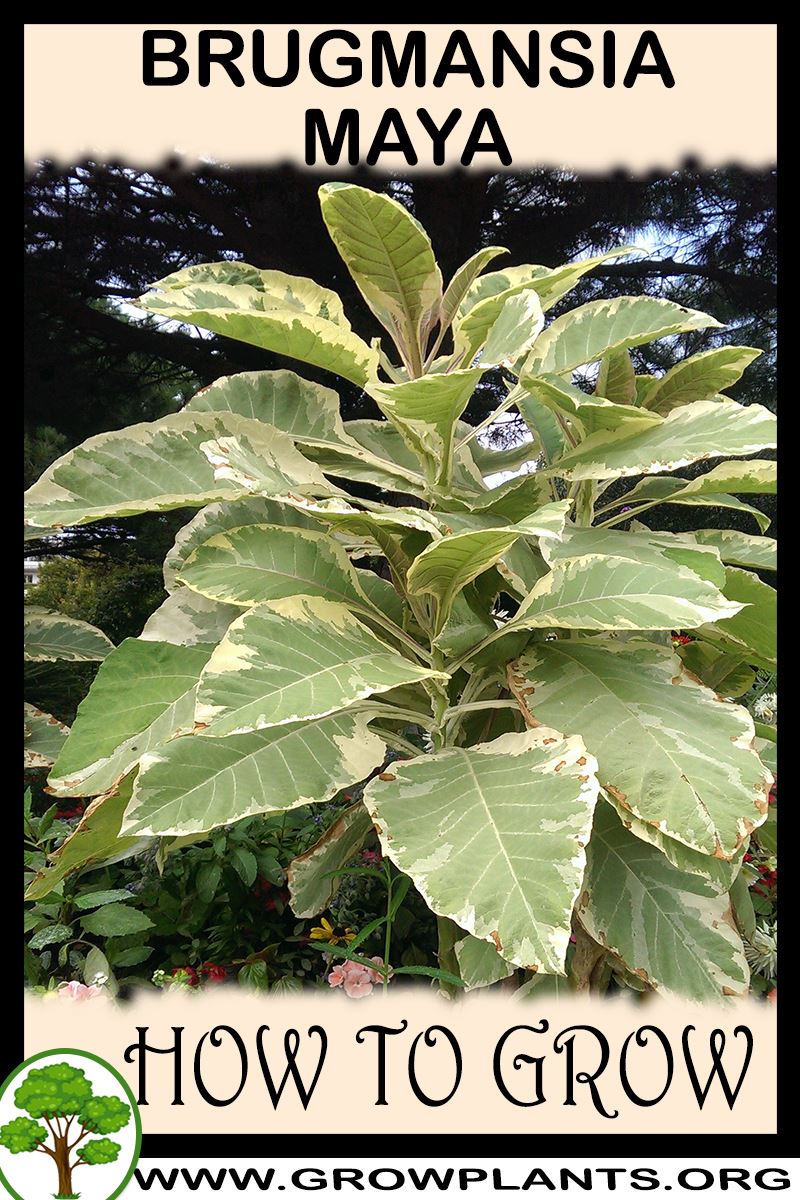
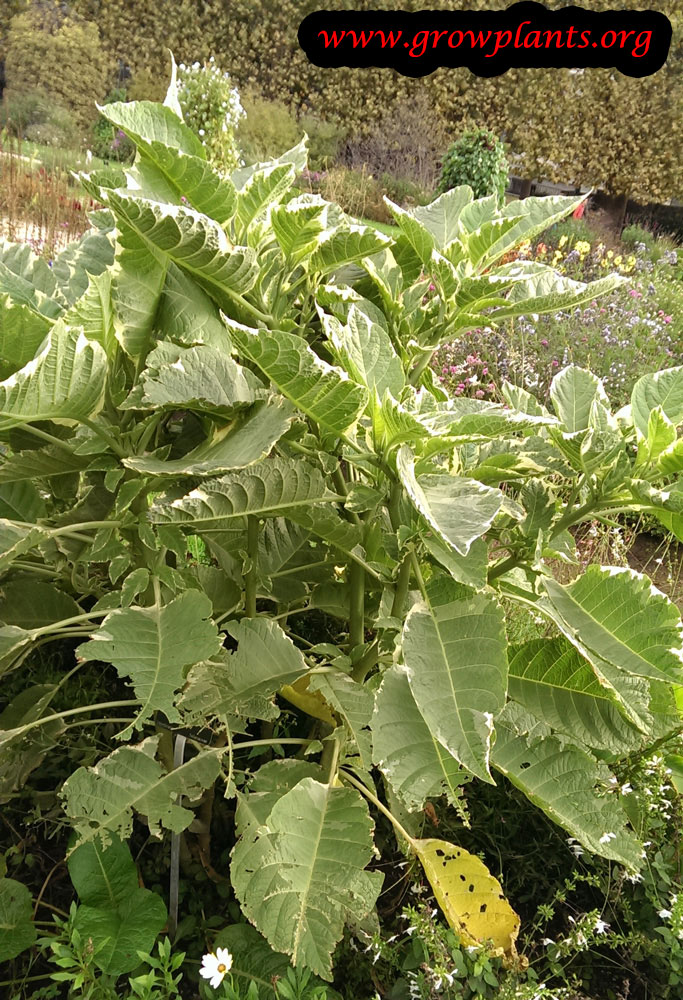
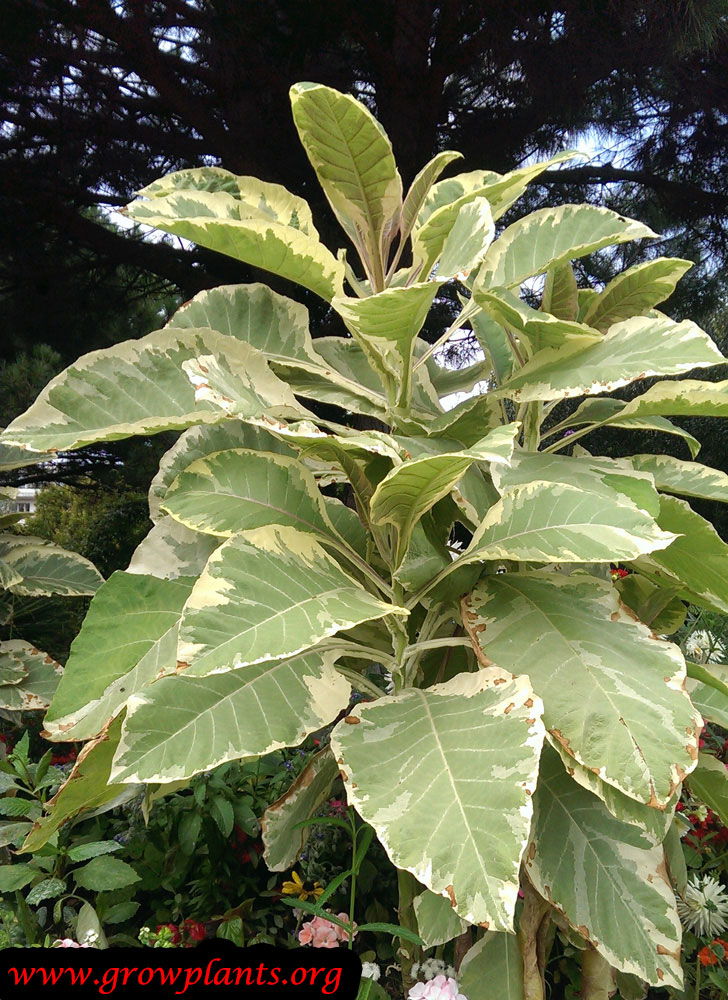
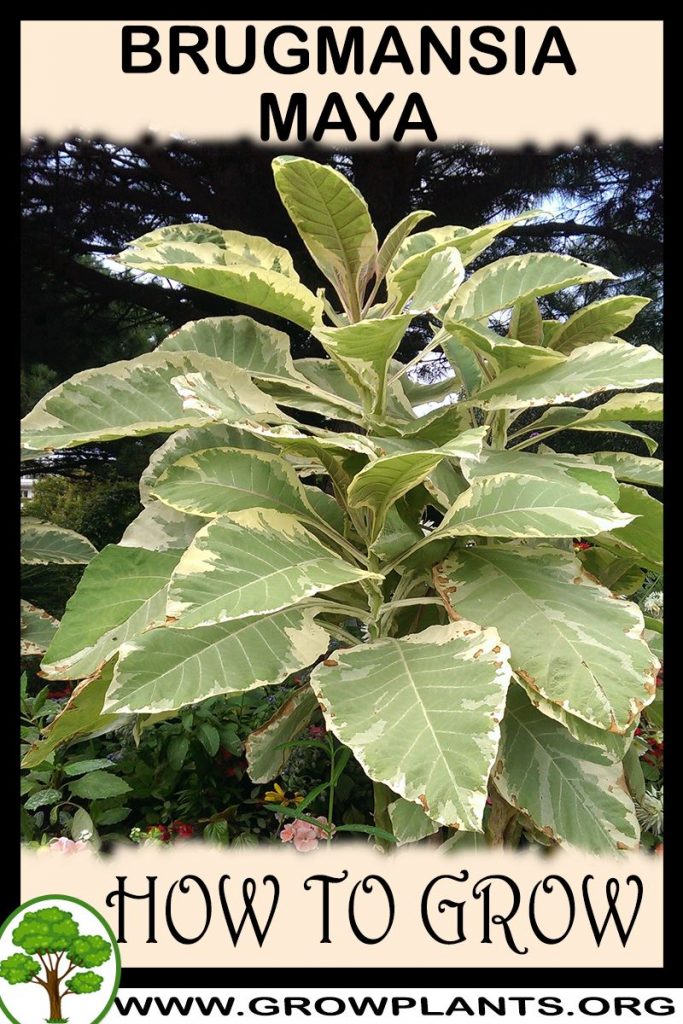
- Leaves & Foliage: Green white-striped oval leaves, 5-15 cm.
- Flower Characteristics: Fragrant white trumpet flowers, strongest in the evening.
Primary Uses & Landscape Value
- Functional & Ornamental Roles: Ornamental flowering shrub/tree; also has traditional medicinal use (but toxic).
Care Guide: Planting, Soil & Watering
Overview: Brugmansia maya is a moderate-growing frost-tender shrub or small tree that prefers full sun and moist, well-drained soil. Give it fertile ground and steady moisture in the warm season while keeping the roots from ever sitting wet.
Quick Care Requirements
| Requirement | Ideal Condition |
|---|---|
| Planting Season | Warm season – spring, summer or autumn, after frost |
| Growth Rate | Moderate |
| Soil Type | Moist but well-draining, fertile soil |
| Water Need | Moderate – steady moisture in warmth, never waterlogged |
Planting & Establishment
- Best Planting Season: Plant in the warm season – spring, summer or autumn – after frost has passed, as it is frost-tender.
- How to Plant:
- Hole Preparation: Dig a hole roughly twice as wide as the root ball and no deeper than it, loosening the sides.
- Soil Amendments: Work organic matter into the backfill to enrich the fertile, moisture-retentive soil it prefers.
- Planting Depth: Set the plant so the root collar is level with the soil surface – do not bury the stem – firm in and stake if needed.
- Growth Speed & Expectations: Growth is moderate; with warmth and regular water it fills out steadily through the warm months.
Soil, Watering & Drainage Care
- Soil Mix & Drainage Needs: Plant in fertile, moist but free-draining soil; good drainage is key as the roots dislike standing water. In containers use a rich potting mix and keep drainage sharp.
- Watering Schedule & Technique:
- Young / Newly Planted: Water in well and keep the soil moist while it establishes.
- Established: Keep the soil steadily moist in warm weather, but never waterlogged.
- Seasonal Adjustments: Water more in summer heat and reduce in winter as growth slows.
Climate, Light & Hardiness
Brugmansia maya is a tender evergreen shrub or small tree for tropical, subtropical and Mediterranean climates, bearing fragrant white trumpet flowers in warm weather. It grows in full sun and needs a frost-free position, with the site rating it at hardiness zone 8 and warmer.
Quick Climate Specifications
| Climate Zones | Tropical, subtropical, Mediterranean |
|---|---|
| USDA Hardiness Zones | Approximately 8 and warmer (site data) |
| Optimal Temp Range | Warm, roughly 18–28°C (64–82°F) |
| Cold Damage Begins | Foliage and soft growth damaged by light frost, near 0°C (32°F) |
| Approx. Survival Minimum | Top growth killed by frost; established plants may resprout from the wood in cold areas |
| Frost Tolerance | Very low |
| Light Conditions | Full sun |
Sunlight & Light Exposure
Optimal Light Setup
Full sun gives the fullest growth and best flowering. In very hot, dry climates a little afternoon shade helps prevent the soft foliage from wilting and scorching.
Temperature Extremes & Hardiness
USDA Hardiness & Regional Limits
Site data places it in zone 8 and warmer; the lower edge of zone 8 corresponds to winter lows around −12 to −7°C (10 to 20°F). Cold tolerance varies with cultivar, plant age, exposure duration and conditions.
Cold Damage & Winter Protection
Light frost blackens leaves and soft stems near 0°C (32°F). In cold areas the plant is best cut back to firm wood; established specimens then resprout in spring, and heavy mulch (or overwintering a container indoors) protects the crown. Young plants are more cold-sensitive than mature ones.
Extreme Heat Tolerance
Good in warmth, but the large soft leaves lose water fast; under extreme heat and dry air the plant wilts and needs shade and steady moisture.
Wind, Humidity & Microclimate
Humidity Preferences
Prefers moderate to high humidity for lush growth.
Wind Tolerance
Low – brittle stems and broad leaves damage easily, so shelter from strong wind.
Microclimate Recommendations
A warm, sheltered, frost-free corner extends the season in cooler zones; grow in a pot to move under cover where frost threatens.
Growing in Pots, Balconies & Indoors
Brugmansia (angel’s trumpet) is a tender flowering shrub grown for its large pendulous trumpets (about 20-100 cm / 8-40 in in this form, though the genus can grow much larger). It is not a houseplant, but it makes an excellent large-container plant for a sunny patio or balcony, and potting it lets you move it under cover to overwinter where winters are cold.
Quick Details
- Container Size: A roomy pot sized to the plant; pot up as the root ball fills
- Indoor Suitability: Not a houseplant – too light-hungry for a room; pot it mainly so it can be overwintered frost-free
- Best Spot: Full sun
- Soil & Drainage: Well-aerated, organic-rich mix (potting mix, or peat with perlite); must drain freely
- Watering in Pots: Average and evenly moist – pots dry faster than open ground; let water drain away
Indoors & On the Windowsill
- Houseplant limits: Grown for its flowers, it needs strong sun and will not thrive deep indoors.
- Overwintering: This is the main reason to pot it – in cold climates move the container somewhere bright and frost-free over winter and water sparingly until growth restarts.
- Safety: All parts of Brugmansia are highly toxic if eaten – keep it well away from children and pets, and never site it where it could be mistaken for something edible.
On a Balcony or Patio
- Light & wind: Give it the sunniest spot; it can grow tall, so shelter it from strong wind and stake if needed. Walls and paving reflect heat, so pots dry quickly – check moisture daily in warm weather. A drip irrigation kit with a timer can take over that watering check automatically.
- Practicalities: A large filled pot is heavy – make sure the balcony can take the weight and that drainage runoff will not be a nuisance below.
Choosing the Pot, Soil & Long-Term Care
- Pot & drainage: A roomy pot with strong drainage holes; skip a standing water saucer to avoid root rot. Terracotta breathes and dries faster, while glazed or plastic pots hold moisture longer.
- Potting mix: Aerated and organic-rich – potting mix, or peat with perlite.
- Feeding: Potted shrubs need feeding more often than those in the ground, as nutrients wash out with each watering – a balanced feed through the growing season.
- Repotting: Pot up as the roots fill the container, and every couple of years refresh the mix and lightly prune the root ball and top growth.
Growing this plant in a greenhouse
A greenhouse can give brugmansia maya frost protection and cold protection. In the right climate it may also be kept growing through winter, depending on how much warmth and light are provided.
Greenhouse at a glance
| Greenhouse suitability | Conditional - depends on your climate |
|---|---|
| Main benefits | frost protection, cold protection |
| Season extension | earlier spring & later autumn |
| Outdoor protection advisable below | about 5°C |
| Maintain greenhouse minimum | around 5°C for active growth |
| Suitable types | unheated greenhouse, polycarbonate greenhouse, lean-to |
| Heating | Heating is optional - useful mainly for winter growing in cold areas. |
Related greenhouse guides
- Greenhouses: How to Choose the Right Greenhouse
- Best Lean-To Greenhouses
- Polycarbonate Greenhouses: What to Look for Before Buying
Fertilizing & Feeding
A steady, light feeder: a balanced complete fertilizer through the growing and blooming season keeps flowering ornamentals healthy without forcing soft growth.
Quick Fertilizing Specs
| Feeding Level | moderate |
|---|---|
| Main Nutrient Priority | A balanced complete fertilizer with steady nitrogen; extra phosphorus is not needed for bloom. |
| Best Feeding Period | Through the active growing and flowering season. |
| Organic Options | Compost and other organic matter improve the soil and supply gentle, steady nutrition. |
| Soil pH | Slightly acidic to near neutral suits most flowering ornamentals. |
| Reduce/Stop Feeding | Ease off feeding as growth slows heading into the cool, dormant rest period. |
Feeding by Growth Stage
Spring growth flush
Support healthy new shoots and leaf growth as the plant wakes up.
| Nutrient direction | A complete, balanced fertilizer with steady nitrogen to build strong foliage and stems. |
|---|---|
| Timing | As new growth begins in spring and the weather warms. |
| Frequency | Light, regular feedings through the active growing season. |
| Fertilizer types | A balanced complete garden fertilizer, A slow-release complete fertilizer worked into the soil, Compost or other organic matter to enrich the soil |
| Precautions | Feed lightly and avoid overfeeding with nitrogen, which pushes soft leafy growth at the expense of flowers. |
Flowering period
Fuel abundant, well-colored flowers while keeping the plant vigorous.
| Nutrient direction | A balanced complete fertilizer with adequate nitrogen; balanced feeding, not extra phosphorus, drives good bloom. |
|---|---|
| Timing | Through the blooming season. |
| Frequency | Steady, light feeding maintained across the flowering period. |
| Fertilizer types | A balanced complete flowering-plant fertilizer, A water-soluble complete fertilizer for container plants |
| Precautions | Skip high-phosphorus ‘bloom booster’ products; they are rarely needed and excess phosphorus can harm the soil. Container plants need even feeding to avoid salt buildup. |
Repeat bloom and rebound
Keep long-blooming plants flushing new flowers after deadheading or shearing.
| Nutrient direction | A balanced complete fertilizer to refuel growth and encourage the next wave of flowers. |
|---|---|
| Timing | After each flush of bloom or a mid-season trim, while the plant is still actively growing. |
| Frequency | Resume light, regular feeding as new growth pushes. |
| Fertilizer types | A balanced water-soluble complete fertilizer, A balanced complete garden fertilizer |
| Precautions | Feed sparingly in heat; combine feeding with consistent watering so nutrients stay available. |
Dormancy or cool-season rest
Let the plant rest through cold or low-light conditions without forcing new growth.
| Nutrient direction | None – withhold fertilizer while the plant is resting. |
|---|---|
| Timing | During cold winter weather or the plant’s low-light dormant rest. |
| Frequency | No feeding at this stage. |
| Fertilizer types | No feeding at this stage – resume only when active growth returns. |
| Precautions | Do not fertilize until active growth resumes; feeding a resting plant risks salt buildup and root injury. |
Nutrient Deficiency Signs & Corrections
Older, lower leaves fade to pale green or yellow and overall growth is weak.
| Possible causes | Low nitrogen in the soil, Nutrients leached out by heavy rain or frequent watering, Cold, wet roots slowing nutrient uptake |
|---|---|
| Appears first on | Older, lower leaves |
| What to check | Recent feeding history, Soil drainage and how often it is watered, Whether roots are healthy and warm enough |
| Possible correction | Apply a balanced complete fertilizer and improve drainage; correct soil pH if it is far off so nutrients stay available. |
Newest leaves turn yellow between green veins (interveinal yellowing) while older leaves stay greener.
| Possible causes | High soil pH locking up iron, Waterlogged or poorly aerated roots, Genuinely low available iron |
|---|---|
| Appears first on | Youngest, newest leaves |
| What to check | Soil pH, Drainage and root health, Whether only new growth is affected |
| Possible correction | Correct soil pH and improve drainage; where iron is truly short, apply a chelated iron product per its label. |
Lush leaves but few flowers, or pale weak blooms.
| Possible causes | Excess nitrogen driving leafy growth over flowers, Too little light for good flowering, A pest or cultural problem rather than a nutrient shortage |
|---|---|
| Appears first on | Flower buds and flowering shoots |
| What to check | How much nitrogen was applied, Hours of direct light, General plant health and pest pressure |
| Possible correction | Ease off nitrogen, move the plant to brighter light, and keep feeding balanced rather than reaching for high-phosphorus products. |
Pruning, Training & Seasonal Maintenance
Brugmansia maya is a compact, white-flowered angel trumpet, a woody, frost-tender shrub or small tree that follows the same key rule as all brugmansias: it flowers only on the mature growth above the first “Y” fork, so you prune above the Y to keep flowering wood and avoid cutting below it, which resets the stem to non-flowering juvenile growth. The facts advise cutting it back to the woody branches in cold areas – a hard overwinter cut-back it tolerates well – and, being poisonous, it is handled with gloves and clean tools.
Quick Pruning & Maintenance Specs
| Pruning Tolerance | High – takes a hard winter cut-back; respect the Y for bloom |
| Primary Pruning Window | Winter / late winter, before the spring flush |
| Secondary Maintenance Window | Light tidy after a bloom flush |
| Typical Frequency | An annual cut-back plus deadheading |
| Main Objective | Keep flowering wood above the Y; control size; overwinter safely |
| Young Plant Priority | Let it reach and pass the first Y before hard pruning |
| Mature Plant Priority | Shape above the Y; remove weak, crossing or cold-damaged wood |
| Best Tool Type | Bypass secateurs and loppers for the soft, thick stems |
| Avoid Heavy Pruning During | Autumn just before frost, unless it is the storage cut-back |
Pruning by Plant Age & Size
Newly Established
Allow a young plant to grow up to its first Y before structural pruning; hard cuts before it forks keep it leafy and flowerless.
Young / Formative
Train it either as a single-trunk standard (keep one stem up to the head) or a bushier multi-stem shrub (cut lower to force basal stems); on this compact selection a low, well-branched shrub is easy to keep to size.
Mature / Established
Prune above the first Y to preserve bloom, remove weak, crossing or cold-killed stems, and in cold areas cut back to the woody branches for winter.
Seasonal Pruning Schedule
Winter / Late-Winter Cut-Back
Objective: reduce size and prepare for cold, cutting to the woody branches as the facts advise. Remove: soft upper and overlong growth. Do NOT remove: the Y framework if you want blooms the same season. Expected response: strong resprouting into flowering shoots in spring.
Post-Flush Tidy
Objective: prompt the next flush. Remove: spent flowered tips lightly. Expected response: quick re-blooming on the new growth above the Y.
Ongoing Sanitary
Objective: remove fungal-spotted or dead wood, cutting into clean tissue below the damage.
Flowering & Fruiting Wood
As with all brugmansias, the white trumpets form on new growth above the first Y fork; the plant must fork before it flowers. Keep the Y and its framework when you cut, and the fresh growth re-blooms; cut below the Y and it must re-climb to the forking stage before flowering again.
Structural Pruning & Training
Grow as a compact standard or a low shrub; remove crossing and inward stems and head back soft growth to keep the plant self-supporting. Its smaller stature makes it well suited to a tidy potted standard.
Special Growth to Remove
- Basal shoots and low watersprouts – remove for a clean standard, or keep for a fuller shrub.
- Spent trumpets – deadhead for tidiness and to limit fungal spotting on decaying flowers.
Container & Small-Space Pruning
Its compact habit suits containers especially well; cut back to the woody framework, root-prune and repot in late winter, and store frost-free. Keeping the Y framework preserves earlier bloom the following season.
Tools
Use bypass secateurs for green and semi-woody stems and loppers for the thicker soft stems; soft ties and a stake steady top-heavy growth. No saw or shears are needed.
Tool Hygiene & Disease Risk
Increased: the plant is poisonous, so wear gloves, keep prunings from children and pets, and wash tools and hands. Wipe blades when cutting fungal-spotted wood.
Cut Placement & Technique
Cut just above a node or the Y to a well-placed bud; take diseased wood a few centimetres into clean tissue; avoid soft stubs, which rot.
Heavy Pruning & Rejuvenation
Well tolerated – the recommended cut-back to the woody branches in cold areas is itself a hard rejuvenation, and the plant resprouts strongly. Keep the Y where you want same-year bloom, or accept a delayed first flush after a lower cut.
Post-Pruning Care
Water and feed the vigorous regrowth in the growing season, stake soft shoots, and watch for fungal spotting and sap-sucking pests on new growth.
Common Pruning Mistakes
- Cutting below the Y and losing the season’s flowers.
- Hard-pruning a juvenile plant before it has forked.
- Handling toxic prunings bare-handed.
- Leaving soft stubs that die back.
When NOT to Prune
Not just before frost except as the deliberate storage cut-back, not during heavy flowering, and not on a young plant that has not reached the Y.
Recommended Tools (by task)
- bypass_secateurs – stems, deadheading and cuts above the Y.
- loppers – the thick soft stems in the winter cut-back.
- soft_ties_stakes – support for top-heavy growth and new shoots.
Pruning Troubleshooting
| Problem | Possible Cause | What to Check | Corrective Action |
| Regrowth but no flowers | Cut below the Y, or plant still juvenile | Whether a Y fork sits above the cuts | Prune only above the Y; let a young plant fork first |
| Lush leaves, sparse bloom | Excess nitrogen | Feeding and vigour | Reduce high-nitrogen feed; retain the Y |
| Cold-damaged stems | Frost on soft or unripened wood | Extent of blackened tissue | Cut back to firm woody branches, as advised for cold areas |
| Dieback at cut ends | Soft stubs left | Stub length above nodes | Recut to a node in clean wood |
Propagation Guide
Brugmansia ‘Maya’ is propagated by stem cuttings, which is both the recommended method and the way to keep this named selection true; seed is not the practical route because seedlings would not reproduce the cultivar. Cuttings root readily in warmth, making it easy to propagate.
All parts are highly poisonous; wear gloves and wash hands when taking or handling cuttings and seed.
Quick Propagation Specs
| Best Propagation Method | Stem cuttings |
| Alternative Methods | Seed (will not keep the cultivar) |
| Propagation Difficulty | Easy |
| Seed True-to-Type | Variable — seed will not reproduce the selection |
| Vegetative True-to-Type | Yes |
| Best Propagation Season | Warm season / spring |
| Cutting Rooting Time | A few weeks in warm, humid conditions |
Stem Cuttings
Cutting Type & Timing
Softwood to semi-hardwood stem cuttings taken in the warm season.
Rooting Setup & Hormone
Root in a moist, peat-based mix (or in water) under high humidity and warmth; a rooting hormone is beneficial but not essential.
Rooting Time
Cuttings usually root within a few weeks.
Bloom & Flower Guide
Quick Details
- Bloom Season: Summer to autumn, extending through much of the year where it stays frost-free
- Time to First Bloom: Usually within a year or two, once the plant is established and putting on woody growth
- Flower Appearance: Large, pendulous, trumpet-shaped white flowers, strongly fragrant in the evening
- Edibility: None – every part of the plant is highly toxic; the flowers must never be eaten
Detailed Blooming Overview
Brugmansia arborea, the angel’s trumpet, is prized for its dramatic hanging blooms. The white flowers release their strongest perfume after dusk, a signal to their night-flying pollinators. Beautiful as they are, treat them strictly as ornamental – the whole genus is loaded with potent tropane alkaloids.
Flower Characteristics
- Trumpet-shaped, pendulous flowers in white
- Fragrance intensifies in the evening
- Historically noted for medicinal use, which reflects its potent alkaloids rather than any safety
Bloom Care & Thinning
- Pollination: In its native range the evening-scented flowers are worked by long-tongued hawk moths and hummingbirds.
- Feeding for bloom: A hungry, thirsty plant – generous watering and feeding through the warm season supports its long flush of flowers.
- Safety: All parts, including the flowers and their nectar, are highly toxic if eaten; site it away from children and pets and wash your hands after handling.
Bloom Health & Protection
- Aphids and spider mites often gather on the tender buds – a jet of water or an insecticidal soap / neem oil keeps them in check.
- In damp, still conditions the open flowers can develop grey mould (botrytis); improving airflow and removing spent blooms helps.
Pests, Diseases & Troubleshooting
Overview: Angel’s trumpet (Brugmansia arborea) is a large soft-wooded Solanaceae shrub, and like its tomato and tobacco relatives it is a magnet for sap-suckers — spider mites are its signature problem under glass or indoors, alongside whitefly, aphids and mealybugs — and it is prone to defoliating caterpillars and to rots and viruses. It is a hungry, thirsty grower, so many ‘problems’ are really water or feeding faults. Every part of the plant is highly toxic (tropane alkaloids), so wear gloves when pruning and keep it away from children and pets.
Quick Troubleshooting Overview
| Issue / Pest | Main Symptom | Primary Solution |
|---|---|---|
| Two-spotted spider mite | Fine speckling, bronzing & webbing, worst in warm dry air | Raise humidity, hose foliage; hort oil / miticide |
| Whitefly | Clouds of white flies, honeydew & sooty mould on undersides | Yellow sticky traps, soap/oil, parasitic wasps |
| Aphids | Sticky curled new growth, colonies on shoot tips | Blast off, insecticidal soap, encourage predators |
| Caterpillars (looper/hornworm) | Large holes, rapid defoliation, dark frass | Hand-pick, Bt spray |
| Root / stem rot | Wilting, blackening stem base in wet soil | Improve drainage, ease off water, remove rot |
| Mosaic virus | Mottled, distorted, streaked leaves | No cure — control pests, remove infected plant |
Common Pests & Management
- Two-spotted spider mite (Tetranychus urticae):
- Symptoms: The classic Brugmansia pest indoors and under glass: fine pale stippling that turns the large leaves dull, grey and bronzed, with fine webbing on the undersides and along leaf stalks; hot, dry, still air lets numbers explode and leaves drop.
- Prevention & Control: Raise humidity and air movement, and hose the foliage (especially undersides) regularly. Introduce predatory mites in a greenhouse. Spray horticultural oil or insecticidal soap thoroughly, repeating every few days, and rotate to a labelled miticide for stubborn outbreaks.
- Whitefly (Trialeurodes vaporariorum, Bemisia tabaci):
- Symptoms: Tiny white moth-like flies rise in a cloud when the plant is brushed; scale-like nymphs on the leaf undersides excrete honeydew that blackens with sooty mould and weakens growth.
- Prevention & Control: Hang yellow sticky traps to monitor and reduce adults, encourage or introduce Encarsia parasitic wasps, and spray insecticidal soap or oil onto the undersides on a still evening. Persistence matters, as generations overlap.
- Aphids (Myzus persicae, Aphis spp.):
- Symptoms: Green, black or peach-coloured colonies cluster on soft shoot tips and flower buds, curling and distorting new growth and leaving sticky honeydew; they can transmit virus.
- Prevention & Control: Dislodge with a water jet, squash small colonies, and encourage ladybirds, hoverflies and lacewings. Spray insecticidal soap or neem on shoot tips where they gather; avoid over-feeding with nitrogen, which fuels soft aphid-friendly growth.
- Caterpillars — cabbage looper & hornworms (Trichoplusia ni, Manduca spp.):
- Symptoms: Large green caterpillars chew ragged holes and can strip whole leaves overnight, leaving dark droppings; hornworms are big, horned and superbly camouflaged along the stems.
- Prevention & Control: Inspect for frass and hand-pick the culprits (wear gloves — the sap is toxic). Spray Bacillus thuringiensis (Bt) or spinosad on the caterpillars in the evening; leave parasitised hornworms (white cocoons on their backs) in place to boost natural control.
- Mealybugs (Planococcus citri):
- Symptoms: White cottony clusters in leaf axils, along veins and around the stem base and roots, with honeydew and sooty mould; common on overwintered indoor plants.
- Prevention & Control: Dab clusters with 70% alcohol on a cotton bud and spray oil or insecticidal soap, repeating weekly. Check overwintering plants often, as warm dry indoor air favours them.
Diseases & Fungal Issues
- Mosaic viruses (Tobacco/Tomato mosaic virus, Brugmansia mosaic virus):
- Symptoms: Mottled light-and-dark green mosaic, yellow streaking, puckering and distortion of leaves, with stunted growth; spread by handling and by sap-sucking pests. There is no cure.
- Treatment & Management: Control aphids and whitefly that spread it, wash hands and sterilise tools between plants (tobacco products on the hands can transmit TMV), and remove and destroy confirmed infected plants. Propagate only from clean stock.
- Root & stem rot (Phytophthora, Pythium, Fusarium):
- Symptoms: Wilting despite moist soil, yellowing lower leaves and a browning or blackening, softening stem base; roots turn brown and mushy in cold, waterlogged conditions.
- Treatment & Management: Grow in free-draining soil or mix, never let the pot stand in water, and ease off watering in cool weather. Cut away rotted tissue, repot into fresh medium, and improve drainage; badly rotted plants are best replaced from cuttings.
- Wilt diseases (Verticillium / Fusarium):
- Symptoms: Yellowing and wilting that often starts on one side or one branch, with browning of the internal stem tissue; progressive dieback.
- Treatment & Management: There is no cure; remove and destroy affected plants and avoid replanting susceptible Solanaceae in the same soil. Keep plants vigorous and unstressed to slow decline.
- Leaf spot & bacterial spot (Alternaria, Pseudomonas spp.):
- Symptoms: Brown or black spots, sometimes with yellow halos or angular water-soaked margins, on the foliage in warm wet conditions.
- Treatment & Management: Remove spotted leaves, water at the base to keep foliage dry, and improve airflow; a copper spray helps in persistent wet-weather outbreaks.
- Powdery mildew:
- Symptoms: White powdery coating on leaves in crowded, humid, poorly ventilated situations, causing yellowing and leaf drop.
- Treatment & Management: Improve airflow and spacing, remove affected leaves, and apply a sulfur or potassium-bicarbonate spray if it spreads.
Growing Difficulties & Abiotic Problems
- Wilting from underwatering:
- Cause & Symptoms: Dramatic drooping of the large leaves on hot days — this is a very thirsty plant that sulks the moment its roots dry, though it usually recovers when watered.
- Correction Strategy: Water generously and often in heat, especially container plants, and mulch to hold moisture; do not confuse this thirst-wilt with rot-wilt (check that the soil is actually dry and the stem base firm).
- Nutrient hunger & chlorosis:
- Cause & Symptoms: Overall pale or yellowing leaves and weak flowering on a fast, heavy-feeding plant, sometimes with interveinal yellowing from magnesium or iron shortage.
- Correction Strategy: Feed regularly through the growing season with a balanced or bloom fertiliser; correct interveinal yellowing with Epsom salts (magnesium) or a chelated micronutrient feed.
- Bud & flower drop:
- Cause & Symptoms: Developing buds yellow and fall before opening after a check from drought, cold, sudden repotting or heavy pest pressure.
- Correction Strategy: Keep water, feeding and temperature steady while the plant is budding, and deal with mites and whitefly early.
- Cold & sunscald damage:
- Cause & Symptoms: Blackened, collapsed growth after frost, or bleached scorch on leaves moved abruptly into strong sun.
- Correction Strategy: Protect from frost (bring under cover or mulch the crown in marginal climates) and acclimatise gradually to full sun; cut back frost-damaged growth once new shoots appear.
What Helps — Products & Tools
The frontline kit is horticultural or neem oil and insecticidal soap for mites, whitefly, aphids and mealybugs, a labelled miticide in reserve for spider mites, Bacillus thuringiensis (Bt) for caterpillars, and yellow sticky traps for monitoring. Feed with a balanced or bloom fertiliser and keep Epsom salts or a chelated micronutrient feed on hand for chlorosis. Use free-draining medium and a copper spray for wet-weather leaf spots. Always wear gloves — the whole plant is highly toxic — and spray oils in the evening to protect pollinators.