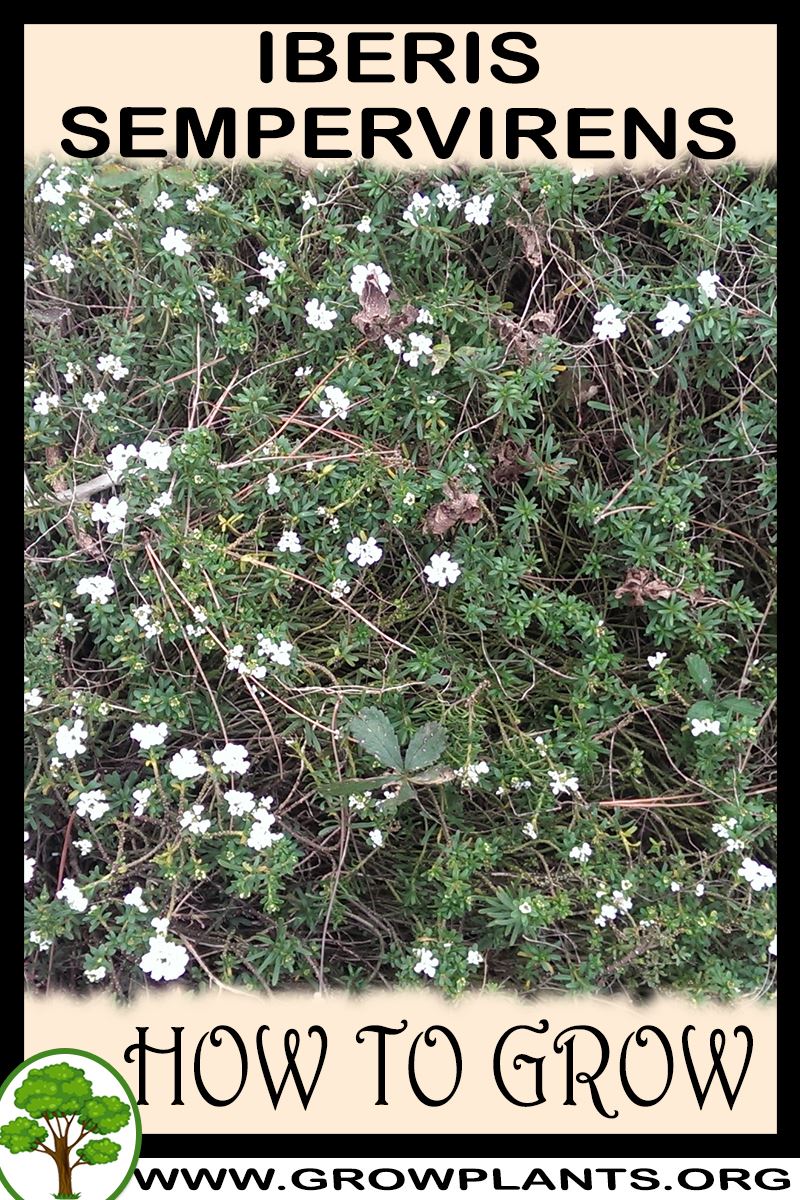
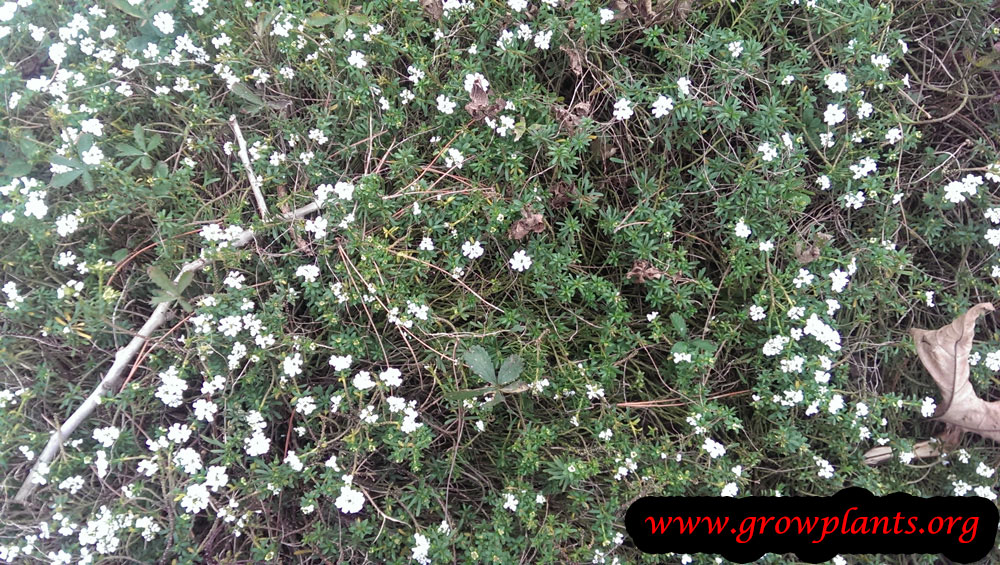
Plant Profile & Key Characteristics
Overview: A low, mat-forming evergreen subshrub of 20-40 cm (8-16 in) grown as an ornamental groundcover. Smothered in fragrant white flower clusters in spring.
Quick Specifications
| Specification | Attribute |
|---|---|
| Plant Type / Life Cycle | Perennial (evergreen subshrub) |
| Foliage Type | Evergreen |
| Mature Size | 20-40 cm tall (8-16 in), spreading wider |
| Growth Rate | Fast |
| Root System | Fibrous |
| Hardiness | USDA zones 4-9 |
Growth Form & Structure
- Height & Spread: Stays low at 20-40 cm (8-16 in) and spreads to form wide mats; also suits containers and wall tops.
- Growth Habit & Form: Low, spreading, mound-forming evergreen groundcover subshrub.
- Lifespan & Maturity: Long-lived perennial that establishes and spreads quickly – can self-seed and spread widely.
Anatomy & Physical Features
- Leaves & Foliage: Narrow, linear dark-green evergreen leaves in rosettes, forming dense cover.
- Flower Characteristics: Fragrant white flowers with a yellow centre in rounded clusters, mainly in spring (see the Bloom guide).
Primary Uses & Landscape Value
- Functional & Ornamental Roles: Fragrant ornamental groundcover for edging, rockeries, walls and slopes in sun or part shade.
Care Guide: Planting, Soil & Watering
Overview: Perennial candytuft is an evergreen, fragrant groundcover subshrub for full sun to half shade in temperate gardens. It grows best in well-draining soil and is a classic rock-garden and edging plant.
Quick Care Requirements
| Requirement | Ideal Condition |
|---|---|
| Planting Season | Spring |
| Growth Rate | Fast |
| Soil Type | Well-draining soil; a classic rock-garden groundcover |
| Water Need | Moderate |
Planting & Establishment
- Best Planting Season: Plant in spring.
- How to Plant:
- Hole Preparation: Dig a hole a little wider than the root ball in a sunny, free-draining spot.
- Soil Amendments: Add grit to heavy soils to improve drainage; rich feeding is not needed.
- Planting Depth: Set the crown level with the soil surface so the base does not stay wet.
- Growth Speed & Expectations: A fast grower that quickly spreads into a low evergreen cushion.
Soil, Watering & Drainage Care
- Soil Mix & Drainage Needs: Well-draining soil is important to avoid rot; it grows well in containers and on rockeries.
- Watering Schedule & Technique:
- Young / Newly Planted: Water regularly after planting while the roots establish.
- Established: Water moderately once established, letting the surface dry slightly between waterings.
- Seasonal Adjustments: Water more in summer heat and less in winter.
Climate, Light & Hardiness
Perennial candytuft is a hardy, evergreen ground-cover subshrub of temperate climates, smothered in white spring flowers. It grows in full sun to half shade and is genuinely cold-hardy (about zone 4–9), with heat and humidity - not cold - setting its warm limit.
Quick Climate Specifications
| Climate Zones | Temperate |
| USDA Hardiness Zones | Site lists zone 4–9 |
| Optimal Temp Range | Mild conditions of roughly 15–22 °C (59–72 °F) |
| Cold Damage Begins | Very cold-tolerant; damage occurs only at the extreme cold end of its range |
| Approx. Survival Minimum | Established plants tolerate hard winter cold consistent with a zone 4 limit, roughly −30 °C (−22 °F) |
| Frost Tolerance | High |
| Light Conditions | Full sun to half shade |
Sunlight & Light Exposure
Optimal Light Setup
Full sun gives the densest mat and heaviest bloom; half shade is tolerated with somewhat looser growth and fewer flowers.
Best Exposure / Orientation
An open, sunny, well-drained bank, wall-top or border edge shows off the cascading habit.
Temperature Extremes & Hardiness
USDA Hardiness & Regional Limits
Zone 4–9 confirms a genuinely hardy evergreen: it comes through cold winters reliably, and its practical limit is at the warm end.
Cold Damage & Winter Protection
Little winter protection is needed within its zones; the evergreen foliage generally holds through frost and snow.
Frost Sensitivity
Frost-hardy - frost poses little threat within its range.
Extreme Heat Tolerance
Hot, humid summers are its weak point: it dislikes prolonged heat with poor drainage and performs best where summers are not oppressive.
Wind, Humidity & Microclimate
Humidity Preferences
It prefers drier air and sharp drainage; humid, wet conditions can cause the crown to rot.
Wind Tolerance
The low, mat-forming habit handles wind well.
Microclimate Recommendations
A raised, sunny, freely-drained spot suits it, especially in regions with hot, humid summers where drainage and airflow matter most.
Growing in Pots, Balconies & Indoors
Perennial candytuft is a low, evergreen, spreading perennial that looks superb tumbling over the edge of a sunny balcony pot, trough or rockery container, smothered in white spring flowers. It is an outdoor plant, not a houseplant.
Quick Details
- Container Size: Medium and wide – about 10-20 L (3-5 gal); a broad trough suits its spread
- Indoor Suitability: Not a houseplant – it needs full sun, cool winters and outdoor air
- Best Spot: Full sun; ideal trailing over a pot rim or wall
- Soil & Drainage: Sharp, free-draining, gritty mix – it dislikes wet feet
- Watering in Pots: Water moderately; drought-tolerant once established
Indoors & On the Windowsill
- Not a houseplant: The grower marks it ‘no’ – it needs full sun and cool winters, and grows weak and shapeless in a warm room.
- Hardy outdoors: Being an evergreen perennial it stays outside year-round in most climates, so there is no need to bring it under cover.
On a Balcony or Patio
- Light & wind: Give it full sun; it trails handsomely over pot edges and walls. Sharp drainage matters more than shelter – it copes with exposure but hates sitting wet.
- Practicalities: Shear it back lightly after flowering to keep the cushion neat and dense.
Choosing the Pot, Soil & Long-Term Care
- Pot & drainage: A wide 10-20 L pot with strong drainage holes; skip a standing-water saucer, as it will not tolerate soggy roots. Terracotta suits it, breathing and drying fast.
- Potting mix: A free-draining mix with added grit or perlite; it prefers lean, sharp conditions.
- Feeding: Feed only lightly – too much feed gives soft, floppy growth at the expense of flowers.
- Repotting: Refresh the mix or pot up about every couple of years; for perennials, lightly prune the root ball and top growth at the same time.
Fertilizing & Feeding
A moderate feeder: light, steady, balanced feeding through the growing season supports both foliage and repeated bloom, tapering off as the plant rests.
Quick Fertilizing Specs
| Feeding Level | moderate |
|---|---|
| Main Nutrient Priority | Balanced nutrition with adequate nitrogen; no phosphorus spike needed for bloom |
| Best Feeding Period | Spring through the flowering season |
| Reduce/Stop Feeding | Taper and stop as the plant enters winter rest |
| Soil pH | Adaptable; most prefer near-neutral, well-drained soil |
| Organic Options | Compost or aged manure improves fertility and structure |
| Micronutrients | Usually supplied by a complete fertilizer; correct only if a deficiency appears |
Feeding by Growth Stage
Spring growth flush
Support new stems and leafy growth as the plant breaks into active growth.
| Nutrient direction | A balanced complete fertilizer with adequate nitrogen to fuel fresh shoots and foliage. |
|---|---|
| Timing | As growth resumes in spring. |
| Frequency | Light, regular feeding through the early growing season. |
| Fertilizer types | Balanced granular or liquid complete fertilizer, Compost or other organic matter worked into the soil |
| Precautions | Avoid heavy nitrogen, which pushes soft foliage at the expense of flowers. |
Bloom period
Sustain flowering without forcing excess leafy growth.
| Nutrient direction | A balanced complete fertilizer; steady nitrogen supports continued flowering rather than a phosphorus spike. |
|---|---|
| Timing | Through the flowering season. |
| Frequency | Light, steady feeding while the plant is in bloom. |
| Fertilizer types | Balanced liquid or granular complete fertilizer |
| Precautions | High-phosphorus bloom-booster products are unneeded; balanced feeding drives bloom. |
Repeat bloom cycles
Keep energy available for successive flushes of flowers.
| Nutrient direction | Continue balanced feeding to replace nutrients used by each flush. |
|---|---|
| Timing | Between and during successive bloom flushes in the warm months. |
| Frequency | Light feeding maintained across the extended bloom period. |
| Fertilizer types | Balanced complete fertilizer |
| Precautions | Keep feeding light and even; avoid heavy doses that favor foliage over flowers. |
Dormancy or winter rest
Let the plant rest; growth and nutrient demand fall away.
| Nutrient direction | None – withhold fertilizer while the plant is resting. |
|---|---|
| Timing | During cold-season dormancy or the rest period after flowering. |
| Frequency | No feeding at this stage. |
| Fertilizer types | No feeding at this stage while the plant is dormant. |
| Precautions | Do not fertilize until active growth resumes in spring. |
Nutrient Deficiency Signs & Corrections
Older, lower leaves turn pale or yellow and growth slows.
| Possible causes | Low soil nitrogen, Nitrogen leached by frequent watering, especially in containers, Cold or waterlogged soil limiting root uptake |
|---|---|
| Appears first on | Older, lower leaves |
| What to check | Recent feeding history, Soil drainage and moisture, Whether overall growth has stalled |
| Possible correction | Apply a balanced complete fertilizer and correct any drainage problem, then resume light regular feeding. |
New leaves yellow between green veins.
| Possible causes | High soil pH reducing iron availability, Waterlogged or cold roots, A genuine iron shortage |
|---|---|
| Appears first on | New, young leaves |
| What to check | Soil pH, Drainage, Whether only new growth is affected |
| Possible correction | Correct soil pH and drainage; if it persists, apply a chelated iron product per its label. |
Leaf margins brown and scorch, often on container plants.
| Possible causes | Fertilizer salt buildup in the pot, Drought stress between waterings, Overfeeding |
|---|---|
| Appears first on | Leaf tips and margins |
| What to check | Feeding rate, Salt crust on soil or pot, Watering consistency |
| Possible correction | Flush the container thoroughly with clean water and reduce the feeding rate. |
Pruning, Training & Seasonal Maintenance
Perennial candytuft (Iberis sempervirens) is an evergreen, mounding subshrub of 20–40 cm grown as a groundcover and edging plant, smothered in white flower heads in spring. Its defining pruning task is a single shear-back of about one-third immediately after flowering: this keeps the mound dense, stops the centre going woody and bare, and often prompts a lighter second flush. Timing is critical, because the flower buds form on shoots made the previous season.
It behaves like a low shearable mat rather than a plant with a branch framework, and it is important that cuts stay in leafy green growth — old, leafless wood does not reliably reshoot — so prevention through yearly post-bloom shearing matters more than any hard corrective cut.
Quick Pruning & Maintenance Specs
| Pruning Tolerance | Moderate — shears well after bloom, but resents cutting into old bare wood |
| Primary Pruning Window | Immediately after spring flowering |
| Secondary Maintenance Window | Light tidy of dead flower stems in autumn/winter |
| Typical Frequency | Once a year, the post-bloom shear |
| Main Objective | Keep the mound compact and dense; prevent a woody open centre |
| Young Plant Priority | Light shear to thicken into a full mound |
| Mature Plant Priority | Shear back about one-third after bloom, staying in green growth |
| Best Tool Type | Hedge shears for the mat; secateurs for stray woody stems |
| Avoid Heavy Pruning During | Late winter / spring before bloom (removes buds); into leafless old wood |
Pruning by Plant Age & Size
Newly Established
Give a light tip trim to encourage branching and start a dense, well-furnished mound.
Young / Formative
There is no framework to train — it is a mound or mat. Shear lightly after the first flush to thicken it, so it fills its space evenly rather than opening up.
Mature / Established
Shear the whole mound back by about a third each year right after flowering, always cutting into leafy green growth. This is what keeps a mature plant compact and prevents the bare, woody centre that develops on unpruned candytuft.
Seasonal Pruning Schedule
Immediately after flowering (primary): the defining cut — shear the mound back by up to a third, removing spent flower heads and keeping it dense; the plant then regrows and sets next spring’s buds through summer and autumn, and may rebloom lightly. Keep the shear in green growth, never into bare old wood. Autumn / winter (secondary): only a light tidy of any dead flower stems and stray growth for appearance — not a hard cut.
Flowering & Fruiting Wood
Flowers are borne in spring on short shoots produced the previous season, so pruning timing decides the display. Shearing right after bloom lets the plant rebuild and set buds for next year; shearing in late winter or spring, by contrast, cuts off the very shoots about to flower and sacrifices the show.
Structural Pruning & Training
Treat it as a spreading evergreen mat. There are no scaffold branches to select; instead keep the mound dense and its centre furnished by regular post-bloom shearing, and cut back growth spreading beyond its space, as the plant can be invasive.
Special Growth to Remove
Remove spent flower heads as part of the post-bloom shear, and cut back stems that flop outward and root where they touch soil, both to tidy the mound and to check its spread.
Container & Small-Space Pruning
It suits troughs, wall tops, and edging. The same rule applies — shear by about a third right after bloom to keep a container plant neat and dense — and confined roots make it all the more important to prevent a woody open centre, since it will not regrow from bare wood.
Tools
It is a genuine shearable mat, so hedge shears make the even post-bloom cut across the mound, while bypass secateurs or precision snips tidy individual woody or straggly stems. No loppers or saw are needed.
Tool Hygiene & Disease Risk
Routine. Aphids are the recorded pest, not a tool-borne disease, so clean, sharp blades are sufficient; disinfect only if you are cutting out material you suspect is diseased.
Cut Placement & Technique
Shear evenly over the whole mound, keeping the blades in leafy green growth and staying above the old leafless wood, which will not break back. This is a shearing (heading) cut across a mat, not selective thinning of branches.
Heavy Pruning & Rejuvenation
Limited. Candytuft does not reliably regenerate from hard cuts into old, bare wood; a plant that has already become woody and open at the centre is usually better layered or replaced than cut hard. The reliable approach is to prevent that state with the yearly post-bloom shear rather than to attempt a rejuvenation cut.
Post-Pruning Care
Water after shearing in dry spells to support the regrowth, and keep the plant in the well-drained soil and full sun it prefers; no feeding is needed simply because it was sheared.
Common Pruning Mistakes
- Shearing in late winter or spring and cutting off the flower display.
- Never shearing, so the centre becomes woody, bare, and open.
- Cutting hard into old leafless wood and expecting it to reshoot.
When NOT to Prune
Do not prune before or during bloom, when it removes the flowers; do not cut into old leafless wood; and avoid shearing so late that soft new growth is caught by hard frost.
Recommended Tools (by task)
- hedge_shears — for the even, one-third shear-back of the mound right after flowering.
- bypass_secateurs — for tidying individual woody or straggly stems the shears miss.
Pruning Troubleshooting
| Problem | Possible Cause | What to Check | Corrective Action |
| Woody, bare open centre | Never sheared, or cut too hard into old wood | Density of the crown and age of the wood | Shear yearly after bloom into green growth; layer or replace a plant already bare |
| Few flowers next spring | Sheared too late in the season, removing set buds | Timing of the cut relative to bloom | Shear only right after flowering, never in late winter or spring |
| Sparse regrowth after cutting | Cut fell into leafless old wood | Where the cuts landed on the stems | Keep all cuts in leafy green growth above the old wood |
Propagation Guide
Perennial candytuft is most reliably increased from semi-ripe or softwood stem cuttings, which keep named selections identical, while the species itself comes fairly true from seed. Propagation is easy by cuttings or division and only moderately fiddly from the fine seed.
Quick Propagation Specs
| Best Propagation Method | Semi-ripe / softwood stem cuttings |
| Alternative Methods | Seed; division of self-rooted mat sections; simple layering |
| Propagation Difficulty | Easy |
| Seed True-to-Type | Usually true-to-type for the species; named cultivars do not come true |
| Vegetative True-to-Type | Yes |
| Best Propagation Season | Cuttings early to mid summer; seed spring or autumn; division after flowering |
| Seed Germination Time | Typically about 2–3 weeks, often uneven |
| Cutting Rooting Time | A few weeks |
| Germination Temperature | 15–20°C (59–68°F) |
| Seed Sowing Depth | Surface to barely covered (fine seed) |
Growing from Seed
Seed Handling & Viability
Seed is fine; store cool and dry until sowing. Species-raised plants are fairly uniform, but seedlings of named forms are not.
Sowing Season
Sow in spring, the plant’s main growth season, or in autumn in mild areas.
Sowing Depth & Orientation
Surface-sow or barely cover; the fine seed germinates better with light.
Germination Conditions & Time
Keep evenly moist at about 15–20°C (59–68°F); expect germination over roughly 2–3 weeks, sometimes staggered.
Seedling Care
Prick out into a gritty, free-draining mix, matching the plant’s need for well-drained soil.
Stem Cuttings
Cutting Type
Non-flowering semi-ripe or softwood shoots about 5–8 cm long.
Best Timing
Early to mid summer, once flowering has finished.
Cutting Preparation
Trim just below a node and strip the lower leaves.
Rooting Setup
Insert into a gritty, free-draining medium kept humid in bright shade.
Rooting Hormone
Optional – the cuttings root readily without it.
Rooting Time
Usually roots within a few weeks.
Division, Offsets, Pups & Suckers
The spreading mat roots where trailing stems rest on the soil, so rooted portions can be lifted and separated after flowering, or stems pegged down to layer and detached once rooted.
Bloom & Flower Guide
Quick Details
- Bloom Season: Mainly spring, with a lighter rebloom into summer (and autumn in mild climates)
- Time to First Bloom: On established plants, usually from the second season
- Flower Appearance: Dense, rounded clusters of small white flowers with a yellow eye
- Edibility: Grown ornamentally; not eaten
Detailed Blooming Overview
Perennial candytuft (Iberis sempervirens) forms a low evergreen carpet that is smothered in fragrant white flower heads in spring. It offers excellent early nectar for bees.
Flower Characteristics
- Small white flowers with a touch of yellow at the centre, packed into rounded, flat-topped clusters.
- Lightly fragrant, and dense enough at peak to hide the foliage.
Bloom Care & Thinning
- Encouraging bloom: Full sun and sharp drainage suit it; shear lightly right after flowering to keep it compact and encourage a tidy rebloom.
- Pollination: The early flowers draw bees and other pollinators.
Pests, Diseases & Troubleshooting
Overview: Candytuft is an easy evergreen perennial, but as a member of the cabbage family (Brassicaceae) it shares that family’s specific pests and, importantly, its diseases — clubroot, white rust, and downy mildew — alongside the usual aphids and slugs. Good drainage and crop hygiene prevent the serious soilborne issues.
Quick Troubleshooting Overview
| Issue / Pest | Main Symptom | Primary Solution |
|---|---|---|
| Aphids | Sticky curled new growth, sooty mold | Water jet, insecticidal soap |
| Flea beetles | Tiny shot-hole pits in leaves | Row cover, kaolin, keep plants vigorous |
| Caterpillars | Chewed leaves, holes (cabbage white/diamondback) | Hand-pick, Bacillus thuringiensis |
| Slugs & snails | Ragged holes in low foliage, slime trails | Iron-phosphate bait, clear debris |
| Clubroot | Stunting, wilting, swollen distorted roots | Raise pH, drainage, remove/avoid replant |
| White rust / downy mildew | White pustules or yellow patches, downy growth | Airflow, dry foliage, resistant stock |
Common Pests & Management
- Aphids (Brevicoryne brassicae / Myzus persicae):
- Symptoms: Green or grey mealy aphids clustering on shoot tips and leaf undersides, causing curled, sticky, distorted growth and sooty mold; can spread viruses.
- Prevention & Control: Support ladybirds and hoverflies, dislodge with water, and use insecticidal soap or neem on stubborn colonies in the evening.
- Flea beetles (Phyllotreta spp.):
- Symptoms: Tiny jumping beetles that pit leaves with numerous small round ‘shot-holes’, worst on young plants in warm dry weather.
- Prevention & Control: Protect seedlings with row cover, keep plants vigorous and watered, use sticky traps and kaolin clay, and treat heavy attacks with spinosad if needed.
- Cabbage caterpillars (Pieris rapae / Plutella xylostella):
- Symptoms: Green caterpillars chewing holes in leaves and leaving dark frass; the cabbage white and diamondback moth larvae are typical.
- Prevention & Control: Hand-pick and check leaf undersides for eggs, encourage parasitic wasps and birds, and spray Bacillus thuringiensis (Bt) for larger infestations.
- Slugs & snails (Gastropoda):
- Symptoms: Ragged holes chewed in the low mat of foliage, with slime trails, worst in damp shade and after rain.
- Prevention & Control: Clear damp harborage, water in the morning, set iron-phosphate bait or copper barriers, and hand-pick after dark.
- Cabbage whitefly (Aleyrodes proletella):
- Symptoms: Tiny white flies on leaf undersides that fly up when disturbed, with honeydew and sooty mold.
- Prevention & Control: Use yellow sticky traps and insecticidal soap on undersides; usually a minor problem on ornamental candytuft.
Diseases & Fungal Issues
- Clubroot (Plasmodiophora brassicae):
- Symptoms: Stunting, poor vigor, wilting in warm afternoons, and swollen, distorted, club-like galls on the roots; a persistent soilborne disease of the cabbage family.
- Treatment & Management: There is no cure once soil is infested: improve drainage, raise soil pH toward neutral-alkaline with lime, avoid moving infested soil, remove and destroy affected plants, and do not replant brassicas (or candytuft) in that ground.
- White rust / white blister (Albugo candida):
- Symptoms: Raised white or cream blister-like pustules on leaf undersides with yellow patches above and sometimes distorted growth.
- Treatment & Management: Remove and destroy infected leaves, space for airflow, avoid overhead watering, and use resistant stock and a labelled fungicide under sustained pressure.
- Downy mildew (Hyaloperonospora parasitica):
- Symptoms: Yellow patches on the upper leaf with fluffy grey-white downy growth underneath in cool, damp, humid conditions.
- Treatment & Management: Improve airflow and drainage, water at the base early in the day, remove affected foliage, and treat with copper if it persists.
- Root & crown rot (Rhizoctonia, Phytophthora):
- Symptoms: Wilting, yellowing, and collapse with dark rotted roots and crown in heavy, wet soil.
- Treatment & Management: Grow in sharply drained soil, avoid overwatering and heavy winter wet, and remove badly affected plants.
Growing Difficulties & Abiotic Problems
- Root rot from wet soil:
- Cause & Symptoms: Yellowing, dieback, and collapse in poorly drained or overwatered ground — candytuft demands good drainage.
- Correction Strategy: Plant in gritty, free-draining soil in full sun, avoid waterlogging, and grow on a slope or raised bed in wet climates.
- Legginess / bare centers after bloom:
- Cause & Symptoms: Plants sprawl and open up, becoming woody and bare in the middle after flowering.
- Correction Strategy: Shear the plant back by about a third right after flowering to keep it compact, dense, and well-shaped.
- Poor bloom / weak growth:
- Cause & Symptoms: Sparse flowering and floppy growth in shade or over-rich soil.
- Correction Strategy: Give it full sun and lean, well-drained soil; avoid heavy feeding, which promotes soft growth at the expense of flowers.
What Helps — Products & Tools
Manage the brassica-family risks culturally first: good drainage, near-neutral to limed soil, and sanitation against clubroot and the mildews. Keep insecticidal soap or neem for aphids and whitefly, Bacillus thuringiensis for caterpillars, iron-phosphate bait for slugs, and row cover plus kaolin for flea beetles. Copper fungicide helps against white rust and downy mildew.