Plant Profile & Key Characteristics
Overview: Bee balm (Monarda) is a fast- to moderate-growing herbaceous perennial (or annual) reaching 40-80 cm (16-32 in), grown for its aromatic foliage and showy, pollinator-friendly flower heads. It is used as an ornamental border plant and herb.
Quick Specifications
| Specification | Attribute |
|---|---|
| Plant Type / Life Cycle | Perennial (can be grown as an annual) |
| Foliage Type | Herbaceous (dies back in cold; evergreen in mild climates) |
| Mature Size | 40-80 cm (16-32 in) tall |
| Growth Rate | Fast to moderate |
| Root System | Rhizomatous – spreads by runners |
| Toxicity | Non-toxic / edible (aromatic leaves and flowers) |
| Hardiness | USDA zones 3-9 |
Growth Form & Structure
- Height & Spread: 40-80 cm (16-32 in) in the ground, spreading by rhizomes into clumps; also grown in containers
- Growth Habit & Form: Clump-forming herbaceous perennial that spreads by rhizomes and can be aggressive
- Lifespan & Maturity: Fast to establish; clumps enlarge each year and are divided periodically
Anatomy & Physical Features
- Leaves & Foliage: Green, oval, serrated leaves that are aromatic, with a scent recalling bergamot orange
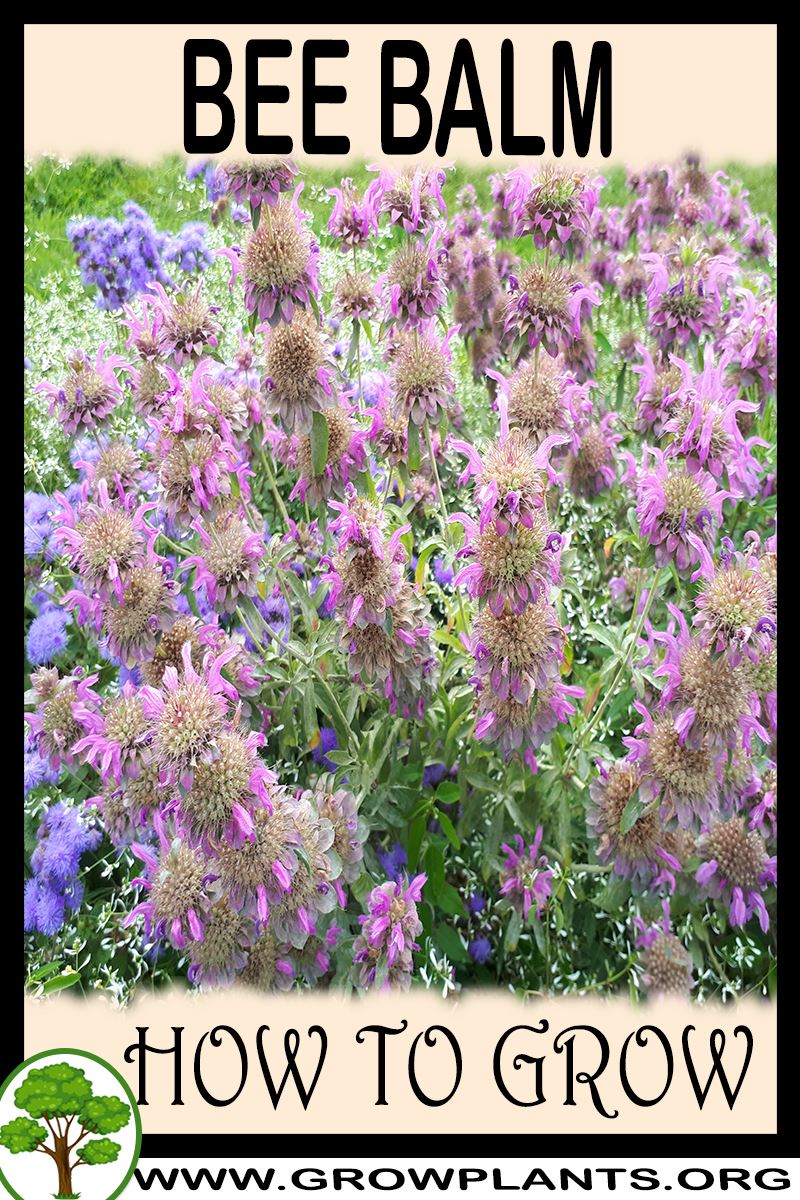
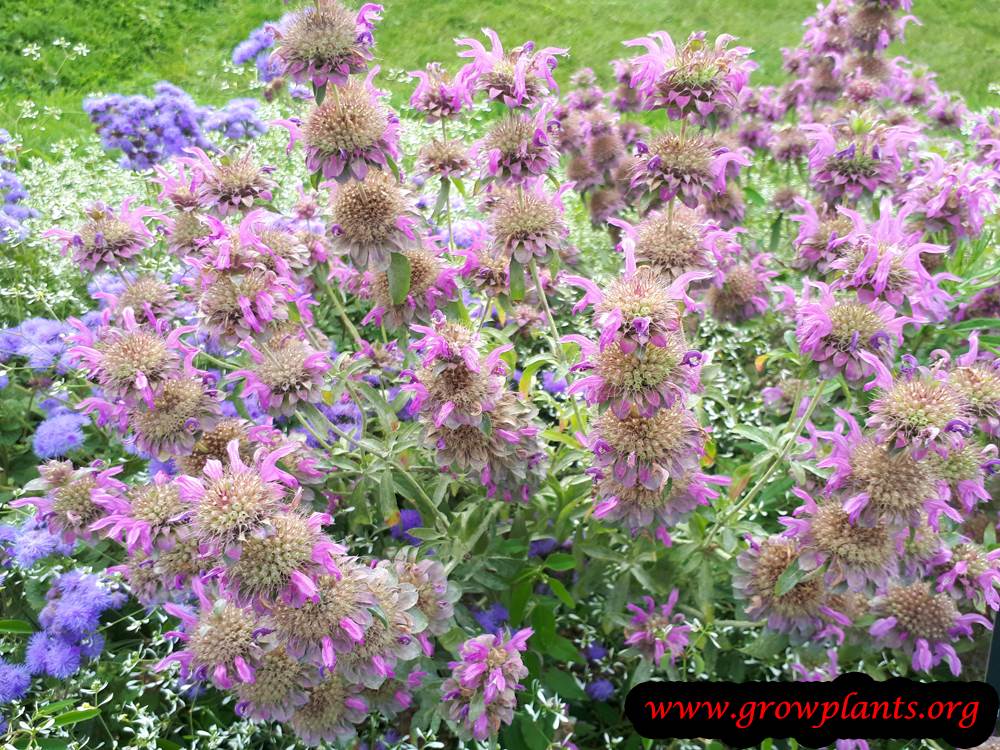
- Flower Characteristics: Tubular flowers in red, pink, purple or white, massed into rounded, ball-shaped heads that attract pollinators (see the Bloom guide)
Primary Uses & Landscape Value
- Edible Uses: Aromatic leaves used for herbal tea (Oswego tea); the flowers are edible; also used medicinally
- Functional & Ornamental Roles: Pollinator and ornamental border/cottage-garden plant, and a culinary/medicinal herb
Care Guide: Planting, Soil & Watering
Overview: Bee balm (Monarda) is a fast-growing herbaceous perennial for full sun to part shade that grows best in rich, moist, well-draining soil. It likes consistent moisture at the roots combined with good air circulation and drainage, which keep it vigorous and reduce foliage problems.
Quick Care Requirements
| Requirement | Ideal Condition |
|---|---|
| Planting Season | In spring after the last frost through autumn (spring for annual plantings) |
| Growth Rate | Moderate to Fast |
| Soil Type | Rich, moisture-retentive but well-draining soil |
| Water Need | Moderate – keep evenly moist, letting the surface just dry between waterings |
Planting & Establishment
- Best Planting Season: Plant in spring after the last frost through autumn; set annual plantings out in spring.
- How to Plant:
- Hole Preparation: Dig a hole as deep as and about twice as wide as the root ball, allowing room for the clump to spread.
- Soil Amendments: Work in compost and organic matter to enrich the soil and help it hold moisture while draining freely.
- Planting Depth: Set the crown level with the soil surface; space plants for good airflow around the foliage.
- Growth Speed & Expectations: Moderate to fast, forming a spreading clump about 40–80 cm tall; it is aggressive and spreads, so give it room.
Soil, Watering & Drainage Care
- Soil Mix & Drainage Needs: Wants a rich, moisture-retentive yet well-draining soil; avoid stagnant, waterlogged sites, and keep air moving through the clump.
- Watering Schedule & Technique:
- Young / Newly Planted: Water regularly to keep the soil consistently moist through the first season.
- Established: Water deeply whenever the surface begins to dry; try to water at the base to keep the foliage dry.
- Seasonal Adjustments: Increase in hot, dry weather; reduce as the plant dies back in autumn and winter.
Climate, Light & Hardiness
Bee balm is a cold-hardy herbaceous perennial suited to temperate climates with cold winters, dying back to its roots each autumn and resprouting in spring. It grows best in full sun to half shade with consistently moist soil and good air movement.
Quick Climate Specifications
| Climate Zones | Temperate |
|---|---|
| USDA Hardiness Zones | 3–9 |
| Light Conditions | Full sun to half shade |
| Frost Tolerance | High (foliage dies back; roots overwinter) |
Sunlight & Light Exposure
Optimal Light Setup
Full sun produces the strongest flowering and best air circulation around the foliage; half shade is tolerated, especially where summers run hot.
Best Exposure / Orientation
An open, airy site with morning sun and good airflow suits the plant's dense clumping habit best.
Temperature Extremes & Hardiness
USDA Hardiness & Regional Limits
Reliably hardy from USDA zone 3 to 9, surviving severe winter cold as an herbaceous perennial whose top growth dies down completely while the roots persist underground.
Cold Damage & Winter Protection
Foliage is killed back by the first hard autumn frosts as a normal part of dormancy; no winter protection is typically needed within its hardiness range.
Frost Sensitivity
Emerging spring growth can be nipped by a late hard frost but usually resprouts from the roots without lasting harm.
Wind, Humidity & Microclimate
Humidity Preferences
Native to humid eastern North American habitats, it tolerates average to high humidity when given adequate air movement around the foliage.
Microclimate Recommendations
Choose an open site with good airflow but some shelter from strong wind, and keep soil consistently moist through the growing season to buffer against summer heat.
Growing in Pots, Balconies & Indoors
Bee balm is an aromatic, pollinator-friendly perennial, not a houseplant, but it grows well in a roomy container on a sunny patio or balcony.
Quick Details
- Container Size: A roomy pot for a clumping perennial, potting on as the clump spreads
- Indoor Suitability: Not a true houseplant; grows best outdoors
- Best Spot: Full sun to half shade
- Soil & Drainage: Aerated, organic-rich mix (peat or coir with perlite or vermiculite); must drain freely
- Watering in Pots: Keep the mix evenly moist – bee balm wilts and mildews if it dries out repeatedly
Indoors & On the Windowsill
- Houseplant limits: It needs full outdoor light and good airflow to flower and stay mildew-free; indoors it would be too dark and stuffy.
On a Balcony or Patio
- Light & wind: Give it sun and good air movement to discourage mildew; keep the pot evenly moist as it dries quickly in summer. Walls and paving reflect heat, so pots dry quickly – check moisture often in hot weather.
- Practicalities: Set the pot where drainage runoff won’t stain, and remember a full, wet container is heavy to move.
Choosing the Pot, Soil & Long-Term Care
- Pot & drainage: A container with strong drainage holes and no standing-water saucer, to avoid root rot; terracotta breathes and dries faster, glazed or plastic holds moisture longer.
- Potting mix: A well-aerated, organic-rich mix – peat or coir with perlite or vermiculite.
- Feeding: Potted plants exhaust their soil quickly – feed a little more often, since watering leaches nutrients away.
- Repotting: Refresh the top of the mix each year and pot on every couple of years, trimming the root ball lightly.
Fertilizing & Feeding
A vigorous, sometimes aggressive flowering perennial that grows well in rich, moist soil; it does best on balanced, moderate feeding rather than a high-phosphorus bloom booster, and can spread even more aggressively if overfed.
Quick Fertilizing Specs
| Feeding Level | Moderate feeder |
|---|---|
| Main Nutrient Priority | Balanced feeding to support the fragrant foliage and the ball-shaped clusters of tubular flowers |
| Best Feeding Period | Spring into the summer-to-autumn bloom season |
| Organic Options | Compost or well-rotted organic matter worked into rich, moisture-retentive soil |
| Reduce/Stop Feeding | Reduce and then stop feeding as the plant dies back to the ground for winter |
| Soil pH | Prefers rich, moist, well-drained soil rather than a lean or dry bed |
Feeding by Growth Stage
Spring growth
Support fresh shoot and foliage growth as clumps emerge from the ground in spring.
| Nutrient direction | A balanced, complete fertilizer worked into rich soil supports healthy early growth. |
|---|---|
| Timing | In spring as new shoots emerge. |
| Frequency | A single early-season feeding is generally enough for this vigorous, fast to medium grower. |
| Fertilizer types | A balanced, complete perennial fertilizer worked into the bed, Compost worked into rich, moisture-retentive soil |
| Precautions | This species can be aggressive and spread readily; avoid heavy feeding that pushes even more vigorous spread than wanted. |
Summer-to-autumn bloom
Support the ball-shaped clusters of tubular flowers that draw pollinators through the main bloom season.
| Nutrient direction | Continued balanced feeding, not a high-phosphorus bloom product, supports strong flowering in this species. |
|---|---|
| Timing | Through the summer and into autumn bloom period. |
| Frequency | A light follow-up feeding during bloom is usually all that is needed beyond the spring application. |
| Fertilizer types | A balanced liquid or granular perennial fertilizer if bloom looks light, No separate high-phosphorus bloom booster is needed |
| Precautions | Avoid heavy nitrogen feeding, which can push excess foliage and worsen this species’ tendency toward powdery mildew in crowded plantings. |
Winter dieback and rest
Let the plant die back to the ground and rest through winter dormancy.
| Nutrient direction | None – withhold fertilizer once the plant dies back for winter. |
|---|---|
| Timing | Autumn through winter. |
| Frequency | No feeding at this stage. |
| Fertilizer types | No feeding at this stage; do not fertilize until new growth resumes in spring. |
| Precautions | Fertilizing dying-back or dormant growth wastes nutrients and can encourage tender growth vulnerable to cold. |
Nutrient Deficiency Signs & Corrections
Pale green, undersized leaves and weaker clump growth than expected for this normally vigorous perennial.
| Possible causes | insufficient nitrogen in the bed, root competition in a crowded, spreading clump, soil that has dried out, reducing nutrient uptake |
|---|---|
| Appears first on | older, lower leaves |
| What to check | overall clump vigor and color, how crowded the planting has become, soil moisture consistency |
| Possible correction | Apply a balanced feed and divide overcrowded clumps to relieve competition. |
Vigorous foliage growth but a light or short bloom display.
| Possible causes | excess nitrogen favoring leafy growth over flowering, overcrowded clumps competing for light and nutrients, insufficient light for a plant that blooms best in good sun |
|---|---|
| Appears first on | overall flower count rather than a specific leaf symptom |
| What to check | recent feeding rate, clump crowding and whether division is due, light exposure of the planting |
| Possible correction | Favor balanced, moderate feeding over heavy nitrogen, divide crowded clumps, and improve light exposure where practical. |
Yellowing between the veins of new leaves while the veins themselves stay green.
| Possible causes | high soil pH limiting iron availability, waterlogged soil restricting root uptake, naturally low soil iron |
|---|---|
| Appears first on | newest leaves at the growing tips |
| What to check | soil pH, drainage and moisture consistency, whether older leaves remain a normal color |
| Possible correction | Correct soil pH and drainage where practical, and apply a chelated iron product per its label if chlorosis persists. |
Pruning, Training & Seasonal Maintenance
Bee balm (Monarda) is a vigorous, clump-forming herbaceous perennial that tolerates moderate to fairly hard cutting since it regrows entirely from the base each year and holds no persistent woody framework. The main jobs are deadheading through its long summer – autumn bloom to keep flowers coming, thinning crowded stems to improve airflow through the clump (this genus is well known for powdery mildew, and congestion is the main driver), and cutting the whole clump down once it dies back for winter. Because next year’s flowers form entirely on new growth, none of this seasonal cutting costs future bloom – the main thing to avoid is working wet, mildew-affected foliage, which spreads the disease rather than controlling it.
Quick Pruning & Maintenance Specs
| Pruning Tolerance | Moderate–High (herbaceous, regrows fully from the base) |
| Primary Pruning Window | Autumn/Winter, cutting the dieback stems to the ground |
| Secondary Maintenance Window | Late spring pinching, plus ongoing deadheading through summer – autumn bloom |
| Typical Frequency | Continuous light deadheading in season, one seasonal cutback, division every 2–3 years |
| Main Objective | Prolong bloom, improve air circulation against mildew, remove spent growth |
| Young Plant Priority | Let the clump establish; pinch only if growth is leggy |
| Mature Plant Priority | Thin crowded interior stems annually and divide the spreading clump periodically |
| Best Tool Type | Precision snips / bypass secateurs |
| Avoid Heavy Pruning During | Peak summer bloom, and humid weather when foliage is wet with mildew present |
Pruning by Plant Age & Size
Newly Established
Minimal – remove only damaged growth and let the young clump establish undisturbed.
Young / Formative
No structural training is needed; instead, pinch the tips of young stems in late spring to encourage bushier, sturdier growth and a slightly staggered bloom, which also helps resist flopping and mildew later in the season.
Mature / Established
Thin out a portion of the densest interior stems each year for airflow, deadhead continually through bloom, and lift and divide the clump every 2–3 years – this genus is noted as aggressive/spreading, so division is as much a size-control tool as a vigor renewal.
Seasonal Pruning Schedule
Pre-Growth/Early-Spring
Objective: clear away any old stems left standing over winter before new shoots emerge. Remove: dead top growth. Not removed: emerging basal shoots. Response: clean new growth from the base with fewer overwintering mildew spores nearby.
Summer Canopy Management
Objective: reduce mildew pressure. Remove: a portion of overcrowded stems from the clump’s interior. Not removed: enough stems to keep flowering display. Response: better airflow through the remaining stems, reduced humidity around foliage.
Post-Flowering / Ongoing Sanitary
Objective: extend bloom and limit self-seeding. Remove: spent flower heads, cut back to the next leaf node, continually through the flowering season. Not removed: healthy buds still forming. Response: fresh flower buds keep forming on new growth; flowering impact is positive, not costly.
Dormant/Winter
Objective: seasonal cleanup. Remove: frost-killed top growth, cut to the ground (can be left standing for winter interest/wildlife and cleared in early spring instead). Response: none lost for next season, since regrowth comes entirely from the base.
Structural Pruning & Training
Renewal here works through division rather than woody-style structural pruning: lifting and splitting the clump every 2–3 years renews vigor, keeps the aggressive spread in bounds, and prevents the weak, congested, mildew-prone center that an old undivided clump develops.
Special Growth to Remove
- Spent flower heads – deadhead promptly to extend bloom.
- Mildew-affected foliage – remove and dispose of it rather than composting, to limit reinfection.
- Old, winter-killed stems at the base.
Container & Small-Space Pruning
In containers, this plant’s spreading habit means more frequent division is needed to avoid it becoming root-bound and congested. Pinch harder in spring for a compact, less floppy container specimen, and keep stems spaced enough within the pot for the same airflow that matters for mildew control in the ground.
Tools
Precision snips for regular deadheading and spring pinching; bypass secateurs for cutting the thicker mature stems during the autumn or spring cutback.
Tool Hygiene & Disease Risk
Increased: powdery mildew is common on Monarda and spreads readily on wet foliage and tools. Avoid working the clump when leaves are wet, and wipe blades between plants when mildew is visible.
Cut Placement & Technique
Deadhead just above the next leaf node to encourage rebranching and further buds; cut old stems flush to the ground during the seasonal cutback, since new shoots emerge from the base rather than from nodes on the old stems.
Heavy Pruning & Rejuvenation
A full cutback to ground level each dormant season is normal and expected for this herbaceous perennial, not a stress event. The genuine rejuvenation tool for Monarda is division – lifting and splitting the clump every 2–3 years in spring or autumn keeps it vigorous and less crowded.
Post-Pruning Care
After removing mildew-affected foliage, focus on airflow and soil-level watering rather than feeding. After the seasonal cutback, a light mulch is useful; watch new spring growth for early mildew signs so thinning can start again promptly.
Common Pruning Mistakes
- Shearing the whole clump densely without thinning, which traps humidity and worsens mildew.
- Deadheading so aggressively that no seed heads are left for pollinators or birds, if that is wanted.
- Leaving the clump undivided for many years, producing a weak, congested, mildew-prone center.
When NOT to Prune
Avoid hard cutting during peak flowering if continuous bloom is the goal – deadhead selectively instead. Avoid working wet, mildew-affected foliage in humid weather, since this spreads spores rather than controlling them. Avoid dividing or disturbing roots during active summer bloom.
Recommended Tools (by task)
- precision_snips – for regular deadheading and pinching young stems in spring.
- bypass_secateurs – for cutting thicker stems during the autumn/spring cutback.
- blade_disinfectant – to wipe blades between mildew-affected plants and limit spread.
Pruning Troubleshooting
| Problem | Possible Cause | What to Check | Corrective Action |
| White powdery coating on leaves | Overcrowded stems, poor airflow, wet foliage | Stem density in the clump interior; watering method | Thin roughly a third of the stems, water at soil level, remove affected foliage |
| Weak or sparse flowering | Overgrown, unrenewed clump | Clump age and congestion | Divide the clump in spring or autumn |
| Floppy, leaning stems | No spring pinching; too much shade or overly rich soil | Light levels; whether tips were pinched | Pinch stem tips in late spring the following season; stake if needed |
Propagation Guide
Bee balm is most easily and reliably increased by dividing its spreading rhizomatous clumps, which matches the site’s own note that this plant grows aggressively; stem cuttings root readily too, while seed works well for the species but not for named cultivars, whose offspring can vary. Overall difficulty is easy.
Quick Propagation Specs
| Best Propagation Method | Rhizome/clump division |
| Alternative Methods | Softwood stem cuttings; seed (for the species) |
| Propagation Difficulty | Easy |
| Seed True-to-Type | Usually true-to-type for the species; named cultivars are often hybrids whose seedlings vary and won’t come true |
| Vegetative True-to-Type | True-to-type |
| Best Propagation Season | Spring (as an annual) through autumn, matching the site’s planting season |
| Seed Germination Time | Typically 1–3 weeks in warmth |
| Cutting Rooting Time | Often just a couple of weeks, as this mint-family plant roots very readily |
| Germination Temperature | Around 18–24°C (64–75°F) |
| Seed Sowing Depth | Surface-sow or barely cover – fine seed generally needs light to germinate |
Growing from Seed
Sowing Season
Sow in spring, matching the site’s planting season.
Sowing Depth & Orientation
Press the small seed onto the surface of a well-drained, rich mix (matching the site’s soil note) without burying it, since it benefits from light to germinate.
Germination Conditions
Moderate warmth, bright light, and consistently moist – not waterlogged – soil.
Germination Time
Usually about 1–3 weeks under warm, moist conditions.
Seedling Care
Note that named cultivars are frequently hybrids, so seed-raised plants may not match the parent’s exact flower color; grow named forms from cuttings or division instead.
Stem Cuttings
Cutting Type
Soft, non-flowering stem tip cuttings.
Best Timing
Spring through summer, during active growth.
Rooting Setup
A moist, well-drained mix, or even water, as this mint-family plant roots very easily.
Rooting Hormone
Not necessary – cuttings root readily without it.
Rooting Time
Often just a couple of weeks.
Rhizomes, Tubers, Bulbs & Corms
Bee balm spreads by underground rhizomes, which is also the source of the aggressive spreading habit the site notes. In spring or autumn, lift a clump and use a knife or spade to divide the rhizome mass into sections that each carry healthy roots and at least one or two growth points; discard the old, woody center of overgrown clumps and replant the vigorous outer sections into well-drained, moist, rich soil (matching the site’s soil note). Regular division every few years also helps keep this spreading plant in check.
Bloom & Edible Flower Guide
Quick Details
- Bloom Season: Summer into autumn
- Time to First Bloom: A perennial – divisions and potted plants flower their first summer, while seed-raised plants often bloom from their second year
- Flower Appearance: Shaggy, rounded heads of tubular florets in red, pink, purple or white, forming a ball- or crown-like whorl
- Edibility: Edible – the flowers and aromatic leaves are edible, used to garnish dishes and to brew a fragrant, bergamot-scented herbal tea (Oswego tea)
Detailed Blooming Overview
Bee balm lives up to its name: the ragged, tufted flowerheads are a magnet for bees, butterflies and hummingbirds all summer. The whole plant is pleasantly aromatic, and the petals lift both the look and flavour of summer salads, drinks and teas.
Flower Characteristics
- Tubular florets in red, pink, purple or white, gathered into a rounded, whorled head, as the grower describes.
- Often blooms in tiers, with a second whorl rising above the first.
Bloom Care & Thinning
- Keep it flowering: Deadhead spent heads to prompt a fresh flush of bloom.
- Vigour: Lift and divide the clump every few years to keep it strong and free-flowering.
- Pollinators: Leave some late flowers standing – they are a valuable nectar source.
Bloom Health & Protection
- Powdery mildew: Monarda is well known for a white, dusty mildew on its leaves in the run-up to and during flowering. Good spacing for airflow and choosing mildew-resistant cultivars help most; a sulfur-based or potassium-bicarbonate fungicide can help if it takes hold.
Fruit & Uses
Bee balm is valued as much as a culinary and tea herb as it is as an ornamental: its fragrant, bergamot-scented leaves and its colorful flowers are both used, mainly fresh or dried for herbal tea and as a seasoning or garnish. Both parts are used without any special processing.
Quick Edible Specs
| Edible Parts | Leaves; Flowers |
| Main Use(s) | Culinary (herb, garnish); herbal tea (the plant’s alternative name "Oswego tea" reflects this); traditionally used medicinally |
| Eaten Raw or Cooked | Raw/fresh, or dried and steeped as tea |
| Preparation Required | None – used fresh or simply air-dried |
| Harvest Season | Leaves as needed through the growing season; flowers picked at bloom, in summer/autumn |
| Time to First Harvest | Leaves can be picked once the plant is established and actively growing; flowers only once it reaches bloom (see Blooming) |
| Storage | Best used fresh; leaves and flowers can also be air-dried and stored for later use in tea |
| Safety/Toxicity Caveat | None noted on the site; as with other strongly aromatic herbs, use in modest, herb-like amounts rather than as a bulk food |
Leaves & Greens
The oval, serrated leaves carry a strong fragrance reminiscent of bergamot orange, which is the basis of the plant’s common uses. Fresh leaves are picked at any point through the season and used as a culinary herb or steeped fresh for tea; leaves can also be dried and stored for later use – the plant’s alternative names "Oswego tea" and "bergamot" both point to this traditional tea use.
Flowers & Flower Buds
The tubular flowers, which cluster into ball-shaped heads in red, pink, purple or white, are also edible and share the same fragrant profile as the leaves. They are picked once open and used fresh as a garnish or added alongside the leaves in tea blends.
Preparation, Uses & Safety
No cooking or processing is required – both leaves and flowers are used fresh or simply air-dried for later use. Beyond culinary and tea use, bee balm has a long history of traditional medicinal use, though no specific health claims are made here. As with other aromatic herbs, use it in moderate, herb-like quantities rather than as a bulk vegetable.
Pests, Diseases & Troubleshooting
Overview: Bee balm (Monarda) is a hardy, aromatic, mint-family perennial whose single defining problem is powdery mildew – few plants are as reliably mildewed in a crowded, dry-rooted border. Beyond that it gets rust and leaf spot, and sap-suckers and stalk borers, but it is otherwise tough and pollinator-friendly. Airflow, division, even moisture and mildew-resistant varieties are the whole game.
Quick Troubleshooting Overview
| Issue / Pest | Main Symptom | Primary Solution |
|---|---|---|
| Powdery mildew (signature) | White powdery coating on leaves, browning, defoliation | Airflow, divide, resistant varieties, thin stems |
| Rust | Orange-brown pustules on leaf undersides | Remove leaves, airflow, avoid wet foliage |
| Leaf spot | Brown/purple spots, yellowing | Sanitation, airflow, copper if severe |
| Aphids | Sticky curled shoot tips | Hose off, insecticidal soap |
| Spider mites | Fine stippling in hot dry spells | Hose, raise humidity, oil/soap |
| Aggressive spreading | Clump outgrows its space via rhizomes | Divide regularly, contain rhizomes |
Common Pests & Management
- Aphids (Aphis / Myzus spp.):
- Symptoms: Colonies on the soft new shoots and flower buds, curling growth and leaving honeydew and sooty mould.
- Prevention & Control: Hose off, encourage the many predators bee balm’s flowers attract, and use insecticidal soap on persistent colonies; avoid harsh sprays that harm pollinators on this bee plant.
- Spider mites (Tetranychus urticae):
- Symptoms: Fine pale stippling, a dull bronzed cast and webbing on drought-stressed plants in hot, dry weather.
- Prevention & Control: Keep the roots evenly moist (drought stress invites both mites and mildew), hose the foliage, and treat outbreaks with insecticidal soap or horticultural oil.
- Four-lined plant bug (Poecilocapsus lineatus):
- Symptoms: Neat rows of small, round, sunken dark-then-translucent spots on the leaves from feeding punctures, mostly in early season.
- Prevention & Control: Tolerate the largely cosmetic damage, remove overwintering debris, and hand-pick the fast-moving nymphs; insecticidal soap if severe on prized plants.
- Stalk borer (Papaipema nebris):
- Symptoms: Sudden wilting of individual stems, with a small entry hole and frass where the larva has tunnelled inside the stem.
- Prevention & Control: Cut out and destroy wilted, infested stems below the borer, clear weedy grasses nearby (an alternate host), and remove old stems in autumn to reduce overwintering.
- Leafhoppers:
- Symptoms: Pale stippling and flecking from feeding, and a potential vector of aster yellows; usually minor.
- Prevention & Control: Tolerate light feeding, encourage natural enemies, and remove any plants showing yellows-type distortion; insecticidal soap only if numbers are high.
Diseases & Fungal Issues
- Powdery mildew (the signature disease) (Golovinomyces / Erysiphe spp.):
- Symptoms: White-to-grey powdery patches spreading across the upper leaves, which then yellow, brown and drop, often leaving stems bare by late summer; worst on crowded, shaded, dry-rooted clumps.
- Treatment & Management: Choose mildew-resistant varieties, space and divide plants for airflow, thin congested stems, and keep the roots evenly moist (drought worsens it). Cut affected plants back after flowering, clean up debris, and use sulphur, potassium bicarbonate or neem preventively where pressure is high.
- Rust (Puccinia menthae):
- Symptoms: Orange-brown to dark powdery pustules on the leaf undersides with yellow blotching above and premature leaf drop in damp conditions.
- Treatment & Management: Remove and destroy infected leaves and autumn debris, improve airflow, and avoid overhead watering; sulphur helps under heavy pressure.
- Leaf spot (Septoria / Cercospora):
- Symptoms: Brown to purple spots on the leaves, sometimes with pale centres, causing yellowing and leaf loss in wet weather.
- Treatment & Management: Sanitation and airflow are key – remove affected leaves and debris and avoid wetting foliage; copper checks severe cases.
- Botrytis / stem rot (Botrytis cinerea):
- Symptoms: Grey mould and soft rot on crowded, damp stems and spent flowers in cool wet spells.
- Treatment & Management: Deadhead, thin the clump, improve airflow, and remove affected material; rarely needs fungicide if the clump is opened up.
Growing Difficulties & Abiotic Problems
- Mildew from crowding and dry roots:
- Cause & Symptoms: Bee balm mildews badly when clumps are congested, poorly ventilated and allowed to dry at the root – the classic recipe.
- Correction Strategy: Divide every 2–3 years, space generously, thin stems in spring for airflow, keep evenly moist with mulch, and grow resistant cultivars; this alone transforms plant health.
- Aggressive spreading:
- Cause & Symptoms: Vigorous rhizomes let the clump march outward and crowd neighbours, and the centre can die out over time.
- Correction Strategy: Divide regularly to rejuvenate and contain, replant the vigorous outer growth, and use a root barrier or grow in a container where space is limited.
- Flopping / leggy stems:
- Cause & Symptoms: Rich soil, too much shade or crowding causes tall, weak, floppy stems.
- Correction Strategy: Grow in full sun in lean-to-moderate soil, avoid over-feeding, and pinch or cut back by a third in early growth for sturdier, bushier plants.
- Poor flowering / bare lower stems:
- Cause & Symptoms: Too much shade, drought or mildew defoliation reduces bloom and strips the lower stems.
- Correction Strategy: Give full sun and even moisture, control mildew, and deadhead to prolong flowering; cut back after bloom for fresh foliage.
What Helps – Products & Tools
Management is overwhelmingly cultural – resistant varieties, division, spacing, airflow and even moisture prevent the mildew that defines this plant. When treatment is warranted, sulphur, potassium bicarbonate and neem check mildew and rust; insecticidal soap and horticultural oil handle aphids and mites; and sanitation controls leaf spot. Because bee balm is a magnet for bees and butterflies, avoid insecticides on the flowers and apply any oils in the evening.