Plant Profile & Key Characteristics
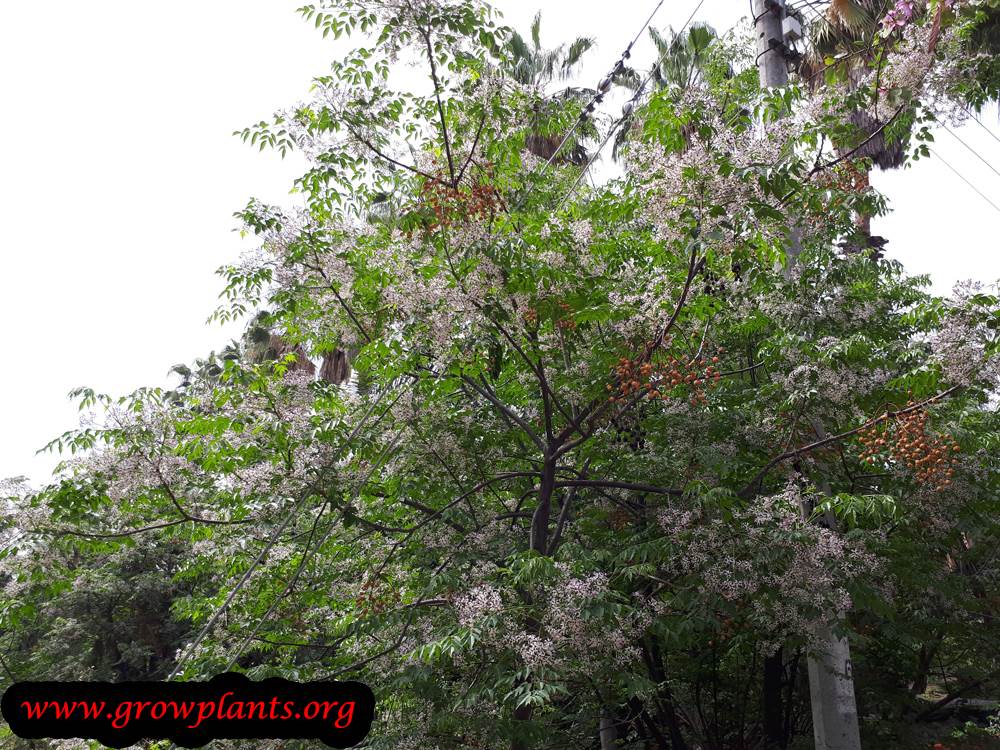
Overview: Melia azedarach (chinaberry) is a fast-growing deciduous tree reaching 5–15 m (15–45 ft), grown as an ornamental and shade tree for its fragrant, pollinator-friendly spring flowers. It is drought tolerant, though all parts — especially the berries — are poisonous.
Quick Specifications
| Specification | Attribute |
|---|---|
| Plant Type / Life Cycle | Perennial (tree) |
| Foliage Type | Deciduous |
| Mature Size | 5–15 m (15–45 ft) |
| Growth Rate | Fast to moderate |
| Toxicity | Toxic — berries and other parts poisonous to people and animals |
| Hardiness | USDA zones 9b+ |
Growth Form & Structure
- Height & Spread: 5–15 m (15–45 ft) with a broad, spreading crown; not suited to container growing.
- Growth Habit & Form: Medium spreading tree with an open, rounded canopy.
- Lifespan & Maturity: Fast-growing and relatively short-lived; can also be trained as a bonsai.
Anatomy & Physical Features
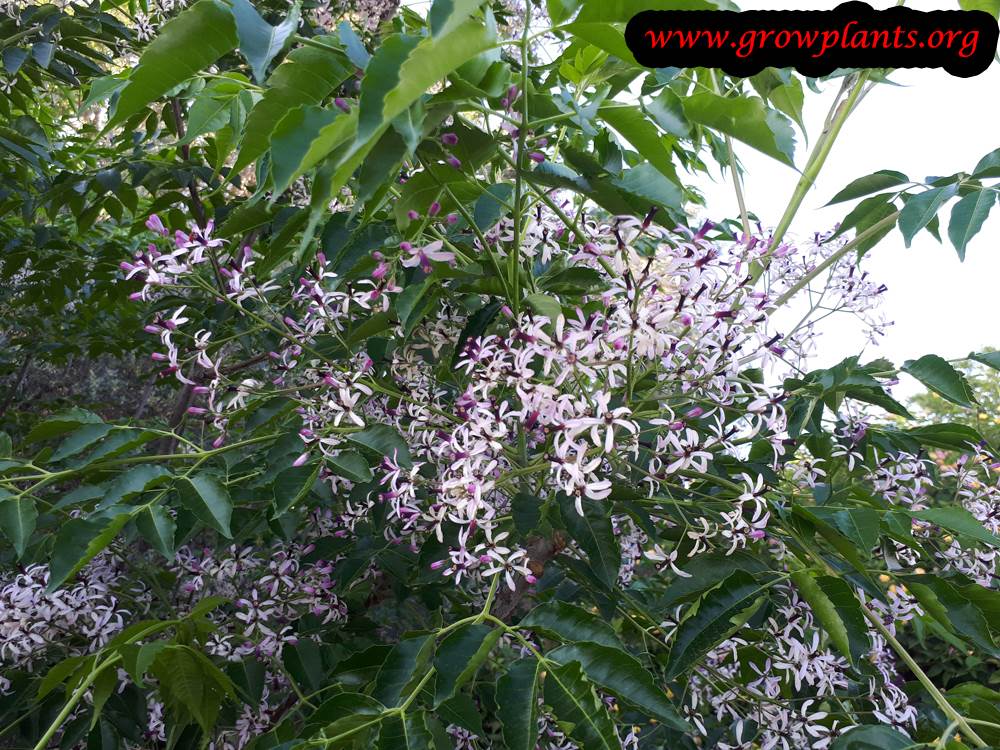
- Leaves & Foliage: Green, oval leaflets arranged in large, pinnate (fern-like) leaves.
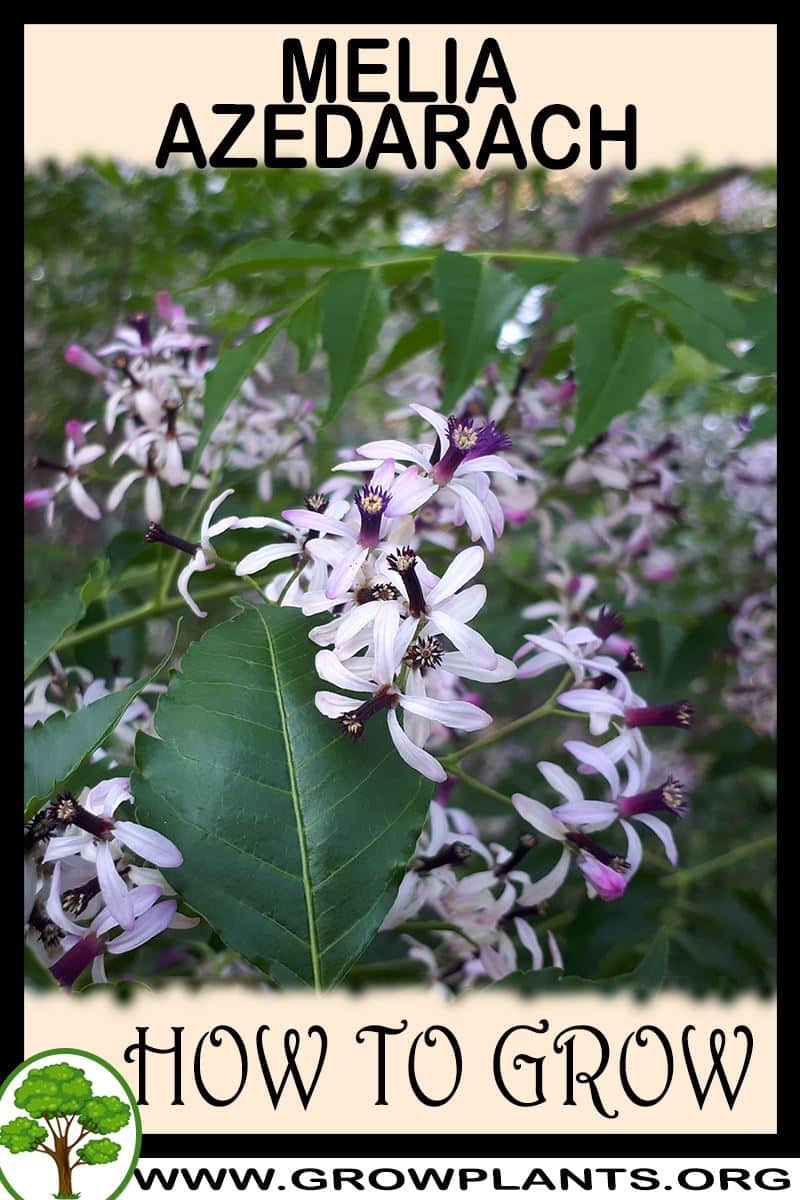
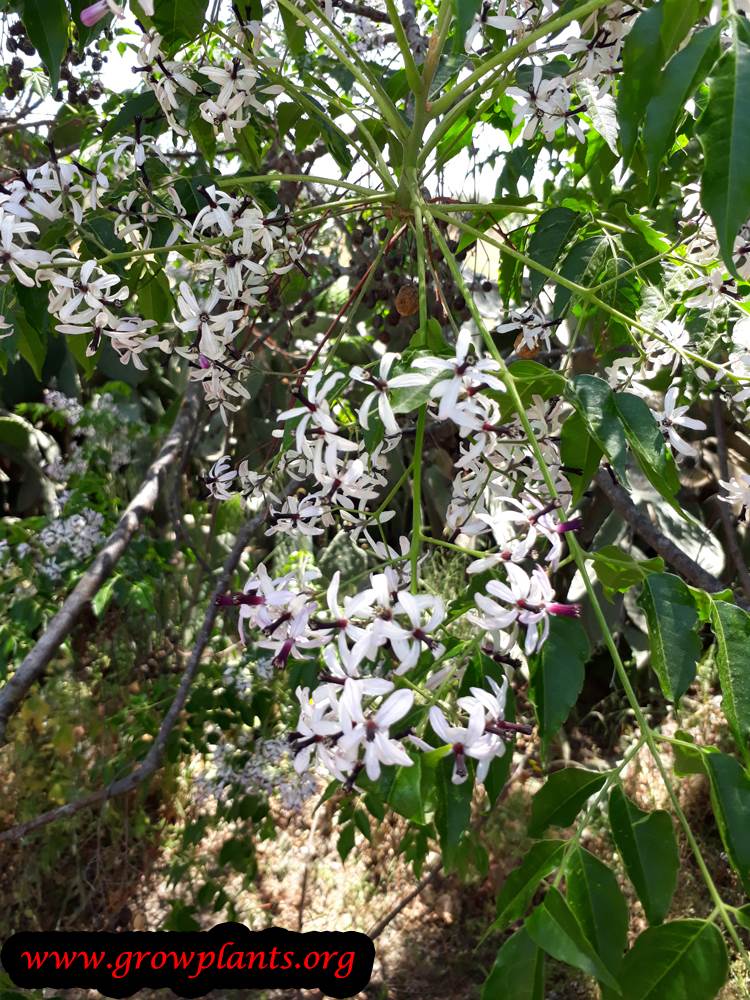
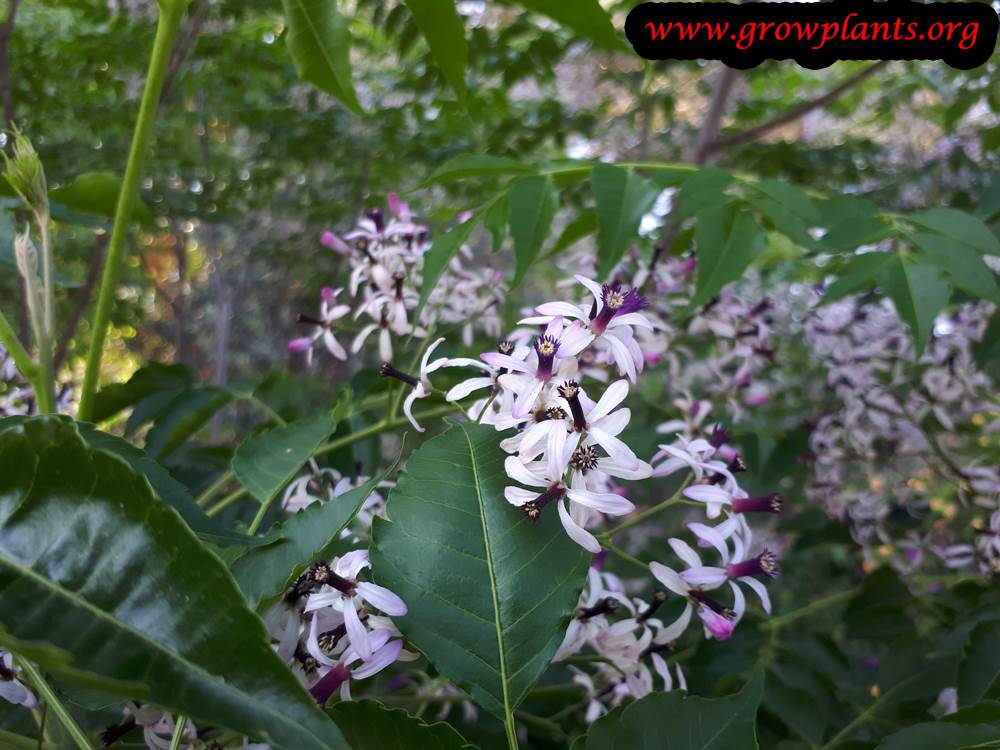
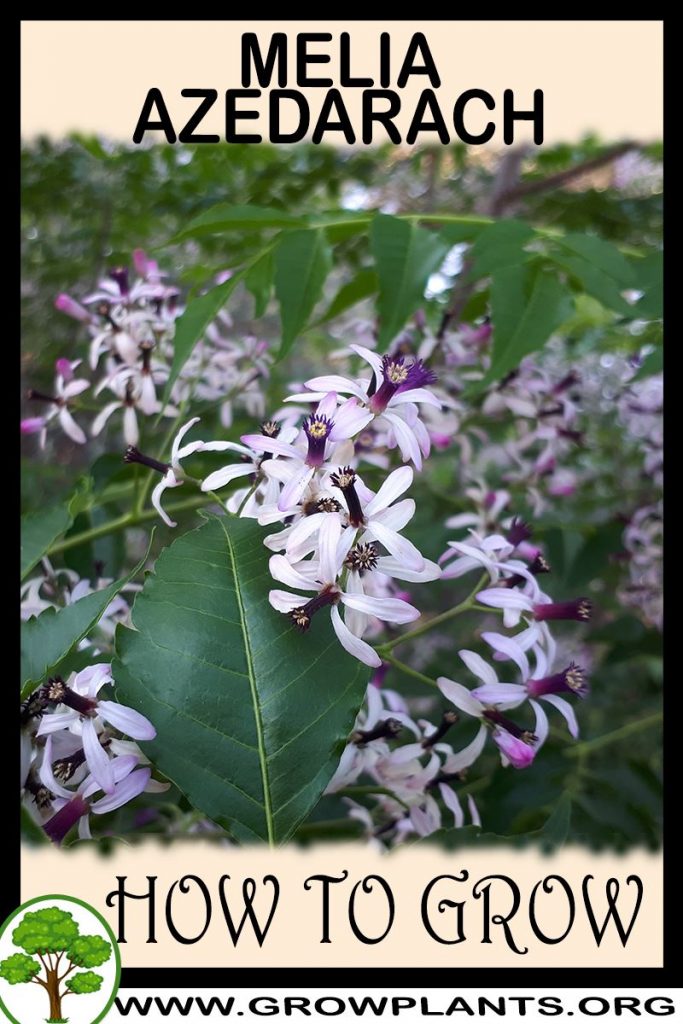
- Flower Characteristics: Fragrant white-to-purple, five-petalled star-shaped flowers with a darker central cone, attractive to pollinators. (See the Bloom accordion for detail.)
- Fruit Profile: Small yellow drupes that persist into winter — poisonous, and they drop and litter beneath the tree.
Primary Uses & Landscape Value
- Functional & Ornamental Roles: Shade tree, ornamental / street tree and bonsai; drought tolerant and attracts pollinators.
Note: Documented as an invasive species in parts of the southeastern and southwestern USA and in Hawaii, where it can outcompete native vegetation.
Care Guide: Planting, Soil & Watering
Overview: Chinaberry (Melia azedarach) is a fast- to medium-growing deciduous shade tree (zone 9b+) that grows in full sun to part shade and is notably drought tolerant. It adapts to most well-draining soils and takes anything from light to generous watering once established.
Quick Care Requirements
| Requirement | Ideal Condition |
|---|---|
| Planting Season | Year-round (in mild, frost-free conditions) |
| Growth Rate | Fast to Moderate |
| Soil Type | Adaptable, well-draining |
| Water Need | Low to High — adaptable, drought tolerant once established |
Planting & Establishment
- Best Planting Season: Can be planted year-round in mild, frost-free conditions.
- How to Plant:
- Hole Preparation: Dig a hole wider than the root ball in a sunny, open position with room for a spreading tree.
- Soil Amendments: Loosen the backfill and improve drainage; the tree is not fussy about soil.
- Planting Depth: Set the root ball at its original depth with the collar at soil level, firm gently and mulch.
- Growth Speed & Expectations: Fast to medium — reaches about 5–15 m (15–45 ft); it is best grown in the ground rather than a container.
Soil, Watering & Drainage Care
- Soil Mix & Drainage Needs: Adaptable to most soils as long as they drain freely, which prevents root rot.
- Watering Schedule & Technique:
- Young / Newly Planted: Water regularly at first to help roots establish.
- Established: Water lightly to generously as needed — the tree is very drought tolerant once settled.
- Seasonal Adjustments: More in hot, dry weather and much less in cool spells.
Climate, Light & Hardiness
Melia azedarach (Chinaberry) is a fast-growing, drought-tolerant deciduous shade tree suited to tropical, mediterranean, desert, and subtropical climates, hardy in USDA zone 9b and warmer. It grows well in full sun to half shade and tolerates a wide range of water availability.
Quick Climate Specifications
| Climate Zones | Tropical, mediterranean, desert, subtropical |
|---|---|
| USDA Hardiness Zones | 9b+ |
| Frost Tolerance | Low to Moderate |
| Light Conditions | Full sun to half shade |
Sunlight & Light Exposure
Optimal Light Setup
Full sun to half shade.
Direct Sun Requirement
Tolerates strong direct sun well.
Best Exposure / Orientation
An open, sunny site suited to its use as a shade tree.
Temperature Extremes & Hardiness
USDA Hardiness & Regional Limits
Hardy in zone 9b and warmer per the source data.
Cold Damage & Winter Protection
As a deciduous tree, it drops its leaves and goes dormant each autumn/winter (consistent with its autumn/winter pruning timing); the dormant tree is more cold tolerant than tender evergreens, though younger or less-established trees are more vulnerable to hard freezes.
Frost Sensitivity
Low to moderate; treat zone 9b as the practical cold limit for reliable outdoor growth.
Extreme Heat Tolerance
Strong, given its drought tolerance and suitability for desert and tropical climates.
Wind, Humidity & Microclimate
Dry-Air Tolerance
High, consistent with its drought tolerance.
Rainfall & Seasonal Moisture
Adapts to a wide range, from small to large amounts of water, once established.
Microclimate Recommendations
An open, sunny site; because it can self-seed aggressively (noted as invasive) and drop messy fruit, consider placement away from paved areas and where its spread can be managed.
Growing in Pots, Balconies & Indoors
Chinaberry is a fast-growing deciduous tree, so it is neither a houseplant nor a long-term container plant – the grower recommends against pots. A young tree can spend a season or two in a large container, but it soon needs open ground.
Quick Details
- Container Size: Not suited to long-term pots – a large tree for open ground
- Indoor Suitability: Not a houseplant; too large for indoor or lasting container culture
- Best Spot: Full sun to half shade in open ground
- Soil & Drainage: Aerated, organic-rich mix (peat or coir with perlite or vermiculite); must drain freely
- Watering in Pots: If grown young in a pot, water moderately and never let it waterlog
Indoors & On the Windowsill
- Not an indoor plant: This is a sizeable tree – far too large and vigorous for indoor life or a permanent pot.
- Safety: All parts, and especially the yellow berries, are poisonous to people and animals – never plant it where children or pets might eat the fruit, and wash hands after handling.
On a Balcony or Patio
- Only while young: A young tree can grow in a large tub for a year or two on a patio, but it quickly outgrows any container and needs planting out.
- Practicalities: A potted young tree is top-heavy and blows over easily – keep it staked and sheltered until it goes into the ground.
Choosing the Pot, Soil & Long-Term Care
- Pot & drainage (young trees only): The largest, heaviest tub you can, with strong drainage holes and no standing water.
- Potting mix: A robust, well-aerated loam-based mix that won’t collapse over a season.
- Feeding: Feed through the growing season while confined, as a potted tree exhausts its soil fast.
- Move on: Plant it into open ground before the roots fill the tub, or it will quickly become stressed and pot-bound.
Fertilizing & Feeding
A fast-to-medium growing, drought-tolerant flowering shade tree that generally needs only moderate feeding, with balanced nutrition doing more for its fragrant spring bloom than any high-phosphorus product.
Quick Fertilizing Specs
| Feeding Level | Moderate feeder |
|---|---|
| Main Nutrient Priority | Balanced, adequate nitrogen to support canopy growth and fragrant spring flowering |
| Best Feeding Period | Spring as new growth begins, continuing through the growing season |
| Organic Options | Compost or well-rotted organic matter worked into the root zone as mulch |
| Reduce/Stop Feeding | Ease off and then stop feeding as the tree goes dormant and drops its leaves |
| Soil pH | Adaptable to a wide range of soils; not a species with a narrow pH requirement |
Feeding by Growth Stage
Spring canopy growth
Support flush canopy growth and shoot extension as the tree leafs out after winter dormancy.
| Nutrient direction | A balanced, complete fertilizer with adequate nitrogen supports healthy new leaf and shoot growth. |
|---|---|
| Timing | In spring as new growth resumes. |
| Frequency | A single seasonal application as growth resumes is typically enough for an established tree of this vigor. |
| Fertilizer types | A balanced, complete tree and shrub fertilizer applied around the root zone, Compost or organic mulch refreshed at the drip line |
| Precautions | Keep fertilizer away from the trunk and apply out at the drip line where feeder roots are most active. |
Fragrant spring bloom
Support the fragrant star-shaped white-to-purple flower clusters that attract pollinators.
| Nutrient direction | Continued balanced feeding, rather than a high-phosphorus product, is what supports strong bloom in this species. |
|---|---|
| Timing | Through the spring flowering period. |
| Frequency | This established tree rarely needs additional feeding beyond its spring application just to support bloom. |
| Fertilizer types | A balanced, complete tree and shrub fertilizer if growth or bloom looks weak, No separate high-phosphorus bloom booster is needed |
| Precautions | Avoid over-fertilizing during bloom, which can push leafy growth at the expense of flowering and add to this tree’s tendency to produce messy fruit litter. |
Autumn leaf drop and winter dormancy
Let the tree enter dormancy and drop its leaves without pushing tender new growth into cold weather.
| Nutrient direction | None – withhold fertilizer once the tree begins dropping leaves for winter. |
|---|---|
| Timing | Autumn through winter dormancy. |
| Frequency | No feeding at this stage. |
| Fertilizer types | No feeding at this stage; do not fertilize until spring growth resumes. |
| Precautions | Fertilizing late in the season can push soft new growth that is vulnerable to cold damage. |
Nutrient Deficiency Signs & Corrections
Pale green, undersized leaves and reduced canopy vigor compared to this tree’s normally fast growth.
| Possible causes | insufficient nitrogen in the root zone, compacted soil limiting root growth and uptake, competition from turf or other plants over the root zone |
|---|---|
| Appears first on | older, interior leaves |
| What to check | overall canopy density and color compared to expected vigor, soil compaction around the root zone, competing vegetation over the roots |
| Possible correction | Apply a balanced tree fertilizer at the drip line and relieve soil compaction where present. |
Healthy canopy growth but a noticeably light or absent spring flower display.
| Possible causes | excess nitrogen pushing leafy growth over flowering, insufficient light reaching the canopy, stress from drought or root disturbance the previous season |
|---|---|
| Appears first on | overall bloom density rather than a single leaf symptom |
| What to check | recent fertilizing history and rates, light exposure to the canopy, any recent drought stress or root disturbance |
| Possible correction | Favor balanced, moderate feeding over heavy nitrogen and address any light or drought stress; high-phosphorus products are not needed to improve bloom. |
Yellowing between the veins of newer leaves while the veins themselves stay green.
| Possible causes | high soil pH limiting iron availability, waterlogged or compacted soil restricting root uptake, root stress from recent transplanting or construction disturbance |
|---|---|
| Appears first on | newest leaves at the shoot tips |
| What to check | soil pH in the root zone, drainage and compaction, recent disturbance to the root area |
| Possible correction | Correct soil pH and drainage where practical, and apply a chelated iron product per its label if chlorosis persists. |
Pruning, Training & Seasonal Maintenance
Chinaberry is a fast-to-medium growing deciduous shade tree reaching 5–15m that tolerates moderate-to-high structural pruning, best done while it is dormant and leafless in autumn/winter when the branch framework is easy to see and cuts heal before the spring flush. Its main pruning priorities are building a sound framework early (this species is documented as having weak, brittle wood and readily forms narrow, poorly attached crotches if left untrained), and ongoing control of the root suckering that contributes to its recognized invasive spread. Because it flowers in spring on new growth produced after winter dormancy, dormant-season pruning does not sacrifice bloom – it typically encourages a stronger flowering flush.
Quick Pruning & Maintenance Specs
| Pruning Tolerance | Moderate–High – vigorous, fast-recovering pioneer tree |
| Primary Pruning Window | Late autumn–winter, while dormant and leafless |
| Secondary Maintenance Window | Deadwood/storm-damage removal and root-sucker control, any season |
| Typical Frequency | Annual formative training for the first 3–5 years; light maintenance every 1–2 years once mature |
| Main Objective | Strong branch structure on an inherently weak-wooded species, plus size/spread and sucker control |
| Young Plant Priority | Select wide-angled scaffold branches early to avoid narrow, weak crotches |
| Mature Plant Priority | Remove included-bark unions, deadwood and root suckers before they become structural liabilities |
| Best Tool Type | Bypass secateurs / loppers / pruning saw by cut size; pole pruner for upper-canopy work |
| Avoid Heavy Pruning During | The spring growth flush, hot/dry summer stress, and wet weather (decay entry into brittle wood) |
Pruning by Plant Age & Size
Newly Established
Remove only damaged or crossing growth; avoid heading cuts, which on this fast grower quickly create weak, narrow-angled forks.
Young / Formative
Train to a modified-leader framework: select several well-spaced, wide-angled scaffold branches in the first few dormant seasons. This matters more than usual for Chinaberry because its rapid growth otherwise produces multiple co-dominant, narrow-crotched stems prone to splitting later.
Mature / Established
Shift to maintenance: remove deadwood, correct any developing included-bark unions, manage crown size/spread, and keep root suckers from establishing around the base.
Seasonal Pruning Schedule
Dormant/Winter
Main structural work: framework selection, thinning of crossing or weak branches, and any size-reduction cuts. Wounds close before the spring flush and before the flowering display, so this timing costs nothing in bloom.
Ongoing Sanitary
Remove deadwood or storm-broken limbs as they occur, and cut root suckers and trunk/base sprouts back to their point of origin as soon as they appear – this species resprouts readily from disturbed roots.
Flowering & Fruiting Wood
Melia azedarach flowers in spring on the current season’s new growth, produced after winter dormancy. Dormant pruning removes only last year’s wood, not flower buds, so it does not reduce the coming bloom – a strong new flush after pruning generally means more flowering shoots, not fewer. The tree also sets abundant fruit that the facts note as a litter nuisance; pruning cannot eliminate fruiting, but moderate crown thinning modestly reduces the fruit load reaching the ground under the canopy.
Structural Pruning & Training
- Branch/shoot selection: favour wide branch angles; this species’ fast growth otherwise produces narrow, weak unions.
- Crossing/rubbing growth: remove promptly – on brittle wood, rub wounds are a ready entry point for decay.
- Height & spread control: manage gradually over 2–3 seasons via thinning cuts rather than one severe reduction.
- Canopy density: moderate thinning reduces wind-sail loading on the brittle wood and eases the messy fruit drop.
Special Growth to Remove
- Root suckers – a genuine and recurring issue for this species; remove at the base as soon as seen to prevent thicket formation and further spread (the facts flag it as invasive).
- Watersprouts on trunk or scaffold limbs after any hard pruning – thin to a few well-placed shoots rather than leaving a dense cluster.
- Self-sown seedlings around the base, given its noted tendency to spread.
Tools
- Bypass secateurs – small twigs and sucker removal.
- Loppers – pencil-to-thumb-thickness formative branches.
- Pruning saw – larger scaffold limbs on maturing trees.
- Pole pruner – upper-canopy cuts on a tree that reaches 5–15m, without climbing for routine work.
Tool Hygiene & Disease Risk
Increased – because the wood is documented as weak/brittle, larger wounds are more vulnerable to decay fungi entering the cut, especially if made in wet weather. Use clean, sharp tools, favour dry dormant-season timing, and avoid leaving large cuts exposed heading into a wet spell.
Cut Placement & Technique
Favour thinning cuts (removing a branch to its point of origin) over heading cuts, which on this species tend to trigger weak watersprout regrowth. Cut just outside the branch collar – never flush, never a long stub. On larger limbs, stage the cut (undercut, then top cut) to prevent the brittle wood from tearing bark down the trunk.
Heavy Pruning & Rejuvenation
The tree resprouts vigorously even from hard cuts or stumps, but that vigour is a liability, not an asset: topping produces a dense mass of weakly attached watersprouts on already brittle wood, creating a future hazard. If significant size reduction is needed, spread it over several dormant seasons using thinning cuts rather than topping in one pass.
Post-Pruning Care
Monitor large wounds for decay or discoloration through the following season. Skip fertiliser after pruning – this is already a fast-growing species and added vigour worsens the watersprout problem. Expect and manage a flush of root-sucker regrowth after any heavy pruning or root disturbance.
Common Pruning Mistakes
- Topping the crown, which forces a thicket of weakly attached regrowth on an already brittle-wooded tree.
- Ignoring root suckers, allowing the tree’s documented invasive spread to continue.
- Heading cuts during formative training, creating narrow, split-prone crotches.
- Cutting only the trunk when trying to remove the tree, without addressing its ability to resprout from roots and stumps.
- Making large cuts right before wet weather, inviting decay into the brittle wood.
When Not to Prune
Avoid heavy cuts during the spring growth/flowering flush, during hot dry summer stress, and immediately before extended wet weather that favours decay entering fresh wounds.
Recommended Tools (by task)
- Small twigs and sucker removal – bypass_secateurs: clean, precise cuts for routine sanitation.
- Formative-training branches – loppers: enough leverage for pencil-to-thumb wood while keeping cuts clean.
- Scaffold limbs on a maturing tree – pruning_saw: needed once branches exceed lopper capacity.
- Upper-canopy work on a 5–15m tree – pole_pruner: reaches high growth without climbing for routine thinning cuts.
Pruning Troubleshooting
| Problem | Possible Cause | What to Check | Corrective Action |
| Repeated flush of suckers at the base | Root disturbance or heavy pruning triggering dormant buds | Base and surrounding root zone for new shoots | Remove promptly and repeatedly at the point of origin; avoid unnecessary root disturbance |
| Split or failing branch unions | Narrow, included-bark crotches from unmanaged fast growth | Bark texture at major forks for included bark | Remove or reduce the weaker of the two limbs while young; train wide angles from the start |
| Dieback or canker near a pruning cut | Decay fungi entering a wound on brittle wood, often after wet-season pruning | Cut edges for discoloration or sunken bark | Prune only in dry dormant weather; make clean collar cuts and avoid stubs |
| Dense brushy regrowth after size reduction | Topping/heading cuts triggering watersprouts instead of structural regrowth | Growth pattern at old large-diameter cuts | Thin sprout clusters to a few well-placed leaders; avoid topping in future reductions |
Propagation Guide
Melia azedarach grows very easily from seed – a major reason it self-seeds and naturalizes so readily in warm climates – and grafting is not needed to grow the straight species, as the site notes. Overall difficulty from seed is easy, though the hard stony seed coat can make germination slow and uneven.
Quick Propagation Specs
| Best Propagation Method | Seed |
| Alternative Methods | Hardwood cuttings; root suckers (with caution – see Suckers below) |
| Propagation Difficulty | Easy |
| Seed True-to-Type | Usually true-to-type for the species |
| Best Propagation Season | Spring, within the plant’s broader All-year planting window in warm climates |
| Seed Germination Time | Can be slow and uneven, often several weeks to a few months, due to the hard seed coat |
| Germination Temperature | Warm, roughly 21–30°C (70–86°F) |
| Seed Sowing Depth | About 2–3cm (0.8–1.2in) |
Growing from Seed
Seed Handling & Viability
Seed is enclosed in a hard, stone-like pit (the fruit’s endocarp) and stores reasonably well when kept cool and dry.
Dormancy & Pre-Sowing Treatment
The hard seed coat slows and staggers germination; scarifying the coat lightly or soaking seed for a day or two before sowing can help speed and even out sprouting.
Sowing Season
Sow in spring; the species can also be planted year-round in frost-free climates per the site’s All-year planting note.
Sowing Depth & Orientation
Sow about 2–3cm (0.8–1.2in) deep; no special orientation is needed.
Germination Conditions
Warm soil and full sun to half shade give the most reliable results.
Germination Time
Often slow and uneven – allow several weeks to a few months given the hard seed coat.
Seedling Care
Because this species self-seeds and spreads aggressively in warm climates (per the site’s Invasive note), avoid letting fallen fruit self-sow uncontrolled and remove unwanted volunteer seedlings promptly.
Grafting & Budding
Why Grafting Is Used
Not needed to grow the species itself, but distinct named ornamental forms such as the umbrella-shaped ‘Umbraculifera’ (Texas umbrella tree) are usually propagated vegetatively to preserve that specific growth habit, since seedlings do not reliably reproduce it.
Preferred Grafting Methods
Standard whip or budding techniques onto seedling Melia azedarach rootstock are typically used for such named forms.
Best Grafting Season
Spring, as growth resumes.
Division, Offsets, Pups & Suckers
Root suckers can arise from disturbed or damaged roots, reflecting this species’ vigorous, sometimes invasive habit. A sucker with its own attached roots can be dug and transplanted, but suckers without adequate roots of their own will not establish – and because of the plant’s invasive tendencies, propagating from volunteer suckers should be done deliberately, not left to spread on its own.
Bloom & Flower Guide
Quick Details
- Bloom Season: Spring
- Time to First Bloom: A tree that flowers once it reaches a few years of maturity
- Flower Appearance: Sprays of small, fragrant, star-shaped flowers, pale purple to white, each with a slender dark central tube
- Edibility: Not edible — Chinaberry is poisonous, so enjoy the flowers for their scent only
Detailed Blooming Overview
In spring the chinaberry tree covers itself in large, loose sprays of small lilac-and-white flowers, prized above all for their sweet fragrance. Each flower has five narrow petals around a slender deep-purple staminal tube, the cone-like centre the grower describes, and the scent draws in plenty of pollinators.
Flower Characteristics
- Five or six narrow, pale purple-to-white petals.
- A distinctive dark purple central tube, like a little cone.
- Borne in large, airy, sweetly scented clusters.
Bloom Care & Thinning
- Site for best flowering: Full sun; drought tolerant once established.
- Pollination: Insects drawn to the fragrance do the work.
- Safety: The plant is poisonous — the berries that follow are especially toxic to people and pets, so grow it for ornament and keep the fruit away from children and animals.
Pests, Diseases & Troubleshooting
Overview: Chinaberry is remarkably pest-resistant – it is a relative of neem and carries its own insecticidal compounds – so its real troubles are structural and environmental rather than insect-driven: brittle wood, invasive toxic fruit, and root or wood rots in old or waterlogged trees. Manage it by keeping the tree healthy and well structured and by controlling its prolific self-seeding.
Quick Troubleshooting Overview
| Issue / Pest | Main Symptom | Primary Solution |
|---|---|---|
| Scale / whitefly | Bumps or white flies, honeydew | Oil sprays, beneficials, ant control |
| Borers | Holes, frass, limb dieback | Keep tree vigorous, prune infested wood |
| Root / wood rot | Canopy dieback, basal fungus | Improve drainage, remove hazard limbs |
| Toxic messy fruit | Staining, poison risk to pets | Site away from paths, sweep fruit |
| Invasive seedlings | Volunteers everywhere | Pull young, deadhead flowers |
Common Pests & Management
- Scale Insects (Coccus / Parlatoria spp.):
- Symptoms: Brown or grey bumps on twigs, branch undersides and leaf ribs; sticky honeydew, sooty mould and slow decline of heavily encrusted limbs.
- Prevention & Control: Prune out badly infested wood; encourage parasitic wasps and lady beetles; spray horticultural oil to smother scale, targeting the crawler stage, on otherwise healthy trees.
- Whitefly (Family Aleyrodidae):
- Symptoms: Clouds of tiny white flying insects rising from disturbed foliage; yellow stippling and honeydew on lower leaves.
- Prevention & Control: Hang yellow sticky traps; hose down undersides; support Encarsia parasitic wasps and predatory beetles; oil or soap sprays to the leaf undersides for heavy pressure.
- Defoliating Caterpillars (various Lepidoptera):
- Symptoms: Chewed, notched or skeletonised leaves and sudden defoliation of branches, sometimes with webbing or frass below.
- Prevention & Control: Hand-pick and prune out nests; established trees tolerate and quickly refoliate; apply Bacillus thuringiensis (Bt) only during serious outbreaks.
- Aphids (Aphis spp.):
- Symptoms: Colonies on the soft new growth causing curling and honeydew; usually minor because the tree’s own compounds deter many insects.
- Prevention & Control: Blast off with water; support natural predators; soap or oil only if persistent.
- Ambrosia & Bark Borers (Scolytinae / Cerambycidae):
- Symptoms: Small entry holes, sawdust-like frass, oozing or dieback of limbs – almost always on trees already stressed by drought or waterlogging.
- Prevention & Control: Keep trees vigorous with sound watering and mulching; prune and burn infested wood; avoid wounding the trunk; there is no effective spray once borers are inside, so prevention through tree health is essential.
Diseases & Fungal Issues
- Armillaria / Root & Wood Rot (Armillaria, Ganoderma spp.):
- Symptoms: Progressive canopy thinning, dieback and white fungal fans or bracket fruiting bodies at the base; brittle, decaying wood and windthrow risk in old trees.
- Treatment & Management: Improve drainage and avoid root injury; remove dead and infected material; there is no cure, so manage by keeping trees healthy and removing hazardous specimens.
- Leaf Spot (Cercospora / Pseudocercospora spp.):
- Symptoms: Angular brown or purplish spots on the compound leaves, with yellowing and early leaf drop in wet seasons.
- Treatment & Management: Rake up and remove fallen leaves to break the cycle; improve airflow; usually cosmetic and rarely needs a copper fungicide.
- Sooty Mould:
- Symptoms: Black film over leaves following whitefly, scale or aphid honeydew.
- Treatment & Management: Control the sap-sucking insects and the mould clears on its own.
- Cotton / Texas Root Rot (Phymatotrichopsis omnivora):
- Symptoms: Sudden wilting and death in hot alkaline soils in affected regions, with a mat of tan fungal strands on the roots.
- Treatment & Management: Only a concern in certain arid alkaline regions; improve organic matter and drainage; avoid replanting susceptible trees on known infested ground.
Growing Difficulties & Abiotic Problems
- Toxic, Messy Fruit:
- Cause & Symptoms: Abundant yellow berries drop and stain paving, and are toxic to people, dogs and livestock if eaten (the source notes the fruit makes a mess).
- Correction Strategy: Site away from paths, patios and play areas; sweep up fallen fruit; consider that birds spread the seed widely.
- Invasive Seedlings:
- Cause & Symptoms: Volunteer seedlings pop up prolifically from bird-sown seed; the tree is a declared weed in many warm regions (the source flags it as invasive).
- Correction Strategy: Remove seedlings while small; deadhead or prune flowering wood where legal spread is a concern; do not plant near natural bushland.
- Brittle Wood & Limb Drop:
- Cause & Symptoms: Fast, soft growth produces weak branch unions that split or drop in storms, especially on topped trees.
- Correction Strategy: Prune for good structure when young; remove crossing and weak limbs; avoid heavy topping that forces brittle regrowth.
- Chlorosis:
- Cause & Symptoms: Yellowing between veins on young leaves in very alkaline or compacted soils.
- Correction Strategy: Improve soil organic matter and drainage; apply chelated iron where needed.
What Helps – Products & Tools
Because the tree is naturally deterrent, chemical needs are minimal: horticultural / neem oil for scale and whitefly, Bacillus thuringiensis (Bt) for caterpillar flare-ups, yellow sticky traps for whitefly, and good cultural care (drainage, structural pruning, fruit clean-up) for everything else.