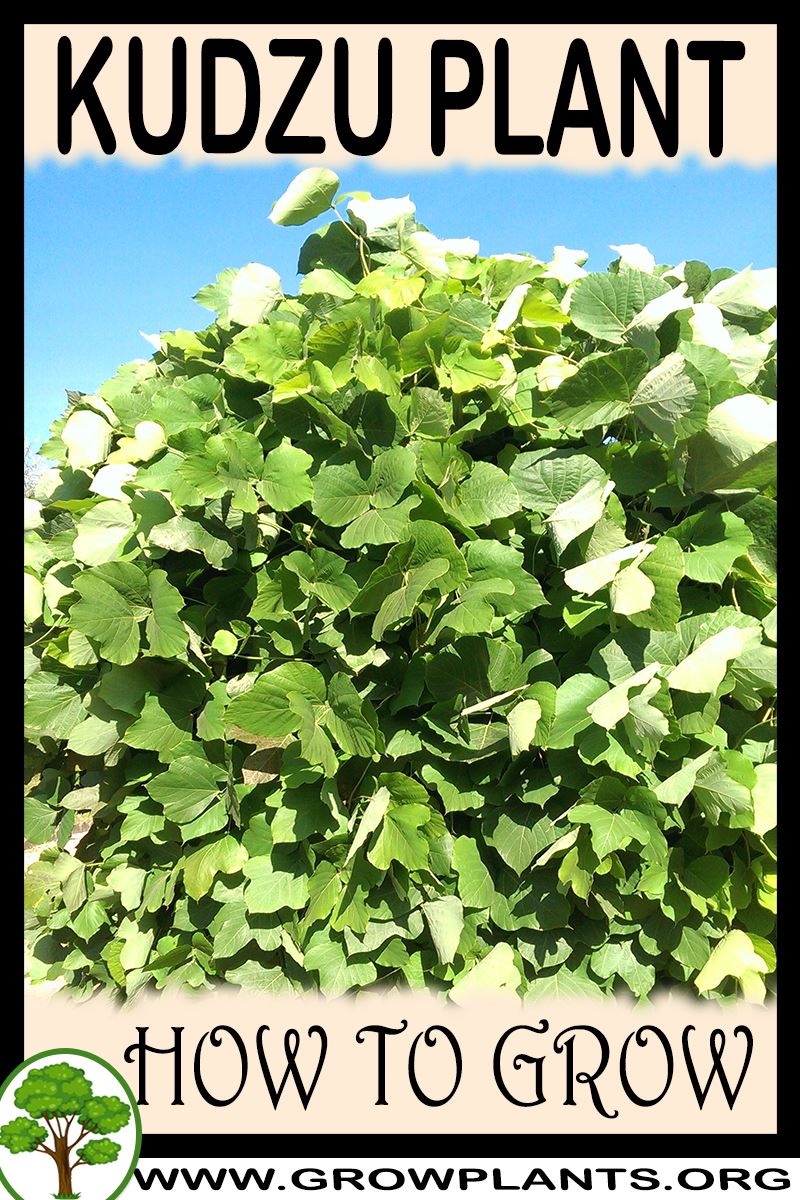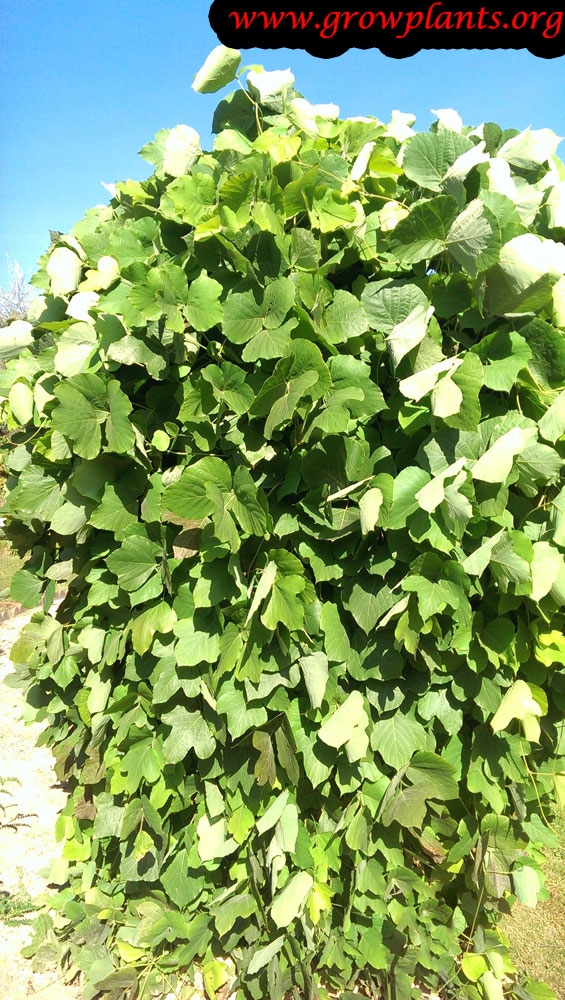

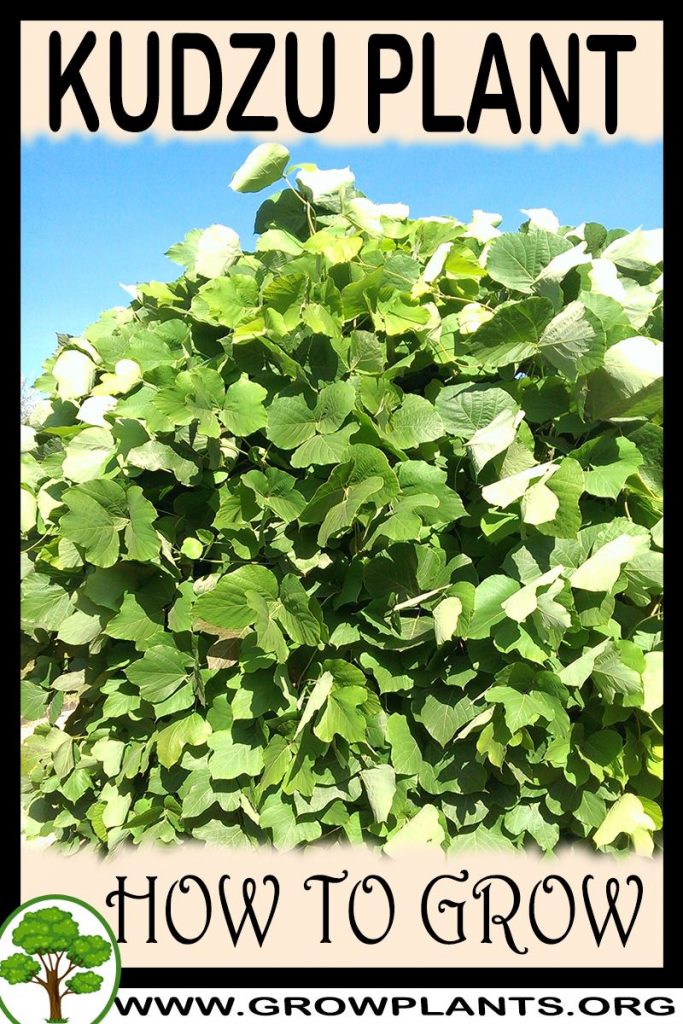
Plant Profile & Key Characteristics
Overview: An extremely vigorous climbing legume reaching 5-25 m (15-75 ft), perennial and semi-evergreen in warm climates but dying back in cold winters. It has edible leaves and a large edible starchy tuber, is used medicinally and fixes nitrogen, but is notoriously invasive.
Quick Specifications
| Specification | Attribute |
|---|---|
| Plant Type / Life Cycle | Herbaceous to semi-woody perennial vine (or annual in cold climates) |
| Foliage Type | Evergreen in warm climates; deciduous / dies back where winters are cold |
| Mature Size | 5-25 m (15-75 ft) |
| Growth Rate | Fast (famously rampant) |
| Root System | Massive starchy tuberous taproot with nitrogen-fixing root nodules |
| Toxicity | Non-toxic / edible (leaves and root are eaten) |
| Hardiness | USDA zones 5-11 |
Growth Form & Structure
- Height & Spread: A rampant vine climbing and sprawling 5-25 m (15-75 ft); needs strong trellising and can be grown in a container, though it must be kept firmly in check.
- Growth Habit & Form: An aggressive, fast-twining herbaceous-to-semi-woody vine that smothers supports and, as a legume, fixes nitrogen in the soil.
- Lifespan & Maturity: A long-lived perennial anchored by a large tuberous root; reaches full vigour quickly and regrows strongly each season.
Anatomy & Physical Features
- Leaves & Foliage: Edible green leaves in a deltoid (triangular) shape, sometimes with 1-3 lobes.
- Flower Characteristics: Purple pea-like flowers borne on upright spikes and pollinated by bees.
Primary Uses & Landscape Value
- Edible Uses: Young leaves cooked as greens; the large white-fleshed, brown-skinned tuber cooked or used to make starch (kudzu/kuzu) and desserts.
- Functional & Ornamental Roles: Grown as an ornamental screen, for medicinal use and as a nitrogen-fixing cover; can be containerised but is not an indoor plant and must be contained because of its invasive nature.
Care Guide: Planting, Soil & Watering
Overview: Kudzu (Pueraria montana) is an extremely fast-growing, nitrogen-fixing legume vine for temperate to subtropical climates (hardiness zone 5-11), grown for its edible leaves and starchy tuber. It wants full sun and a strong trellis, tolerates a wide range of soils, and grows best with regular to plentiful water – but it is notoriously aggressive and invasive, so site it with great care.
Quick Care Requirements
| Requirement | Ideal Condition |
|---|---|
| Planting Season | In the warm season, spring through autumn |
| Growth Rate | Fast (extremely vigorous) |
| Soil Type | Adaptable; well-draining, tolerates poor soils |
| Water Need | Moderate to high |
Planting & Establishment
- Best Planting Season: Plant in the warm season, from spring through autumn, when warmth drives rapid establishment – but only where you can fully contain it, as it spreads aggressively.
- How to Plant:
- Hole Preparation: Set the plant at the base of a very sturdy trellis or fence, loosening a hole a little larger than the root ball; the deep tuber needs loose soil to develop.
- Soil Amendments: As a nitrogen-fixing legume it thrives even in poor soil and needs little feeding; a little compost helps establishment, but avoid pampering an already vigorous plant.
- Planting Depth: Set the crown at the level it was growing and firm in; do not bury the stem.
- Growth Speed & Expectations: Explosively fast, climbing 5-25 m and needing frequent, hard pruning to stay in bounds; thinning the flowers also helps limit its spread.
Soil, Watering & Drainage Care
- Soil Mix & Drainage Needs: Almost any well-draining soil suits it; it is best confined to a large container or a strictly controlled bed to curb its spread, with drainage holes to keep the roots healthy.
- Watering Schedule & Technique:
- Young / Newly Planted: Water regularly to establish the young plant, keeping the soil moist but not waterlogged.
- Established: Water moderately to generously in the growing season; once established it is tough and adaptable but grows fastest with steady moisture.
- Seasonal Adjustments: Give more in summer heat and less in winter, as top growth dies back in colder zones and regrows from the crown.
Climate, Light & Hardiness
Kudzu is an extremely vigorous legume vine for temperate, subtropical and Mediterranean climates, growing in full sun. The dataset gives roughly zones 5–11: the top growth is frost-tender, but the crown and roots are cold-hardy, so plants die back in winter and regrow from the base.
Quick Climate Specifications
| Climate Zones | Temperate, subtropical, Mediterranean |
|---|---|
| USDA Hardiness Zones | Approximately 5–11 (per dataset) |
| Optimal Temp Range | Approximately 20–30 °C / 68–86 °F |
| Cold Damage Begins | Foliage killed by frost near 0 °C / 32 °F |
| Approx. Survival Minimum | Crown and roots survive hard winter cold within the zone range and resprout in spring |
| Frost Tolerance | Foliage Very Low; crown Moderate–High |
| Light Conditions | Full sun |
| Wind Tolerance | Moderate |
Sunlight & Light Exposure
Optimal Light Setup
Full sun drives its notoriously fast growth; the vine needs strong support and firm control.
Temperature Extremes & Hardiness
USDA Hardiness & Regional Limits
Across zones 5–11 the plant behaves as a root-hardy perennial: warm-season top growth is frost-killed each winter, then the hardy crown resprouts. In warm-winter zones growth can be near year-round, which magnifies its aggressive, potentially invasive spread.
Cold Damage & Frost Sensitivity
Frost blackens the foliage but does not kill established crowns; a longer, warmer season simply means more rampant growth.
Extreme Heat Tolerance
It thrives in prolonged summer heat.
Wind, Humidity & Microclimate
Humidity Preferences
Adapted to warm, humid conditions but tolerant of a wide range given warmth.
Microclimate Recommendations
Any warm, sunny site will do - the practical limit is containment, not climate, wherever winters stay mild.
Growing in Pots, Balconies & Indoors
Kudzu is an enormously vigorous climber. A pot can technically hold a young plant and helps contain its running roots, but it quickly outgrows any container and is far too large and aggressive to be a houseplant.
Quick Details
- Container Size: A large, deep pot, 40 L (10 gal) or more, mainly to contain its roots
- Indoor Suitability: Not an indoor plant; an extremely vigorous climber, too large and fast for any room
- Best Spot: Full sun – the sunniest spot available
- Soil & Drainage: Aerated, organic-rich mix – peat or coir with perlite or vermiculite; must drain freely
- Watering in Pots: Keep the mix consistently moist in the growing season; it is a thirsty, fast grower
Indoors & On the Windowsill
- Houseplant limits: Not a houseplant – it is one of the fastest, largest climbers there is, impossible to contain indoors.
- Contain it: If grown at all, a pot helps keep its running roots from escaping – never let it root into the ground where it can become invasive.
On a Balcony or Patio
- Light, heat & wind: Give it the sunniest spot you can. Walls, railings and paving reflect heat, so pots dry quickly – check moisture daily in warm weather, and shelter tall growth from wind. A drip irrigation kit with a timer can take over that watering check automatically.
- Support: On a balcony or patio give it a trellis, netting or a cane wigwam to climb; mind the weight of large filled pots and where drainage water runs off shared balconies.
Choosing the Pot, Soil & Long-Term Care
- Pot & drainage: A large pot (40 L or more) with strong drainage holes; skip a standing water saucer to avoid root rot. Terracotta breathes and dries fast; glazed or plastic holds moisture longer.
- Potting mix: Use a well-aerated, organic-rich mix – peat or coir blended with perlite or vermiculite for free drainage.
- Feeding: Potted plants lose nutrients as watering leaches them from the mix, so feed more often than in open ground – a balanced liquid feed through the growing season.
- Manage its vigour: Cut back hard and often; even in a pot it needs constant control, and spent material should be bagged, not composted where it can regrow.
Growing this plant in a greenhouse
A greenhouse can give kudzu frost protection, cold protection, humidity control and extra warmth.
Greenhouse at a glance
| Greenhouse suitability | Conditional - depends on your climate |
|---|---|
| Main benefits | frost protection, cold protection, humidity control, extra warmth |
| Season extension | earlier spring & later autumn |
| Outdoor protection advisable below | about 10°C |
| Maintain greenhouse minimum | around 15°C for active growth |
| Suitable types | heated greenhouse, polycarbonate greenhouse, lean-to |
| Heating | Heating is recommended in cold climates for continuous growth. |
Related greenhouse guides
- Greenhouses: How to Choose the Right Greenhouse
- Best Greenhouse Heaters
- Greenhouse Climate Control: Temperature, Ventilation and Humidity
- Best Lean-To Greenhouses
Fertilizing & Feeding
This is a light feeder: as a legume it fixes much of its own nitrogen, so rely on soil organic matter and only a light balanced feed, leaning on potassium as pods fill.
Quick Fertilizing Specs
| Feeding Level | Light – a legume that fixes much of its own nitrogen. |
|---|---|
| young_feeding | A modest balanced feed as seedlings establish. |
| mature_feeding | Light feeding that leans on potassium as pods fill. |
| Main Nutrient Priority | Balanced nutrition with restrained nitrogen; potassium at pod fill. |
| Best Feeding Period | Through the active growing season. |
| Organic Options | Compost or well-rotted organic matter worked into the bed. |
| Soil pH | Near neutral to slightly acidic suits most legumes. |
| Reduce/Stop Feeding | Ease off as the crop matures and pods dry. |
| Micronutrients | Rarely needed; correct only if a deficiency shows. |
Feeding by Growth Stage
Establishment
Settle young plants and encourage rooting and early climbing.
| Nutrient direction | A modest balanced complete fertilizer; lean on organic matter rather than heavy feeding. |
|---|---|
| Timing | As young plants establish and start to climb. |
| Frequency | A light feeding while the plant establishes. |
| Fertilizer types | Balanced complete fertilizer, Compost or well-rotted organic matter |
| Precautions | Avoid strong feeding on young plants; water it in well. |
Climbing vegetative growth
Support keeping this vigorous vine in check without forcing soft, over-lush growth.
| Nutrient direction | Go easy on nitrogen – this legume fixes much of its own; a restrained balanced feed is plenty. |
|---|---|
| Timing | Through the main climbing and leafy growth phase. |
| Frequency | Little and only occasional; on decent soil this vigorous vine rarely needs feeding at all. |
| Fertilizer types | Balanced complete fertilizer, nitrogen kept modest |
| Precautions | Excess nitrogen drives rampant foliage over flowers and pods. This vine is aggressive, so avoid rich feeding that only fuels rampant growth. |
Flowering and pod set
Support flowering and pod or seed development.
| Nutrient direction | Lean toward potassium as flowers and pods form; keep nitrogen modest. |
|---|---|
| Timing | From flowering through pod and seed development. |
| Frequency | Light feeding that favors potassium as pods form. |
| Fertilizer types | Balanced fertilizer supplying adequate potassium |
| Precautions | Steady moisture and modest feeding during pod fill; avoid a late nitrogen push. |
Nutrient Deficiency Signs & Corrections
Overall pale, yellow-green foliage and weak growth even on reasonable soil.
| Possible causes | Poor rhizobial nodulation, so little nitrogen is being fixed, Cold or waterlogged soil suppressing root and nodule activity, Genuinely low soil nitrogen on very poor ground |
|---|---|
| Appears first on | Older, lower leaves first. |
| What to check | Dig a root and look for pink, active nodules, Soil drainage and temperature, Whether the seed or bed carried the right legume inoculant |
| Possible correction | Ensure the right rhizobia are present, improve drainage and warmth, and give only a modest balanced feed if the ground is truly poor. |
Yellowing between the veins of the youngest leaves while the veins stay green.
| Possible causes | High or alkaline soil pH locking up iron and manganese, Waterlogged or cold roots reducing micronutrient uptake, Occasionally low available iron or manganese in the soil |
|---|---|
| Appears first on | New growth at the shoot tips. |
| What to check | Soil pH, Drainage and watering habits, Whether symptoms follow cool, wet spells |
| Possible correction | Correct soil pH toward the plant’s preferred range, improve drainage, and if it persists apply a chelated iron or manganese product per its label. |
Scorched leaf edges, wilting, or white crusting on the soil despite adequate water.
| Possible causes | Over-application of fertilizer, Poor leaching in containers or heavy soil, Letting the root zone dry out between heavy feeds |
|---|---|
| Appears first on | Leaf margins and tips; container plants first. |
| What to check | Recent fertilizer amounts, Drainage, Soil crusting or white surface residue |
| Possible correction | Ease off feeding, water thoroughly to flush excess salts from the root zone, then feed only lightly. |
Pruning, Training & Seasonal Maintenance
Kudzu is a notoriously invasive, extremely vigorous semi-woody vine (5–25 m in a season) where “pruning” really means containment: hard, repeated cutting back to stop it smothering everything around it, severing the runners that root wherever they touch the ground, and removing flowers before they set seed. It tolerates and quickly recovers from hard cutting because it regrows from a massive root crown, which is exactly why constant control is essential. Before planting it at all, check local regulations — it is a banned or listed invasive in many regions.
Pruning & the Edible Harvest
Kudzu’s root (a starch source), young leaves, shoots and flowers are all edible, but it is a highly invasive, often legally-restricted weed — check local rules before growing it. Repeated hard cutting drives fresh young edible leaves and shoots, a renewal effect, whereas the starchy root is harvested by digging rather than pruning; the flower spikes are edible too, but are cut off to stop seeding, so containment and the flower crop conflict.
Quick Pruning & Maintenance Specs
| Pruning Tolerance | Very high — regrows aggressively from the root crown |
| Primary Pruning Window | Repeatedly through the growing season |
| Typical Frequency | Frequent and ongoing to keep it in bounds |
| Main Objective | Contain spread; sever rooting runners; prevent seeding |
| Young Plant Priority | Restrict to its support from the start |
| Mature Plant Priority | Cut back hard; remove runners and flower spikes |
| Best Tool Type | Bypass secateurs to loppers; saw on old basal stems |
Pruning by Plant Age & Size
Newly Established
Confine it immediately to a strong support and a defined area; do not let leaders reach the ground, where they root and start new crowns. Containment discipline from day one is the whole game.
Young / Formative
There is no ornamental framework to build — “training” is purely restriction. Head back leaders constantly to keep the vine within bounds and off neighbouring plants and structures.
Mature / Established
Cut back hard and often. Trace and sever any runners that have rooted at their nodes, and dig out those root crowns, or the plant simply advances. Remove flower spikes to stop seed spread.
Seasonal Pruning Schedule
Summer Canopy Management
Objective: keep the rampant vine contained. Remove: all escaping leaders and any runners touching soil. Do NOT remove: nothing is off-limits — err on the side of cutting more. Expected response: fast regrowth, so repeat often. Impact on spread: the more thoroughly and frequently you cut, the more you exhaust the root reserves.
Ongoing Sanitary & Seed Control
Objective: prevent reproduction and rooting. Remove: flower spikes before they set seed, and pods; runners rooting at nodes. Do NOT remove: (not applicable — containment is the priority). Impact: deflowering plus cutting rooting nodes is the key to limiting spread.
Structural Pruning & Training
Control is by hard heading and by severing ground contact, not by canopy design. Repeatedly shorten leaders to the support line and cut every stem that reaches soil, because each rooted node becomes an independent plant.
Special Growth to Remove
Runners (stolons) are the plant’s main means of conquest: cut them and dig out the crowns they form. Remove flower spikes to prevent seeding. The edible root and young leaves can be harvested, but harvesting does not substitute for disciplined containment.
Container & Small-Space Pruning
A large, isolated container with no soil contact for the runners is the safest way to grow kudzu, and even then it must be cut back hard and often. Never site it where leaders can reach open ground.
Tools
Bypass secateurs and loppers for the mass of green and semi-woody stems; a pruning saw for the thick, older basal stems. A spade is essential for digging out rooted crowns. Hedge shears can speed bulk cutting of soft growth but do not address the rooting runners.
Tool Hygiene & Disease Risk
Routine for disease: no major tool-borne pathogen. The real hygiene concern is spread — clean cut stems and severed runners off the site and dispose of them so they cannot re-root; do not compost live material.
Cut Placement & Technique
Cut leaders back well within the intended area, and sever runners right at the point they enter the soil, then lift the rooted node. On thick basal stems cut low and cleanly. There is no need to protect buds — the aim is suppression, not shaping.
Heavy Pruning & Rejuvenation
Fully tolerated — and that is the problem: cutting the entire top back to the crown does not kill it; it regrows vigorously from the root. Repeated hard cutting over seasons is used to exhaust the roots, ideally combined with removing the crown, rather than to rejuvenate the plant.
Post-Pruning Care
No aftercare encourages this vine — the intent is the opposite. Do not feed or water to boost regrowth. Instead, monitor constantly and re-cut as it rebounds; withholding help and repeatedly removing top growth is what weakens it.
Common Pruning Mistakes
- Letting leaders touch the ground and root, creating new independent crowns.
- Leaving flower spikes to set seed and spread further.
- Cutting the top once and assuming it is dealt with — it regrows from the root.
- Composting live prunings and runners, which simply re-establish.
When NOT to Prune
There is essentially no time to hold back with kudzu — the caution is the reverse: never leave it uncut long enough to escape or seed. Avoid planting it where it cannot be strictly contained in the first place.
Recommended Tools (by task)
- loppers — for cutting back the mass of vigorous semi-woody leaders.
- pruning_saw — for the thick older basal stems.
- garden_spade — for digging out rooted runner crowns, without which the vine returns.
Pruning Troubleshooting
| Problem | Possible Cause | What to Check | Corrective Action |
| New plants appearing away from the base | Runners rooting at nodes | Stems in contact with soil | Sever at the soil and dig out each rooted crown |
| Vine keeps returning after cutting | Regrowth from the root crown | Whether the crown was removed | Cut repeatedly to exhaust roots; excavate the crown |
| Spread to new areas by seed | Flower spikes left to set seed | Presence of flowers/pods | Remove flower spikes before seed set |
Propagation Guide
Kudzu roots so freely from its crowns, rooted stem nodes and cuttings that vegetative pieces are the quickest way to start it, while seed has a hard coat and needs scarifying. It is highly invasive and legally restricted in many regions, so propagate only where permitted and keep it strictly contained.
Quick Propagation Specs
| Best Propagation Method | Division of rooted crowns / stem nodes (or cuttings) |
| Alternative Methods | Seed, scarified |
| Propagation Difficulty | Easy — often too easy |
| Seed True-to-Type | Variable |
| Vegetative True-to-Type | Yes |
| Best Propagation Season | Warm season for cuttings/division; spring for seed |
| Germination Temperature | Warm, roughly 20–30°C (68–86°F) |
Growing from Seed
Dormancy & Pre-Sowing Treatment
The hard seed coat needs scarifying or soaking before it germinates; this is not the usual route, since vegetative pieces are so easy.
Stem Cuttings & Layering
Stems root at the nodes wherever they touch soil — a natural layering. Rooted nodes and stem cuttings establish readily in warm, moist conditions.
Division, Offsets, Pups & Suckers
The large root crown can be lifted and divided; each crown section carrying a bud regrows vigorously. Given the plant’s invasiveness, dispose of surplus material responsibly rather than composting or dumping it.
Bloom & Edible Flower Guide
Quick Details
- Bloom Season: Spring and summer
- Time to First Bloom: Established vines usually flower once well settled, often after a season or two
- Flower Appearance: Purple pea flowers packed onto upright spikes, carrying a distinct grape-like scent
- Edibility: Edible, the fragrant flowers are used to make jelly and syrup
Detailed Blooming Overview
For all its reputation as a runaway grower, kudzu earns a place here for its flowers, which rise in purple spikes with a surprising scent of grape. They are a genuine edible flower, most often turned into a rosy jelly or syrup, and they draw bees while they last. The same vigour that makes the vine flower so freely is why keeping it in check matters.
Flower Characteristics
- Purple pea flowers held on upright spikes.
- Sweetly grape-scented.
- Edible and popular for jelly and syrup.
Bloom Care & Thinning
- Pollination: Worked by bees.
- Thinning the bloom: To keep the plant from becoming invasive, thin the blossom and cut back spent flower spikes before they set seed.
- Containment: This is a vigorous, in many regions invasive, vine; grow it only where you can manage its spread, and remove flowers to limit self-seeding.
Fruit & Uses
Kudzu is edible: the young leaves are cooked as a green, and the large starchy root (tuber) is used cooked — it is the source of kudzu starch. The purple flowers are also traditionally eaten.
Quick Edible Specs
| Edible Parts | Young leaves; root / tuber; flowers (traditional) |
|---|---|
| Main Use(s) | Leaves cooked as a vegetable; root cooked and processed for starch; flowers made into jelly/relish |
| Eaten Raw or Cooked | Cooked |
| Preparation Required | Cook the leaves; peel and cook or process the root |
| Harvest Season | Leaves year-round; root lifted in autumn to winter |
| Safety/Toxicity Caveat | Take young leaves and eat all parts cooked |
Leaves & Greens
The green, deltoid (sometimes 1–3-lobed) young leaves are harvested year-round and cooked. Once the plant is established you can trim freely and take the young leaves.
Roots & Tubers
The white, brown-skinned, lobed root is lifted in autumn to winter. It is cooked, and is the classic source of kudzu starch used, for example, in set desserts.
Flowers & Flower Buds
The purple flowers, borne on spikes, are also traditionally eaten, for example made into a jelly.
Preparation, Uses & Safety
Cook the young leaves, and peel and cook or process the root for its starch. Kudzu is also used in traditional medicine; no health claims are made.
Pests, Diseases & Troubleshooting
Kudzu is an extraordinarily vigorous legume vine that is itself an invasive weed, so its real management challenge is controlling the plant rather than protecting it — its worst ‘problem’ is uncontrolled growth smothering everything around it. It hosts a set of legume pests (notably the kudzu bug, plus defoliating beetles and caterpillars and aphids) and is an important reservoir of soybean rust, which matters to nearby crops. Manage it with containment and, where wanted as a crop/forage, with standard legume sanitation and beneficials.
Quick Troubleshooting Overview
| Issue / Pest | Main Symptom | Primary Solution |
|---|---|---|
| Uncontrolled vigour (the main issue) | Vines smothering shrubs, trees and structures; rampant spread | Cut/mow repeatedly, dig crowns, contain roots; graze; only then herbicide |
| Kudzu bug | Clusters of olive-green bugs on vines; sap loss, odor when crushed | Tolerate on kudzu; on nearby crops use monitoring/soap/beneficials |
| Defoliating beetles & caterpillars | Skeletonised/holed leaves | Encourage predators/birds; Bt for caterpillars if protecting a planting |
| Aphids | Sticky curled shoots; sooty mould; virus | Beneficials, water jet, soap if needed |
| Soybean rust | Tan-brown pustules on leaf undersides | Matters for nearby soybean; sanitation, remove reservoir kudzu |
| Root/crown rot | Wilting, rotted crown in waterlogged ground | Improve drainage; rarely limiting on this tough plant |
Common Pests & Management
- Kudzu bug (Megacopta cribraria):
- Symptoms: Olive-green, squarish stink-bug relative that clusters in large numbers on kudzu stems and leaf axils, sucking sap; it is strongly associated with kudzu (and soybean), emits an unpleasant odour when disturbed, and can stain skin. On kudzu it does little lasting harm, but it readily moves onto soybean and can be a household nuisance.
- Prevention & Control: On kudzu itself no control is needed or wanted. Where it invades nearby soybean or homes, monitor with sweep nets, conserve the egg parasitoid Paratelenomus and predators, and use insecticidal soap or targeted sprays on crops only. Sealing homes excludes overwintering adults.
- Japanese beetle & other leaf beetles (Popillia japonica; Chrysomelidae):
- Symptoms: Metallic beetles that skeletonise leaves, chewing tissue between the veins and leaving a lacy appearance; kudzu is a favoured host and can support large populations that then damage nearby ornamentals and crops.
- Prevention & Control: Hand-pick or knock beetles into soapy water in the morning on plantings you value, use pheromone traps well away from the plants you protect (traps can attract more), and treat larvae (grubs) in turf with beneficial nematodes or milky spore. On kudzu itself, defoliation is not a concern.
- Aphids (Aphis glycines / Aphis craccivora):
- Symptoms: Colonies of small insects on shoots and leaf undersides sucking sap, curling growth and leaving honeydew and sooty mould; important mainly because kudzu can act as a green bridge and virus/aphid reservoir for legume crops.
- Prevention & Control: Encourage ladybirds, lacewings and parasitic wasps, which usually keep them in check outdoors. Control is only warranted when protecting a nearby crop, using insecticidal soap or oil; removing reservoir kudzu reduces crop pressure.
- Caterpillars (loopers & armyworms) (Chrysodeixis includens / Anticarsia gemmatalis):
- Symptoms: Soybean looper and velvetbean caterpillar and similar larvae chew and skeletonise foliage; kudzu is a host that can build populations moving into soybean fields.
- Prevention & Control: Encourage birds, parasitic wasps and predatory bugs; a Bacillus thuringiensis (Bt) spray controls young larvae where you are protecting a planting. On kudzu grown as forage, tolerate light defoliation.
- Spider mites (Tetranychus urticae):
- Symptoms: In hot, dry conditions mites stipple and bronze the foliage and spin fine webbing, weakening leaves; more noticeable on stressed or dusty plants and can spread to neighbouring crops.
- Prevention & Control: Reduce dust and drought stress, encourage predatory mites, and rinse foliage where practical. Miticidal oil is only justified when protecting a valued adjacent planting.
Diseases & Fungal Issues
- Soybean rust (Phakopsora pachyrhizi):
- Symptoms: Kudzu is a key overwintering host of this serious rust: small tan to reddish-brown pustules form on leaf undersides, yellowing and dropping leaves; while kudzu tolerates it, the plant serves as a green reservoir that seeds epidemics in nearby soybean.
- Treatment & Management: For the plant itself no treatment is needed, but its role as a reservoir is the concern — controlling or removing kudzu near soybean production reduces regional inoculum. In crops, resistant varieties and timely fungicides are used; monitoring kudzu for early rust is a recognised early-warning tool.
- Leaf spots & blights (Cercospora / Colletotrichum / Pseudomonas):
- Symptoms: Various brown or angular leaf spots and anthracnose-type lesions appear in warm, wet conditions, causing some yellowing and leaf drop; rarely significant on such a vigorous plant but can be a crop-disease reservoir.
- Treatment & Management: Sanitation and airflow limit them where kudzu is grown deliberately; on invasive stands they are of interest mainly as inoculum sources for nearby legume crops. No treatment is warranted on the weed itself.
- Root & crown rot / nematodes (Pythium / Phytophthora; Meloidogyne spp.):
- Symptoms: In waterlogged ground the massive crowns and roots can rot, and root-knot nematodes gall the roots; neither usually limits this resilient plant but both can affect it as a crop and are shared with legumes.
- Treatment & Management: Improve drainage where kudzu is cultivated for forage; nematode and rot management follow standard legume practice. On unwanted kudzu these diseases are simply part of what stresses the stand.
Growing Difficulties & Abiotic Problems
- Rampant, invasive growth (the real ‘problem’):
- Cause & Symptoms: Kudzu’s defining issue is its own vigour: it can grow a foot a day in summer, smothering trees, shrubs, fences and buildings, rooting at the nodes and regrowing from massive starchy crowns, and is legally a noxious/invasive weed in many regions.
- Correction Strategy: Containment is the task: repeated close mowing or cutting through the season to exhaust the roots, grazing, and digging out the woody crowns; persistent regrowth may need targeted systemic herbicide on cut stumps. Never plant it where it can escape, and check local invasive-species rules before growing it at all.
- Frost dieback:
- Cause & Symptoms: Top growth is killed back by frost and winter cold, dying to the ground, though the crowns survive and resprout vigorously in spring in suitable climates.
- Correction Strategy: Expect seasonal dieback and strong regrowth; in control programmes, winter is a good time to locate and remove crowns while the vines are dormant.
- Waterlogging / poor sites:
- Cause & Symptoms: Even this adaptable plant grows poorly and can suffer crown rot in permanently waterlogged ground, and is less aggressive on very wet or very poor sites.
- Correction Strategy: Where grown as forage, choose free-draining ground; where controlling it, note that poor wet sites weaken stands and can be exploited in management.
What Helps – Products & Tools
For kudzu the key ‘tools’ are physical and cultural: mowers, loppers and a mattock for repeated cutting and crown removal, and, only where necessary and legal, a systemic (glyphosate/triclopyr-type) herbicide on cut stumps. Where it is grown or where its pests threaten nearby crops, keep insecticidal soap/oil and Bt for kudzu bug, beetles and caterpillars, beneficial nematodes/milky spore for beetle grubs, and monitor for soybean rust as an early-warning host. Always check invasive-species regulations before planting.