Plant Profile & Key Characteristics
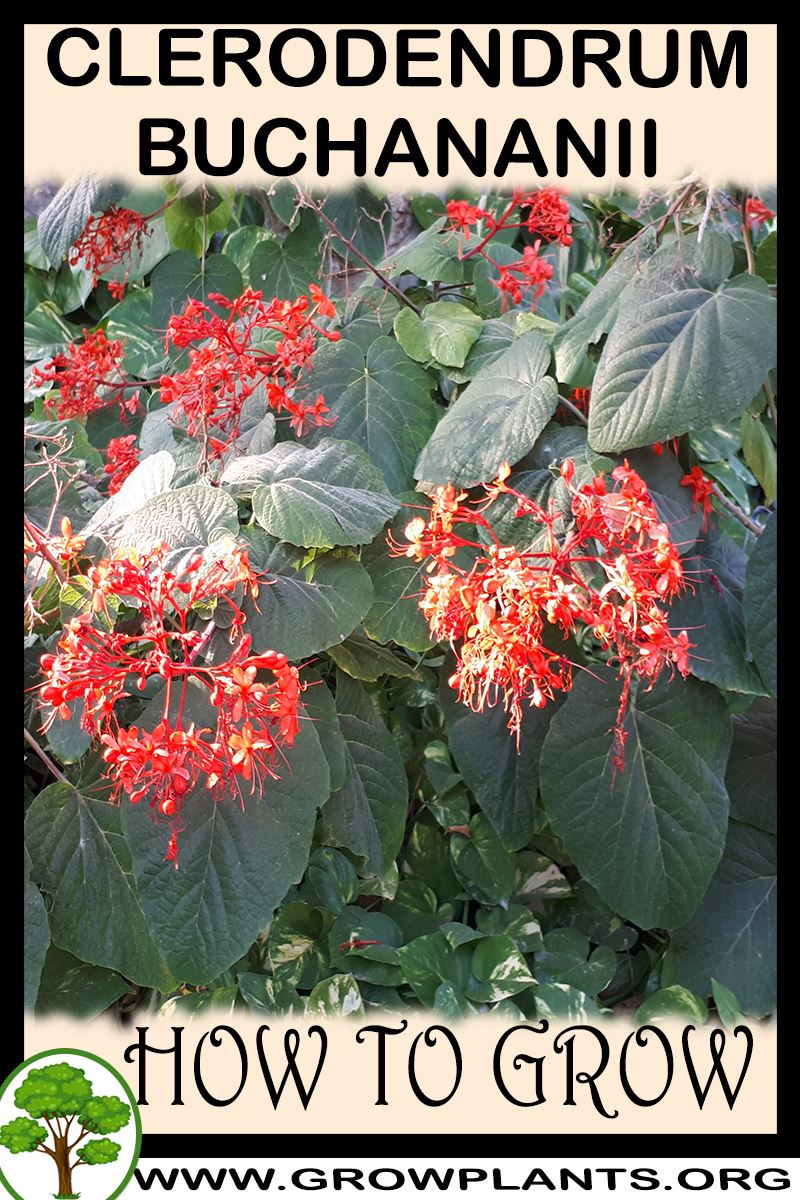
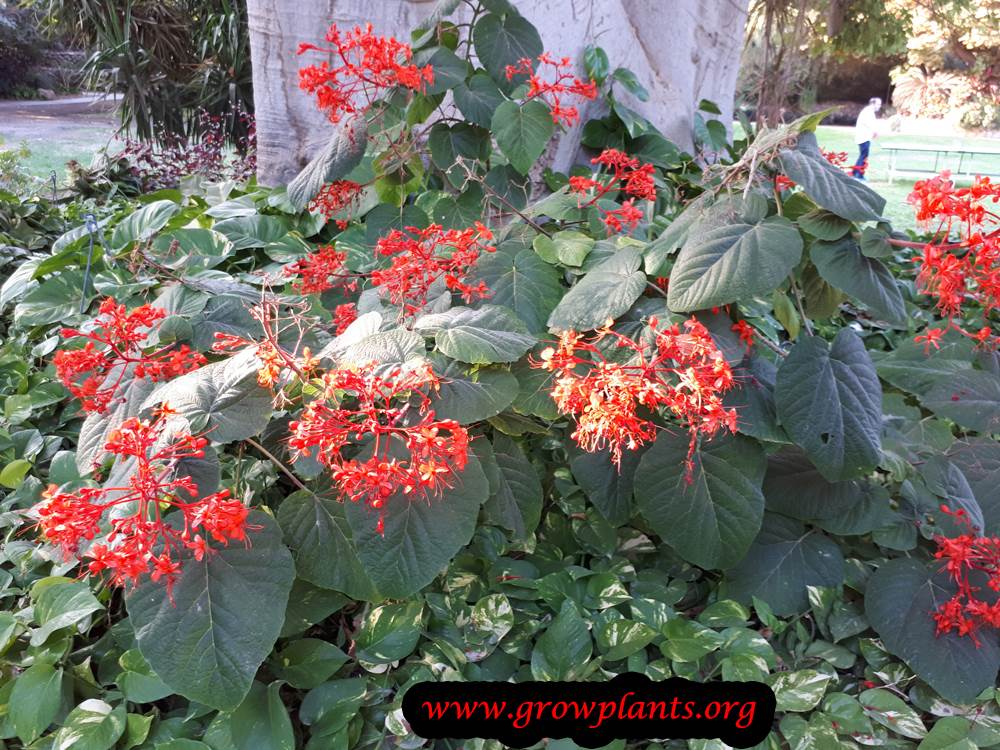
Overview: Clerodendrum buchananii (glorybower) is an upright evergreen shrub reaching 1-2 m, grown for its clusters of red bell-shaped flowers. This perennial serves as a flowering ornamental and informal hedge.
Quick Specifications
| Specification | Attribute |
|---|---|
| Plant Type / Life Cycle | Perennial |
| Foliage Type | Evergreen (deciduous in cooler climates) |
| Mature Size | 1-2 m (3-6 ft) tall |
| Growth Rate | Fast to Moderate |
| Hardiness | USDA zone 10b+ |
Growth Form & Structure
- Height & Spread: 1-2 m (3-6 ft) in the ground; grows in containers at least 100-200% larger than the root ball, with support recommended.
- Growth Habit & Form: Upright evergreen shrub that benefits from trellising or support.
- Lifespan & Maturity: Perennial; fast to reach its mature size in warm conditions.
Anatomy & Physical Features
- Leaves & Foliage: Green to dark green, large heart-shaped leaves.
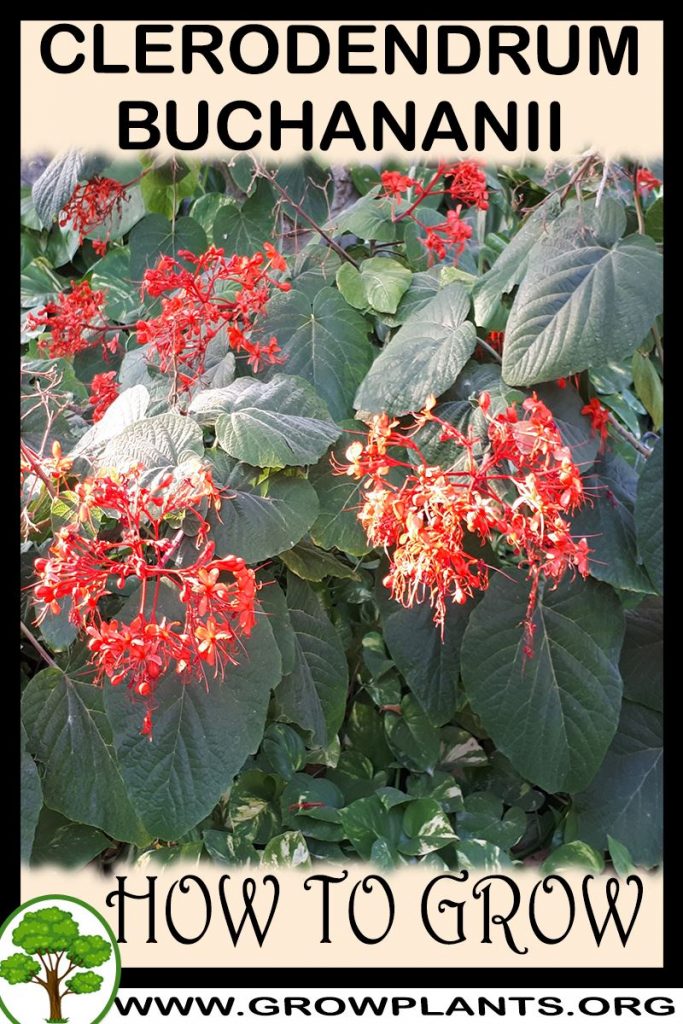
- Flower Characteristics: Red, bell-shaped flowers borne in clusters.
Primary Uses & Landscape Value
- Functional & Ornamental Roles: Flowering ornamental shrub, informal hedge and container plant.
Care Guide: Planting, Soil & Watering
Overview: Glorybower is a fast-growing tender shrub that thrives in warm, frost-free conditions in full sun to part shade, in rich, well-drained soil kept steadily moist. Mulch to hold moisture, provide support where trained upright, and feed it once a year.
Quick Care Requirements
| Requirement | Ideal Condition |
|---|---|
| Planting Season | Spring–summer in zone 10b, spring–autumn in zone 11, year-round in zone 12+ |
| Growth Rate | Moderate to Fast |
| Soil Type | Rich, well-drained soil with plenty of organic matter |
| Water Need | Moderate to High — keep the soil moist and mulched |
Planting & Establishment
- Best Planting Season: Plant spring to summer in zone 10b, spring to autumn in zone 11, and year-round in zone 12 and warmer.
- How to Plant:
- Hole Preparation: Dig a generously large hole, and set support or a trellis in place at planting where the shrub is trained upright.
- Soil Amendments: Fill with organic matter, chopped dead leaves and humus, and mulch after planting to keep the soil moist.
- Planting Depth: Set the plant so the root ball is lightly covered, keeping the collar near the surface, and keep it moist for the first few weeks until established.
- Growth Speed & Expectations: Moderate to fast, forming a 1–2 m shrub; prune once a year and feed to keep it vigorous.
Soil, Watering & Drainage Care
- Soil Mix & Drainage Needs: Rich, moisture-retentive but well-drained soil suits it; mulch conserves moisture while good drainage prevents root rot.
- Watering Schedule & Technique:
- Young / Newly Planted: Keep the soil moist for the first few weeks after planting until the shrub establishes.
- Established: Water regularly and deeply to keep the soil consistently moist; do not let it dry out fully.
- Seasonal Adjustments: Water more in heat and active growth; reduce in cool weather.
Climate, Light & Hardiness
Clerodendrum buchananii is a warm-climate flowering shrub that grows in full sun to half shade across tropical, subtropical, and mediterranean conditions. It is reliably hardy outdoors only from about USDA zone 10b upward, and cutting propagation is recommended in the warmth of 21–25°C (70–77°F).
Quick Climate Specifications
| Climate Zones | Tropic, subtropical, or Mediterranean |
|---|---|
| USDA Hardiness Zones | Approximately 10b and warmer |
| Frost Tolerance | Low |
| Light Conditions | Full sun to half shade |
Sunlight & Light Exposure
Optimal Light Setup
Grows well from full sun through half shade; flowering is generally best with good light.
Direct Sun Requirement
Tolerates full direct sun in warm climates.
Temperature Extremes & Hardiness
USDA Hardiness & Regional Limits
Suited to USDA zone 10b and warmer; where winters bring frost, it needs to be grown in a container that can be sheltered, or treated as a warm-season plant only.
Cold Damage & Winter Protection
Cold slows and can damage growth; the plant establishes and grows best at warm temperatures around 21–25°C (70–77°F).
Frost Sensitivity
Frost-sensitive.
Growing in Pots, Balconies & Indoors
Clerodendrum buchananii is a vigorous flowering shrub (around 1-2 m). The grower does not rate it as a houseplant – it wants strong light to bloom – but it grows well in a large container on a sunny balcony or patio.
Quick Details
- Container Size: A pot 100-200% larger than the root ball (or a smaller pot with the roots trimmed at planting)
- Indoor Suitability: Not a houseplant – too little indoor light for good flowering
- Best Spot: Full sun to half shade
- Soil & Drainage: Potting mix or peat/coir with perlite; refresh as drainage declines
- Watering in Pots: Average to generous – it likes steady moisture but must drain freely
Indoors & On the Windowsill
- Not a houseplant: The grower marks it unsuitable indoors; without strong light it grows leggy and shy to flower.
- Bright sun-room: The nearest indoor option is a very bright, sunny conservatory or sun-room rather than an ordinary room.
On a Balcony or Patio
- Sun & shelter: Give it a warm, sunny, wind-sheltered spot; a large pot dries fast in reflected wall heat, so check moisture often and water generously in warm spells.
Choosing the Pot, Soil & Long-Term Care
- Pot & drainage: A container 100-200% larger than the root ball with strong drainage holes and no standing saucer; alternatively plant in a smaller pot and trim the roots when you do.
- Potting mix: Potting mix or peat/coir with perlite; the grower notes drainage fades after a few years, so replace the soil then.
- Feeding: The grower advises adding organic matter and fertiliser at least once a year, as potted plants exhaust and leach nutrients.
- Refresh the mix and pot on about every two years, lightly root-pruning and top-pruning to keep it vigorous.
Fertilizing & Feeding
A fast-growing flowering shrub often used as a hedge – it responds well to a steady feeding routine through its growing and flowering season, then eases off as growth naturally slows going into its rest period.
Quick Fertilizing Specs
| Feeding Level | Moderate |
|---|---|
| young_feeding | Light, steady feeding while a newly planted or newly rooted shrub is establishing its root system. |
| mature_feeding | Regular balanced feeding through the growing and flowering season for an established shrub or hedge. |
| Main Nutrient Priority | A balanced feed with adequate nitrogen to support strong shrub growth and the clusters of bell-shaped red flowers. |
| Best Feeding Period | The main growing season leading into and through bloom. |
| Organic Options | Working organic matter and mulch into the planting area supports steady growth alongside any fertilizer. |
| Reduce/Stop Feeding | Ease off feeding as the shrub’s growth slows heading into its cooler rest period. |
Feeding by Growth Stage
Establishment
Help a newly planted shrub or hedge specimen build a strong root system before pushing top growth.
| Nutrient direction | Light, balanced feeding that supports root establishment without forcing excessive top growth too soon. |
|---|---|
| Timing | The first growing season after planting. |
| Frequency | Feed lightly while the shrub is settling in, increasing only once strong new growth confirms it has established. |
| Fertilizer types | A diluted balanced fertilizer worked into the planting hole and surrounding soil, Organic matter and mulch mixed into the bed at planting to support the developing root system |
| Precautions | Avoid heavy feeding right at planting time, since a stressed, unestablished root system can be damaged by concentrated fertilizer. |
Growth and Bloom
Support vigorous shrub growth together with the clusters of bell-shaped red flowers this plant is grown for.
| Nutrient direction | A balanced feed with adequate nitrogen to drive both healthy foliage and strong flower clusters. |
|---|---|
| Timing | The main growing season leading into and through the bloom period, which shifts with climate – later in the year in warm climates, spring in cooler ones. |
| Frequency | Feed on a steady, moderate schedule through active growth and flowering. |
| Fertilizer types | A balanced shrub or flowering-plant fertilizer applied around the root zone, A fresh layer of organic mulch renewed periodically to feed the soil as it breaks down |
| Routine trace nutrients | iron, manganese |
| Precautions | Avoid overly nitrogen-heavy feeding late in the season, since it can push soft new growth that is more vulnerable to pests and cold. |
Dormancy or Seasonal Rest
Let the shrub rest through its slow season without encouraging tender new growth that cooler conditions can’t support.
| Nutrient direction | None – withhold fertilizer while the shrub’s growth has clearly slowed for the season. |
|---|---|
| Timing | The cooler part of the year following bloom, when growth visibly slows or the plant sheds leaves in less tropical climates. |
| Frequency | No feeding at this stage – resume once active growth clearly restarts the following season. |
| Fertilizer types | No feeding at this stage – maintenance watering only, no fertilizer product needed. |
| Precautions | Do not fertilize during the rest period; unused nutrients in slow-growing or dormant soil can build up and stress the roots. |
Nutrient Deficiency Signs & Corrections
The shrub grows well but produces fewer or smaller flower clusters than expected.
| Possible causes | A nitrogen-heavy feeding routine favoring leafy growth over flowering, Insufficient light reducing overall flowering potential, A shrub that has not been pruned, leaving old wood that flowers less freely |
|---|---|
| Appears first on | The flowering shoots compared with the surrounding foliage |
| What to check | Check light exposure at the planting site, Check when the shrub was last pruned and whether it needs a shaping cut |
| Possible correction | Balance the feeding routine rather than leaning heavily nitrogen-forward, and prune at the appropriate season to encourage fresh flowering wood. |
Leaves turn pale or yellow between the veins while the veins themselves stay green.
| Possible causes | Iron unavailability linked to an overly alkaline soil pH, Waterlogged soil limiting healthy root function, General nutrient deficiency from an extended period without feeding |
|---|---|
| Appears first on | The newest leaves |
| What to check | Check drainage at the planting site, Check how long it has been since the last balanced feeding |
| Possible correction | Improve drainage and soil condition first; if pale new leaves persist, a chelated iron product applied per its label can help. |
Pruning, Training & Seasonal Maintenance
Clerodendrum buchananii is a moderately fast-growing shrub that flowers in dense clusters at the tips of its current season’s growth, so the safest and most effective time to prune is right after a bloom cycle finishes — this lets the plant push a fresh flush of growth that will carry the next round of flowers, without ever cutting off buds that are already forming. Because bloom timing shifts with climate (autumn/winter in the tropics, spring in cooler areas), the practical rule is to prune by the plant’s own flowering, not by a fixed calendar date. It tolerates moderate to fairly hard pruning well and is typically pruned once a year to keep its size and shape in check.
Quick Pruning & Maintenance Specs
| Pruning Tolerance | Moderate to High |
| Primary Pruning Window | Immediately after flowering finishes (timing varies by climate) |
| Typical Frequency | Once a year |
| Main Objective | Shape the shrub, remove dead/weak wood, and stimulate the new growth that carries the next bloom |
| Young Plant Priority | Establish 3–5 well-spaced main stems; stake if growth is lax |
| Mature Plant Priority | Renewal-thin older, weak stems; control overall size |
| Best Tool Type | Bypass secateurs, with small loppers for older basal wood |
| Avoid Heavy Pruning During | While the plant is actively in bloom |
Pruning by Plant Age & Size
Newly Established
Remove only damaged growth in the first year; do not hard-prune until the plant has built a basic framework of several main stems.
Young / Formative
Select three to five well-placed main stems as the shrub’s framework and remove weaker competing shoots; the fact that this species benefits from trellising or support when young suggests staking lax growth until stems thicken, rather than any formal leader-training system.
Mature / Established
On established plants, focus on renewal — removing the oldest, least productive stems at the base every year or two to make room for vigorous replacement growth, and controlling overall height and spread.
Flowering & Fruiting Wood
Flowers form in clusters at the tips of the current season’s growth, not on older persistent wood, so pruning shortly after flowering does not remove next season’s flower buds — instead it encourages the fresh terminal growth that will carry them. Pruning too early, while flower buds are still developing on that season’s growth, is what actually costs a bloom cycle.
Structural Pruning & Training
Remove crossing or inward-growing branches to keep an open, airy framework, and thin congested stems so light reaches the interior of the shrub. Renewal pruning – cutting the oldest stems back to the base periodically – keeps the shrub flowering vigorously rather than becoming woody and sparse at the center.
Special Growth to Remove
- Dead or damaged wood: remove at any time it is noticed.
- Weak, spindly branches: cut back to a strong junction; these rarely flower well and crowd better growth.
- Spent flower clusters: trim off once fully faded unless seed is being collected.
Container & Small-Space Pruning
In a container, prune a little more assertively for compactness, since pot-grown plants have less root volume to support a large framework; refresh the potting mix and add organic matter or fertilizer at least annually, as containerized plants exhaust their soil’s nutrients faster than an in-ground shrub.
Tools
- Bypass secateurs: for the bulk of shaping and thinning cuts on stems up to finger thickness.
- Loppers: for thicker basal stems when removing old wood during renewal pruning.
Tool Hygiene & Disease Risk
Routine hygiene is generally adequate. This species does attract aphids, spider mites and mealybugs, which can colonize soft new growth after a hard prune, so inspect regrowth rather than assuming any dieback is pruning-related; wipe blades if cutting through visibly infested material.
Cut Placement & Technique
Use thinning cuts (removing a stem back to its point of origin) in preference to heading cuts to keep a natural shape, cut just above an outward-facing bud to direct new growth away from the shrub’s center, and avoid flush cuts or long stubs, which are slow to heal.
Heavy Pruning & Rejuvenation
Tolerates a fairly hard annual cutback well: after flowering, an overgrown or leggy plant can be reduced by up to a third to a half of its size, which sacrifices little since the removed wood was not going to flower again anyway — the plant responds with vigorous new growth that carries the next bloom.
Post-Pruning Care
Water normally after pruning and keep an eye on the resulting flush of soft new growth for aphids, spider mites and mealybugs, which are drawn to tender regrowth; avoid heavy feeding immediately after a hard prune, since the plant is already primed to push new shoots.
Common Pruning Mistakes
- Pruning before flowering finishes, removing buds that were about to open.
- Leaving weak, crowded stems in place instead of thinning them, which reduces flowering and airflow.
- Cutting on a fixed calendar date rather than tracking the plant’s actual bloom timing, which shifts with climate.
When NOT to Prune
Avoid pruning while the plant is in active bloom, and avoid a hard cutback right after transplanting, before the root system has re-established.
Pruning Troubleshooting
| Problem | Possible Cause | What to Check | Corrective Action |
| Few or no flowers after pruning | Pruned too late, removing developing flower buds on that season’s new growth | Timing of last prune relative to the local bloom period | Shift pruning to immediately after flowering finishes next cycle |
| Vigorous leafy growth but sparse flowers | Over-fertilizing or over-hard pruning pushing vegetative growth at flowering’s expense | Recent fertilizer use and severity of last cutback | Ease off nitrogen-heavy feeding and prune moderately rather than severely |
| Dense, sparse-flowering interior | Congested old stems shading the center of the shrub | Stem age and crowding at the shrub’s base | Renewal-thin the oldest stems at the base to open the framework |
| Dieback at cut ends | Flush cuts, stub cuts, or pest colonization of soft new regrowth | Cut placement and presence of aphids/mealybugs on new shoots | Recut cleanly above a healthy node and treat any pest colonies |
Recommended Tools (by task)
- bypass_secateurs: the main tool for annual shaping, thinning, and deadheading cuts.
- loppers: for removing thicker old stems during renewal pruning.
- soft_ties_stakes: to support young or lax-growing stems, matching the source note that this species benefits from trellising or support.
Propagation Guide
Clerodendrum buchananii can be propagated vegetatively from stem cuttings. Seed is also possible where viable seed is produced and is appropriate for the species or genus-level plant.
Quick Propagation Specs
| Best Vegetative Method | Stem cuttings |
| Seed | Possible where viable seed is produced |
| Grafting | Not required |
Cuttings root best in early spring at around 21-25°C (70-77°F), in moist, humid conditions using a peat-based mix and a rooting hormone; a greenhouse or a small perforated plastic box helps hold humidity, and the first roots typically take a few weeks to form. For seed, a peat mix with vermiculite (or another well-ventilated medium) in a sunny, humid spot at the same 21-25°C range works well.
Stem Cuttings
Take healthy non-flowering stem material with viable nodes. Remove lower leaves, place the cutting in a clean, free-draining propagation medium, and maintain humidity without keeping the medium waterlogged until roots develop.
Growing from Seed
Use mature, viable seed when seed propagation is desired. Seed-grown plants may vary, especially on cultivated or genus-level pages.
Aftercare
Keep rooted cuttings protected from severe stress while they establish, then increase light and normal watering gradually.
Bloom & Flower Guide
Quick Details
- Bloom Season: Autumn to winter in the tropics; spring in cooler areas
- Flower Appearance: Red bell-shaped flowers carried in clusters
- Edibility: Not eaten – an ornamental flowering shrub
Detailed Blooming Overview
Clerodendrum buchananii (glorybower) is an evergreen to deciduous shrub grown for its bold clusters of red bloom. Flowering falls in autumn and winter in warm, tropical climates and shifts to spring where it is cooler. It suits tropical, subtropical and Mediterranean gardens in roughly zone 10b and warmer, and can also be used as a hedge.
Flower Characteristics
- Rich red, bell-shaped flowers.
- Gathered into showy clusters at the stem tips.
- Set against large, heart-shaped, deep-green leaves.
Bloom Care & Thinning
- After flowering: Prune to shape and keep the shrub tidy; it flowers on newer growth.
- Position: Warmth, shelter and steady moisture encourage the best display.
- Pollination: The tubular red flowers attract butterflies and sunbirds.
Pests, Diseases & Troubleshooting
Overview: Clerodendrum (glory bower) is a vigorous tropical shrub whose signature problem is whitefly – it is a magnet for them – with the resulting honeydew and sooty mould, plus the other sap-suckers of soft-leaved shrubs. Diseases are minor; the bigger management challenges are its whitefly load and its habit of suckering far and wide. Good airflow, natural enemies and vigilance on the leaf undersides keep it in check.
Quick Troubleshooting Overview
| Issue / Pest | Main Symptom | Primary Solution |
|---|---|---|
| Whitefly | Clouds of tiny white flies rise from disturbed foliage | Yellow sticky traps; soap/oil on leaf undersides; parasitoids |
| Sooty mould | Black film on leaves from whitefly/aphid honeydew | Control the sap-suckers; wash foliage |
| Aphids/mealybugs | Sticky new growth; white tufts in leaf axils | Rinse/alcohol swab; neem/soap; conserve predators |
| Spider mites | Fine speckling and bronzing in hot, dry air | Raise humidity; hose foliage; light oil if severe |
| Leaf spot | Brown/angular spots in warm humid conditions | Airflow; remove leaves; copper if wet |
| Suckering spread | New shoots pop up around and away from the plant | Remove suckers; root barrier; contain in beds/pots |
Common Pests & Management
- Whitefly (Trialeurodes / Aleyrodidae):
- Symptoms: The defining pest: clouds of tiny white moth-like flies rise whenever the foliage is disturbed, and their scale-like nymphs crowd the leaf undersides, excreting copious honeydew that blackens the plant with sooty mould and weakens growth.
- Prevention & Control: Monitor and trap adults with yellow sticky traps, conserve and introduce Encarsia parasitic wasps, and spray insecticidal soap or a light oil thoroughly onto the leaf undersides where nymphs live, repeating to catch successive hatches. Avoid soft, over-fed growth.
- Aphids (Aphidoidea):
- Symptoms: Soft green or black aphids cluster on the soft new shoots and flower clusters, curling growth and adding to the honeydew and sooty mould load.
- Prevention & Control: Rinse colonies off and conserve ladybirds, lacewings and hoverflies. Neem or insecticidal soap clears heavier colonies; controlling aphids and whitefly together reduces sooty mould.
- Mealybugs (Pseudococcus / Planococcus spp.):
- Symptoms: White cottony masses lodge in leaf axils, stem junctions and on the roots, with honeydew and sooty mould; heavy colonies yellow and weaken the plant.
- Prevention & Control: Swab with alcohol and follow with insecticidal soap or light oil weekly, checking roots at repotting and isolating new plants.
- Two-spotted spider mite (Tetranychus urticae):
- Symptoms: Fine pale stippling and a dull bronze cast to leaves in hot, dry conditions, with webbing on the undersides in bad cases.
- Prevention & Control: Raise humidity and hose down foliage, and conserve predatory mites; a light oil is used only if bronzing spreads.
- Scale insects (Coccidae / Diaspididae):
- Symptoms: Brown or grey limpet-like scales on stems and leaf undersides, sapping vigour and (soft scales) adding honeydew.
- Prevention & Control: Prune out crusted wood, dab with alcohol, and use a horticultural oil on the crawler stage; conserve parasitic wasps.
- Root-knot nematode (Meloidogyne spp.):
- Symptoms: In warm soils, stunting and heat-wilting with galled roots that reduce water uptake.
- Prevention & Control: Grow in clean or container soil, mulch heavily to build antagonistic microbes, keep plants watered, and rotate planting sites.
Diseases & Fungal Issues
- Leaf spot (Cercospora / Colletotrichum spp.):
- Symptoms: Brown to angular spots, sometimes ringed or haloed, develop on leaves in warm, humid, crowded conditions and can merge into blotches with some leaf drop.
- Treatment & Management: Improve airflow, avoid overhead watering late in the day, and remove spotted leaves and debris. A copper fungicide checks spread in persistent wet weather.
- Sooty mould (Capnodium spp.):
- Symptoms: A superficial black film coats leaves and stems wherever whitefly and aphid honeydew has fallen, dulling the foliage and reducing photosynthesis – very common on this honeydew-rich shrub.
- Treatment & Management: Control the whitefly and aphids producing the honeydew and the mould dries and flakes away; wash valued foliage. It is a symptom of the pests, not a primary disease.
- Root rot (Phytophthora / Pythium):
- Symptoms: In soggy, poorly drained or overwatered soil the roots rot and the plant wilts and declines with yellowing foliage.
- Treatment & Management: Grow in free-draining soil, let the surface dry between waterings, and improve drainage; remove rotted tissue and avoid deep planting.
- Powdery mildew (Erysiphe spp.):
- Symptoms: Occasionally a white powdery bloom appears on leaves in crowded, still conditions, causing some yellowing.
- Treatment & Management: Improve airflow and remove affected leaves; sulphur or bicarbonate is only occasionally needed on this shrub.
Growing Difficulties & Abiotic Problems
- Suckering spread:
- Cause & Symptoms: Clerodendrum species spread vigorously by root suckers, sending up new shoots around and well beyond the parent, which can become invasive.
- Correction Strategy: Remove suckers regularly, install a physical root barrier, or grow the plant in a large container to contain its spread.
- Chlorosis:
- Cause & Symptoms: Yellowing between the veins of new leaves on alkaline or waterlogged soils where iron is locked up.
- Correction Strategy: Improve drainage, mulch with organic matter, feed a balanced fertiliser and correct with chelated iron.
- Cold / dry-air leaf drop:
- Cause & Symptoms: Cold draughts, frost or very dry air cause leaf yellowing and drop on this tender tropical shrub.
- Correction Strategy: Keep it warm and frost-free with reasonable humidity, and shelter it from cold draughts; container plants should overwinter under cover in cool climates.
What Helps – Products & Tools
For Clerodendrum the whole game is whitefly: yellow sticky traps, Encarsia parasitic wasps, and insecticidal soap or a light horticultural oil on the leaf undersides, plus neem for aphids and mealybug. A copper fungicide covers leaf spot in wet weather, chelated iron corrects chlorosis, and washing the foliage clears the sooty mould once the pests are controlled.