
Plant Profile & Key Characteristics
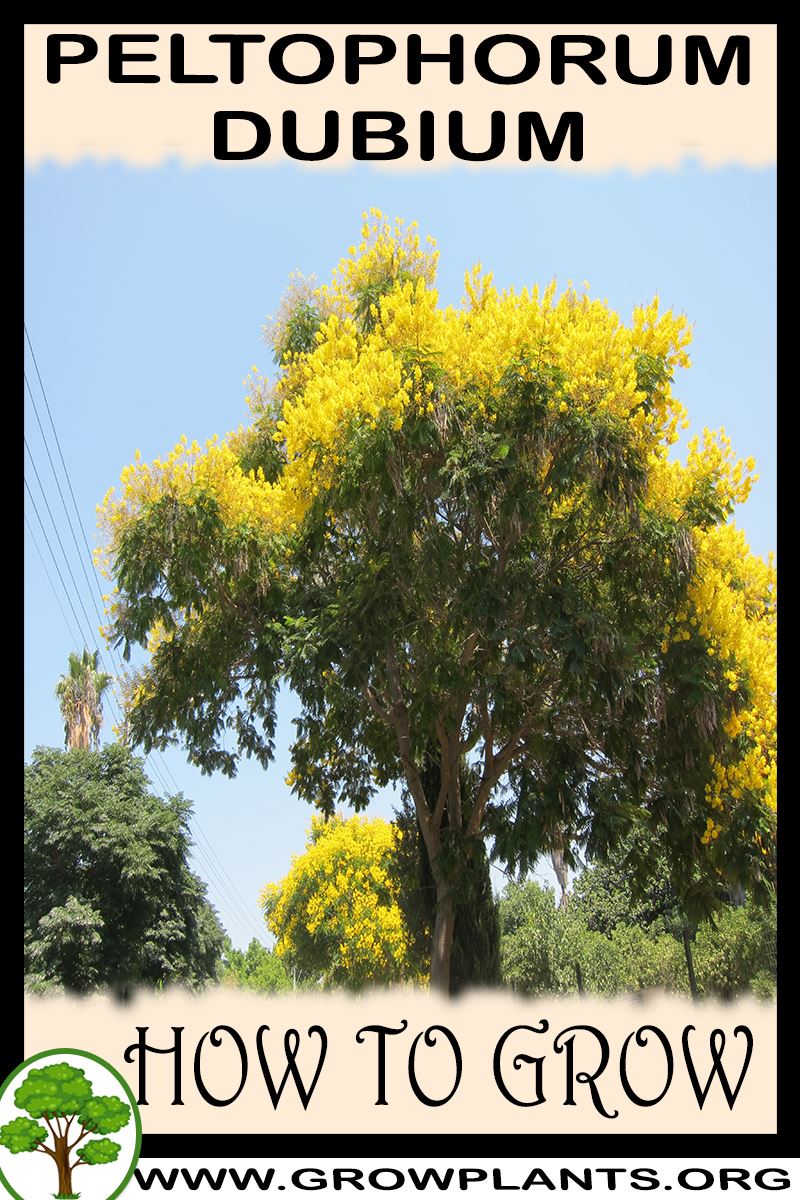
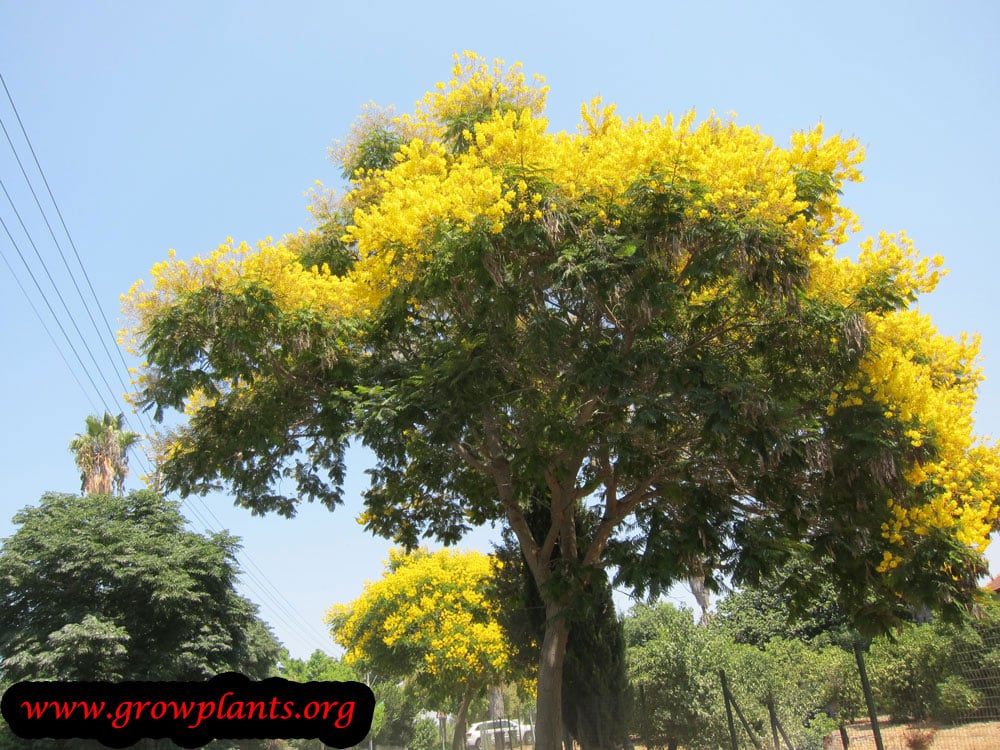
Overview: Peltophorum dubium (yellow poinciana) is a large tree reaching 10-20 m (30-60 ft), evergreen or deciduous depending on climate, grown as an ornamental and drought-tolerant shade tree, and also as bonsai. It is a fast-growing legume that can become invasive.
Quick Specifications
| Specification | Attribute |
|---|---|
| Plant Type / Life Cycle | Perennial (tree, legume) |
| Foliage Type | Evergreen or deciduous (climate-dependent) |
| Mature Size | 10-20 m tall (30-60 ft) |
| Growth Rate | Fast to moderate |
| Hardiness | USDA zone 9b+ |
Growth Form & Structure
- Height & Spread: Grows 10-20 m (30-60 ft) in the ground; not suited to long-term container culture except as trained bonsai.
- Growth Habit & Form: Large tree with a broad, spreading crown that casts good shade.
- Lifespan & Maturity: Long-lived, fast to establish into a sizeable shade tree.
Anatomy & Physical Features
- Trunk & Bark: Substantial woody trunk supporting a wide canopy.
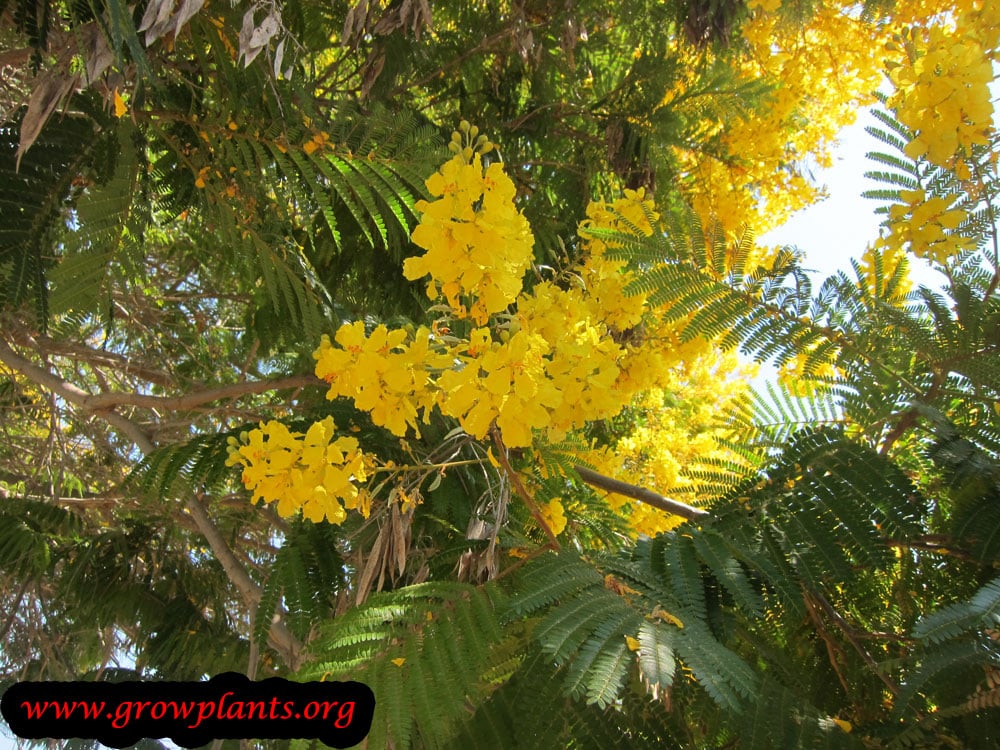
- Leaves & Foliage: Fine, feathery bipinnate leaves made of tiny 1-2 mm leaflets.
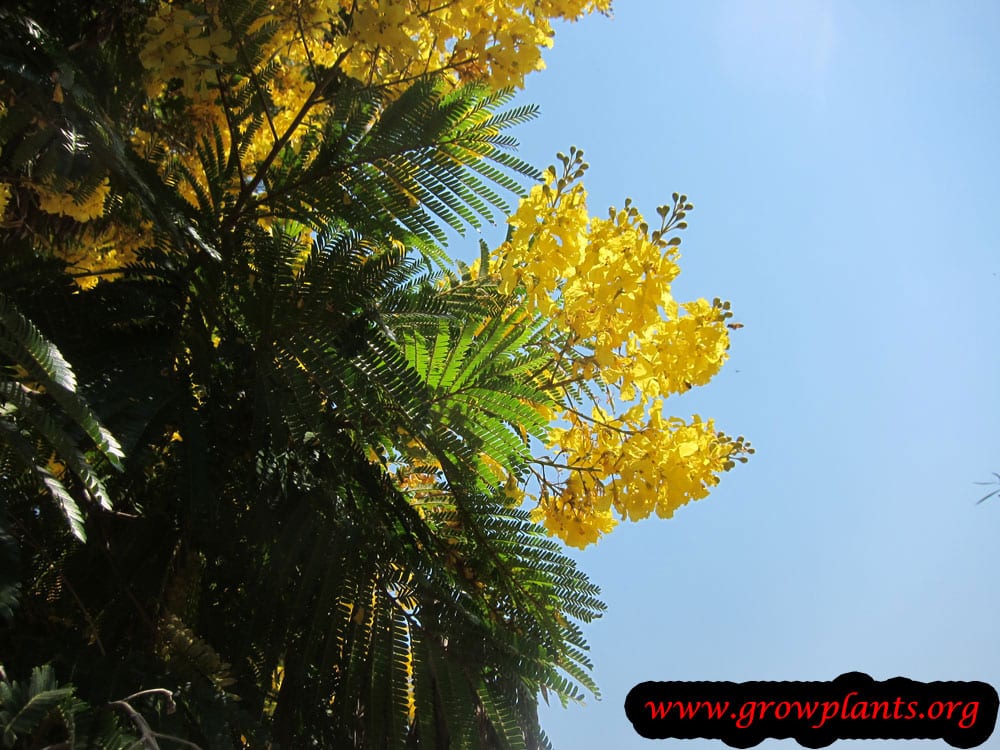
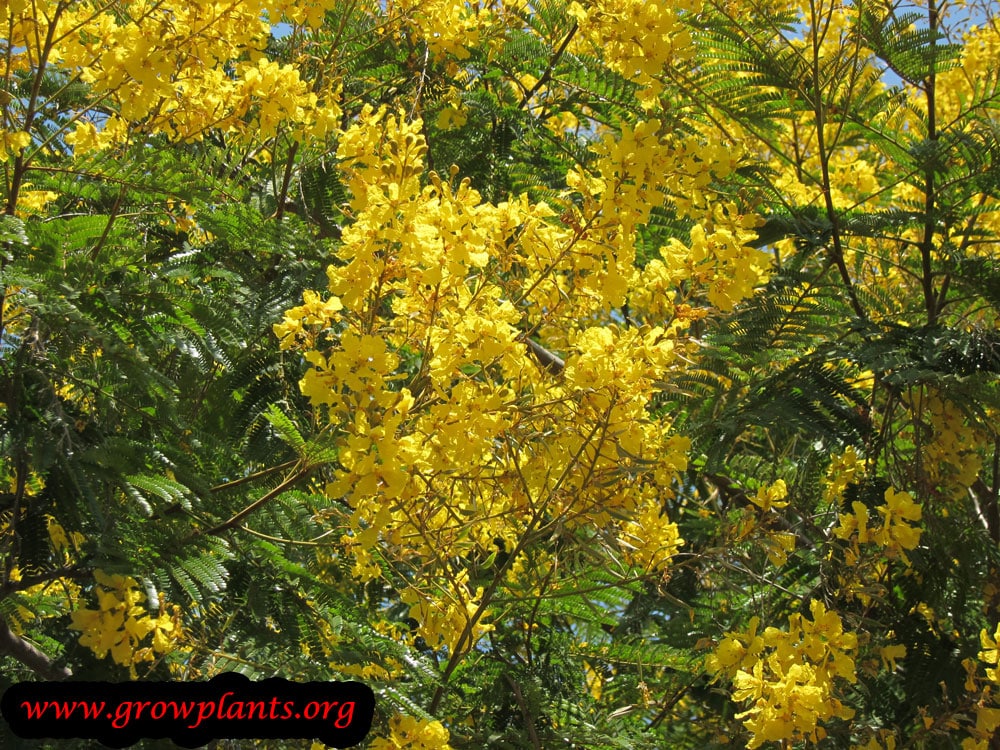
- Flower Characteristics: Yellow flowers with a brown centre and four crepe-paper-like wavy petals, borne in showy sprays.
Primary Uses & Landscape Value
- Functional & Ornamental Roles: Ornamental flowering shade tree for parks and avenues, and a subject for bonsai; site with care due to its invasive potential.
Care Guide: Planting, Soil & Watering
Overview: Yellow poinciana is a fast-growing, drought-tolerant shade tree that thrives in full sun and well-drained soil. Once established it needs only low to moderate water.
Quick Care Requirements
| Requirement | Ideal Condition |
|---|---|
| Planting Season | Spring, or winter in hot climates |
| Growth Rate | Moderate to Fast |
| Soil Type | Well-drained soil |
| Water Need | Low to Moderate – drought-tolerant once established |
Planting & Establishment
- Best Planting Season: Plant in spring, or in winter in hot climates, so it roots before the heat (hardy zone 9b+).
- How to Plant:
- Hole Preparation: Dig a hole about twice the width of the root ball and as deep, on free-draining ground.
- Soil Amendments: Mix a little organic matter into the backfill and make sure the site drains well.
- Planting Depth: Set the tree with its root collar at soil level; do not bury the trunk base.
- Growth Speed & Expectations: A fast-to-moderate grower reaching 10-20 m and making a broad shade canopy.
Soil, Watering & Drainage Care
- Soil Mix & Drainage Needs: Needs well-drained soil; it is a large tree not suited to containers in the ground. Avoid waterlogged ground.
- Watering Schedule & Technique:
- Young / Newly Planted: Water regularly through the first season to establish.
- Established: Once established it is drought-tolerant – water deeply but infrequently.
- Seasonal Adjustments: More during summer drought, minimal in the cool season.
Climate, Light & Hardiness
This yellow poinciana is a fast, large subtropical-to-tropical shade tree that wants full sun, heat and a long warm season, and it is notably drought-tolerant once established. It is frost-sensitive but among the hardier of its group, placed by the site data at roughly USDA zone 9b and warmer.
Quick Climate Specifications
| Climate Zones | Tropical, subtropical, mediterranean, desert (warm) |
|---|---|
| USDA Hardiness Zones | Approximately 9b and warmer (site data) |
| Optimal Temp Range | Approximately 22–33°C (72–91°F) |
| Cold Damage Begins | Young growth suffers with light frost, near 0–2°C (32–36°F) |
| Approx. Survival Minimum | Established trees may briefly take a few degrees of frost (around −3°C / 27°F); varies by age, exposure duration, and conditions |
| Frost Tolerance | Low |
| Light Conditions | Full sun |
| Wind Tolerance | Moderate |
Sunlight & Light Exposure
Optimal Light Setup
Full sun is best for a strong, well-shaped canopy and abundant crepe-like yellow flowers.
Direct Sun Requirement
It is a true sun tree; direct light supports its fast growth and flowering.
Best Exposure / Orientation
An open, warm site with room to spread suits this large tree.
Temperature Extremes & Hardiness
USDA Hardiness & Regional Limits
The site places it around zone 9b and up, so it grows across warm-temperate, mediterranean, desert and subtropical-to-tropical regions where hard freezes are uncommon.
Cold Damage & Winter Protection
Light frost nips young growth; protect young trees over their first winters in the coolest parts of its range. Mature trees tolerate brief light frost better.
Frost Sensitivity
Frost is the main limit - seedlings and young trees are considerably more sensitive than established specimens.
Extreme Heat Tolerance
Excellent; it thrives in high heat and, being drought-tolerant, copes with hot, dry desert-edge conditions.
Wind, Humidity & Microclimate
Dry-Air Tolerance
Good - it grows in dry as well as humid warm climates.
Wind Tolerance
Reasonably wind-firm once established, though fast, soft growth benefits from some shelter when young.
Microclimate Recommendations
In marginal cool areas, a warm, sunny, sheltered spot reduces frost risk to young trees; give this large, vigorous (and potentially invasive) tree plenty of room.
Growing in Pots, Balconies & Indoors
This is a very large, fast-growing shade and flowering tree – the grower rates it neither as a houseplant nor as a container plant. It really needs open ground; a pot suits it only very briefly while it is a seedling.
Quick Details
- Container Size: Only short-term – a deep nursery pot for a seedling
- Indoor Suitability: No
- Best Spot: Full sun
- Soil & Drainage: Free-draining mix
- Watering in Pots: Small to average while young in a pot
Indoors & On the Windowsill
- Not for indoors or pots: Too big and too vigorous; the grower does not recommend containers. Keep it for open ground.
On a Balcony or Patio
- Young trees only: At most a seedling can spend its first year in a large pot before being planted out; long term it is a big tree and unsuited to a balcony.
Choosing the Pot, Soil & Long-Term Care
- Short-term potting: If raised in a pot, use a deep container with a free-draining mix and plant out before it becomes root-bound; feed while potted, as nutrients leach.
Growing this plant in a greenhouse
A greenhouse can give peltophorum dubium frost protection and cold protection.
Greenhouse at a glance
| Greenhouse suitability | Conditional - depends on your climate |
|---|---|
| Main benefits | frost protection, cold protection |
| Season extension | earlier spring & later autumn |
| Outdoor protection advisable below | about 2°C |
| Suitable types | unheated greenhouse, polycarbonate greenhouse |
| Heating | Heating is optional - useful mainly for winter growing in cold areas. |
Related greenhouse guides
- Greenhouses: How to Choose the Right Greenhouse
- Polycarbonate Greenhouses: What to Look for Before Buying
Fertilizing & Feeding
A light to moderate feeder. As a nitrogen-fixing legume it supplies much of its own nitrogen, so it needs only modest, balanced feeding through spring and the flowering season; heavy nitrogen produces leaves at the expense of flowers.
Quick Fertilizing Specs
| Feeding Level | Light to moderate |
|---|---|
| Main Nutrient Priority | Balanced nutrition; go easy on nitrogen |
| Best Feeding Period | Spring through the flowering season |
| Organic Options | Compost, aged manure or leaf mulch |
| Soil pH | Adapts to a wide range; needs well-drained soil |
| Reduce/Stop Feeding | Ease off as growth slows into dormancy |
Feeding by Growth Stage
Spring flush and canopy growth
Support the new season’s shoot and leaf growth so the plant enters bloom in good health.
| Nutrient direction | A balanced complete fertilizer; because this is a nitrogen-fixing legume it needs only gentle nitrogen, so favour a light balanced feed over a heavy nitrogen push. |
|---|---|
| Timing | As growth resumes in spring. |
| Frequency | A few light feedings spread through the active growing season. |
| Fertilizer types | A balanced granular or slow-release complete fertilizer, Compost or other organic matter worked into the surface |
| Precautions | Keep fertilizer off the trunk and avoid overfeeding nitrogen, which pushes foliage at the expense of flowers. |
Flowering
Sustain flowering without forcing excessive leafy growth.
| Nutrient direction | Continue a balanced complete fertilizer; adequate overall nutrition, not high phosphorus, drives good bloom. |
|---|---|
| Timing | Through the flowering period. |
| Frequency | Light, steady feeding during bloom. |
| Fertilizer types | A balanced complete fertilizer |
| Precautions | Avoid high-phosphorus bloom-booster products; balanced, light nutrition suits this plant better. |
Dormancy or winter rest
Let the plant rest as growth and nutrient demand fall away in the cool season.
| Nutrient direction | None – withhold fertilizer while the plant is dormant. |
|---|---|
| Timing | Autumn into winter, as growth slows. |
| Frequency | No feeding at this stage. |
| Fertilizer types | No feeding at this stage while the plant is dormant. |
| Precautions | Do not fertilize until active growth resumes in spring. |
Nutrient Deficiency Signs & Corrections
Older, lower leaves turn uniformly pale or yellow and overall growth is weak.
| Possible causes | Low soil nitrogen or poor root-nodule activity on this legume, Waterlogged or compacted roots limiting uptake, Very sandy, low-fertility soil |
|---|---|
| Appears first on | Older, lower leaves |
| What to check | How wet the root zone stays and whether the soil drains freely, Whether the plant has been fed at all this season, General soil fertility and organic matter |
| Possible correction | Improve drainage, work in organic matter, and apply a balanced complete fertilizer at a modest rate. |
New leaves are pale or yellow between green veins while the veins stay green.
| Possible causes | High (alkaline) soil pH locking up iron, Waterlogged or cold soil reducing root uptake, A genuine iron shortage in the soil |
|---|---|
| Appears first on | Youngest leaves at the shoot tips |
| What to check | Soil pH and whether the soil is chalky or alkaline, How well the soil drains and whether symptoms follow wet spells, Whether only the new growth is affected |
| Possible correction | Correct soil pH where possible and apply a chelated iron product according to its label; improve drainage. |
Older leaves develop browning, scorched margins.
| Possible causes | Potassium shortage in the soil, Fertilizer or soil salt build-up in the root zone, Drought stress between waterings |
|---|---|
| Appears first on | Margins of older leaves |
| What to check | Recent fertilizer use and any salt crust on the soil surface, Soil moisture and the watering pattern, Whether only leaf edges, not whole leaves, are affected |
| Possible correction | Water thoroughly to rinse excess salts through, even out watering, and use a balanced fertilizer with adequate potassium at a modest rate. |
Pruning, Training & Seasonal Maintenance
Peltophorum dubium is a fast-growing, large ornamental shade tree, and its pruning is almost entirely about structure: because it puts on height and girth quickly, weak, narrow forks left uncorrected on a young tree become split-prone limbs on a 10–20 m mature tree. The objective is therefore a single dominant leader and well-attached scaffolds while young, then minimal maintenance — deadwood and clearance — at maturity. It flowers in summer–autumn on the current season’s growth, so cool-season structural pruning does not cost the next bloom.
Quick Pruning & Maintenance Specs
| Pruning Tolerance | Moderate; vigorous, responds to cuts with strong regrowth |
| Primary Pruning Window | Winter / cool dry season (dormant-ish, structural) |
| Typical Frequency | Regularly in the formative years; occasional once mature |
| Main Objective | Strong single-leader scaffold; then deadwood and clearance |
| Young Plant Priority | Suppress competing leaders, space scaffolds, correct weak forks |
| Mature Plant Priority | Deadwood, storm damage, crown cleaning, clearance |
| Best Tool Type | Secateurs and loppers when young; saw and pole pruner when tall |
| Avoid Heavy Pruning During | The main growth flush, and heat/drought stress |
Pruning by Plant Age & Size
Newly Established
Remove only damaged growth after planting. Do not head the young tree; let it gain height and a strong root system first.
Young / Formative
Train a central leader. Because this tree grows fast, competing co-dominant leaders and included-bark unions form quickly, so identify and suppress rival leaders early and select well-spaced scaffold branches with wide angles. Progressively raise the crown for clearance if it is used as a street or shade tree.
Mature / Established
Structural work should be largely done. Limit pruning to deadwood, storm-broken limbs, crossing branches and clearance. Avoid large cuts, which on a vigorous tree provoke watersprouts.
Seasonal Pruning Schedule
Winter / Cool Dry Season (main window)
Objective: structural correction and deadwood. Remove competing leaders, weak forks, dead and crossing wood. Do NOT remove sound, well-placed scaffold limbs. Expected response is vigorous spring growth; because flowers form on new growth in summer–autumn, dormant-season cuts do not sacrifice the coming bloom.
Ongoing Sanitary
Remove deadwood and damaged limbs whenever seen, and thin excess watersprouts that follow any large cut.
Flowering & Fruiting Wood
Peltophorum dubium flowers in summer to autumn on the current season’s shoots, in terminal panicles. Because bloom is carried on new growth, structural pruning in the cool season removes almost no flower potential. It is grown as an ornamental, not for a harvest, so there is no fruiting-wood management — but note that the abundant seed makes it weedy where it is invasive.
Structural Pruning & Training
This is the heart of the tree’s pruning. Because of fast growth, watch for co-dominant stems and included bark and correct them while cuts are small. Manage ultimate height and spread within the space available, and use modest thinning only — the canopy does not need aggressive opening.
Special Growth to Remove
Expect watersprouts after any heavy cut; thin them to one or none per site. Where the tree is invasive, remove spent flower panicles and seed pods to cut down on volunteer seedlings.
Tools
Match tool to cut size: bypass secateurs and loppers for formative cuts on young wood, a pruning saw for scaffold limbs, and a pole pruner for high deadwood and thinning on a tall mature tree. Hedge shears have no role on a specimen shade tree.
Tool Hygiene & Disease Risk
Routine. No significant pruning-transmitted disease is associated with this tree; keep tools clean and sharp for clean-healing cuts.
Cut Placement & Technique
Cut just outside the branch collar, never flush and never leaving stubs. Use the three-cut method (undercut, top cut, final collar cut) on any limb heavy enough to tear bark. Prune to outward-facing buds when shortening young shoots to keep the crown open.
Heavy Pruning & Rejuvenation
The tree will tolerate crown reduction, but as a vigorous grower it responds with a flush of watersprouts and slow wound closure on large cuts. Topping is the wrong approach; make correct structural cuts early instead, so heavy reduction is never needed.
Post-Pruning Care
Do not force feeding after pruning — this vigorous tree already regrows strongly. Monitor for watersprouts, and in hot climates watch newly exposed limbs and bark for sunburn after crown-raising.
Common Pruning Mistakes
- Topping the tree, which triggers weak, crowded watersprout regrowth.
- Leaving co-dominant leaders and included-bark forks on a fast, heavy-limbed tree — a future failure point.
- Flush cuts and stubs that decay slowly on a large wound.
- Ignoring seedlings where the tree is invasive — deadhead to limit spread.
When NOT to Prune
Avoid heavy limb removal during the active growth flush and during heat or drought stress, when large wounds and vigorous watersprouting are most problematic.
Recommended Tools (by task)
- bypass_secateurs — formative cuts and shoot selection on young flexible wood.
- loppers — removing competing leaders and branches a few centimetres thick.
- pruning_saw — scaffold-limb and deadwood removal on the developing and mature trunk.
- pole_pruner — high deadwood and clearance cuts on a tall shade/street tree.
Pruning Troubleshooting
| Problem | Possible Cause | What to Check | Corrective Action |
| Dense clusters of upright watersprouts | Large heading cuts / topping on a vigorous tree | Sites of recent big cuts | Thin sprouts to one leader each; stop topping and use structural cuts |
| Split or torn fork on a maturing tree | Co-dominant leaders with included bark not corrected young | Union angles and bark inclusion on main forks | Reduce or remove the weaker leader while cuts are still manageable |
| Slow-closing, discoloured large wounds | Flush cuts or oversized cuts made in the wrong season | Cut position relative to the collar; timing | Cut to the collar; keep future cuts smaller and in the cool season |
| Crowded dark interior canopy | Over-dense growth after heavy feeding/pruning | Light penetration and airflow inside the crown | Light thinning of crossing wood; avoid high-nitrogen pushes |
Propagation Guide
This fast legume tree is raised from seed, the site's listed method; the hard, water-impermeable coat germinates far more evenly after a hot-water soak or light scarification. Seedlings are reasonably uniform, making it an easy plant to raise once the seed is pre-treated.
Quick Propagation Specs
| Best Propagation Method | Seed |
| Propagation Difficulty | Easy (with seed pre-treatment) |
| Seed True-to-Type | Mostly uniform |
| Best Propagation Season | Spring (winter in hot climates) (site) |
Growing from Seed
Dormancy & Pre-Sowing Treatment
The hard legume coat blocks water; pour hot water over the seed and let it soak until it swells, or nick the coat, before sowing.
Sowing Season
Spring, or winter in hot climates (site).
Sowing Depth & Orientation
Sow shallowly, roughly one to two seed-widths deep.
Germination Conditions
Warm, moist, well-drained soil (site: well-drained) in a sunny position.
Germination Time
Softened seed usually sprouts within a few weeks; untreated seed is slow and erratic.
Seedling Care
Grow on in full sun; the species is fast-growing.
Bloom & Flower Guide
Quick Details
- Bloom Season: Summer to autumn
- Flower Appearance: Yellow flowers with a brown center and crinkled, crepe-paper-like petals, in showy clusters
- Edibility: Ornamental – the flowers are not eaten
Detailed Blooming Overview
A large shade tree that carries clusters of crinkled yellow flowers, each with a brown center, through summer and into autumn. The blooms are popular with bees.
Flower Characteristics
- Yellow petals with a crepe-paper texture.
- A brown or rusty center to each flower.
Bloom Care & Thinning
- Pollination: By bees and other insects.
- After bloom: Spent flowers drop freely beneath the canopy.
Pests, Diseases & Troubleshooting
Overview: Yellow poinciana / ibirá-pitá (Peltophorum dubium) is a warm-climate flowering legume tree, and like most such trees it is fairly robust: caterpillar defoliators, scale, mealybug and aphids (with their sooty mould) are the main pests, and leaf spot the main disease. Its bigger practical issues are abiotic – frost sensitivity when young, chlorosis on poor soils, and brittle wood.
Quick Troubleshooting Overview
| Issue / Pest | Main Symptom | Primary Solution |
|---|---|---|
| Caterpillars / defoliators | Chewed, skeletonised compound leaves, frass | Tolerate/hand-pick, Bt on young larvae, encourage birds |
| Scale / mealybug | Encrustations, honeydew, sooty mould | Prune out, horticultural oil, beneficials |
| Aphids | Sticky, curled new shoots | Water jet, beneficials, insecticidal soap |
| Borers | Bore-holes and frass in stressed limbs | Keep trees vigorous, prune out infested wood |
| Leaf spot / mildew | Spots or powder on leaflets, leaf drop | Airflow, sanitation, copper or sulfur if needed |
| Chlorosis / weak wood | Yellow veined leaves; brittle limbs | Chelated iron, drainage; formative pruning |
Common Pests & Management
- Caterpillars / Defoliators (Catopsilia, Eurema (sulphur butterflies) and other Lepidoptera):
- Symptoms: Larvae of sulphur/emigrant butterflies and assorted moths chew and skeletonise the compound leaves, sometimes defoliating young trees; frass beneath.
- Prevention & Control: Tolerate light feeding on established trees (they support butterflies), hand-pick or prune out heavy clusters on young trees, and encourage birds and parasitic wasps. Bt on young larvae for serious outbreaks.
- Scale Insects & Mealybugs (Coccus, Saissetia, Planococcus spp.):
- Symptoms: Brown, grey or cottony encrustations on twigs, leaf axils and undersides; sticky honeydew and black sooty mould, with yellowing and dieback of heavily infested shoots.
- Prevention & Control: Prune out encrusted wood, encourage lady beetles and parasitic wasps, and wash off honeydew; horticultural oil smothers crawlers – repeat to catch generations.
- Aphids (Aphis, Toxoptera spp.):
- Symptoms: Colonies on soft new shoots and flower stalks with honeydew and sooty mould; curled, distorted young growth.
- Prevention & Control: Encourage beneficials and hose off colonies; insecticidal soap for heavy outbreaks, and avoid excess nitrogen that fuels soft growth.
- Stem / Wood Borers (Cerambycid & buprestid beetles):
- Symptoms: Larvae tunnel trunks and branches of stressed or damaged trees, leaving bore-holes, frass and weakened, wind-prone limbs.
- Prevention & Control: Keep trees vigorous and unstressed, avoid bark wounds, prune out and destroy infested wood, and paint/seal large cuts; healthy trees resist attack.
Diseases & Fungal Issues
- Leaf Spot (Cercospora, Phyllosticta, Pseudocercospora spp.):
- Symptoms: Brown or grey rounded spots, sometimes with yellow halos, on the leaflets in warm humid weather; heavy spotting yellows and drops foliage.
- Treatment & Management: Improve airflow by thinning the canopy, rake up fallen leaves, and avoid overhead wetting; a copper fungicide only under sustained pressure.
- Powdery Mildew (Erysiphales):
- Symptoms: White powdery coating on young leaves and shoots in crowded, humid conditions; distorted new growth.
- Treatment & Management: Prune for light and airflow, remove affected shoots, and use sulfur or potassium bicarbonate if persistent.
- Root Rot & Sooty Mould (Phytophthora / Capnodium):
- Symptoms: Wilting and dieback with dark rotted roots in waterlogged soil (root rot); black sooty film over honeydew from sap-suckers (sooty mould).
- Treatment & Management: Plant in free-draining soil and avoid waterlogging for root rot; control scale, mealybug and aphids to clear the sooty mould, then wash it off.
Growing Difficulties & Abiotic Problems
- Frost Sensitivity (young trees):
- Cause & Symptoms: Soft young growth and whole young trees are damaged or killed by frost; these are warm-climate legumes.
- Correction Strategy: Plant in a warm, sheltered spot, protect young trees over their first cold seasons, and prune frost-damaged wood after the danger passes.
- Chlorosis in Alkaline / Poor Soil:
- Cause & Symptoms: Yellowing between green veins on alkaline, compacted or waterlogged soils where iron and micronutrient uptake fails.
- Correction Strategy: Improve drainage and add organic matter, adjust pH where practical, and apply chelated iron for a quick correction.
- Weak Wood & Limb Breakage:
- Cause & Symptoms: Fast, soft growth makes for brittle branches that split in wind or under heavy bloom, especially with narrow forks.
- Correction Strategy: Prune formatively for strong, wide-angled branches when young, thin the canopy to reduce wind-load, and remove damaged limbs promptly.
- Aggressive Surface Roots:
- Cause & Symptoms: A large, fast legume tree with vigorous, sometimes buttressed surface roots that can lift paving and compete with nearby plants.
- Correction Strategy: Site well away from paving, foundations and small beds, give it room, and mulch rather than cultivate over the root zone.
What Helps – Products & Tools
A shade-tree kit: horticultural oil for scale and mealybug, insecticidal soap for aphids, Bt for caterpillar defoliators, chelated iron for chlorosis, and a copper or sulfur fungicide only if leaf spot or mildew is heavy. Sound formative pruning for strong branch structure prevents more damage than any spray.