Plant Profile & Key Characteristics
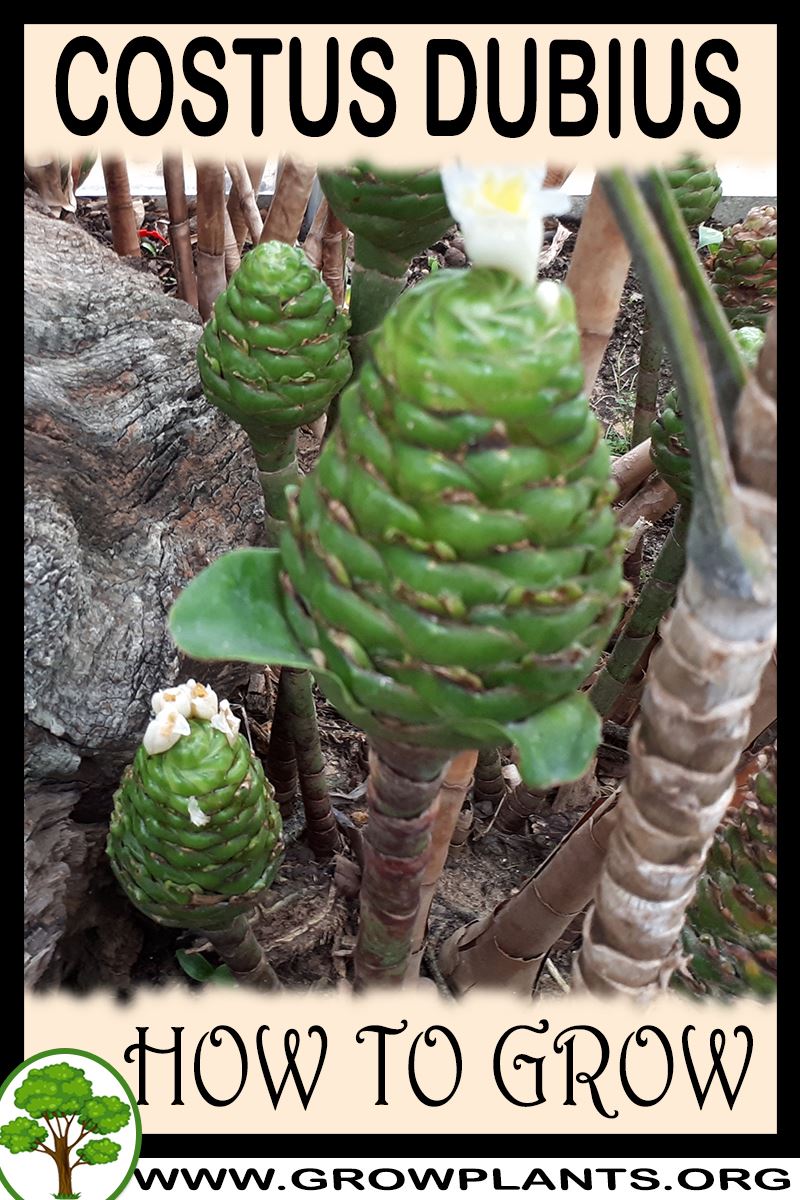
Overview: Costus dubius (Spiral ginger) is an evergreen rhizomatous perennial reaching 1-2.5 m (40-100 in) tall, with elliptic green leaves spiralling up cane-like stems. It is grown as an ornamental fragrant plant for tropical, Mediterranean and subtropical gardens or as a houseplant.
Quick Specifications
| Specification | Attribute |
|---|---|
| Plant Type / Life Cycle | Perennial (evergreen geophyte) |
| Foliage Type | Evergreen where frost-free / indoors |
| Mature Size | 1-2.5 m (40-100 in) tall |
| Growth Rate | Fast to moderate |
| Root System | Rhizomatous (geophyte) |
| Hardiness | USDA zone 10b+ |
Growth Form & Structure
- Height & Spread: 1-2.5 m (40-100 in) tall in the ground, spreading by rhizomes into clumps; also grown in containers and indoors
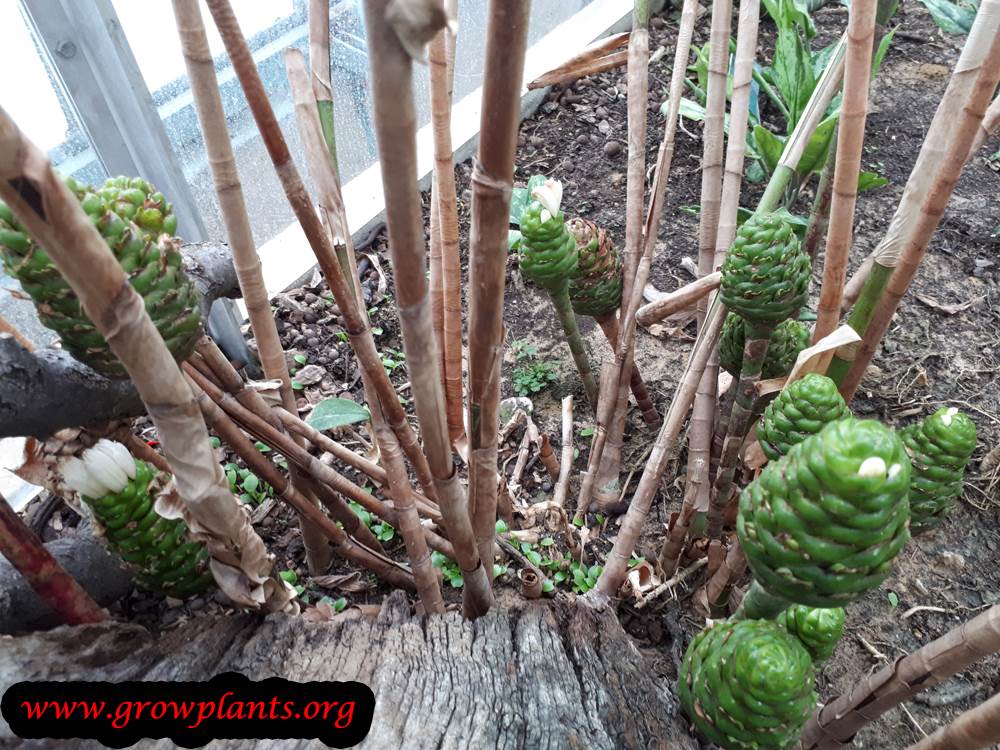
- Growth Habit & Form: Clumping herbaceous ginger with cane-like stems that spiral as they grow
- Lifespan & Maturity: Long-lived perennial that regrows from its rhizome each season
Anatomy & Physical Features
- Leaves & Foliage: Green elliptic leaves, with some green-and-white variegated forms, in a spiral rosette
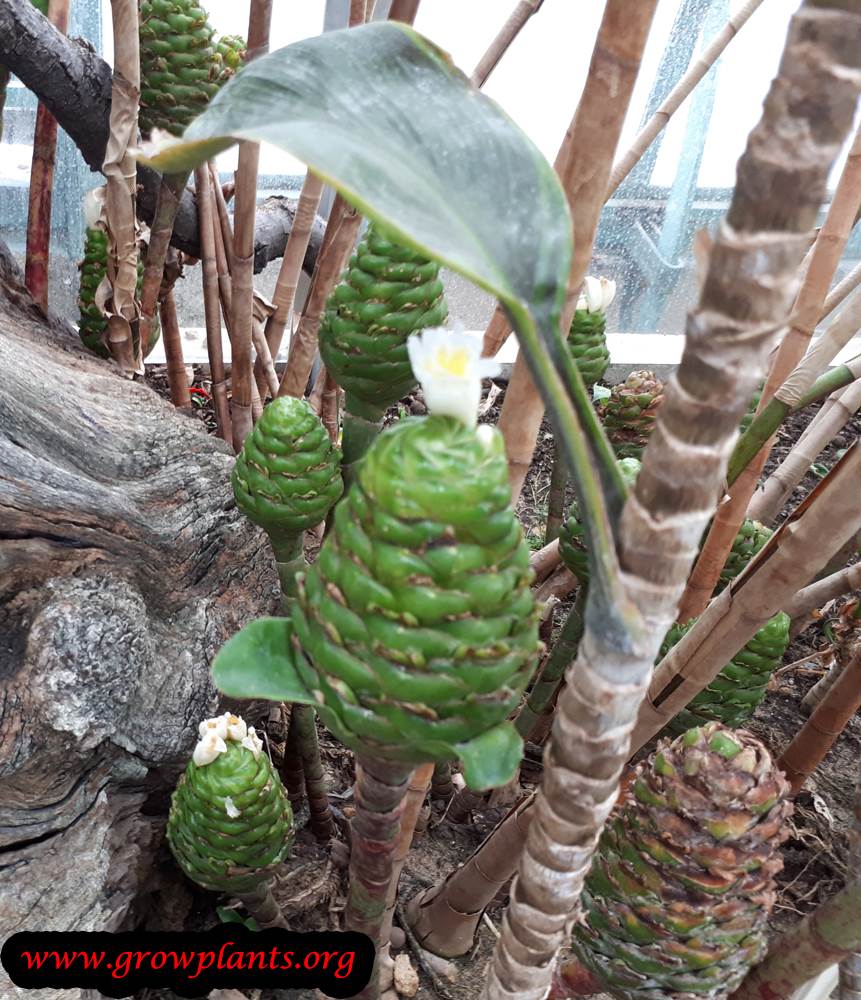
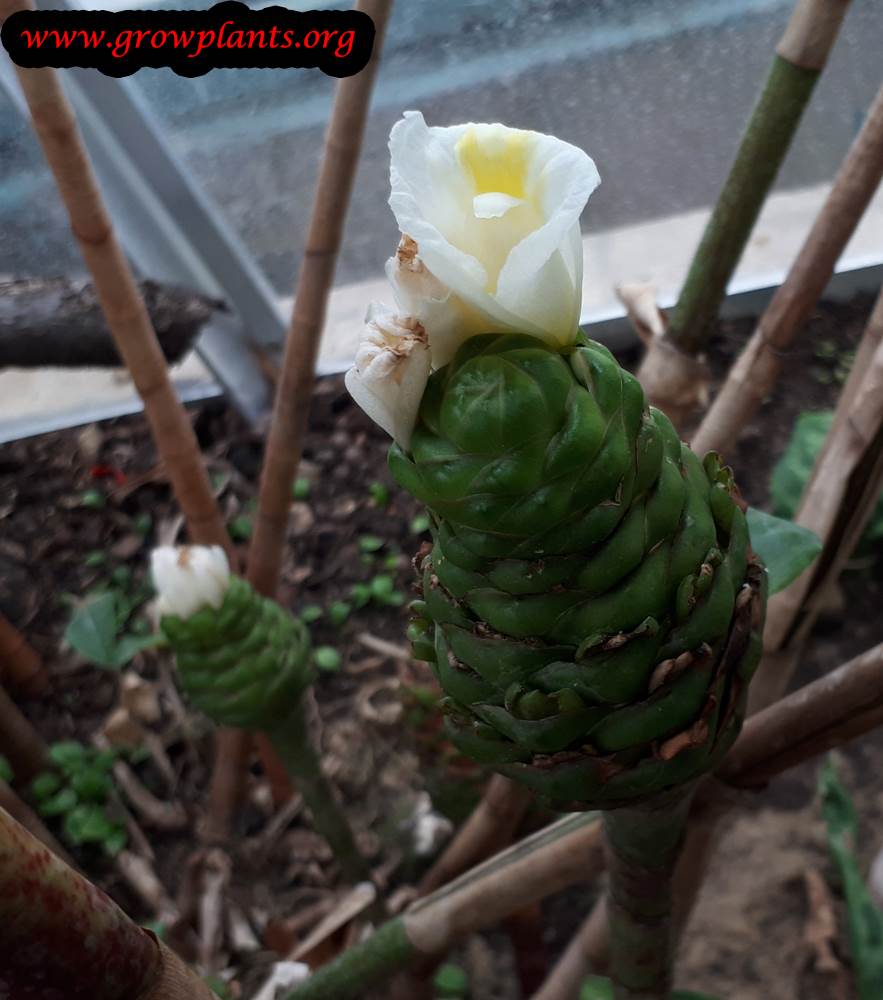
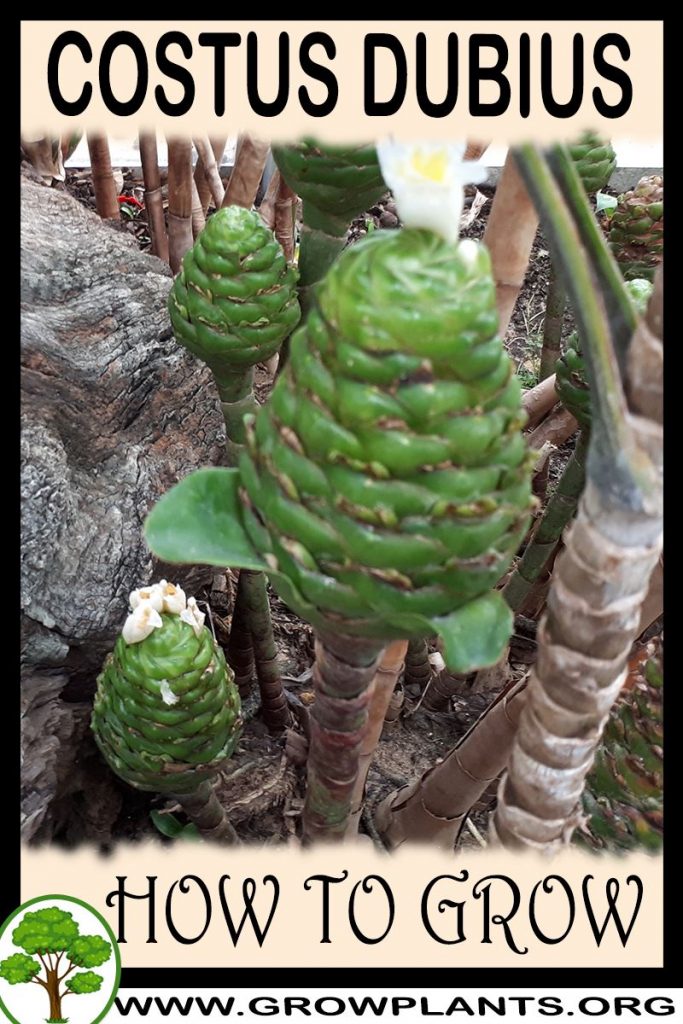
- Flower Characteristics: Fragrant yellow or white flowers emerging from green hive-shaped bracts.
Primary Uses & Landscape Value
- Functional & Ornamental Roles: Ornamental fragrant foliage-and-flower plant for tropical, Mediterranean and subtropical borders, as a container plant or as an indoor houseplant
Care Guide: Planting, Soil & Watering
Overview: Costus dubius (spiral ginger) is a fast-growing tropical perennial that loves warmth, humidity and rich, moisture-retentive soil in full sun to partial shade. It is a thirsty plant that wants consistently moist — but never waterlogged — soil, and it grows only in frost-free conditions.
Quick Care Requirements
| Requirement | Ideal Condition |
|---|---|
| Planting Season | Warm season — spring through autumn |
| Growth Rate | Moderate to Fast |
| Soil Type | Rich, organic, moisture-retentive but well-draining |
| Water Need | Moderate to High — keep the soil consistently moist |
Planting & Establishment
- Best Planting Season: Plant during the warm months, from spring through autumn, while temperatures are high; as it has no frost tolerance, grow it in the open ground only in frost-free climates (zone 10b and warmer) and elsewhere keep it in a container that can be moved under cover for winter.
- How to Plant:
- Hole Preparation: Dig a hole roughly twice the width of the root ball and to the same depth, loosening the base so the fleshy rhizomes can spread.
- Soil Amendments: Blend in generous compost or well-rotted organic matter to hold moisture and feed this hungry, fast grower, while keeping the mix open enough to drain.
- Planting Depth: Set the plant with the crown at soil level and the rhizome just below the surface; do not bury the stems.
- Growth Speed & Expectations: Expect fast to moderate growth in warmth — clumps can reach 1-2.5 m (40-100 in) and spread steadily through the warm season.
Soil, Watering & Drainage Care
- Soil Mix & Drainage Needs: Use a rich, humus-heavy mix that stays moist yet drains freely; in pots choose a large container with good drainage holes so the roots never sit in stagnant water.
- Watering Schedule & Technique:
- Young / Newly Planted: Water frequently to keep the soil evenly moist as the plant establishes.
- Established: Water regularly and deeply so the soil stays consistently moist, especially in heat; this moisture-loving plant dislikes drying out.
- Seasonal Adjustments: Water generously during warm, active growth and reduce watering in cooler weather when growth slows.
Climate, Light & Hardiness
Costus dubius (a spiral ginger) is a warm-climate tropical plant for tropical, Mediterranean, and subtropical gardens, or houseplant growing elsewhere. It tolerates a flexible range of light from full sun to full shade, but needs consistent warmth and humidity year-round.
Quick Climate Specifications
| Climate Zones | Tropics, Mediterranean, subtropics |
|---|---|
| USDA Hardiness Zones | 10b+ |
| Frost Tolerance | None |
| Light Conditions | Full sun to half shade or full shade |
Sunlight & Light Exposure
Optimal Light Setup
Adaptable across full sun, half shade, and full shade, making it easy to place in a range of garden or indoor spots.
Temperature Extremes & Hardiness
USDA Hardiness & Regional Limits
Reliable outdoors year-round only in USDA zone 10b and warmer; elsewhere grow as a houseplant or seasonal container plant.
Cold Damage & Winter Protection
Needs warm conditions all year; the source data specifically flags that it does not tolerate a cold season, so container plants should come indoors well before any cold weather.
Frost Sensitivity
Frost sensitive; not suited to any outdoor freeze exposure.
Wind, Humidity & Microclimate
Humidity Preferences
Prefers high humidity, in keeping with its tropical understory origin.
Growing in Pots, Balconies & Indoors
Costus dubius (Spiral ginger) (Costus dubius) is a lush, shade-tolerant foliage plant, and the grower confirms it grows well both as a houseplant and in containers. It can reach about 1-2.5 m (40-100 in), so give a mature plant room and a large pot, but its tolerance of shade makes it a fine leafy houseplant.
Quick Details
- Container Size: A large, deep container – this is a big, vigorous plant (to about 1-2.5 m (40-100 in))
- Indoor Suitability: A good houseplant (grower-confirmed); tolerates shade well
- Best Spot: Half to full shade indoors or out; keep it out of harsh direct sun
- Soil & Drainage: Rich, organic, moisture-retentive mix that still drains freely
- Watering in Pots: Keep evenly moist – these gingers like generous water; never let them go bone dry
Indoors & On the Windowsill
- A good houseplant: The grower confirms it grows well indoors, and its tolerance of shade suits ordinary room light.
- Give it room: It is a large plant, so allow space and a big pot for the foliage to develop.
- Humidity: Like most gingers it enjoys warmth and humidity – group it with other plants or mist in dry rooms.
On a Balcony or Patio
- Shade & shelter: On a balcony or patio give it a warm, sheltered, part-shaded spot out of strong wind, which tears the large leaves.
- Water & weight: A big leafy plant in a big pot is heavy and thirsty – site it where you can water often and drainage can escape freely.
Choosing the Pot, Soil & Long-Term Care
- Pot & drainage: A large container with strong drainage holes; skip a standing-water saucer to avoid root rot.
- Potting mix: A rich, organic, moisture-retentive mix opened up with perlite so it holds water yet still drains.
- Feeding: Potted gingers are hungry – feed regularly through the growing season, as watering leaches nutrients from the pot.
- Repotting: Divide and refresh the mix every couple of years as the clump fills the pot.
- Overwintering: Where winters are cold, bring the pot into a warm, bright spot – it is frost tender.
Fertilizing & Feeding
A lush, evergreen tropical geophyte grown for its fragrant yellow-or-white flowers set inside green, hive-shaped bracts, this plant grows and blooms for most of the year in its warm climate and is a moderate, fairly steady feeder rather than one with a sharply defined dormant season.
Quick Fertilizing Specs
| Feeding Level | Moderate feeder |
|---|---|
| Main Nutrient Priority | Balanced feeding with adequate nitrogen to support this fast-to-medium growing plant’s lush rosette foliage and near-continuous flowering |
| Best Feeding Period | Through the warm-season active growth and bloom period, which can extend for much of the year in frost-free climates |
| Organic Options | Compost or well-rotted organic matter worked into humid, moisture-retentive soil |
| Reduce/Stop Feeding | Ease off if growth visibly slows during any cooler or lower-light stretch |
| Micronutrients | Usually met by a complete fertilizer in organic-rich soil; correct only a diagnosed problem |
| Soil pH | Grows well in humid, moisture-retentive garden or container soil without needing a particular pH |
Feeding by Growth Stage
Establishment
Help a newly planted or newly potted division root in and begin producing its rosette of elliptic leaves.
| Nutrient direction | A balanced, complete fertilizer supports steady root and rosette establishment in warm, humid conditions. |
|---|---|
| Timing | At planting or potting, in warm weather. |
| Frequency | A starter feeding at planting, followed by light regular feeding as the plant settles in, is usually enough. |
| Fertilizer types | A balanced, complete starter fertilizer, Compost or organic matter worked into the planting area |
| Precautions | Keep the humid, moisture-retentive soil this plant favors evenly moist; avoid feeding into cold or waterlogged conditions. |
Active growth and near-continuous bloom
Sustain the lush rosette foliage and support the fragrant yellow-or-white flowers held inside green, hive-shaped bracts through the plant’s long bloom period.
| Nutrient direction | Continued balanced feeding with adequate nitrogen supports both the plant’s lush foliage and its extended flowering. |
|---|---|
| Timing | Through the main warm-season growth period, when bloom can appear across much of the year and peaks in the warmer months. |
| Frequency | Regular, moderate feeding through this long active period keeps growth and flowering going well. |
| Fertilizer types | A balanced, complete fertilizer, Organic matter renewed as a top-dressing |
| Precautions | Reduce feeding if growth visibly slows in a cooler or lower-light stretch, rather than feeding on a fixed routine regardless of active growth. |
Nutrient Deficiency Signs & Corrections
Older, lower leaves fade to pale green or yellow and new rosette growth slows.
| Possible causes | low available soil or container nutrients, nutrients leaching from the frequent watering this plant needs, root crowding in an undersized container |
|---|---|
| Appears first on | older, lower leaves |
| What to check | recent feeding history, container size and drainage, watering frequency |
| Possible correction | Apply a balanced, complete fertilizer and check that the container or bed has adequate root room. |
New leaves emerge pale yellow while the veins stay distinctly green.
| Possible causes | waterlogged or poorly aerated soil, high soil pH limiting iron availability, root stress from recent division or repotting |
|---|---|
| Appears first on | newest leaves in the rosette |
| What to check | soil drainage and aeration, soil pH, recent transplant or division activity |
| Possible correction | Improve drainage and apply a chelated iron product per its label if the soil is alkaline. |
Plant produces lush foliage but few or no fragrant flowers within the bracts.
| Possible causes | insufficient light for a plant that flowers best with good bright light, overfeeding with a nitrogen-heavy fertilizer favoring leaves over flowers, slug damage reducing overall plant vigor |
|---|---|
| Appears first on | whole-plant effect rather than a single stem |
| What to check | light exposure, recent fertilizer type and amount, signs of slug feeding |
| Possible correction | Improve light exposure, moderate feeding to a balanced routine, and manage slugs directly. |
Pruning, Training & Seasonal Maintenance
Costus dubius (a spiral ginger) grows as a clump of soft, fleshy canes rising from a spreading rhizome, not as a woody shrub — each cane spirals upward, may open its fragrant yellow-to-white flowers from green, hive-shaped bracts near the tip, and then gradually declines once that cycle finishes. Because new growth always comes from the rhizome rather than by branching off an old cane, pruning is essentially year-round housekeeping: removing spent or dying canes and leaves at the base to keep the clump tidy and make room for the vigorous new shoots that replace them.
Quick Pruning & Maintenance Specs
| Pruning Tolerance | High (regrows readily from the rhizome) |
| Primary Pruning Window | All year in warm climates; heaviest cane removal after a cane finishes flowering |
| Typical Frequency | Ongoing, as canes decline or flower out |
| Main Objective | Remove spent/declining canes and dead leaves; keep the clump renewing itself |
| Young Plant Priority | Minimal – let new divisions establish a first flush of canes |
| Mature Plant Priority | Base-level cane renewal and clump density control |
| Best Tool Type | Precision snips / bypass secateurs |
Pruning by Plant Age & Size
Newly Established
Remove only damaged or dead leaves; a young division needs its full cane and leaf mass to build up the rhizome.
Young / Formative
No structural training applies — this is a clumping rhizomatous herbaceous plant, not a tree or vine. Simply let canes emerge and thin overcrowded shoots if the clump becomes dense.
Mature / Established
Ongoing cane renewal: cut individual canes at the base once they have flowered and begin to yellow or decline, rather than trying to keep every cane indefinitely.
Structural Pruning & Training
Thin overcrowded canes at the base to maintain airflow and an open, attractive clump; this is a renewal-pruning habit typical of rhizomatous gingers rather than a canopy-thinning one, since each cane is a self-contained, once-through shoot rather than a branch that regrows from where it’s cut.
Special Growth to Remove
- Dead leaves and spent stems/canes, which the plant sheds naturally as new growth emerges from the rhizome.
- Canes that have finished their flowering cycle and are visibly declining — cut these at the base rather than partway, since they will not resprout laterally from a partial cut.
Container & Small-Space Pruning
Grown indoors or in a container, more frequent cane thinning helps keep the clump compact; when repotting, dividing and thinning the rhizome itself controls overall size more effectively than just cutting canes.
Tools
- Precision snips: for dead leaves and thin new growth.
- Bypass secateurs: for cutting thicker, fleshy mature canes cleanly at the base.
Tool Hygiene & Disease Risk
Routine: this species’ main problem is slugs, not a tool-transmissible pathogen, so ordinary clean, sharp tools are sufficient.
Cut Placement & Technique
Cut spent canes as close to the base (soil/rhizome level) as possible — a partial cut leaves an unproductive stub, since regrowth comes from the rhizome, not from buds along the old cane.
Heavy Pruning & Rejuvenation
Tolerated: like many rhizomatous gingers, an overgrown or leggy clump can be cut back hard to near ground level, and it will resprout a fresh flush of canes from the rhizome during the next warm growing period.
Post-Pruning Care
Keep the rhizome zone consistently moist (this species likes average-to-heavy water) after a hard cutback to support the new flush, and watch for slugs targeting tender new shoots.
Common Pruning Mistakes
- Cutting a declining cane partway up instead of at the base, leaving a stub that will not produce new growth.
- Removing canes that are still actively flowering, sacrificing the current bloom display for no horticultural benefit.
When NOT to Prune
Avoid cutting canes that are still in active bloom if you want to keep the current flower/bract display; there is little other seasonal restriction given the plant’s year-round growth in warm climates.
Recommended Tools (by task)
- precision_snips – for routine removal of dead leaves and thin declining growth.
- bypass_secateurs – for clean base cuts through thicker, fleshy mature canes.
Propagation Guide
Costus dubius is most reliably propagated by rhizome division or stem cuttings, since the site notes that vegetative reproduction is needed to reproduce the mother plant’s exact traits – an important point for the variegated green-and-white leaved forms, which would not come true from seed. Seed is possible but grows slowly to a mature clump; overall this plant is Easy to Moderate to propagate vegetatively.
Quick Propagation Specs
| Best Propagation Method | Rhizome division |
| Alternative Methods | Stem/cane cuttings; seed (species form only) |
| Propagation Difficulty | Easy to Moderate |
| Seed True-to-Type | Variable – variegated forms will not come true |
| Vegetative True-to-Type | Yes – required to preserve variegation and exact form |
| Best Propagation Season | Spring through autumn (the site’s active planting season) |
| Cutting Rooting Time | Typically several weeks under warm, humid conditions |
| Germination Temperature | Warm, roughly 22–28°C (72–82°F), matching its tropical/subtropical habit |
Growing from Seed
Seed can be used to raise the species form, but variegated selections will not reproduce their white leaf patterning from seed. Sow fresh seed in a warm, humid, well-drained mix; as with most tropical gingers, germination is often slow and uneven, so patience is needed.
Stem Cuttings
Cutting Type
Sections of the leafy, rosette-topped cane/stem can be cut and rooted, similar to other spiral gingers.
Best Timing
Spring to summer, during the plant’s active warm-season growth.
Rooting Setup
Root in a moist, humid, well-drained medium out of direct hot sun; this tropical plant roots best with consistent warmth and humidity.
Rooting Hormone
Not required – cane and rhizome sections of gingers typically root without hormone treatment.
Rooting Time
Generally a few weeks under warm, humid conditions.
Rhizomes, Tubers, Bulbs & Corms
Rhizome Division
As a herbaceous geophyte, Costus dubius spreads by underground rhizomes; established clumps can be lifted and divided into sections, each with at least one growth point/eye and some roots attached, then replanted at the same depth. Division is best done during the active growing season (spring through autumn) so new divisions can establish before any cooler or drier period.
Bloom & Flower Guide
Quick Details
- Bloom Season: Can flower through much of the year, mainly summer to autumn
- Time to First Bloom: On established clumps once they are in strong, warm-season growth
- Flower Appearance: Fragrant yellow or white flowers opening from within green, hive-shaped bracts
- Edibility: Ornamental only – grown as a fragrant ornamental, not for eating
Detailed Blooming Overview
Costus dubius is a spiral ginger grown for its handsome foliage and its curious cone of bloom. The showy part is a green, hive-shaped cluster of bracts, and from within it the true flowers open a soft, fragrant yellow or white, a few at a time. It flowers best on a settled clump in warmth and humidity, mostly through the summer-to-autumn stretch.
Flower Characteristics
- Fragrant flowers in yellow or white, opening from within the bracts.
- Green, hive-shaped bracts that form the long-lasting cone of the display.
Bloom Care & Thinning
- Encouraging bloom: Warmth, humidity and an established clump bring on the best flowering; feed and water well in the growing season.
- After flowering: Cut spent flowering stems back to the base to keep the clump fresh.
- Pollination: The nectar-rich flowers are visited by bees and, in warm climates, nectar-feeding birds.
Pests, Diseases & Troubleshooting
Overview: Spiral gingers are lush tropicals whose main enemies are dry-air spider mites and the usual greenhouse sap-suckers, plus fungal leaf spots and rhizome rot where drainage or humidity is wrong. Grow them warm, humid and in rich but free-draining soil, keep the foliage clean and the air moving, and you’ll avoid most trouble; treat pests organically and be ruthless about cutting away any soft, rotten rhizome tissue.
Quick Troubleshooting Overview
| Issue / Pest | Main Symptom | Primary Solution |
|---|---|---|
| Spider mites | Fine stippling, bronzing and webbing on leaves in dry air | Raise humidity, rinse foliage, oil / predatory mites |
| Mealybug & scale | White fluff or brown bumps in leaf axils and stems | Alcohol swab, insecticidal soap, horticultural oil |
| Fungal leaf spot | Brown/black spots with yellow halos on leaves | Remove leaves, improve airflow, copper fungicide |
| Rhizome / root rot | Yellowing, wilting, foul soft rot at the base | Cut to clean tissue, dry, repot in free-draining mix |
| Root-knot nematode | Stunting, galled roots, decline despite good care | Sanitise soil, add organic matter, rotate/replace media |
| Low-humidity leaf browning | Crispy brown leaf edges and tips | Raise humidity, flush salts, use clean water |
Common Pests & Management
- Spider mites (Tetranychus urticae):
- Symptoms: The number-one indoor problem: fine pale stippling, a dull silvery-bronze cast and delicate webbing on leaf undersides in warm, dry, stagnant air; leaves brown and drop in bad cases.
- Prevention & Control: Keep humidity high and hose or wipe the foliage, especially undersides. Improve airflow and avoid drought stress. Introduce predatory mites (Phytoseiulus persimilis) under cover, or apply horticultural oil / insecticidal soap, rotating types to prevent resistance.
- Mealybugs (Planococcus & Pseudococcus spp.):
- Symptoms: White cottony masses tucked into leaf axils, along the midrib and in the furled new leaf; sticky honeydew and sooty mould follow, and root mealybug can attack the rhizome zone.
- Prevention & Control: Dab colonies with 70% alcohol, wipe leaves clean, and isolate new plants. Insecticidal soap or neem on repeat covers light infestations; a soil systemic drench is the fallback for heavy or root-zone attacks.
- Scale insects (Coccidae & Diaspididae):
- Symptoms: Brown or tan limpet-like bumps along stems and leaf veins, often with honeydew from soft scale; growth weakens and yellows.
- Prevention & Control: Scrape off and treat with horticultural oil or insecticidal soap in the cool evening, repeating every couple of weeks. Prune out heavily encrusted canes; encourage parasitic wasps outdoors.
- Aphids (Aphis spp.):
- Symptoms: Clusters of soft green or black insects on tender new growth and flower bracts, causing distortion, honeydew and sooty mould.
- Prevention & Control: Rinse off with water, support natural predators, and use insecticidal soap or neem if they persist. Avoid heavy nitrogen feeding that drives soft, aphid-prone flushes.
- Root-knot nematode (Meloidogyne spp.):
- Symptoms: Above-ground stunting, wilting and decline that ignore good watering and feeding; roots show characteristic knotty galls when lifted.
- Prevention & Control: Use clean, pasteurised or fresh media and healthy divisions, and add plenty of organic matter to support antagonistic microbes. Discard badly galled plants; solarise or replace infested bed soil and rotate.
Diseases & Fungal Issues
- Fungal leaf spot (Cercospora, Colletotrichum & related fungi):
- Symptoms: Round to angular brown or black spots, often ringed with a yellow halo, spreading in warm wet conditions and from overhead watering; spots may merge and blight large areas of leaf.
- Treatment & Management: Remove and destroy spotted leaves, water at the base to keep foliage dry, and improve air circulation and spacing. A copper-based fungicide checks persistent spread; avoid crowding and leaf wetness going into humid weather.
- Rhizome & root rot (Pythium, Fusarium & bacterial (Ralstonia) rots):
- Symptoms: Yellowing, wilting and collapse with a soft, foul-smelling, discoloured rhizome and roots; often follows waterlogging, cold wet soil or a dirty cut.
- Treatment & Management: Grow in rich but sharply draining soil, keep it moist not sodden, and warm. If rot appears, lift the plant, cut the rhizome back to firm white tissue with a sanitised blade, dust with sulfur, dry, and replant in fresh mix. Discard bacterial-wilt plants.
- Rust (Puccinia-type fungi (occasional)):
- Symptoms: Powdery orange to brown pustules on leaf undersides with yellow flecking above, mainly in warm humid conditions.
- Treatment & Management: Remove affected leaves, improve airflow and reduce leaf wetness. A sulfur or appropriate fungicide helps under persistent pressure; usually minor on well-grown plants.
Growing Difficulties & Abiotic Problems
- Low-humidity leaf browning & salt burn:
- Cause & Symptoms: Dry indoor air, hard or salty water and fertiliser build-up crisp the leaf edges and tips to brown.
- Correction Strategy: Raise humidity (grouping, pebble trays, misting the air), flush the pot periodically with clean water to leach salts, and feed at modest rates. Use rain or filtered water where tap water is hard.
- Sunburn / leaf scorch:
- Cause & Symptoms: Abrupt exposure to strong direct sun bleaches and browns the foliage of these understorey plants.
- Correction Strategy: Give bright, filtered light or morning sun with afternoon shade, and acclimatise gradually when moving plants outdoors.
- Cold damage:
- Cause & Symptoms: Temperatures near or below about 10°C blacken and collapse the soft foliage; the rhizome may rot in cold wet soil.
- Correction Strategy: Keep plants warm and protected from cold drafts; in cool climates grow in containers and overwinter indoors, keeping the rhizome barely moist.
- Chlorosis / nutrient shortage:
- Cause & Symptoms: Pale yellowing between green veins on poor or waterlogged soil signals nitrogen or micronutrient shortfall.
- Correction Strategy: Feed with a balanced fertiliser through the growing season, correct drainage, and apply chelated iron/manganese if interveinal yellowing persists.
What Helps – Products & Tools
The practical kit is insecticidal soap, neem or horticultural oil for mites, mealybug, scale and aphids (with a humidity boost to deter mites), copper fungicide for leaf spot and sulfur for rust, plus a sharp sanitised knife and free-draining mix for managing rhizome rot. Predatory mites and clean media round out an organic-first approach.