
Plant Profile & Key Characteristics
Overview: Pawpaw is a deciduous large shrub or small tree reaching 3-6 m (10-20 ft), the hardiest member of the tropical custard-apple family. This perennial is grown for its sweet edible fruit and is suited to temperate and subtropical gardens.
Quick Specifications
| Specification | Attribute |
|---|---|
| Plant Type / Life Cycle | Perennial (deciduous shrub / small tree) |
| Foliage Type | Deciduous |
| Mature Size | 3-6 m tall (10-20 ft) |
| Growth Rate | Moderate to fast |
| Root System | Taproot; spreads by basal root suckers into colonies |
| Toxicity | Fruit flesh edible; seeds, leaves and bark are toxic |
| Hardiness | USDA zones 6-9 (10a with care) |
Growth Form & Structure
- Height & Spread: 3-6 m (10-20 ft) tall; can be kept small in a large container or as a bonsai, and readily forms suckering colonies in the ground.
- Growth Habit & Form: Deciduous shrub or small pyramidal tree; sends up aggressive basal shoots that form thickets.
- Lifespan & Maturity: Long-lived; begins bearing fruit in about 2-4 years.
Anatomy & Physical Features
- Flower Characteristics: Purple triangular flowers with a meaty scent that attracts beetles and flies for pollination (see Bloom guide).
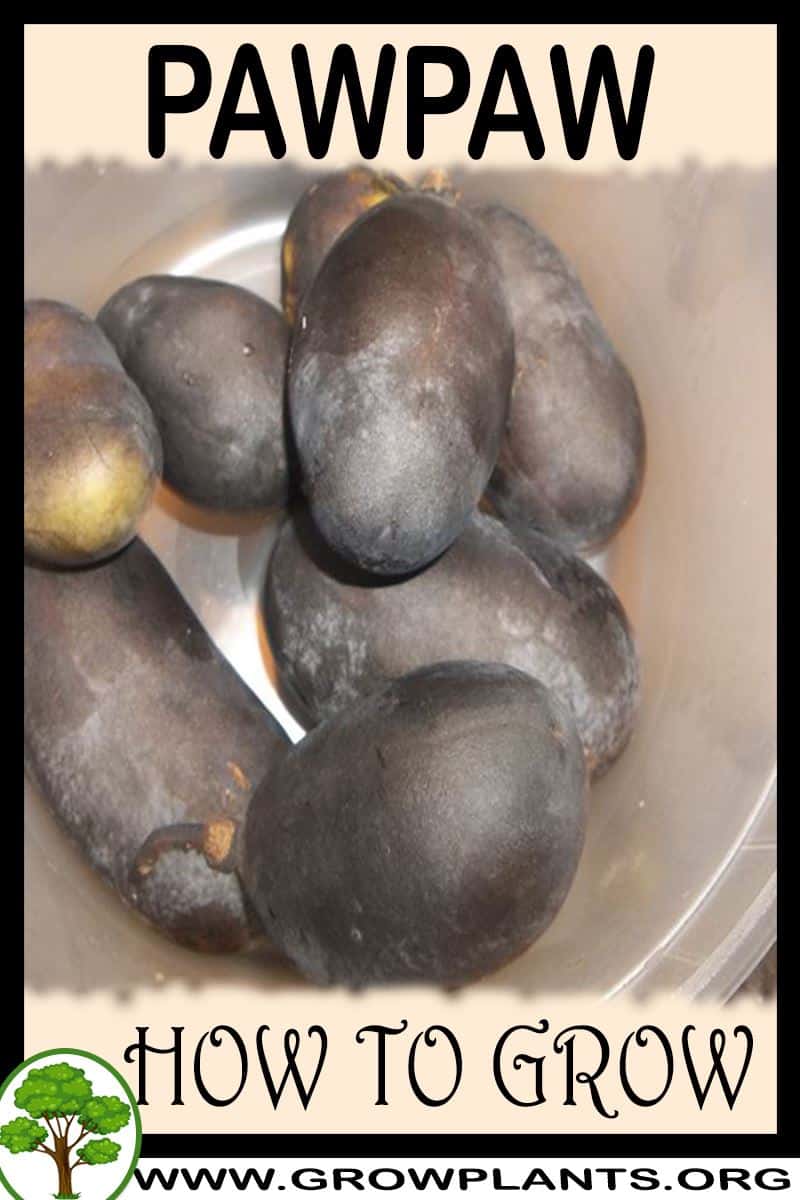
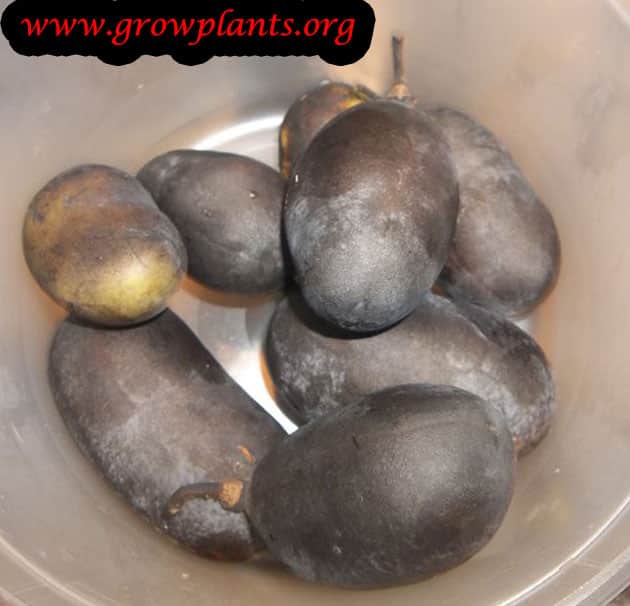
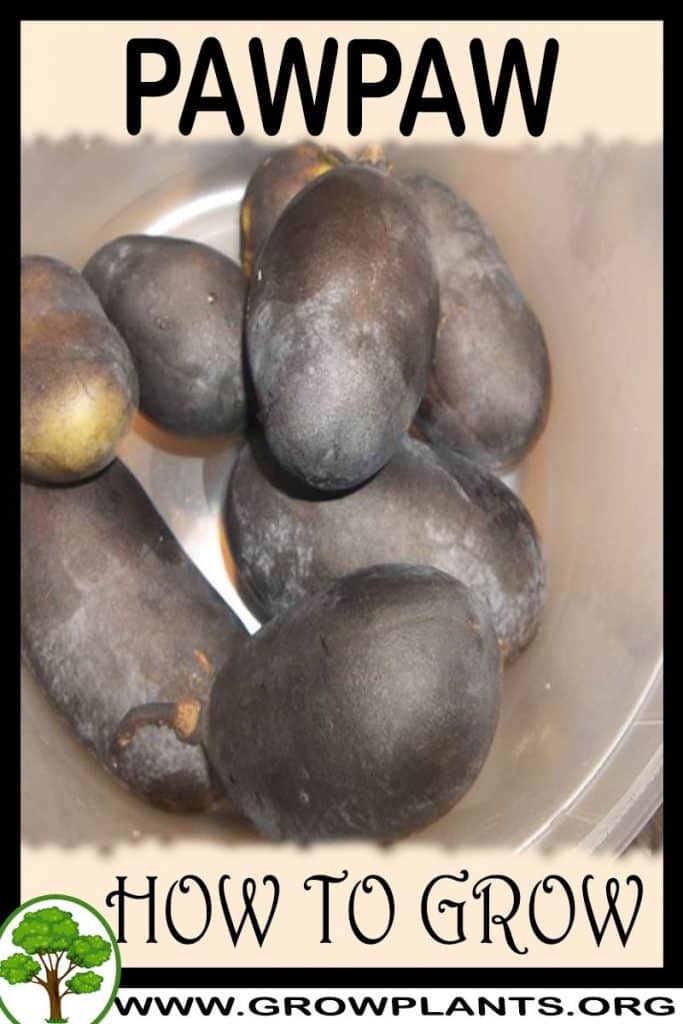
- Fruit Profile: Large fruit with brown skin and soft custard-like white flesh (see Fruit guide).
Primary Uses & Landscape Value
- Edible Uses: Ripe fruit eaten raw or used in juice, cakes and jam.
- Functional & Ornamental Roles: Fruit tree for temperate gardens; useful for naturalising thanks to its suckering habit.
Care Guide: Planting, Soil & Watering
Overview: Pawpaw is a small deciduous tree of temperate climates (hardiness zone 6–9, or 10a with care) that needs winter chilling hours and grows in full sun to part shade. It prefers deep, rich, well-drained soil kept evenly moist, with mulch to protect its roots.
Quick Care Requirements
| Requirement | Ideal Condition |
|---|---|
| Planting Season | Late winter to early spring, while dormant |
| Growth Rate | Moderate to fast (quicker with feeding) |
| Soil Type | Deep, rich, organic, well-drained and evenly moist |
| Water Need | Moderate to high |
Planting & Establishment
- Best Planting Season: Plant while dormant in winter to early spring; the tree can also go in through spring and summer, but late winter to early spring is best.
- How to Plant:
- Hole Preparation: Dig a hole about 50% wider than the root ball so roots settle into loosened soil.
- Soil Amendments: Mix organic matter, humus and dead leaves into some of the returned soil, add fertilizer, and mulch after planting.
- Planting Depth: Set the tree at its original depth, firm the soil gently but enough to keep it stable, and stake if it is not steady. Pawpaw resents root disturbance, so handle young trees carefully.
- Growth Speed & Expectations: Growth is moderate to fast – quicker with adequate feeding – reaching 3–6 m.
Soil, Watering & Drainage Care
- Soil Mix & Drainage Needs: Rich, deep, well-drained soil suits it best; keep it moist but not waterlogged, and mulch to conserve moisture and protect the roots.
- Watering Schedule & Technique:
- Young / Newly Planted: Water twice on planting day, then every day for the first two weeks while the tree establishes.
- Established: Water established trees regularly and deeply, giving an average to large amount, especially through the growing season.
- Seasonal Adjustments: Water more in summer heat and during fruiting; the tree is deciduous and needs little water once dormant in winter.
Climate, Light & Hardiness
Pawpaw is a cold-hardy deciduous fruit tree native to temperate climates, needing real winter chill to grow and fruit well, though it also succeeds in Mediterranean and subtropical gardens. It grows in full sun to half shade, with fuller sun generally producing more fruit.
Quick Climate Specifications
| Climate Zones | Temperate, Mediterranean, subtropical |
|---|---|
| USDA Hardiness Zones | 6–9, and 10a with the right care |
| Frost Tolerance | High (dormant tree) |
| Light Conditions | Full Sun / Half Shade |
Sunlight & Light Exposure
Optimal Light Setup
Full sun generally gives the best fruit yield, though pawpaw also tolerates half shade, reflecting its natural habit as an understory tree.
Shade & Heat Management
Pawpaw handles full-sun exposure well across its temperate-to-subtropical climate range once established.
Temperature Extremes & Hardiness
USDA Hardiness & Regional Limits
Pawpaw is hardy in USDA zones 6–9, and can be grown with attentive care into zone 10a, spanning cold temperate winters through mild subtropical conditions.
Cold Damage & Winter Protection
The dormant tree tolerates winter cold well within its rated zones; planting in winter to early spring, when the tree is still dormant, gives it the best start.
Frost Sensitivity
Spring blossoms are more vulnerable to a late frost than the dormant wood, which can reduce fruit set for the season.
Chilling Requirement
Winter chilling hours are listed as an important care requirement for pawpaw, supporting proper dormancy break and spring flowering.
Wind, Humidity & Microclimate
Microclimate Recommendations
Plant in a sunny to lightly shaded site with rich, mulched soil, avoiding frost-prone low spots that could damage spring blossoms.
Growing in Pots, Balconies & Indoors
Pawpaw is a fruit tree rather than a houseplant – indoors it will not get enough light to grow or crop. The grower does raise it in large containers, though, kept small as a shrub or even a bonsai, which makes it a workable patio or balcony plant.
Quick Details
- Container Size: Start about 20%% larger than the root ball and grow the pot up with the tree (see the grower’s tip)
- Indoor Suitability: Not a houseplant; keep it small in a pot outdoors
- Best Spot: Full sun (more fruit) to half shade – the sunniest outdoor spot gives the most fruit
- Soil & Drainage: Peat, perlite and organic matter with plenty of drainage holes
- Watering in Pots: Average to generous; water regularly but never waterlogged
Indoors & On the Windowsill
- Not a houseplant: The grower does not grow Pawpaw indoors – a room, even by a window, is too dim for it to grow well or fruit.
- Cold tolerance: Pawpaw is a hardy temperate tree that needs a cold winter dormancy, so it stays outdoors year-round and does not need bringing inside.
- Safety: The ripe pulp is edible, but the seeds and skin are toxic – keep seeds away from children and pets.
On a Balcony or Patio
- Light & wind: Give it the sunniest, most sheltered spot; keep young, brittle growth staked and out of strong wind.
- Reflected heat & drying: Walls and paving reflect heat and dry pots fast, so check moisture daily in warm weather. A drip irrigation kit with a timer can take over that watering check automatically.
- Pollination: Keeping the tree small in a pot makes hand-pollinating the flowers far easier, which these trees often need for a good crop.
Choosing the Pot, Soil & Long-Term Care
- Pot & drainage: A pot with strong drainage holes is essential; skip a permanently full water saucer to avoid root rot, and empty any tray the same day it collects water.
- Potting mix: The grower’s blend is peat, perlite and organic matter – open and free-draining.
- Feeding: Feed about four times a year and work in some humus a few times a year; potted trees need topping up more often as nutrients leach away.
- Refreshing the soil: Every few years swap out part (not all) of the soil from the sides and top and trim some of the root ball, rather than moving to an ever-larger pot.
Grower’s Container Tip
- Grow the pot up with the tree: Start only about 20%% larger than the root ball and step up a size each time the roots fill it, rather than starting a small tree in a big pot. The grower favours this because it protects the health of the soil and keeps care efficient.
- Graft two cultivars: Consider grafting two cultivars onto one potted plant to help pollination and fruit set in a small space.
Fertilizing & Feeding
Pawpaw is a moderate feeder overall, but as a temperate deciduous tree it should be fed on a spring-through-summer cycle rather than year-round, and feeding should stay measured given how readily this species sends up root suckers.
Quick Fertilizing Specs
| Feeding Level | moderate |
|---|---|
| young_feeding | Young trees benefit from a nitrogen-leaning feed timed to spring growth to help them establish a strong framework. |
| mature_feeding | Bearing trees do best on a balanced feed that leans toward potassium as fruit develops. |
| Main Nutrient Priority | Nitrogen while young and establishing, shifting to balanced-to-potassium once fruiting begins. |
| Best Feeding Period | As new growth resumes in spring through the active summer growing season; not during winter dormancy. |
| Organic Options | Compost and organic matter worked into mulch support steady feeding without forcing excess vigor. |
| Soil pH | Prefers rich soil with consistent moisture. |
Feeding by Growth Stage
Newly Planted Pawpaw
Help a young pawpaw establish roots in rich soil after transplanting.
| Nutrient direction | Keep feeding light and balanced while the root system establishes; this understory tree does not need heavy fertilizer to get started. |
|---|---|
| Timing | Once the tree shows clear new spring growth after planting. |
| Frequency | Light feeding through the first growing season, tapering back if growth stalls. |
| Fertilizer types | A balanced, general-purpose fruit tree fertilizer applied sparingly, Organic matter worked into the planting hole and renewed as mulch |
| Precautions | Avoid heavy fertilizer right at planting; pawpaw roots establish gradually and are easily stressed by concentrated feed. |
Young, Establishing Pawpaw
Build a sturdy framework as the tree grows from shrub-like form toward a small tree.
| Nutrient direction | Favor a nitrogen-forward feed timed to spring growth to support steady branching. |
|---|---|
| Timing | As new growth begins in spring and continues through summer. |
| Frequency | Regular light feedings through the spring and summer growing season, stopping well before dormancy. |
| Fertilizer types | A nitrogen-leaning complete fruit tree fertilizer applied during the growing season, Composted organic matter worked into the mulch |
| Routine trace nutrients | iron, manganese, zinc |
| Precautions | Pawpaw is known for sending up basal shoots and can be somewhat aggressive; avoid heavy nitrogen that encourages excess sucker growth around the base rather than a strong central framework. |
Established, Pre-Bearing Pawpaw
Maintain balanced growth as the tree matures toward its first fruit set.
| Nutrient direction | Shift toward a balanced feed rather than the nitrogen-heavy routine used while young. |
|---|---|
| Timing | At the start of spring growth and again as flowering approaches. |
| Frequency | Moderate, evenly spaced feeding through the spring and summer growing months. |
| Fertilizer types | A balanced complete fruit tree fertilizer, Organic matter renewed in the mulch each season |
| Routine trace nutrients | iron, manganese, zinc |
| Precautions | Because pawpaw flowers rely on carrion-mimicking scent to attract beetles and flies rather than typical pollinators, avoid heavy nitrogen at bloom that could favor leafy growth over flowering. |
Mature, Fruit-Bearing Pawpaw
Support fruit development on a bearing tree while managing its tendency to sucker.
| Nutrient direction | Keep nitrogen moderate and let potassium play a larger role as fruit develops. |
|---|---|
| Timing | As new spring growth resumes and again while fruit is developing over summer. |
| Frequency | Regular, moderate feeding through the growing season, stopping well before the tree goes dormant for winter. |
| Fertilizer types | A balanced to potassium-leaning fruit tree fertilizer timed to fruit development, Fresh organic mulch renewed around the root zone each season |
| Routine trace nutrients | iron, manganese, zinc |
| Precautions | Because pawpaw suckers readily from the base, avoid heavy nitrogen applications that could fuel unwanted root sprouts at the expense of fruiting wood. |
Nutrient Deficiency Signs & Corrections
New leaves yellow between veins that remain green
| Possible causes | Iron deficiency linked to alkaline or compacted soil limiting iron uptake, Poor drainage keeping roots too wet to function well, Recent transplant or root disturbance temporarily limiting uptake |
|---|---|
| Appears first on | Newest leaves toward the shoot tips |
| What to check | Soil drainage and how long water sits after rain or irrigation, Soil pH relative to the tree’s preferred range, Whether the pattern is limited to new growth or has spread |
| Possible correction | Improve drainage and correct soil pH before assuming a straight iron shortfall; a chelated iron product applied per its label can help once those conditions are addressed. |
Numerous shoots sprouting from the base or roots rather than from the main framework
| Possible causes | A natural growth habit for this species that can be intensified by excess nitrogen, Root disturbance, such as nearby digging or mowing damage, triggering sucker response, General vigor from favorable growing conditions rather than any deficiency |
|---|---|
| Appears first on | Base of the trunk and along nearby surface roots |
| What to check | Recent nitrogen feeding rate relative to the tree’s stage, Any recent root disturbance near the base, Whether suckers are being routinely removed or left to accumulate |
| Possible correction | Reduce nitrogen rates going forward and prune out unwanted suckers rather than fertilizing further; this is a growth-habit issue more than a nutrient deficiency. |
Pale overall leaf color and reduced shoot extension during the growing season
| Possible causes | Nitrogen deficiency from under-feeding during the spring-to-summer growth window, Root stress from poor drainage limiting nutrient uptake, Fresh organic mulch still breaking down and temporarily tying up nitrogen |
|---|---|
| Appears first on | Older leaves lower in the canopy first |
| What to check | Feeding history relative to the tree’s current growth stage, Mulch type and timing of the last application, Shoot growth compared with a typical season |
| Possible correction | Resume a stage-appropriate spring feeding routine and confirm drainage is adequate before increasing fertilizer. |
Pruning, Training & Seasonal Maintenance
Pawpaw tolerates only light-to-moderate pruning and, unlike the tropical Annona trees in this collection, flowers on wood grown the previous season – so removing too much of last year's growth in a dormant prune can remove next spring's flower buds along with it. Its own guidance is explicit: prune mainly "in the beginning" to set the tree's form as a single tree or a multi-stem shrub, then limit later cuts to weak or damaged branches. The tree also suckers aggressively from the roots, so the other major recurring task is managing that basal growth rather than shaping the canopy.
Quick Pruning & Maintenance Specs
| Pruning Tolerance | Low–Moderate |
| Primary Pruning Window | Winter dormancy |
| Typical Frequency | Light, mostly in the formative years; occasional thereafter |
| Main Objective | Set tree/shrub form early; remove weak wood; manage root suckers |
| Young Plant Priority | Choose and commit to a single-trunk tree form or a multi-stem shrub form |
| Mature Plant Priority | Remove weak or damaged branches; control root-sucker spread |
| Best Tool Type | Bypass secateurs, loppers; spade for dividing root suckers |
| Avoid Heavy Pruning During | Dormant-season removal of last year's growth, since that wood carries next spring's flowers |
Pruning by Plant Age & Size
Newly Established
This is the key pruning window for pawpaw: decide now whether the tree will be trained to a single leader or allowed to form a multi-stem shrub clump, since later correction is harder once the form is set.
Young / Formative
Central-leader training for a single-trunk tree, or select-and-thin for a multi-stem shrub form; remove weak, spindly branches that won't hold fruit weight.
Mature / Established
Minimal intervention – remove only dead, damaged or clearly weak wood, and stay on top of root suckers around the base each season.
Seasonal Pruning Schedule
Dormant/Winter
Objective: remove weak/damaged wood and take root suckers for propagation if wanted. What NOT to remove: healthy one-year-old wood, since that is what flowers the following spring. Flowering impact: over-cutting last year's growth directly reduces next spring's bloom.
Flowering & Fruiting Wood
Pawpaw flowers on one-year-old wood (the previous season's growth), appearing in spring around leaf-out. This is the opposite timing logic from the Annona trees in this collection: hard dormant pruning here removes potential flowers rather than forcing new flowering wood, so cuts should be selective (weak/dead/crossing wood) rather than a routine annual hard cutback.
Structural Pruning & Training
- Single-leader or multi-stem shrub form, decided while young.
- Remove crossing or weak branches that won't support the fruit.
- No routine canopy-density thinning is called for – pawpaw is not managed for hand-pollination access the way the Annona species are.
Special Growth to Remove
- Root suckers: pawpaw is noted as an aggressive root-suckering species; remove unwanted suckers around the base each season, or retain and dig selected ones (with their own roots) for propagation, ideally taken in the dormant season before spring root activity begins.
Container & Small-Space Pruning
Pawpaw can be grown in a large container while young, with size held through root and top pruning at repotting; because the species is self-incompatible, grafting a second, genetically distinct cultivar onto the same tree is a practical way to secure cross-pollination in a small-space planting rather than needing two separate trees.
Tools
Bypass secateurs for young formative work, loppers for thicker weak-wood removal, and a spade if dividing root suckers for propagation.
Tool Hygiene & Disease Risk
Routine: pawpaw's own facts list only aphids as a pest, consistent with the species' general reputation for being lightly troubled by pests and disease; clean, sharp tools are sufficient.
Cut Placement & Technique
- Cut weak or crossing branches back to a healthy lateral or the trunk, just outside the branch collar.
- When taking root suckers for propagation, sever with a clean cut close to the parent root, retaining as much of the sucker's own root as possible.
Heavy Pruning & Rejuvenation
Not a routine practice: pawpaw is not described as tolerating hard rejuvenation pruning the way the fast-flushing Annona trees do, since its flowers sit on the previous year's wood. Limit cuts to formative shaping and ongoing weak-wood removal rather than periodic hard cutbacks.
Post-Pruning Care
- Water newly transplanted or recently root-divided suckers consistently while they establish.
- Monitor cut sites on young trees for dieback before the next dormant season.
Common Pruning Mistakes
- Hard-pruning in winter as if forcing a new flush (correct for the Annona trees) – on pawpaw this removes the one-year-old wood that would have flowered.
- Letting root suckers go unmanaged, allowing the tree to spread into an unwanted thicket.
- Delaying the tree/shrub form decision past the formative years, making later correction harder.
When NOT to Prune
- Don't remove healthy one-year-old wood in a dormant prune expecting it to regrow flowers the same way tropical Annona trees do – it won't.
- Avoid major pruning immediately after transplanting.
Recommended Tools (by task)
- Formative shaping of the young tree/shrub – bypass_secateurs: precise cuts while establishing form.
- Weak-wood removal on established trees – loppers: for the occasional thicker branch.
- Root-sucker division for propagation or removal – garden_spade: needed to lift a sucker with its roots intact or sever unwanted ones cleanly at the base.
Pruning Troubleshooting
| Problem | Possible Cause | What to Check | Corrective Action |
| Poor bloom/fruit set the spring after a heavy prune | Removed too much of the previous year's wood, which carries the flowers | How much one-year-old growth was cut the prior dormant season | Limit future dormant cuts to weak/dead wood only |
| Spreading thicket of root suckers around the tree | Suckers left unmanaged over multiple seasons | Number and spread of basal shoots | Remove unwanted suckers each dormant season; retain only what's wanted for form or propagation |
Propagation Guide
Pawpaw is usually multiplied by digging up rooted basal shoots, which the site notes this species produces readily (sometimes aggressively) and which come true to the parent; grafting onto seedling rootstock is used to guarantee a specific cultivar’s fruit taste, seed count, size and earlier bearing, while seed (which must be fresh) gives a variable seedling tree. Difficulty is Easy for basal shoots and Moderate for grafting or seed-raised rootstock.
Quick Propagation Specs
| Best Propagation Method | Basal shoots (rooted suckers) for an easy true-to-type plant; grafting for a specific named cultivar |
| Alternative Methods | Seed (fresh only, for rootstock or an unnamed tree); stem cuttings (listed by the site, no technique detail given) |
| Propagation Difficulty | Easy for basal shoots; Moderate for grafting/seed |
| Seed True-to-Type | Variable – seedlings differ in fruit quality |
| Vegetative True-to-Type | Yes |
| Best Propagation Season | Winter to early spring for basal shoots, taken while the tree is still dormant and before spring root growth resumes |
Growing from Seed
Seed Handling & Viability
The site specifically notes fresh seed must be used for Pawpaw – do not let seed dry out or store it long-term.
Dormancy & Pre-Sowing Treatment
Not detailed by the site beyond requiring fresh seed. As general horticultural/extension guidance for this species (not confirmed by the site), Pawpaw seed is considered recalcitrant and typically needs a period of several months of cold, moist stratification before it will germinate well.
Division, Offsets, Pups & Suckers
Vegetative Method
Basal shoots (root suckers) – the site notes this tree can send up basal shoots aggressively, and these are the standard way to vegetatively reproduce it.
Best Timing
Winter or early spring; roots begin active growth again in spring, so it’s best to take shoots while the tree is still dormant in winter.
Technique
Dig out the basal shoot together with its own roots when separating it from the parent plant.
Grafting & Budding
Why Grafting Is Used
Grafting (like basal shoots) is used to guarantee a specific cultivar’s fruit taste, seed count, size, fewer years to bearing and a longer season, rather than relying on a variable seedling. The site notes it’s also possible to graft different cultivars onto the same tree.
Preferred Grafting Methods
Not detailed by the site; whip-and-tongue or chip budding onto Pawpaw seedling rootstock is the general nursery approach for this species.
Rootstock
Seedling Pawpaw rootstock, or an established basal shoot.
Best Grafting Season
Dormant season (winter to early spring), consistent with the timing given for taking basal shoots.
Bloom & Flower Guide
Quick Details
- Bloom Season: Spring to summer
- Flower Appearance: Deep purple-maroon, triangular (three-parted) flowers
- Edibility: Grown for its fruit; the flowers are not eaten (they carry a faint carrion scent)
Detailed Blooming Overview
Pawpaw’s spring flowers are an unusual deep purple-maroon, and they give off a faint meaty, carrion-like smell that draws beetles and flies rather than bees. Those pollinators are not very efficient, so natural fruit set is often low, and many growers hand-pollinate to make the most of the bloom.
Flower Characteristics
- Purple-maroon flowers of triangular, three-parted form
- A faint meaty scent that suits their beetle and fly visitors
- Open in spring, often before the leaves are fully out
Bloom Care & Thinning
- Thinning: thin the bloom in the first two years, while the tree establishes.
- Pollination: by beetles and flies. Because they are inefficient, hand-transferring pollen between two genetically different pawpaws markedly improves fruit set.
Fruit & Uses
Pawpaw (Asimina triloba, the North American pawpaw – not related to papaya) is grown for its fruit, which has brown skin and soft, custard-like pale pulp often compared in flavour to banana and mango. The ripe pulp is eaten fresh and raw, or used for juice, jam and baking.
Quick Edible Specs
| Edible Parts | Fruit pulp |
|---|---|
| Main Use(s) | Culinary – fresh eating, juice, jam, baking |
| Eaten Raw or Cooked | Raw (fresh pulp); cooked for jam/baking |
| Preparation Required | Cut or peel open, scoop out the pulp, remove seeds and skin |
| Harvest Season | Summer / Autumn |
| Time to First Harvest | A few years from planting; grafted trees or those grown from basal shoots typically bear sooner than seed-grown trees (see Propagation) |
| Storage | Fruit is soft and bruises easily once ripe – use soon after harvest, or refrigerate briefly |
| Safety/Toxicity Caveat | Skin and seeds are not eaten (they contain compounds that can cause stomach upset); a minority of people are sensitive and can get a mild skin or mouth reaction from handling or eating the pulp/skin |
Fruit
Fruit has brown skin over soft, pale, custard-textured pulp; ripeness is judged by the fruit softening and giving slightly to gentle pressure, similar to a ripe pear. Cut or peel the fruit open, scoop out the pulp with a spoon, and discard the skin and the large seeds, which are not eaten.
Harvesting
Harvest in summer to autumn as fruit softens; ripe fruit drops readily, so it is often picked as it starts to soften and finished ripening indoors for a few days. Handle gently, as the ripe fruit bruises easily.
Preparation, Uses & Safety
Pulp is eaten fresh with a spoon, or used in juice, jam and baking (a popular substitute for banana in recipes). Skin and seeds are not eaten – they contain compounds that can cause digestive upset if consumed, and a minority of people experience mild skin or mouth irritation from contact with the pulp or skin, so it is worth trying a small amount first if eating pawpaw for the first time.
Note: Ripe fruit drops naturally and bruises easily on impact; laying a tarp or net under the tree during ripening season helps collect it undamaged.
Pests, Diseases & Troubleshooting
Overview: Pawpaw (Asimina triloba) is famously pest- and disease-free thanks to natural acetogenins in its tissues, needing no routine spraying – the only issues are minor and mostly cosmetic. Pawpaw is remarkably free of serious pests and diseases: its leaves, bark and twigs contain natural acetogenins that deter most insects and browsing mammals, so it needs no routine spray program. The few issues that do arise are minor and cosmetic – an occasional flower borer, a cosmetic leaf/fruit spot, and post-harvest fruit softening – so management is mostly good sanitation, patience while young trees establish in shade, and gentle handling of the fragile ripe fruit.
Quick Troubleshooting Overview
| Issue / Pest | Main Symptom | Primary Solution |
|---|---|---|
| Pawpaw peduncle borer | Young fruitlets/flowers drop with a small larva in the stalk | Pick up dropped fruitlets; damage is usually minor, no spray needed |
| Phyllosticta spot | Black flecks/spots on leaves and fruit skin, surface only | Rake up leaf litter, thin for airflow; cosmetic, rarely treated |
| Rhizopus fruit rot | Ripe/over-ripe fruit softening with whiskery mould | Harvest at right stage, handle gently, refrigerate, discard rots |
| Deer / animals | Occasional browse on very young trees only | Protect young trees; established pawpaw is largely avoided |
| Sunscald (young leaves) | Bleached/scorched leaves on seedlings in full sun | Shade the first year or two, then acclimatise to sun gradually |
Common Pests & Management
- Pawpaw peduncle borer (Talponia plummeriana):
- Symptoms: A small caterpillar tunnels into flower and young-fruit stalks (peduncles), causing scattered flowers and fruitlets to wither and drop early.
- Prevention & Control: Simply collect and dispose of dropped flowers and fruitlets to remove larvae; losses are usually minor against natural fruit thinning, so sprays are rarely warranted.
- Zebra swallowtail larvae (Eurytides marcellus):
- Symptoms: Pawpaw is the sole host of this butterfly; larvae chew some foliage but populations are naturally low and cause negligible, cosmetic leaf damage.
- Prevention & Control: Tolerate them as part of the ecosystem – this native butterfly depends on pawpaw; handpick only in the rare case a very small tree is being noticeably stripped.
- Deer & browsing mammals ((vertebrate)):
- Symptoms: Established pawpaw foliage is generally avoided due to its bitter acetogenins, but very young, tender trees may occasionally be nibbled.
- Prevention & Control: Protect newly planted trees with a cage or guard until established; mature trees seldom need any protection.
- Occasional scale & aphids (Coccoidea / Aphididae):
- Symptoms: Uncommon; light colonies of scale on twigs or aphids on tender new growth, sometimes with a little sticky honeydew, but rarely reaching damaging levels.
- Prevention & Control: Usually needs nothing; hose off aphids or wipe off scale, and reserve horticultural oil or insecticidal soap for the rare persistent cluster.
Diseases & Fungal Issues
- Phyllosticta leaf & fruit spot (Phyllosticta asiminae):
- Symptoms: Small black flecks or purple-black spots on leaves and superficial dark blotches on the fruit skin; almost entirely cosmetic and not affecting flesh quality.
- Treatment & Management: Rake up and remove fallen leaves to reduce inoculum and keep the canopy open for airflow; fungicides are rarely justified for what is a surface blemish.
- Rhizopus soft rot (Rhizopus spp.):
- Symptoms: Ripe and over-ripe fruit soften and collapse with grey-black whiskery mould, mainly a post-harvest and bruise-related problem on the delicate fruit.
- Treatment & Management: Harvest at the correct firm-ripe stage, handle very gently to avoid bruising, refrigerate promptly, and discard any damaged or rotting fruit.
Growing Difficulties & Abiotic Problems
- Seedling sunscald:
- Cause & Symptoms: Young pawpaw leaves are shade-adapted; in full sun the first year or two they bleach, scorch and brown at the margins.
- Correction Strategy: Provide light shade for the first one to two seasons (a shade cloth or nurse planting), then gradually acclimatise the tree to full sun as it matures.
- Transplant shock:
- Cause & Symptoms: New trees sulk, wilt or die back because pawpaw has a brittle, fleshy taproot that resents disturbance.
- Correction Strategy: Plant container-grown stock young, disturb the roots as little as possible, keep evenly moist after planting, and be patient through a slow first year.
- Poor fruit set:
- Cause & Symptoms: Few or no fruit despite flowering, because the flowers are protogynous and pollinated by flies/beetles, not bees, and need cross-pollination.
- Correction Strategy: Plant two genetically different trees for cross-pollination and hand-pollinate flowers with a soft brush to lift yields; ensure adequate light for flowering.
- Drought stress:
- Cause & Symptoms: Leaf wilting, marginal browning and early leaf drop when the root zone dries out, especially on young trees.
- Correction Strategy: Mulch well and water deeply during dry spells, particularly for the first few years, to keep the root zone evenly moist.
What Helps – Products & Tools
Pawpaw needs almost no pest inputs – the best ‘products’ are a shade cloth for young trees, a soft brush for hand-pollination, and gentle handling at harvest. In the rare event of insects, insecticidal soap or horticultural oil handles aphids or scale; sanitation (removing dropped fruit and leaf litter) manages the borer and leaf spot. This is one of the lowest-input fruit trees you can grow.