

Plant Profile & Key Characteristics
Also known as: Chirimoya, Chirimuya custard apple
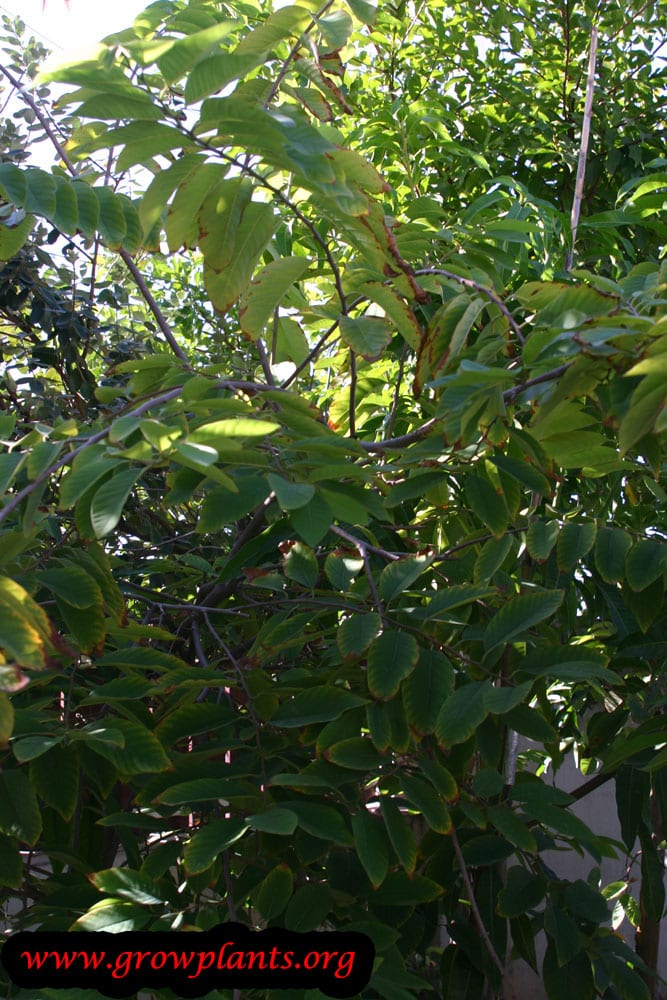
Overview: Cherimoya is a subtropical fruit tree, evergreen but deciduous in cold weather, usually kept to 2-5 m. It is grown for its sweet, custard-textured, heart-shaped fruit.
Quick Specifications
| Specification | Attribute |
|---|---|
| Plant Type / Life Cycle | Perennial tree |
| Foliage Type | Evergreen (deciduous in cold weather) |
| Mature Size | 2-5 m (6-15 ft) |
| Growth Rate | Moderate |
| Toxicity | Fruit flesh edible; seeds and bark are toxic (contain annonacin) – do not eat the seeds |
| Hardiness | USDA zone 10+ |
Growth Form & Structure
- Height & Spread: 2-5 m (6-15 ft); best kept small to make hand pollination easier, and can be container- or bonsai-grown.
- Growth Habit & Form: Small spreading tree, often trained low and dense.
- Lifespan & Maturity: Long-lived; grafted trees bear in 2-3 years, seedlings in 4+ years, with heavy crops after 7-9 years.
Anatomy & Physical Features
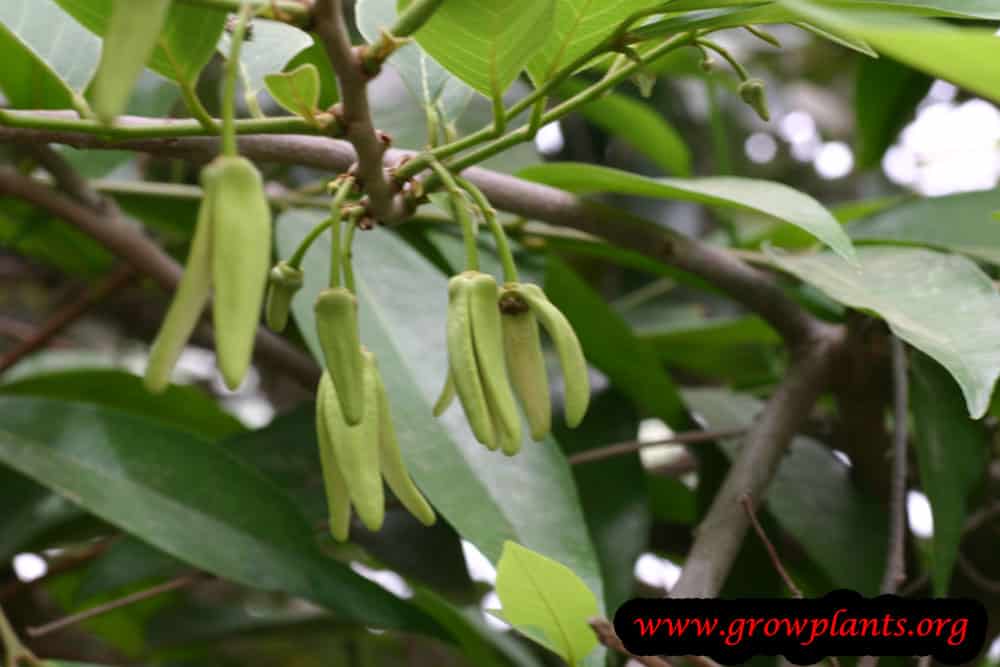
- Flower Characteristics: Small green-yellowish protogynous flowers with offset female and male stages, usually needing hand pollination (see the Bloom accordion).
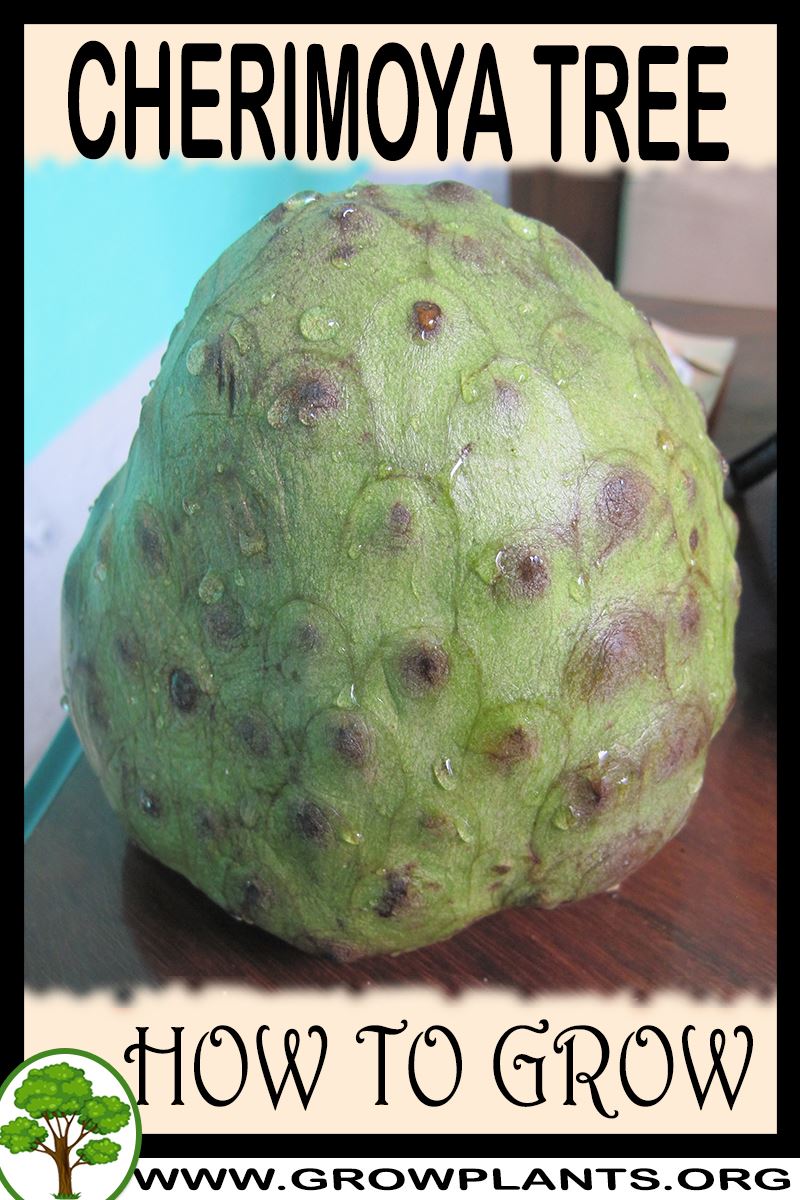
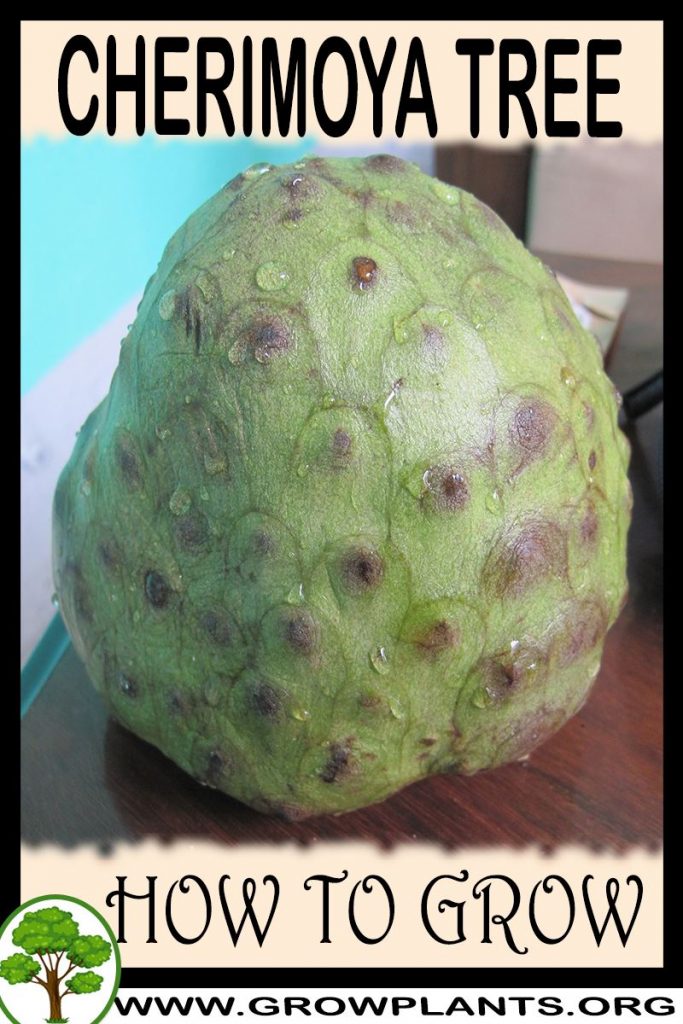
- Fruit Profile: Heart-shaped fruit with knobbly green-yellow skin and sweet, creamy white-yellow flesh (see the Fruit accordion).
Primary Uses & Landscape Value
- Edible Uses: Fruit eaten raw or made into juice, cakes and jam.
- Functional & Ornamental Roles: Grown as a dooryard fruit tree; can be kept as a container or bonsai specimen.
Care Guide: Planting, Soil & Watering
Overview: Cherimoya is a subtropical fruit tree that grows in rich, well-draining soil enriched with organic matter and mulched. It prefers steady, moderate water and even moisture.
Quick Care Requirements
| Requirement | Ideal Condition |
|---|---|
| Planting Season | Spring, summer or autumn |
| Growth Rate | Moderate to Fast |
| Soil Type | Rich, organic, well-draining |
| Water Need | Moderate (keep evenly moist) |
Planting & Establishment
- Best Planting Season: Spring, summer or autumn
- How to Plant:
- Hole Preparation: Dig a hole about 50% wider than the root ball so the roots can spread into loosened soil.
- Soil Amendments: Mix organic matter, dried leaves and humus into the backfill, and cover the soil surface with mulch to hold moisture.
- Planting Depth: Set the tree so the root collar sits at soil level, firm the soil enough to keep it stable (stake if wobbly) without compacting it hard, and don’t bury the trunk.
- Growth Speed & Expectations: Moderate, forming a compact tree that is easiest kept small for hand pollination.
Soil, Watering & Drainage Care
- Soil Mix & Drainage Needs: Rich, organic soil that holds moisture yet drains freely; heavy waterlogging rots the roots, so keep drainage sharp and mulch the surface.
- Watering Schedule & Technique:
- Young / Newly Planted: Water twice on planting day, then daily for the first two weeks while the tree establishes.
- Established: Water deeply and regularly, keeping the soil evenly moist but never waterlogged; increase watering through the fruiting season.
- Seasonal Adjustments: More water in warm, dry weather and during fruit set; ease off in cool weather, but never let the root zone dry out completely.
Climate, Light & Hardiness
Cherimoya is a warm-climate evergreen suited to tropical, Mediterranean, and subtropical gardens, turning deciduous in cold weather and tolerating little frost. It grows well in full sun to half shade with good general adaptability to warm-climate conditions.
Quick Climate Specifications
| Climate Zones | Tropical, Mediterranean, subtropical |
|---|---|
| USDA Hardiness Zones | 10+ |
| Frost Tolerance | Low |
| Light Conditions | Full Sun / Half Shade |
Sunlight & Light Exposure
Optimal Light Setup
Full sun to half shade both work well for cherimoya; keeping the tree compact in a sunnier spot also makes hand-pollination easier to carry out.
Shade & Heat Management
As a warm-climate species, cherimoya tolerates full sun without special heat protection within its preferred zones.
Temperature Extremes & Hardiness
USDA Hardiness & Regional Limits
Cherimoya is rated for USDA zone 10 and warmer. Cold weather turns the normally evergreen tree deciduous, an early sign it is nearing its climatic limit.
Cold Damage & Winter Protection
In cool weather the tree sheds its leaves rather than staying evergreen; in borderline zone 10 areas, a warm, sheltered microclimate helps reduce the risk of more serious cold damage.
Frost Sensitivity
Frost tolerance is low, so cherimoya is best suited to frost-free or near frost-free gardens.
Wind, Humidity & Microclimate
Humidity Preferences
Hand-pollination technique for cherimoya calls for keeping collected male flowers in a dark, high-humidity, cool, ventilated place, indicating the tree favors relatively humid tropical-to-subtropical air.
Microclimate Recommendations
In marginal zone 10 locations, a warm, frost-sheltered planting site helps protect the tree from cold damage through winter.
Growing in Pots, Balconies & Indoors
Cherimoya is a fruit tree rather than a houseplant – indoors it will not get enough light to grow or crop. The grower does raise it in large containers, though, kept small as a shrub or even a bonsai, which makes it a workable patio or balcony plant.
Quick Details
- Container Size: Start about 20%% larger than the root ball and grow the pot up with the tree (see the grower’s tip)
- Indoor Suitability: Not a houseplant; keep it small in a pot outdoors
- Best Spot: Full sun to half shade – the sunniest outdoor spot gives the most fruit
- Soil & Drainage: Peat, perlite and organic matter with plenty of drainage holes
- Watering in Pots: Average; water regularly but never waterlogged
Indoors & On the Windowsill
- Not a houseplant: The grower does not grow Cherimoya indoors – a room, even by a window, is too dim for it to grow well or fruit.
- Overwintering under cover: This is a tender tropical, so in cold-winter climates the great advantage of a pot is that you can move it into a frost-free, bright spot (a conservatory, greenhouse or porch) for the cold season and back out once it warms.
- Safety: The ripe flesh is edible, but the seeds and bark contain toxic compounds – keep seeds away from children and pets and never let them be chewed.
On a Balcony or Patio
- Light & wind: Give it the sunniest, most sheltered spot; keep young, brittle growth staked and out of strong wind.
- Reflected heat & drying: Walls and paving reflect heat and dry pots fast, so check moisture daily in warm weather. A drip irrigation kit with a timer can take over that watering check automatically.
- Pollination: Keeping the tree small in a pot makes hand-pollinating the flowers far easier, which these trees often need for a good crop.
Choosing the Pot, Soil & Long-Term Care
- Pot & drainage: A pot with strong drainage holes is essential; skip a permanently full water saucer to avoid root rot, and empty any tray the same day it collects water.
- Potting mix: The grower’s blend is peat, perlite and organic matter – open and free-draining.
- Feeding: Feed about four times a year and work in some humus a few times a year; potted trees need topping up more often as nutrients leach away.
- Refreshing the soil: Every few years swap out part (not all) of the soil from the sides and top and trim some of the root ball, rather than moving to an ever-larger pot.
Grower’s Container Tip
- Grow the pot up with the tree: Start only about 20%% larger than the root ball and step up a size each time the roots fill it, rather than starting a small tree in a big pot. The grower favours this because it protects the health of the soil and keeps care efficient.
- Graft two cultivars: Consider grafting two cultivars onto one potted plant to help pollination and fruit set in a small space.
Fertilizing & Feeding
Cherimoya is a moderate feeder: young trees want a nitrogen-forward push to build structure, while bearing trees do better on a balanced feed with more potassium support at fruiting.
Quick Fertilizing Specs
| Feeding Level | moderate |
|---|---|
| young_feeding | Young trees benefit from a nitrogen-leaning feed to build canopy before bearing. |
| mature_feeding | Bearing trees do best on a balanced feed that leans toward potassium as fruit develops. |
| Main Nutrient Priority | Nitrogen while establishing, shifting to a balanced-to-potassium approach once the tree bears fruit. |
| Best Feeding Period | The warm active growing season, tapering off as growth slows. |
| Organic Options | Compost, aged manure, and humus worked into mulch support steady, gentle feeding. |
| Soil pH | Prefers rich, well-drained soil; watch for iron chlorosis symptoms if the soil trends alkaline. |
Feeding by Growth Stage
Newly Planted Cherimoya
Support root establishment after transplanting into rich, well-draining soil.
| Nutrient direction | Prioritize root establishment over top growth; keep feeding light and balanced. |
|---|---|
| Timing | Begin light feeding once new growth shows the tree has settled in after planting. |
| Frequency | Feed sparingly through the first growing season, easing off if growth slows. |
| Fertilizer types | A balanced, general-purpose fruit tree fertilizer worked lightly into the surrounding soil, Compost or aged organic matter mixed in at planting and refreshed as mulch |
| Precautions | Avoid concentrated fertilizer against the trunk or root ball; overfeeding a newly settled tree can scorch tender roots. |
Young, Establishing Cherimoya
Build a strong canopy and root system before the tree begins bearing.
| Nutrient direction | Lean toward a nitrogen-forward feed to drive vegetative growth, tapering as the canopy fills in. |
|---|---|
| Timing | Feed during the active warm-season growth flushes. |
| Frequency | Several light feedings spread across the growing season work better than one heavy application. |
| Fertilizer types | A nitrogen-leaning complete fruit tree fertilizer, Composted manure or organic nitrogen sources worked into the mulch layer |
| Routine trace nutrients | iron, manganese, zinc |
| Precautions | Because two trees are often grown together to improve pollination, avoid crowding roots with heavy fertilizer bands that favor one tree over the other. |
Established, Pre-Bearing Cherimoya
Maintain steady, balanced growth as the tree matures toward its first fruit set.
| Nutrient direction | Shift toward a balanced feed rather than the nitrogen-heavy approach used for young trees. |
|---|---|
| Timing | Feed at the start of the warm growing season and again as flowering approaches. |
| Frequency | Moderate, evenly spaced feedings through the active growing months. |
| Fertilizer types | A balanced complete fruit tree fertilizer, Organic matter and humus worked into the mulch each season |
| Routine trace nutrients | iron, manganese, zinc |
| Precautions | Because cherimoya flowers are protogynous and prone to poor natural fruit set, avoid excess nitrogen right at bloom time, which can favor leafy growth over flowering. |
Mature, Fruit-Bearing Cherimoya
Support fruit development and sustained yields on a bearing tree.
| Nutrient direction | Keep nitrogen moderate and let potassium play a larger role as fruit swells, supporting fruit quality rather than pushing more leafy growth. |
|---|---|
| Timing | Feed as new growth resumes in the growing season and again as fruit is developing. |
| Frequency | Regular, moderate feedings through the growing and fruiting season, then ease off as the tree slows. |
| Fertilizer types | A balanced to potassium-leaning fruit tree fertilizer timed to fruit development, Fresh mulch and organic matter renewed around the root zone each season |
| Routine trace nutrients | iron, manganese, zinc |
| Precautions | Because hand pollination is often needed for a good crop, avoid heavy nitrogen applications right at flowering that could push vegetative growth at the expense of bloom. |
Nutrient Deficiency Signs & Corrections
New leaves turn yellow between dark green veins while the veins themselves stay green
| Possible causes | Iron deficiency, often triggered by alkaline or poorly drained soil that locks up iron, High soil pH limiting iron uptake despite adequate iron in the soil, Waterlogged or compacted roots that struggle to take up nutrients regardless of soil fertility |
|---|---|
| Appears first on | Newest leaves at the branch tips |
| What to check | Soil drainage and how long water sits after irrigation, Soil pH, since alkaline conditions are a common trigger for this pattern, Whether the discoloration is confined to new growth or spread through the whole canopy |
| Possible correction | Improve drainage and correct soil pH toward the tree’s preferred range before assuming a straight iron deficiency; a chelated iron product applied per its label can help once the underlying cause is addressed. |
Overall pale green to yellow leaf color and slowed shoot growth across the canopy
| Possible causes | Nitrogen deficiency from under-feeding, especially on a young tree pushing canopy growth, Root stress from poor drainage or compacted soil limiting nutrient uptake, Heavy mulch or organic matter still breaking down and temporarily tying up nitrogen |
|---|---|
| Appears first on | Older leaves lower in the canopy, spreading upward if uncorrected |
| What to check | Recent feeding history and whether the tree has had a nitrogen-forward feed this season, Mulch type and whether fresh, undecomposed material was added recently, General vigor and shoot extension compared to prior seasons |
| Possible correction | Resume a nitrogen-leaning feeding routine appropriate to the tree’s stage and confirm drainage is adequate before increasing fertilizer. |
Abundant flowering but few fruit actually forming
| Possible causes | Incomplete pollination from the flower’s female-then-male timing rather than a nutrient problem, Boron shortfall reducing pollen viability and fruit set, Weather or humidity conditions during bloom that reduce natural pollinator activity |
|---|---|
| Appears first on | Whole-tree fruit count rather than any single leaf |
| What to check | Whether hand pollination has been attempted during the female flower stage, General nutrient status of the tree heading into bloom, Presence of pollinating beetles or bees during the bloom window |
| Possible correction | Address pollination directly through hand pollination first; only consider a boron-containing product per its label if a boron shortfall is suspected and confirmed. |
Pruning, Training & Seasonal Maintenance
Cherimoya tolerates moderate-to-fairly hard annual pruning and flowers on new terminal growth, so a single winter cut both shapes the tree and builds the wood that will carry the coming bloom. Its own care notes are explicit that the tree is best kept small (2–5 m) specifically because this makes hand-pollination easier – cherimoya flowers are protogynous and reliable fruit set commonly depends on hand-pollinating between the female and male phases. Growth here is only rated "medium" (not fast), so the tree needs less aggressive annual renewal than some of its faster-growing relatives.
Quick Pruning & Maintenance Specs
| Pruning Tolerance | Moderate–High |
| Primary Pruning Window | Winter, before the spring flush |
| Secondary Maintenance Window | After the summer/autumn harvest |
| Typical Frequency | Once a year |
| Main Objective | Keep the tree deliberately small (2–5 m) so every flower can be hand-pollinated |
| Young Plant Priority | Head low early to lock in a compact, reachable framework |
| Mature Plant Priority | Annual renewal of terminal wood; resist letting the tree grow beyond hand-pollinating reach |
| Best Tool Type | Bypass secateurs and loppers – a compact tree rarely needs a saw |
| Avoid Heavy Pruning During | Spring/summer bloom, while pollination is being hand-assisted |
Pruning by Plant Age & Size
Newly Established
Remove only damaged growth in the first year; stake for stability if needed rather than pruning for it.
Young / Formative
Open-center, multi-leader training with an early, low head – because the care guidance specifically wants this tree kept small, formative pruning should be more assertive here than on the larger Annona relatives, establishing the mature height early rather than correcting it later.
Mature / Established
Shorten terminal growth each winter to renew flowering wood and to actively hold the tree at its intended small size; some canopy interlacing is fine and keeps flowers clustered for hand-pollination.
Seasonal Pruning Schedule
Dormant/Winter
Objective: force the flush that carries the bloom while re-checking overall size. Remove dead wood and any growth pushing the tree past its target height. Response: moderate new terminal growth (this is a medium, not fast, grower).
Post-Harvest
Objective: light cleanup of spent fruiting twigs after summer/autumn harvest, without major structural cuts.
Flowering & Fruiting Wood
Fruit forms on current-season terminal growth. Because natural pollination is unreliable (protogynous flowers, difference in bloom hours between male and female phase across the tree), keeping the canopy low and compact through pruning is what makes hand-pollination practical – this is as much a fruiting-wood consideration as a size one.
Structural Pruning & Training
- Open-center, low, compact framework, actively held at 2–5 m.
- Allow some branch interlacing to keep flowers clustered and reachable.
- Where two trees are planted close together, some growers train branches from each tree to interlace with the other, sharing a canopy to keep flowers within reach of hand-pollination across both trees.
- Remove crossing or rubbing limbs as the tree matures, but avoid opening the canopy so much that flowers scatter out of hand-pollinating reach.
Special Growth to Remove
- Rootstock suckers below the graft union (grafting is standard practice for named cherimoya cultivars).
- Unwanted new shoots at points where leaves were hand-stripped from the base.
Container & Small-Space Pruning
Cherimoya's naturally compact size makes it one of the better Annona relatives for container or bonsai-style culture; regular tip-pinching plus a modest root-and-canopy trim at repotting is usually enough. Grafting a second cultivar onto the same container tree is a practical way to improve pollination odds where only one specimen fits.
Tools
Bypass secateurs for the bulk of the annual work and loppers for the occasional thicker one-year branch; a saw is rarely needed on a tree deliberately kept this small.
Tool Hygiene & Disease Risk
Routine: the documented pest, aphids, is not a tool-transmissible disease risk; clean, sharp tools are sufficient.
Cut Placement & Technique
- Head to an outward-facing bud on formative and renewal cuts to keep the canopy open at hand-pollinating height.
- Cut just outside the branch collar on any larger removal; avoid flush cuts.
Heavy Pruning & Rejuvenation
Tolerated: a cherimoya that has outgrown its intended size can be cut back hard in winter to bring it back to the 2–5 m target. Expect a moderate flush (this is a medium grower, so regrowth is less explosive than on faster relatives) and a lighter bloom for one season while it recovers.
Post-Pruning Care
- Water consistently to support the new flush.
- Watch for sunburn on bark exposed by opening a previously dense canopy.
- Hold off extra feeding right after a hard cut; resume normal fertilizing once new growth hardens.
Common Pruning Mistakes
- Letting the tree grow past hand-pollinating reach instead of pruning to the recommended small size from the start.
- Over-thinning the canopy for airflow and scattering flowers, which hurts hand-pollination more than it helps fruit quality.
- Pruning during the bloom window and interrupting the male/female-phase pollination effort.
When NOT to Prune
- During spring/summer bloom, while hand-pollination is underway.
- Immediately after transplanting, before the tree is established.
Recommended Tools (by task)
- Annual formative and renewal cuts on this deliberately compact tree – bypass_secateurs: handles the bulk of the work at this small mature size.
- Occasional thicker one-year wood – loppers: for the rare cut a hand secateur can't manage.
Pruning Troubleshooting
| Problem | Possible Cause | What to Check | Corrective Action |
| Low fruit set despite heavy bloom | Mismatched male/female flower timing; tree too tall or dense for effective hand-pollination | Whether hand-pollination was attempted, canopy height/accessibility | Hand-pollinate at the female phase; prune next winter to bring height back down |
| Tree outgrowing its recommended small size | Formative pruning skipped or too light in the early years | Age at first structural prune, current height vs. 2–5 m target | Head back hard next winter and repeat annually to hold size |
| Weak regrowth after a hard cut | Cherimoya is only a medium grower, so recovery is slower than faster Annona relatives | Watering and feeding after the cut, severity of the cut | Increase post-prune watering; avoid stacking a second hard cut the following year |
Propagation Guide
Cherimoya can be started from seed, but the site confirms grafting is necessary to get a reliable, true-to-type fruiting tree, with air layering or cuttings offered as the alternative vegetative routes. Difficulty is Easy from seed and Moderate for grafting or air layering.
Quick Propagation Specs
| Best Propagation Method | Grafting (for a true-to-type fruiting tree); seed for rootstock |
| Alternative Methods | Air layering; stem cuttings |
| Propagation Difficulty | Easy from seed; Moderate for grafting/air layering |
| Seed True-to-Type | Variable – seedlings differ in fruit quality |
| Vegetative True-to-Type | Yes |
| Best Propagation Season | Spring is best for the tree; also possible in summer, and year-round in hardiness zone 12+ |
| Seed Germination Time | 2–4 weeks |
| Seed Sowing Depth | 3–5 cm (~1–2 inches) |
Growing from Seed
Sowing Season
Spring will be best for the tree, though sowing in summer is also possible, and in hardiness zone 12+ it can be done year-round.
Sowing Depth & Orientation
Dig a hole bigger than the seed and sow about 3–5 cm (~1–2 inches) deep, covering lightly, preferably with peat soil or vermiculite; other soils are possible as long as the mix stays well ventilated for best results.
Germination Conditions
Moist soil, sunny location, average watering; water regularly and don’t let the soil dry out.
Germination Time
Typically 2–4 weeks.
Seedling Care
Keep seedlings in a sunny, humid spot with moist soil. Raise seedlings in individual pots rather than together, since most will be grafted afterward and not all will establish; select the best ones to transplant to their final spot. Store any saved seed in a dry, dark location at room temperature until sowing.
Grafting & Budding
Why Grafting Is Used
The site confirms grafting is necessary for Cherimoya to reliably reproduce a good fruiting tree, rather than relying on a variable seedling.
Rootstock
Seedling Cherimoya rootstock, raised as described in the seed section above.
Air & Ground Layering
Air layering is named directly by the site as one of the vegetative-reproduction options for Cherimoya, alongside cuttings and grafting, though no specific timing or technique detail is given here.
Bloom & Flower Guide
Quick Details
- Bloom Season: Spring to summer
- Flower Appearance: Small green-yellowish flowers
- Edibility: Grown for its fruit; the flowers are not eaten
Detailed Blooming Overview
Cherimoya carries small green-yellow flowers that open female first and later turn male (protogynous). The female and male phases fall at different times – around early morning into the afternoon – so the flower is rarely ready to fertilize itself, and hand-pollination reliably lifts fruit set.
Flower Characteristics
- Small, green-yellowish flowers
- Female and male phases occur at separate times on the same tree
- Protogynous: female first, then male
Bloom Care & Thinning
- Thinning: thin the bloom in the first two years, while the tree establishes.
- Pollination: by beetles and bees, and often by hand for reliable fruit set.
- How to hand-pollinate: collect male pollen with a cotton swab and transfer it to the receptive female flowers. Gather flowers in the male phase (from weaker areas, not next to the females you want to pollinate) and keep them dark, humid, cool, and airy until use; once a flower has shed its pollen it is spent. Growing two different cultivars raises your chances, and setting out things that attract beetles – such as watermelon or melon rinds – can help too.
Fruit & Uses
Cherimoya is grown specifically for its edible fruit – a heart-shaped fruit with a soft, dandruff-textured green-yellow skin around sweet, custard-like white pulp. The pulp is eaten fresh and raw once ripe, or used for juice, jam and cakes.
Quick Edible Specs
| Edible Parts | Fruit pulp |
|---|---|
| Main Use(s) | Culinary – fresh eating, juice, jam, cakes |
| Eaten Raw or Cooked | Raw (fresh pulp); cooked for juice, jam and cakes |
| Preparation Required | Cut open, scoop out the pulp, remove the seeds |
| Harvest Season | Summer / Autumn |
| Time to First Harvest | Several years from planting; grafted trees generally bear sooner than seed-grown ones, and full, heavy cropping takes longer to establish (see Propagation for details) |
| Storage | Pick a little before fully ripe and let finish softening off the tree; use soon after ripening |
| Safety/Toxicity Caveat | Seeds are not eaten – discard when eating the pulp |
Fruit
Fruit is heart-shaped with a soft-textured, dandruff-like green-yellow skin; the inner pulp is white to pale yellow and custard-textured. Ripeness is judged by the fruit softening slightly to the touch. Cut the fruit open, scoop the pulp with a spoon, and remove the dark seeds as you eat – they are not eaten.
Harvesting
Harvest in summer to autumn; pick fruit a little before it is fully soft and let it finish ripening off the tree, since tree-ripened fruit is delicate. Netting under the tree can help collect fruit.
Preparation, Uses & Safety
Pulp is eaten fresh with a spoon or used for juice, jam and cakes. Skin and seeds are not eaten.
Pests, Diseases & Troubleshooting
Overview: The cherimoya is an Annona (custard-apple family) tree whose defining pests are mealybugs — the family signature, sheltering deep in the fruit surface — along with scale, fruit flies, the specialist Annona seed borer and wood-boring ambrosia beetles. Its key diseases are anthracnose, Diplodia (black) fruit rot and Phytophthora collar/root rot, while poor fruit set (often needing hand-pollination) is its defining growing challenge. The single most damaging pests are mealybugs (which hide between the knobby fruit segments) and, for the crop’s integrity, the Annona seed borer and fruit flies; anthracnose is the dominant disease in humid climates. Cherimoya is the most cold-tolerant Annona, suiting cool subtropics, but reliably needs hand-pollination and is very mealybug- and anthracnose-prone. Management centres on orchard hygiene, fruit bagging, ant/mealybug control and an open, airy canopy.
Quick Troubleshooting Overview
| Issue / Pest | Main Symptom | Primary Solution |
|---|---|---|
| Mealybugs | White cottony masses between fruit segments | Beneficials, ant control, bag fruit, oil into crevices |
| Fruit flies | Stung, maggoty, prematurely dropping fruit | Bag fruit, sanitation, bait/pheromone traps |
| Annona seed borer | Round holes and tunnels through fruit/seeds | Bag fruit early, destroy infested fruit |
| Anthracnose | Black sunken spots on flowers/fruit, mummies | Open canopy, sanitation, copper fungicide |
| Collar / root rot | Trunk-base lesions, wilting, dieback | Mound planting, sharp drainage, keep collar dry |
| Poor fruit set | Flowers drop without setting | Hand-pollinate, steady moisture |
Common Pests & Management
- Mealybugs (Planococcus / Pseudococcus / Ferrisia spp.):
- Symptoms: The signature Annona pest: white cottony masses tucked between the fruit segments, in the calyx, leaf axils and on shoot tips, oozing honeydew that blackens with sooty mould. Heavy infestations disfigure fruit and downgrade the crop, and the mealybugs shelter deep in the knobby fruit surface where they are hard to reach.
- Prevention & Control: Encourage natural enemies — ladybirds (especially the mealybug destroyer Cryptolaemus) and lacewings — and control the ants that farm and protect them with sticky bands on the trunk. Bag developing fruit to exclude egg-laying, prune for openness and light, and spot-treat with horticultural oil or insecticidal soap, directing the spray into the fruit crevices and calyx.
- Scale insects (Coccidae / Diaspididae):
- Symptoms: Brown, black or greyish limpet-like bumps clamped to stems, leaf undersides and fruit, with honeydew and sooty mould; growth slows and heavily infested shoots die back.
- Prevention & Control: Prune out badly encrusted wood, band trunks to exclude tending ants, and encourage parasitic wasps and ladybirds; horticultural oil smothers scale, timed to the vulnerable crawler stage.
- Fruit flies (Ceratitis / Bactrocera / Anastrepha spp.):
- Symptoms: Females sting ripening fruit to lay eggs; maggots tunnel the flesh, which softens, browns internally and drops early, often with a sour smell and exit punctures.
- Prevention & Control: Bag fruit early, collect and destroy fallen and stung fruit to break the cycle, and hang protein-bait or pheromone fruit-fly traps to monitor and reduce adults. Harvest at the correct maturity rather than leaving fruit to over-ripen on the tree.
- Annona seed borer (Bephratelloides spp.):
- Symptoms: A specialist chalcid wasp whose larvae bore into the seeds and pulp; small round exit holes pit the fruit surface, tunnels run through the flesh, and secondary rots enter through the wounds, ruining fruit from the inside.
- Prevention & Control: Bag fruit as soon as it sets to block egg-laying, and rigorously collect and destroy all infested and fallen fruit (including mummies) to interrupt the life cycle — sanitation is the single most effective control. There is no easy spray, so exclusion and orchard hygiene are paramount.
- Ambrosia / bark beetles (Xylosandrus / Scolytinae):
- Symptoms: Tiny beetles bore into trunk and branches, pushing out fine sawdust ‘toothpicks’; they carry fungi that stain and rot the wood, and stressed or wet-footed trees can wilt and die back from girdling galleries.
- Prevention & Control: Keep trees vigorous and unstressed (correct water and drainage), prune out and burn infested wood, and avoid wounding the trunk; monitor with ethanol-baited traps where the beetle is known.
- Aphids (Aphidoidea / Toxoptera spp.):
- Symptoms: Colonies on soft new flush and flower buds causing honeydew, sooty mould and distorted young growth; mainly a nuisance on nursery and young trees.
- Prevention & Control: Hose off, encourage ladybirds and lacewings, control ants, and use insecticidal soap or oil on persistent flushes.
Diseases & Fungal Issues
- Anthracnose (Colletotrichum gloeosporioides):
- Symptoms: The major Annona disease in humid climates: dark sunken spots on leaves, blackened flowers and young fruit that fail to set, and sunken black rotting lesions on maturing and stored fruit; mummified fruit hang on the tree.
- Treatment & Management: Prune for an open, airy canopy, remove mummified fruit and dead wood, and avoid overhead wetting of flowers and fruit. Collect fallen debris; protective copper fungicide during flowering and fruit development, and careful post-harvest handling, limit losses in wet seasons.
- Diplodia / black fruit rot (Lasiodiplodia theobromae):
- Symptoms: A firm blackish-brown rot that spreads from the stem-end of the fruit, often after harvest, turning the flesh dark and hard; also causes stem-end dieback of twigs.
- Treatment & Management: Harvest cleanly without stem-end injury, cool fruit promptly, and sanitise pruning tools; remove dead wood and mummies, and use protective copper sprays where stem-end rot is chronic.
- Collar & root rot (Phytophthora spp.):
- Symptoms: Dark, oozing lesions at the trunk base and collar, wilting canopy, yellowing and dieback, and browned, rotted roots in wet, heavy or poorly drained soil.
- Treatment & Management: Plant on a mound in free-draining soil, keep the graft union and collar dry, avoid piling mulch against the trunk, and never overwater. Improve drainage; a phosphonate treatment can help protect valuable trees under Phytophthora pressure.
- Leaf spot / purple blotch (Cercospora / Pseudocercospora spp.):
- Symptoms: Angular brown to purplish leaf spots that merge and cause yellowing and premature leaf fall in warm, humid weather.
- Treatment & Management: Improve airflow with pruning, remove fallen leaves, and avoid overhead irrigation; copper fungicide protects new growth under heavy pressure.
Growing Difficulties & Abiotic Problems
- Poor fruit set:
- Cause & Symptoms: Annona flowers are protogynous and awkwardly structured, and natural pollinators are often scarce, so many flowers drop without setting fruit.
- Correction Strategy: Hand-pollinate in the early stages of flowering by transferring fresh pollen to receptive female-stage flowers with a small brush; maintain steady moisture and avoid stress during flowering.
- Fruit splitting & cracking:
- Cause & Symptoms: Irregular watering — a heavy soak after a dry spell — makes maturing fruit split, inviting rot and pests.
- Correction Strategy: Keep soil moisture even through fruit development with mulch and regular irrigation, avoiding wide wet-dry swings.
- Cold / wind sensitivity:
- Cause & Symptoms: These subtropical-to-tropical trees are frost-tender (with cherimoya the most cold-tolerant and soursop the least); cold blackens foliage and kills tender growth, and wind tatters leaves and drops fruit.
- Correction Strategy: Site in a warm, sheltered, frost-free spot, protect young trees from cold, and provide a windbreak; grow in containers to move under cover in marginal climates.
- Sunburn & salt/nutrient issues:
- Cause & Symptoms: Exposed bark and fruit scald in strong sun, and these trees can show zinc, iron or boron deficiencies and salt burn on poor or saline soils.
- Correction Strategy: Whitewash or shade exposed trunks, mulch to buffer roots, and correct micronutrient deficiencies with foliar feeds; leach salts with deep irrigation and improve soil organic matter.
What Helps — Products & Tools
The backbone of care is orchard sanitation, fruit bagging, ant control (sticky trunk bands) and canopy pruning for light and airflow. Suitable product types include horticultural oil and insecticidal soap for mealybugs and scale, protein-bait and pheromone fruit-fly traps, biological control (Cryptolaemus mealybug destroyer), copper fungicide for anthracnose and fruit rots, and phosphonate for Phytophthora. A soft brush for hand-pollination is one of the most valuable ‘tools’ for reliable cropping.