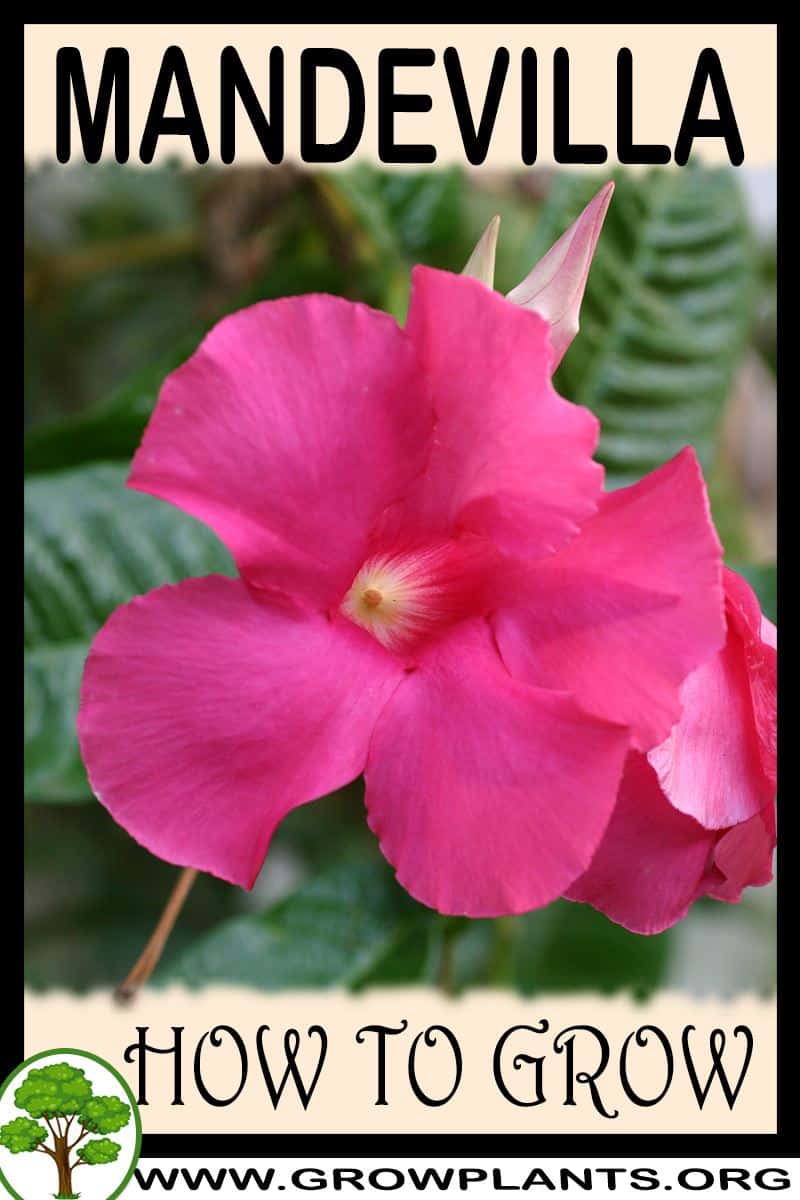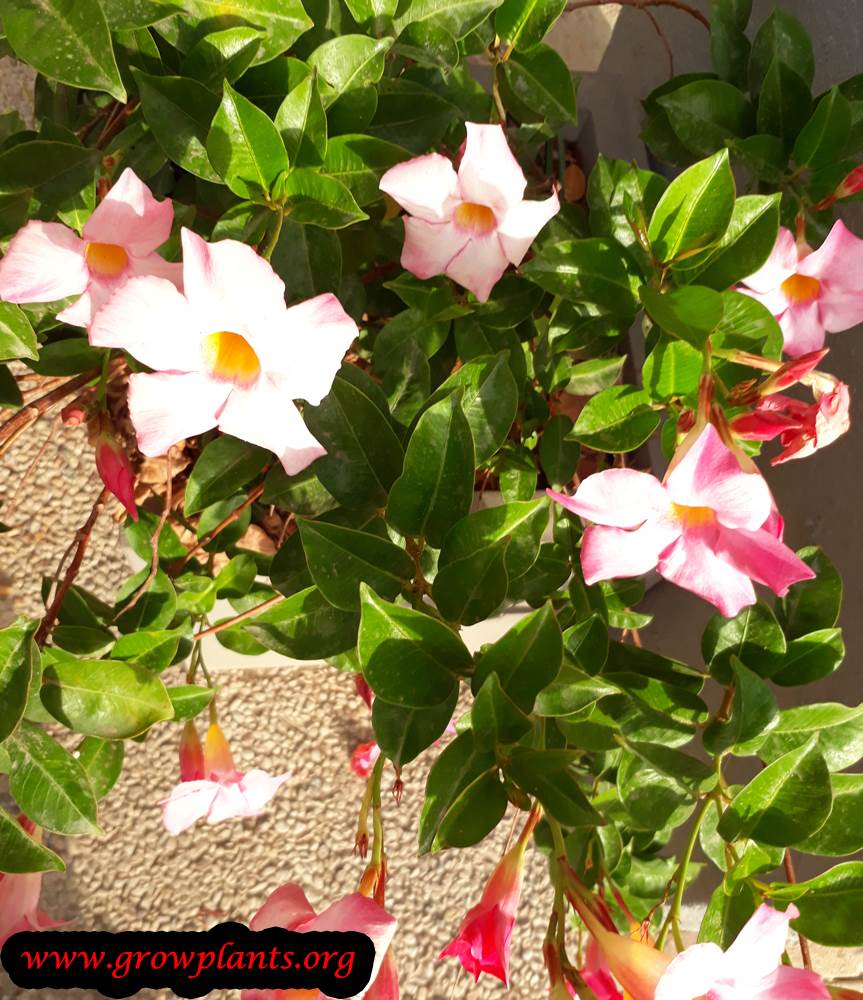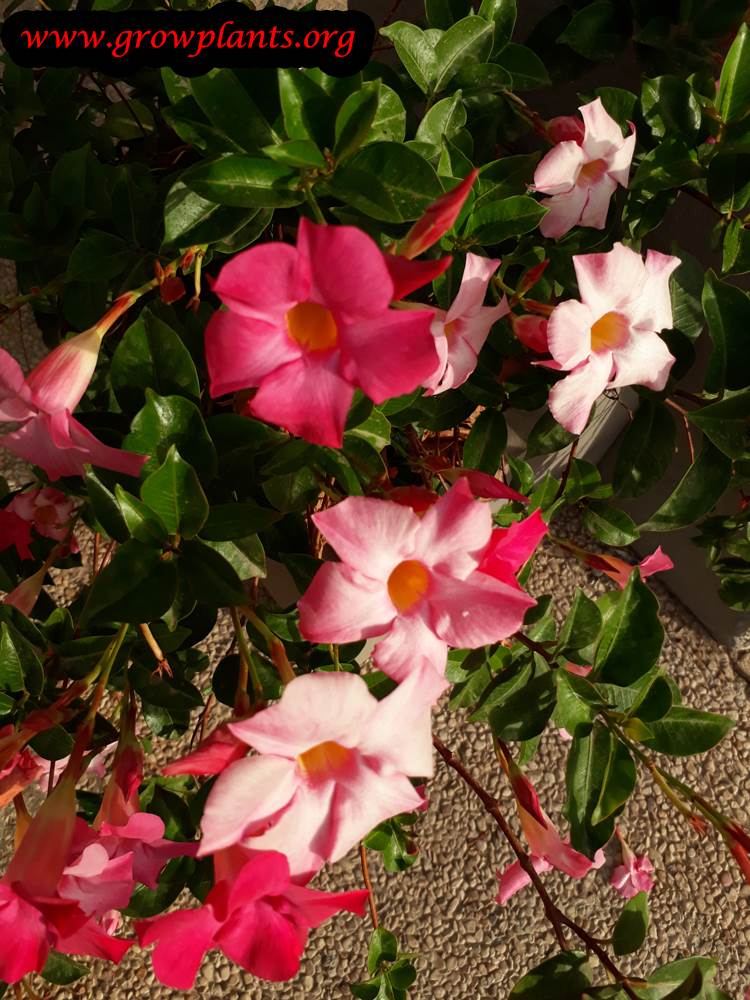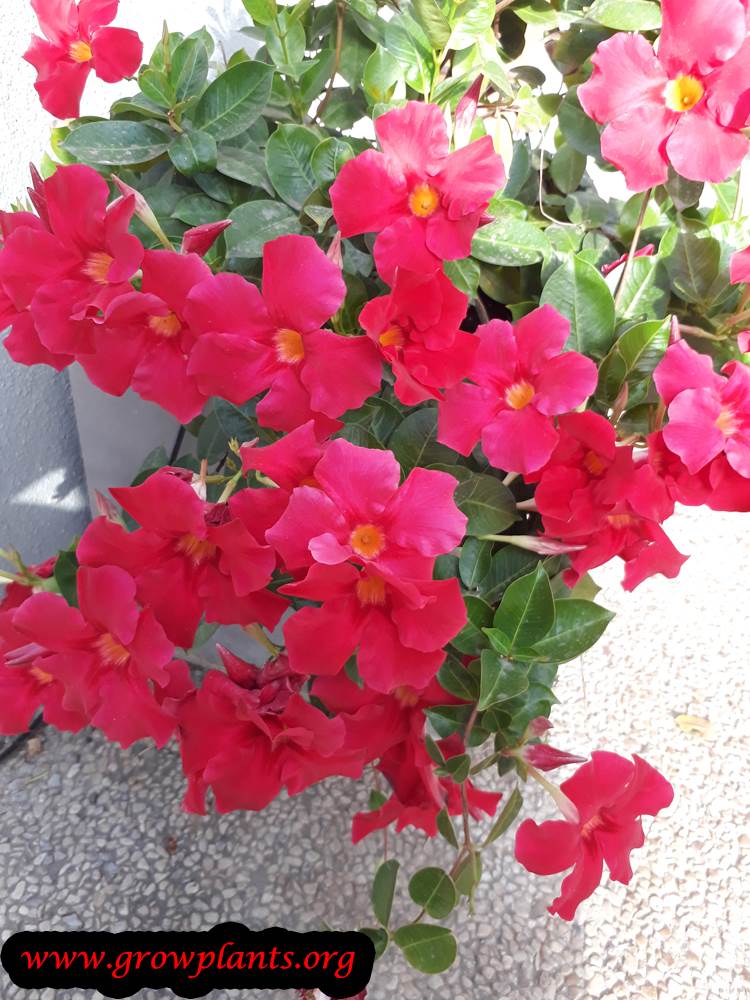



Plant Profile & Key Characteristics
Overview: A fast-growing, twining evergreen vine reaching 1-6 m (3-20 ft), often grown as a summer annual in cold climates. It is prized as an ornamental for its large, fragrant, trumpet-shaped flowers over a long season.
Quick Specifications
| Specification | Attribute |
|---|---|
| Plant Type / Life Cycle | Evergreen perennial vine (grown as an annual where winters are cold) |
| Foliage Type | Evergreen |
| Mature Size | 1-6 m (3-20 ft) long |
| Growth Rate | Fast |
| Toxicity | Milky latex sap can irritate skin and eyes (dogbane family, Apocynaceae) — not for eating |
| Hardiness | USDA zone 9 and up as a perennial; grown as an annual in zones 3-8 |
Growth Form & Structure
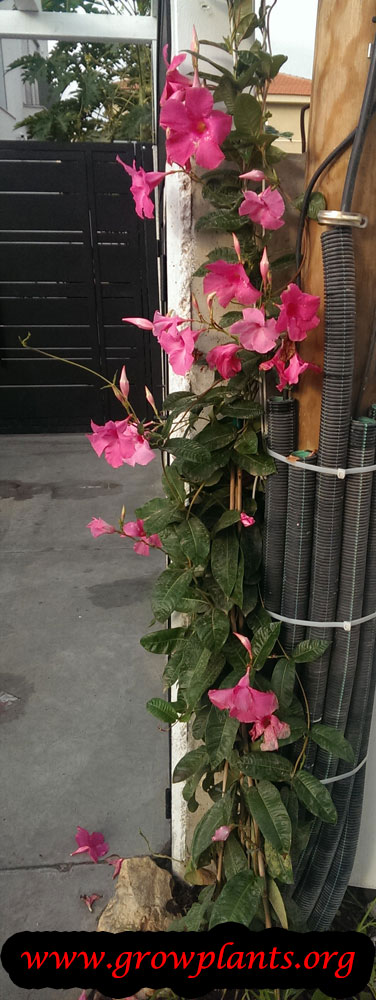
- Height & Spread: Climbs 1-6 m (3-20 ft) on a trellis or support in the ground; stays much shorter and bushier in a pot, where it is often kept as a patio or conservatory plant.
- Growth Habit & Form: Twining woody vine that needs trellising; can be pinched to a bushy, mounded form in containers.
- Lifespan & Maturity: Long-lived where frost-free, reaching flowering size quickly and blooming from summer into autumn.
Anatomy & Physical Features
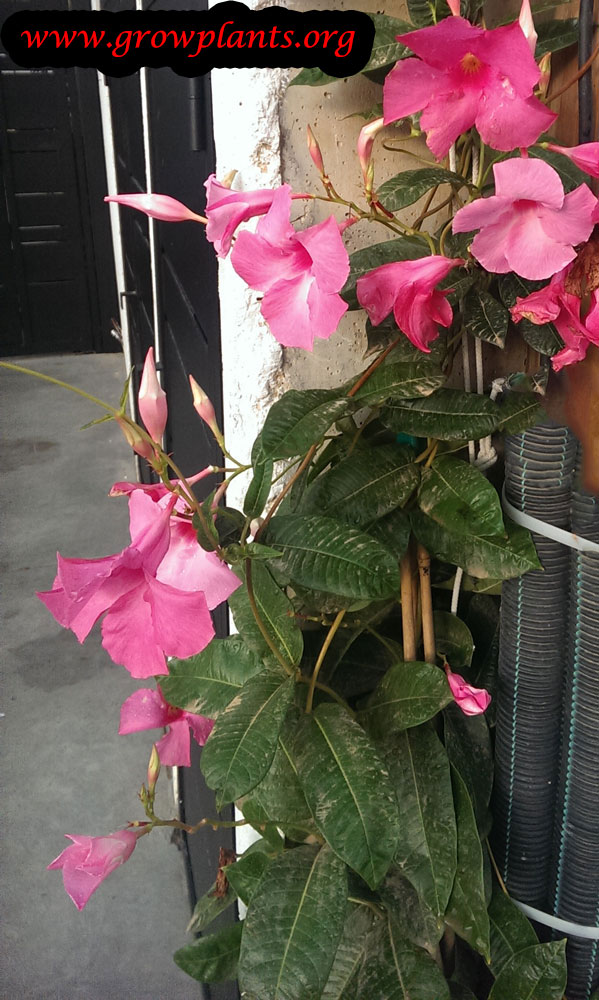
- Leaves & Foliage: Glossy green, elliptic leaves arranged in whorls along the stems.
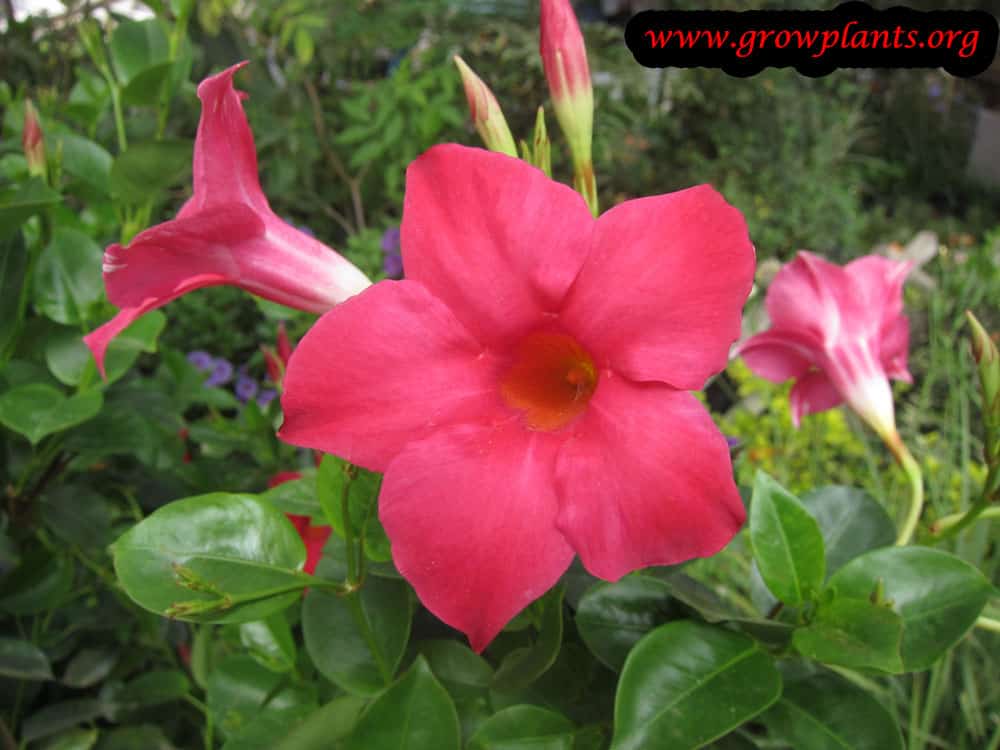
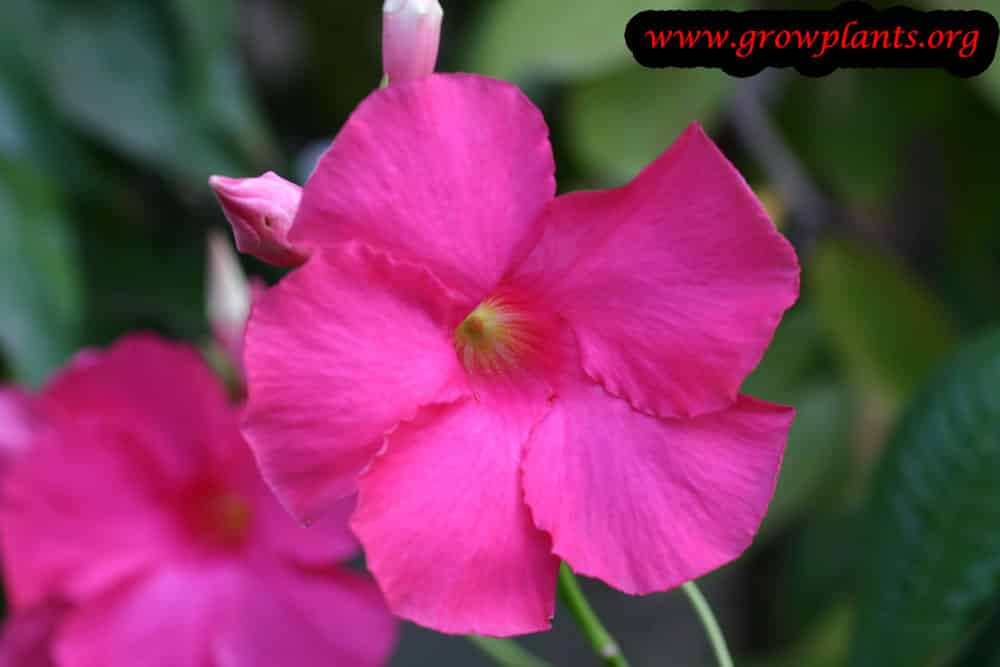
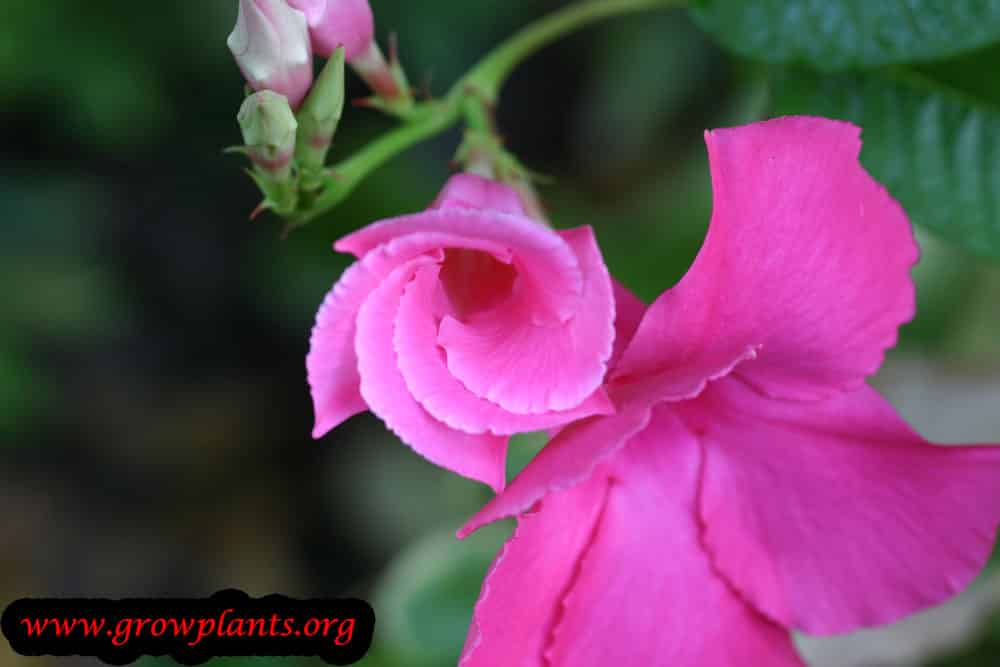
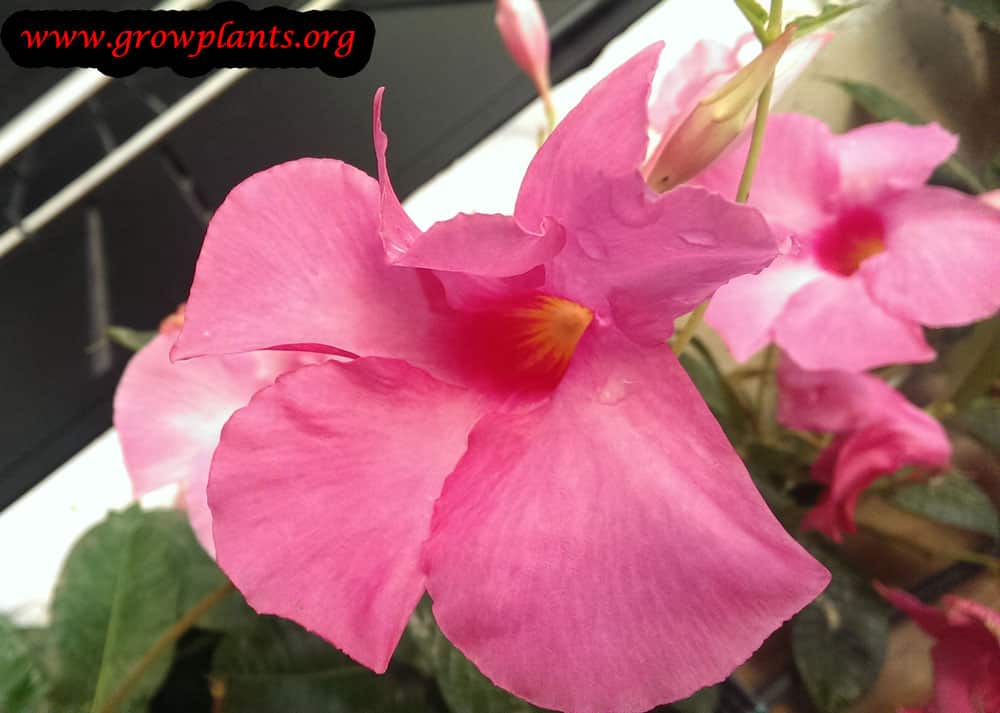
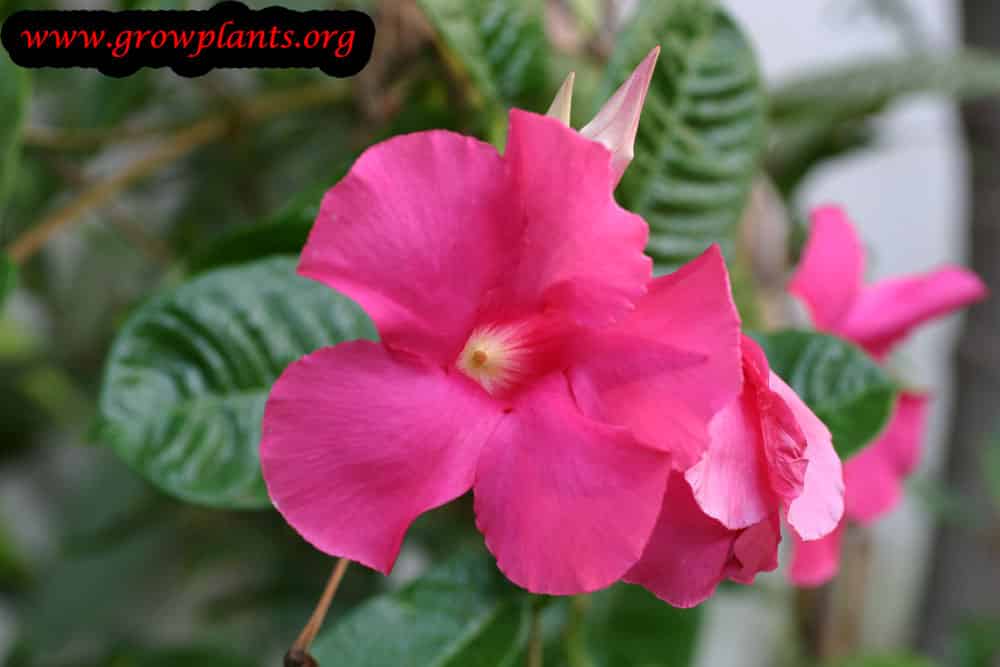
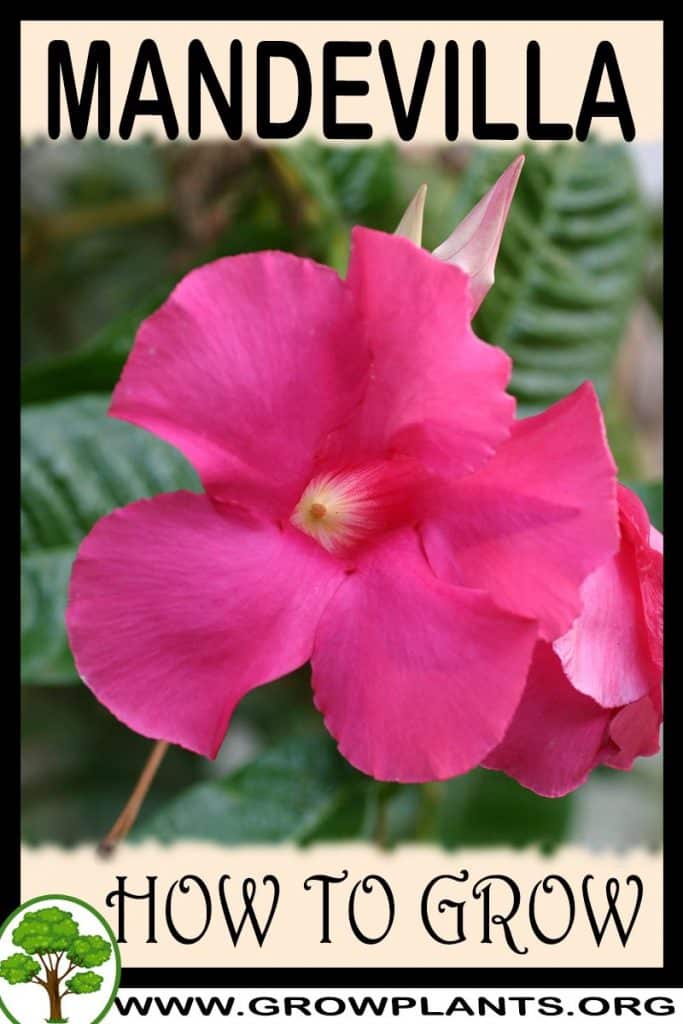
- Flower Characteristics: Large, fragrant, trumpet- to bell-shaped flowers in pink, red, yellow or white, borne in clusters.
Primary Uses & Landscape Value
- Functional & Ornamental Roles: Ornamental flowering climber for fences, trellises, arches and pillars and a popular large patio-container and hanging-basket plant; grown as a summer annual in cold regions. Some cultivars can be invasive in warm climates.
Care Guide: Planting, Soil & Watering
Overview: Mandevilla (rocktrumpet) is a fast-growing, frost-tender flowering vine that thrives in full sun to half shade in rich, well-drained soil with a support to climb. It likes steady moisture through the warm growing season and sharp drainage to keep its roots healthy.
Quick Care Requirements
| Requirement | Ideal Condition |
|---|---|
| Planting Season | Spring, once frost has passed |
| Growth Rate | Fast |
| Soil Type | Rich, well-draining |
| Water Need | Moderate to high; keep evenly moist, not waterlogged |
Planting & Establishment
- Best Planting Season: Plant in spring after the last frost, when the soil has warmed; it must be kept frost-free.
- How to Plant:
- Hole Preparation: Dig a hole as wide as the root ball beside a trellis or support the vine can climb.
- Soil Amendments: Blend in compost or organic matter for richness, plus grit if drainage is poor.
- Planting Depth: Set the root ball level with the surrounding soil and firm gently.
- Growth Speed & Expectations: A fast climber reaching anywhere from 1 to 6 m depending on cultivar and climate; some cultivars can be vigorous to the point of being invasive.
Soil, Watering & Drainage Care
- Soil Mix & Drainage Needs: Wants a rich but freely draining mix; good drainage prevents root rot, and a quality potting mix suits container plants.
- Watering Schedule & Technique:
- Young / Newly Planted: Water regularly to keep the soil evenly moist while the vine establishes.
- Established: Water deeply and consistently through the growing season, letting the top few centimetres dry slightly between waterings.
- Seasonal Adjustments: Water more in summer heat; cut back sharply in winter when growth slows.
Climate, Light & Hardiness
Mandevilla is a tropical to subtropical, frost-tender twining vine that needs a warm, essentially frost-free climate to persist as a perennial, and full sun to half shade for good flowering. Outside its frost-free range it is grown as a warm-season annual, replanted or overwintered each year.
Quick Climate Specifications
| Climate Zones | Tropical, subtropical, warm Mediterranean climates for perennial growth |
|---|---|
| USDA Hardiness Zones | Approximately 9+ as a perennial in frost-free conditions; commonly grown as a warm-season annual as far as approximately zone 3–8 |
| Optimal Temp Range | Approximately 18–29°C (64–85°F) |
| Cold Damage Begins | Foliage and flowering typically suffer once temperatures drop below approximately 10°C (50°F), with clearer chilling injury below about 5°C (41°F) |
| Approx. Survival Minimum | An established, mature plant in a sheltered, borderline-frost-free site may briefly survive light frost near 0°C (32°F), but sustained freezing typically kills top growth and often the whole plant; young plants are more cold-sensitive than mature ones |
| Frost Tolerance | None to Very Low |
| Light Conditions | Full sun to half shade |
| Wind Tolerance | Moderate |
Sunlight & Light Exposure
Optimal Light Setup
Full sun to half shade suits Mandevilla well; more sun generally supports fuller flowering.
Shade & Heat Management
As a warm-climate species it tolerates strong heat without needing shade for heat protection; light shade in the hottest part of the day is optional rather than necessary.
Best Exposure / Orientation
An open, sunny, sheltered spot away from cold-air pockets is best, especially near the cooler edge of its growable range.
Temperature Extremes & Hardiness
USDA Hardiness & Regional Limits
The site data places Mandevilla at approximately zone 9+ for reliable perennial, frost-free growth, with zones 3–8 representing where it is commonly grown as a warm-season annual instead. Cold is the limiting factor outdoors, not heat.
Cold Damage & Winter Protection
Cold damage appears first as leaf yellowing and drop, then stem dieback in a freeze. Near the cold edge of its range, mulching the root zone and siting against a warm, sheltered wall can help an established plant resprout even if top growth is lost.
Frost Sensitivity
Frost sensitivity is high, and cold tolerance varies with plant age and exposure duration - young or recently planted vines are more vulnerable than large, established ones.
Extreme Heat Tolerance
Good; this Mandevilla tolerates hot growing-season conditions well.
Wind, Humidity & Microclimate
Humidity Preferences
Prefers moderate to high humidity, in keeping with its tropical/subtropical origin.
Dry-Air Tolerance
Tolerates average garden humidity in warm climates reasonably well but is not naturally adapted to prolonged very dry, arid air.
Wind Tolerance
Moderate - as a twining vine it benefits from a trellis or other support that reduces stem whipping and breakage in strong, sustained wind.
Rainfall & Seasonal Moisture
Suited to climates with a warm, humid growing season; prolonged cold, wet winter conditions compound cold stress rather than being tolerated on their own.
Microclimate Recommendations
A warm, sheltered, sunny spot - a south-facing wall or fence in marginal climates - buffers both wind and winter cold, and gives the vine something to climb.
Growing in Pots, Balconies & Indoors
Mandevilla (rocktrumpet) is a twining tropical vine grown for its glossy leaves and showy trumpet flowers. The grower notes it is not a houseplant – it flowers best in strong light – but it thrives in a container on a warm, sunny patio or balcony with something to climb, and a pot lets you overwinter it under cover where winters are cold.
Quick Details
- Container Size: A roomy pot, about 10-20 L (2.5-5 gal), with a trellis or support
- Indoor Suitability: Not a true houseplant; needs more light than a room offers – a bright sunroom or the sunniest window at best
- Best Spot: Full sun to half shade; warm and sheltered
- Soil & Drainage: Rich, free-draining potting mix (peat/coir with perlite or vermiculite)
- Watering in Pots: Keep evenly moist in growth; pots dry fast, but never waterlogged
Indoors & On the Windowsill
- Not a houseplant: The grower marks it unsuitable indoors – in ordinary room light it grows thin and shy to flower. The brightest, warmest sunny window or a heated sunroom is the most you should attempt.
- Overwintering under cover: The main reason to pot it in cold climates – Mandevilla is frost-tender, so bring the container into a bright, frost-free room or greenhouse before the cold sets in, cut back watering, and return it outside when warmth returns. You can prune it back to keep it manageable.
- Toxic – keep it away: The milky sap is an irritant and the plant is poisonous if eaten, so keep it away from children and pets and wash your hands after handling.
On a Balcony or Patio
- Light & support: Give it the sunniest, most sheltered spot and a trellis, obelisk or railing to twine up; tie in the shoots as they grow.
- Wind & heat: Shelter it from strong wind; walls and paving reflect heat, so sun-warmed pots dry quickly – check moisture often in hot spells.
- Weight & runoff: A large pot with a support can be top-heavy, so stand it securely, and mind drainage runoff on the balcony floor.
Choosing the Pot, Soil & Long-Term Care
- Pot & drainage: A roomy pot with strong drainage holes; skip a standing saucer of water to avoid root rot. Terracotta breathes and dries faster; glazed or plastic holds moisture longer.
- Potting mix: A rich, well-aerated mix – good potting compost, or peat/coir with perlite or vermiculite.
- Feeding: Potted plants leach nutrients, so feed regularly through the growing season to fuel flowering.
- Repotting: Refresh the mix and pot on about every couple of years, with a light prune of roots and top growth to keep it vigorous.
Growing this plant in a greenhouse
A greenhouse can give mandevilla frost protection and cold protection.
Greenhouse at a glance
| Greenhouse suitability | Conditional - depends on your climate |
|---|---|
| Main benefits | frost protection, cold protection |
| Season extension | earlier spring & later autumn |
| Outdoor protection advisable below | about 10°C |
| Maintain greenhouse minimum | around 10°C for active growth |
| Suitable types | heated greenhouse, polycarbonate greenhouse, lean-to |
| Heating | Heating is recommended in cold climates for continuous growth. |
Related greenhouse guides
- Greenhouses: How to Choose the Right Greenhouse
- Best Greenhouse Heaters
- Greenhouse Climate Control: Temperature, Ventilation and Humidity
- Best Lean-To Greenhouses
Fertilizing & Feeding
A moderate feeder: steady balanced feeding through the warm growing season supports strong bloom, with feeding stopped during the cool-season rest.
Quick Fertilizing Specs
| Feeding Level | Moderate feeder |
|---|---|
| Main Nutrient Priority | Balanced feeding with adequate nitrogen; balanced nutrition, not extra phosphorus, drives bloom |
| Best Feeding Period | Spring through the warm growing and blooming season |
| Organic Options | Compost, humus, mulch, and other organic matter |
| Reduce/Stop Feeding | Stop feeding during the cool-season rest and overwintering |
| Micronutrients | Usually met by a complete fertilizer; correct only diagnosed issues such as iron chlorosis |
| Soil pH | Slightly acidic to near neutral |
Feeding by Growth Stage
Spring growth as warmth returns
Fuel healthy new stems and leaves as the plant breaks into active growth in warm weather.
| Nutrient direction | A balanced complete fertilizer with adequate nitrogen to build the framework of stems and foliage that will carry the flowers. |
|---|---|
| Timing | As new growth begins in spring or the start of the warm season. |
| Frequency | Begin light, regular feeding as active growth resumes. |
| Fertilizer types | A balanced complete fertilizer, Compost, humus, and organic matter worked into the soil |
| Precautions | Go easy at first; heavy nitrogen early can push leafy growth at the expense of flowers. |
Blooming through the warm season
Support continuous flowering through the main bloom period.
| Nutrient direction | Keep to a balanced complete fertilizer with adequate nitrogen; steady balanced nutrition, not extra phosphorus, drives strong bloom. |
|---|---|
| Timing | Through the summer-into-autumn bloom period. |
| Frequency | Steady, light feeding across the active blooming season. |
| Fertilizer types | A balanced complete fertilizer, A balanced controlled-release fertilizer for steadier feeding in containers |
| Precautions | Avoid overfeeding with nitrogen, which favors leaves over flowers; keep nutrition balanced and consistent. |
Cool-season rest
Let the plant rest through cool weather without pushing tender new growth.
| Nutrient direction | None – withhold fertilizer while the plant is resting and not in active growth. |
|---|---|
| Timing | During cool weather and the winter rest, or indoors over winter in cold regions. |
| Frequency | No feeding at this stage; resume only when active growth returns in spring. |
| Fertilizer types | No feeding at this stage; do not fertilize until warm-season growth resumes. |
| Precautions | Do not fertilize a resting plant; feeding now wastes nutrients and can cause salt buildup in the root zone. |
Nutrient Deficiency Signs & Corrections
Older, lower leaves turn pale green to yellow and both growth and flowering slow.
| Possible causes | low available soil nitrogen, nitrogen leached out by heavy watering or rain, thin soil low in organic matter |
|---|---|
| Appears first on | older, lower leaves |
| What to check | recent feeding history, soil organic matter, watering and drainage |
| Possible correction | Apply a nitrogen-containing complete fertilizer and build organic matter, then keep watering even. |
Youngest leaves yellow between the veins while the veins themselves stay green.
| Possible causes | iron made unavailable by alkaline or high-pH soil, waterlogged or cold roots limiting uptake, genuinely low soil iron |
|---|---|
| Appears first on | new, youngest leaves |
| What to check | soil pH, drainage and root health, whether the newest growth is most affected |
| Possible correction | Correct soil pH where needed and apply a chelated iron product per its label, and improve drainage. |
Leaf margins brown or scorch and growth stalls despite adequate watering.
| Possible causes | fertilizer salt buildup in the root zone, under-watering that concentrates salts, excessive or too-frequent feeding, especially in containers |
|---|---|
| Appears first on | leaf margins and tips |
| What to check | recent fertilizer amounts, watering consistency, drainage, especially in containers |
| Possible correction | Ease off feeding, water thoroughly to flush accumulated salts, then return to lighter feeding. |
Pruning, Training & Seasonal Maintenance
This entry covers the Mandevilla genus generally (Rocktrumpet) rather than one named cultivar, so treat specific figures below as typical for the genus – individual cultivars vary in vigour and mature size. Mandevilla is a twining vine that needs trellising, is perennial from zone 9 up (grown as an annual, often container-overwintered, in zones 3–8), and flowers on current-season growth, so it tolerates fairly firm pruning without sacrificing bloom as long as the cut is made before the growth flush. The safest general window is autumn into winter.
Quick Pruning & Maintenance Specs
| Pruning Tolerance | Moderate–High |
| Primary Pruning Window | Autumn–Winter, or late winter for overwintered container plants before regrowth |
| Secondary Maintenance Window | Ongoing tying-in and tip-pinching through the growing season |
| Typical Frequency | One structural prune yearly + ongoing training |
| Main Objective | Train the twining growth to a support; encourage branching for fuller bloom |
| Young Plant Priority | Pinch tips to force lateral branches rather than one bare runner |
| Mature Plant Priority | Redirect and thin twining growth, remove dead/tangled stems |
| Best Tool Type | Precision snips and bypass secateurs, plus soft ties |
| Avoid Heavy Pruning During | An active bloom flush |
Pruning by Plant Age & Size
Newly Established
Remove only damaged growth at transplant and set the first tie to a support so the twining stem starts climbing correctly.
Young / Formative
Training system: twining vine trained up a stake or trellis. Pinch growing tips while young to force side branches rather than a single bare runner.
Mature / Established
Redirect wandering growth back onto the support, thin tangled or overlapping stems, and shorten runners outgrowing the available trellis space.
Seasonal Pruning Schedule
Pre-Growth / Autumn–Winter
Objective: structural shaping and length control ahead of the next growth flush. Remove: dead, tangled or overlong stems. Do not remove: the current framework still furnished with side branches. Expected response: fuller new twining, flowering growth. Flowering impact: minimal, since this is dormant-season wood.
Ongoing Sanitary
Remove dead stems and untangle wayward growth through the growing season.
Flowering & Fruiting Wood
Flowers on current-season growth across the genus. A structural cut made before the growth flush does not sacrifice bloom; cutting after new growth is already underway and budding removes part of that season’s display.
Structural Pruning & Training
Training is central: as a twining vine it has no self-supporting framework, so stems must be wound and tied to a support. Thin overlapping or self-shading stems so flowers are not hidden inside a tangled mass.
Special Growth to Remove
Dead stems and tangled growth that has wound back on itself rather than climbing outward. No rootstock suckers apply (not typically grafted).
Container & Small-Space Pruning
Commonly grown in containers, including as an overwintered houseplant in the cooler zones where it is grown as an annual outdoors. A container specimen benefits from a firmer cutback in late winter before it resumes active growth, both to control size and to remove leggy indoor growth.
Tools
Precision snips for tip-pinching and tying-in; bypass secateurs for thicker dead or overgrown stems. Loppers and a saw are not appropriate for this soft-stemmed vine. Avoid hedge shears, which would shear the twining growth rather than train it.
Tool Hygiene & Disease Risk
Routine risk – clean, sharp tools are sufficient. Like related Apocynaceae vines, Mandevilla has a milky sap that can irritate skin, so wipe blades after cuts and wear gloves.
Cut Placement & Technique
Pinch or cut just above a node to force branching at that point. Wind the stem around the support rather than tying it rigidly straight.
Heavy Pruning & Rejuvenation
Tolerated well as a fast-growing vine – a hard cutback to a compact framework produces vigorous new twining growth, commonly used to reset an overwintered container plant each spring, with a temporary pause in flowering while the new framework establishes.
Post-Pruning Care
Water as normal through regrowth and watch new soft growth for aphids, mealybug and mites, the pests already noted for this genus. Do not rush fertilizer beyond the plant’s normal feeding schedule just because it was cut back.
Common Pruning Mistakes
Letting the vine send up bare runners without ever pinching for branching; tying stems too rigidly instead of letting them twine; cutting hard during an active bloom flush; neglecting a container/overwintered plant until it is badly leggy.
When NOT to Prune
During an active bloom flush; immediately after transplanting or repotting; right before moving an annual-grown plant indoors while still in full leaf.
Recommended Tools (by task)
- Tip-pinching young growth for branching – precision_snips: the main formative task for a twining vine.
- Removing dead or overgrown runners – bypass_secateurs: the largest stem size this soft-wooded vine produces.
- Training stems onto a trellis or stake – soft_ties_stakes: essential, since this genus has no self-supporting structure.
Propagation Guide
Mandevilla is most commonly propagated from stem tip cuttings, which reliably reproduce a given plant’s growth habit and flower colour; seed is a workable but less-used alternative, and since most garden Mandevilla are named hybrids or cultivars, cuttings are the more dependable way to keep a specific selection true. Propagation is easy to moderate – cuttings root well but can be somewhat slow, so consistent warmth and humidity matter more than speed.
Quick Propagation Specs
| Best Propagation Method | Stem tip cuttings |
| Alternative Methods | Seed |
| Propagation Difficulty | Easy to Moderate |
| Seed True-to-Type | Variable – hybrid/cultivar offspring may not come true |
| Vegetative True-to-Type | Yes |
| Best Propagation Season | Spring |
| Cutting Rooting Time | Typically several weeks under warm, humid conditions |
| Germination Temperature | Roughly 21–27°C (70–80°F), consistent with this frost-free, warm-climate genus |
Growing from Seed
Germination Conditions
Seed germinates in warm, consistently moist, humid conditions typical of these frost-free tropical vines.
Germination Time
Germination timing varies with seed freshness and warmth and can be slow or uneven.
Seedling Care
Grow seedlings on in bright light with steady moisture and warmth until well established.
Stem Cuttings
Cutting Type
Semi-firm stem tip cuttings with a few nodes, taken from healthy, non-flowering growth.
Best Timing
Spring, as new growth begins.
Cutting Preparation
Cut just below a node and remove the lower leaves. Stems exude a milky latex sap typical of the Apocynaceae family; let the cut firm briefly and handle the sap with care.
Rooting Setup
Insert into a moist, free-draining, humidity-retentive mix (such as peat-based or peat/perlite) and keep warm and humid – a covered propagator, small greenhouse, or misting helps.
Rooting Hormone
A rooting hormone is optional but can improve rooting consistency, since Mandevilla cuttings can be somewhat slow to strike.
Rooting Time
Rooting typically takes several weeks under warm, humid conditions.
Bloom & Flower Guide
Quick Details
- Bloom Season: Summer and autumn
- Time to First Bloom: Blooms through the warm season once established; young plants begin flowering as they start to climb and put on new growth
- Flower Appearance: Fragrant, trumpet- to bell-shaped flowers in pink, red, yellow or white, borne in clusters
- Edibility: Toxic — do not eat; the milky sap is an irritant and the plant is poisonous if ingested
Detailed Blooming Overview
Mandevilla, or rocktrumpet, is a twining tropical vine grown for a long succession of large trumpet flowers. From summer into autumn it opens fragrant blooms in pink, red, yellow or white among glossy leaves. It belongs to the dogbane family (Apocynaceae), so cut stems bleed a milky latex — beautiful in bloom, but best sited away from where the sap will be handled or tasted.
Flower Characteristics
- Fragrant, trumpet-to-bell flowers in pink, red, yellow or white, carried in clusters.
- Blooms are held on new growth and open in succession over a long season.
- The flared, five-lobed flowers draw butterflies and other pollinators.
Bloom Care & Thinning
- Light & warmth: full sun and heat drive the heaviest flowering.
- Pruning for bloom: flowers form on new shoots, so a light prune in late winter or early spring encourages fresh flowering growth — wear gloves, as the sap is an irritant.
- Feeding & support: a phosphorus- and potassium-rich feed, plus something to climb, keeps bloom coming.
- Handling & safety: the sap can irritate skin and eyes and the plant is toxic if eaten — keep away from children and pets.
Bloom Health & Protection
- Aphids, mealybugs and whiteflies gather on buds and soft new growth; neem oil or insecticidal soap keeps them down.
- Spider mites can stipple growth in hot, dry conditions; rinsing the foliage and raising humidity helps, with a miticide if needed.
Pests, Diseases & Troubleshooting
Overview: Mandevilla (including the dipladenia types) are vigorous tropical dogbane-family vines that are trouble-free outdoors in warmth but a magnet for sap-suckers under glass or when overwintered indoors. Watch the leaf undersides, grow them warm, bright and evenly moist, and most problems stay minor.
Quick Troubleshooting Overview
| Issue / Pest | Main Symptom | Primary Solution |
|---|---|---|
| Mealybugs | White cottony tufts in leaf axils; sticky honeydew and sooty mold | Alcohol swab, wash off, neem/horticultural oil |
| Spider mites | Fine speckling and webbing in warm dry indoor air | Raise humidity, hose, horticultural oil |
| Whitefly | Tiny white flies rising from disturbed foliage; sticky leaves | Yellow sticky traps, insecticidal soap/neem |
| Aphids & scale | Clustered insects or waxy bumps on stems and shoots; honeydew | Rinse off, insecticidal soap, oil |
| Powdery mildew | White powder on leaves in humid, crowded, low-light conditions | Improve airflow and light, sulfur spray |
| Yellowing leaves | General yellowing from cold or overwatering | Keep warm, water evenly, improve drainage |
Common Pests & Management
- Mealybugs (Planococcus citri):
- Symptoms: White cottony clusters in leaf axils, on stems and along veins, with sticky honeydew and sooty mold; a very common problem on plants brought indoors for winter.
- Prevention & Control: Dab colonies with an alcohol swab and wash off with soapy water; repeat weekly with neem or horticultural oil. Isolate new plants and inspect axils regularly, as mealybugs hide in tight crevices.
- Spider mites (Tetranychus urticae):
- Symptoms: Fine pale stippling, a dull bronzed look and delicate webbing on shoot tips and leaf undersides in warm, dry indoor air.
- Prevention & Control: Raise humidity, rinse foliage and avoid drought stress; treat undersides with horticultural oil or insecticidal soap, and release predatory mites under glass.
- Whitefly (Trialeurodes vaporariorum):
- Symptoms: Tiny white flies that lift in a cloud when the plant is disturbed, with sticky leaves and sooty mold from honeydew.
- Prevention & Control: Use yellow sticky traps to monitor and thin adults; spray leaf undersides with insecticidal soap or neem, repeating to catch nymphs, and conserve parasitic wasps.
- Aphids (Aphis spp.):
- Symptoms: Soft green or black insects on new shoots and buds causing distortion, honeydew and sooty mold; note mandevilla’s milky sap when handling.
- Prevention & Control: Hose off or squash small colonies, encourage ladybirds and lacewings, and use insecticidal soap or neem for heavier outbreaks.
- Scale insects (Coccidae / Diaspididae):
- Symptoms: Brown or waxy bumps along stems and leaf veins; soft scales add honeydew and sooty mold, and heavy loads weaken the vine.
- Prevention & Control: Scrape off light infestations; smother the rest with horticultural oil, repeating to catch crawlers, and prune out badly encrusted stems.
Diseases & Fungal Issues
- Powdery mildew (Erysiphe / Oidium spp.):
- Symptoms: White powdery patches on leaves and shoots in humid, crowded, low-light situations, sometimes with leaf distortion.
- Treatment & Management: Improve airflow and light, avoid crowding, and keep foliage dry; treat with sulfur, potassium bicarbonate or a horticultural-oil spray at first signs.
- Botrytis (grey mold) (Botrytis cinerea):
- Symptoms: Grey fuzzy mold on flowers and soft growth in cool, damp, still conditions.
- Treatment & Management: Remove spent flowers and debris, ventilate, and reduce overhead watering; use a suitable fungicide only if it persists.
- Root rot (Phytophthora / Pythium spp.):
- Symptoms: Wilting, yellowing and collapse with dark, mushy roots in soggy or poorly drained mix.
- Treatment & Management: Grow in free-draining medium, let the surface dry between waterings, and avoid standing water; remove rotted roots and drench with a fungicide, or restart from a healthy cutting.
- Southern blight (Sclerotium rolfsii):
- Symptoms: White fungal threads and mustard-seed-like sclerotia at the stem base in hot, humid conditions, with sudden wilting.
- Treatment & Management: Remove affected plants and infested surface soil, improve drainage and airflow, and avoid mulch piled against the stem.
Growing Difficulties & Abiotic Problems
- Yellowing from cold or overwatering:
- Cause & Symptoms: General leaf yellowing and drop when temperatures fall too low or roots sit wet, especially in winter indoors.
- Correction Strategy: Keep above its cold threshold, water only when the top of the mix dries, and ensure good drainage; move to a warmer, brighter spot.
- Bud drop:
- Cause & Symptoms: Flower buds abort after sharp changes in light, temperature, watering or a move to a new location.
- Correction Strategy: Keep conditions stable, provide bright light and even moisture, and avoid relocating plants while they are budding.
- Oedema:
- Cause & Symptoms: Corky bumps or water blisters on leaf undersides when the plant takes up more water than it loses in cool, damp, dull weather.
- Correction Strategy: Water less in low-light spells, increase air movement and light; damage is cosmetic and stops once watering is balanced.
- Sunburn on relocation:
- Cause & Symptoms: Bleached scorched patches when a plant grown indoors is moved abruptly into full outdoor sun.
- Correction Strategy: Harden off gradually over one to two weeks before exposing to full sun.
What Helps – Products & Tools
The mandevilla toolkit is insecticidal soap and neem or horticultural oil for mealybugs, mites, whitefly, aphids and scale; yellow sticky traps for whitefly; and sulfur or potassium-bicarbonate fungicide for powdery mildew. Grow warm, bright and free-draining to head off root rot. Apply oils in the evening to protect pollinators, and wear gloves – the milky sap can irritate skin. Always follow the label.