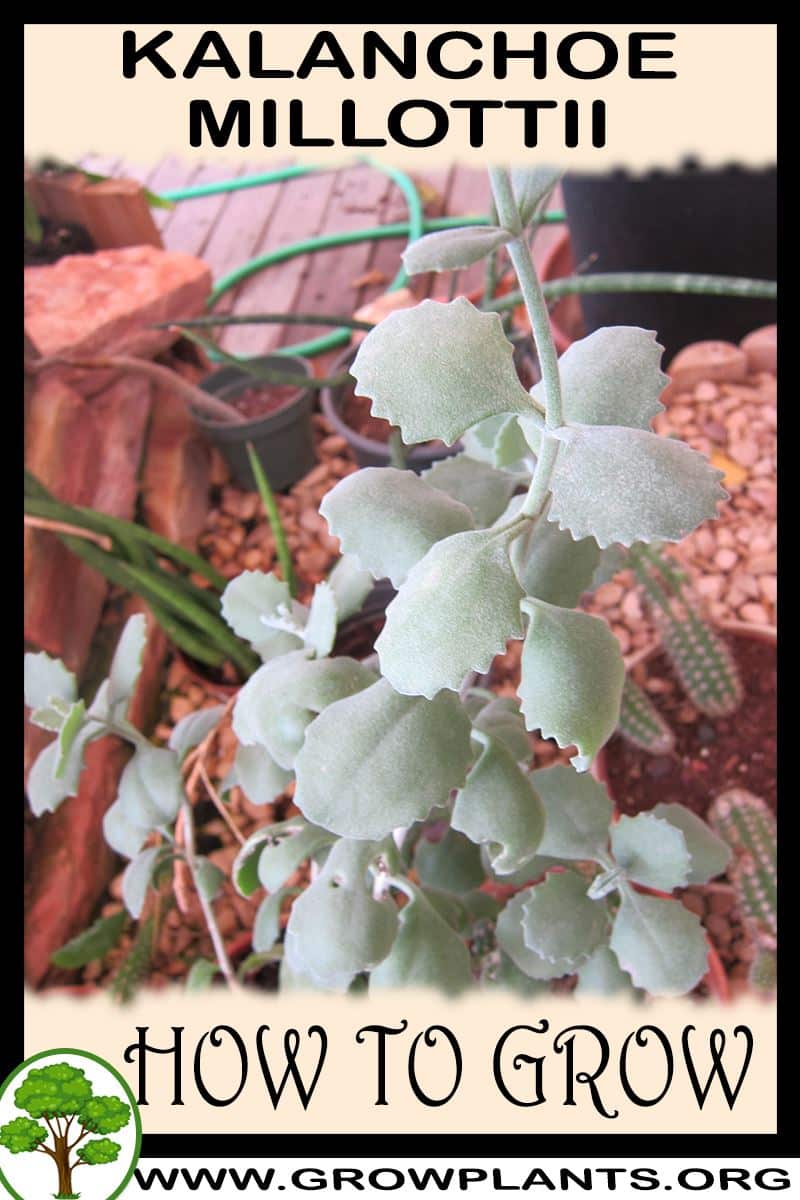


Plant Profile & Key Characteristics
Overview: Kalanchoe millottii is an evergreen succulent subshrub 10–40 cm (4–16 in) tall, grown for its grey-green, velvety scalloped leaves. It is slow-growing, drought tolerant and suited to containers and warm gardens.
Quick Specifications
| Specification | Attribute |
|---|---|
| Plant Type / Life Cycle | Perennial |
| Foliage Type | Evergreen (succulent) |
| Mature Size | 10–40 cm tall (4–16 in) |
| Growth Rate | Slow |
| Root System | Fibrous and shallow (typical of succulents) |
| Toxicity | Toxic – contains cardiac glycosides (bufadienolides); harmful to cats, dogs and livestock if ingested |
| Hardiness | USDA zones 10–12 |
Growth Form & Structure
- Height & Spread: A small succulent subshrub 10–40 cm (4–16 in) tall for containers and warm gardens.
- Growth Habit & Form: Upright, branching succulent subshrub.
Anatomy & Physical Features
- Leaves & Foliage: Fleshy, rhomboid grey-to-green leaves with a serrated margin and a soft, felted surface.
- Flower Characteristics: White, cross-shaped flowers borne in clusters on stems (winter to spring).
Primary Uses & Landscape Value
- Functional & Ornamental Roles: Ornamental foliage plant for containers and drought-tolerant plantings.
Care Guide: Planting, Soil & Watering
Overview: This Kalanchoe is a drought-tolerant succulent for warm, frost-free climates (desert, mediterranean and subtropical) that stores water in its fleshy leaves. It needs a gritty, free-draining soil and only occasional watering, thriving in full sun to light shade.
Quick Care Requirements
| Requirement | Ideal Condition |
|---|---|
| Planting Season | In spring, summer or autumn during the warm season, avoiding frost |
| Growth Rate | Slow |
| Soil Type | Gritty, free-draining mix (cactus/succulent mix or sandy soil) |
| Water Need | Low – water sparingly and let the soil dry out between waterings; avoid overwatering |
Planting & Establishment
- Best Planting Season: Plant in the warm season, spring to autumn, in frost-free conditions.
- How to Plant:
- Hole Preparation: Make a planting pocket about as deep as the root ball and a little wider, in fast-draining ground or a raised gritty bed.
- Soil Amendments: Open up the soil with coarse sand, grit or a cactus mix rather than heavy, moisture-holding material; keep the site sharply drained.
- Planting Depth: Set the plant so the base of the stem sits at soil level; do not bury the fleshy stem, which can rot if kept wet.
- Growth Speed & Expectations: Slow-growing; the grey-green millottii is a slow grower reaching about 10 to 40 cm.
Soil, Watering & Drainage Care
- Soil Mix & Drainage Needs: Sharp drainage is essential to prevent root and stem rot. In containers use a cactus or succulent mix, add a layer of grit at the base, and make sure the pot drains freely.
- Watering Schedule & Technique:
- Young / Newly Planted: Water lightly after planting and then only when the soil has dried, letting new roots reach for moisture.
- Established: Water sparingly once established, giving a thorough drink and then letting the soil dry out completely before the next.
- Seasonal Adjustments: Water a little more in the heat of summer growth, and keep it nearly dry through the cool, low-light winter months.
Climate, Light & Hardiness
Kalanchoe millottii is a warmth-loving, drought-tolerant succulent for desert, subtropical, and Mediterranean climates, thriving in full sun to half shade with sharply drained soil. It has very little cold tolerance.
Quick Climate Specifications
| Climate Zones | Desert, Subtropical, Mediterranean |
|---|---|
| USDA Hardiness Zones | 10–12 |
| Frost Tolerance | None to Very Low |
| Light Conditions | Full Sun to Half Shade |
Sunlight & Light Exposure
Optimal Light Setup
Full sun to half shade both suit this succulent well.
Temperature Extremes & Hardiness
USDA Hardiness & Regional Limits
Suited to USDA zones 10–12, essentially frost-free climates; like most succulents from warm regions it has little tolerance for freezing temperatures.
Frost Sensitivity
Frost-sensitive; grow outdoors only where winters stay reliably above freezing, or bring container specimens under cover in cooler climates.
Extreme Heat Tolerance
As a desert-adapted succulent, it tolerates high heat well provided the soil is not kept wet.
Wind, Humidity & Microclimate
Dry-Air Tolerance
Well adapted to dry air and arid conditions, as expected of a desert- and Mediterranean-climate succulent.
Growing in Pots, Balconies & Indoors
This felted Kalanchoe is a small, drought-tolerant succulent. The grower lists it as not a deep-room houseplant, but like most Kalanchoe it does well in a pot on a bright, sunny windowsill, and being tender it is potted so it can come indoors for winter in cold climates.
Quick Details
- Container Size: A small pot, 1-4 L, for this 10-40 cm succulent
- Indoor Suitability: A bright-windowsill succulent rather than a low-light room plant
- Best Spot: Full sun to part shade – the brightest window indoors
- Soil & Drainage: Gritty, fast-draining cactus/succulent mix
- Watering in Pots: Sparingly – let the mix dry out fully between waterings; overwatering rots it
Indoors & On the Windowsill
- Windowsill succulent: Give it the sunniest sill you have; with enough direct light it keeps its compact, felted form indoors.
- Low light: In a dim room it stretches and weakens, which is why the grower rates it as not a true room plant.
- Overwintering & safety: Tender to frost, so bring it in for winter and keep it nearly dry. Keep it away from cats and dogs – Kalanchoe is toxic if eaten.
On a Balcony or Patio
- Light & heat: Loves a hot, sunny balcony; the reflected wall heat suits it and the free-draining mix copes with drying out.
- Rain: Shelter it from prolonged rain so the pot never stays waterlogged.
Choosing the Pot, Soil & Long-Term Care
- Pot & drainage: A small pot with strong drainage holes and no standing-water saucer to avoid root rot; terracotta breathes and dries faster, glazed or plastic holds moisture longer – succulents demand sharp drainage.
- Potting mix: A gritty cactus/succulent mix – add extra perlite, pumice or coarse sand.
- Feeding: Potted plants are fed more often than those in the ground, as watering steadily leaches nutrients from the mix – a weak succulent feed once or twice in the growing season is plenty.
- Repotting: Pot up only when crowded, every couple of years, into a slightly larger pot.
Fertilizing & Feeding
A drought-tolerant succulent subshrub that stores water and nutrients in its fleshy leaves; it thrives on minimal feeding and can be damaged by anything richer, since excess nutrition tends to produce weak, leggy growth rather than the plant’s naturally compact form.
Quick Fertilizing Specs
| Feeding Level | Light feeder – minimal feeding suits this succulent’s slow, drought-adapted growth |
|---|---|
| Main Nutrient Priority | A low-nitrogen formula that avoids pushing soft, leggy growth |
| Best Feeding Period | Active growth in the warmer growing season |
| Soil pH | Tolerates a wide soil pH range in well-drained soil |
| Reduce/Stop Feeding | Stop feeding entirely once growth slows or the plant rests |
Feeding by Growth Stage
Active Growth
Support steady, compact growth of leaves and stems during the warmer active season
| Nutrient direction | A dilute, low-nitrogen fertilizer formulated for succulents or cacti keeps growth compact and sturdy |
|---|---|
| Timing | Through the warmer months when the plant is actively growing |
| Frequency | Light, infrequent feeding is usually all that’s needed while actively growing |
| Fertilizer types | A diluted low-nitrogen succulent or cactus fertilizer, A balanced fertilizer applied at a light rate |
| Precautions | Avoid rich or high-nitrogen feeding, which produces soft, leggy growth prone to rot and stretching toward light |
Dormant / Rest Period
Let the plant rest during its slow-growth period without pushing new growth
| Nutrient direction | None – withhold fertilizer while the plant is resting |
|---|---|
| Timing | During the cooler or slow-growth part of the year |
| Frequency | No feeding at this stage |
| Fertilizer types | No feeding at this stage – allow the plant to rest undisturbed |
| Precautions | Do not fertilize during dormancy; resume only once vigorous new growth is visible |
Nutrient Deficiency Signs & Corrections
Stems stretch out with wide spacing between leaves and an overall weak, leaning habit
| Possible causes | Overfeeding, especially with a nitrogen-rich fertilizer, Insufficient light causing the plant to reach, Overwatering encouraging soft growth |
|---|---|
| Appears first on | New stem growth and upper leaves |
| What to check | Recent feeding rate and type, Light exposure, Watering frequency |
| Possible correction | Cut back feeding, move to brighter light, and let the soil dry appropriately between waterings |
Overall pale or dull leaf coloring compared to the plant’s normal green-to-gray tone
| Possible causes | General nutrient deficiency from long-term unfed growth, Insufficient light, Root stress from poor drainage |
|---|---|
| Appears first on | Whole plant, most visible on older leaves |
| What to check | Time since last feeding, Light levels, Soil drainage and root condition |
| Possible correction | Resume light feeding with a dilute succulent fertilizer during the active season and confirm drainage is adequate |
Softening or mushy tissue at the base of stems or leaves
| Possible causes | Root or stem rot from overwatering, Poorly drained soil, Overfeeding compounding water stress |
|---|---|
| Appears first on | Base of stems and lower leaves |
| What to check | Soil moisture and drainage, Pot drainage holes, Recent watering and feeding history |
| Possible correction | Improve drainage, reduce watering, and withhold feeding until the plant recovers |
Pruning, Training & Seasonal Maintenance
Kalanchoe millottii is a soft, felted-leaf succulent subshrub that tolerates light, frequent grooming rather than heavy structural pruning – growers report removing dead parts year-round. The main jobs are keeping the low 10–40 cm clump compact and deadheading the winter–spring flower stems once bloom finishes, since flowers form on soft stems rather than persistent wood. As a soft, easily-rooted succulent it does tolerate occasional stem renewal if a clump gets leggy, but bigger cuts are safest outside of active bloom and outside cold, damp spells when rot risk is higher.
Quick Pruning & Maintenance Specs
| Pruning Tolerance | Low–Moderate (grooming and light renewal; not heavy restructuring) |
| Primary Pruning Window | Year-round, as dead or spent growth appears |
| Secondary Maintenance Window | After the winter–spring bloom (deadheading) |
| Typical Frequency | Light, ongoing |
| Main Objective | Remove dead/spent growth; keep the clump compact |
| Young Plant Priority | Pinch tips to build a bushy base |
| Mature Plant Priority | Deadhead spent flower stems; renew leggy stems occasionally |
| Best Tool Type | Clean precision snips or a small sharp blade |
| Avoid Heavy Pruning During | Active winter–spring bloom and cold, wet weather |
Pruning by Plant Age & Size
Newly Established
Remove only damaged or transport-stressed leaves; hold off on tip pruning until the plant is rooted in and actively growing.
Young / Formative
Pinch growing tips once established to encourage a bushier, multi-stemmed subshrub instead of one leggy stem — no formal training system is needed for a plant this size.
Mature / Established
Deadhead spent flower stems after bloom, and periodically cut the oldest, leggiest stems back near the base to trigger fresh basal growth; cuttings root readily (per propagation notes), so trimmed stem tips can simply be replanted.
Seasonal Pruning Schedule
Post-Flowering: objective – clear spent flower stalks once the winter–spring bloom finishes; remove the flowering stem down to a healthy leaf pair or the base; do not remove young non-flowering rosettes; response – energy redirects into vegetative growth and next season’s basal shoots; flowering impact – none, spent stems will not rebloom.
Ongoing Sanitary (year-round): objective – remove dead, damaged or rotting leaves and stems as they appear, including any slug/snail damage; remove dead or damaged tissue only; do not remove healthy leaves; response – fewer entry points for rot; flowering impact – none.
Structural Pruning & Training
As a low clumping subshrub, not a tree or vine, the only real “structural” task is height & spread control — pinching or shortening stems to keep the clump dense within its 10–40 cm size — plus light thinning of an overcrowded clump to keep air moving between the fleshy stems, which lowers rot risk in humid spells.
Special Growth to Remove
- Spent flower stems, after bloom
- Dead or rotting leaves, including any slug/snail-damaged tissue
- Etiolated (stretched, pale) stems from low light — cut back to a leaf node
Container & Small-Space Pruning
Grows well in containers but is not suited as an indoor houseplant. In pots, pinch a little more assertively to keep the clump proportionate to the container, and remove lower leaves that sit against damp soil or mulch to reduce rot risk; container plants dry more predictably than in-ground ones, so cuts here carry somewhat less rot concern than during rainy in-ground spells.
Tools
Precision snips for flower stalks and stem tips; a small, clean blade for thicker renewal cuts at the base of older stems.
Tool Hygiene & Disease Risk
Increased — succulent stem tissue is prone to rot at the cut if tools are dirty or cuts are made on wet tissue. Use a clean, sharp blade and let larger cuts callus before watering resumes.
Cut Placement & Technique
Cut just above a leaf node or leaf pair in a single clean pass; avoid crushing the fleshy stem. For renewal cuts, cut low, close to a set of healthy leaves near the base.
Heavy Pruning & Rejuvenation
Moderate rejuvenation is tolerated: an overly leggy clump can be cut back by up to about half, ideally in warm, dry conditions outside of bloom. Because this is a slow-growing species, regrowth is unhurried — stagger any hard renewal cuts over more than one season rather than cutting the whole clump at once.
Post-Pruning Care
Let cut surfaces dry and callus for a day or two before resuming normal watering; avoid wetting fresh cuts. Check cut ends for soft or discolored tissue in the days after. Skip feeding immediately after a hard cut — let the plant recover first.
Common Pruning Mistakes
- Watering or wetting stems right after cutting, inviting rot at the wound
- Leaving spent flower stalks on for months, which looks untidy and can draw slug/snail damage
- Pruning heavily during the winter–spring bloom and losing the flower display for no real horticultural reason
When NOT to Prune
- During the winter–spring bloom, if flowers are wanted
- In cold, damp weather, when fresh cuts callus slowly and rot more easily
- Immediately after transplanting, until the plant is re-established
Recommended Tools (by task)
- Deadheading spent flower stems (thin, soft stem): precision_snips – a clean, fast cut on soft succulent tissue without crushing it.
- Renewal cuts on older, thicker leggy stems: grafting_knife – a single clean slicing cut lowers rot risk on succulent stem tissue compared with a scissor-action blade.
Propagation Guide
Kalanchoe millottii is most reliably propagated from stem cuttings, which is also the method needed to keep a specific named variety true, since the site notes vegetative propagation is required to preserve the specific variety. Seed is possible but may not reproduce that same variety, and overall this succulent is easy to propagate from cuttings.
Quick Propagation Specs
| Best Propagation Method | Stem cuttings |
| Alternative Methods | Leaf cuttings (less reliable); seed |
| Propagation Difficulty | Easy |
| Seed True-to-Type | Variable – vegetative propagation is needed to keep a specific variety true |
| Vegetative True-to-Type | Yes |
| Best Propagation Season | Spring through autumn |
| Cutting Rooting Time | Typically a few weeks once callused |
| Germination Temperature | Around 20–25°C (68–77°F) |
Growing from Seed
Sowing Season
Warm months, spring to summer.
Germination Conditions
Sow on the surface of a well-drained succulent mix and keep lightly moist and warm; as with most Kalanchoe, germination can be slow and uneven.
Stem Cuttings
Cutting Type
Short stem-tip cuttings with a few leaves.
Best Timing
Spring to autumn, during active growth.
Cutting Preparation
Let the cut end callus over (dry) for a day or two before inserting, as is standard for succulents, to reduce rot risk.
Rooting Setup
Insert into a gritty, fast-draining mix and water sparingly until roots form.
Rooting Hormone
Optional – not required for reliable rooting but can speed things along.
Rooting Time
Generally a few weeks.
Leaf & Root Cuttings
Individual leaves can sometimes be rooted in a gritty mix, but leaf propagation is less consistently successful for this felted-leaf Kalanchoe than for thinner-leaved succulents, so stem cuttings remain the more dependable choice.
Bloom & Flower Guide
Quick Details
- Bloom Season: Winter into spring
- Flower Appearance: Small white flowers with a cross-like four-petal shape, carried in clusters on upright stems
- Edibility: Not edible – toxic; Kalanchoe contains bufadienolide cardiac glycosides that are poisonous to people and especially to pets
Detailed Blooming Overview
This felted, blue-green succulent flowers in the cooler months, sending up slender stems topped with clusters of small pale blooms. As with many kalanchoes, cool nights and shorter days help trigger the display. It is grown chiefly for its soft, scalloped foliage, with the winter-to-spring flowers as a quiet bonus.
Flower Characteristics
- Small, four-petalled white flowers in a neat cross shape.
- Held in loose clusters at the tips of upright stems above the rosettes.
Bloom Care & Thinning
- Safety: All parts, including the flowers, are toxic if eaten – keep away from children, cats and dogs.
- Managing the bloom: Remove the flower stems once they fade to keep the plant tidy and direct energy back into the rosettes.
Pests, Diseases & Troubleshooting
Overview: Kalanchoes are easy-going succulents whose troubles are overwhelmingly about moisture and light, not insects: overwatering brings stem and root rot – the number-one killer – while the genus is also notably prone to powdery mildew. Sap-suckers like mealybugs, aphids and scale appear mainly on stressed or indoor plants. Grow in gritty free-draining soil, bright light and with a dry-between-waterings routine and it stays healthy.
Quick Troubleshooting Overview
| Issue / Pest | Main Symptom | Primary Solution |
|---|---|---|
| Mealybugs | White cottony fluff in leaf axils and roots, sticky leaves | Alcohol swab / hose; insecticidal soap or oil |
| Aphids | Sticky, distorted flower stems and new growth | Water jet; insecticidal soap |
| Scale & spider mites | Brown bumps or fine stippling/webbing | Horticultural/neem oil; raise humidity for mites |
| Powdery mildew | White powdery film on leaves | Airflow, keep leaves dry; sulfur / bicarbonate |
| Stem & root rot | Soft, black, mushy base; collapse | Gritty free-draining mix; water sparingly |
| Etiolation / sunburn | Stretched pale growth, or scorched patches | Bright light; acclimate to sun gradually |
Common Pests & Management
- Mealybugs (Planococcus citri / Rhizoecus spp.):
- Symptoms: Cottony white tufts tucked into leaf axils and along stems (and, as root mealybugs, white specks on the roots of an unthrifty plant); sticky honeydew, stunting and yellowing follow.
- Prevention & Control: Dab clusters with an alcohol-moistened swab, hose the plant, and treat with insecticidal soap or neem oil; for root mealybugs, bare-root, wash and repot into fresh gritty mix in a clean pot. Avoid over-feeding with nitrogen.
- Aphids (Aphis spp.):
- Symptoms: Soft green, grey or black insects clustered on tender new growth and especially on flower stems and buds, with sticky honeydew and distorted, curled growth.
- Prevention & Control: Rinse off with a water jet, pinch badly infested flower stalks, encourage ladybirds, and use insecticidal soap on persistent colonies.
- Scale insects (Coccus / Aspidiotus spp.):
- Symptoms: Immobile brown or tan bumps on stems and leaf undersides, sticky leaves and sooty mold in heavy cases.
- Prevention & Control: Scrape off light infestations by hand, prune badly affected growth, and smother the rest with horticultural or neem oil in the evening.
- Spider mites (Tetranychus urticae):
- Symptoms: Fine pale stippling, a dull look and fine webbing on leaf undersides in hot, dry indoor air.
- Prevention & Control: Raise humidity a little and rinse the foliage; treat with insecticidal soap or a light miticidal oil, taking care with fuzzy-leaved kinds that mark easily.
- Fungus gnats (Bradysia spp.):
- Symptoms: Small dark flies running over the soil surface; larvae in constantly damp mix nibble roots of seedlings and young plants – a sign the soil is being kept too wet.
- Prevention & Control: Let the top of the mix dry out (which suits the plant anyway), use yellow sticky traps and a gritty top-dressing, and drench with Bacillus thuringiensis israelensis or beneficial nematodes if larvae persist.
- Snails & slugs (Cornu / Deroceras spp.):
- Symptoms: Irregular grazed holes and slime trails on soft leaves and new growth in damp, mild conditions – a minor, mostly outdoor issue.
- Prevention & Control: Hand-pick after dark, set beer traps, and ring plants with grit or copper tape; keeping the surface dry and gritty deters them and also cuts rot.
Diseases & Fungal Issues
- Powdery mildew (Oidium / Erysiphe spp.):
- Symptoms: White powdery patches or a dusty film on leaves and stems; Kalanchoe is notably susceptible, and infection distorts growth and mars the foliage, worst in crowded, humid, poorly ventilated conditions.
- Treatment & Management: Increase airflow and light, avoid crowding and overhead watering, remove affected leaves, and treat with a sulfur, potassium-bicarbonate or neem-based fungicide; grow on the dry side.
- Stem, crown & root rot (Pythium / Phytophthora / Fusarium spp.):
- Symptoms: A soft, blackening, mushy base or stem, wilting despite (or because of) wet soil, and sudden collapse – the commonest cause of death, driven by overwatering and cold, wet soil.
- Treatment & Management: Prevention is the cure: gritty free-draining mix, careful watering, warmth and never letting the plant sit in water. Cut back to firm, healthy tissue and re-root clean cuttings or offsets; discard badly rotted plants.
- Gray mold (botrytis) (Botrytis cinerea):
- Symptoms: Fuzzy grey-brown mold on leaves, stems or fading flowers in cool, damp, still air, causing soft decay.
- Treatment & Management: Remove affected parts and spent flowers promptly, improve ventilation, lower humidity, and avoid wetting the foliage; a fungicide is rarely needed if airflow is corrected.
- Bacterial soft rot & leaf spot (Erwinia / Xanthomonas spp.):
- Symptoms: Water-soaked, slimy, foul-smelling rot of leaves or stem, or dark angular leaf spots, spreading fast in warm, wet, crowded conditions.
- Treatment & Management: There is no chemical cure – cut out and destroy affected tissue with clean tools, keep foliage dry, improve airflow, and avoid injuring the plant; propagate from clean, healthy material.
Growing Difficulties & Abiotic Problems
- Etiolation (stretching):
- Cause & Symptoms: Pale, weak, elongated growth with widely spaced leaves as the plant reaches for light in too much shade.
- Correction Strategy: Move to bright light or full sun (acclimating gradually), and prune or behead leggy stems to restart compact growth from cuttings.
- Sunburn:
- Cause & Symptoms: Bleached, brown or scorched patches when a shade-grown or newly bought plant is moved abruptly into strong direct sun.
- Correction Strategy: Introduce sun gradually over a week or two; provide light afternoon shade in the hottest climates.
- Overwatering & edema:
- Cause & Symptoms: Soft, translucent, yellowing or blistered leaves and dropping foliage from too-frequent watering or poor drainage; the leading route to rot.
- Correction Strategy: Water only when the mix has dried, use a gritty succulent mix and a pot with drainage, and cut back sharply in cool, low-light periods.
- Cold damage:
- Cause & Symptoms: Translucent, blackened or mushy leaves after exposure below about 5–10°C; these are frost-tender succulents.
- Correction Strategy: Keep above 10°C, move containers indoors or under cover in cold weather, and keep the plant dry when cool to limit rot.
- Water marking of felted leaves:
- Cause & Symptoms: Permanent spots, blotches and trapped moisture on the fine hairs of felt-leaved kinds when watered overhead or splashed.
- Correction Strategy: Water at the soil only, keep droplets off the foliage, and give bright light and airflow so any wetting dries quickly.
What Helps – Products & Tools
Kalanchoe care is mostly about restraint: gritty free-draining soil, bright light and dry-between-waterings routine prevent the rot that kills most plants. For pests, insecticidal soap, neem or horticultural oil covers mealybugs, aphids, scale and mites; yellow sticky traps and a dry surface handle fungus gnats. Sulfur, potassium-bicarbonate or neem fungicide treats the powdery mildew this genus is prone to. Keep foliage dry, especially on felted-leaf types, and spray oils in the evening to protect pollinators.