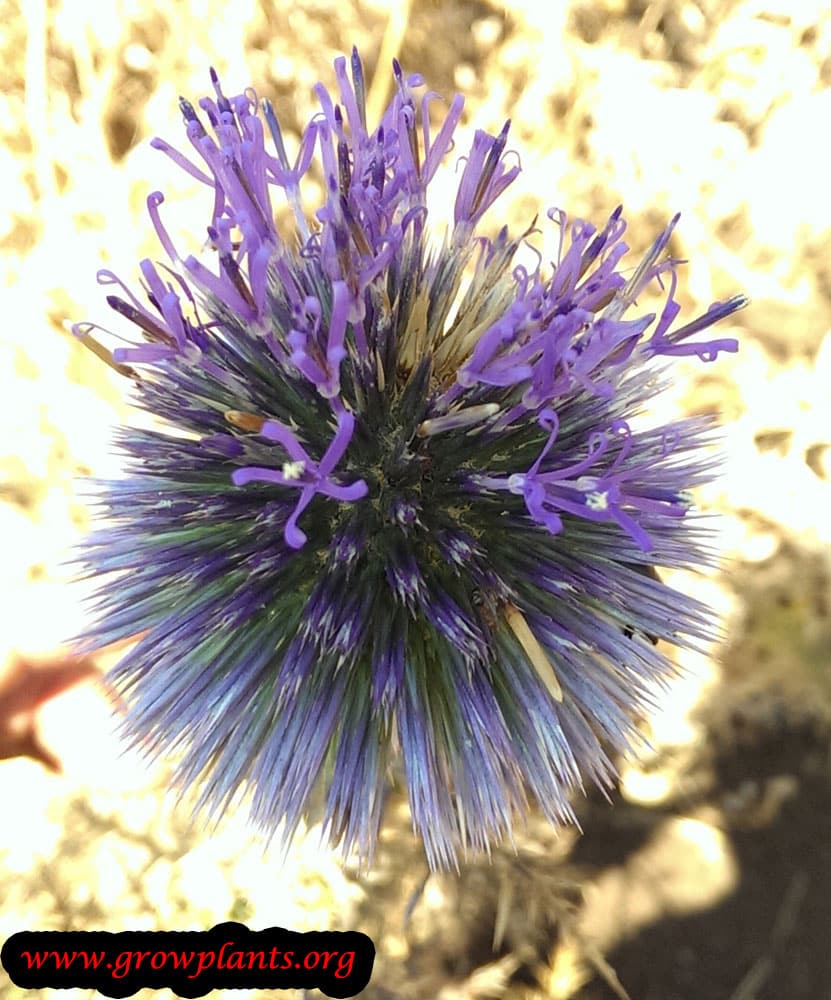


Plant Profile & Key Characteristics
Overview: An upright herbaceous perennial (Globe thistle) reaching about 0.5-2 m tall, grown for its spherical, spiny blue flower heads and coarse, thistle-like foliage. It is used mainly as an ornamental and cut/dried flower and is excellent for pollinators.
Quick Specifications
| Specification | Attribute |
|---|---|
| Plant Type / Life Cycle | Perennial (herbaceous) |
| Foliage Type | Deciduous (dies back in summer/winter) |
| Mature Size | 0.5-2 m tall (20-80 in) |
| Growth Rate | Moderate to fast |
| Root System | Deep taproot |
| Hardiness | USDA 3-11 |
Growth Form & Structure
- Height & Spread: Upright stems 0.5-2 m (20-80 in) tall; also grown in large containers.
- Growth Habit & Form: Clump-forming herbaceous perennial with stiff, branching stems topped by round flower heads.
- Lifespan & Maturity: Reaches full size within a season or two and returns each year from the crown.
Anatomy & Physical Features
- Leaves & Foliage: Green, oval leaves with sharply serrated, spiny margins; the young leaf stalk is the edible part reported for this plant.
- Flower Characteristics: Small blue, purple or white flowers packed into round, pompon-like flower heads that attract pollinators.
Primary Uses & Landscape Value
- Edible Uses: The source reports the young leaf stalks as an edible part; harvested when fully grown from the base.
- Functional & Ornamental Roles: Ornamental border perennial, striking fresh or dried cut flower, and a strong pollinator (bee and butterfly) plant.
Care Guide: Planting, Soil & Watering
Overview: Globe thistle is a tough, drought-tolerant perennial that thrives in full sun and well-drained soil, even poor or dry ground. Once established it needs little water, making it well suited to hot, dry gardens.
Quick Care Requirements
| Requirement | Ideal Condition |
|---|---|
| Planting Season | In the warm season — spring through autumn |
| Growth Rate | Moderate to Fast |
| Soil Type | Well-draining; tolerates dry, poor soil |
| Water Need | Low to Moderate — drought tolerant once established |
Planting & Establishment
- Best Planting Season: Plant from spring through autumn during the warm season, in an open, sunny spot.
- How to Plant:
- Hole Preparation: Dig a hole a little wider than the root ball in a sunny, open spot with good drainage.
- Soil Amendments: It isn’t fussy — improve heavy soil with grit for drainage, but avoid over-rich, wet conditions.
- Planting Depth: Set the crown level with the soil surface.
- Growth Speed & Expectations: Fast to moderate; it establishes quickly and can reach up to about 2 m.
Soil, Watering & Drainage Care
- Soil Mix & Drainage Needs: Wants free-draining soil and tolerates drought; sharp drainage prevents rot in wet winters.
- Watering Schedule & Technique:
- Young / Newly Planted: Water regularly while establishing, keeping the soil lightly moist.
- Established: Water sparingly — it’s drought tolerant and prefers to dry out between waterings.
- Seasonal Adjustments: Little to no extra water in cool seasons; water occasionally in prolonged summer heat.
Climate, Light & Hardiness
Globe thistle is an exceptionally wide-ranging, drought-tolerant perennial hardy from roughly zone 3 to 11, thriving in full sun with well-drained soil and a dry season; it tolerates both cold winters and desert heat.
Quick Climate Specifications
| Climate Zones | Mediterranean, desert, subtropics, temperate |
|---|---|
| USDA Hardiness Zones | Approximately 3–11 |
| Light Conditions | Full sun |
Temperature Extremes & Hardiness
USDA Hardiness & Regional Limits
One of the hardier plants in this group, spanning roughly zone 3 through 11 - tolerating both cold winters and hot, dry summers.
Extreme Heat Tolerance
Good, given its desert-climate adaptation and drought tolerance.
Wind, Humidity & Microclimate
Dry-Air Tolerance
Well suited to dry, well-drained conditions, consistent with its preference for a dry season.
Growing in Pots, Balconies & Indoors
Globe thistle carries steely-blue spherical flower heads on stems of 0.5-2 m and thrives in poor, dry, sunny sites. The grower confirms it grows in containers but is not a houseplant – it wants full outdoor sun and open air.
Quick Details
- Container Size: Roughly 15-30 L (4-8 gal), scaled to the plant’s height
- Indoor Suitability: Not an indoor plant – a sun-loving border plant, better outdoors
- Best Spot: Full sun to part shade, outdoors
- Soil & Drainage: Free-draining, not-too-rich mix – these thistles resent soggy soil
- Watering in Pots: Water moderately and let the top of the mix dry between waterings – these plants dislike constantly wet feet, and pots must drain freely
Indoors & On the Windowsill
- Not a houseplant: The grower marks it No – it needs full outdoor sun and does not adapt to a room.
- Windowsill note: A spiny, sun-loving border plant is not suited to a sill; enjoy it outdoors in a pot or bed.
On a Balcony or Patio
- Light, wind & heat: Give it the sunniest spot you have. Walls and paving reflect heat so pots dry quickly – check moisture often in warm weather. On an exposed balcony, stake tall stems and shelter from strong wind.
- Practicalities: A full pot is heavy once watered – make sure the balcony can take the load and that drainage runoff has somewhere to go.
Choosing the Pot, Soil & Long-Term Care
- Pot & drainage: Use a pot with strong drainage holes and skip a standing-water saucer to avoid root rot. Terracotta breathes and dries faster; glazed or plastic pots hold moisture longer.
- Potting mix: A well-aerated, organic-rich mix – potting mix or peat/coir blended with perlite or vermiculite for free drainage.
- Feeding: Potted plants need feeding more often than those in open ground, as nutrients leach out with each watering – feed regularly through the growing season.
- Long-term care: Every couple of years refresh the top of the mix or pot up; divide congested clumps and lightly trim roots to keep the plant vigorous.
Fertilizing & Feeding
A light feeder overall: this drought-tolerant perennial thrives on well-drained soil and needs little beyond a modest balanced feeding as growth resumes and through its summer-into-autumn bloom.
Quick Fertilizing Specs
| Feeding Level | Light feeder |
|---|---|
| Main Nutrient Priority | Balanced feeding with adequate potassium to support sturdy bloom stems |
| Best Feeding Period | Spring growth flush through the summer bloom season |
| Organic Options | Compost or well-rotted organic matter worked into well-drained soil |
| Reduce/Stop Feeding | Feeding tapers off as the plant flowers and then dies back for winter |
| Micronutrients | Rarely an issue in well-drained soil; correct only a diagnosed deficiency |
| Soil pH | Tolerates a wide range of soil, preferring it well-drained |
Feeding by Growth Stage
Spring emergence
Support fresh basal foliage and stem growth as this drought-tolerant perennial breaks dormancy.
| Nutrient direction | A balanced complete fertilizer with modest nitrogen encourages sturdy new growth without forcing lush, floppy foliage. |
|---|---|
| Timing | As new growth emerges in spring. |
| Frequency | A light feeding as growth resumes is usually enough for this easy-care perennial. |
| Fertilizer types | A balanced, complete fertilizer applied lightly, Compost or organic matter worked into the soil surface |
| Precautions | Keep feeding light; overfeeding this drought-tolerant plant can produce weak, sprawling stems that flop before bloom. |
Bud set and bloom
Support formation of the spiny, globe-shaped flower heads and sturdy bloom stalks through summer into autumn.
| Nutrient direction | Balanced feeding with adequate potassium supports strong stems and steady bloom without pushing excess soft foliage. |
|---|---|
| Timing | Through the summer and into the autumn bloom period. |
| Frequency | Light feeding continued through the bloom season is generally sufficient. |
| Fertilizer types | A balanced complete fertilizer, potassium-forward if stems seem weak, Organic matter as a light top-dressing |
| Precautions | Avoid heavy nitrogen feeding during bloom, which can weaken stems and reduce flowering on this tough, low-input plant. |
Autumn dieback and winter rest
Let the herbaceous perennial die back naturally and rest before next season’s regrowth.
| Nutrient direction | None – withhold fertilizer once the foliage begins dying back for the season. |
|---|---|
| Timing | From autumn dieback through winter dormancy. |
| Frequency | No feeding during this rest period. |
| Fertilizer types | No feeding at this stage; do not fertilize a dormant, dying-back perennial. |
| Precautions | Withhold fertilizer until fresh growth appears again in spring. |
Nutrient Deficiency Signs & Corrections
Older leaves turn uniformly pale green to yellow and new growth is stunted.
| Possible causes | low available soil nitrogen, nitrogen leached by heavy rain or irrigation, thin, low-organic-matter soil |
|---|---|
| Appears first on | older, lower leaves |
| What to check | recent feeding history, soil organic matter level, drainage and watering pattern |
| Possible correction | Apply a balanced, nitrogen-containing fertilizer lightly and work organic matter into the soil. |
Leaf margins turn brown or scorched and flower stems seem weak or prone to flopping.
| Possible causes | low soil potassium, sandy, fast-draining soil that leaches nutrients, uneven or insufficient watering during bloom |
|---|---|
| Appears first on | older leaf margins and flowering stems |
| What to check | soil texture and drainage, recent feeding balance, stem strength at bloom time |
| Possible correction | Apply a balanced fertilizer with adequate potassium and correct any drainage or watering extremes. |
Leaf tips or margins scorch brown despite the plant otherwise looking healthy.
| Possible causes | fertilizer salt buildup from over-application, under-watering that concentrates soil salts, poor drainage in heavy or compacted soil |
|---|---|
| Appears first on | leaf tips and margins |
| What to check | recent fertilizer amounts, soil drainage, watering consistency |
| Possible correction | Ease off feeding, water thoroughly to help flush excess salts, then return to lighter applications going forward. |
Pruning, Training & Seasonal Maintenance
Globe thistle is a spiny, drought-tolerant herbaceous perennial that dies back to a basal clump after its Summer/Autumn bloom. The plant’s own data centers pruning on removing dead leaves and stems through summer; as with many herbaceous perennials, a full cutback of the finished flowering stems—done in late autumn or held over to early spring—resets the clump for the next season.
Quick Pruning & Maintenance Specs
| Pruning Tolerance | Moderate |
| Primary Pruning Window | Summer, ongoing (per the plant’s own data) |
| Secondary Maintenance Window | Late autumn or early spring – whole-clump renewal cutback |
| Main Objective | Summer sanitary tidiness plus seasonal clump renewal |
| Young Plant Priority | None – allow clump establishment |
| Mature Plant Priority | Cut spent flowering stems soon after bloom, or leave for winter seedhead interest and cut back in early spring instead |
| Best Tool Type | Bypass secateurs, with gloves for the spiny foliage |
| Avoid Heavy Pruning During | Active bloom, if pollinator value or winter seedhead interest is wanted |
Pruning by Plant Age & Size
Newly Established
No cutting—let the clump establish.
Young / Formative
Not applicable; basal clump habit with no structural framework to train.
Mature / Established
Each year, choose between (a) cutting spent flower stems soon after bloom to tidy the clump and limit self-seeding, or (b) leaving the stems and steel-blue seedheads standing through winter for structural/wildlife interest, then cutting the whole clump back hard in early spring before new growth emerges.
Seasonal Pruning Schedule
Ongoing Sanitary (Summer)
Objective: matches the plant’s own “Summer” pruning-season and “dead leaves and stems” fields directly. Remove: dead leaves and spent stems as they occur.
Post-Flowering / Dormant Renewal (Late Autumn or Early Spring)
Objective: reset the clump for the next season. Remove: cut the whole clump back to the basal rosette—whichever timing is chosen, this is the main renewal cut. Expected response: a full fresh flush the same growing season.
Special Growth to Remove
- Spent flowering stems/seedheads, for self-seeding control—this species grows across a wide hardiness range (zone 3–11 per its own data) and can spread.
- Dead leaves and stems through summer, per the plant’s own data.
- If harvesting the edible young leaf stalk, per the plant’s own harvest note, take it from the base while young and tender.
Tools
- Bypass secateurs for the spiny, stiffer perennial stems.
- Gloves for handling—spines are flagged in the plant’s own data.
Tool Hygiene & Disease Risk
Routine—no disease is flagged; the plant’s own pest notes (aphids, spider mites) are not tool-transmitted.
Cut Placement & Technique
Cut spent stems down to the basal rosette rather than leaving tall stubs. Harvest young leaf stalks at the base, per the plant’s own note.
Heavy Pruning & Rejuvenation
Tolerated well—cutting the whole clump back hard in late autumn or early spring is standard renewal practice for this and related thistle-family perennials, with a full fresh flush expected the same growing season.
Post-Pruning Care
None special; watch for the aphids and spider mites the plant’s own data flags on the fresh spring flush.
Common Pruning Mistakes
- Cutting the clump back too early in autumn, losing the winter seedhead interest many gardeners want.
- Cutting too late in spring, damaging emerging new shoots.
- Handling the spiny foliage without gloves.
When NOT to Prune
- Avoid a hard cutback in the middle of the summer bloom.
- Wait until flowering is clearly finished, or hold until early spring if leaving seedheads for winter interest.
Recommended Tools (by task)
- Task: Cutting spent flower stems/whole-clump renewal – stiff, spiny stems → bypass_secateurs – handles the stiffer, spine-covered growth better than snips.
Propagation Guide
Globe thistle can be started from seed, but established clumps are also commonly divided or increased from root cuttings to produce new plants identical to the parent, useful for retaining a particular flower-color form. Propagation is easy by seed or division, and moderate by root cuttings.
Quick Propagation Specs
| Best Propagation Method | Seed or division of established clumps |
| Alternative Methods | Root cuttings taken during winter dormancy |
| Propagation Difficulty | Easy (seed, division); Moderate (root cuttings) |
| Seed True-to-Type | Usually true-to-type |
| Vegetative True-to-Type | Yes |
| Best Propagation Season | Spring, summer or autumn for seed/planting, per the site; division in spring; root cuttings in winter dormancy |
Growing from Seed
Sowing Season
Sow in spring, summer or autumn.
Germination Conditions
Sow in well-drained soil in full sun, matching this plant’s drought-tolerant preference; avoid waterlogged conditions.
Leaf & Root Cuttings
Root cuttings can be taken from dormant plants in winter and started in a gritty, well-drained medium; this reproduces the parent plant’s characteristics and offers a useful alternative where division isn’t practical.
Division, Offsets, Pups & Suckers
Divide established clumps in spring as new growth begins, ensuring each division has healthy roots and at least one growth point; replant promptly in well-drained soil.
Bloom & Flower Guide
Quick Details
- Bloom Season: Summer into autumn
- Time to First Bloom: Usually flowers in its first full season, building up in later years
- Flower Appearance: Perfectly spherical pompon heads of tiny florets in steel-blue, purple or white
- Edibility: Ornamental only – not eaten (the plant’s edible part is the leaf stalk, not the flower)
Detailed Blooming Overview
Globe thistle is grown for its unmistakable flower heads – near-perfect spheres of countless tiny florets in metallic blue, purple or white. They stand on strong stems above jagged foliage from summer into autumn and are one of the very best plants for bees and butterflies. The globes also dry beautifully, holding their colour and shape long after cutting.
Flower Characteristics
- Spherical pompon heads made up of many small florets.
- Colours range through steel-blue, purple and white.
- Held on stiff, upright stems – excellent for cutting and drying.
Bloom Care & Thinning
- Cutting and drying: Cut the globes just as they colour up but before they fully open for the best dried heads.
- Upkeep: Deadhead to prolong bloom, or leave some heads to self-seed; it is drought-tolerant once established.
- Pollination: An outstanding magnet for bees and butterflies.
Pests, Diseases & Troubleshooting
Globe thistle is an exceptionally tough, drought-hardy, deep-rooted perennial that is largely trouble-free and even shrugs off deer and rabbits, so its short pest list is a genuine reflection of a robust plant rather than an oversight. The few real problems are sap-sucking aphids in soft seasons, occasional mildew in humid air, and rot where the taproot sits in wet soil. Grow it lean, sunny, and well-drained and it mostly looks after itself.
Quick Troubleshooting Overview
| Issue / Pest | Main Symptom | Primary Solution |
|---|---|---|
| Aphids (esp. black bean aphid) | Dense colonies on stems and flower buds; honeydew | Water jet; insecticidal soap; predators usually cope |
| Spider mites | Fine stippling in hot, dry spells | Raise humidity; horticultural oil or soap |
| Powdery mildew | White dusty coating on leaves in humid air | Space and thin; sulfur or potassium bicarbonate |
| Crown / root rot | Wilting and blackened crown in wet, heavy soil | Improve drainage; avoid overwatering the taproot |
| Flopping | Tall stems splaying open | Grow lean and sunny; avoid rich soil and shade |
Common Pests & Management
- Aphids, incl. black bean aphid (Aphis fabae, Uroleucon spp.):
- Symptoms: The main insect nuisance. Dense black or green colonies pack onto the upper stems and around the globe-shaped flower buds, sucking sap and coating the plant in sticky honeydew that blackens with sooty mould; ants farm them.
- Prevention & Control: A firm jet of water dislodges most colonies, and insecticidal soap clears the rest. Globe thistle is a magnet for bees and hoverflies, so lean on natural enemies (ladybirds, lacewings, hoverfly larvae) and avoid broad-spectrum sprays that would harm the pollinators it feeds.
- Spider mites (Tetranychus urticae):
- Symptoms: In prolonged hot, dry conditions the leaves take on a fine pale stippling and may look dull and bronzed, with mites and faint webbing on the undersides.
- Prevention & Control: Raise humidity and airflow, rinse the foliage, and spray insecticidal soap or a light horticultural oil to the undersides, repeating as needed. Adequate soil moisture in heatwaves reduces stress and mite pressure.
- Leaf-eating caterpillars & occasional beetles:
- Symptoms: Now and then caterpillars or beetles chew the coarse foliage, but the tough, prickly, grey-hairy leaves deter most grazers and damage is usually cosmetic.
- Prevention & Control: Hand-pick the occasional caterpillar, and tolerate light chewing on such a robust plant. Bacillus thuringiensis is available if caterpillars ever become numerous, but it is rarely warranted.
Diseases & Fungal Issues
- Powdery mildew (Erysiphe spp.):
- Symptoms: In humid, still, crowded conditions a white-to-grey powdery film spreads over the leaves, most often late in the season or on shaded, congested clumps, dulling and sometimes distorting the foliage.
- Treatment & Management: Improve spacing, sun, and airflow and avoid wetting the foliage late in the day. Sulfur or potassium-bicarbonate sprays check mild outbreaks; cutting the plant back after flowering removes affected growth and it reshoots clean.
- Crown & root rot (Sclerotium, Phytophthora spp.):
- Symptoms: In heavy, wet, poorly drained soil, especially over winter, the deep taproot and crown rot, causing wilting, yellowing, and collapse.
- Treatment & Management: Plant in full sun in free-draining soil and avoid overwatering and winter waterlogging; improve clay with grit or use a raised position. This drought-lover far prefers to be too dry than too wet, and rot is almost always a drainage problem.
- Leaf spots (various fungi):
- Symptoms: Occasional brown or grey leaf spots may appear in wet seasons but rarely trouble such a tough plant.
- Treatment & Management: Remove badly spotted leaves and clear debris; improve airflow. Fungicide is almost never justified on globe thistle.
Growing Difficulties & Abiotic Problems
- Flopping in rich soil or shade:
- Cause & Symptoms: Grown in fertile, moist soil or too much shade, the stems become soft and overly tall and splay outward, dropping the striking blue globes.
- Correction Strategy: Grow lean: full sun, unimproved well-drained soil, and no extra feeding produce sturdy self-supporting stems. Support tall clumps discreetly if needed, or choose more compact selections.
- Resents wet feet & transplanting:
- Cause & Symptoms: The long taproot dislikes waterlogging and being moved, so plants in wet soil rot and large divisions often sulk.
- Correction Strategy: Site permanently in a dry, sunny, well-drained spot and disturb established plants as little as possible; propagate from root cuttings or seed rather than digging up the taproot.
- Self-seeding:
- Cause & Symptoms: Globe thistle can seed around freely and become weedy where happy.
- Correction Strategy: Deadhead spent globes before seed sets (this also encourages rebloom), leaving a few heads for birds and winter structure if desired.
What Helps — Products & Tools
This is a plant to manage almost entirely by good siting and hand-work: full sun, lean well-drained soil, and space for air movement prevent nearly every problem. A firm water jet and insecticidal soap handle aphids while preserving the bees and hoverflies it attracts, sulfur or potassium-bicarbonate spray suppresses occasional powdery mildew, and a light horticultural oil deals with spider mites in a heatwave. No routine chemical program is needed on such a tough perennial.
Frequently Asked Questions
How do you grow globe thistle?
Globe thistle is a tough, drought-tolerant perennial that thrives in full sun and well-drained soil, even poor or dry ground, and once established it needs little water. Plant from spring through autumn during the warm season in an open, sunny spot, setting the crown level with the soil surface.
How do you propagate globe thistle?
Globe thistle can be propagated from seed, sown in spring, summer or autumn in well-drained soil in full sun. Established clumps are also commonly divided in spring as new growth begins, giving each division healthy roots and at least one growth point before replanting promptly in well-drained soil. Root cuttings taken from dormant plants in winter, started in a gritty, well-drained medium, are a moderate-difficulty alternative that reproduces the parent plant’s characteristics.
Does globe thistle self-seed, and how do you stop it spreading?
Yes – globe thistle can seed around freely and become weedy where it’s happy. To control unwanted seedlings, deadhead spent flower globes before they set seed, which also encourages rebloom; you can still leave a few heads standing for birds and winter structure if you want some self-seeding.
Why is my globe thistle flopping over?
Flopping usually means the plant is growing in soil that’s too fertile or moist, or in too much shade – this makes the stems soft and overly tall so they splay outward and drop the blue globes. Grow it lean instead: full sun, unimproved well-drained soil, and no extra feeding produce sturdy, self-supporting stems, and heavy nitrogen feeding during bloom should be avoided since it can weaken stems and reduce flowering.
Can globe thistle be grown in a container?
Yes – it grows well in containers, though it is not a houseplant and still wants full outdoor sun and open air rather than a room or windowsill. Water moderately and let the top of the mix dry between waterings, since it dislikes constantly wet feet and the pot must drain freely. On a balcony, remember a full pot is heavy once watered, so make sure the balcony can take the load and that drainage runoff has somewhere to go.