Plant Profile & Key Characteristics
Overview: A robust annual or biennial thistle 0.5-1.8 m (1.5-6 ft) tall with striking white-marbled, spiny leaves and purple flower heads. Grown as an ornamental, as an edible vegetable and, above all, as a medicinal herb.
Quick Specifications
| Specification | Attribute |
|---|---|
| Plant Type / Life Cycle | Annual or biennial herb (herbaceous) |
| Foliage Type | Herbaceous (not evergreen) |
| Mature Size | 0.5-1.8 m (1.5-6 ft) |
| Growth Rate | Moderate to fast |
| Root System | Fleshy taproot |
| Toxicity | Edible to humans (leaves, flower heads and roots) and medicinal; can accumulate nitrates and be toxic to grazing livestock in large amounts |
| Hardiness | USDA zones 6-11 |
Growth Form & Structure
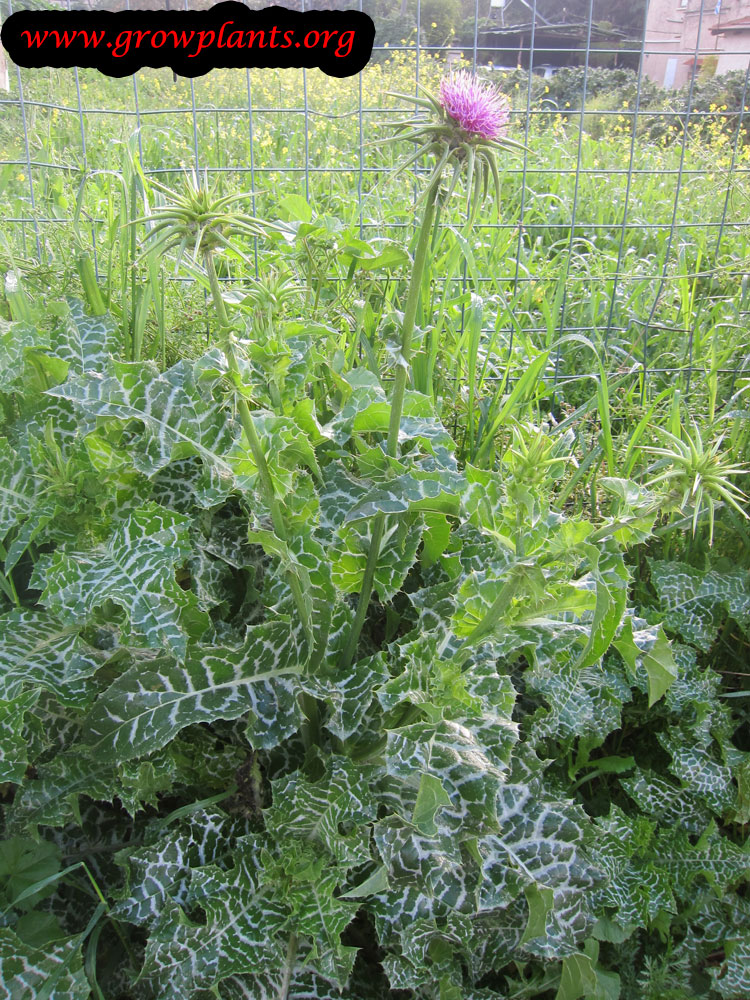
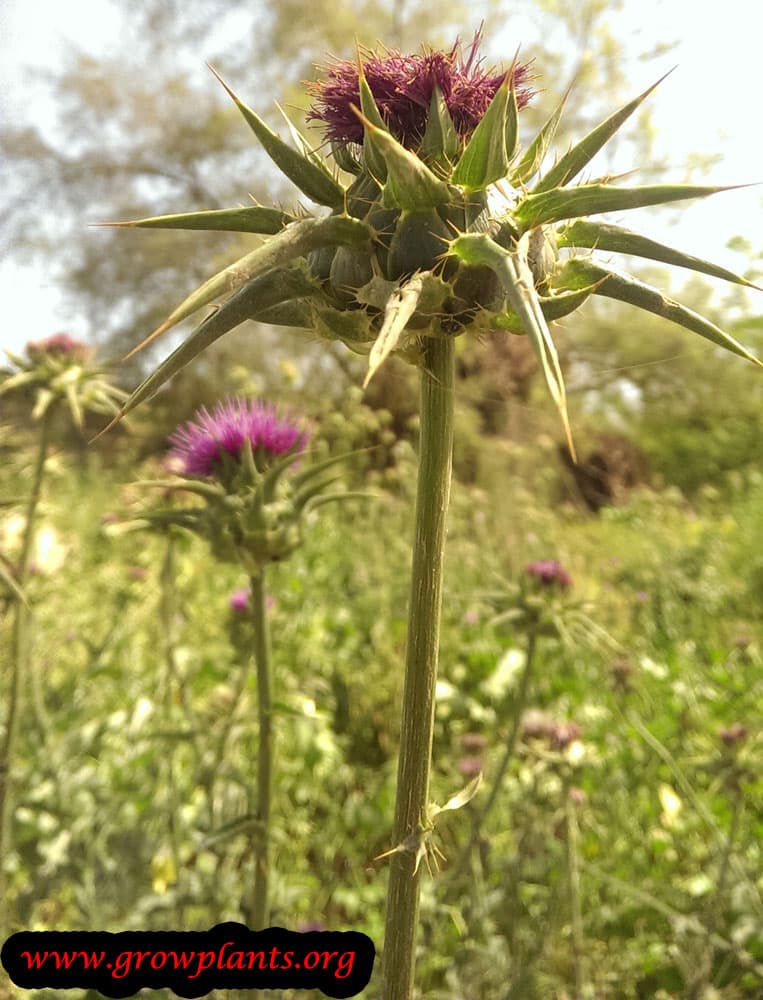
- Height & Spread: A basal rosette sends up a branched flowering stem to 0.5-1.8 m (1.5-6 ft); can be grown in a large pot.
- Growth Habit & Form: Large, coarse rosette-forming herb with a stout, branching flower stem; spiny throughout.
- Lifespan & Maturity: Completes its life cycle in one to two years, flowering, setting abundant seed and then dying.
Anatomy & Physical Features
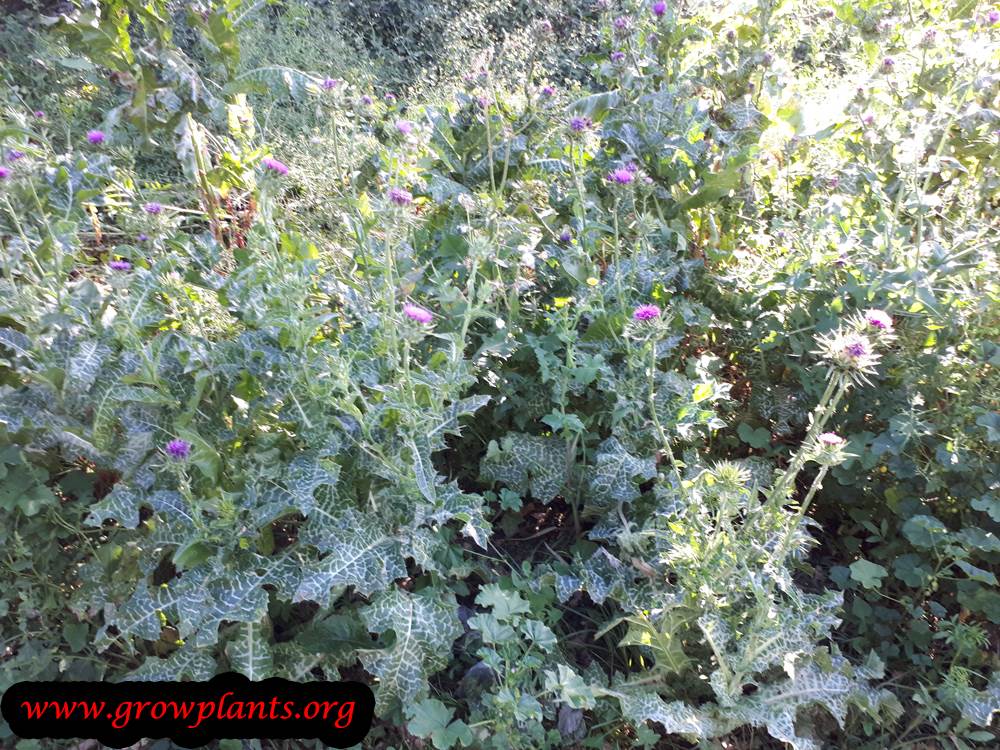
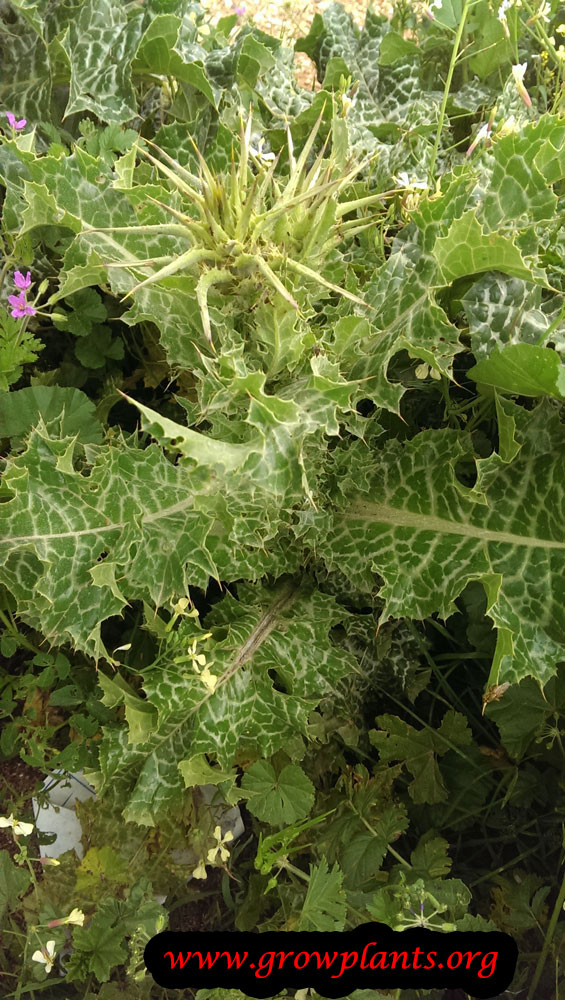
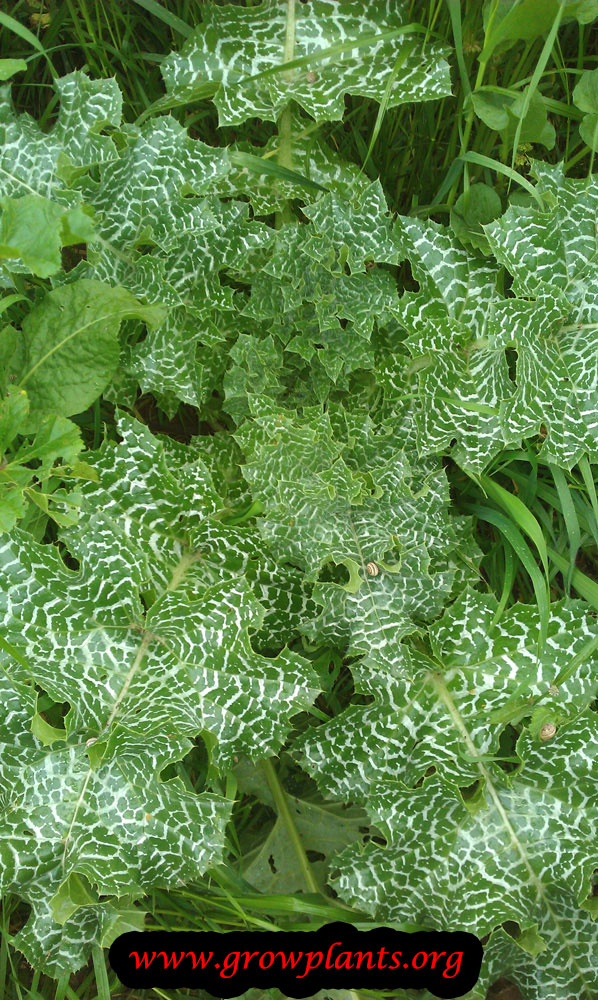
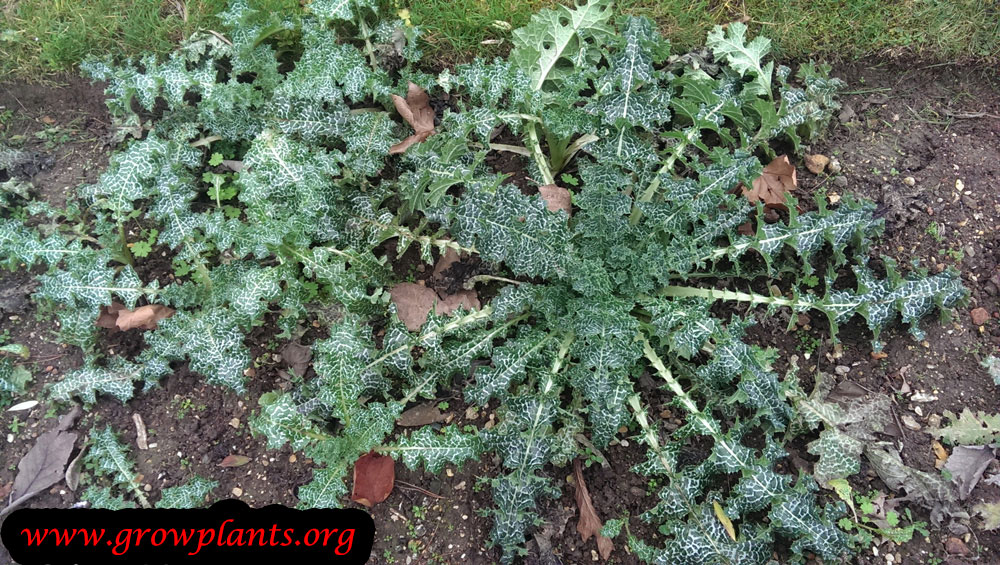
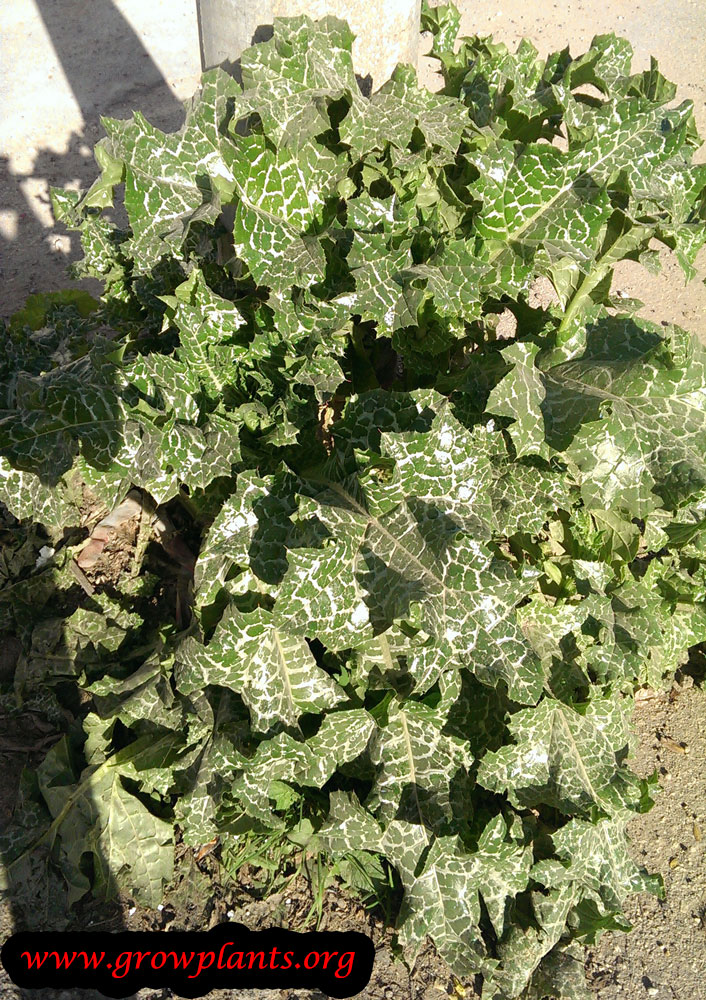
- Leaves & Foliage: Large, glossy green leaves boldly marbled with white veins and edged with spines.
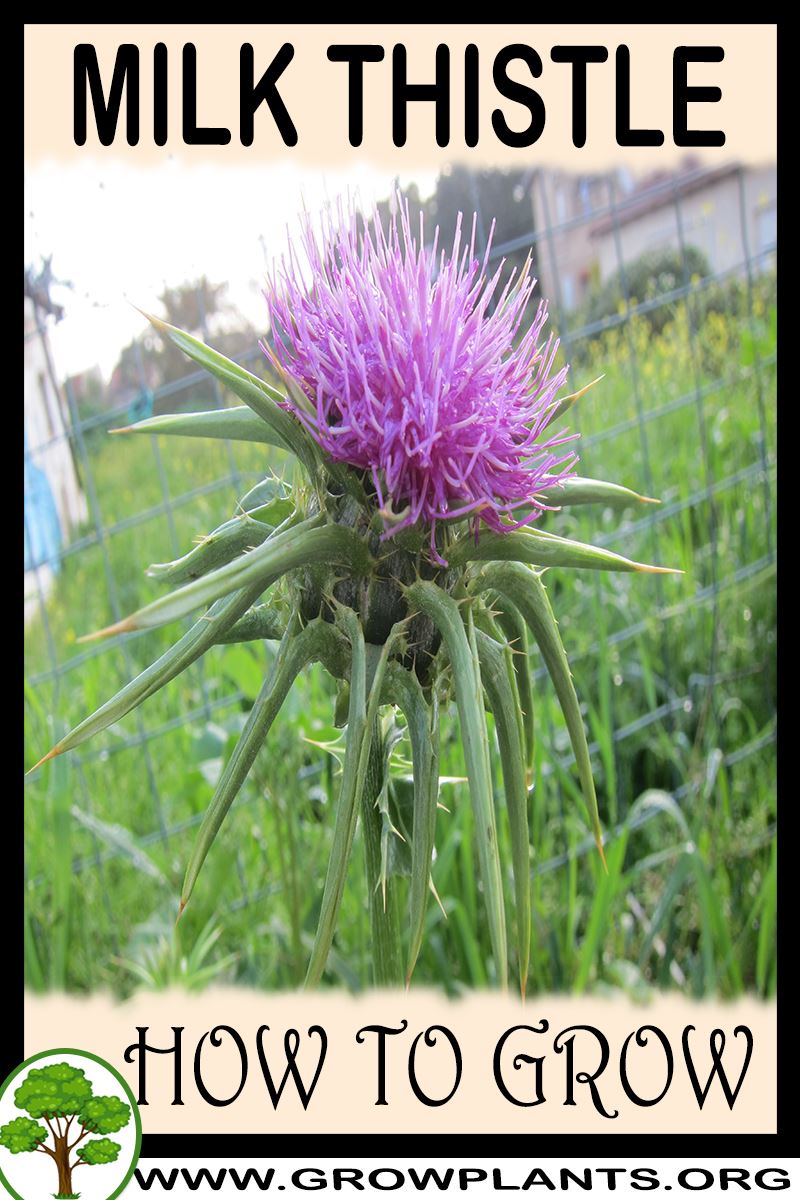
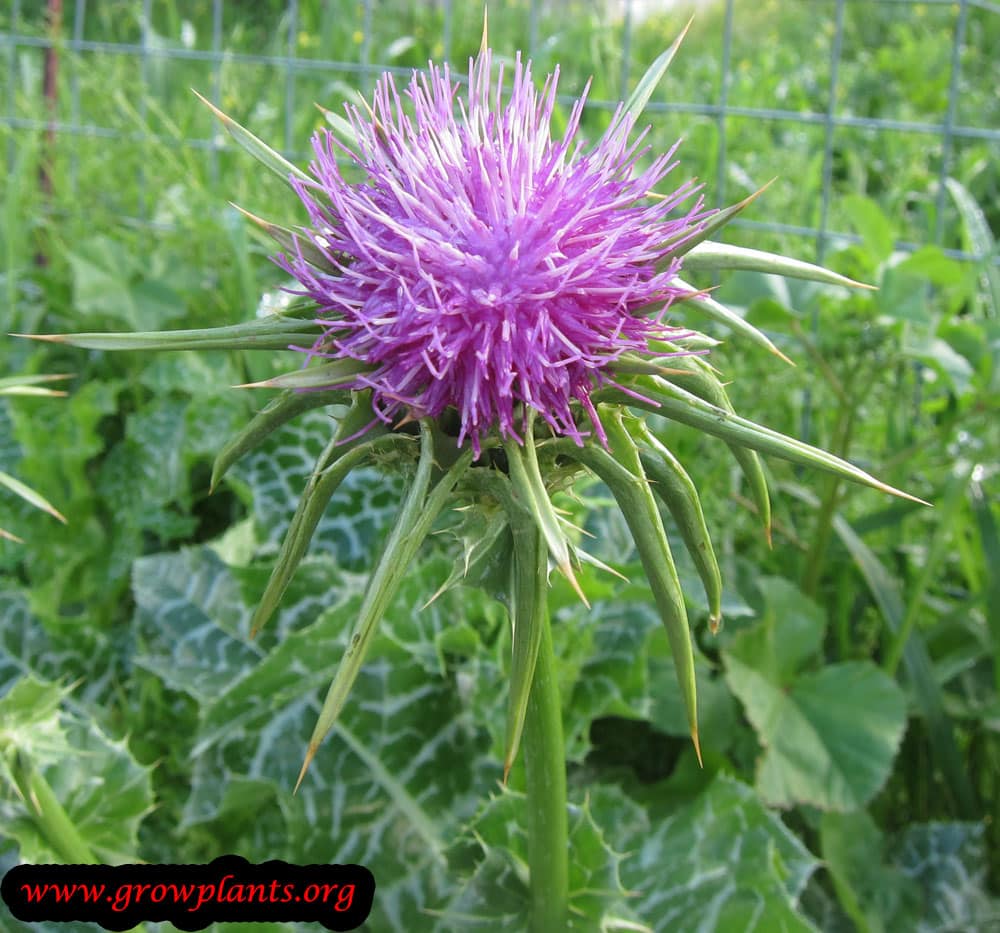
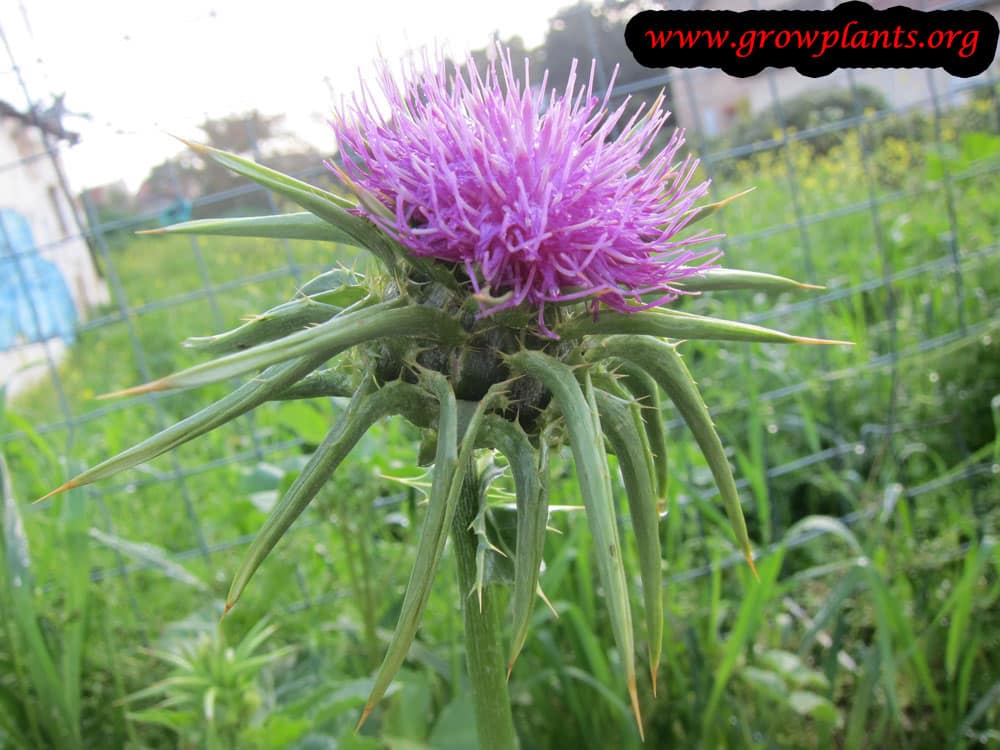
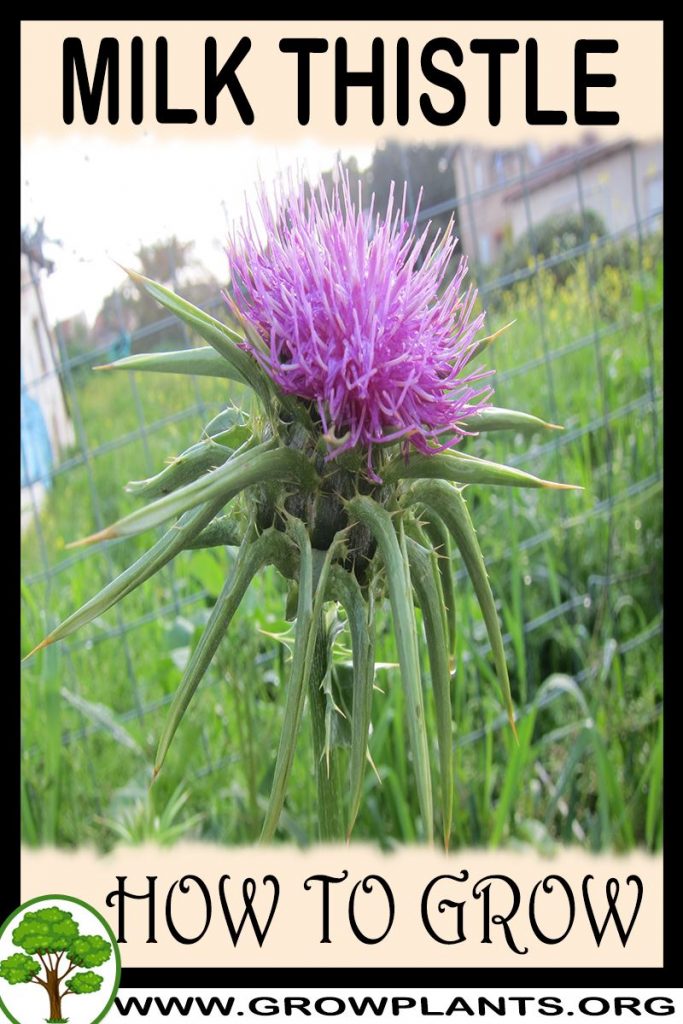
- Flower Characteristics: Solitary purple (rarely white or pink) thistle heads ringed with spiny bracts.
Primary Uses & Landscape Value
- Edible Uses: Young de-spined leaves are eaten cooked or in salads, the flower heads cooked like a small artichoke, and the taproot cooked as a root vegetable; the seeds are the source of the medicinal ‘milk thistle’ (silymarin).
- Functional & Ornamental Roles: Ornamental and pollinator plant (bees and butterflies) and a traditional medicinal herb; can self-seed and become invasive.
Care Guide: Planting, Soil & Watering
Overview: Milk thistle (Silybum marianum) is an undemanding annual or biennial that grows best in full sun in ordinary, free-draining soil. It is drought-tolerant and thrives on neglect, needing only modest water once its deep taproot is established.
Quick Care Requirements
| Requirement | Ideal Condition |
|---|---|
| Planting Season | In spring in cold climates; in autumn in warm climates |
| Growth Rate | Moderate to fast |
| Soil Type | Ordinary, well-drained soil; adaptable and not fussy |
| Water Need | Low to moderate — drought-tolerant; let the soil dry between waterings |
Planting & Establishment
- Best Planting Season: Sow or plant in spring where winters are cold, or in autumn in warm climates; it is grown across zones 6–11 and prefers to establish in the cool season.
- How to Plant:
- Hole Preparation: For transplants, dig a hole matching the depth of the root ball; milk thistle resents root disturbance, so handle its taproot gently or sow direct.
- Soil Amendments: It needs little enrichment — a lean, well-drained soil is fine; avoid overly rich beds, which produce soft, floppy growth.
- Planting Depth: Set transplants at the same depth they grew, with the crown at the soil surface; when sowing seed, cover lightly.
- Growth Speed & Expectations: Fast to moderate growth into a large rosette and flowering stem up to about 1.8 m; it self-seeds freely and can become invasive.
Soil, Watering & Drainage Care
- Soil Mix & Drainage Needs: Provide ordinary, free-draining soil; in containers use a well-draining mix, as this deep-rooted plant dislikes waterlogged conditions.
- Watering Schedule & Technique:
- Young / Newly Planted: Water after planting or sowing to establish the seedlings, keeping the soil lightly moist until they take hold.
- Established: Once the taproot develops it is drought-tolerant — water only occasionally in dry spells, letting the soil dry between waterings.
- Seasonal Adjustments: Little supplemental water is needed except in prolonged summer drought; keep it on the dry side otherwise.
Climate, Light & Hardiness
Milk thistle is an adaptable annual-to-biennial plant hardy across a broad range spanning Mediterranean, desert, temperate, and subtropical climates; it wants full sun and has no unusual climate requirements beyond that.
Quick Climate Specifications
| Climate Zones | Mediterranean, desert, temperate, subtropical |
|---|---|
| USDA Hardiness Zones | Approximately 6–11 |
| Light Conditions | Full sun |
Temperature Extremes & Hardiness
USDA Hardiness & Regional Limits
Broadly adapted from roughly zone 6 to 11. As an annual or biennial, it is grown for completing its 1–2 year cycle within a season's climate window rather than for multi-year cold survival.
Growing in Pots, Balconies & Indoors
Milk thistle is a bold annual or biennial to around 1.8 m, with white-marbled leaves and purple heads. The grower confirms it grows in containers but is not a houseplant – it wants full outdoor sun and open air.
Quick Details
- Container Size: Roughly 15-30 L (4-8 gal), scaled to the plant’s height
- Indoor Suitability: Not an indoor plant – a sun-loving border plant, better outdoors
- Best Spot: Full sun to part shade, outdoors
- Soil & Drainage: Free-draining, not-too-rich mix – these thistles resent soggy soil
- Watering in Pots: Water moderately and let the top of the mix dry between waterings – these plants dislike constantly wet feet, and pots must drain freely
Indoors & On the Windowsill
- Not a houseplant: The grower marks it No – it needs full outdoor sun and does not adapt to a room.
- Windowsill note: A spiny, sun-loving border plant is not suited to a sill; enjoy it outdoors in a pot or bed.
On a Balcony or Patio
- Light, wind & heat: Give it the sunniest spot you have. Walls and paving reflect heat so pots dry quickly – check moisture often in warm weather. On an exposed balcony, stake tall stems and shelter from strong wind.
- Practicalities: A full pot is heavy once watered – make sure the balcony can take the load and that drainage runoff has somewhere to go.
Choosing the Pot, Soil & Long-Term Care
- Pot & drainage: Use a pot with strong drainage holes and skip a standing-water saucer to avoid root rot. Terracotta breathes and dries faster; glazed or plastic pots hold moisture longer.
- Potting mix: A well-aerated, organic-rich mix – potting mix or peat/coir blended with perlite or vermiculite for free drainage.
- Feeding: Potted plants need feeding more often than those in open ground, as nutrients leach out with each watering – feed regularly through the growing season.
- Season to season: As a short-lived plant there is no long-term repotting – empty and refill the pot with fresh, clean mix each cycle so pests and disease are not carried over.
Fertilizing & Feeding
A light feeder: this fast-growing, self-sowing annual or biennial thrives in average soil and generally needs only a light balanced feeding while it is actively growing.
Quick Fertilizing Specs
| Feeding Level | Light feeder |
|---|---|
| Main Nutrient Priority | Balanced feeding with modest nitrogen to support leaf and flower-head development |
| Best Feeding Period | Active growth from the seedling stage through flowering |
| Organic Options | Compost or well-rotted organic matter worked into the bed |
| Reduce/Stop Feeding | Feeding tapers off as the plant flowers, sets seed, and completes its life cycle |
| Micronutrients | Rarely an issue in average garden soil; correct only a diagnosed deficiency |
| Soil pH | Tolerates a wide range of soil |
Feeding by Growth Stage
Seedling establishment
Help young plants build roots and their first rosette of spiny, marbled leaves.
| Nutrient direction | A balanced fertilizer with modest nitrogen supports steady early leaf growth without forcing weak, soft tissue. |
|---|---|
| Timing | Soon after seedlings or transplants are established in the bed. |
| Frequency | A light feeding at establishment is generally enough to get this vigorous plant going. |
| Fertilizer types | A balanced, complete fertilizer applied lightly, Compost or organic matter worked into the soil at planting |
| Precautions | Keep feeding light; this self-sowing plant grows vigorously on its own and rich feeding mainly encourages spread. |
Active growth to flowering
Support the rosette-to-flower-stalk transition and development of the edible leaves, flower heads, and root.
| Nutrient direction | A balanced feeding sustains steady growth through to flowering; heavy nitrogen is rarely needed on this weedy, adaptable plant. |
|---|---|
| Timing | Through active vegetative growth up to flowering. |
| Frequency | Occasional light feeding through the growing season is usually sufficient. |
| Fertilizer types | A balanced complete fertilizer applied sparingly, Compost as a light top-dressing |
| Precautions | Avoid overfeeding, which can push excess soft leaf growth prone to powdery mildew and encourage unwanted self-seeding. |
Nutrient Deficiency Signs & Corrections
Older leaves fade to pale green or yellow and overall growth is stunted.
| Possible causes | low available soil nitrogen, nitrogen leached by heavy watering or rain, thin, low-organic-matter soil |
|---|---|
| Appears first on | older, lower leaves |
| What to check | recent feeding history, soil organic matter, watering and drainage |
| Possible correction | Apply a balanced, nitrogen-containing fertilizer lightly and build up soil organic matter. |
Interveinal yellowing appears on older leaves while the veins themselves stay green.
| Possible causes | low soil magnesium, heavy potassium feeding competing with magnesium uptake, leaching in light, sandy soils |
|---|---|
| Appears first on | older, lower leaves |
| What to check | soil magnesium status, how potassium-heavy recent feeding has been, soil texture and leaching |
| Possible correction | Apply a labeled magnesium source such as a dolomitic amendment and rebalance overall feeding. |
Leaf margins brown or scorch and growth stalls despite adequate watering.
| Possible causes | fertilizer salt buildup in the root zone, under-watering that concentrates soil salts, excessive or too-frequent feeding |
|---|---|
| Appears first on | leaf margins and tips |
| What to check | recent fertilizer amounts, watering consistency, soil drainage |
| Possible correction | Ease off feeding, water thoroughly to flush accumulated salts, then return to lighter feeding going forward. |
Pruning, Training & Seasonal Maintenance
Milk thistle is a fast, self-seeding annual-to-biennial. The plant’s own data is direct: pruning is “No need” across the growing season. The one pruning-relevant task worth doing is deadheading spent flowerheads before they set seed, since the species is explicitly flagged invasive and spreads readily by self-seeding.
Quick Pruning & Maintenance Specs
| Pruning Tolerance | Low – little to no cutting is needed or beneficial |
| Primary Pruning Window | None fixed – as-needed through the season |
| Secondary Maintenance Window | Pre-seed-set, after Spring/Summer bloom, if controlling spread |
| Main Objective | Preventing unwanted self-seeding; sanitary leaf removal |
| Young Plant Priority | None |
| Mature Plant Priority | Deadhead spent flowerheads if self-seeding is unwanted; remove mildew-affected leaves |
| Best Tool Type | Bypass secateurs, with gloves – both leaf margins and flowerheads are spiny |
| Avoid Heavy Pruning During | Not applicable – this is a low-pruning plant throughout |
Pruning by Plant Age & Size
Newly Established / Young
No pruning—let the rosette (year one, if biennial) or young plant establish undisturbed.
Mature
Deadhead spent flowerheads before seed-down disperses if self-seeding is unwanted. Remove mildew-affected leaves promptly.
Seasonal Pruning Schedule
Ongoing (All Season)
Objective: matches the plant’s own “All season”/”No need” pruning data directly. Remove: only mildew-affected or dead leaves as they appear, per the plant’s own flagged pest (powdery mildew). Do not remove: healthy foliage—no structural cutting is called for.
Post-Flowering
Objective: control spread, after the Spring/Summer bloom. Remove: spent flowerheads before the spiny seed heads mature and disperse, if not seed-saving or harvesting—this species is documented as invasive/self-seeding. Do not remove: heads you intend to seed-save.
Special Growth to Remove
- Spent flowerheads—for self-seeding control, given the plant’s own “Invasive” flag.
- Powdery-mildew-affected leaves, per the plant’s own pest data—remove and dispose rather than compost, to reduce spore spread.
Tools
- Bypass secateurs—gloves are needed given the plant’s own noted spines on the flowerhead and leaf margins.
Tool Hygiene & Disease Risk
Increased—remove and dispose of (don’t compost) powdery-mildew-affected foliage, per the plant’s own flagged disease, to reduce reinfection.
Cut Placement & Technique
Cut flowerheads at the stem, well before the seed-down forms.
Heavy Pruning & Rejuvenation
Not applicable—matches the plant’s own “No need” data directly; it is a short-lived annual/biennial with no framework to rejuvenate.
Post-Pruning Care
None special.
Common Pruning Mistakes
- Letting seed heads mature and disperse, given the plant’s documented invasiveness and rapid self-seeding.
- Composting powdery-mildew-affected material instead of disposing of it.
When NOT to Prune
- No need to prune while the plant is actively flowering unless deadheading specifically for seed control.
- Otherwise this species simply doesn’t require intervention, matching its own “No need” fact.
Recommended Tools (by task)
- Task: Deadheading spent flowerheads / removing mildew-affected leaves – spiny stem and head → bypass_secateurs – a single clean cut behind protective gloves, avoiding the plant’s own documented spines.
Propagation Guide
Milk thistle is propagated from seed, the only method the site lists and the standard way to grow this annual-to-biennial plant; no grafting or vegetative propagation is used. Propagation is easy, and the site’s note that this plant is invasive reflects how readily it self-seeds if flower heads are left to mature.
Quick Propagation Specs
| Best Propagation Method | Direct-sown seed |
| Alternative Methods | Nursery-grown seedlings/transplants |
| Propagation Difficulty | Easy |
| Seed True-to-Type | Yes |
| Best Propagation Season | Spring in cold climates; autumn in warm climates, per the site |
Growing from Seed
Sowing Season
Sow in spring where winters are cold, or in autumn in warmer climates, matching the site’s planting-season guidance.
Sowing Depth & Orientation
Sow seed shallowly, just covered with soil.
Germination Conditions
Germinates readily in full sun without a special pretreatment reported.
Seedling Care
Handle seedlings with care as the spiny foliage develops; remove flower heads before seed sets if self-seeding is unwanted, since the site notes this plant can become invasive.
Bloom & Edible Flower Guide
Quick Details
- Bloom Season: Spring in warm climates; summer in cooler areas
- Time to First Bloom: As an annual or biennial, it flowers in its first or second year
- Flower Appearance: Solitary purple heads – rarely white or pink – ringed by stiff, spiny bracts
- Edibility: Yes – the flower head is edible cooked, like a small artichoke, once the spines are trimmed
Detailed Blooming Overview
Milk thistle is easily recognised by its glossy, white-veined leaves and its bold purple flower heads guarded by sharp spiny bracts. Caught young, the fleshy base of the head can be prepared and eaten much like a small artichoke. Left to mature, the heads ripen into the seeds famed in herbal medicine – but do note that this is a vigorous self-seeder that can spread freely if the heads are allowed to ripen.
Flower Characteristics
- Solitary heads of purple florets, rarely white or pink.
- Encircled by stout, spine-tipped bracts.
- Held on tall stems above the marbled, white-veined foliage.
Bloom Care & Thinning
- Eating the heads: Take the young heads while tender, trim away the spiny bracts, and cook the fleshy base.
- Managing spread: Deadhead before the seed ripens to keep this aggressive self-seeder in check.
- Pollination: The heads attract bees, butterflies and other pollinators.
Fruit & Uses
Milk thistle is a multi-part edible: young leaves and the immature flower head are cooked as vegetables once their spines are removed, and the taproot can be cooked like other root vegetables. The seeds, though not covered in the site’s own data, are the plant’s best-known traditional part and are used mainly for extraction rather than as a table food.
Quick Edible Specs
| Edible Parts | Young leaves; flower head; root; seeds (traditional use, see note) |
|---|---|
| Main Use(s) | Culinary – cooked leafy green/salad, cooked flower head (like a small artichoke), cooked root; seeds – traditionally used medicinally (no health claims made here) |
| Eaten Raw or Cooked | Leaves – cooked or salad; Flower head – cooked; Root – cooked |
| Preparation Required | Remove spines from leaves and flower head before eating; peel/scrub the root before cooking |
| Harvest Season | Leaves – spring through autumn (into winter in hardiness zone 10–11); Flower head – during bloom, spring to summer; Root – summer |
| Time to First Harvest | Leaves are cut at their base once young and tender; the root is lifted later in the season once established (see Propagation for establishment) |
| Storage | Best used fresh; root can be stored briefly like other fresh root vegetables |
| Safety/Toxicity Caveat | Leaves and flower head carry sharp spines that must be removed before eating; no significant toxicity otherwise documented for the leaf, flower or root in normal food amounts |
Leaves & Greens
Leaves are green, sometimes marked with white veining, with spiny edges. Young leaves are cut at the base through spring, summer and autumn (into winter in the warmest zones) and used cooked or in salad; the spines should be trimmed away first (e.g. with scissors) since they are sharp even though the leaf itself is not toxic.
Flowers & Flower Buds
The flower head is edible in the same way as a small thistle "artichoke": it is spiny, purple (rarely white or pink), and best used cooked. Pick while the head is still relatively young; as with the leaves, trim the spines before preparing.
Roots & Tubers
The taproot is white-fleshed with a brownish peel. It is lifted in summer, then cooked like other root vegetables.
Seeds, Pods & Nuts
The seeds are the part milk thistle is best known for worldwide, though this is not covered in the site’s own growing data. They are traditionally used medicinally (no health claims made here) and are not typically prepared as a table food, so are mentioned only for completeness – treat any use of the seed as a supplement, not a substitute for the leaf/flower/root uses documented on this site.
Harvesting
Leaves can be cut repeatedly at the base through most of the growing season while young; the flower head is picked while blooming, in spring to summer; the root is lifted once in summer, ending that plant’s further leaf/flower harvest.
Preparation, Uses & Safety
Trim the sharp spines from leaves and flower heads before cooking or salad use. The root is peeled/scrubbed and cooked like other roots. No significant food-safety toxicity is documented for the leaf, flower head or root eaten in normal amounts; the main hazard is purely mechanical (the spines). Seeds are traditionally used medicinally rather than eaten as food.
Pests, Diseases & Troubleshooting
Overview: Milk thistle is a robust, weedy annual/biennial that is naturally vigorous and largely self-sufficient; its main issues are powdery and downy mildews, a handful of thistle-feeding insects, and rot in wet, rich ground. As a tough pioneer plant it rarely needs intervention.
Quick Troubleshooting Overview
| Issue / Pest | Main Symptom | Primary Solution |
|---|---|---|
| Powdery mildew | White powdery film on leaves in dry, crowded air | Airflow; sulphur/potassium-bicarbonate if needed |
| Downy mildew | Yellow patches above, grey mould beneath, in wet weather | Airflow; remove affected leaves |
| Aphids | Clusters on shoots & buds; honeydew | Hose off; insecticidal soap |
| Thistle caterpillars | Chewed, webbed leaves (painted-lady larvae) | Tolerate or hand-pick |
| Leaf/stem rot | Yellowing, collapse in wet, rich soil | Free-draining lean soil; avoid overwatering |
| Self-seeding | Prolific unwanted seedlings the next year | Deadhead before seed set to contain |
Common Pests & Management
- Aphids (Aphis / Uroleucon spp.):
- Symptoms: Green or black clusters on the soft shoots, flower buds and stems, sucking sap and leaving honeydew and sooty mould; usually a minor issue on such a vigorous plant.
- Prevention & Control: Hose off colonies or wipe them away; insecticidal soap deals with heavier numbers. Predators build up quickly on the thistle’s flowers, so routine spraying is rarely needed.
- Thistle caterpillars (Vanessa cardui):
- Symptoms: Painted-lady butterfly larvae that feed within loose silken webbing on the leaves, skeletonising patches of foliage; damage is cosmetic and supports a valued pollinator.
- Prevention & Control: Tolerate the feeding for the butterflies, or hand-pick and remove webbed leaves if damage is unacceptable. Bacillus thuringiensis (Bt) is an option for heavy infestations but sacrifices the butterflies.
- Weevils & capitulum feeders (Larinus / Rhinocyllus spp.):
- Symptoms: Thistle-specialist weevils whose larvae develop in the flower heads, reducing seed set; largely relevant only where seed is being harvested medicinally.
- Prevention & Control: No control is needed for ornamental or wildlife use; where seed yield matters, remove and destroy infested heads and encourage a diverse insect fauna. These insects are in fact used as biocontrol of weedy thistles.
Diseases & Fungal Issues
- Powdery mildew (Erysiphe / Leveillula spp.):
- Symptoms: A white, powdery coating on the leaves and stems, worst in warm, dry days with humid nights or in crowded, still plantings; it yellows and prematurely ages the foliage.
- Treatment & Management: Space plants for airflow, grow in full sun, and avoid crowding. Remove badly affected leaves; a sulphur, potassium-bicarbonate or milk-based spray checks it if needed, though a vigorous plant usually tolerates it to flowering and seeding.
- Downy mildew (Peronospora / Plasmopara spp.):
- Symptoms: Pale yellow, angular patches on the upper leaf surface with a greyish or violet mould beneath in cool, wet, humid weather; heavy infection distorts and kills leaves.
- Treatment & Management: Improve airflow and drainage, avoid overhead watering, and remove and destroy affected foliage. Cultural control usually suffices; a copper fungicide is available for severe outbreaks in wet seasons.
- Root & stem rot (Sclerotinia / Phytophthora / Pythium spp.):
- Symptoms: Yellowing, wilting and basal or root decay in wet, rich or poorly drained soil, sometimes with white fungal growth (Sclerotinia); the plant prefers lean, well-drained ground.
- Treatment & Management: Grow on free-draining, not-too-rich soil, avoid overwatering, and give good spacing. Remove and destroy rotted plants and avoid replanting thistles or susceptible crops in the same spot the following season.
Growing Difficulties & Abiotic Problems
- Rot in wet, over-rich soil:
- Cause & Symptoms: Yellowing, floppy, rotting growth where the soil is heavy, wet, or heavily fed; milk thistle is a lean-ground pioneer that dislikes coddling.
- Correction Strategy: Grow in full sun on free-draining, unenriched soil, water sparingly once established, and avoid rich feeding, which produces soft, disease-prone growth.
- Prolific self-seeding:
- Cause & Symptoms: A single plant sets abundant wind-borne seed and can become weedy, appearing uninvited across the garden the following year.
- Correction Strategy: Deadhead the flower heads before the seed matures if you wish to contain it, and remove unwanted seedlings while young. In many regions it is a declared weed, so preventing seed escape is important.
- Bolting & short life:
- Cause & Symptoms: As an annual/biennial it flowers, sets seed and dies within a season or two; a spent, browning plant is completing its natural cycle, not failing.
- Correction Strategy: Simply let it complete its cycle and self-sow a controlled number of replacements, or sow fresh seed. Nothing is wrong when an old plant declines after flowering.
What Helps – Products & Tools
Milk thistle needs almost nothing: insecticidal soap for the rare heavy aphid flush, Bacillus thuringiensis (Bt) only if caterpillars must be curbed, and a sulphur, potassium-bicarbonate or copper fungicide for stubborn powdery or downy mildew. The most useful ‘tools’ are secateurs for deadheading before it self-seeds and a lean, free-draining site — this is a rugged plant best left largely to its own devices.