


Plant Profile & Key Characteristics
Also known as: Hungarian chamomile, Wild chamomile, Blue chamomile, Scented mayweed, Matricaria recutita
Overview: German chamomile (Matricaria chamomilla) is a fast-growing aromatic annual herb 10-50 cm with feathery foliage and small white-and-yellow daisy flowers; grown for chamomile tea and as a medicinal, fragrant and ornamental herb.
Quick Specifications
| Specification | Attribute |
|---|---|
| Plant Type / Life Cycle | Annual |
| Mature Size | 10-50 cm (4-20 in) |
| Growth Rate | Fast |
| Root System | Shallow, fibrous |
| Toxicity | Non-toxic / edible |
| Hardiness | USDA 4-10 (11 with care) |
Growth Form & Structure
- Height & Spread: 10-50 cm (4-20 in); grows well in small containers (2.5-7 L). Space plants about 20-30 cm (8-12 in) apart.
- Growth Habit & Form: Upright, branching annual herb with finely divided foliage; self-seeds readily.
- Lifespan & Maturity: Fast annual, flowering within the season.
Anatomy & Physical Features
- Leaves & Foliage: Finely divided (pinnate), narrow, aromatic green leaves.
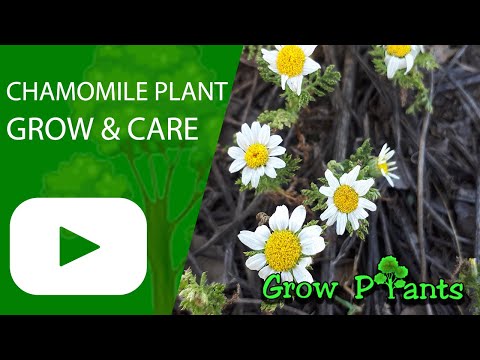
- Flower Characteristics: Small daisy flowers – white rays around a yellow centre (see Bloom guide).
Primary Uses & Landscape Value
- Edible Uses: Flowers and leaves used for chamomile tea and other beverages; a medicinal herb.
- Functional & Ornamental Roles: Herb garden, pollinator plant and fragrant ornamental; self-seeding filler.
Care Guide: Planting, Soil & Watering
Overview: German chamomile (Matricaria chamomilla) is a fast-growing annual herb (zones 4–10, and 11 with care) that grows in full sun to part shade and tolerates heavier soils. It likes soil kept moist, especially while young, with only low to moderate watering thereafter.
Quick Care Requirements
| Requirement | Ideal Condition |
|---|---|
| Planting Season | Spring–summer in zones 4–10a; autumn–winter in 10b–11 |
| Growth Rate | Fast |
| Soil Type | Heavier soil, kept moist when young |
| Water Need | Low to Moderate |
Planting & Establishment
- Best Planting Season: Plant in spring to summer in zones 4–10a, or autumn to winter in the warmer zones 10b–11.
- How to Plant:
- Hole Preparation: Dig a hole a little larger than the root ball.
- Soil Amendments: Add fertilizer and organic matter, and mulch around young plants to hold moisture.
- Planting Depth: Set the root ball at soil level and firm gently.
- Growth Speed & Expectations: Fast — reaches about 10–50 cm (4–20 in) and readily self-seeds.
Soil, Watering & Drainage Care
- Soil Mix & Drainage Needs: Tolerates heavier soil but still needs good drainage; in containers (2.5–7 L / 0.5–1.5 gal) use potting or peat mix with perlite, humus and organic matter, with plenty of drainage holes.
- Watering Schedule & Technique:
- Young / Newly Planted: Water at least once a day at first and keep the soil moist while plants establish.
- Established: Water lightly to moderately, letting the surface dry between waterings.
- Seasonal Adjustments: More in warm, dry weather and less in cool spells; let any water in a pot saucer drain the same day.
Climate, Light & Hardiness
German chamomile is a fast-growing annual that self-sows readily across Mediterranean, subtropical, and temperate climates, listed for USDA zone 4–10 and grown with care into zone 11. It takes full sun to half shade, and because it is an annual, its planting window shifts from spring–summer in cooler zones to an autumn–winter cool-season cycle in the hottest zones (10b–11).
Quick Climate Specifications
| Climate Zones | Mediterranean, subtropical, temperate |
|---|---|
| USDA Hardiness Zones | 4–10, and 11 with the right care |
| Frost Tolerance | Low |
| Light Conditions | Full sun to half shade |
Sunlight & Light Exposure
Optimal Light Setup
Full sun produces the most flowers; half shade is acceptable, especially in hot climates where it also helps prolong bloom.
Temperature Extremes & Hardiness
USDA Hardiness & Regional Limits
Being an annual, its wide zone 4–11 listing reflects where a frost-free (or workable cool-season) window exists to complete its life cycle rather than year-round survival of a single plant.
Frost Sensitivity
Frost-sensitive foliage and flowers; in zone 4–10a it is grown through the frost-free spring–summer months, while in the hot zone 10b–11 range growers instead plant it in the cooler autumn–winter window to avoid summer heat.
Extreme Heat Tolerance
Peak summer heat in zone 10b–11 is a bigger limiting factor than cold, which is why cultivation there shifts to autumn through winter.
Growing in Pots, Balconies & Indoors
German chamomile is a fast, fragrant annual herb grown for its edible tea flowers. The grower does not rate it as a houseplant, but it is small enough to grow on a very sunny windowsill, balcony or patio in a pot.
Quick Details
- Container Size: 2.5-7 L (0.5-1.5 gal); start in a pot at least 200% larger than the plant (grower’s values)
- Indoor Suitability: Not a deep-indoor houseplant, but manageable on a very bright, sunny windowsill
- Best Spot: Full sun to part shade
- Soil & Drainage: Free-draining mix with plenty of holes; the grower stresses good drainage
- Watering in Pots: Water moderately; let the base drain and dry out the same day – do not leave it standing wet
Indoors & On the Windowsill
- Houseplant limits: The grower marks it as not a houseplant – indoors it needs strong direct light to bloom, so keep it to the sunniest sill rather than a room interior.
- Windowsill growing: A compact plant on a bright sill can give a few flowers for tea; direct sun is essential.
On a Balcony or Patio
- Light, wind & heat: It is happy on a balcony or patio in good light. Pots dry quickly because walls and paving reflect heat, so check them often in warm spells; shelter tall stems from wind and mind the pot weight and drainage runoff.
- Practicalities: A shallow, wide 2.5-7 L pot in full sun suits it; deadhead to keep flowers coming.
Choosing the Pot, Soil & Long-Term Care
- Pot & drainage: Start about 200% larger than the plant, in a 2.5-7 L pot with plenty of drainage holes; the grower lets the base fill with water but ensures it dries out the same day to avoid rot.
- Pot material: Terracotta breathes and dries quickly (handy for sun-loving Mediterranean plants); glazed or plastic pots hold moisture longer.
- Potting mix: The grower uses potting mix or peat with perlite, mixed with humus and organic matter; chopped mulch on top helps keep the surface moist.
- Feeding: Potted plants use up nutrients faster because watering leaches them out, so feed a little more often than plants in open ground.
Grower’s Container Tip
- Right-size the pot & base-water: Start in a container about 200% larger than the plant; you can let the pot base fill with water but make sure it dries out the same day – his method for keeping the roots moist without rotting them.
Fertilizing & Feeding
A fast-growing annual grown mainly for its edible, tea-quality flowers; it germinates and grows quickly in fertile soil and does not need heavy feeding to perform well.
Quick Fertilizing Specs
| Feeding Level | light |
|---|---|
| young_feeding | Give seedlings only a light feeding once they are established, after the initial flush of germination and early growth. |
| mature_feeding | Through the rest of its one growing season, light, occasional feeding is enough to keep flower production going. |
| Main Nutrient Priority | A balanced, modest fertilizer supports healthy foliage and steady flowering without excess soft growth. |
| Best Feeding Period | The active growing season from establishment through the main bloom flush. |
| Organic Options | Compost and organic matter worked into the soil at planting suit this annual well. |
| Soil pH | Tolerates a range of soil pH, though it does best avoiding extremes. |
| Reduce/Stop Feeding | Feeding is not needed once the plant is finishing its bloom and setting seed at the end of its single growing season. |
Feeding by Growth Stage
Establishment from seed or transplant
Support a young German chamomile plant through germination and early rooting.
| Nutrient direction | Light, balanced feeding; rich, organically prepared soil at planting usually covers the plant’s early needs. |
|---|---|
| Timing | At sowing or transplanting, and through early seedling growth. |
| Frequency | A single light feeding once seedlings are growing is usually enough to start. |
| Fertilizer types | A balanced fertilizer worked into the soil at planting, or a light dose of compost |
| Precautions | Avoid concentrated fertilizer directly on young seedlings, which can scorch fine new roots. |
Active growth and bloom
Support foliage growth and a full flush of tea-quality flowers through its single growing season.
| Nutrient direction | Keep nitrogen modest; this fast annual flowers well on lean feeding, and excess nitrogen favors soft foliage over flowers. |
|---|---|
| Timing | From active leafy growth through the main bloom period. |
| Frequency | This plant rarely needs feeding beyond an occasional light application through its growing season. |
| Fertilizer types | An occasional light, balanced fertilizer application, or a compost top-dressing |
| Precautions | Avoid frequent or nitrogen-heavy feeding, which produces excess leafy growth at the expense of flowering. |
Nutrient Deficiency Signs & Corrections
Pale, yellow-green older foliage and weak, slow growth.
| Possible causes | Nitrogen deficiency in poor soil, Waterlogged or compacted soil limiting root uptake, Natural decline as the plant finishes its bloom cycle |
|---|---|
| Appears first on | Older, lower foliage first |
| What to check | Soil drainage and texture, Recent feeding history, Whether new growth at the tips still looks healthy |
| Possible correction | A light, balanced feeding during active growth is usually enough to correct a genuine deficiency. |
New growth turning pale to yellow while the veins stay green.
| Possible causes | High or alkaline soil pH tying up iron, Poor drainage limiting root function, Root stress after transplanting |
|---|---|
| Appears first on | Newest leaves at the growing tips |
| What to check | Soil pH and drainage, Whether the plant was recently transplanted, Whether older foliage remains a normal green |
| Possible correction | Address the underlying soil pH or drainage issue; a chelated iron product applied per its label can help if color does not recover on its own. |
Interveinal yellowing on older foliage while the veins remain green.
| Possible causes | Magnesium deficiency in light, sandy, or heavily leached soil, Excess potassium competing with magnesium uptake, Normal aging of older foliage |
|---|---|
| Appears first on | Older foliage |
| What to check | Whether yellowing is between the veins rather than whole-leaf, Soil type and watering pattern, Overall vigor of new growth |
| Possible correction | Rule out watering and soil issues first; a chelated or soluble magnesium product used per its label can correct a genuine deficiency. |
Pruning, Training & Seasonal Maintenance
German chamomile is a fast-growing annual, so its pruning is confined to a single season and centers on one trade-off: deadheading to keep flowers coming for harvest versus leaving some heads to set seed so the plant self-sows for next year. There is no woody framework, mat, or perennial base to maintain or renew – once the growing season ends, the whole plant is spent and removed rather than cut back for regrowth.
Quick Pruning & Maintenance Specs
| Pruning Tolerance | Moderate (soft annual stems, tolerates frequent light cutting) |
| Primary Pruning Window | Throughout the single growing season, during bloom |
| Typical Frequency | Deadhead/harvest every few days while flowering |
| Main Objective | Prolong flower harvest for tea; balance with self-seeding for next year |
| Young Plant Priority | None – let seedlings establish before any cutting |
| Mature Plant Priority | Harvest/deadhead most flower heads; leave a late-season portion to seed |
| Best Tool Type | Precision snips or fingers, for soft flowering stems |
| Avoid Heavy Pruning During | Seedling stage, and at end of season if self-sowing is wanted |
Pruning by Plant Age & Size
Newly Established
No pruning at this stage – let seedlings grow undisturbed until they begin to branch and bud.
Young / Formative
No structural training applies to this upright annual; it branches and flowers on its own without pinching.
Mature / Established
The only ongoing task is harvesting/deadheading flower heads as they open, continuing through the bloom period; there is no later renewal stage since the plant is annual.
Seasonal Pruning Schedule
Summer Canopy Management
Objective: maximize flower harvest while the plant blooms. Remove: open flower heads at their peak for tea, which doubles as deadheading. Do not remove: every single head late in the season if self-sowing for next year is wanted – leave a portion to mature and drop seed. Response: continued flower production on remaining stems through the season. Flowering impact: harvesting/deadheading prolongs bloom within the season but has no effect on “next year’s” growth in the perennial sense, since this plant does not persist – only self-sown seedlings return.
Special Growth to Remove
There is no renewal or structural growth to remove on this annual; the only relevant action is removing (harvesting) spent flower heads, or deliberately leaving late-season heads to set seed for volunteers next year.
Container & Small-Space Pruning
In containers, harvest flowers promptly since a pot planting has less benefit from self-sowing (seed mostly falls back into the same limited soil volume); at season’s end simply remove the spent plant rather than attempting to cut it back for regrowth.
Tools
Precision snips, or simply pinching by hand – stems are entirely soft and never require anything heavier.
Tool Hygiene & Disease Risk
Increased care is worthwhile – this plant’s noted pest/disease list includes powdery mildew, so remove and discard (don’t compost) any mildew-affected foliage, and wipe tools if mildew is present before moving to other plants.
Cut Placement & Technique
Harvest/deadhead flower heads with their short stalks rather than tearing them off, to avoid damaging the branching point below.
Post-Pruning Care
No special aftercare is needed beyond normal watering; avoid fertilizing purely in response to deadheading, since this fast-growing annual flowers freely on its own.
Common Pruning Mistakes
Deadheading every single flower all season and then being surprised the planting doesn’t return next year from self-sown seed; alternatively, letting all heads go to seed too early and reducing the tea harvest.
When NOT to Prune
Don’t cut back very young seedlings, and don’t remove all late-season flower heads if you want the planting to self-sow and return the following year.
Recommended Tools (by task)
- Flower harvest / deadheading – precision_snips: quick, clean cuts on soft flower stalks through the bloom period.
Propagation Guide
German chamomile is propagated primarily from seed.
Quick Propagation Specs
| Primary Method | Seed |
Humidity and a temperature of 5-20°C (41-68°F) also suit germination, in full sun.
Growing from Seed
Surface-sow the fine seed or cover only very lightly and keep the medium evenly moist until seedlings establish.
Bloom & Edible Flower Guide
Quick Details
- Bloom Season: Spring and summer, occasionally into autumn
- Time to First Bloom: In its first season, roughly six to eight weeks from sowing
- Flower Appearance: Small daisy-like heads with white petals around a raised yellow center
- Edibility: The flowers are edible and are the classic ingredient for a calming herbal tea
Detailed Blooming Overview
German chamomile is grown above all for its flowers, which appear through spring and summer as a froth of small white daisies. A useful way to tell it apart is the flower’s center – the yellow disc sits on a raised, hollow cone, a hallmark of this species. The blooms are edible, wonderfully aromatic, and dry beautifully for tea.
Flower Characteristics
- Small daisy-like heads, white ray petals surrounding a domed yellow center.
- The central disc is raised and hollow – a reliable identifier for German chamomile.
- Edible and fragrant; picked and dried for a soothing herbal tea.
Bloom Care & Thinning
- Managing the bloom: Harvest the flowers when they are fully open and the petals begin to reflex; frequent picking encourages a longer flush.
- Pollination: Pollinated by bees, and the open flowers draw pollinators in generally.
Bloom Health & Protection
- Aphids sometimes cluster on the soft buds and flower stems – a firm jet of water or a little insecticidal soap usually clears them without harming the flowers.
Fruit & Uses
German chamomile is an annual chamomile whose small, white-petalled, yellow-centered flowers and finely divided leaves are edible, used mainly fresh or dried for tea/infusions. It is the species most often used for commercial chamomile tea.
Quick Edible Specs
| Edible Parts | Flowers; Leaves (and stems) |
|---|---|
| Main Use(s) | Beverage (tea/infusion); traditionally also regarded as a medicinal herb (traditional-use note only) |
| Eaten Raw or Cooked | Infused (tea) or used fresh |
| Preparation Required | None beyond rinsing; dry for storage |
| Harvest Season | Flowers – spring/summer, rarely autumn; Leaves/stems – spring, summer and autumn |
| Time to First Harvest | After the plant is established |
| Storage | Air-dry flowers and leaves for long-term tea use; best fresh otherwise |
| Safety/Toxicity Caveat | Chamomile is in the daisy (Asteraceae) family – people with ragweed or related pollen allergies should be cautious |
Flowers & Flower Buds
The white-petalled, yellow-centered flowers are the primary edible/tea part, picked once open during the spring–summer (occasionally autumn) bloom season, and used fresh or air-dried.
Leaves & Greens
The narrow (about 0.2mm wide, 1–2cm long), finely divided leaves and stems are also edible and can be cut once the plant is established, through spring, summer and autumn. They are used the same way as the flowers, mainly for beverages.
Harvesting
Flowers are picked through the spring–summer bloom season (occasionally into autumn) as they open; leaves and stems can be cut alongside them once established. This annual plant self-seeds readily (see Care), so harvesting flowers before they fully set seed also helps manage volunteer seedlings.
Preparation, Uses & Safety
No cooking is required – flowers and leaves are used fresh or air-dried, mainly steeped as a beverage/tea, and the flowers are traditionally regarded as a medicinal herb (a traditional-use note only, not a health claim). As a daisy-family (Asteraceae) plant, anyone with ragweed or related pollen allergies should be cautious when consuming or handling it.
Pests, Diseases & Troubleshooting
Overview: German chamomile (Matricaria chamomilla) is an easy annual aromatic daisy that is generally pest-light — its scented foliage even repels some insects and it is often grown as a companion plant — but it can attract aphids and thrips, suffer powdery mildew in crowded humid conditions, and damp off as seedlings. Grown in sun with airflow and lean soil, it needs little intervention, and organic controls suit a plant usually harvested for tea.
Quick Troubleshooting Overview
| Issue / Pest | Main Symptom | Primary Solution |
|---|---|---|
| Aphids | Clusters on stems, buds and undersides; honeydew | Hose off, insecticidal soap or neem; support predators |
| Thrips | Silvery flecking and distorted flowers | Blue sticky traps, insecticidal soap or spinosad |
| Spider mites | Fine stippling and webbing in hot dry spells | Rinse, raise humidity, insecticidal soap |
| Powdery mildew | White powdery coating on leaves in humid crowding | Airflow, spacing, sulphur/potassium bicarbonate |
| Damping-off | Seedlings collapse at soil line | Clean mix, sow thinly, avoid overwatering |
| Grey mould / stem rot | Fuzzy grey or white rot on crowded, wet plants | Airflow, remove debris, avoid overwatering |
Common Pests & Management
- Aphids (Aphis / Myzus spp.):
- Symptoms: Green, grey or black clusters mass on stems, flower buds and leaf undersides, sucking sap, distorting growth and leaving honeydew; the most likely pest on chamomile and a magnet that can protect nearby crops.
- Prevention & Control: Rinse off with water and treat with insecticidal soap or neem if needed; chamomile’s flowers attract hoverflies, lacewings and ladybirds that usually control aphids naturally, so avoid harsh sprays.
- Thrips (Frankliniella / Thrips spp.):
- Symptoms: Silvery streaks and flecking on leaves and petals with distorted, discoloured flowers; thrips also downgrade blooms cut for tea.
- Prevention & Control: Hang blue sticky traps, remove spent flowers, and use insecticidal soap or a spinosad product if numbers build, repeating to catch new thrips.
- Spider mites (Tetranychus urticae):
- Symptoms: In hot, dry weather leaves show fine pale stippling and light webbing on the undersides, dulling and yellowing.
- Prevention & Control: Rinse the foliage, avoid drought stress, and apply insecticidal soap if mites persist; humidity and airflow discourage them.
- Mealybugs (Planococcus citri):
- Symptoms: Occasional white cottony tufts in leaf axils and stem joints on container or crowded plants, with honeydew.
- Prevention & Control: Spot-treat with alcohol and insecticidal soap; usually a minor issue outdoors.
Diseases & Fungal Issues
- Powdery mildew (Erysiphaceae (Golovinomyces / Podosphaera)):
- Symptoms: A white powdery film on leaves and stems in crowded, humid, poorly ventilated stands, causing yellowing and weakening plants.
- Treatment & Management: Space plants for airflow, grow in full sun, and avoid overhead watering; remove affected foliage and treat with sulphur or potassium bicarbonate where persistent.
- Damping-off (Pythium / Rhizoctonia / Fusarium):
- Symptoms: Seedlings rot and topple at the soil line, or seeds fail to emerge, in cold, wet, overcrowded seed compost.
- Treatment & Management: Sow thinly in clean, free-draining seed mix, avoid overwatering, provide warmth and airflow, and water from below; do not sow too deep or too dense.
- Grey mould & sclerotinia rot (Botrytis cinerea; Sclerotinia sclerotiorum):
- Symptoms: Fuzzy grey mould on spent flowers and damaged tissue, or a white cottony rot collapsing stems at the base in cool, damp, crowded conditions.
- Treatment & Management: Remove faded flowers and dead material, improve ventilation and spacing, and avoid overwatering; a botrytis-active fungicide can be used in prolonged damp, though sanitation usually suffices.
- Aster yellows (phytoplasma (leafhopper-vectored)):
- Symptoms: Yellowed, stunted, distorted growth with greened or deformed flowers, spread by leafhoppers.
- Treatment & Management: Remove and destroy affected plants promptly, control leafhoppers and weedy reservoirs; there is no cure once infected.
Growing Difficulties & Abiotic Problems
- Flopping / lodging:
- Cause & Symptoms: Tall stems flop over in rich soil, shade or after rain, especially in dense plantings.
- Correction Strategy: Grow in full sun and lean soil, avoid excess nitrogen, and space or lightly support plants; chamomile stands best when not over-fed.
- Poor germination / bolting:
- Cause & Symptoms: Erratic emergence in cold or buried seed, or rapid bolting in heat cutting the useful flowering period.
- Correction Strategy: Surface-sow (the seed needs light), keep evenly moist for germination, and sow in the cooler part of the season to prolong flowering.
- Overwatering:
- Cause & Symptoms: Yellowing and rot where soil stays wet; chamomile prefers drier, well-drained conditions.
- Correction Strategy: Provide free-draining soil and water moderately, letting the surface dry between waterings.
What Helps – Products & Tools
Chamomile is easy and best kept healthy culturally — sun, airflow, lean soil and its own beneficial-attracting flowers. When needed, insecticidal soap and neem handle aphids, thrips and mites, blue sticky traps and spinosad target thrips, and sulphur or potassium bicarbonate controls powdery mildew. Observe pre-harvest intervals since flowers are used for tea.
