




Plant Profile & Key Characteristics
Overview: Geranium soboliferum (Japanese cranesbill) is a clump-forming, evergreen herbaceous perennial reaching 20-40 cm (8-16 in), grown as an ornamental border plant. It is valued for its finely cut foliage and richly veined purple-to-pink late-season flowers, and is very hardy.
Quick Specifications
| Specification | Attribute |
|---|---|
| Plant Type / Life Cycle | Perennial |
| Foliage Type | Evergreen (semi-evergreen in cold climates) |
| Mature Size | 20-40 cm (8-16 in) |
| Growth Rate | Moderate to Fast |
| Hardiness | USDA zones 2-9 |
Growth Form & Structure
- Height & Spread: 20-40 cm (8-16 in) tall, spreading into clumps; also grows well in pots and containers.
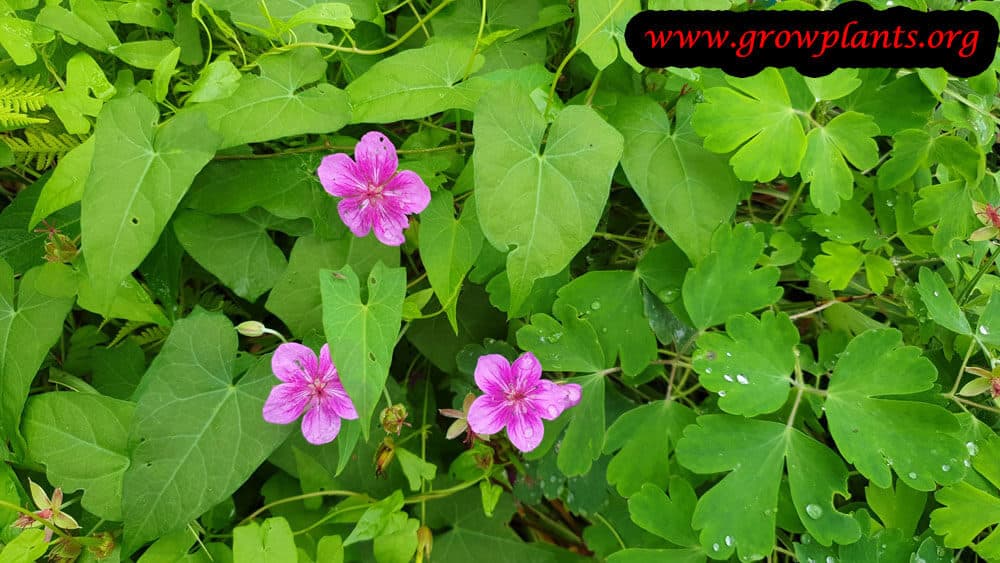
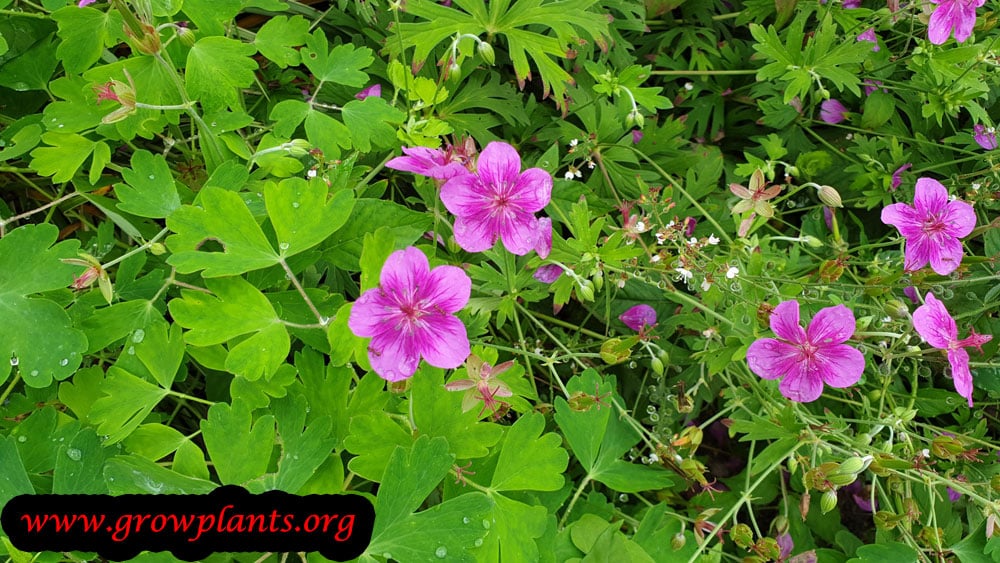
- Growth Habit & Form: Mounding, clump-forming herbaceous perennial that works as a spreading groundcover.
- Lifespan & Maturity: Long-lived perennial; establishes quickly.
Anatomy & Physical Features
- Leaves & Foliage: Green, finely cut palmate leaves that colour in autumn.
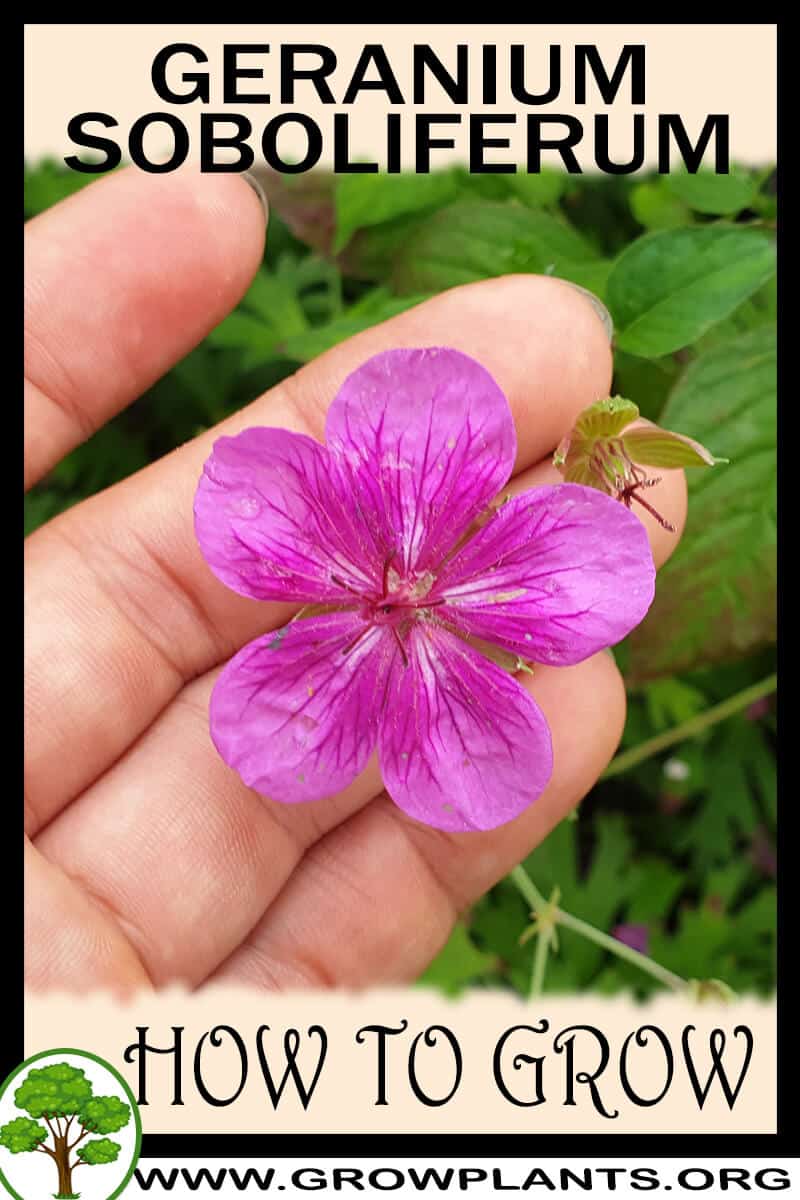
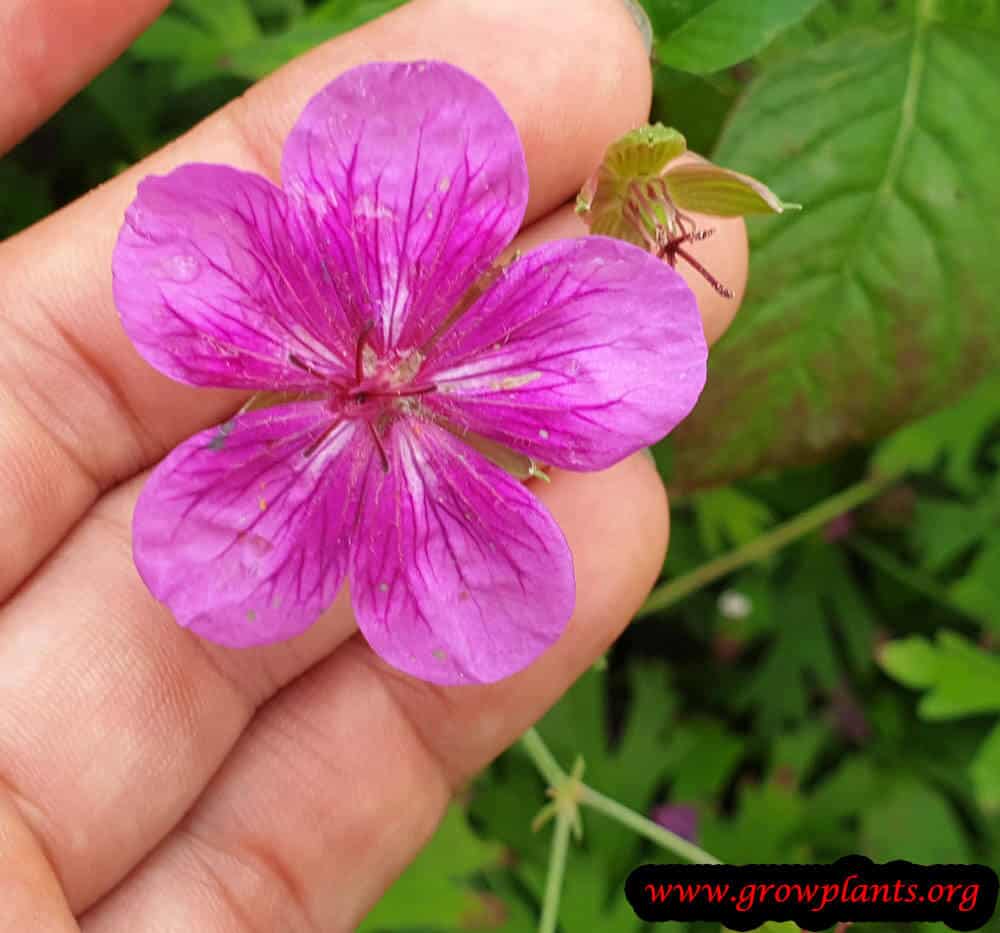
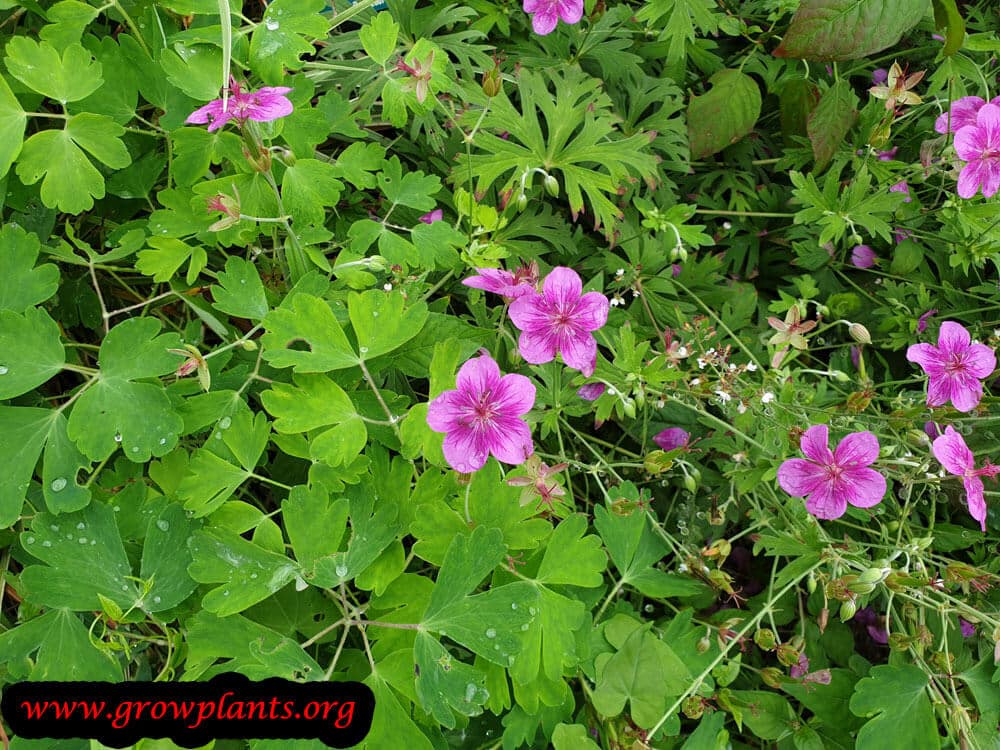
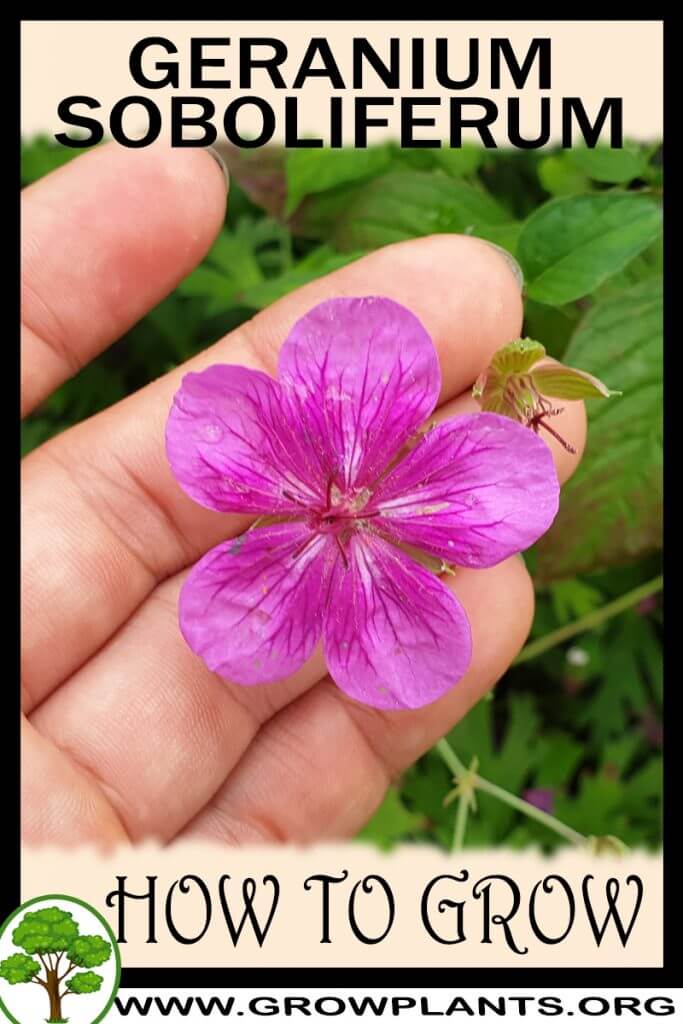
- Flower Characteristics: Flat 5-petalled flowers in purple, blue or pink, often finely veined (full detail in the Bloom guide).
Primary Uses & Landscape Value
- Functional & Ornamental Roles: Ornamental groundcover, border and cottage-garden plant.
Care Guide: Planting, Soil & Watering
Overview: Geranium soboliferum is a hardy, easy-going perennial cranesbill for temperate gardens, growing in full sun to part shade. It thrives in a fertile, humus-rich soil that stays moist yet drains well, and appreciates steady moisture through the growing season.
Quick Care Requirements
| Requirement | Ideal Condition |
|---|---|
| Planting Season | Spring through autumn |
| Growth Rate | Fast to moderate |
| Soil Type | Fertile, humus-rich, moist and well-draining |
| Water Need | Moderate to high – keep the soil evenly moist |
Planting & Establishment
- Best Planting Season: Plant during the growing season, from spring through autumn, avoiding the peak of summer heat in hot areas; these are cold-hardy perennials that establish best in mild, moist conditions.
- How to Plant:
- Hole Preparation: Dig a hole about twice the width of the root ball and no deeper, loosening the surrounding soil so the roots can spread.
- Soil Amendments: Improve the soil with compost or well-rotted organic matter to add fertility and hold moisture, while keeping the drainage free.
- Planting Depth: Set the plant with its crown level with the soil surface, and do not bury the crown, which can rot in wet conditions.
- Growth Speed & Expectations: Growth is fast to moderate, forming a spreading, weed-smothering clump about 20-40 cm tall.
Soil, Watering & Drainage Care
- Soil Mix & Drainage Needs: It likes a moisture-retentive but well-drained, fertile soil rich in organic matter. In containers use a good-quality potting mix and make sure the pot drains freely, and mulch to keep the roots cool and moist.
- Watering Schedule & Technique:
- Young / Newly Planted: Keep newly planted cranesbills evenly moist while they establish, watering whenever the surface begins to dry.
- Established: Once established they are fairly tough but grow best with regular deep watering; water generously in dry spells, especially the heat-sensitive kinds.
- Seasonal Adjustments: Water more during warm, dry weather and less in cool or wet periods; established clumps tolerate short dry spells but resent prolonged drought and heat.
Climate, Light & Hardiness
Geranium soboliferum (Japanese cranesbill) is a very cold-hardy herbaceous perennial suited to temperate and subtropical-highland climates with a distinct cold winter. It grows well in full sun to half shade and is exceptionally frost-hardy, dying back to the roots each winter across USDA zones 2–9.
Quick Climate Specifications
| Climate Zones | Temperate, Subtropical (cool-winter areas) |
|---|---|
| USDA Hardiness Zones | 2–9 |
| Optimal Temp Range | Approximately 10–25°C (50–77°F) |
| Cold Damage Begins | Foliage dies back with the first hard autumn frost, near 0°C (32°F) |
| Approx. Survival Minimum | Dormant roots are extremely cold-hardy, typically surviving well below −30°C (−22°F) in zone 2 winters |
| Frost Tolerance | High overall (foliage: Low; dormant roots: Very High) |
| Light Conditions | Full Sun to Half Shade |
| Wind Tolerance | Moderate |
Sunlight & Light Exposure
Optimal Light Setup
Full sun to half shade both work well; in hotter parts of its range some afternoon shade keeps foliage fresher through summer.
Direct Sun Requirement
Direct sun is not essential - the plant flowers reliably in half shade as well as full sun.
Shade & Heat Management
In warmer temperate and subtropical gardens, light afternoon shade reduces leaf stress during hot spells.
Best Exposure / Orientation
An open bed or woodland-edge position with morning sun and some midday relief suits it in warmer climates.
Temperature Extremes & Hardiness
USDA Hardiness & Regional Limits
One of the hardier garden geraniums, reliable across a broad USDA range of roughly zones 2–9. A genuine cold winter benefits the plant’s dormancy cycle, and it is equally at home in cold-temperate and milder subtropical gardens.
Cold Damage & Winter Protection
Top growth dies down naturally each autumn/winter; this is normal dieback rather than damage, and the root system needs no special winter protection even in the coldest listed zones.
Frost Sensitivity
Leaves and stems are frost-tender and collapse with hard freezes, while the dormant crown and roots are highly frost-hardy.
Extreme Heat Tolerance
Moderate; sustained intense heat, especially combined with dry air, can stress foliage, so it performs best where summers are not extremely hot or where afternoon shade is available.
Wind, Humidity & Microclimate
Humidity Preferences
Prefers moderate humidity and consistently moist (not waterlogged) soil, in keeping with its average-to-generous water needs.
Wind Tolerance
Moderate; the mounding growth habit is reasonably wind-resistant but benefits from some shelter in very exposed sites.
Rainfall & Seasonal Moisture
Suited to climates with reliable rainfall or irrigation through the growing season; it does not favor prolonged drought.
Microclimate Recommendations
A cool, humus-rich bed with steady moisture and, in hot-summer areas, afternoon shade gives the best results.
Growing in Pots, Balconies & Indoors
Geranium soboliferum is a hardy perennial cranesbill that grows nicely in a container but is not a houseplant – it needs open air and good light. In a pot it makes a tidy patio or balcony plant.
Quick Details
- Container Size: A small to medium pot for a compact 20-40 cm plant
- Indoor Suitability: Not a houseplant – needs outdoor light and air; a bright sill at most
- Best Spot: Full sun to half shade, outdoors
- Soil & Drainage: Free-draining but moisture-retentive mix
- Watering in Pots: Average to generous water – keep evenly moist; it dislikes drying out
Indoors & On the Windowsill
- Houseplant limits: The grower does not rate it as a houseplant – hardy cranesbills want a cool, bright, airy spot and sulk in warm, dim rooms. A cool, bright windowsill is the most it will accept.
- Overwintering: Fully hardy – it dies back and overwinters outdoors without shelter.
On a Balcony or Patio
- Light & wind: It takes sun or part shade and suits a cooler, part-shaded balcony well.
- Practicalities: Small pots dry fast – check moisture regularly, as this species prefers steady moisture.
Choosing the Pot, Soil & Long-Term Care
- Pot & drainage: Use a pot with strong drainage holes and skip a standing-water saucer, which invites root rot. Terracotta breathes and dries faster, while glazed or plastic pots hold moisture longer.
- Potting mix: A well-aerated, organic-rich medium – a quality potting mix, or peat/coir loosened with perlite or vermiculite.
- Feeding: Potted plants run through their soil faster as nutrients leach away with each watering, so feed a little more often than plants in open ground.
- Repotting: Refresh the mix and pot up roughly every couple of years, lightly trimming the root ball and top growth on perennials. Lift and divide the clump every few years to keep it vigorous.
Fertilizing & Feeding
A moderate feeder: a balanced fertilizer through spring and the long bloom period keeps foliage and flowers going, with feeding tapered off as the clump heads into cold-season dormancy.
Quick Fertilizing Specs
| Feeding Level | Moderate feeder |
|---|---|
| Main Nutrient Priority | Balanced feeding with adequate nitrogen for foliage and season-long bloom |
| Best Feeding Period | Spring through the extended bloom period |
| Organic Options | Compost or well-rotted manure worked into the bed |
| Reduce/Stop Feeding | Taper off feeding as the season cools and the clump heads toward dormancy |
| Micronutrients | Usually supplied by a complete fertilizer and organic matter; correct only a diagnosed deficiency |
| Soil pH | Near neutral, tolerating a fairly wide range |
Feeding by Growth Stage
Spring flush of growth
Support fresh basal foliage and stem growth as the clump breaks winter dormancy.
| Nutrient direction | A balanced complete fertilizer with adequate nitrogen builds leafy growth ahead of bloom. |
|---|---|
| Timing | As new growth emerges in spring. |
| Frequency | A light feeding at the start of active growth generally carries the plant into bloom. |
| Fertilizer types | A balanced complete fertilizer, Compost or well-rotted manure worked into the soil |
| Precautions | Keep nitrogen moderate; overly lush, soft growth can flop and is more attractive to slugs, a known pest of this plant. |
Extended bloom period
Sustain the long spring-into-autumn flush of purple, blue, or pink flowers.
| Nutrient direction | Continued balanced feeding supports repeat flowering better than pushing any single nutrient. |
|---|---|
| Timing | Through the extended spring-to-autumn bloom period. |
| Frequency | An occasional light feeding sustains flowering without encouraging excess foliage. |
| Fertilizer types | A balanced complete fertilizer, Compost as a light top-dressing |
| Precautions | Avoid heavy or frequent feeding late in the bloom period, which can delay the plant’s move into dormancy. |
Cold-season dormancy
Let the clump rest through cold weather without pushing tender new growth.
| Nutrient direction | None – withhold fertilizer while the plant is dormant or cut back for the cold season. |
|---|---|
| Timing | Autumn into winter, once growth slows and the plant dies back or is cut back in colder climates. |
| Frequency | No feeding at this stage. |
| Fertilizer types | No feeding at this stage; do not fertilize until active growth resumes in spring. |
| Precautions | Do not fertilize a dormant clump; feeding now wastes nutrients and can encourage frost-tender growth. |
Nutrient Deficiency Signs & Corrections
Older, lower leaves fade to pale green or uniform yellow and the clump loses vigor.
| Possible causes | low available soil nitrogen, nitrogen leaching after heavy rain or watering, thin, low-organic-matter soil |
|---|---|
| Appears first on | older, lower leaves |
| What to check | recent feeding history, soil organic matter, drainage after rain |
| Possible correction | Apply a balanced fertilizer with adequate nitrogen and work organic matter into the bed. |
Interveinal yellowing appears on older palmate leaves while the veins stay green.
| Possible causes | low soil magnesium, potassium-heavy feeding competing with magnesium uptake, leaching in light, fast-draining soils |
|---|---|
| Appears first on | older, lower leaves |
| What to check | soil magnesium status, how potassium-heavy recent feeding has been, soil texture and drainage |
| Possible correction | Apply a labeled magnesium source such as Epsom salt and rebalance overall feeding. |
Leaf margins brown or scorch and flowering stalls despite adequate watering.
| Possible causes | fertilizer salt buildup in the root zone, under-watering that concentrates salts, excessive or too-frequent feeding |
|---|---|
| Appears first on | leaf margins and tips |
| What to check | recent fertilizer amounts, watering consistency, bed drainage |
| Possible correction | Ease off feeding, water thoroughly to flush accumulated salts, then return to lighter feeding. |
Pruning, Training & Seasonal Maintenance
Geranium soboliferum is a herbaceous, clump-and-colony-forming perennial (the species name literally refers to its habit of producing spreading stolon-like shoots), so pruning is purely seasonal maintenance rather than any woody structural work. The main objectives are a mid-season shear-back after the first flush of bloom to keep foliage fresh and encourage rebloom through summer–autumn, an autumn/winter cutback of the dying top growth, and periodic control of its spreading basal shoots where a tidier clump is wanted. None of this timing affects flower quality the following year, since the plant regrows entirely from its crown/rhizomes each spring.
Quick Pruning & Maintenance Specs
| Pruning Tolerance | High (herbaceous top-growth only) |
| Primary Pruning Window | Autumn / Winter cutback of dead top growth |
| Secondary Maintenance Window | Mid-summer shear-back after first bloom flush |
| Typical Frequency | 1–2 shearings through the season; one seasonal cutback |
| Main Objective | Refresh foliage, extend flowering (spring–autumn), manage spreading habit |
| Young Plant Priority | Leave largely unpruned to establish; no shaping needed |
| Mature Plant Priority | Shear back hard after the main bloom flush; edge or thin spreading shoots if containment is wanted |
| Best Tool Type | Hand shears / bypass secateurs |
| Avoid Heavy Pruning During | Peak spring–early-summer bloom |
Pruning by Plant Age & Size
Newly Established
No pruning needed beyond removing any damaged foliage; allow the young clump to establish before any shearing.
Young / Formative
No formal training applies to this herbaceous spreader; if a tidier, less colonizing clump is desired from the start, periodically remove young stoloniferous shoots wandering beyond the intended planting area.
Mature / Established
Once the first bloom flush fades and foliage looks tired, shear the whole plant back by roughly half to refresh growth and often trigger a second flowering flush; manage spread by removing outward-creeping stolons at their point of origin.
Seasonal Pruning Schedule
| Post-Flowering (first flush) | Objective: renew foliage, encourage rebloom | Remove: tired foliage and spent flower stems, cut back by about half | Do not remove: fresh basal growth at the crown | Response: flush of new leaves and a second bloom period through summer–autumn |
| Dormant/Winter | Objective: seasonal die-back cleanup | Remove: fully dead, frost-browned foliage | Do not remove: the living crown/rhizome system | Response: clean resprouting from the base next spring |
Special Growth to Remove
- Runners/stolons – this species spreads by stolon-like shoots (reflected in its name); remove or sever unwanted ones at their base if a contained clump is preferred, otherwise leave them to naturalize the colony
- Spent flower stems after each bloom flush
- Fully dead foliage at season’s end
Container & Small-Space Pruning
In containers, shear back promptly after the first bloom flush to keep the plant compact, and check regularly for stolons reaching the pot’s edge or drainage holes, since the same spreading habit that colonizes garden beds can quickly crowd a container.
Tools
- Hand shears or bypass secateurs for the mid-season cutback of the whole clump
- Precision snips for deadheading and removing individual stolons
Tool Hygiene & Disease Risk
Routine: clean, sharp tools are sufficient – no notable tool-transmitted disease risk is indicated for this species.
Cut Placement & Technique
Shear the clump back to a uniform height just above the basal foliage rosette; sever unwanted stolons close to the point where they root, rather than just cutting the visible runner mid-length.
Post-Pruning Care
Water well after the mid-season shear-back to support fast regrowth, since this species tolerates an average-to-large amount of water; no extra feeding is required beyond normal seasonal care.
Common Pruning Mistakes
- Never shearing back after the first bloom flush, leading to floppy, tired-looking summer foliage and reduced rebloom
- Ignoring spreading stolons until the colony has outgrown its bed
- Cutting back hard during peak bloom instead of after the flush fades
When NOT to Prune
Avoid a hard shear-back while the plant is in peak spring–early-summer flower; wait until that first flush visibly fades.
Recommended Tools (by task)
- bypass_secateurs – the mid-season and winter cutback of clump foliage
- precision_snips – deadheading and removing individual unwanted stolons
Propagation Guide
Geranium soboliferum is easiest and fastest to increase by dividing its spreading, stolon-like rootstock – in fact the species name “soboliferum” means “sucker-bearing,” referring to this habit of producing rooted offshoots around the parent clump. Seed-grown plants of this species generally come reasonably true to type, but division is preferred for quick, reliable establishment. Overall this is an easy plant to propagate.
Quick Propagation Specs
| Best Propagation Method | Division of the clump/rootstock |
| Alternative Methods | Seed; basal spring cuttings |
| Propagation Difficulty | Easy |
| Seed True-to-Type | Usually true-to-type (species plant, not a named hybrid) |
| Vegetative True-to-Type | Yes |
| Best Propagation Season | Spring or autumn for division; spring for seed sowing |
| Seed Germination Time | Typically a few weeks, sometimes slower and uneven |
| Cutting Rooting Time | Usually a few weeks for basal cuttings to root |
| Germination Temperature | Cool to moderate, roughly 15–21°C (59–70°F) |
| Seed Sowing Depth | Shallow – just cover the seed |
Growing from Seed
Seed Handling & Viability
Collect seed once the beaked seed capsules begin to split, as hardy geranium seed can scatter quickly at maturity; store in a cool, dry place until sowing.
Dormancy & Pre-Sowing Treatment
Many hardy Geranium species germinate more evenly after a period of cold, moist stratification (for example an outdoor winter sowing or a few weeks refrigerated in damp medium); this is optional but commonly used to improve and even out germination.
Sowing Season
Best sown in spring, or outdoors in autumn to receive natural winter chilling.
Germination Conditions
Cool to moderately cool temperatures with consistently moist (not waterlogged) growing medium.
Germination Time
Germination can take a few weeks and may be irregular, especially without pre-chilling.
Seedling Care
Keep young seedlings evenly moist and in bright but not scorching light until well rooted before transplanting.
Division, Offsets, Pups & Suckers
This species naturally spreads by short underground rhizomes/stolons that send up new rooted shoots around the base of the plant – these can simply be severed with a portion of root attached and replanted. Divide established clumps in spring or autumn, ensuring each division has healthy roots and at least one growth point; reduce top growth slightly at replanting to ease establishment and keep divisions consistently moist until new growth resumes.
Bloom & Flower Guide
Quick Details
- Bloom Season: Late spring through autumn, with the main flush in early summer
- Time to First Bloom: Established plants flower each year; from seed, usually in the second season
- Flower Appearance: Flat, saucer-shaped flowers with five petals in purple, blue or pink
- Edibility: Ornamental – grown for its flowers, not for eating
Detailed Blooming Overview
Japanese cranesbill (Geranium soboliferum) is a true hardy geranium that carries its open, five-petalled flowers over a long season. Individual blooms are short-lived, but a healthy clump keeps producing them from late spring into autumn, weaving colour through the foliage.
Flower Characteristics
- Flat, saucer-shaped flowers with five rounded petals.
- Colour ranges through purple, blue and pink, often with finer veining.
- Held on slender stalks just above the mound of foliage.
Bloom Care & Thinning
- Encouraging more flowers: Deadhead spent blooms as they fade; a light shear after the first flush often brings a second wave of flowers.
- Pollination: The open flowers are readily worked by bees and hoverflies.
Pests, Diseases & Troubleshooting
Overview: Hardy cranesbill geraniums (true Geranium, not the bedding Pelargonium) are robust, long-lived perennials with few life-threatening enemies. Their main season-long issues are powdery mildew on crowded clumps and a handful of sap-suckers and leaf-chewers; the single most useful intervention is a hard shear-back after the first flush, which strips old foliage, pests and disease together and forces clean new growth. Lead with airflow, division and cultural hygiene before reaching for sprays.
Quick Troubleshooting Overview
| Issue / Pest | Main Symptom | Primary Solution |
|---|---|---|
| Aphids | Sticky, curled young leaves and buds; colonies on shoot tips | Blast off with water, encourage ladybirds/lacewings; soap or neem if needed |
| Powdery mildew | White powdery film on leaves in late season, crowded plants | Improve airflow, shear back hard, water at the base |
| Vine weevil | Plant collapses; C-shaped white grubs eating roots (containers) | Biological nematodes to the compost; check and hand-pick adults at night |
| Geranium sawfly | Ragged holes and window-paning in leaves in summer | Hand-pick green larvae; tolerate light damage, shear back if severe |
| Rust | Orange-brown pustules on leaf undersides | Remove affected leaves, thin the clump, avoid overhead watering |
| Slugs & snails | Shredded new shoots, slime trails on spring growth | Traps, barriers, evening patrols; iron-phosphate pellets if pressure is high |
Common Pests & Management
- Aphids (Aphis / Myzus spp.):
- Symptoms: Clusters of green, black or pink soft-bodied insects on shoot tips, buds and leaf undersides; sticky honeydew, sooty mould and distorted new growth.
- Prevention & Control: Knock colonies off with a jet of water; support ladybirds, lacewings and hoverflies. Spot-treat persistent colonies with insecticidal soap or neem, spraying in the evening to protect pollinators.
- Vine weevil (Otiorhynchus sulcatus):
- Symptoms: Notched, chewed leaf margins from night-feeding adults; far worse are the plump C-shaped white grubs that sever roots, causing container plants to wilt and collapse suddenly.
- Prevention & Control: Drench container compost with parasitic nematodes (Steinernema/Heterorhabditis) in warm soil; hand-pick adults after dark, and check root balls when repotting.
- Geranium sawfly (Ametastegia / Protemphytus spp.):
- Symptoms: Small pale-green caterpillar-like larvae that rasp holes and create window-paning between veins, sometimes stripping leaves to a skeleton in summer.
- Prevention & Control: Hand-pick larvae from leaf undersides; tolerate minor damage. A hard shear-back removes larvae with the foliage; use a targeted bio-insecticide only under heavy pressure.
- Slugs & snails (Deroceras / Cornu spp.):
- Symptoms: Ragged holes in tender spring shoots and low leaves, with tell-tale slime trails; worst in damp, shaded, mulched sites.
- Prevention & Control: Hand-collect at night, set beer traps, use grit or copper barriers and keep the crown clear of debris. Iron-phosphate pellets are the safest bait if needed.
- Capsid bugs (Lygocoris pabulinus):
- Symptoms: Small green sap-sucking bugs whose feeding kills spots of tissue, so expanding leaves show scattered tattered holes and puckering.
- Prevention & Control: Damage is usually cosmetic and outgrown; encourage general predators and clear weedy overwintering cover. Rarely warrants spraying.
- Leafhoppers (Eupteryx spp.):
- Symptoms: Fine pale stippling and mottling on the upper leaf surface, with tiny wedge-shaped insects that hop when disturbed.
- Prevention & Control: Maintain vigour and airflow; hose foliage and support predators. Insecticidal soap in the evening only if stippling is heavy.
Diseases & Fungal Issues
- Powdery mildew (Podosphaera / Golovinomyces spp.):
- Symptoms: White, powdery patches on upper leaves and stems, worst in late summer on crowded or drought-stressed clumps; leaves yellow and dry.
- Treatment & Management: Space and divide clumps for airflow, water at the base, and shear the whole plant back hard after flowering to regrow clean foliage. Sulfur or a bicarbonate/potassium spray if persistent.
- Rust (Puccinia spp.):
- Symptoms: Bright orange to brown powdery pustules on leaf undersides with yellow flecking above; heavy infection browns and drops leaves.
- Treatment & Management: Remove and bin affected leaves promptly, thin the clump, and avoid wetting foliage. A shear-back resets the plant; use a suitable fungicide only for repeat outbreaks.
- Downy mildew (Peronospora / Plasmopara):
- Symptoms: Angular yellow blotches on the upper surface with a grey-purple furry growth beneath in cool, wet spells.
- Treatment & Management: Improve drainage and airflow, remove infected leaves, and avoid overhead watering. Copper-based sprays can help in prolonged wet weather.
- Botrytis / grey mould (Botrytis cinerea):
- Symptoms: Fuzzy grey mould on faded flowers and damaged or congested foliage in humid conditions, leading to soft brown rot.
- Treatment & Management: Deadhead, remove dead material, and open up the plant for airflow. Cutting back a soggy, mildewed clump usually clears it without chemicals.
- Leaf spot (Cercospora / Ascochyta):
- Symptoms: Discrete brown or purplish spots that may merge; largely cosmetic on established plants.
- Treatment & Management: Remove spotted leaves, clean up fallen debris, and keep foliage dry. Rarely needs treatment beyond sanitation.
Growing Difficulties & Abiotic Problems
- Mid-season collapse / scruffiness:
- Cause & Symptoms: After the first flush many cranesbills flop open, brown off and look tired, especially in heat.
- Correction Strategy: Shear the whole plant back hard to 5–8 cm; water and a light feed force a fresh mound of foliage and often a second flush of bloom.
- Legginess & poor flowering in shade:
- Cause & Symptoms: Stretched, sparse, weak-flowering growth in too much shade or over-rich soil.
- Correction Strategy: Move to brighter light for most species (some woodlanders excepted), and avoid over-feeding, which favours leaf over flower.
- Drought scorch:
- Cause & Symptoms: Crisped leaf margins and wilting on thin or sunny soils in summer.
- Correction Strategy: Mulch to conserve moisture, water deeply in dry spells, and cut back to rejuvenate; established plants are quite drought-tolerant once settled.
- Crown crowding / centre die-out:
- Cause & Symptoms: Old congested clumps lose vigour and die out in the middle.
- Correction Strategy: Lift and divide every 3–4 years in the dormant or cool season to renew the plant and reduce mildew.
What Helps – Products & Tools
Reach first for cultural tools: a sharp pair of shears for the rejuvenating cut-back, collars and barriers, and parasitic nematodes for vine weevil in pots. For sap-suckers, insecticidal soap or neem/horticultural oil applied in the evening; for mildew and rust, sulfur or a potassium-bicarbonate fungicide; iron-phosphate slug pellets where slugs are relentless.