Plant Profile & Key Characteristics
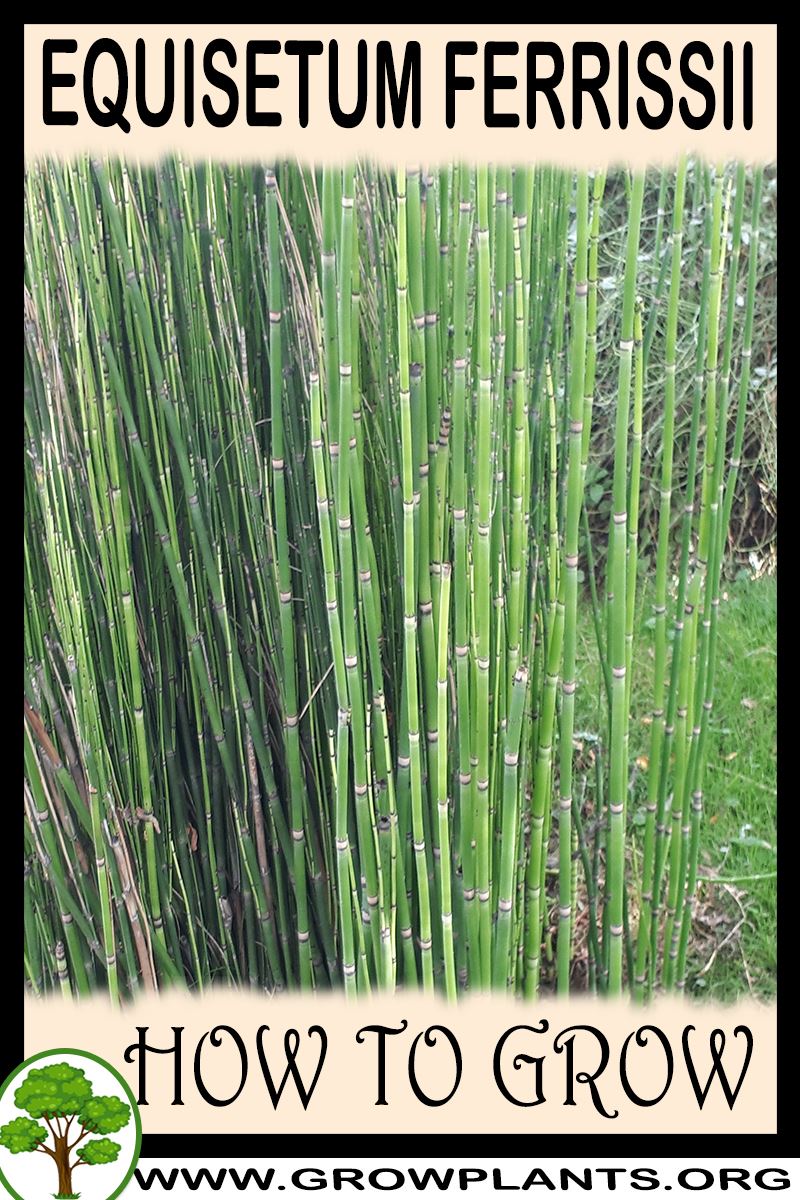
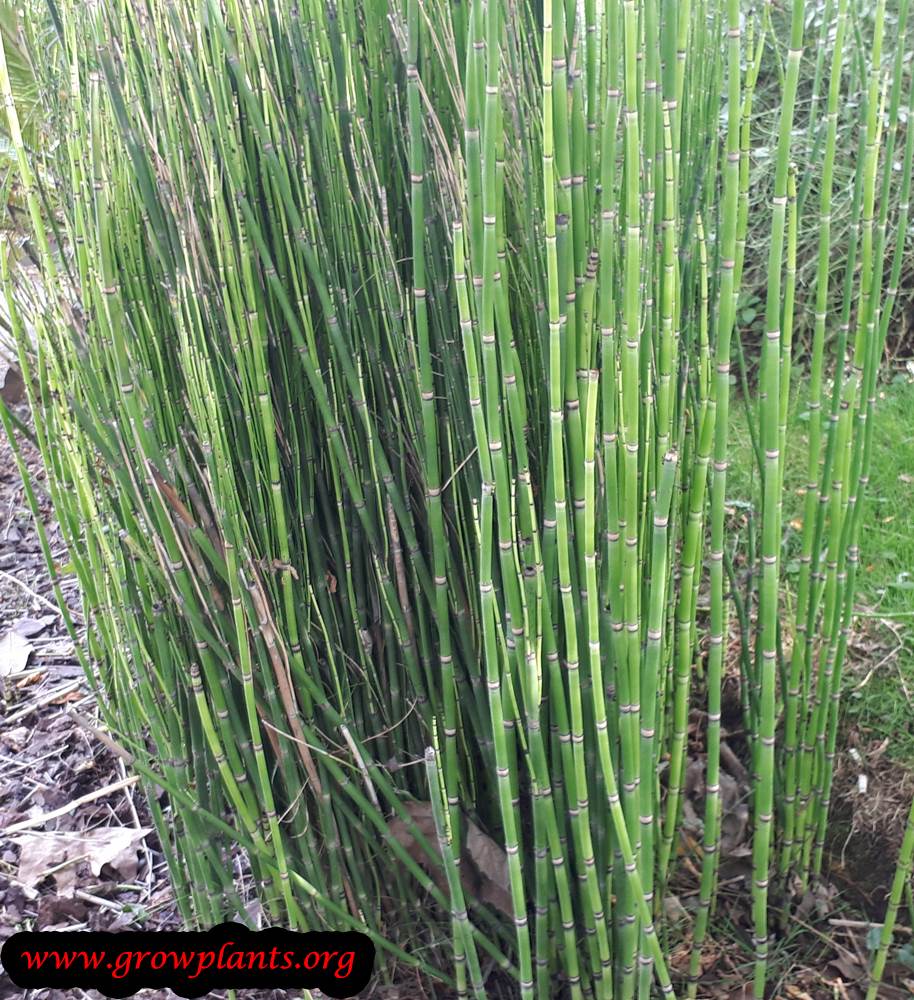
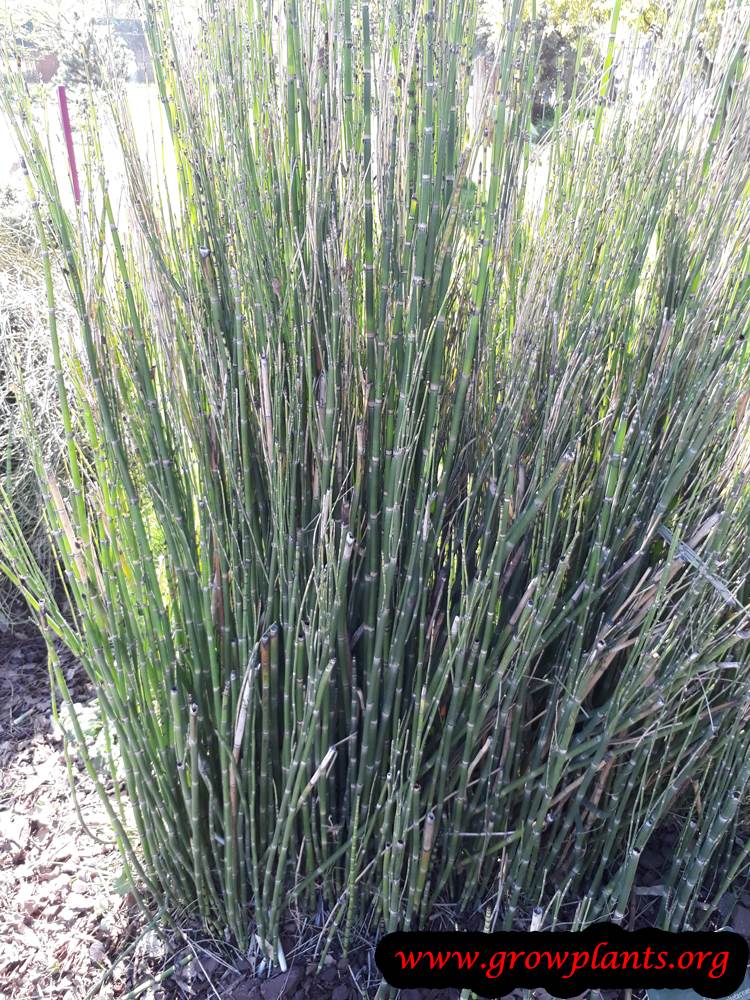
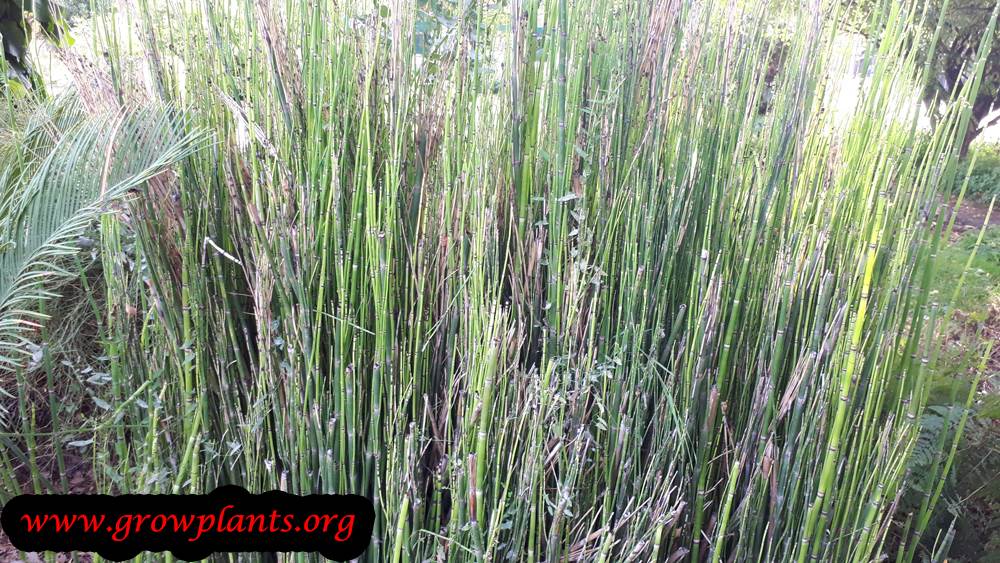
Overview: Equisetum ferrissii (Horsetail plant) is a primitive evergreen or deciduous perennial 30-90 cm (12-36 in) tall, with hollow, jointed green stems and no true leaves. A fast-spreading marginal/wetland plant, it is grown as an architectural ornamental and used medicinally, but is aggressively invasive.
Quick Specifications
| Specification | Attribute |
|---|---|
| Plant Type / Life Cycle | Perennial (spore-bearing fern ally) |
| Foliage Type | Evergreen or deciduous |
| Mature Size | 30-90 cm (12-36 in) tall |
| Growth Rate | Fast |
| Root System | Rhizomatous (deep, aggressively spreading) |
| Toxicity | Toxic if ingested – contains thiaminase, poisonous to livestock |
| Hardiness | USDA zone 3-11 |
Growth Form & Structure
- Height & Spread: 30-90 cm (12-36 in) tall, spreading indefinitely by rhizomes – best contained in pots or with root barriers.
- Growth Habit & Form: Upright hollow jointed green stems forming dense colonies; no true leaves.
- Lifespan & Maturity: Long-lived perennial.
Anatomy & Physical Features
- Leaves & Foliage: Reduced to tiny scales at the stem joints; the hollow green jointed stems photosynthesise.
- Flower Characteristics: Non-flowering – reproduces by spores from brown cone-like tips (strobili), not true flowers.
Primary Uses & Landscape Value
- Functional & Ornamental Roles: Grown as a striking architectural plant for ponds, bog gardens and containers; has traditional medicinal and scouring uses.
Care Guide: Planting, Soil & Watering
Overview: Equisetum ferrissii is a fast-spreading, moisture-loving perennial that thrives in wet ground and even shallow water in full sun. It tolerates most soils as long as they stay consistently wet, and spreads aggressively, so containment is wise.
Quick Care Requirements
| Requirement | Ideal Condition |
|---|---|
| Planting Season | Warm season (spring through autumn) |
| Growth Rate | Fast |
| Soil Type | Wet, boggy soil (tolerates poor drainage) |
| Water Need | High – keep the soil wet at all times |
Planting & Establishment
- Best Planting Season: Plant from spring through autumn into wet ground or at a pond margin.
- How to Plant:
- Hole Preparation: Dig a hole matching the root ball; because it spreads by rhizomes, plant into a sunken pot or lined bed to keep it contained.
- Soil Amendments: No special enrichment is needed – it grows in most soils, and a heavy, water-retentive medium actually suits it.
- Planting Depth: Set the crown at soil level or just below; it also grows happily with its base standing in shallow water.
- Growth Speed & Expectations: Growth is fast and vigorous – expect rapid spread, so site it where the running rhizomes can be controlled.
Soil, Watering & Drainage Care
- Soil Mix & Drainage Needs: Unlike most plants, horsetail wants moisture-retentive soil and tolerates standing water; sharp drainage is not required.
- Watering Schedule & Technique:
- Young / Newly Planted: Keep the soil saturated from the start and never let a newly planted clump dry out.
- Established: Water generously and often to keep the ground wet; in containers, stand the pot in a saucer of water.
- Seasonal Adjustments: Reduce watering in cool dormancy but keep the soil damp, and increase in summer heat.
Climate, Light & Hardiness
Equisetum ferrissii (Horsetail) is an exceptionally cold-hardy and adaptable perennial suited to Mediterranean, desert, subtropical, and temperate climates, given consistently wet soil. It thrives in full sun and tolerates winter cold across an unusually wide zone range.
Quick Climate Specifications
| Climate Zones | Mediterranean, desert, subtropical, and temperate climates |
|---|---|
| USDA Hardiness Zones | Approximately zone 3–11 |
| Optimal Temp Range | Wide-ranging; tolerates both cool and warm growing conditions provided the soil stays wet |
| Cold Damage Begins | Above-ground stems die back with hard freezes; the rhizome persists |
| Approx. Survival Minimum | The rhizome survives the severe winter cold typical of zone 3 |
| Frost Tolerance | High (rhizome); stems have Low frost tolerance |
| Light Conditions | Full Sun |
Sunlight & Light Exposure
Optimal Light Setup
Full sun is preferred for the densest, most vigorous stands.
Direct Sun Requirement
Performs best with direct sun for most of the day.
Best Exposure / Orientation
An open, sunny position at the water’s edge or in consistently moist ground suits this plant well.
Temperature Extremes & Hardiness
USDA Hardiness & Regional Limits
Site data places this plant across an unusually broad zone 3–11 range, reflecting a very hardy underground rhizome that survives severe winter cold even where the above-ground stems die back annually.
Cold Damage & Winter Protection
Stems typically die back with the first hard frost; no special winter protection is needed since the rhizome resprouts in spring.
Frost Sensitivity
The visible stems are frost sensitive and die back readily, but this does not harm the plant’s long-term survival.
Extreme Heat Tolerance
Tolerates heat well provided the soil remains consistently wet; drying out is more damaging than heat itself.
Wind, Humidity & Microclimate
Rainfall & Seasonal Moisture
Needs consistently wet, boggy, or waterlogged conditions to thrive; this is a defining requirement rather than a minor preference.
Microclimate Recommendations
Pond margins, bog gardens, or containers standing in water suit this plant’s wetland nature across its very wide climate range; note that it can be aggressive and spread readily in favorable wet conditions.
Growing in Pots, Balconies & Indoors
Equisetum ferrissii (horsetail) is a moisture-loving, full-sun plant, not a houseplant – the grower confirms it is unsuited to indoor growing. Because it spreads aggressively by runners, growing it in a container is actually the recommended way to enjoy its architectural stems while keeping it firmly under control.
Quick Details
- Container Size: A solid, sealed or watertight pot to contain the runners
- Indoor Suitability: Not a houseplant; grow outdoors
- Best Spot: Full sun
- Soil & Drainage: Any mix; it happily tolerates wet, poorly drained conditions
- Watering in Pots: Generous – it loves constant moisture and can even sit in a water tray
Indoors & On the Windowsill
- Not for indoors: The grower marks it as unsuitable as a houseplant; it wants full outdoor sun and bog-like moisture.
- Overwintering: Fully hardy – leave the pot outside; the stems die back and return.
On a Balcony or Patio
- Containment: Always keep it potted – never let a pot with drainage holes sit on open soil, as roots escape and colonise. A watertight container is safest.
- Light & water: Full sun and plenty of water; a saucer of standing water is fine for this bog plant.
Choosing the Pot, Soil & Long-Term Care
- Pot & drainage: Unusually, this plant tolerates – even enjoys – standing water, so a sealed container or one on a hard surface with a water tray works well and stops it spreading.
- Potting mix: Any moisture-retentive mix; it is not fussy.
- Feeding: Needs very little feeding – it is a vigorous survivor.
- Dividing: Every year or two, lift and reduce the clump to keep it in bounds and refresh the pot.
Fertilizing & Feeding
A very light feeder – this wetland species thrives in naturally mineral-rich, consistently moist ground and rarely needs supplemental fertilizer to grow vigorously.
Quick Fertilizing Specs
| Feeding Level | Light feeder, often needs none |
|---|---|
| young_feeding | Typically none needed at planting if the bed is rich and consistently wet |
| mature_feeding | Minimal to no feeding for established plantings in a suitable wet bed |
| Main Nutrient Priority | Balanced nutrition, but the growing medium itself usually meets this plant’s needs |
| Best Feeding Period | Warm-season active growth, if feeding at all |
| Organic Options | A rich, organic wet substrate can fully substitute for direct fertilizing |
| Reduce/Stop Feeding | Stop feeding through the cold-season dieback and always keep fertilizer away from open water |
Feeding by Growth Stage
Establishment
Help newly planted rhizomes settle into consistently wet, mineral-rich soil before growth ramps up
| Nutrient direction | Very little feeding is needed at planting – this species is adapted to naturally mineral-rich wet ground and rarely needs a nutrient boost to establish |
|---|---|
| Timing | At planting into a bog, pond margin, or consistently moist bed |
| Frequency | Feeding is rarely needed at this stage; the wet, mineral-rich growing medium usually supplies enough |
| Fertilizer types | Typically none needed – a rich, wet planting medium substitutes for direct feeding |
| Precautions | Avoid adding fertilizer directly to open water features to prevent feeding algae rather than the plant |
Active Growth
Support steady stem growth during the warm growing season in permanently wet or marginal-pond conditions
| Nutrient direction | If feeding at all, keep it light – a mineral-rich, wet substrate typically supplies what this plant needs without added fertilizer |
|---|---|
| Timing | Warm-season active growth |
| Frequency | Minimal feeding is usually enough for plants growing in a naturally rich wet bed or aquatic substrate |
| Fertilizer types | Root-zone aquatic plant tabs or an organic-rich substrate can substitute for liquid feeding in pond margins |
| Precautions | Keep any feeding away from open water to avoid promoting algae growth |
Cold-Season Dieback
Let top growth die back through winter without pushing new growth into cold conditions
| Nutrient direction | None – withhold fertilizer while stems die back for winter |
|---|---|
| Timing | Autumn into winter in cooler climates |
| Frequency | No feeding at this stage |
| Fertilizer types | No feeding at this stage – cut back dead stems instead of feeding |
| Precautions | Do not fertilize during winter dieback; resume only once new stems emerge in spring |
Nutrient Deficiency Signs & Corrections
New stems emerge noticeably thinner and shorter than established growth
| Possible causes | nutrient-poor growing medium lacking the minerals this species favors, inadequate consistent moisture, overcrowding limiting rhizome expansion |
|---|---|
| Appears first on | newest emerging stems |
| What to check | moisture consistency, medium richness, planting density |
| Possible correction | Improve the richness and moisture consistency of the growing medium rather than adding routine fertilizer |
Stems yellow or brown prematurely outside of normal winter dieback
| Possible causes | the bed drying out between waterings, which this wetland species tolerates poorly, nutrient deficiency in very poor soil, natural seasonal dieback mistaken for a problem |
|---|---|
| Appears first on | stem tips and overall stem color |
| What to check | soil moisture consistency, season and typical dieback timing, medium richness |
| Possible correction | Restore consistent moisture first, since this species is far more sensitive to drying out than to nutrient shortage |
Nearby open water develops an algae bloom after feeding
| Possible causes | excess fertilizer reaching open water rather than the plant’s root zone, runoff from over-application, insufficient plant uptake relative to nutrients applied |
|---|---|
| Appears first on | surrounding open water rather than the plant itself |
| What to check | how and where fertilizer was applied, proximity to open water, recent feeding amounts |
| Possible correction | Apply any feeding directly to the root zone or substrate rather than broadcasting near open water, and reduce the amount used |
Pruning, Training & Seasonal Maintenance
Equisetum ferrissii (horsetail) is a rhizomatous, non-flowering fern ally with jointed hollow stems, so "pruning" here means cutting old or browned stems at the base year-round rather than any woody shaping. It tolerates being cut hard to the ground and regrows readily from its rhizomes, but because those spreading rhizomes – not the top growth – are what make this species aggressively invasive, cutting back the visible stems is a cosmetic and containment task, not a way to control the plant’s spread.
Quick Pruning & Maintenance Specs
| Pruning Tolerance | High (tolerates being cut fully to the ground) |
| Primary Pruning Window | All year |
| Secondary Maintenance Window | N/A – maintenance is continuous rather than seasonal |
| Typical Frequency | As needed, whenever stems brown or a tidy reset is wanted |
| Main Objective | Remove old/browned jointed stems and spent fertile (cone-bearing) stems for tidiness |
| Young Plant Priority | Leave newly planted stands to establish; no pruning needed |
| Mature Plant Priority | Cut old stems at the base as they brown; full cut-to-ground reset if the stand looks tired |
| Best Tool Type | Precision snips or bypass secateurs (stems are thin and hollow, not woody) |
| Avoid Heavy Pruning During | No strict restriction – stems regrow readily at any time of year |
Pruning by Plant Age & Size
Newly Established
Leave a newly planted stand alone apart from removing any clearly dead stems, letting it establish its rhizome network before any cutting back.
Young / Formative
No structural training applies – horsetail has no branching framework to shape; its only "training" equivalent is physical containment of the rhizomes (see Container & Small-Space Pruning), not stem pruning.
Mature / Established
On an established stand, ongoing removal of individual old or browned stems at the base keeps the clump looking fresh; a full cut-to-ground reset can be done at any point if the whole stand has become tired-looking, since regrowth from the rhizomes is quick.
Special Growth to Remove
- Old or browned jointed stems, cut at the base.
- Spent fertile stems (the yellow-brown cone-bearing stems) once their spores have been shed, if a tidier look is wanted; note this does not meaningfully reduce spread, since the species spreads mainly by rhizome, not spores, in cultivation.
Container & Small-Space Pruning
Growing this species in a container (with a solid, sunken base) is a common and effective way to enjoy it while limiting its aggressive, invasive rhizome spread; in a container, cutting back top growth is purely cosmetic, and the real containment comes from the pot itself blocking rhizome escape, not from pruning.
Tools
- Precision snips or bypass secateurs for cutting the thin, hollow jointed stems at the base – no loppers or saw are needed for this herbaceous, non-woody plant.
Tool Hygiene & Disease Risk
Routine – clean tools are sufficient; no transmissible disease is associated with pruning this species. Given its invasive rhizomes, however, avoid moving cut stem or rhizome fragments to other beds or compost that might resprout elsewhere.
Cut Placement & Technique
Cut individual stems at or near ground level, close to where they emerge, rather than partway up – a partial cut leaves a hollow stub that browns and looks untidy without any horticultural benefit.
Heavy Pruning & Rejuvenation
Horsetail tolerates being cut entirely to the ground at any time of year and regrows quickly and vigorously from its rhizomes; this is a normal reset rather than a stressful rejuvenation, unlike hard pruning in woody plants.
Post-Pruning Care
Water normally afterward; because this is a wetland-adapted plant that wants consistently moist to wet soil, do not let the root zone dry out while regrowth pushes back up. No feeding is needed to force the reset.
Common Pruning Mistakes
- Assuming that cutting back top growth controls the plant’s spread – the invasive vector is the rhizome system underground, which cutting stems does not address.
- Composting cut stems or rhizome fragments where they might resprout in an unwanted location.
When NOT to Prune
There is no season to specifically avoid; the main caution is behavioral rather than seasonal – do not rely on stem cutting alone as a control measure if the goal is actually to contain the plant’s spread.
Recommended Tools (by task)
- precision_snips – for cutting individual thin, hollow stems at the base, whether for routine tidying or a full cut-to-ground reset.
Propagation Guide
Horsetail is propagated almost exclusively by dividing its spreading rhizomes, which the site confirms is the method used (no seed option is listed) – this matches its biology as a spore-bearing plant rather than a seed plant. Rhizome division is easy and, given how readily this species spreads, care is needed to contain it rather than encourage further spread.
Quick Propagation Specs
| Best Propagation Method | Rhizome division |
| Alternative Methods | Spores (biologically possible, rarely practical) |
| Propagation Difficulty | Easy (division); Specialist (spores) |
| Vegetative True-to-Type | Yes |
| Best Propagation Season | Spring, before or as new shoots emerge |
Rhizomes, Tubers, Bulbs & Corms
Rhizome Division
Lift a section of the spreading underground rhizome in spring and cut or pull it apart, making sure each division includes at least one node or growth point. This species runs vigorously in the wet ground it prefers (per the site’s care notes), and the site flags it as aggressive and invasive, so even small rhizome fragments left behind can resprout – contain divisions in a pot or behind a barrier rather than planting directly into open wet soil unless spread is wanted. Divisions establish and send up new jointed stems within the same growing season.
Spores
The yellow-brown cone-like structures the site describes (the strobili, at the tips of fertile stems in summer) are the plant’s true reproductive structures and release spores rather than seed. Spore propagation is biologically possible but rarely used outside specialist or botanical settings, since the spores are short-lived and need to be sown fresh onto a constantly moist, sterile medium; rhizome division is far more practical for ordinary garden propagation.
Pests, Diseases & Troubleshooting
Overview: Horsetail is a primitive ‘living fossil’ rush that is virtually free of pests and diseases – its tough, silica-rich, chemically defended stems are avoided by almost everything, and it is itself often a weed. Realistically the only ‘troubleshooting’ it needs is containing its aggressively spreading rhizomes; keep it in water or a barrier and it looks after itself.
Quick Troubleshooting Overview
| Issue / Pest | Main Symptom | Primary Solution |
|---|---|---|
| Invasive spread | Rhizomes/runners escaping into surrounding ground | Grow in a pot or lined bed; barrier the roots |
| Chlorosis (rare) | Occasional yellowing if grown too dry | Keep consistently moist; it likes wet feet |
| Aphids (very rare) | Odd colony on soft new shoots | Water jet; usually needs nothing |
| Root rot (uncommon) | Decline only in stagnant, anaerobic containers | Refresh water; ensure some oxygen at roots |
| Flopping/legginess | Weak stems in deep shade | Give more light for stiff upright stems |
Common Pests & Management
- Aphids (rare) (Aphididae):
- Symptoms: Very occasionally a small colony appears on the softest young shoots; damage is negligible and the plant’s tough, gritty tissue deters most feeding.
- Prevention & Control: Simply hose them off; horsetail rarely if ever needs insecticidal treatment.
- Slugs & snails (minor) (Gastropoda):
- Symptoms: Slugs may rasp very young emerging shoots in spring, but the silica-hardened mature stems are left alone.
- Prevention & Control: No action is usually needed; hand-pick if young shoots are being grazed in a display planting.
Diseases & Fungal Issues
- Root / rhizome rot (uncommon) (Anaerobic decay):
- Symptoms: Decline only occurs in stagnant, oxygen-starved container water or badly compacted, permanently anaerobic mud; stems yellow and soften.
- Treatment & Management: Refresh standing water periodically and use an aquatic-suitable substrate; horsetail thrives in wet ground but benefits from some water movement or oxygen. Genuine disease is very rare.
- Foliar issues (negligible):
- Symptoms: Horsetail is remarkably disease-resistant; no significant fungal or bacterial diseases affect it in cultivation. (Notably, an extract of horsetail is even used traditionally as a plant fungicide/tonic.)
- Treatment & Management: No treatment required – this is one of the healthiest plants you can grow. Simply provide the wet, sunny-to-part-shaded conditions it enjoys.
Growing Difficulties & Abiotic Problems
- Invasive spread (the real problem):
- Cause & Symptoms: Horsetail’s deep, brittle, fast-running rhizomes are extremely difficult to eradicate once loose in a garden – the main reason it needs ‘management’. Broken root fragments regrow.
- Correction Strategy: Never plant it free in open ground. Grow it in a sealed container, a pond basket, or a bed lined with a solid root barrier, standing in or beside water. Remove any escaping shoots promptly and completely; do not rotavate, which chops and multiplies the rhizomes.
- Chlorosis from drought:
- Cause & Symptoms: Grown too dry it can pale and weaken, as it is naturally a plant of wet ground and stream margins.
- Correction Strategy: Keep the soil constantly moist to wet – it happily grows in standing water – and it will stay lush and green.
- Weak, floppy stems:
- Cause & Symptoms: In deep shade stems can grow lax and lean.
- Correction Strategy: Give it full sun to part shade for stiff, upright, architectural stems.
What Helps – Products & Tools
Horsetail essentially needs no pest or disease products at all – it is one of the most trouble-free plants in cultivation. The only ‘tools’ worth having are a stout root-barrier or a watertight container to contain it, and a spade to remove escapees. (Its high silica content even makes horsetail tea a traditional home fungicide for other plants.)